
















The secretory pathway transports proteins from the endoplasmic reticulum (ER) to the Golgi apparatus, where proteins undergo critical modifications including N-linked glycosylation (adding sugar groups to asparagine), folding in an oxidizing environment that prepares them for extracellular stability, and lipid synthesis; the Golgi then sorts proteins to their final destinations such as lysosomes, storage compartments, or the plasma membrane through vesicular transport.
Secretory Pathway Overview: ER, Golgi & Protein Sorting
Added:Basic eukaryotic cell anatomy, specifically the identification and general functions of the endoplasmic reticulum (ER) and Golgi apparatus.
The central dogma of molecular biology, particularly the process of translation (how ribosomes synthesize proteins from mRNA).
The levels of protein structure (primary, secondary, tertiary, quaternary) and the fundamental chemical bonds driving protein folding.
An understanding of basic biomolecules, including lipids, carbohydrates, and proteins, and their general biological roles.
The molecular mechanisms of vesicle budding and fusion, including the roles of coat proteins (COPI, COPII, clathrin) and SNARE proteins.
The Unfolded Protein Response (UPR) and ER-Associated Degradation (ERAD) pathways, which handle cellular stress and misfolded proteins.
Targeted transport pathways to specific organelles, such as the mannose-6-phosphate receptor pathway for targeting proteins to lysosomes.
Pathophysiological consequences of secretory pathway defects, such as I-cell disease, cystic fibrosis, or neurodegenerative disorders linked to protein misfolding.
65.2K views586likes9:54Original Release: 2017-11-08
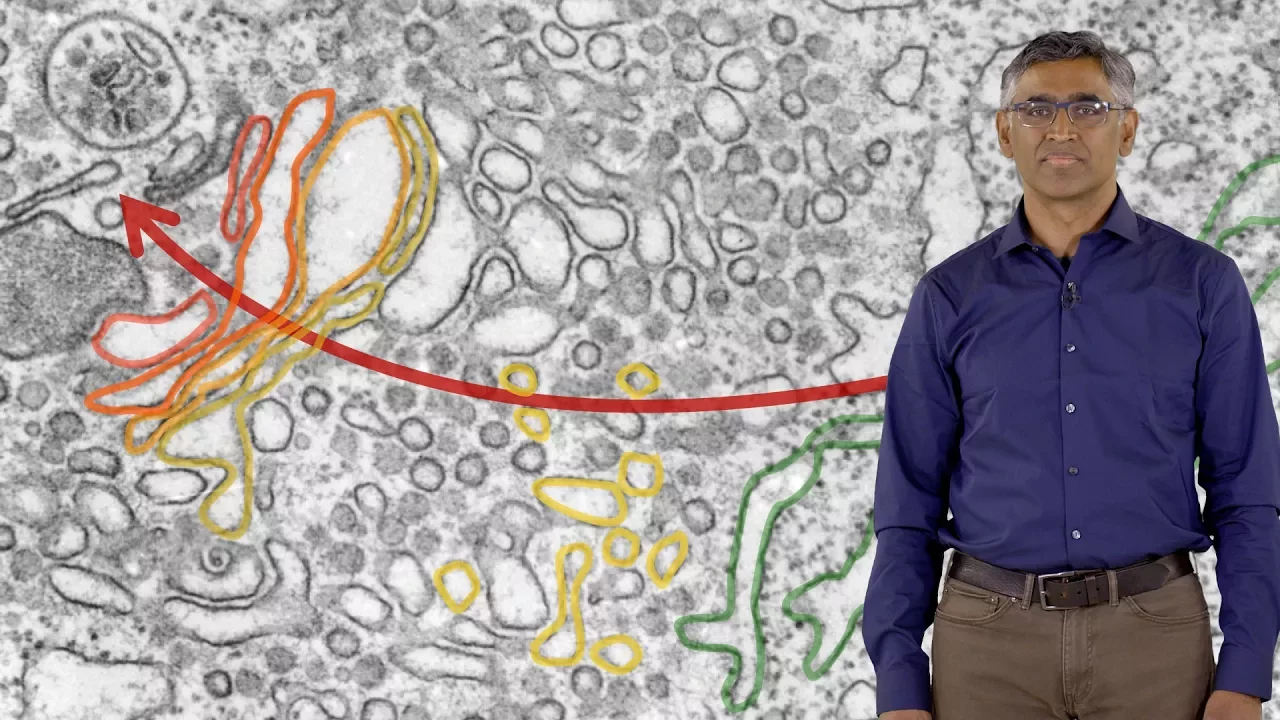
I like to do today is give you a broad overview of the secretory pathway what the major steps in the secretory pathway are and just a general overview of what happens of those steps so the first step in the secretory pathway is the endoplasmic reticulum or er that's where newly synthesized proteins enter the ER enter the secretory pathway and they're then processed and butted off into vesicles for transport to the next step in the secretory pathway the Golgi apparatus the Golgi apparatus is a stack generally a stack of membrane cisternae these kind of pancake-like departments where a number of other protein processing events occur but the main function of the Golgi is to act as a hub for sorting proteins for routing them to different locations within the cell it's best to think of the golgi is like an airport hub where all the proteins for example fly into Chicago and people get routed everywhere to places like the lysosome two different storage compartments in case of like a number of secreted proteins that use stockpile and then dump into the bloodstream like insulin or most importantly how proteins get to the surface of the plasma membrane that this is the way that they get routed there so you have vesicles they're targeted and fused to the plasma membrane and that's how transmembrane proteins get there that's also how secreted proteins all the proteins in your bloodstream end up there is through this exocytosis or secretion mechanism so that's the general steps in kind of the general overview of how proteins move through the pathway but what I want to do now is what different functions take place in each of these different membrane compartments of the secretory pathway so as I mentioned previously the ER is the gateway to the entire secretory pathway so that's where new protein synthesis occurs and proteins are synthesized there and as a result of that protein synthesis that means that the proteins also have to begin folding there and that creates some special problems that I'm going to went to in a minute so proteins fold in the ER and then additionally lipids are also synthesized on the surface of the ER and that's how lipids are often traffic through the cell and that's an active area of research right now how lipids are traffic throughout the cell I'm going to that as well calcium is stored in the ER and that often has a signaling function and lastly n-linked glycosylation occurs in the ER so what is n-linked glycosylation that is adding sugar groups to asparagine now the N is the single letter code for asparagine so that is incredibly useful knowing the single letter codes where everything is like knowing the alphabet I use the alphabet every day of my life since learning it knowing those single amino acid codes is incredibly useful so n linked glycosylation occurs in the ER that it's mainly useful at least in terms of the way i teach the course as a marker for different biochemical processes that were occurring in the ER now as we move on to the golgi we also have proteins get processed as I mentioned they get sorted so processing means that they get trimmed and clipped but the other thing that you'll often see for example an MCAT exams or other things is this only like oscillation constellation in this case the Oh does not refer to the amino acid code it refers to serine and threonine and the reason that it's called linked is because both of those amino acids have hydroxyl groups so the sugar is added via the hydroxyl to the amino acid now given these functions now these are all things that you could memorize and it's good to know about them but what's really interesting is what these facts actually mean and the implications they have for how the cell functions and so I like to do is walk you through some of that now now as I mentioned in my overview one of the things that happens in the ER is that proteins that are entering the secretory pathway have to fold and this creates a special problem for secretory proteins because the biochemical environment inside the cell and outside the cell are very different so the cytoplasm of the cell is reducing and outside the cell its oxidizing because of the oxygen-rich atmosphere so this has drastic effects on how protein is full so you have proteins that normally are in a reducing environment and yet have to be stable in an oxidizing environment so as a result the ER acts as a kind of airlock where proteins enter the ER and have to fold in a in a biochemical environment that is more oxidizing than what you've seen normally in the cytoplasm so that those proteins that are inside the vesicle when eventually they reach the plasma membrane and the contents are dumped out in the proteins now out in the oxidizing world those proteins are stable and don't become destabilized by the change in the chemical environment so what you need is this special biochemical environment for uni a special folding environment and that's what the ER does so one way to think about how the ER works is it basically acts as an airlock where you have a reducing environment in the cytoplasm proteins are translated moved into the ER and they fold in an increasingly oxidizing environment so that they are stable they folded when they're eventually deposited in the world outside the cell so you provide a transition system for allowing proteins to fold in an environment that will be conducive to them being stable and wherever they finally end up now another biochemical function that's associated with the ER is lipid synthesis as I mentioned now if all the lipids are synthesized on the surface of the ER there's a whole set of problems that are associated with that but the more interesting ones and more intractable ones is the fact that there are a number of other membrane compartments that are need lipids in order to maintain their integrity so for example Maya conned RIA so if you're synthesizing lipids on the surface of the ER how do you go and transfer those lipids in order to support mitochondrial function and this has long been a problem in biochemistry and cell biology is how do these lipids get from the ER to the mitochondria now until relatively recently there's just been a lot of ideas and it hasn't really been very clear but now there's this very active recent era of research where it is clear that the ER makes all sorts of different contexts with different organelles within the cell it reaches out and hugs them and so one one of the ways that this happens is that there are all these ER organelle contact sites so you'll have PR mitochondrial contact sites ER plasma membrane contact sites there's all sorts of different ways that the ER makes content and direct physical contact with other membrane-bound compartments and it's believed to transfer lipids directly and this is something that people are really excited about taking apart okay lastly my survey of like what do these all these facts mean I just want to go back to this issue of protein glycosylated in the ER because I think this raises a lot of issues of how one part of the course interacts with other parts of the course so I mentioned that protein glycosylation occurs in the ER you have n linked protein glycosylated but that means that I'm adding sugar groups to proteins in the ER but somehow I've got to take sugar that exists in the cytoplasm and move it into the ER so how is that done that implies that there has to be some sort of transporter system for moving various types of sugars that I use in protein glycosylation into the ER where then enzymes utilize those substrates and and add the glue the sugar groups to various proteins but that also means yeah raises a whole other set of questions do I need energy in order to concentrate sugars and this relatively small membrane bound compartment also as I consume sugar and I throw off byproducts as part of the glycosylation system how do I get rid of those byproducts do I have another set of transporter system so there's we often think of the ER as just being this membrane bag where things happen but there's a lot of interchange and transport across it and that when you learn a simple fact like protein glycosylation occurs in the ER there's a whole set of different systems that we've all read about in the class or that we will learn about in the class that you realize that all these systems have to act in concert in order for just one of these simple functions to take place so when you learn about small molecule transport we usually learn about it in the context of ion flows or or various other things but those transporters don't all have to be getting things out from outside the cell into the cell or vice-versa they can be moving things from within a compartment into the cytoplasm or from the cytoplasm into the
Up Next
43:07
Protein Localization Inside Cells: Historical Experiments and Signal Hypothesis Explained
@scicommlab
36.1K views•2017-08-03
50:12
Bacterial Communication: Quorum Sensing and Biofilm Formation Explained
@JHUAAP
12.6K views•2011-06-28

5:35
Enteric Nervous System Explained: The Gut's Brain | Neurobiology Lecture
@alumniu6029
438 views•2018-09-12
7:08
Bacteriophages: Earth's Deadliest Killers and Future Antibiotics
@kurzgesagt
34.6M views•2018-05-13
Related Study Plans & Knowledge Roadmaps
Structured learning paths in Biology
biology
RNAi: Biogenesis, RISC & Gene Silencing
01Molecular Biology Foundations: DNA to Protein
02Introduction to RNA Interference (RNAi)
03Molecular Biogenesis of miRNA and siRNA
+ 2 more learning modules
10h5 modules
Explore Roadmap
biology
Mycorrhizae: Signaling, Biophysics & Ecology
01Foundations of Mycorrhizal Symbiosis
02Molecular Signaling and Root Colonization
03Biophysics and Bioenergetics of Nutrient Exchange
+ 1 more learning modules
11h4 modules
Explore Roadmap
biology
Circadian Clocks: TTFL, SCN & Periphery
01Foundations of Molecular Biology & Gene Expression
02Introduction to Chronobiology and Actograms
03The Core TTFL: Molecular Architecture of the Clock
+ 3 more learning modules
14h6 modules
Explore Roadmap
biology
Population Genetics: Math, Drift & Selection
01Genetic & Probability Foundations
02The Hardy-Weinberg Principle and Baseline Models
03Mathematical Modeling of Natural Selection
+ 3 more learning modules
18h6 modules
Explore Roadmap