The Taylor diffusion cloud chamber demonstrates radioactivity by using alcohol (a dipole molecule) that condenses around ionized air particles created when alpha particles pass through, making their tracks visible under illumination; the apparatus consists of a sealed chamber containing alcohol vapor cooled by dry ice, with a radium source that emits alpha particles which ionize the air, causing alcohol droplets to form along their paths.
Teaching Radioactivity: Diffusion Cloud Chamber Experiment
Added:Deep Dive
Understanding of basic atomic structure, specifically the composition of the nucleus (protons and neutrons) and the concept of isotopes.
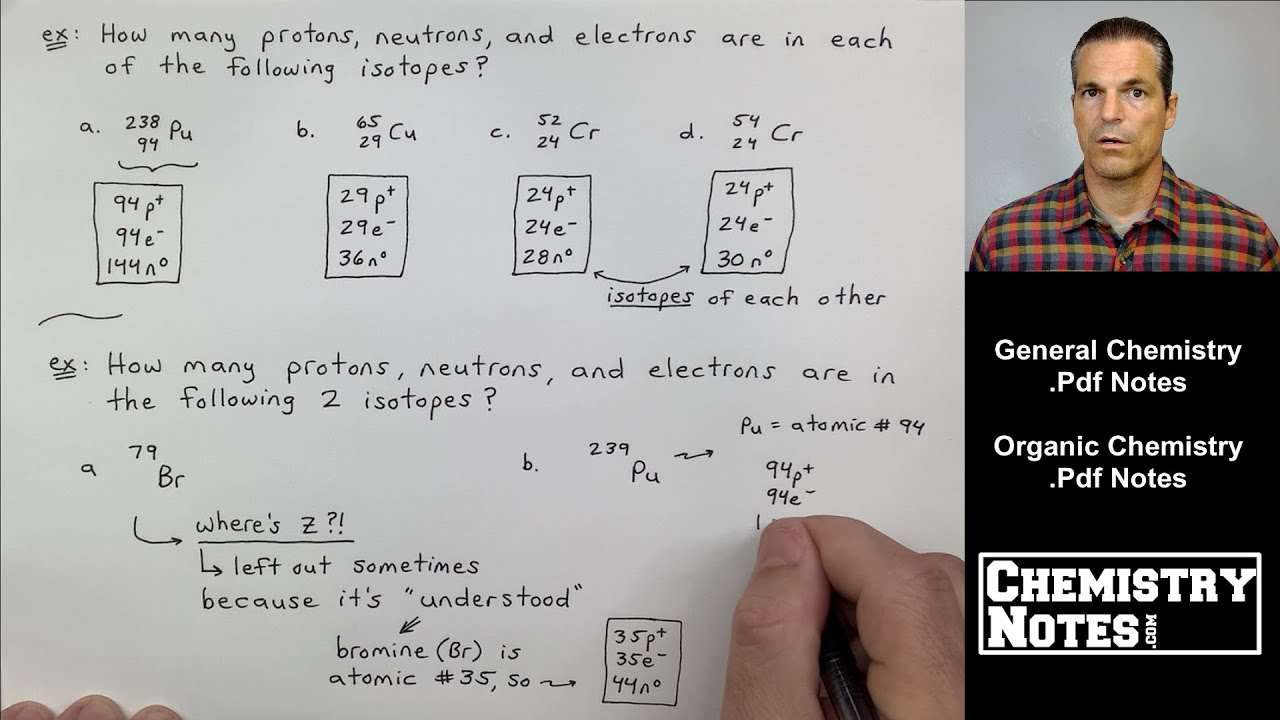
S2E3 atomic structure and isotopes
197
Atoms consist of protons, neutrons, and electrons, with protons and neutrons in the nucleus accounting for nearly all atomic mass while electrons contribute negligibly; isotopes are atoms of the same element with identical proton numbers but different neutron counts, which is represented using nuclear symbol notation (mass number A at top left, atomic number Z at bottom left) and hyphen notation (element-name-mass number), allowing calculation of protons, neutrons, and electrons for any isotope.
Click to watch →
Elementos e Átomos | Química | Khan Academy
247.8K
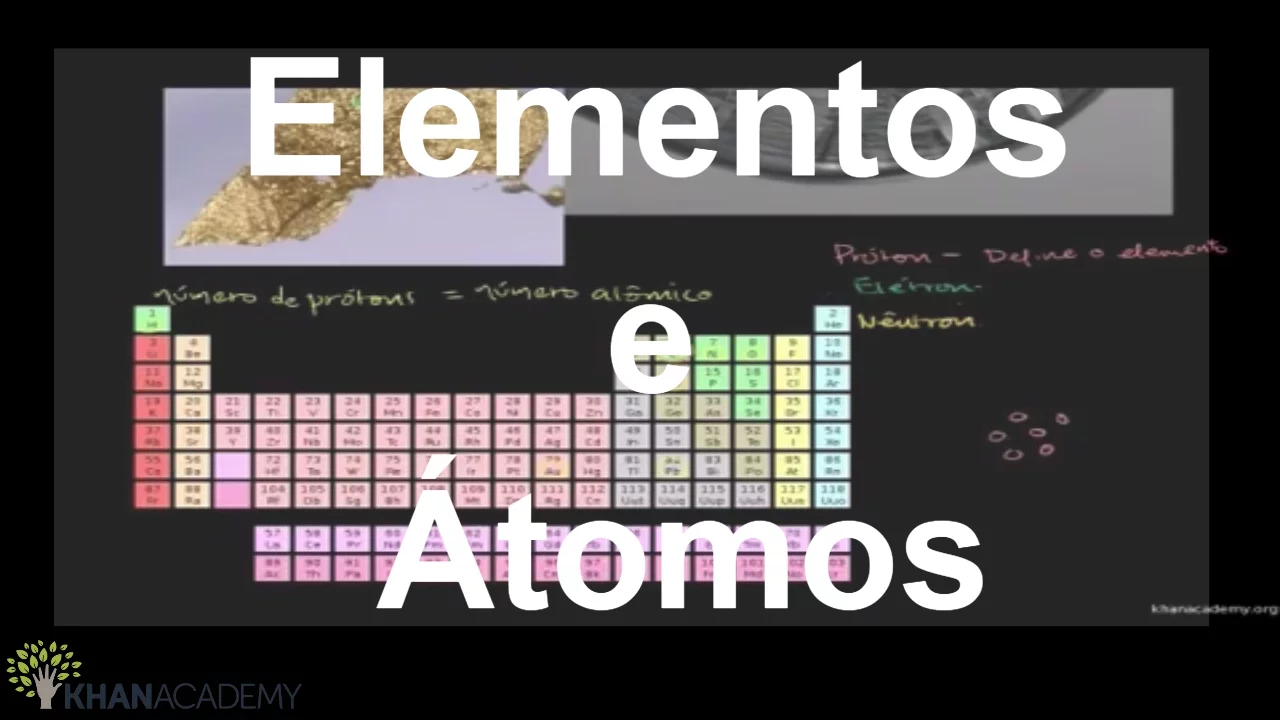
Atoms consist of a central nucleus containing protons and neutrons, surrounded by orbiting electrons. The number of protons (atomic number) defines the element—for example, carbon always has 6 protons. Neutrons and electrons can vary without changing the element's identity. Variants with different neutron counts are called isotopes, such as Carbon-12 (6 protons, 6 neutrons) versus Carbon-14 (6 protons, 8 neutrons). This structural understanding reveals how matter maintains its properties at the atomic level.
Click to watch →

Lab Assistant Physics | Rajasthan Lab Assistant Live Class | Nuclie | By Sameer Sir
22.4K
Atoms consist of a nucleus containing protons and neutrons, surrounded by electrons. The atomic number (Z) equals the number of protons and determines the element. The atomic mass (A) equals protons plus neutrons. The number of neutrons is calculated as A - Z. Isotopes are atoms of the same element (same Z) but with different numbers of neutrons (different A). For hydrogen, the three isotopes are protium (1 proton, 0 neutrons), deuterium (1 proton, 1 neutron), and tritium (1 proton, 2 neutrons).
Click to watch →

Term2 Nuclei One shot in 35 min🔥 || Nuclei full chapter one Shot Class 12th Physics || Abhishek sir
145.1K
Protons and neutrons are fundamental nuclear particles. Protons have +1.6 × 10^-19 C charge and mass 1.6726 × 10^-27 kg, while neutrons are neutral with mass 1.6749 × 10^-27 kg. The atomic number (Z) equals proton count, determining element identity. The mass number (A) equals protons plus neutrons. Isotopes share the same atomic number but different neutron counts. Hydrogen has three isotopes: Protium (1p, 0n), Deuterium (1p, 1n), and Tritium (1p, 2n).
Click to watch →

CH 2 - Inorganic Chemistry
120
An atom is the basic unit of matter, consisting of a nucleus (containing protons and neutrons) and an electron cloud. Protons are positively charged, neutrons are neutral, and electrons are negatively charged. Isotopes are atoms of the same element with the same number of protons but different numbers of neutrons. For hydrogen, the three isotopes are Hydrogen-1 (no neutrons), Hydrogen-2 (deuterium, one neutron), and Hydrogen-3 (tritium, two neutrons). The atomic number represents the number of protons, while the atomic mass number represents protons plus neutrons.
Click to watch →
Deep Dive
The fundamental concept of radioactivity, specifically what alpha decay is and the physical characteristics of an alpha particle (a helium-4 nucleus).

Radyoaktivite
286K
Alpha decay is a type of radioactive decay where an unstable nucleus emits an alpha particle, which is a helium nucleus (2 protons and 2 neutrons, represented as ⁴He²⁺). The parent nucleus loses 4 mass units and 2 atomic numbers. Alpha particles are the slowest of all radiation types, are positively charged, and are easily stopped by materials. They have high ionizing power but low penetrating power.
Click to watch →

مراجعة مركزة | مراجعة جميع كلاميات الفصل العاشر 2024
143.3K
Alpha decay is the first type of radioactive decay where an unstable nucleus emits an alpha particle to become more stable. An alpha particle is identical to a helium-4 nucleus, consisting of 2 protons and 2 neutrons, with mass number 4 and atomic number 2. Alpha particles carry a positive charge equal to twice the charge of a proton. For a nucleus to undergo alpha decay, it must have a positive decay energy (Q > 0), which ensures the decay is energetically favorable. The original nucleus is called the parent nucleus, and the resulting nucleus is called the daughter nucleus.
Click to watch →

فيزياء سادس علمي | الفصل التاسع النووية | المحاضرة 3 تصوير2025 ال أنحلال الاشعاعي
194.5K
Alpha decay is the first type of radioactive decay where an unstable nucleus emits an alpha particle. The alpha particle is identical to a helium nucleus, consisting of 2 protons and 2 neutrons. It has a mass number of 4 and an atomic number of 2, carrying a positive charge equal to twice the charge of a proton.
Click to watch →

الفصل التاسع || المحاضرة الثالثة || فيزياء السادس علمي
17.4K
Alpha decay is a radioactive process where unstable nuclei with large mass and volume emit alpha particles to achieve greater stability. An alpha particle is a helium nucleus containing 2 protons and 2 neutrons, with mass number 4 and charge +2. During alpha decay, the mass number decreases by 4 and the atomic number decreases by 2, transforming the original element into a different element. This decay occurs spontaneously when the decay energy is positive, and nuclei with large mass and volume are most likely to undergo alpha decay.
Click to watch →

আধুনিক পদার্থবিজ্ঞান ও ইলেকট্রনিকস - ওয়ানশট ক্লাস - পদার্থবিজ্ঞান ।। SSC!
65K
Alpha decay is a type of radioactive decay where an unstable nucleus emits an alpha particle. An alpha particle is identical to a helium nucleus, containing 2 protons and 2 neutrons with a mass number of 4 and atomic number of 2. When a nucleus undergoes alpha decay, its atomic number decreases by 2 and its mass number decreases by 4, transforming it into a different element.
Click to watch →
Deep Dive
The process of ionization, where a charged particle strips electrons from surrounding atoms or molecules as it travels through a medium.

Hiệu ứng Unruh | Thư Viện Thiên Văn
80.2K
Ionization is the process where radiation particles or rays interact with atoms or molecules in the environment, causing them to lose or gain electrons. When atoms or molecules exist, they are electrically neutral with equal numbers of electrons and protons. When affected, such as losing or gaining an electron (usually losing), they become positively or negatively charged ions. The separated electron becomes a free electron with strong interaction capability.
Click to watch →

Mi Amigo Pancri Se Va Para Siempre de Minecraft...
8.3K
Ionization is the process by which atoms or molecules become electrically charged particles called ions, occurring when neutral atoms or molecules gain or lose electrons.
Click to watch →

DGCA AME Exams Module 3.1 Electron theory | CAR 66 EASA | Full preparation
1.2K
Ionization is the process where atoms lose or gain electrons. When atoms lose electrons, they become positively charged (cations). When atoms gain electrons, they become negatively charged (anions). Neutral atoms have equal numbers of protons and electrons. The number of valence electrons determines how many chemical bonds an atom can form. Free electrons in the outermost orbit can easily be dislodged and participate in chemical reactions, making them essential for bonding and electrical conduction.
Click to watch →

Physics - Radioactivity - Ionisation
146.3K
Ionization is the process of turning a neutral atom into an ion or a charged atom. This occurs when radiation knocks electrons out of atoms.
Click to watch →

Lecture 27 Interactions of Radiation with Matter
1.9K
Charged particles interact with matter through ionization and radiation production. Electrons produce bremsstrahlung radiation when accelerated, with maximum photon energy equal to the electron's kinetic energy. Cherenkov radiation occurs when charged particles exceed the speed of light in a medium (not vacuum), producing an electromagnetic shock wave visible as a blue glow in nuclear reactor pools. Specific ionization—the number of ion pairs produced per centimeter—varies dramatically: alpha particles (~40,000 ion pairs/cm) have much higher ionization than protons (~4,200 ion pairs/cm) or electrons. Higher ionization means shorter particle range. Neutrons, being electrically neutral, do not directly ionize but interact via the strong nuclear force, producing secondary particles (like recoiling protons) that then cause ionization.
Click to watch →
Deep Dive
The principles of state changes and thermodynamics, particularly how a gas becomes a supersaturated vapor and the conditions required for condensation.

Mod-01 Lec-11 Vacuum Evaporation Deposition
6.2K
The equilibrium vapor pressure formula enables prediction of vapor pressure at any temperature: P = P° × exp[(ΔS_vap/R)(T°/T)] × exp[-(ΔH_vap/RT)]. Condensation flux (J_c) differs from incident flux (J_i) due to re-evaporation losses. A critical incident flux threshold exists - below this value, condensation does not occur. Higher substrate temperatures increase this critical value. The condensation coefficient (α_c) depends on surface cleanliness and contamination levels. Two time factors govern condensation: residence time (particles remaining on surface) and diffusion time (migration to favorable attachment sites). Super saturation occurs when pressure above substrate exceeds equilibrium vapor pressure, preventing re-evaporation and ensuring net condensation. This condition is achieved by keeping substrate temperature low while maintaining higher pressure above the substrate.
Click to watch →

Cambios de Estado del Agua
77.8K
Condensation is the gas-to-liquid phase transition where vapor releases latent heat at constant temperature. This process requires two essential conditions: first, the air must reach its dew point temperature where it can no longer hold all its water vapor; second, condensation nuclei must be present. These nuclei are tiny solid particles suspended in the atmosphere, including dust, salt, sand, and smoke. Without these nuclei, water vapor cannot condense even when cooled below the dew point, remaining as supercooled vapor. This explains why condensation forms on surfaces like windows and bottles rather than occurring uniformly in the air. The presence of nuclei enables the phase change to proceed efficiently.
Click to watch →

Zbudowałem detektor promieniowania w CERN-ie
91.5K
A saturated vapor is a state where air contains as much gas as it can hold at a given temperature. When more gas is added or temperature decreases, the vapor becomes supersaturated and cannot hold all the gas molecules. This concept is analogous to humidity exceeding 100% in weather conditions, where water vapor would condense into liquid droplets if nucleation sites were available.
Click to watch →
Relative Humidity - Dew Point, Vapor & Partial Pressure, Evaporation, Condensation - Physics
221.6K
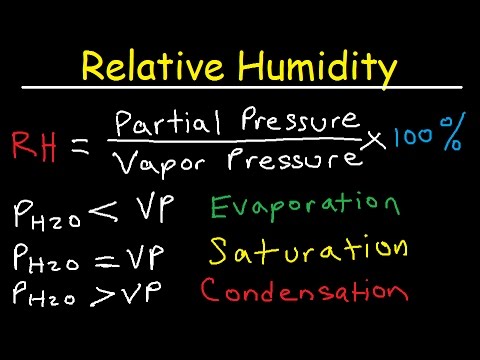
Super saturation occurs when the partial pressure of water vapor exceeds the vapor pressure at a given temperature, meaning the air contains more water vapor than it can normally hold under normal circumstances. This unstable condition happens when air is cooled rapidly before the excess water vapor can condense. In super saturated conditions, the rate of condensation exceeds the rate of evaporation, causing water vapor to condense into liquid droplets. This phenomenon explains why clouds form and why fog appears when warm, moist air is cooled quickly.
Click to watch →
Lecture14 Physics of Condensation
5.3K
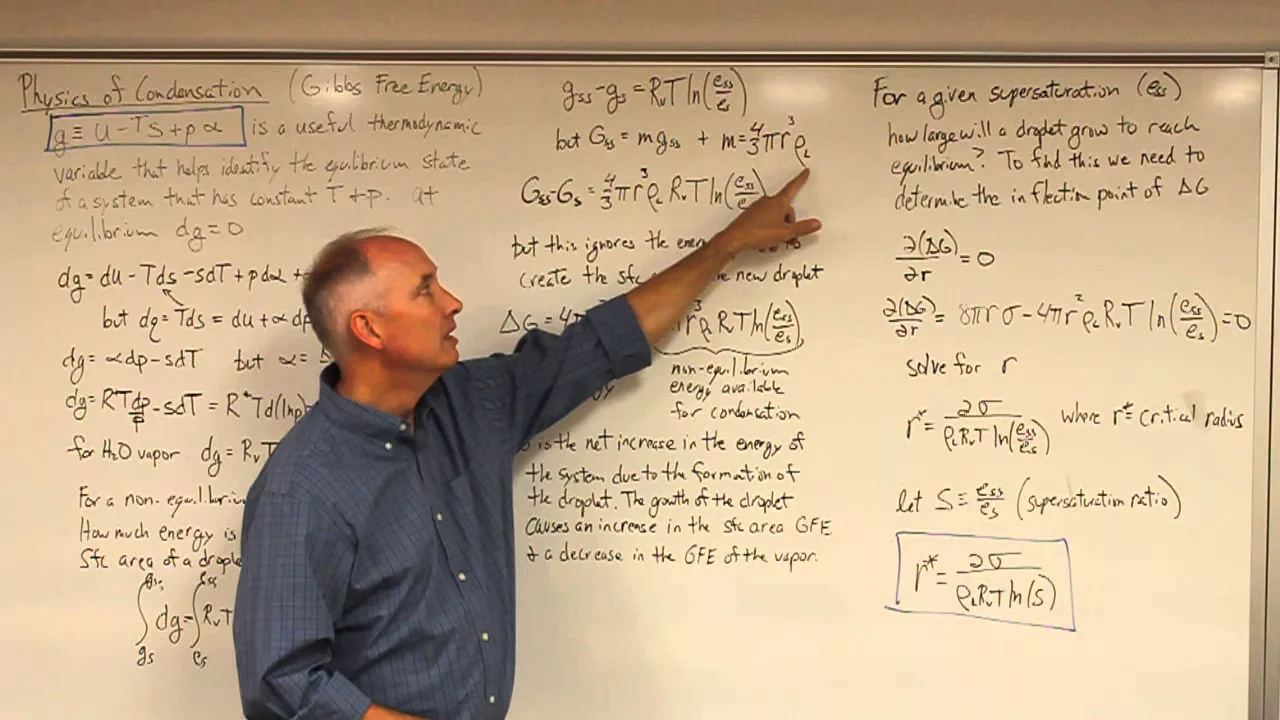
This section establishes the thermodynamic framework for understanding atmospheric condensation. It introduces Gibbs free energy per unit mass (g = u - Ts + pa) as the key variable identifying equilibrium states at constant temperature and pressure. The differential form dg = v dp - s dt reveals how changes in pressure and temperature affect system stability. For water vapor, this becomes dg = r_v*T*d(ln e) - s dt. Supersaturation (relative humidity > 100%) creates non-equilibrium conditions where dg ≠ 0, providing the driving force for condensation. The excess Gibbs free energy in supersaturated vapor powers droplet growth as the system seeks equilibrium.
Click to watch →
Prerequisite Knowledge
- Concept 01Understanding of basic atomic structure, specifically the composition of the nucleus (protons and neutrons) and the concept of isotopes.
- Concept 02The fundamental concept of radioactivity, specifically what alpha decay is and the physical characteristics of an alpha particle (a helium-4 nucleus).
- Concept 03The process of ionization, where a charged particle strips electrons from surrounding atoms or molecules as it travels through a medium.
- Concept 04The principles of state changes and thermodynamics, particularly how a gas becomes a supersaturated vapor and the conditions required for condensation.
Subsequent Learning
- Step 01Comparing the distinct visual tracks of different radiation types, such as comparing the thick, straight tracks of alpha particles with the thin, erratic tracks of beta particles.
- Step 02Investigating the effect of external magnetic or electric fields on particle tracks to determine the charge and momentum of the ionizing radiation (Lorentz force).
- Step 03Exploring the historical role of cloud chambers in particle physics, including the discovery of the positron and the muon.
- Step 04Advancing to modern radiation and particle detection technologies, such as bubble chambers, Geiger-Müller counters, and silicon pixel detectors used in high-energy physics.
Preparation
Source Insertion
Cooling Setup
Final Assembly
Observation
Preparation
0:00Playing Section
- 1
Position alcohol around the chamber's edge.
- 2
Alcohol attracts ionized air particles.
Digital Simulations and Virtual Laboratories in Radiation Education
While hands-on experiments like the diffusion cloud chamber offer direct physical observation of particle tracks, critics argue they present significant logistical, financial, and safety challenges in school settings. Setting up a physical cloud chamber requires hazardous materials like high-purity isopropyl alcohol and dry ice, which can be difficult to source and handle safely. Furthermore, the apparatus is notoriously finicky, often leading to failed experiments that waste valuable instructional time. Consequently, many science educators advocate for interactive digital simulations and virtual laboratories as superior alternatives. Virtual platforms provide a highly reliable, hazard-free environment where students can manipulate variables (such as changing magnetic fields, adjusting pressures, or switching particle sources) that are impossible to alter in a basic classroom setup. These digital tools ensure equitable access to particle physics concepts without the regulatory burdens, ongoing costs, and safety risks associated with storing and handling physical radioactive sources and chemical coolants.
Deep Dive
Comparing the distinct visual tracks of different radiation types, such as comparing the thick, straight tracks of alpha particles with the thin, erratic tracks of beta particles.
COMPRÉ RELOJES RADIACTIVOS Y OTRAS COSITAS ☢⚛
88.6K
Alpha particles (helium nuclei with 2 protons and 2 neutrons) create thick, straight tracks in cloud chambers due to their high mass and charge. Beta particles (high-energy electrons) create thinner, curved tracks due to their lower mass and charge. The track characteristics allow identification of the radiation type and provide information about the radioactive source.
Click to watch →

physics class 12 chapter 21 short questions | 21.1 to 21.10 | physics ka safar
70.3K
Alpha particles (+2 charge, high mass) have high ionization but low penetration, stopping quickly. Beta particles (-1 charge, electrons) have moderate ionization and penetration. Gamma rays (no charge, no mass) have lowest ionization but highest penetration. Alpha particles ionize through electrostatic attraction, while beta particles cause ionization through repulsion. Cloud chambers reveal radiation types through distinct track patterns: alpha produces short thick tracks, beta produces longer erratic tracks, and gamma produces faint or no tracks. Alpha detection requires thin mica windows due to low penetration, while gamma detection needs no window.
Click to watch →
Edexcel International A-Level Physics: May 2025 Unit 5 Past Paper Walkthrough
1.7K
This section covers particle physics: (1) Alpha particles produce thick, straight tracks because they are massive (4 atomic mass units) and highly ionizing; (2) Beta particles produce thin, twisted tracks because they are much less massive (approximately 1/2000 of proton mass) and easily deflected; (3) Alpha particles are helium-4 nuclei (⁴₂He) with mass approximately 4 atomic mass units.
Click to watch →
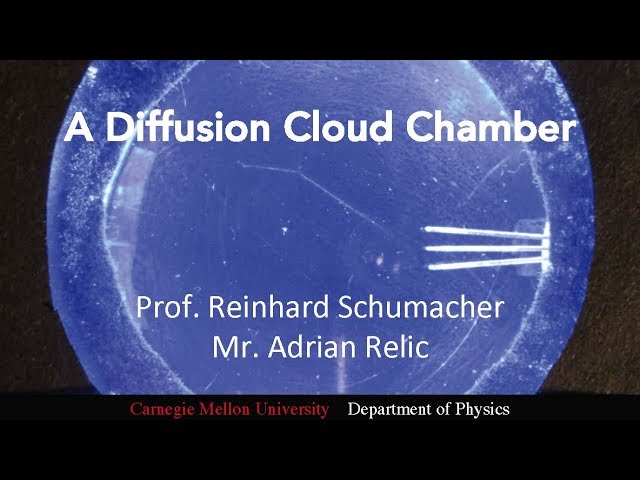
A Diffusion Cloud Chamber
22K
Different types of ionizing radiation produce distinct track patterns in cloud chambers. Alpha particles (heavy helium nuclei) create sharp, straight tracks about 3.8 cm long due to their high ionization density. Beta particles (high-speed electrons) produce short, diffuse tracks that appear and disappear quickly because they are lighter and ionize less efficiently. The video demonstrates these differences using lead-210 sources, showing how alpha tracks are crisp and easily distinguishable from the fleeting beta tracks.
Click to watch →
Edexcel IAL Physics Unit 5 | WPH15/01 | Q (1-13) | June 2025 Solution
294
In cloud chambers, alpha particles leave thick, straight tracks because they are highly ionizing (due to their large mass and double positive charge) and travel in straight lines without significant deflection. Beta particles leave thin, twisted tracks because they have much smaller mass, causing them to be more easily deflected by atomic nuclei and electrons in the chamber, and they cause less ionization per unit distance traveled.
Click to watch →
Deep Dive
Investigating the effect of external magnetic or electric fields on particle tracks to determine the charge and momentum of the ionizing radiation (Lorentz force).

Yüklü Parçacıkların Manyetik Alandaki Hareketi | 44.GÜN | 2025 AYT Fizik kampı
63.9K
The Lorentz force combines electric and magnetic forces: F_total = qE + q(v × B). When electric and magnetic forces balance, particles move straight. Applications include metal detectors, particle accelerators, and mass spectrometers. Charged particles with equal momentum and equal radii in magnetic fields must have equal charges (R = mv / (qB)). Electric fields can change particle speed (doing work), while magnetic fields only change direction (no work). Particles in magnetic fields undergo uniform circular motion with constant speed but changing velocity direction. The Lorentz force provides centripetal acceleration, making magnetic fields useful for particle separation and focusing.
Click to watch →

المراجعة المركزة 2025 كلاميات الفصل الثاني بمحاضرة واحدة
180.8K
When a positively charged particle moves perpendicular to a uniform electric field, it experiences an electric force (F = qE) that causes it to move parallel to the field lines. When the same particle moves perpendicular to a uniform magnetic field, it experiences a magnetic force (F = qvB) that causes it to move in a circular path. The Lorentz force is the resultant force when both fields are present. To experimentally distinguish electric from magnetic fields, fire a charged particle perpendicular to the field: parallel deflection indicates an electric field, while circular deflection indicates a magnetic field.
Click to watch →

MAGNETIC EFFECT OF ELECTRIC CURRENT | Most Important Questions For NEET | Prashankaal Series
107.6K
This section covers the Lorentz force and particle motion in magnetic fields. The Lorentz force is F = q(E + v × B), with the magnetic component causing circular motion with radius R = mv/qB. Particles with smaller mass-to-charge ratio have smaller radii and larger deflections. For particles with the same charge, lighter particles deflect more than heavier particles. A velocity selector uses perpendicular electric and magnetic fields to allow particles with specific velocity v = E/B to pass undeflected. The magnetic dipole moment of a current loop is μ = I × A, with direction given by the right-hand rule.
Click to watch →

فيزياء السادس علمي || 1- جزء اول - الفصل الثاني || المجالين الكهربائي والمغناطيسي وقوة لورنز
1.2M
The Lorentz force is the total force experienced by a charged particle moving through both electric and magnetic fields, calculated as the vector sum of the electric force (F = qE) and the magnetic force (F = qvB sinθ). When a positive charge moves perpendicular to an electric field, it experiences a force parallel to the field lines; when moving perpendicular to a magnetic field, it experiences a force perpendicular to both velocity and field, causing circular motion. The magnetic force is maximum when velocity is perpendicular to the magnetic field (90°) and zero when parallel (0°). This principle is applied in cathode ray tubes to control electron beam paths.
Click to watch →

المراجعة المركزة | فيزياء السادس العلمي | جميع شرحيات الفصل الثاني في محاضرة واحدة
111.2K
Charged particles experience different forces in electric and magnetic fields. In an electric field, particles accelerate parallel to field lines according to F = qE. In a magnetic field, particles move in circular paths perpendicular to field lines according to F = qvB sin(θ). The force direction depends on charge sign: positive charges follow the right-hand rule, negative charges move oppositely. Maximum force occurs at 90° to the field, zero force when parallel. The Lorentz force combines electric and magnetic forces: F_Lorentz = qE + q(v × B). This force governs charged particle motion in electromagnetic fields and has applications in cathode ray tubes.
Click to watch →
Deep Dive
Exploring the historical role of cloud chambers in particle physics, including the discovery of the positron and the muon.

LES RAYONS COSMIQUES
39.1K
Cloud chambers revolutionized particle physics by visualizing charged particle tracks through supersaturated vapor condensation. Wilson's invention revealed electrons, alpha particles, and later the positron (1932)—the first antimatter particle, earning Anderson the 1936 Nobel Prize. The muon discovery (1936) added another layer of mystery, being 207 times heavier than electrons with no immediate theoretical explanation. These discoveries expanded the 'particle zoo' and demonstrated how cosmic ray studies drove fundamental physics breakthroughs.
Click to watch →

I raggi cosmici: messaggeri dell'Universo - 25/02/2021
555
The cloud chamber was developed by Charles Wilson in 1911, inspired by natural cloud formation. It makes invisible particle tracks visible by creating supersaturated vapor that condenses around ions created by passing particles. This principle connects natural cloud formation to laboratory particle detection. The cloud chamber enabled discoveries of the positron and muon, revolutionizing particle physics. A simple chamber requires a container, cooling source (dry ice at -78°C), and supersaturated vapor (alcohol). The container must be insulated to maintain temperature gradient. After 10-15 minutes, the chamber is ready for observation.
Click to watch →

Il laboratorio dei raggi cosmici (D. Domenici)
26K
In 1932 at Caltech, Carl Anderson developed the cloud chamber, a revolutionary particle detector consisting of a chamber with superheated vapor inside a powerful electromagnet. This instrument could visualize particle tracks by photographing the condensation trails left by charged particles. Anderson placed his cloud chamber inside a powerful electromagnet, which curves charged particles according to the Lorentz force, allowing measurement of their momentum. He discovered a track with the characteristics of an electron but curving as if it had positive charge. No positively charged particle with the same mass as an electron was known. Anderson recalled that Paul Dirac had predicted that for every particle, there should exist an antiparticle with the same mass but opposite charge. Anderson realized he had discovered the first antimatter particle, the positron (anti-electron). In 1934, Anderson and Seth Neddermeyer discovered the muon, a particle with mass intermediate between an electron and a proton.
Click to watch →

The Cloud Chamber: Revealing a Hidden World
11.3K
Charles Wilson, a Scottish meteorologist at Ben Nevis observatory, invented the cloud chamber in 1911 while studying the Brocken spectre phenomenon. Initially attempting to create controlled clouds for meteorological research, he discovered that charged particles like cosmic rays caused cloud formation even in meticulously cleaned chambers. This accidental discovery proved revolutionary for particle physics, enabling direct visualization of subatomic particles. Before cloud chambers, scientists relied on indirect methods like electroscopes measuring charge loss. The cloud chamber allowed differentiation of particles by mass, charge, and velocity through magnetic field interactions, leading to major discoveries including the positron (1932), muon (1936), and kaon (1947). Alexander Langsdorf solved early limitations in 1936 by inventing the continuously sensitive diffusion cloud chamber, which uses dry ice, alcohol vapor, and supercooled conditions to create persistent detection capability.
Click to watch →

Sternengeschichten Folge 510: Die wunderbare Nebelkammer
3.3K
The cloud chamber revolutionized science by making invisible particles visible. Charles Wilson developed this instrument by creating conditions where rapid air expansion causes condensation, forming fog that reveals particle trajectories. He discovered that cosmic rays and radioactive materials ionize air, creating condensation nuclei that make particle paths visible. This breakthrough enabled discovery of the positron (first antimatter evidence), the muon, and the kaon. The chamber became the most important particle physics instrument for decades, allowing scientists to study particle collisions, radioactive decays, and identify unknown particles. Wilson's work transformed our understanding of subatomic particles and earned him the 1927 Nobel Prize.
Click to watch →
Deep Dive
Advancing to modern radiation and particle detection technologies, such as bubble chambers, Geiger-Müller counters, and silicon pixel detectors used in high-energy physics.

Ионизирующее излучение / Георгий Тихомиров в Рубке ПостНауки
39.3K
Ionizing radiation detection evolved from photographic plates (used by Becquerel) to sophisticated modern instruments. Geiger-Müller counters use gas-filled tubes that produce electrical pulses when ionized by radiation. Scintillation detectors emit light when struck by radiation particles. Cloud chambers visualize particle tracks through condensation. Modern detectors cover a wide range of energies and particle types. Periods of half-life are experimentally measured and continuously refined, with errors ranging from fractions of a percent for well-studied isotopes to 50% for less characterized ones. Theoretical predictions cannot replace experimental verification.
Click to watch →
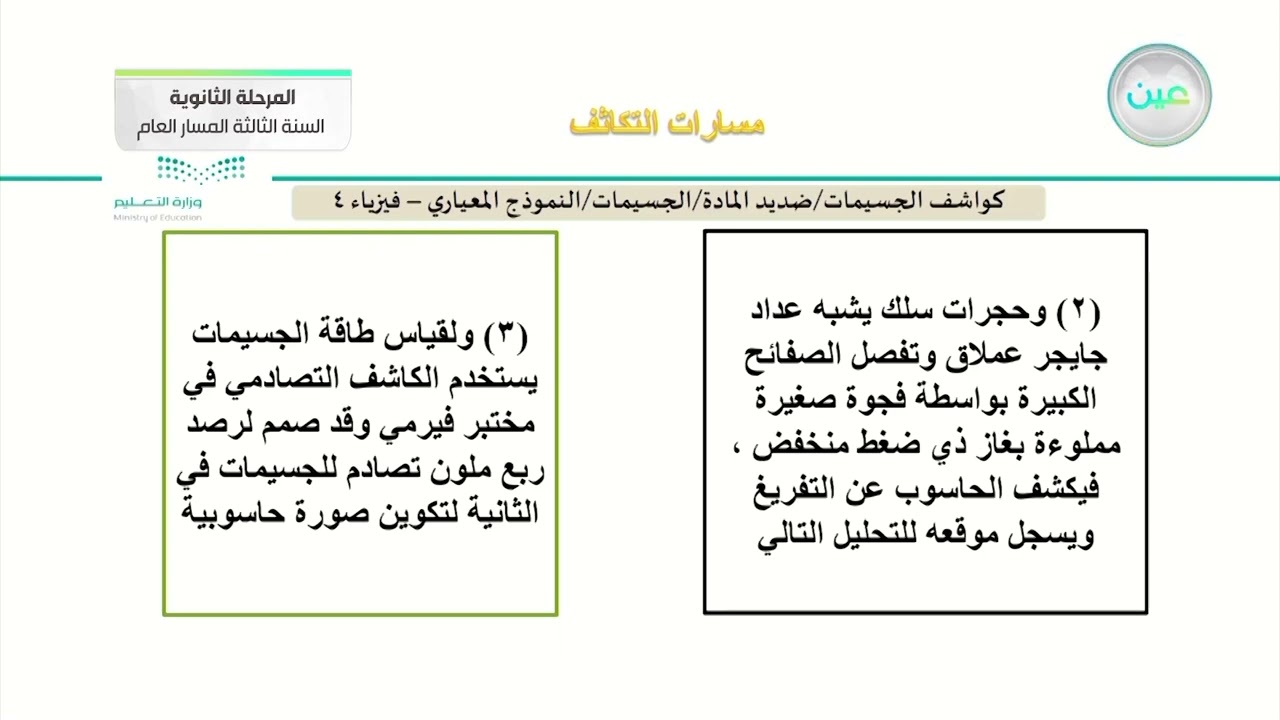
كواشف الجسيمات / ضديد المادة / الجسيمات / النموذج المعياري - الفيزياء 3 (3-3) - المرحلة الثانوية
178
This section covers three major particle detection technologies. The Geiger counter uses ionization of gas inside a tube with charged electrodes to detect radiation through current pulses. Cloud chambers use supersaturated vapor that condenses along particle paths, creating visible tracks. Bubble chambers use superheated liquid that forms bubbles along particle trajectories. These technologies allow scientists to visualize and study particle interactions, with bubble chambers at Fermilab capable of recording hundreds of thousands of collisions per second for computer analysis.
Click to watch →

53 Атомная, ядерная физика
2K
Several methods detect ionizing radiation: (1) Geiger-Müller counter (1908) uses gas ionization to detect beta/gamma; (2) Cloud chamber (1912) visualizes particle tracks via supersaturated vapor condensation; (3) Bubble chamber (1952) uses superheated liquid hydrogen; (4) Nuclear emulsion (1928) uses silver halide crystals; (5) Scintillation counters use fluorescent materials. Each method has different capabilities for detecting different particle types and energies.
Click to watch →

Particle Physics: Bubble Chambers
31.2K
Bubble chambers, invented in 1952 by Donald Glaser, detect charged particles by using superheated liquid hydrogen that forms bubbles along particle tracks when pressure is reduced; these bubbles are photographed and analyzed to study particle interactions, though they have been largely replaced by modern electrical detectors that use ionization and amplification principles.
Click to watch →
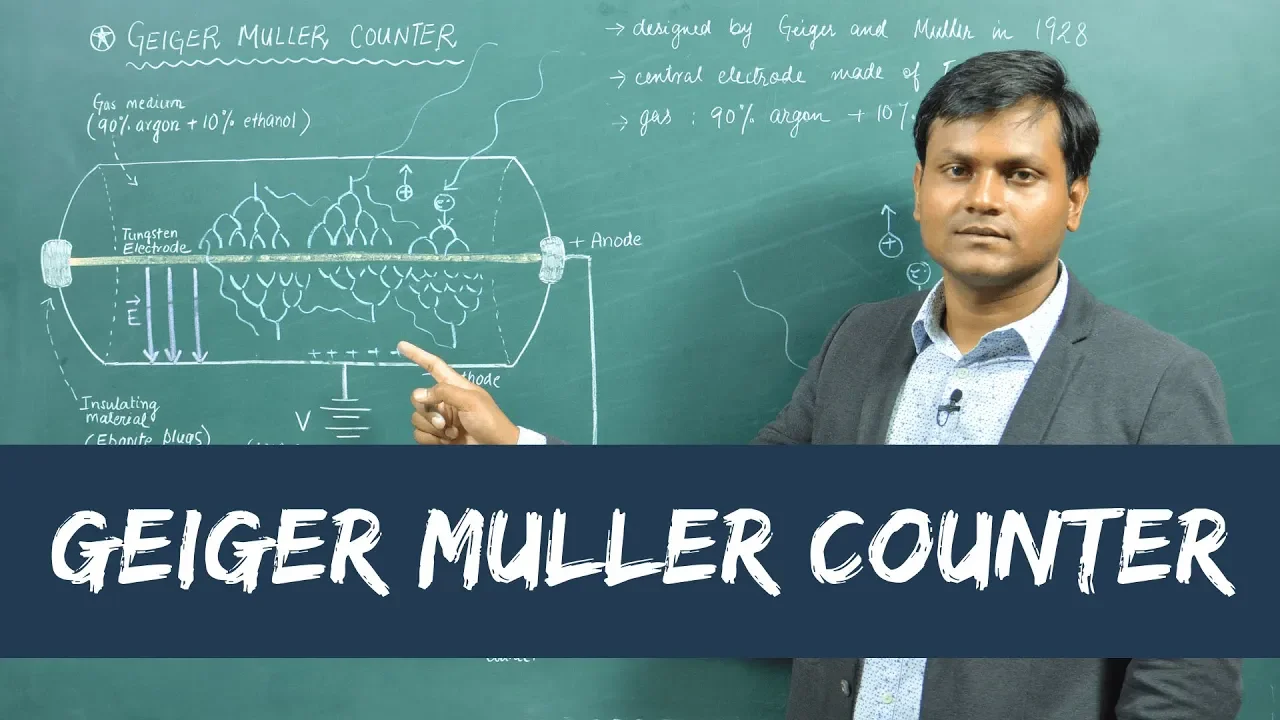
What is GM Counter? - Geiger Muller Counter
624.3K
A Geiger-Müller (GM) counter is a nuclear radiation detector that operates on the Townsend Avalanche principle, where a high voltage (1000-3000V) across a gas-filled tube causes ionized particles from incoming radiation to trigger a cascade of secondary ionizations, producing a detectable electrical pulse; however, the detector has a dead time of 200-400 microseconds during which it cannot detect additional particles, and employs chemical or external quenching methods to prevent spurious counts from recombination photons.
Click to watch →
Preparation
Source Insertion
Cooling Setup
Final Assembly
Observation
Preparation
0:00- 1
Position alcohol around the chamber's edge.
- 2
Alcohol attracts ionized air particles.
Digital Simulations and Virtual Laboratories in Radiation Education
While hands-on experiments like the diffusion cloud chamber offer direct physical observation of particle tracks, critics argue they present significant logistical, financial, and safety challenges in school settings. Setting up a physical cloud chamber requires hazardous materials like high-purity isopropyl alcohol and dry ice, which can be difficult to source and handle safely. Furthermore, the apparatus is notoriously finicky, often leading to failed experiments that waste valuable instructional time. Consequently, many science educators advocate for interactive digital simulations and virtual laboratories as superior alternatives. Virtual platforms provide a highly reliable, hazard-free environment where students can manipulate variables (such as changing magnetic fields, adjusting pressures, or switching particle sources) that are impossible to alter in a basic classroom setup. These digital tools ensure equitable access to particle physics concepts without the regulatory burdens, ongoing costs, and safety risks associated with storing and handling physical radioactive sources and chemical coolants.
Understanding of basic atomic structure, specifically the composition of the nucleus (protons and neutrons) and the concept of isotopes.
The fundamental concept of radioactivity, specifically what alpha decay is and the physical characteristics of an alpha particle (a helium-4 nucleus).
The process of ionization, where a charged particle strips electrons from surrounding atoms or molecules as it travels through a medium.
The principles of state changes and thermodynamics, particularly how a gas becomes a supersaturated vapor and the conditions required for condensation.
Comparing the distinct visual tracks of different radiation types, such as comparing the thick, straight tracks of alpha particles with the thin, erratic tracks of beta particles.
Investigating the effect of external magnetic or electric fields on particle tracks to determine the charge and momentum of the ionizing radiation (Lorentz force).
Exploring the historical role of cloud chambers in particle physics, including the discovery of the positron and the muon.
Advancing to modern radiation and particle detection technologies, such as bubble chambers, Geiger-Müller counters, and silicon pixel detectors used in high-energy physics.
25K views192likes1:36@InstituteofPhysicsOriginal Release: 2019-07-24
we're now going to have a look at the cloud chamber the first job is to put the alcohol around the edge why use alcohol alcohol is a dipole molecule meaning that it will be attracted towards the ionized air particle when I find the source for the cloud chamber you'll see it's mounted in a cork in a metal tint I'm going to pick the source up by the cork and I'm not going to touch the end which is covered with the luminous paint which contains radium I carefully thread it through and the cork also seals the chamber and stops the alcohol vapor from coming out so now it's time to put the dry ice into the bottom of the chamber I'm not going to pack it to the top just come up with nothing to cover the bottom of the chamber and then put the sponge in to hold it in place and attach the bottom and turn it to lock it in place once you've done that you can turn chamber back over we can use the small wedges to ensure that it's flat on the table and we're now ready to illuminate the chamber you can then view from the top of the chamber to see the tracks produced by the ionizing radiation
Up Next

10:59
High Voltage Ionizer Teardown: Design Flaws & Electrical Analysis
@bigclivedotcom
94.7K views•2022-06-12

12:53
21cm Hyperfine Transition in Neutral Hydrogen: Radio Astronomy Basics
@AaronRobertParsons
12.4K views•2011-10-13

32:32
NMR Spin Physics I: Zeeman Effect, Resonance Condition & Larmor Frequency
@nptel-indianinstituteofsci8064
2.3K views•2024-01-17

27:14
Entropy and the Second Law of Thermodynamics Explained
@veritasium
27.5M views•2023-07-01
Related Study Plans & Knowledge Roadmaps
Structured learning paths in Physics
physics
Nuclear Physics (Decay, Fission & Reactors)
01Atomic Structure and the Binding Force
02Radioactive Decay and Half-Life
03Nuclear Fission Mechanics and Chain Reactions
+ 2 more learning modules
12h5 modules
Explore Roadmap
physics
Soft Matter (Polymers, Colloids & Rheology)
01Foundations of Soft Matter & Thermal Forces
02Polymer Physics and Macromolecules
03Colloids, Surfactants, and Self-Assembly
+ 2 more learning modules
38h5 modules
Explore Roadmap
physics
Analytical Mechanics: Lagrangian & Hamiltonian
01Mathematical Foundations: Calculus of Variations
02From Newtonian Mechanics to Constraint Dynamics
03The Principle of Least Action & Lagrangian Mechanics
+ 3 more learning modules
28h6 modules
Explore Roadmap
physics
General Relativity (Spacetime & Cosmology)
01Foundations of Relativity: Special Relativity
02The Geometry of Spacetime: Equivalence Principle & Curvature
03Einstein's Field Equations: The Mathematics of Gravity
+ 2 more learning modules
55h5 modules
Explore Roadmap