

















![A. François – [#3] La méthode comparative – cours “Linguistique historique et Typologie”](https://i.ytimg.com/vi/VmX_LYpetbk/maxresdefault.jpg)




Historical linguistics studies how languages change over time through systematic processes including lexical change (semantic shifts like extension, narrowing, amelioration, and deterioration), phonological changes (assimilation, palatalization, mergers, and splits), morphological changes (analogy-driven regularizations), and syntactic changes (reanalysis and borrowing). The comparative method, developed by historical linguists, allows reconstruction of proto-languages by identifying regular sound correspondences between cognates across related languages, enabling scholars to trace language families and understand how languages evolve systematically rather than randomly.
Historical Linguistics: The Comparative Method Explained
Added:Basic phonetics and the International Phonetic Alphabet (IPA) to recognize and describe different speech sounds.
The concept of language families and the fundamental premise that languages can descend from a common ancestor (proto-language).
The distinction between synchronic (studying language at a specific moment) and diachronic (studying language change over time) linguistics.
Basic terminology of semantics, particularly how literal and figurative meanings of words can differ.
Application of specific historical sound laws, such as Grimm's Law and Verner's Law, to trace Germanic language developments.
The method of Internal Reconstruction, which allows linguists to hypothesize earlier stages of a single language without comparative data.
How to differentiate between cognates (genetically related words) and loanwords resulting from language contact and borrowing.
Computational cladistics and phylogenetic methods used in modern quantitative historical linguistics to build language family trees.
691 views22likes21:50Original Release: 2020-03-26
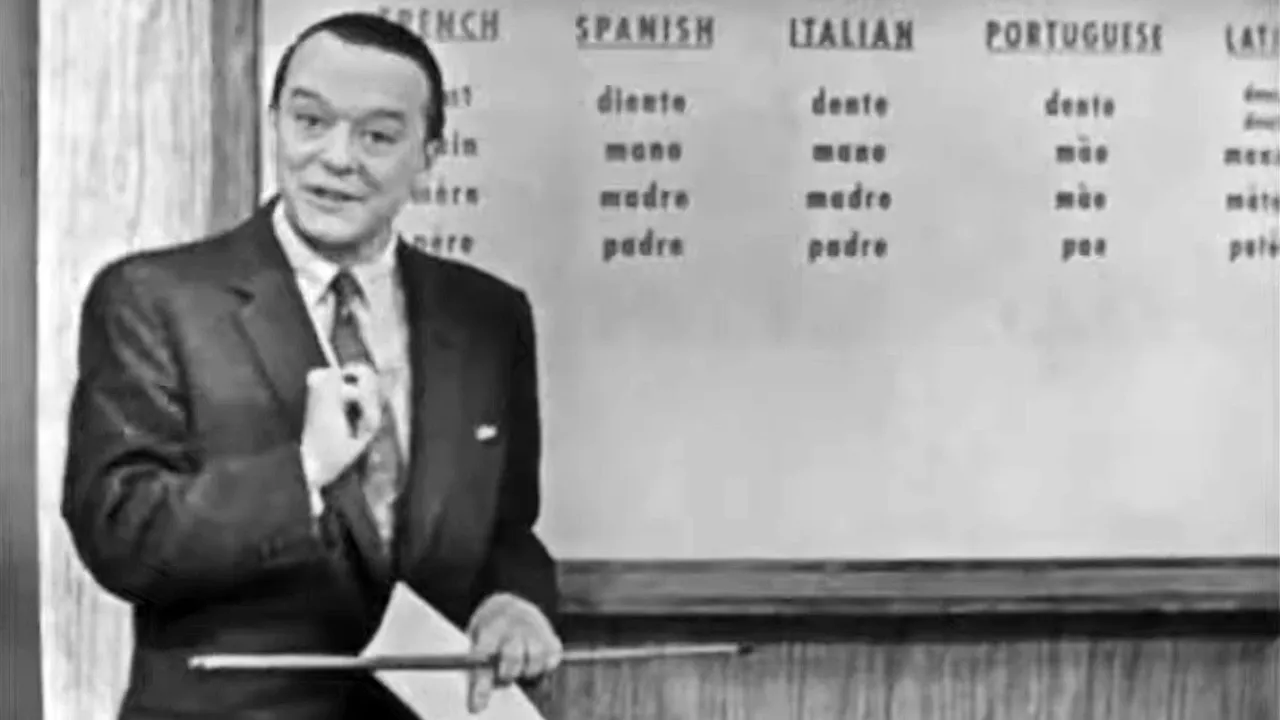
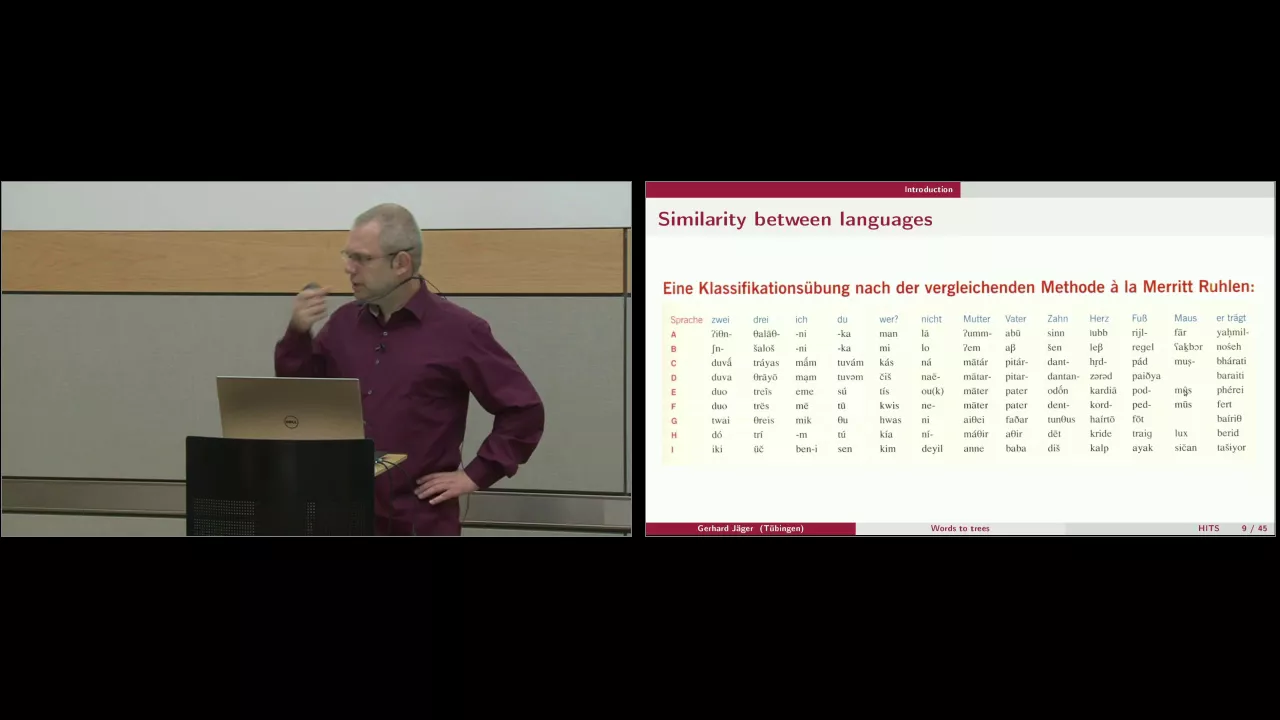
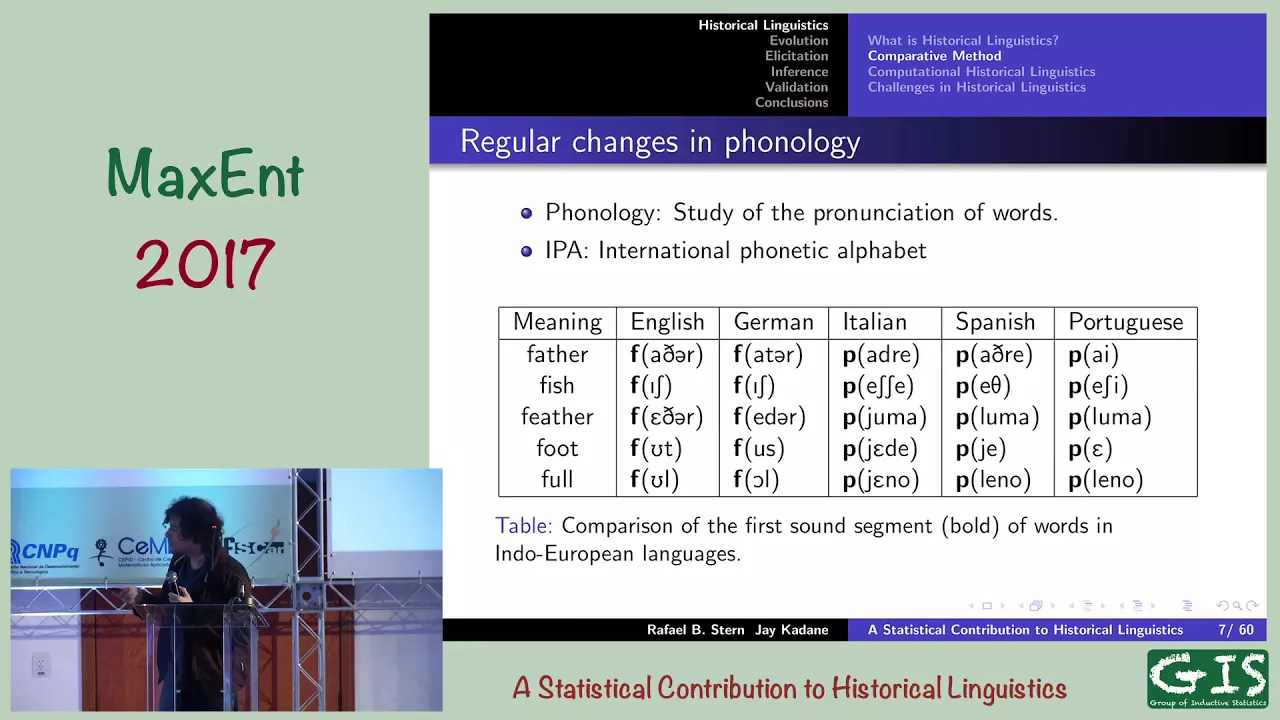
so today we're gonna talk about some fundamental concepts in historical linguistics but first we should take a moment to appreciate the simple fact that all languages change over time and that languages don't just remain static over the centuries that's kind of weird it could have been the case that languages just are the same for four thousand years the way that many animal systems are communication have really not changed all that much in the last five ten thousand years but human languages constantly change today we're going to talk about to start by talking about lexical change semantic change change a words word meaning we're gonna talk about the regularity of sound change and the comparative method just for a little bit you could take a whole class in that and we'll talk a little bit about how sentences change how grammar changes first of course we should hit again that all languages vary variation in languages natural language change is natural the language change isn't typically just shoot off all random language change is principled and is regular a systematic may be a better word it's a common myth that language has just become lazier than the kids today or speaking lazier than the kids a thousand years ago did or that languages become simpler over time that all language change is simplification but that's actually not true if a language simplifies one part of the grammar that could actually make another part of the grammar more complicated take a look at some cases of that later first get a couple of fundamental concepts out of the way concepts in terms I'll be referring to the rest of the talk proto language is the sort of ancestor language from which all these other languages descend if you've ever studied Spanish French Italian all those languages descent from Latin so we could treat Latin is the sort of proto language for the rest of the Romance family but also when we talk about proto-language we're talking about the theory the historical linguists construct that's our hypothesis of what that language must have been like because it's not always the case that we have really great documentation and through historical linguistic methods we can push paths what we have in the written documentation we also used the same sort of mother sister daughter terminology that we use to describe languages that we also use in syntax so we described two languages that descend from a common ancestor languages sister languages so we describe Spanish and French as sister languages we also talk about them other languages daughter languages in cetera a good example of that is a sketch of this proto-indo-european tree and here this very top node would be a proto-indo-european tea ancestral language that connects hittite latin irish gothic greek german english latley and vedic persian and a whole number of other language in this case we would say that old High German and Old English are sisters few more fundamental concepts including the notion of the cognate if you've ever studied a bunch of you know Italian and a bunch of French or a bunch of Spanish and I'll enter French then you notice that a lot of the words are very similar or maybe even the same those are related words and when the words are related by inheritance that is they're both inherited from the proto-language from the mother language we call those cognates the comparative method essentially involves assembling those cognates and digging down to figure out how they all correspond and we'll get into a little bit more detail there later this is a really good example of some of those terms in action for instance this is a cognate set involving three words a word for father a word for three and word for heart this involves three sounds in the proto language in proto-indo-european P T and K classic the first three consonants that we would always talk about and we mark those with an asterisk to indicate that they're reconstructions their theories they're not actually going out and talking to indo-european speakers whereas the sanskrit the Latin the Greek these are all attested so they don't have a start because we've read them we've heard them the reflex of proto-indo-european P in sanskrit is p and latin is p and greek is p but in gothic it's f the reflex with proto-indo-european t in sanskrit is T in Latin is T Greek is T but in gothic is so and so on but first before all that let's talk about words lexical change can be pretty chaotic but at the end of the day words change step by step in terms of their meaning for instance we know that the word bead used to mean prayer but now it means a little kind of perforated stone that you could put a string through how did that happen that seems like two totally random concepts right well unless you maybe our Catholic and pray the rosary or if you do a sort of a chant that involves counting on beads like Buddhists do that's the connection right by doing a prayer over and over again that involves the stone those associations happen and that's the next step in the chain of language change on the next line I'm going to give a couple examples of semantic changes I don't want to give a grand theory of all the allowable types of semantic change a couple of colleagues and I wrote a paper a couple of years ago called anything-goes because sometimes when it comes to words changing meeting really seems like anything goes but there are some really common kinds of changes for instance extension the word dog used to refer to a very specific kind of dog just Mastiffs and Bulldogs that kind of it don't but now it just means any old dog the word covered used to literally be a place you put your cups and I wouldn't call it covered just that nowadays a cupboard could be anything at all that's another extension the word was narrow specific it got much broader happens all the time another example of the opposite of that is a narrowing change right so the word hound used to be the generic term for any dog and canine was a hound but now hound is a very specific subtype of dog you can ask the American Kennel Club what it means I don't know what it means life is another word that underwent narrowing it used to just mean any woman any woman at all was was what the word wife meant but now it's a very specific kind of woman defined relationally there's some other kinds of common changes called Federation and amelioration when a word gets better or where it gets worse Federation is an example of when a word gets worse so the word knave originally used to mean mrs. servant was a kind of a neutral term for a person who you employ to help you but now you can call someone a knave and it's sort of an insult it means like a roguish person's and you would rip you off an amelioration change is a word like pretty pretty used to mean something like crafty sly underhanded and now it's just a sort of a nice thing to say and speaking of the word nice that's another good example of language change step by step today when we think about the word nice it's just a nice thing to call somebody Pleasant someone who's nice is agreeable they're easy to get along with in the 16th century if you called someone nice it meant that they were kind of dainty 200 years before that it meant that they were shy hundred years before that I meant that they were kind of silly one more to say about that was in a second the origin the etymology of that word in Latin was ignorant and so that's the connection and someone who is ignorant someone who's foolish was playing the fool who's subtle is agreeable nice the word silly is another really great example of the step by step notion of language change especially of semantic changes originally silly meant something like lucky happy innocent harmless from harmless to pitiable so when you look down upon with kind of compassion from someone you look down upon with to some when you look down upon without compassion to someone now who is silly so language change is systemic it's step by step we took a look earlier in the semester at some phonological processes some phonological rules like appendices deletion those can also be historical linguistics changes so language change can be phonetically conditioned for instance assimilation changes when Latin okto became Italian okto that was an assimilation change of total assimilation change we also see palatalization changes influenced by front vowels and palatal glides which have an effect on nearby sounds so for instance Latin Ganton became old French gent the concept we took a look at in the sociolinguistics unit was the merger right so we talked about how some speakers have merged the vowel in cought as in the thing you sleep in with the vowel in caught as in something the past tense of the catch so for these speakers this is a change in the language it's a change in the vowel system it's a phonological historical change there's a connection between the socio linguistics and the historical linguistics the things that survived the variables that survived over time often come from dialectal variants like the cot cot merger but on top of that there's also splits so for instance French didn't use to have a whole system of nasal vowels like it does today today French has both oral and nasal vowels for instance you could call someone your beau and that's there you're sort of loved or you could talk about something as being bald and that's something good well that's a split originally this au was just allophonic lis nasalized because it was next to a nasal but over time this nasal vowel became a full-blown phoneme of its own another big thing and we've talked about a little bit that speakers do is just borrow words from each other borrow sentences from each other borrow sounds from each other sometimes borrowing happens multiple times for instance English and French have been in close contact for a very very long time so we see multiple layers of loanwords between English and French the English word chief and the English word chef both come from the same French word but hundreds of years apart so far apart that in French they were pronounced differently so we borrowed them as being pronounced differently another thing that we see is that languages change words that they borrow in order to fit their own phonologies in order to fit their own grammars there are some wonderful examples of this from Japanese with an important language change that happens is analogy I'm sure you're familiar with analogies especially proportional analogies you may have had to answer analogy questions in order to get into university in the first place analogy questions like toes are 2 feet as X are 2 hands and the answer would be fingers these all have the same form right a is 2 B as C is 2 what you know fill in the blank this also happens in language change and it's sometimes called internal borrowing it's as if speakers are filling in the blanks in their own grammar with bits of their own grammar from elsewhere some great examples of that involve English and verb inflections there's a total of five inflectional forms that the English verb could take most don't but the word take actually is a good example of one that does so the verb take shows up as take takes took taken and taking in these forms in these contexts and we can see a whole bunch of verbs that sometimes take all unique forms like take and sometimes share all the exact same forms like hit I hit you hit he hits he was hit the hit person it's just hit all the way through this has a role to play in language change for instance the word dive the old pattern the past tense of dive was dived nowadays many speakers considered ov to be the correct past tense of death the reason is because of analogy dive sounds a lot like drive and ride and right it's got that same sort of phonological pattern so speakers by analogy turn dive into dove and divin and all sorts of other kinds of forms that make the prescriptivists roll their eyes but now let's move into a little bit of the real meat of this comparative method comparative method is the way that historical linguists make solid defensible claims about history about language about what happened because just because we see two words next to each other and they look the same that doesn't mean they're related for instance there's a Greek word deca that means ten and we could ask ourselves is that related to English and if it is related to English what word is it related to well seems like it's related to the word decade like deca ten decade means ten I'm gonna argue that actually it's related to the word ten because it turns out that the English word decade when the government was comes from French was it borrowing ten is the true carbonate to deca even though they don't look anything alike that's just how long it's been since those languages were connected on the extreme end we can demonstrate related words that look nothing alike and Albanian is a great way to do that the English word Sal is related to this Albanian word with which it barely shares any of the same letters or sounds the Latin word serpent is related to this Albanian form again it doesn't look anything like it how do we know these words are related to comparative method comparative method really has a couple of steps but we're gonna focus mostly on the first three in the first step you find words that you believe to be cognates and you assemble them together into a carbonate set in order to prove that they're cognates you'll need to establish the existence of sound correspondences regular systematic widespread correspondences between two sounds in two different languages having done that you'll be able to reconstruct what the older sound the proto sound must have been step one assemble cognates usually if you're studying a couple of languages then you'll have a couple of hints or a couple of ideas about what the cognates might be so you're probably not starting out of nowhere but if you are starting out of nowhere where do you look well one place to look would be words that you would expect that might not change very often you know the newest fashions are changing all the time in English so it can feel a little disorienting but we're not going out and inventing a new word for fire every week we're not going out and getting new words for cousin or new words for leaf what do you think that every language or most every language has a word for water food people friend language what concepts that's probably a good place to start in a real historical linguistics class we could spend a lot of time talking a lot more about that but for now we'll leave it there there are also a number of accidental similarities that are just accidents there are only so many sounds that the human mouth can produce and every once in a while one has got a lined up by sheer coincidence for instance the English word mess means something dirty something untidy some state of affairs that is unacceptable due to filth or disorganization well it turns out there's a Mayan word mess that's pronounced very similar Liam just also happens to mean disorderly garbage and a mess so does this prove that English and Mayan or sister languages probably not why how do we know that this is not enough evidence well by invoking the comparative method we can check to see whether this correspondence of sounds and concepts holds up and of course it doesn't the word man in English has no similarity to the word man in mine the word Mouse doesn't have any similarity the word in mind the word moving the word mother go down the list of all the M words in English or Mayan and you won't see any other similarity like that the comparative method has just proven to you that Mayan and English are not related okay I gather that that's an extreme case the next thing you have to do is establish sound correspondences when you do see cognates that really are cognates you could try it now yourself what do you think the most likely ancestor of these four sounds are in this sound correspondence in the Romance language family in Italian you have kado in Spanish you have kado in Portuguese you have kuru in French you have Cher and Latin you have cotton what do you think was the older form was a que or was it a SH all things being likely okay that is you reconstructing the proto sound we know that Italian Portuguese Spanish have k in this particular context where French has ash we can document that Latin had the co so we can tell that much but even if we didn't have Latin it would be so obvious that the co was the correct proto sound 1 we know that it's more likely for a cup to become a show especially in the context of a higher a front vowel that's palatalization that's what we see in phonology all the time we also see that the majority of these languages show K and French ich is just sort of off on its own by itself so that's another piece of evidence that it's more likely that the K is the proto sound to wrap up a couple of comments about syntactic change so far we talked about morphological change semantic change of lexical changes sentences of course also change over time but talking about syntactic change can be a little more complicated the two things we'll talk about in syntactic change are reanalysis and borrowing reanalysis is when the underlying structure the tree structure of a sentence changes historically in English going could only be a lexical verb it could never be an auxiliary verb you could only say Hunter is going to the store you couldn't say hunter is going to go to the store that's a change from a modal verb an auxilary verb to a lexical verb that's a change in the syntactic structure we also see borrowing syntactic borrowing there's some really great examples of that from Spanish language contact from Aztec in languages in here we're going to talk about the comparative syntax so the comparative in English is something like I am funnier than you in the old style we see this kind of complex way of indicating comparative semantics in people in modern PPU people use something that looks a whole lot like Spanish mas kelana que borrowed from Spain next time we'll talk about language endangerment language documentation and then the class after that we'll talk about language revitalisation have a good weekend
Up Next

71:00
Proto-Indo-European: A Language Guide with Dr. Andrew Byrd (2022) | Jackson Crawford
@JacksonCrawford
75K views•2022-06-17
36:52
Constraint Interaction in Optimality Theory: Epenthesis & Deletion
@Vidyamitra
180 views•2018-08-20

8:59
Forensic Linguistics: How Language Solves Crimes | PBS
@pbsstoried
1M views•2024-01-25

21:32
Accent Expert Explains U.S. Regional Dialects | Part 1
@WIRED
9.3M views•2021-01-21
Related Study Plans & Knowledge Roadmaps
Structured learning paths in Linguistics
linguistics
Optimality Theory: Tableaux & Constraints
01Phonological Basics: Sounds, Syllables & Rules
02Foundations of Optimality Theory: GEN, CON, and EVAL
03The Constraint Inventory: Markedness vs. Faithfulness
+ 2 more learning modules
15h5 modules
Explore Roadmap
linguistics
Morphosyntactic Alignment: S, A & P Systems
01Foundations of Syntax: Transitivity and Arguments
02The Linguistic Variables: Mapping S, A, and P
03Nominative-Accusative Alignment
+ 3 more learning modules
12h6 modules
Explore Roadmap
linguistics
Analyzing Sign Language: Phonology & Syntax
01Foundations of Sign Language Linguistics
02Phonology: The Five Parameters of a Sign
03Morphology: Word Formation and Classifiers
+ 2 more learning modules
14h5 modules
Explore Roadmap
linguistics
Pragmatics: Speech Acts, Grice & Politeness
01Introduction to Pragmatics: Meaning in Context
02Grice’s Cooperative Principle & Implicature
03Speech Act Theory
+ 2 more learning modules
14h5 modules
Explore Roadmap