Interpreters in Go (Lexer, Parser & AST)
Learning Goal: Designing and building a tree-walk interpreter for a custom programming language from scratch using Go. This hands-on curriculum takes you from absolute language processing basics to handling complex lexical scope, user-defined functions, and closures in Go.
- Estimated Total Study Time: 30 Hours
- Prerequisites: Basic knowledge of programming concepts. No prior compiler/interpreter experience is required; a brief crash course on Go is included in Module 1.
Module 1: Foundations of Go & Language Concepts
This module establishes a deep foundation in both general language design theory and Go syntax. You will learn the mechanical differences between compilers and interpreters, how source text is mapped to system executions, and how to harness Go's static type system, maps, and structures to prepare for language architecture.
Recommended Videos

Why this video
For any developer pivoting to Go from Python or JavaScript, this quick-paced, comprehensive crash course gets you fully acquainted with package management, struct initialization, maps, static typing, and slice manipulation—all of which form the base structures of our lexical and syntax analyzers.

Why this video
This video breaks down Thorsten Ball's popular modern interpreter building approaches alongside Bob Nystrom’s "Crafting Interpreters". It frames the architectural paths we will traverse (specifically lexical scanning, recursive descent parsing, AST creation, and evaluation scopes) and contrasts typical compiler pipelines with interpreted virtual machine runs.
Why this video
This video provides a academic perspective on language translation phases. You will learn how source code is processed step-by-step from lexical analyzers (tokenizers) to intermediate code generation, illustrating why structured parsing is needed to prevent errors before executing our logic.
Knowledge Checkpoint
- What are the architectural differences between an interpreter (line-by-line / AST execution) and a traditional ahead-of-time (AOT) compiler?
- How do you declare, initialize, and modify Go structures (
struct) and hash maps (map[string]T)? - What is the role of Go interfaces in constructing an extensible system?
Module 2: Lexical Analysis: Building the Lexer
The lexical analysis phase converts raw character streams (the raw code written in your custom language) into a well-defined stream of tokens. This module covers the theoretical foundations of token structures and state machines, guiding you through the process of writing an absolute zero-dependencies lexer using Go structs.
Recommended Videos

Why this video
This highly practical coding walkthrough illustrates exactly how to architecture a modular lexer struct in Go. It teaches you how to maintain position tracking, look-ahead index cursors, and assign distinct token types (such as operators, identifiers, and literals) to character groups.
Why this video
This brief and direct explanation strips away academic jargon to illustrate the direct mapping from raw string inputs (let x = 5) to clean token arrays. It serves as an intuitive mental model before you start modeling the character iteration state machine.

Why this video
This segment explains how simple state-machine behavior can transition characters dynamically depending on current context. It visualizes lexer states and details how state patterns cleanly translate to structured Go loops and condition trees.
Knowledge Checkpoint
- How does a lexer distinguish between generic identifiers (e.g., variable names like
foo) and reserved language keywords (e.g.,let,fn,if)? - How do you implement a
peekChar()method in your Go lexer to check the next character without advancing the main read pointer? - What is the role of an
EOF(End of File) token inside your stream?
Module 3: Syntax Analysis: Parsing & Abstract Syntax Trees (AST)
This module shifts focus from linear token sequences to hierarchical node relationships. You will discover how recursive descent structures parse nested expressions and learn to implement Pratt parsing—an elegant, table-driven approach used to resolve operator precedence (such as multiplying before adding).
Recommended Videos

Why this video
This video explains how to build recursive AST nodes in Go to handle binary operations (e.g., 5 + 10 * 2). It shows how node definitions map to structural interfaces in Go, ensuring that any AST node can easily yield structural representations during evaluation.

Why this video
Pratt parsing is widely considered the cleanest strategy for expression parsing. This video shows how to build a working Pratt Parser in Go from scratch. It explains how tokens use binding power to resolve operators of varying precedence using infix and prefix map registrations.
Why this video
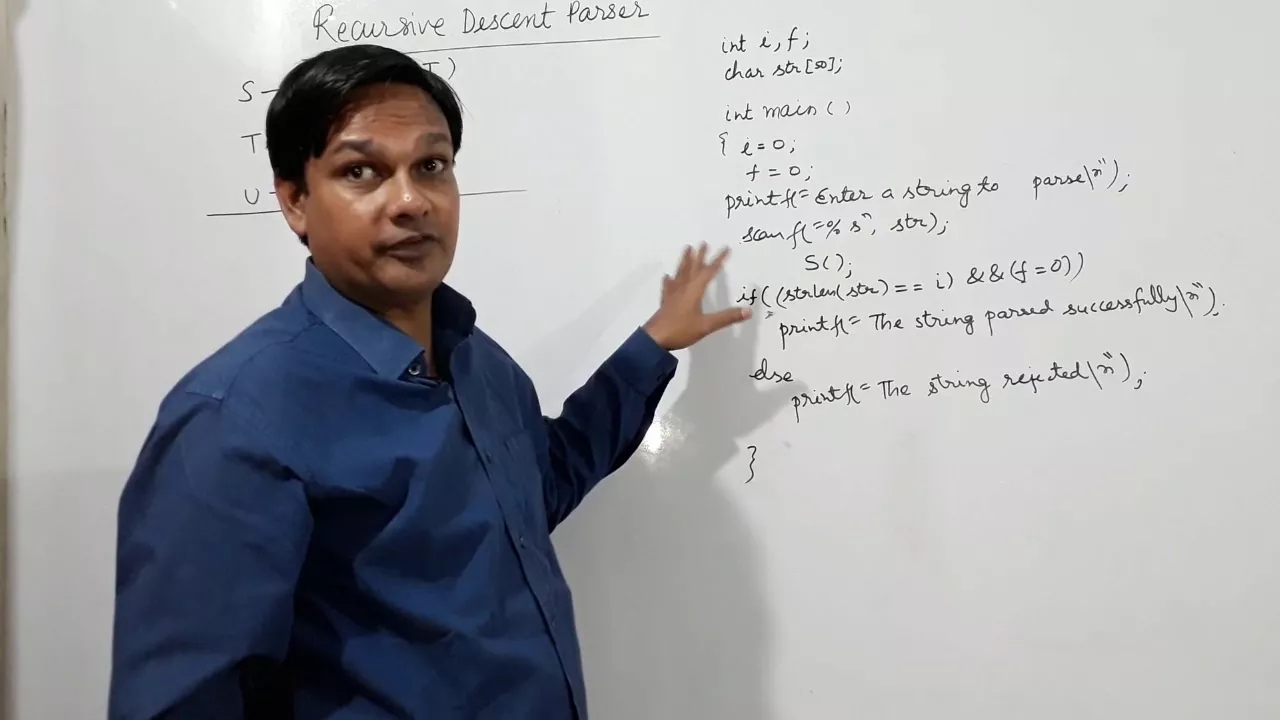
This video provides a step-by-step breakdown of how recursive descent parsers process syntax trees. Understanding these core mechanics will help you write parser loops that correctly flag syntax errors when tokens do not match expectations.
Knowledge Checkpoint
- What is the structural difference between a Concrete Syntax Tree (Parse Tree) and an Abstract Syntax Tree (AST)?
- In Pratt parsing, how do prefix and infix parse functions differ, and how does "binding power" determine parsing order?
- How do you represent a general AST node in Go using interfaces?
Module 4: Evaluation: Basic Expressions & Environments
Once your parser successfully outputs a tree, the interpreter must walk that tree to execute operations. In this module, you will build an AST evaluation engine in Go. You will implement direct tree-walk strategies, write error-reporting mechanisms, and construct a robust environment state tracking system.
🔍 Gap Alert & Self-Directed Guidance: While video coverage on basic tree walking exists, specific step-by-step tutorials detailing recursive environment lookup chains for parent scope delegation in pure Go are rare. To ensure your success, please study the architectural patterns and custom-written code block below.
Recommended Videos

Why this video
This practical guide walks through a classic tree-walk evaluator. It explains how program evaluation loops iterate over lists of expressions, recursively resolving tree branches and returning underlying program values.

Why this video
This classic presentation by the creators of Go demonstrates how to use the language's native interface mechanisms to build clear expression evaluators. You'll learn how to utilize dynamic dispatch to traverse diverse structures cleanly.

Why this video
This video demonstrates how evaluation steps recursively resolve operand structures into final runtime objects. It clarifies how to write nested node evaluators for integers, booleans, and binary operations.
🛠️ Hands-On implementation: Go Environment Scoping
To fill the implementation gaps identified in the curriculum review, use the following structural pattern to manage scopes in your Go interpreter. This pattern delegates variable lookup to a parent environment recursively, allowing you to establish local and lexical nested scoping.
package object
import "fmt"
// Object represents every evaluated value in your interpreter type Object interface { Type() string Inspect() string }
// Environment holds identifier bindings and refers to an outer parent scope type Environment struct { store map[string]Object outer *Environment }
// NewEnvironment creates a root-level environment scope func NewEnvironment() *Environment { return &Environment{ store: make(map[string]Object), outer: nil, } }
// NewEnclosedEnvironment creates a child environment nested inside an outer scope func NewEnclosedEnvironment(outer *Environment) *Environment { return &Environment{ store: make(map[string]Object), outer: outer, } }
// Get queries variables recursively from the current scope up to the root level func (e *Environment) Get(name string) (Object, bool) { val, ok := e.store[name] if !ok && e.outer != nil { return e.outer.Get(name) // Look up the parent environment hierarchy } return val, ok }
// Set binds a new variable value to the current local scope func (e *Environment) Set(name string, val Object) Object { e.store[name] = val return val }
Knowledge Checkpoint
- How does a recursive
Eval(node Node, env *Environment)function use Go's type assertions to determine which AST node to execute? - What is the role of an enclosing environment pointer (
outer *Environment) when executing code in nested loops or blocks? - How do you handle and propagate errors (like mismatched types in expression logic, e.g.,
5 + true) during tree walking?
Module 5: Control Flow, Functions & Closures
This final module elevates your custom language from a basic calculator to a fully functional programming language. You will learn to parse and evaluate conditional branches (if/else structures), manage function call environments, passing arguments into local parameters, and preserve references via closures.
Recommended Videos

Why this video
This practical lesson demonstrates how to extend your parsing and runtime evaluation structures to support function declarations (fn), function parameters, body blocks, and function invocation. It illustrates how closure scopes preserve references to variables defined in their outer scopes.

Why this video
A theoretical exploration of lambda calculus and why closures require a bound lexical environment alongside a function's parameters. This provides the conceptual foundation needed to correctly structure closures at runtime.

Why this video
This short and intuitive reference visualizes functions capturing enclosing execution environments. Use this clean mental model when implementing state retention within your custom interpreter.
🛠️ Self-Directed Extension: Implementing If/Else & Loop Evaluation
To resolve the remaining gaps from the review feedback, use this pseudo-implementation pattern when writing evaluator methods for branching control flows in Go:
// Example logic pattern to evaluate AST Block Statements func evalBlockStatement(block *ast.BlockStatement, env *Environment) Object { var result Object for _, statement := range block.Statements { result = Eval(statement, env) if result != nil { // Early exits for Return values or errors stop block execution rt := result.Type() if rt == RETURN_VALUE_OBJ || rt == ERROR_OBJ { return result } } } return result }
// Pattern to evaluate If/Else conditional expressions func evalIfExpression(ie *ast.IfExpression, env *Environment) Object { // Evaluate the condition expression in the current context environment condition := Eval(ie.Condition, env) if isError(condition) { return condition }
// Determine truthiness of condition
if isTruthy(condition) {
    return Eval(ie.Consequence, env) // Run main block
} else if ie.Alternative != nil {
    return Eval(ie.Alternative, env) // Run else block
}
return NULL_OBJ
}
func isTruthy(obj Object) bool { switch obj { case NULL_OBJ: return false case TRUE_OBJ: return true case FALSE_OBJ: return false default: return true // Customize truthy logic as desired } }
Knowledge Checkpoint
- How does local variable execution work inside an active function block without leaking variables into the parent global scope?
- What is the exact sequence of events required to initialize an enclosed environment when executing a closure?
- How are return statements handled so that they exit early from nested block statements?
Course Map
This map outlines the path from raw code representation to fully evaluated AST nodes with parent scoping capabilities.
Key People Index
- Thorsten Ball: Author of "Writing An Interpreter In Go", pioneer of pragmatic, dependency-free interpreter implementation inside the Go ecosystem.
- Pratt, Vaughan: Inventor of Top Down Operator Precedence (Pratt Parsing), providing an efficient solution for parsing arithmetic expressions with operator hierarchies.
- Rob Pike: Co-creator of Go. His public presentations (including his classic talk on lexical scanning in Go) influenced how scanners use state-based functions.
Final Self-Assessment
Complete this comprehensive self-assessment to verify that your interpreter works as expected.
- Lexer correctness: Your lexer correctly converts a string containing multiple operations, identifiers, and brackets (e.g.
let result = (5 + 10) * 2;) into a flat slice of parsed tokens. - String formatting: Your AST structures implement a
String()method to inspect, serialize, and print your program structure for easy debugging. - Pratt precedence parsing: Your parser correctly outputs the expression
5 + 10 * 2as an expression tree representing(5 + (10 * 2))rather than((5 + 10) * 2). - Dynamic environment lookups: Your interpreter correctly returns variable bindings from outer scopes while allowing localized overrides inside nested code blocks.
- Expression Evaluation: Evaluating
10 > 5 == trueproduces a truthy boolean type in your runtime representation. - Branching flows: Evaluating
if (x > y) { x } else { y }returns the expected branch result depending on variables currently stored inside the active Environment. - Clean Function Invocation: Defining a function block with variable parameters binds arguments to parameters in a isolated call environment, executing with zero leakage into the global scope.
- Nested Closures: Your language supports higher-order closures (e.g., executing a function that returns an inner function that preserves references to local parameters).
- Zero external dependencies: Your complete interpreter runs using only standard Go library utilities (
fmt,io,strings,bytes).