












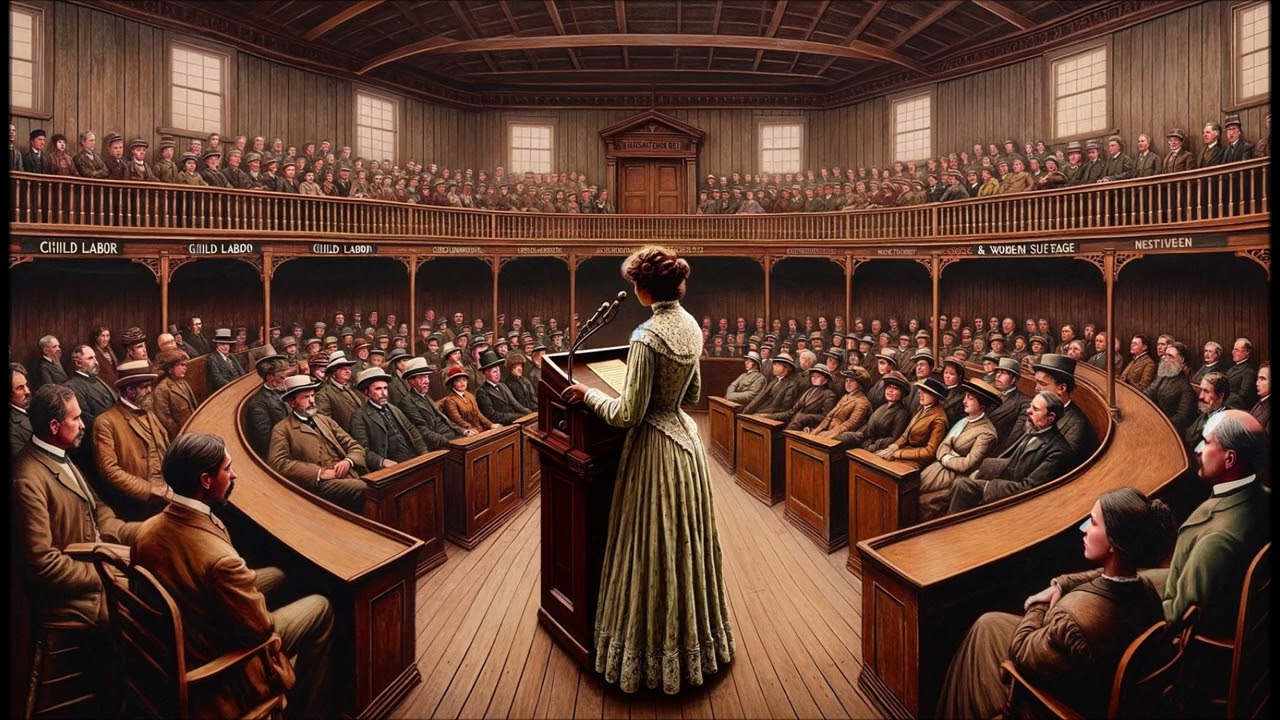











The Lowell Mill Girls, young women employed in the Lowell Cotton Mills starting in the early 1820s, endured grueling 14-hour workdays, 73-hour workweeks, dangerous machinery, and poor living conditions, yet they organized the Lowell Female Labor Reform Association in 1845 to advocate for better working conditions, ultimately inspiring future labor and suffrage movements despite facing societal opposition to women speaking publicly.
Mill Girls Documentary: Lowell Cotton Mills History & Labor Reform
Added:The First Industrial Revolution: Understanding the transition from agrarian economies to mechanized manufacturing in the United States during the early 19th century.
19th-Century Gender Roles: Familiarity with the 'Cult of Domesticity' and societal expectations regarding women's labor and independence.
The Rise of the New England Textile Industry: Knowledge of how water-powered mills and technological innovations established Massachusetts as an industrial hub.
Basic Concepts of Labor and Capital: Understanding the relationship between factory owners, wages, working conditions, and the emergence of wage labor.
The Evolution of the US Labor Movement: Tracking how early actions like those in Lowell paved the way for major organizations like the Knights of Labor and the AFL-CIO.
The Intersection of Labor Reform and Women's Suffrage: Exploring how early female labor organizing influenced the broader women's rights movement leading to the Seneca Falls Convention and beyond.
Federal Labor Legislation: Studying subsequent policy achievements, such as the establishment of the 10-hour workday and the Fair Labor Standards Act of 1938.
Comparative Global Labor Rights: Analyzing how the struggle of the Lowell Mill Girls mirrors modern labor disputes in developing nations' textile industries today.
1.2K views19likes9:23Original Release: 2022-05-19
[Music] 14 hours of tirelessly operating dangerous machines a day 73 hours of monotonous and exhausting work per week a deplorable living quarter over-occupied with six people a bedroom a history of constant protests and strikes against this company all of this corruption and misrepresentation leads to one company formed from the glory of the industrial revolution a staple of disgraceful working conditions in the early 19th century all right let's see hi i'm alex dow and i work in an entry level job hello my name is aj and i am also in the entry level workforce the workforce has changed a lot since the 1830s and 40s since this time pain working dictions have got a lot better so in the pursuit of learning we will go out on a journey to learn about the workforce's past as we arrived at the lowell cotton mills we were fascinated by the history around us the lowell cotton mills began their operations in the early 1820s their business was unique because they started to employ women to work at the mills because their lives were very challenging at the farms where they supposedly came from this allowed the mills to employ women and pay them with very low wages and deplorable living quarters these young women were sent to work over 12 hours a day six days a week with only sundays for rest their repetitive and dangerous jobs included operating unsafe and complicated machines and the constant lint emanating throughout the air that commonly caused lung cancer among workers because of this the workers went on strike in 1836 after their pay was cut eventually this turned into advocating for a 10 hour work day in safer working conditions in 1845 the lowell female labor reform association or lflra was formed the lflra fought hard for the well-being of workers with their long working hours and the dangerous machines they were forced to operate when we finally entered the cotton mills we could almost grasp what it was really like to work on this cottonmouth [Music] [Applause] [Music] after taking in the deafening sounds of machinery we met with the director of the tsangas industrial center to learn more about this history [Music] in the boarding houses one of the pluses was that young women got to meet other young women from all around new england and that was probably pretty stimulating they were sharing pieces of reading material the poems and things like that they belong to self-improvement groups uh in the evening they could sit in the dining room or in the parlor and it's always good i think to think about the pros and the cons of a situation in history so you're not coloring the picture too much in that same boarding house you were rising very early depending on the season you might be getting up at five o'clock in the morning quickly getting dressed and hurrying into the mill there was no electricity in the period i'm talking about which is roughly the 1820s to the 1840s or so so you weren't going to be in the mill in the winter late at night because the only light was from whale oil lamps of course an open flame even if it's behind a globe when the days were long it could be very tedious and difficult to be in a mill yes you're breathing in lint but you can also get your hair caught in a leather belt you can get a part of your clothing they wore long dresses with long sleeves caught in some part of the equipment and you maybe try to cut yourself free very quickly uh but there were some sometimes horrific accidents it's not like they happened every day on every floor but boy when one happened the word got out because it could be pretty gruesome the other danger of working in a lot of the spaces in a factory or in one of lowell's mills was that there was an awful lot of noise and that noise could gradually deafen somebody who spent enough years in the mill if they were working six days a week that was a lot of exposure to lint to standing on their feet all day to the hazards of getting caught up in a machine and just the harm to their spirit of being in such a monotonous situation for so many hours of of a seven-day week you know some instances they vaguely alluded to where uh sexual harassment was something that they had to face so i i would i would consider that a kind of a danger that wasn't as much talked about in the mills [Music] i don't know of a direct connection i haven't read of any current or recent activists saying they were inspired by the lowell female labor reform association but it would amaze me if there if you couldn't trace a line from that early female activism which got a lot of attention because it was so unusual it was really frowned upon for women to be speaking out in public especially to a mixed audience for them to be mistreated the way they were in the factory by having these monotonous jobs by not being really paid all that well and sometimes their boarding house rates would their their fees would go up which was essentially a pay cut and sometimes their pay was cut and they worked long hours and they got fed up with it so they together decided to protest in a group and it was effective it took decades for certain things to pass like the 10 hour law but ultimately they prevailed and they had to have been an inspiration to the early suffragists some of these women were suffragists and they also protested against slavery when they could in their after work hours uh or they sometimes uh contributed some of their hard-earned pay to some of these causes it's easy to imagine a line from their early activism leading up to 20 and 21st century activism [Music] after visiting the low cotton mills we saw the striking differences between working conditions now versus then we could really see how the protests of the 1830s changed workforces for the better allowing us to have the appreciable working conditions we work in today unfortunately there is still more to be changed the federal minimum wage is too low for workers to pay their taxes debts loans and even for their own health a lack of training in the modern day workforce also leads to inexperienced workers as the present commonly replicates the past let us stand up against the working conditions of today in hopes for better working conditions tomorrow just like the lflra of yesterday we must combat these problems like the ruthless woman who fought for their rights while still remembering their hardships along the way [Music] so [Music] so [Music] you
Up Next

5:14
Viscose Rayon: Manufacturing Process, Properties & Uses
@TextileVlog
174.6K views•2021-08-20

12:54
Triumph of Orthodoxy Icon: Byzantine Art & History Explained
@BenCallan
2.1K views•2024-08-06

9:49
FastAPI vs Flask vs Django: Choosing the Right Python Web Framework
@TechWithTim
302.5K views•2024-05-26

1:42
Game of Thrones Opening Credits: A Cinematic Analysis
@gameofthrones
46.3M views•2011-04-18
Related Study Plans & Knowledge Roadmaps
Structured learning paths in General & Interdisciplinary Studies
general-studies
Elevator Engineering: History, Physics & Cities
01From Hoists to Safety Brakes: The Dawn of Vertical Lift
02Hydraulic vs. Traction: The Engineering Physics of Elevators
03Modern Speed, Safety, and Algorithms
+ 2 more learning modules
12h5 modules
Explore Roadmap
general-studies
Rubber: Material Science, History & Geopolitics
01Origins of Natural Rubber & Mesoamerican History
02The Chemistry of Natural Rubber & Vulcanization
03The Geopolitics of the Rubber Boom & Colonization
+ 2 more learning modules
12h5 modules
Explore Roadmap
general-studies
Containerization: Evolution, Logistics & Trade
01Ancient Trade & Bulk Cargo: Amphorae to Barrels
02The Industrial Revolution & Cardboard Packaging
03The Containerization Revolution: Malcom McLean
+ 2 more learning modules
12h5 modules
Explore Roadmap
general-studies
Textile Tech: Evolution, Labor & Global Impact
01Pre-Industrial Textiles: Handloom & Cottage Industry
02Mechanization: The Spinning Jenny to the Power Loom
03The Factory System & Global Labor Transformation
+ 2 more learning modules
10h5 modules
Explore Roadmap