













![Estudo das cordas vibrantes [FÍSICA FÁBRIS] Aula 364 Acústica](https://i.ytimg.com/vi/vdzC477wUFg/maxresdefault.jpg)



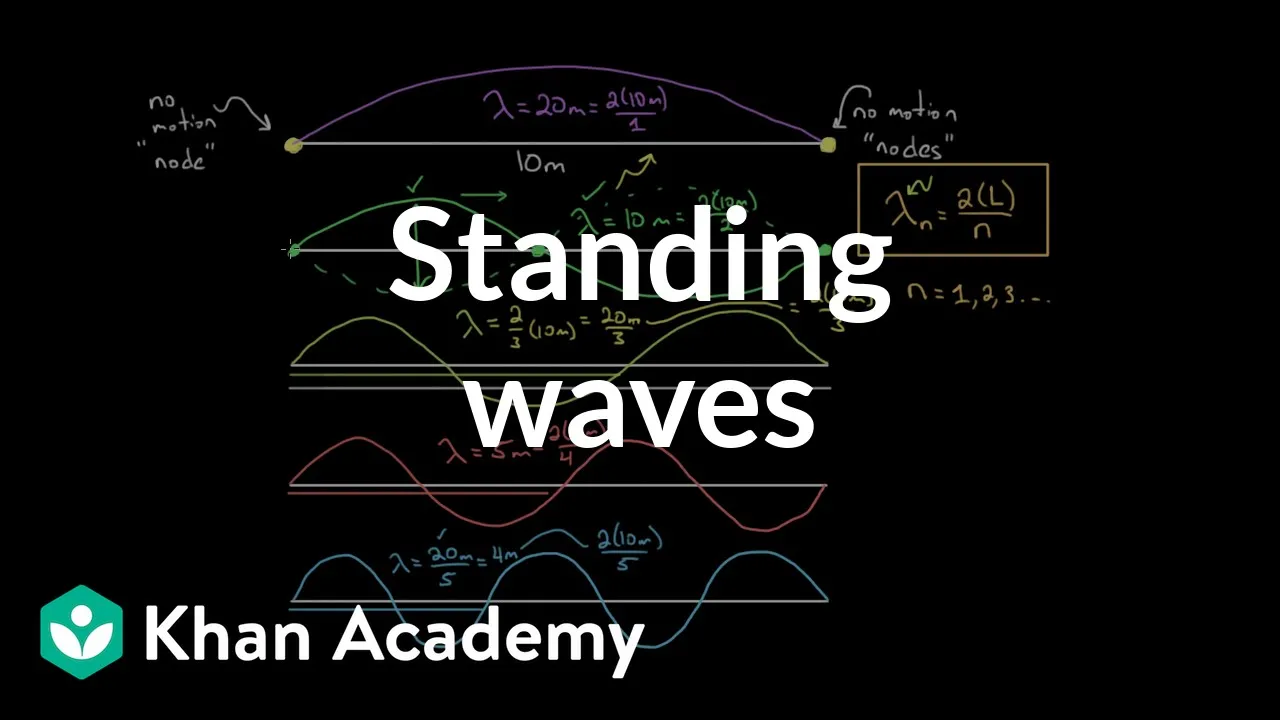
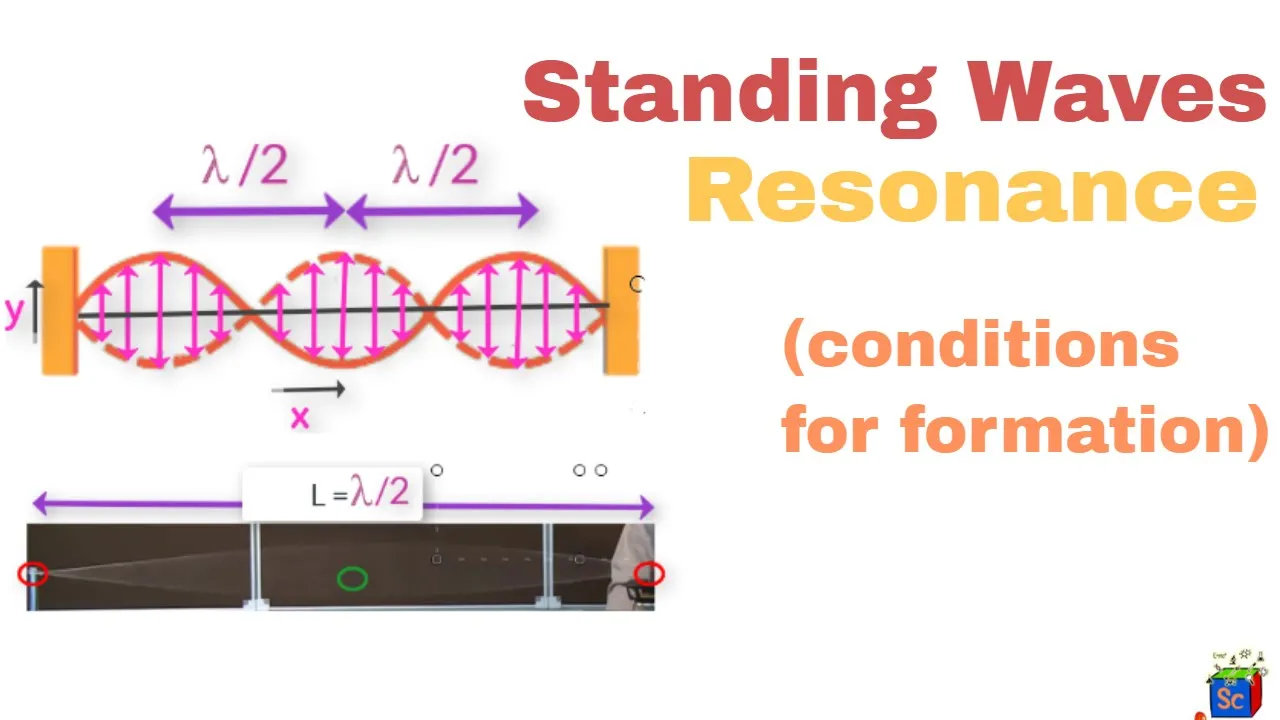
Standing waves on a string are generated when a wave driver sends waves down a string that reflect back and interfere with incoming waves; constructive interference creates antinodes (points of maximum displacement) while destructive interference creates nodes (points of zero displacement). For a string held at both ends, only specific frequencies called harmonics produce standing waves, where the nth harmonic has n times the fundamental frequency and contains n/2 wavelengths, with nodes at both ends and additional nodes between them.
Standing Waves on a String: Harmonics and Nodes | Physics Demo
Added:Understanding of basic wave properties, including wavelength, frequency, amplitude, and the wave speed relationship (v = fλ).
The principle of superposition and wave interference, specifically how waves combine constructively and destructively.
Wave reflection behavior, particularly how a transverse wave pulse behaves when reflecting off a fixed boundary (phase inversion).
Mathematical derivation of the formulas for harmonic wavelengths (λ = 2L/n) and resonant frequencies on a string fixed at both ends.
Exploration of standing waves in air columns, comparing the boundary conditions of open-ended and closed-ended pipes.
Real-world applications of harmonics in musical acoustics, such as how string tension, length, and density affect the tuning of instruments like guitars and violins.
Introduction to quantum mechanics concepts, specifically how boundary conditions and standing wave patterns relate to quantized energy states in the 'particle in a box' model.
1.1M views12.9Klikes4:38Original Release: 2010-08-13
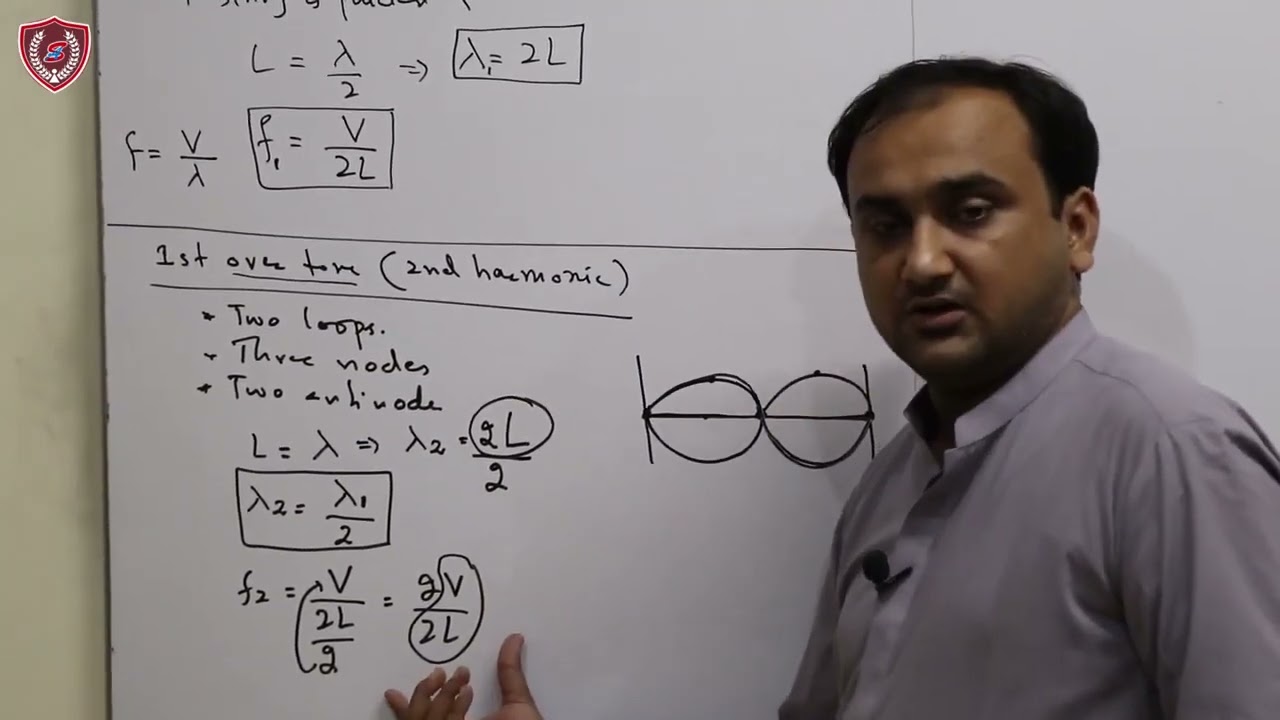
so what we have here is a frequency generator it's connected to what's called a wave driver it's just a speaker it's going to pump up and down at Whatever frequency I set this guy to when this guy pumps up and down well he sends a wave sends a wave down to this end the wave reflects comes back now if I set it to just uh any old frequency let me just uh turn this on well yeah let's go a little higher so it's sending waves back and forth but these waves are out of sync if you like they're they're not exhibiting con consistently constructive or destructive interference at any one point but if I set it here for example I have what's called a standing wave that is the wave that's that's sent down and reflects constructively interferes with the next wave that comes down right at this point now the waves that reflect that come down and reflect destructively interfere with the incoming waves right here and that's called a node I can touch it and it still is working so the node is not moving here it's moving up and down and here it's moving up and down down and we'll see that in a second with the highspeed camera so here we have What's called the second harmonic it's the second possibility for a standing wave for a string that's held at both ends because notice this is a node this is a node and The Middle's a node so we have three nodes for this way now like I said second harmonic well what's the first one the first one will be half this number so 8.5 and there we go it's basically the scenario of a of a jump now I can find any of the other har all of the other harmonics are multiples of this number so we just saw that two times this number was the second harmonic or the second possibility well if I go three times this number I should get the third harmonic well 3 * 8.5 I guess what is that around 25.5 and there we go so that's the third harmonic how many wavelengths is this well it's one and a half one and 1/2 wavelengths and it's easier to see in high speed so check out this shot with the high-speed camera and uh verify for yourself that it is one and 1/2 wavelengths so again third harmonic one and a half wave lights well let's go to the sixth harmonic the sixth harmonic will just be double this frequency so we go up to 50 and there we go that's the sixth harmonic beautiful and it's six times the fundamental frequency which we measured in the beginning to be 88.5% herts so check this guy out we have 1 2 3 wavelengths and in the next video the explanation video we'll go through the calculations and the derivations
Up Next

7:50
Standing Waves on a String: Harmonics & Resonance | AP Physics 2
@onlearningcurve
87.3K views•2012-12-31

12:53
21cm Hyperfine Transition in Neutral Hydrogen: Radio Astronomy Basics
@AaronRobertParsons
12.4K views•2011-10-13

32:32
NMR Spin Physics I: Zeeman Effect, Resonance Condition & Larmor Frequency
@nptel-indianinstituteofsci8064
2.3K views•2024-01-17

27:14
Entropy and the Second Law of Thermodynamics Explained
@veritasium
27.5M views•2023-07-01
Related Study Plans & Knowledge Roadmaps
Structured learning paths in Physics
physics
Nuclear Physics (Decay, Fission & Reactors)
01Atomic Structure and the Binding Force
02Radioactive Decay and Half-Life
03Nuclear Fission Mechanics and Chain Reactions
+ 2 more learning modules
12h5 modules
Explore Roadmap
physics
Soft Matter (Polymers, Colloids & Rheology)
01Foundations of Soft Matter & Thermal Forces
02Polymer Physics and Macromolecules
03Colloids, Surfactants, and Self-Assembly
+ 2 more learning modules
38h5 modules
Explore Roadmap
physics
Analytical Mechanics: Lagrangian & Hamiltonian
01Mathematical Foundations: Calculus of Variations
02From Newtonian Mechanics to Constraint Dynamics
03The Principle of Least Action & Lagrangian Mechanics
+ 3 more learning modules
28h6 modules
Explore Roadmap
physics
General Relativity (Spacetime & Cosmology)
01Foundations of Relativity: Special Relativity
02The Geometry of Spacetime: Equivalence Principle & Curvature
03Einstein's Field Equations: The Mathematics of Gravity
+ 2 more learning modules
55h5 modules
Explore Roadmap