


















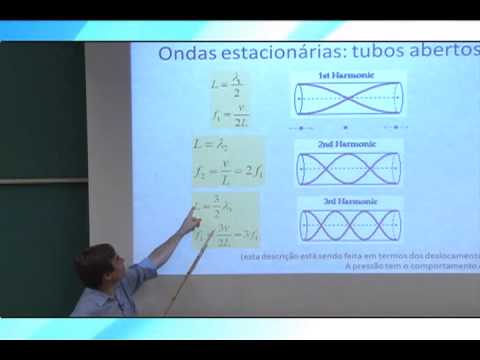


Standing waves on a string form when two identical periodic waves traveling in opposite directions interfere, creating nodes (points of no oscillation) and anti-nodes (points of maximum amplitude); the length of one loop is always half a wavelength, and the resonant frequencies follow the relationship f_n = n × f_1, where n is the harmonic number (fundamental frequency = first harmonic, second harmonic = first overtone, third harmonic = second overtone, etc.), meaning the frequency increases proportionally with the number of loops.
Standing Waves on a String: Harmonics & Resonance | AP Physics 2
Added:Understanding of basic wave properties, including amplitude, frequency, wavelength, and the wave speed equation (v = f * lambda).
The principle of superposition and wave interference, specifically constructive and destructive interference.
Wave reflection behaviors at boundaries, including phase changes at fixed boundaries versus free boundaries.
Mathematical derivation of the harmonic wavelengths and frequencies for strings with fixed ends (L = n * lambda / 2).
Analysis of standing waves in air columns, comparing open-pipe and closed-pipe resonators to string boundaries.
The physics of stringed musical instruments, exploring how tension, length, and linear density affect pitch.
An introduction to Fourier analysis, demonstrating how complex wave shapes are synthesized from fundamental and harmonic frequencies.
87.3K views455likes7:50Original Release: 2012-12-31
I have a spring here and Krick will produce a periodic wave on its Left End the wave travels down the spring and when it reaches the right end of the spring it gets reflected and comes back the reflected wave interferes with the incoming wave and when condition is right we get a standing wave like this I guess it's called a standing wave because the wave does not look like it is traveling to the right or to the left the wave looks like it's just oscillating up and down without going anywhere we say that the spring is oscillating in Loops right now there are three loops and when I say the condition is right I mean the source frequency the frequency of krick's hand matches the Springs natural frequencies or resonant frequencies if you remember resonance back in the simple harmonic motion unit you know that when there is resonance energy in an oscillator can build up easily for example when there is resonance the source does not have to move up and down very much to make the spring oscillate with at large amplitudes but if the frequency of his hand does not match any resonant frequencies well the spring does not oscillate in loops and energy does not build up well so between one Loop and two Loops there's not a lot of energy building up at the lowest resonant frequency the spring oscillates in one Loop he can increase his frequency and the next resonance frequency would give him two loops and then three loops and four Loops see if you can get five Loops good job Kenrick standing waves are results of interference the interference of two identical periodic waves here we have the light blue wave traveling to the right and the red wave traveling to the left if we use the superp position principle to add the two waves together at any moment we will get the dark blue interference result which is the dark blue standing wave notice that there are five red dots stay still at all times those dots are called the nodes when we draw standing waves on a string instead of drawing the Rope at one moment we often draw it this way to show that the string oscillates in Loops the points with no oscillation are called notes the points are oscillating with the largest amplitude are called anti- nodes since there is no vibration at a node I can touch a node and the vibration can still go up however if I touch an anti node I can M up the standing waves because one wave length is always the wave going up down and then back the length of one Loop is always half a WAV length so one Loop is always half a wavelength you shall find this very useful for standing wave problems now let's look at the natural or resonant frequencies in a string unlike a spring Mass system or a simple pendulum that only has one period and therefore one frequency a string can have infinite number of resonant frequencies a string can oscillate in 1 2 three or any whole number of Loops the lowest resonant frequency has one Loop and it is called the fundamental frequency or first harmonic two Loops will be the second harmonic three Loops the third harmonic four Loops the fourth harmonic Etc if we count the overtones we only start after the fundamental frequency so the second harmonic is the first overtone the third harmonic is the second overtone and then the third overtone for the fundamental frequency if the String's length is l in the length L there is one Loop so l equals to the length of one Loop and the one Loop is always a half wavelength for the second harmonic in the length L there are two loops and each Loop is always half a wavelength since a loop is always half a wavelength the length of a loop is always proportional to Lambda because 1/2 is always a constant in this case the length of a loop is half that of the fundamental frequency so the wavelength changes by a factor of 1/2 because the length of a loop changes by a factor of 1/2 and because the speed is a frequency time Lambda we can compare these three numbers for these two first harmonic and the second harmonic which of these three numbers do you think is the same the speed frequency or wavelength for the first and second harmonic the speed is the one that is the same because it's the same medium it's the same string Under the same tension so the speed is the same that means if this one's wav length is half that must mean the frequency has to be be doubled because 2 * 1/2 equals to 1 so if wavelength is half the frequency must be doubled in order to keep the speed the same that means the frequency for the second harmonic must be twice the fundamental frequency if this one has a frequency that's what we call the fundamental frequency for the second over tone or the third harmonic the length of one loop again it is half wav length which means it's proportional to the wavelength the length of one Loop compared to the fundamental frequency is 1/3 of that so the length of what Loop changes by a factor of 1/3 that means the wavelength changes by a factor of 1/3 because speed equals to frequency time Lambda just like before the speed is the same that means if the wavelength changes by a factor of 1/3 the frequency must triple so the third harmonic must have a frequency that is three times the fundamental frequency of course then for the fourth harmonic because the length of a loop is 1/4 that length of the loop that means the wavelength changes by a factor of 1/4 and the frequency must quadruple so this fourth harmonic must be four times the fundamental frequency and then of course the fifth harmonic will be five times the fundamental frequency so the N harmonic IC with n Loops must have a frequency that is n times the fundamental frequency so if a String's fundamental frequency is 100 Hertz its overtones will be 200 300 400 500 Herz Etc the N harmonic will be n * 100 Herz
Up Next

15:39
Doppler Effect Explained: Moving Source & Listener Derivations with Examples
@ZaksLab
3K views•2023-02-01

12:53
21cm Hyperfine Transition in Neutral Hydrogen: Radio Astronomy Basics
@AaronRobertParsons
12.4K views•2011-10-13

32:32
NMR Spin Physics I: Zeeman Effect, Resonance Condition & Larmor Frequency
@nptel-indianinstituteofsci8064
2.3K views•2024-01-17

27:14
Entropy and the Second Law of Thermodynamics Explained
@veritasium
27.5M views•2023-07-01
Related Study Plans & Knowledge Roadmaps
Structured learning paths in Physics
physics
Nuclear Physics (Decay, Fission & Reactors)
01Atomic Structure and the Binding Force
02Radioactive Decay and Half-Life
03Nuclear Fission Mechanics and Chain Reactions
+ 2 more learning modules
12h5 modules
Explore Roadmap
physics
Soft Matter (Polymers, Colloids & Rheology)
01Foundations of Soft Matter & Thermal Forces
02Polymer Physics and Macromolecules
03Colloids, Surfactants, and Self-Assembly
+ 2 more learning modules
38h5 modules
Explore Roadmap
physics
Analytical Mechanics: Lagrangian & Hamiltonian
01Mathematical Foundations: Calculus of Variations
02From Newtonian Mechanics to Constraint Dynamics
03The Principle of Least Action & Lagrangian Mechanics
+ 3 more learning modules
28h6 modules
Explore Roadmap
physics
General Relativity (Spacetime & Cosmology)
01Foundations of Relativity: Special Relativity
02The Geometry of Spacetime: Equivalence Principle & Curvature
03Einstein's Field Equations: The Mathematics of Gravity
+ 2 more learning modules
55h5 modules
Explore Roadmap