






















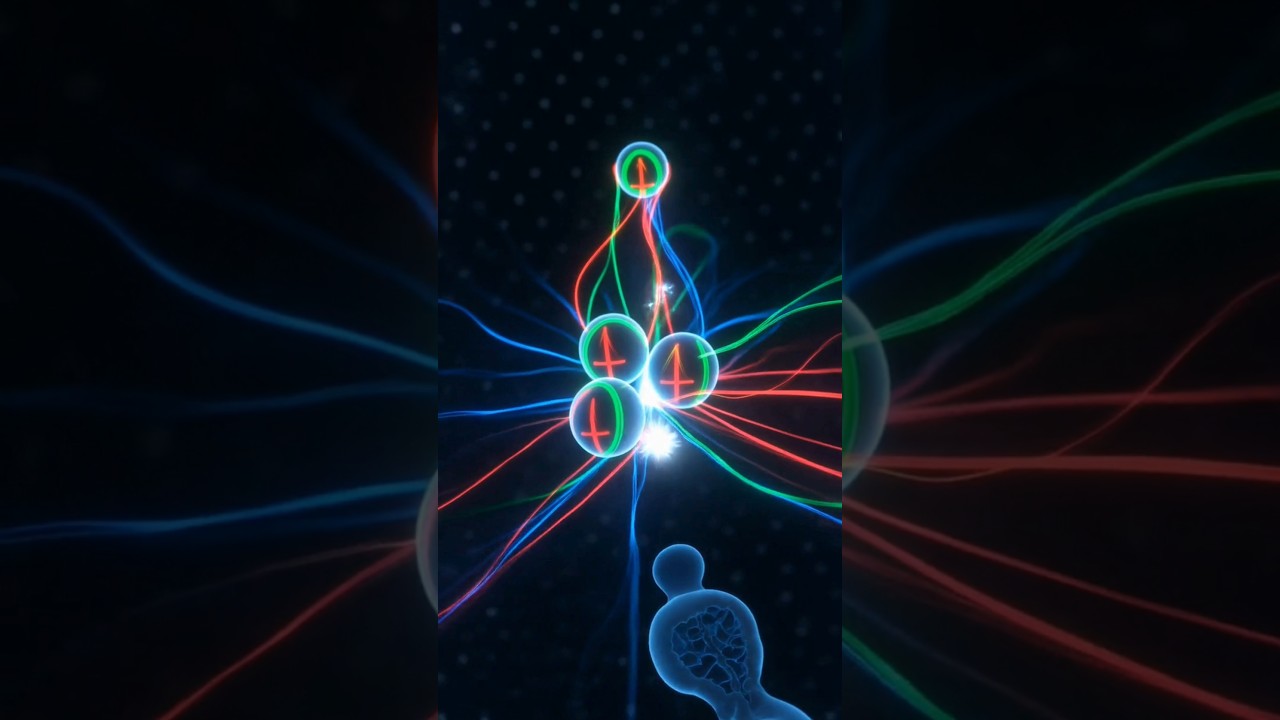

The arrow of time—the fundamental distinction between past and future—is explained by the second law of thermodynamics, which states that entropy (disorder) tends to increase over time. The early universe was in a highly organized, low-entropy state, and as it has expanded, it has become increasingly disordered. This increase in entropy provides the directionality we perceive in time, explaining why we can remember the past but not predict the future with certainty.
The Arrow of Time, Many Worlds, & Black Holes | Sean Carroll
Added:The Second Law of Thermodynamics and the statistical definition of entropy as a measure of disorder.
Fundamental principles of Quantum Mechanics, including quantum superposition and the concept of wave function collapse.
Basic concepts of General Relativity, specifically how mass bends spacetime to form gravitational wells and black holes.
The cosmological distinction between ordinary baryonic matter, dark matter, and dark energy.
A deep dive into Quantum Foundations, comparing the Many-Worlds Interpretation (Hugh Everett) with the Copenhagen and De Broglie-Bohm interpretations.
Black hole thermodynamics, including Hawking radiation, the holographic principle, and the black hole information loss paradox.
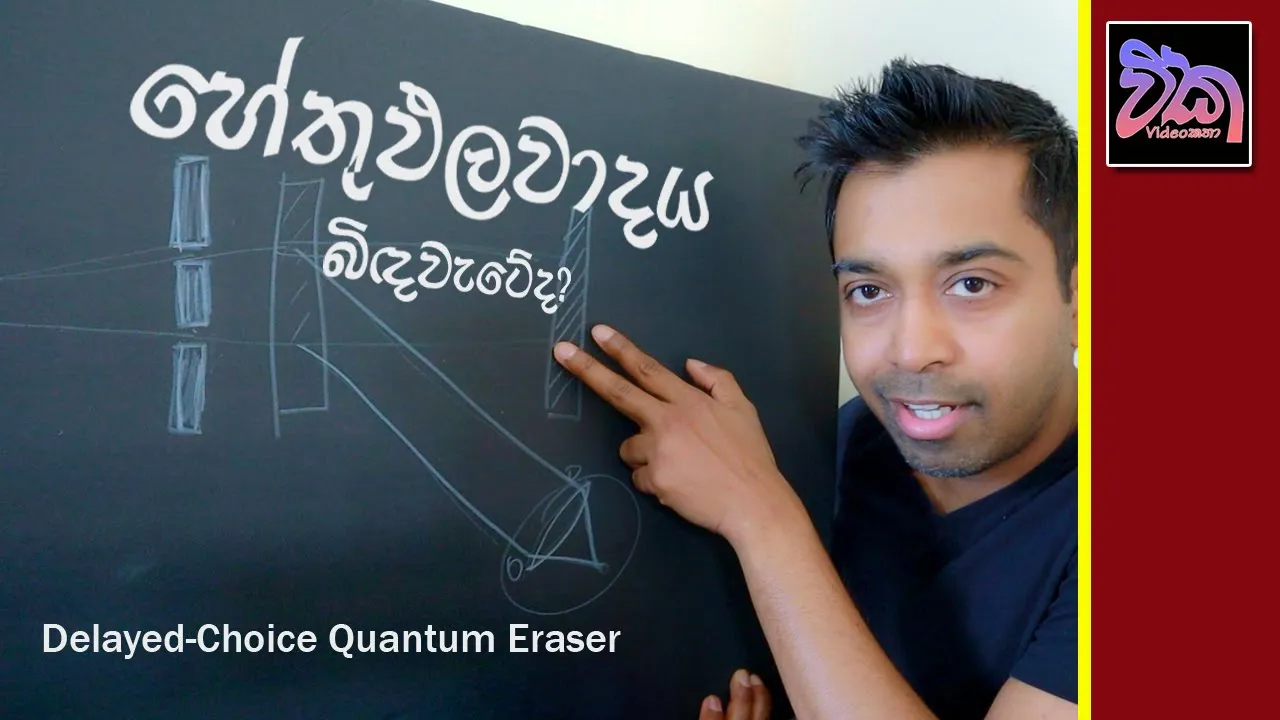
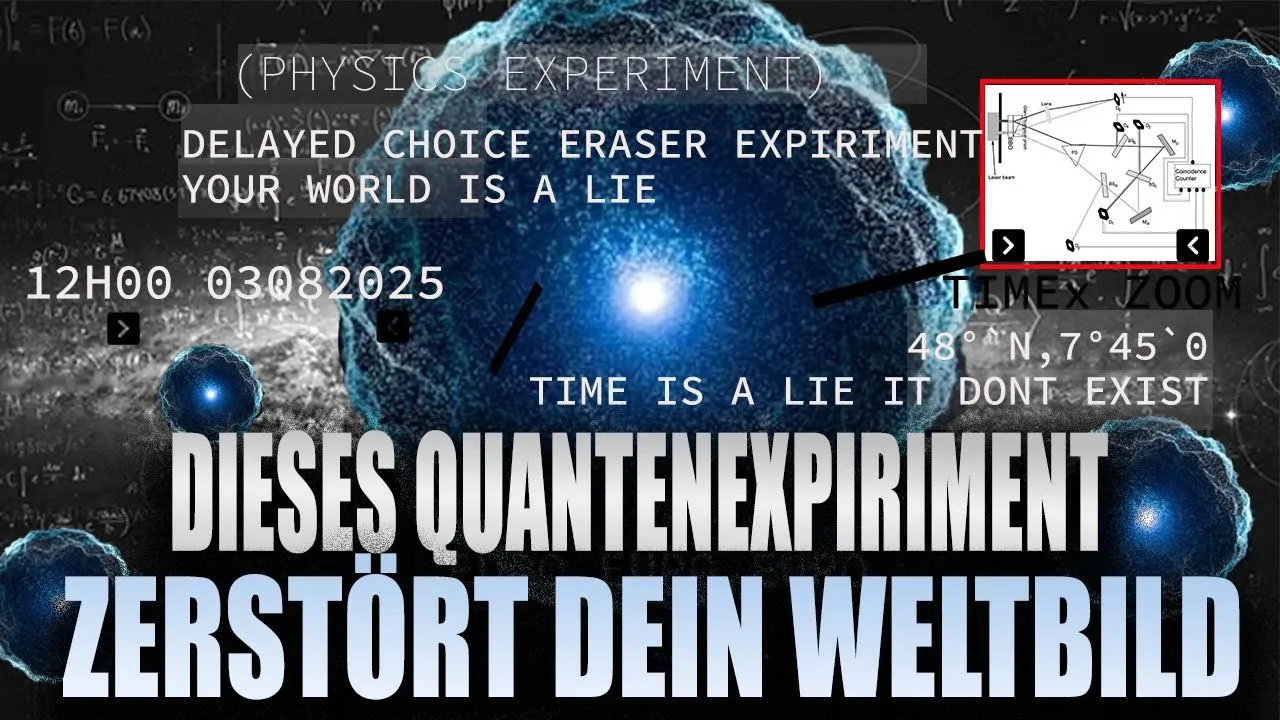
Advanced quantum mechanics experiments, specifically the physics behind Wheeler's delayed-choice experiment and quantum erasers.
The cosmological 'Past Hypothesis' and how the low-entropy state of the early universe dictates the thermodynamic arrow of time.
Current candidates for a Theory of Everything (ToE), such as String Theory and Loop Quantum Gravity, which attempt to unify general relativity with quantum mechanics.
449.1K views10.5Klikes1:00:49Original Release: 2026-01-27
Something that's fascinated me for decades, ever since I could think about this question, and that's the arrow of time. I can have photographs of the past. I cannot have photographs that are truly representing what happens in the future. The early universe, fourteen billion years ago, near the Big Bang, was in a very special, organized state. And it's becoming more disorganized and higher entropy, as we say, ever since then. That's where the arrow of time comes This is StarTalk Cosmic Queries Edition. Neil deGrasse Tyson, your personal astrophysicist. We got here, of course, Lord Chuck Nice. Hey, what's happening, man? You all locked and loaded there? I'm locked and loaded because we got queries, man. And they're not just queries about anything to anyone. No. They're queries on, like, cosmology to one of our cosmologist about town yes one of my one of our fave interviews we've got sean carroll on the line sean how you doing man hey how's it going lord chuck i didn't know you got a promotion yeah if you try hard like he does you you might get one too yeah i mean no kings but lords are okay the occasional lord There you go. That's right. No, I'm down with the Mill Kings, but I'm still Lord Nice. So let's catch people up on your trajectory through life. You spent a lot of your professional career at Caltech over in Pasadena, and now you joined us back on the East Coast in Baltimore at the Johns Hopkins University. And I've got you as the Homeward Professor of Natural Philosophy. That's right. There aren't that many of those. I'm basically the only one, so it's nice. Right. This is a very retro title. It is. Okay. I think Newton had a title of natural philosophy. Right. Before the word physics was a thing. Yeah. Yeah. And you're one of my favorite people out there because not only do you bring science to the public, which is something we care deeply about here at StarTalk. but you have, for me, the best combination of astrophysics fluency, physics fluency, and philosophy fluency. You put all that together and there's no boring conversation you will ever have ever. True. But we're gonna try to change that today. I'm gonna take this as a challenge. Yeah, I bet I can do it. So Sean, you had a couple of books recently. I mean, you're always out there, you know, talking physics smack with an interested public. You have 2 in a row here, Space, Time, and Motion. That's what's left after that, right? That's a lot, yeah. That's pretty much everything, right? But no, not for Sean Carroll. He's got quanta and fields. Oh, wow, look at that. Now it is everything. Space, time, and motion, and then quanta and fields. What's left? What's left will be volume 3, which is complexity and emergence. That's what I'm nearly done with writing right now. So it's a whole 3part series called The Biggest Ideas in the Universe, yeah. That's definitely what that is. For sure. For sure. You know, fields is a thing that if I didn't study physics, I'd still think they were kind of imaginary. You go back to Faraday, right? Who says there's magnetism there, but there's a field. Well, can I see it? No. But like the iron filings can see it. but i can't right okay but if you take away the iron father is it still there yeah and so just just to what did it take to get everybody comfortable with the idea of a field that's a great question because it wasn't easy it took a while you know um isaac newton worried about the fact that he didn't know about the concept of fields. He said that there was a gravitational force between the sun and the earth, and it depends on the distance. The inverse square law, the bigger the distance, the less the force. But he didn't know how it got there. How does the earth know where the sun is, how far away it is, how massive it is? And he said, this is over my pay grade. I'm going to leave this for future generations to decide, which is not the kind of thing that Isaac Newton said very often. so it wasn't until the eighteen hundreds so he knew something was up he knew something needed further explanation yeah action at a distance you know einstein famously said spooky action at a distance for quantum mechanics but even in newton's time there was this weird thing how what is it that takes the gravitational force and moves it from the sun to the earth etc and vice versa yeah And in some way, there was an answer there from Laplace, Pierre-Simon Laplace. But it wasn't until Faraday, like you said, that he starts moving magnets and watching electrical currents pop up in a wire next to it. Like not there, not touching it, right? Through empty space, something happened. And the great thing about Faraday was he was an absolutely genius intuitive physicist. He was not the math expert that you sometimes need to be. So Maxwell, James Clark Maxwell came along, was a huge admirer of Faraday and basically made it all mathematically respectable and said, yeah, there's these things called the electric field and the magnetic field, and they fill all of space and you can't see them, but we can predict what they're going to do. And they're super duper important for explaining everything. I think Faraday, if memory serves, in none of his published papers does an equation of any kind appear. That's possible. I didn't know quite that factoid, but it's absolutely in keeping. He was thinking about, in fact, it wasn't even fields that he primarily focused on. he imagined lines of force. So like out of an electron, there's an electric field we would say now, but he thought they were like literally lines of force filling all of space. And Maxwell's first papers were about trying to make mathematical sense of lines of force. And he eventually said, nah, it's better to think of fields with little vectors. So like little arrows at every point, and then the lines are sort of moving in the direction of the arrows. that all happened in the 19th century all happened in the 19th century and the great thing was you know if you think of the number of different apparent phenomena in the world that we now think of as electricity and magnetism in action right heat light um radio waves x-rays uh you know the magnets all this stuff like very very different things all explained in just 2 fields talking to each other electricity and magnetism That's amazing. That's completely crazy. And I was just thinking, I go through this sort of existential moment maybe once a month. I'm sitting there and I press a button on my smartphone and it changes the channel on my TV. And then I press another button, it starts my car, which is 3 miles away. And I'm thinking, this is magic. Yeah, basically. Yeah, and this is why writing books is good because you write a book and you say like, you point your remote control at your TV and a radio wave comes out and turns it on and you get many emails saying, that's an infrared wave, not a radio wave. You don't know what you're talking about. but they're all different manifestations of electromagnetism. And so- No, no, wait, wait, but my cell phone is not- Your cell phone is not, but your remote control is. Yeah, that's for sure. Yeah, exactly. Who knows these things? I can't keep track of these things. I'm just a theoretical physicist. It's funny, while you guys are talking, I'm sitting here with my iPad and I'm taking my finger and moving the screen up and down. Into this void above your Right. And it's exactly the same thing. Isn't that the electromagnetic field on my finger? Basically everything is the electromagnetic field. Other than gravity, it's all electromagnetism all the way down. We live it. We just live it. There's a hugely important philosophy of science lesson here, because like Neil said, you can't see the electric field or the magnetic field, but they're clearly everywhere. Like we have equations that describe them exactly and make predictions and fit all the data. Therefore, we accept that they are there. You don't need to see them with your eyes to have evidence that they're part of reality. i i do a whole stand-up bit about that which is i try to beat that into chuck every time when i say the universe is under no obligation to make sense to you which believe it or not i can't accept you must make sense to me because i am the center of all things And so, Sean, what's this latest paper we have you publish here, co-authored, what Hawking radiation looks like as you fall into a black hole? Was that something that needed to be addressed? It's something that I've worried about for decades. And honestly, really? Yeah. Well, so here's the question. There's 2 things that we think are true about a black hole. One is if you're standing very far away and you look at the black hole, Stephen Hawking says, black holes give off radiation. OK, not that much radiation, admittedly, especially for a big black hole. But he, again, has an equation that predicts exactly how much you should see. The second thing is we have this feeling, no one's ever done it, but we have this belief that if you fall into a black hole, you see nothing special when you cross the boundary, when you cross the event horizon, right? It just looks like ordinary empty space everywhere. But these 2 statements seem a little bit contradictory because if I'm standing far away and I see radiation coming out and then I just fall in, I stop my rocket ship or whatever and let myself fall in, you know, Neil, that you should see that radiation get blue shifted. It should look brighter and brighter and more and more energetic. So why does it turn off when you hit the event horizon? What actually happens? What is it that you see? And it turns out this is a hundred percent, you know, implicit in all the equations that we have, but took a lot of work to actually pull it out. and the answer, in a very short, slightly oversimplified form, is: there is high intensity radiation when you're crossing the event horizon, but you're moving so fast that you don't have time to observe it, so it looks to you like there's nothing there. wow, yes, mean in a heisenberg uncertainty principle way, you, you don't have time to observe it. yeah, exactly right. and by the way, before i forget, i got to give huge credit to chris shaloo, my co-author, on this. he was a grad student at harvard who, just graduated, did all the heavy lifting on this and other projects, and he, he was fantastic. so he, you know, he got the right answer after other people's got it wrong. graduate students, they have to have an exception to the slave amendment in the constitution for graduate students. right, just so you know. why are they not? are they only 35ths of a person, 35ths of a scientist. yeah, 35ths of a scientist. is that what they are? his graduate student did the heavy lifting. right there it is, but see, that's the whole. sean is in the bahamas and his graduate- and that's the way it should be- sean already did his work. okay, that's the whole idea. i would have loved to do the heavy lifting, but for his sake, i needed to let him have that experience. you know how it is, of course. yes, i mean, listen, leonardo da vinci. uh, when he painted, he had artisans that worked under him. yeah, and they do a bunch of the work. yeah, and then you come in and you sign your name. No, but I will tell you this: that in physics and astronomy, in our journals, it is not our tradition to put our degrees after our name, the way it is in the social sciences. And why is that? Well, I made up a reason why that's good, but I don't know if it had different origins. And, Sean, you might have some insight here If you didn't otherwise know the people. you have no idea who is senior, who is junior, because a brilliant idea can come out of anybody, even your students. And so there's no reason to segregate who's got title and who doesn't? because a brilliant idea is a brilliant idea, no matter the package, and a stupid idea is a stupid idea No matter who comes up with it. Yeah, I like that. I like that system. It's very egalitarian. I like that. Nope, that's Ready, Do you harbor questions about the universe, Some long-held bit of cosmic curiosity lingering within you, Or questions about anything at all? You can become a Patreon supporter of StarTalk. You have access to our exclusive question line on our website. Those are where we draw our questions for our cosmic learning, Some of the most extreme objects in the universe. StarTalk is a work in progress where we every month come up with some new way, some new idea, some new understanding of how to bring the universe down to Earth. We could not do that without your support. Thank you And, as always, keep looking up, Sean. one other thing before we get to our Patreon questions, Something that's fascinated me for decades, ever since could think about this question, And that's the arrow of time. Some of my earliest books in middle school were all about time and how it passes. and why do we know? time is going forward rather than backwards, And you have some emergent thinking on that. I absolutely do. This is something that was hugely important for me in my career. The arrow of time is just the fact that the past and future are different from each other. I can have photographs of the past. I cannot have photographs that are truly representing what happens in the future. AI's, got your future, Lord Chuck can do it, but I can't do it. So you know why is this true? And Aristotle wouldn't even have had the question: Like they're just different things, Like why is an elephant not an orange? Like what are you even asking? But once Isaac Newton comes along with his theory of physics, suddenly the distinction between the past and future disappears, Like these equations. don't treat the past and future differently, Right, Yeah. So it turns out, long story short, that it's a cosmology question. The early universe, fourteen billion years ago, near the Big Bang, was in a very special organized state, And it's becoming more disorganized and higher entropy, as we say, ever since then. That's where the arrow of time comes from. But OK, why was the early universe like that? And that we don't know. So I wrote a paper about this 20 years ago and I'm revisiting that now to try to improve upon it. We still don't know, but I do think we're making progress in that direction. Well, I hope so. after 20 years, That's not very long in the history of the universe, You know what I was going to say. Excuse me, I'm pulling the universe on me. It's a fourth of your life, a fifth of your life. The universe will wait. We know which direction time moves, because certain phenomena we would never see in reverse, Like some famous ones are. you drop blob of ink in water, the ink will disperse. You never see that happen in reverse. So if you're just eavesdropping on a scene and no one told you which way time was pointing, just by phenomena that occur, you should be able to figure it out, like you never see an orange fall up from the ground back onto a branch. right, but these are. you know, you're picking good examples, but, let's admit, you're picking the easy examples. we understand those examples, but i can make a choice about what to do right now. like i could make a choice right now. this is the most boring podcast ever. i'm going to storm off and not do it. you won't be the first, but i can't make a choice now not to have come on the podcast in the first place. i can't make a choice that affects the past. oh, look at that. and and so that's right there, at the boundary of physics and philosophy, both the physicists and the philosophers need to, uh, think about this, and again, we have good ideas, but there's still work to be done. wow, and now, now you got me thinking about the multiple timelines and, uh, parallel universes and every single like, if we are on a call it a trajectory, every choice that we make, all those other possible trajectories from this point of decision still continue forward, just without me. so what the hell is happening there? I'm not sure if I'm quite on board with your explanation there of what's going on. Well, no, what I'm saying is I'm being way too literal, Sean. What I'm saying is the possibilities of all those trajectories. Well, to the many worlds, hypothesis, Is that what that is? Is that what I'm talking about? Well, it's pretty close. I mean many worlds- is like really down to earth and equation based- There's the Schrodinger equation of quantum mechanics- tells you what set of things happen in the future and which don't. And it's not because you're making a decision creates a difference between one world and another, It's because of entanglement in the underlying quantum structure of reality. But we do have reason to believe that there are other copies of the universe where things turned out a little bit different. and uh, it's. it's. uh, you can all. if you have an iphone, you can download an app called universe splitter, and i'm a big, i'm a big salesman for this app here and i don't get any commission or anything. but i think everyone should get it, because when you're torn between 2 decisions, um, you know, should I take this job or should I just continue living a life of leisure? You can ask the phone and it will plug in these 2 options and it will send a photon down a beam splitter that has a fifty, fifty chance of saying you should take the job or you should just stay sitting around, And then there'll be. if you do it, if you obey the instructions, you know there will be a world in which you did the other thing. That brings me to my question. You got a question before we start, Before we even start, And specifically, Did you pay your 5 dollars a month? I'm going to owe you In another world. he did In another world I paid That's funny. All right, Sean, this is specifically for you. okay, This question? That is your question. It's my question. first of all, you have to be familiar with this experiment In the double-slit, delayed choice quantum eraser experiment. okay, I know you've been worried about that one. yeah, No, I really am, Sean, I'm dead serious. I told Neil this is keeping me up at night. Sean, that's a thing. It's a thing. Yeah, it's a thing right. It's the double-slip, delayed choice quantum eraser experiment. Okay, I'd never heard of this. Okay, go, Okay. And maybe it's all I don't know. maybe it's I read about it and I'm just like. this is crazy. Maybe it's BS? I don't know. Give it to me All right. So it appears that the photons know they're being measured Like they actually know. All right. So the signal photons and the idler photons show a constructive wave interference pattern when they're not measured by a detector. But there's 4 detectors and they can't know because of the way the detectors are set up, because the photons are split and some go on not to be measured and some go on to be measured. OK, now here's the deal. There is no wave interference pattern when they are measured. So this makes it look like they know when they're being observed. I can understand the whole explanation of entanglement. I don't know why I should say I can accept it. I don't know why. it's easy for me to accept that, but I can just accept it. What I can't know or understand is a particle, knowing that it's being watched. So are there any hypotheses that would explain why this thing with no. So that's just that your query there sounds like you just need the double slit experiment. I'm still distracted by the rest of what it's called. No, this is beyond the double split, double slit experiment because, well, maybe I'll let Sean explain it because I can explain it, but I'm probably not going to do, explain it as eloquently as Sean, the way the experiment is set up. Yeah, the double slit experiment is, of course, a famous thought experiment originally. They wrote down what it should do long before they ever did it to illustrate the magic of quantum mechanics. You have a single electron going through 2 slits. It's detected somewhere on the other side. And it's just a dot. You can't figure out that much from the dot. But you do that many, many, many times. And what you see is an interference pattern. It's like a wave. went through the 2 slits and waves go up and down depending on how far away they are from the target and so a wave going through one slit can interfere with the wave going through the other slit and that's what you see in the distribution of dots on the detector screen so The miracle occurs when you observe which slit the electron goes through, right? Because in the Copenhagen usual way of thinking about quantum mechanics, when you observe the electron, you collapse its wave function. It's no longer going through both slits. You saw it go through one or the other and magically the interference pattern goes away because indeed you changed the electron dramatically by observing which one it goes through. So that's all standard stuff. Everyone and their mom learns that in kindergarten when they're learning about quantum mechanics. The delayed choice quantum eraser experiment is a hilariously convoluted elaboration of that, which makes people feel bad for no good reason at all. Oh, thank God. I actually wrote a blog post about it called The Notorious Delayed Choice Quantum Eraser, where I make fun of people who are trying to make you lose sleep because of this. Well, they got to me. They got it. I know. Yeah, we're all victims here, I think. So the way that that works is rather than just observe whether the electron goes to the left slit or the right slit, what do you mean by observe? You mean like maybe you with your eyeball or with some measuring apparatus have detected it. But what if you just entangle it a little bit, like you entangle it with one little particle, okay? Then unlike if you personally had observed it, you could imagine unentangling it. You could imagine not letting it get the interference pattern destroyed, or you could imagine having it be destroyed. And you can make that decision after the electron's been detected. That's the slightly spooky part, right? That's the spooky part, right. If you were the kind of person who spoke a language of the electron goes through one slit or the other slit and it's making a decision, then what Chuck says, like, it sounds like the electron's decision was affected by what I did after it was detected. Oh, my God, how could that be? But if you just talk the language of a wave going through and becoming entangled and taking quantum mechanics seriously, all of this is a hundred percent what is predicted by the Schrodinger equation of quantum mechanics without anything, knowing anything, anything, making any choices or anything going backward in time. Okay. So there. So there you have it. It's hard to explain, but I encourage people to Google notorious delayed choice quantum eraser and they will find my blog post and they will hear it all. And this is literally the chapter I wrote for my book, Something Deeply Hidden, which is all about quantum mechanics. And I read the chapter and said, this is too much. Like they don't need this. Like this is too complicated and specific. So I just made it a blog post instead. Excellent. And where do we find that blog post? On my blog, preposterousuniverse.com slash blog. But again, if you just Google delayed choice quantum eraser with the word notorious in front, my blog post will come up first, I promise you. Preposterous universe. Preposterous universe. That's preposterous. Exactly. All right. All right. Well, that was good, man. All right. Thanks for that. You got your 0 dollars worth. Yeah, I got my 0 dollars worth. It's a perfect example of rather than trying to demystify quantum mechanics, sometimes people try to mystify it. They try to make it sound even more confusing than it It is. Quantum mechanics really is confusing. You don't need to make it sound more confusing than it is. And that's what this is doing. And you're absolutely right. Well, that's cool, man. Well, I appreciate that. Okay, here we go. This is from our buddy, Kevin the Sommelier. And he says, if dark matter were a wine varietal would we be at the I know it exists but I can't quite describe it stage or the I swear I taste something but everyone thinks I'm making it up stage that's funny on a more grounded note for the holidays Gaia Promis. Gaia. Gaia. Gaia. Oh, Gaia, like Gaia. No, G-A-J-A. Gaia. It's Italian. Okay. Gaia Promis, which is a beautiful Super Tuscan, will pair incredibly well with any roast that you are planning. And you're familiar with this Gaia Promis. It's expensive, but it's good. Okay. All right. And you say that like, Chuck, you can't afford it. That's what you just said. That's what I was hearing. That's all I heard. You were like, Gaia, yeah, Chuck, you cannot afford it. Okay. So maybe one day I'll pour it for you at my house. In the meantime, keep dreaming. But the yellow tail is good, Chuck. Don't worry. You'll love it. 2 buck Chuck. 2 buck Chuck. I'm down. So in that question, I guess he's trying to, using his wine expertise, trying to probe what's really going on with dark matter, dark energy, or both? No, he said dark matter. Just dark matter. Yeah. Yeah, could you just put some anchoring onto, because a lot of people think we're just making it up. Yeah, making it up. Yeah. And does it have to be a particle? Ooh, ooh, that's a tougher one. You made it tough. I had an easy question. You threw me a softball there. See, this is what I do, man. You just saw what I did with that stupid delayed double slit thing. I can't help. And Neil, we just did this earlier. We were together earlier before you got on. And he was just like, Chuck, you overthink everything. Just calm down, bro. Look, back in my day, when Neil and I were young, it was perfectly okay to think that maybe dark matter didn't exist. In other words, there were absolutely things going on in galaxies and clusters of galaxies, things like that, that looked like dark matter, looked like there's more matter in a galaxy than we could attribute, account for just by counting the stars and the gas and the dust. But maybe there was something weird going on with gravity. Maybe Isaac Newton and Albert Einstein didn't have the last word. We've long since passed that phase of the development of cosmology, and I think a lot of people haven't caught up because we've learned so much more from the leftover radiation from the Big Bang, the cosmic microwave background, from gravitational lensing with clusters of galaxies, from the growth of structure of galaxies and clusters and things like that. Dark matter exists. It's really there in some form or another. Now, maybe gravity is also modified. That's perfectly OK. But yeah, there's something called dark matter. Is it a particle? Well, we got to admit, we don't know what it is. The range of possibilities goes from some tiny fraction of the mass of an electron to the mass of the moon or something like that. I mean, there's a very, very large range of possible masses that dark matter could have if it's a particle. Could it be something beyond a particle? It always could be like this. Anything is possible. But boy, it really acts like particle like like we know a lot about where the dark matter is, how much of it there is, how fast it's moving. It looks exactly like some massive, slowly moving particle that was sort of still stationary in the early universe and started moving ever since then. So it's our job to go actually find it. Then we'll know. So 2 small points. Whenever given the occasion, I don't describe it as dark matter because we don't know it's matter, but it is definitely dark gravity. That's what it is, right? because we're tracking gravity at every turn that we say we're measuring the dark matter so i think that's the the most honest way to describe it because because sean you've seen this they're they're they're uh clickbait there's a news article that says uh you know scientists may be wrong about dark matter of course it might not be matter yeah But we can't be wrong about dark gravity because we don't know what it is, right? I'm just trying to distinguish that. No, I think that's a perfectly good and fair distinction. But I think that I would just be more conclusive about what we do know. You know, like I said. And you sounded very good there. You sounded really good. In the eighties, what we were discovering was there's more gravity at the edges of galaxies than there is that you would predict from the stars, et cetera, inside. so okay maybe gravity is different but nowadays we see gravity where there is no ordinary matter to cause it so it's not just that the strength of gravity is different but it's just pointing at something which we're not seeing so that's dark matter you said a moment ago that we might one day need to modify gravity, but that's not what we need to do to explain dark matter. It is not sufficient to explain dark matter. We need extra stuff out there. And just to be super duper clear, because again, much like the notorious delayed choice quantum eraser experiments, sometimes people like to make things harder to understand rather than easier to understand. There are people who have theories of modified gravity where they've changed Einstein's theory of gravity and they say: I can explain away the dark matter. But when you look at their theory of gravity, in addition to changing gravity, they've also put new sources of gravity in there which are just dark matter. Right, They break the universe in the process. Right, Okay, All right. Well, that's okay. Kevin, kudos for the creative work. posing of the question, This is Rachel Ambrose And Rachel says: Hey, Rachel, here from Austin Texas, I'm a big fan of Sean and his Mindscape podcast. Thank you, Rachel. I've been thinking Product placement. Rachel says I've been thinking about the spinning universe hypothesis which says the entire universe may be rotating very slowly as a whole. This was hypothesized to help resolve the Hubble tension, But I was thinking, if it's true, could this also help us explain dark energy as a kind of centrifugal force or centrifugal, depending upon how you want to say it? Yeah, look, I'll be super honest, and my honest answer is: I don't know. That sounds like a research program. Rachel should write a paper about this and submit it to the physical review. I doubt it is the slightly longer answer, because if the universe is rotating, then that tends to break the isotropy of the universe. Okay, God bless you for that. I'm going to fill you in. Isotropy just means things look the same in every direction. Okay, Statistically the same. Statistically the same. Not exactly the same, Of course, That's right. So there's not like a big hotspot in one side of the universe and cold spot on the other side. It's more or less the same average everywhere, with little fluctuations around it, And we have that right now. That's exactly what we have. And so once you start messing with that, can you mess with it like just a little bit, and maybe no one has noticed yet. Sure, You absolutely always can, it's hard to do that. And the theory that we have for dark energy with Einstein's cosmological constant just does a really good job at fitting the data in a sort of a simple, direct, blatant kind of. here I go kind of way. So I'm absolutely open to creative new things like the rotation of the universe, but where would that come from? I'm not sure. And what other effects would it have on observable quantities? I'm also not sure. So that sounds like a work all right. okay, very cool. i think we still need verification that that net angular momentum is manifest everywhere. i think it was just one pocket of the universe where they made this measurement and and so you would need to do more of the universe to reveal this. right, if it's really true. so it was just. it was the. it's. which way that spiral galaxies are rotating right? yeah, if there's a net rotation in one direction over here, that says there's something going on in the whole universe. right, because these houses wouldn't know about each other necessarily. there's something. so they would be. they're responding to the same thing exactly. that's the case, correct? i got you right? okay, by the way, there's just just to, so people know that you got to be careful about these things. there was one study that had the brilliant idea. it was a while back, so we didn't have. you know, the computers weren't there. they had volunteers. it was like citizen science. they said: here are some pictures of spiral galaxies. You go through them, you citizen scientists, and tell us: are they counterclockwise spirals or are they clockwise spirals? Okay, And you would expect it to be 5050, but it was like 7030. Like there were a lot more clockwise spirals than counterclockwise spirals And the astronomers were like: oh my God, what is going on. And someone had the brilliant idea: Okay, let's give the same galaxies to the same people, but let's take the mirror image of them, Let's flip them. Ah, what a smart idea. And guess what? It was still 70 percent clockwise galaxies. It was people were seeing things. People are not unobjective. Get people out of the equation. So you just just got to be careful about all of these things. Sean Browning says: Hello, this is Sean Browning from Hood River, Oregon. In a previous episode, Neil stated that if you were to fall into a black hole, that would see the future of the universe unfold, Or you would see the future of the universe unfold Behind you. Right? Yeah, yeah. If that's true. then what would happen if the black hole finished evaporating before the universe ended? so i think that the details matter here. you know we there's a way that we have a thinking about black holes. that is sort of idealized, like i wrote a textbook on general relativity and you can learn about black holes in there. but the real world black holes are messy and you know they're made of stuff and things like that. so i don't actually think it's true that you see an enormous amount of the past of the universe in a real black hole. in a real black hole, you would, as as as you know, get spaghettified and die very quickly, right? so right, if you're in a real evaporating black hole, you would first get spaghettified and then you would be released as a stream of- uh, black body radiation, and you're not. none of you is experiencing anything here. so, uh, yeah, i think that you don't need to worry, like you would. you would see more, maybe, than you would if you were outside the black hole. but there's no apparent paradox that you're going to see the whole thing gotcha. okay, you're, uh, very literal, sean. um, but the point is, if your time is slowing down as you near the black hole, then the time for the rest of the universe is speeding up. right, i mean you see, sorry, you, you're normal, and the rest of the universe is speeding up. so i think that's the foundation of this question. that is, however long it takes you to fall into the black hole. will the universe, or vice versa? will one of them live out their days before the other one finishes? what it's doing I think you should always think about. I mean what I would like is that everyone in the world thought about space-time diagrams And light cones. you know your past light cone, which is the set of all things that can send light signals to you without moving faster than the speed of light. it never covers the whole universe. It never sees the future. It never sees things that are further away from you than the speed of light can get. That's true, whether you're inside a black hole or not. So there's some quantitative question about how much you see. but there's no worry. you're seeing things that didn't happen yet before the black hole evaporated. Wow, That's a bummer. You're the one falling into a black hole. There's other bummers you have to worry about. Let me tell you: This is true. It's not your biggest bummer. It's not the biggest bummer, All right? This is Shadow Dominic. And he says: Is his name Shadow Dominic? Yeah, All right, He says: Hi, this is Dominic from Madison, Wisconsin. If you could instantly know the answer to one currently unsolved physics problem, no strings attached. Was that a pun? Stay away from strings theory. Was that a pun? What are you doing, bro? He says: which one would you pick and why? I mean the cheating answer is yes, Tell me the theory of everything. Then I could like work out everything else from that. Let me, let me double up behind you. What gives you the confidence that a theory of everything even exists Because the universe exists? No, no, no, I'm not accepting that. No, don't tell me, No, So You should accept the universe, Neil. It could be that quantum physics and general relativity in this universe never come together and there's nothing that would ever bring them together. That's just how the universe is. We're invoking a philosophical bias of beauty to even assert that there is one theory of everything. No, that's not true. The universe exists. There is something that happens, right, We don't know the best way of summarizing what happens. The best way of summarizing what happens in the universe might just be to literally list everything that happens. That would be a terribly uninformative theory of the world. We think we can do much better than that. I'm not saying that the theory of everything is simple or elegant or fits on a napkin or a T-shirt or anything like that, But there is some full and complete description of the universe. The fact that you said it could be a very long account of everything that happens, but if it's everything that happens, then that's everything that happens. So that could be just a really messy, ugly, not philosophically beautiful theory of everything, Because there's a page in the book for everything that happens. Right, Because I'm very much in agreement with the philosophy that we should not be going around telling the universe how to behave. We can't decide ahead of time what the universe is like. It's absolutely possible that the ultimate explanations are not that simple. I actually don't believe that. I think the ultimate explanation probably will be really really simple. I don't know. yeah, What if you can't access that information Like it is non-accessible on this plane of existence? but the answer is there. Or you're saying: are we just too stupid as humans? That's another way to ask your question. Yeah, I guess it is. Sean, do you think that we have sufficient intellect to even get there. Yes, Okay, Oh, All right, That's encouraging. Oh man, loving him some humble sapiens there. Okay, I mean, again, we don't know. But what I like to do is just think about how far we've already come. You know, a hundred years ago, we had just finished getting quantum mechanics. We didn't know about the expansion of the universe. We certainly didn't know about quantum fields in the Standard Model and all these things. And we didn't know about other galaxies yet. It happened in in in 19 26. Holy moly. Yeah. Of course, it's possible we'll never get there, but the rate at which we've been learning things, and this is just the past hundred years. Think about the past thousand years and ten thousand years from now, we're going to know a lot. If we're here. Yeah. If we are here. One of the hypotheses that I thought was intriguing was that as we measure the limits of whatever the limits are of what we're measuring, we might reach a cutoff like in a Truman Show example where he goes to the horizon, but the horizon is a painted sky. So we look at like the energy levels of gamma rays or we find a cutoff that would have no natural explanation other than that somebody programmed this and they had to put in a limit because they couldn't put infinity into their software. yeah so i think that's it's it's fascinating to imagine at a slightly more detailed careful level what are the ways that we could become convinced that we're not ever going to find a simple theory of everything that's another way to think about it yeah and things like that are you know maybe we get evidence that we live in a simulation or that you know that that that the laws of physics are different from place to place in time to time and so even if we get them figured out here we won't know them some other way but again what What's amazing to me is how rock solid and reliable the laws of physics are. Like we're able to extrapolate them way past the environments in which we invent them and they still work. I just gotta put one example on the table, which is big bang nucleosynthesis. This is my favorite example of exactly this. A bunch of scientists, mostly in the 20th century, figured out the rules of nuclear physics, the rules of gravity, the rules of cosmology, and they realized the universe is fourteen billion years old, and they extrapolate these rules back to when the universe was one minute old. And they make a prediction for how much hydrogen and helium they should be, and they got it right. Like, what in the world? That's the impressive thing to me. Like, we can figure this stuff out. Fantastic. Well, that's very encouraging. And there's another example I got from Rich Gott. George Gamow makes a prediction based on this early nucleosynthesis of the universe that there should be a residual temperature of the universe. And that would be the temperature pretty much, not pretty much, that would be the temperature everywhere. Everywhere, everywhere. So think of the level of extrapolation this required. And he said the temperature would be ten degrees. Okay? Okay. So then we finally measure it. It's 3 degrees. Wow. Okay, so you can say he was an idiot He really crapped the bed The standards were lower back then chuck it was a very But rich got said that's like predicting that a tenfoot flying saucer would land on the lawn of the White House, but it was a 3foot flying saucer instead. Right, yeah. That's pretty wild. It's still, oh my gosh, it's a flying saucer. No, that's super impressive. Yeah. All right, very cool. Okay, so you helped me, talked me off the ledge there. You know, every now and then I just wake up skeptical that we're going to ever figure anything out. And what we have figured out, I need to be more impressed with that. People are impatient, yeah, I know. It'll take some time. Thank you. So what else you got? All right, this is Shota, I'll say Zidzi Guri. Zidzi Guri. I'm betting that is so not right, but go on. Easy for you to say. All right, Shota Zidzi Guri. Anyway, hello, this is Shota from Georgia. What a name like that. Maybe it's Soviet Georgia. I mean, Georgia, it's not Soviet anymore. Yeah, it's not Soviet anymore, but yeah, I know what you're saying. uh he said uh or shota says regarding the many worlds interpretation is it simply a mathematical framework we use to describe quantum behavior and apparent wave function collapse or do you think it represents an actual physical process in which the universe truly branches into separate real worlds yeah how real are these these other worlds? Yeah, it's a great question. So the way I like to think about it is we have an equation, the Schrodinger equation. You can read about it in my book, Quanta and Fields, by the way. And the equation makes predictions for what's going to happen. And the the simplest reading of the prediction is that the universe branches into these many copies slightly changed because in one the electron is spinning clockwise and the other it's counterclockwise. But otherwise the universe is the same. And we live in one of those possibilities. We don't see the other ones, and it seems to fit the data. So then you say, OK, what about all those other possibilities? Should we take them seriously as real? And the answer is, if you take our possibility as real, then you have 2 choices. Number one, either you take the other possibilities as also real. You treat them equal. They're all there in the equation. I'm going to take them seriously. Or you tell me why I shouldn't treat the other ones as real. And there's a long history of people trying to come up with reasons why the other worlds aren't there. Disappearing worlds, theories of quantum mechanics, as Ted Bund has called them. It turns out to be hard. It turns out to be awkward. It doesn't fit in well with modern physics. You can try to do it. It's a free country. Go nuts. Invent all the theories of quantum mechanics you want. Or you can just say, yeah, they're there. I don't care. They don't bother me. They don't take up the resources we have in our world or anything. It's not grabbing a beer in the middle of the night from your fridge. And just correct me if I'm wrong, when we think of what's called the Copenhagen interpretation, that's the many worlds hypothesis, correct? No, that's the opposite. The opposite. So describe the opposite. Copenhagen is the one that was invented by Bohr and Heisenberg back in the day. And Bohr is the only one who's Danish in that pair. Yes, that is correct. So why does he get the name? Why does his hometown get the name of the idea? He was slightly older than everybody else, and he founded the Institute for Theoretical Physics in Copenhagen, where all this work was done. So. Well, there you go. He had the money. Heisenberg was a postdoc at this time, and Bohr was a famous physicist. So Copenhagen puts in the laws of physics the notion of measurement. It says that when you make a measurement of something, a dramatic effect occurs where the wave function that describes the system completely changes. The real hardcore Copenhagen philosophy is that there is no such thing as what the system is doing before you measure it. The whole of reality consists of nothing but measurement outcomes. That's what Copenhagen actually says. I remembered learning that, but I didn't connect it with the Copenhagen interpretation. And if we were divided into camps, that's my camp. It took me a while to grow accustomed. Let me restate what you just said. It doesn't even make sense to talk about it. unless there's a measurement of it. To talk about a state of a system, unless you can measure it. And then the measurement is the reality of what things are. Did I oversimplify that? No, that's actually quite good. And I'm all about, like, the universe doesn't care about you and your measurements. The universe is just out there, and I'm just going to believe in it. Why not? The universe is impersonal, and the word measurement should not appear in the fundamental laws of physics. that's cool, I like that, I like that. All right, this is Rory L. who says, hello, Dr. Tyson, Lord nice Dr. Carol, Rory from Colorado here, the happy recipient of a gift subscription. Wow, somebody gave him a Patreon gift subscription. Hey, guess what? You guys can do that too. Give a gift subscription to somebody else, buy him a year of Patreon. And by the way, that's a cheap ass subscription. It really is. but you can make somebody really happy for not so much money. Okay. Dr. Carroll, which science discipline do you rely upon the most when studying a possible multiverse or is it a combination? Thanks. And throw philosophy in there as well as a branch of thought. Why not? Yes. I presume that the question is referring to like, is it mostly a philosophical question or is it mostly a physics question? Or is it mostly quantum physics or relativity physics? How about that? Add that in there. Right. Different parts of physics are also very relevant here. But this is exactly why I chose to title myself a professor of natural philosophy, because I don't. think that there's a boundary or a dividing line between the philosophy of it all and the physics of it all. You are never going to invent quantum mechanics by sitting around in your armchair thinking about how the universe would be, right? You needed experiments that gave you, giving you data that you couldn't otherwise account for. And that's what led us to quantum mechanics. then quantum mechanics leads us to this idea of many worlds happening every time you make a quantum measurement and philosophy becomes super important for accounting for that for understanding that the physicists bless their hearts have done a terrible job most of them just live in denial and don't even wanna think about this. And it's kind of an embarrassment, but the philosophers have at least taken up the challenge. I don't think that we're done yet. I don't think we have a perfect understanding of everything. That's good for me, full employment for me and my graduate students. We still have things left to do, but I think you need them all. There's no one answer there. As everyone from the South knows, if you say bless his heart, the next thing isn't gonna be a nasty insult. Well, yeah, in the South, bless his heart means F you. They got it down to a science. The most polite F you possible. Bless his heart. Bless his heart. This is John Mayer. He says, hi, I'm John from San Diego. And listen, every episode I listen to, it's my jam. Thank you, dear Dr. Tyson and Dr. Carroll. Can advertise that? What? StarTalk, it's your jam. It's my jam. He says, Dr. Tyson, Dr. Carol, and the energetic Lord Nice, please help me understand how a photon traveling between stars experiences no time, yet also has a wavelength pattern and changes over space and time. Is the wavelength a function of the photon or is it a display function of the space-time medium within which it is traveling within? Or is it even something else? What a great question. people love this question I get this question it's uh and they don't like the answer which is that photons don't experience things they're just single particles electrons don't experience things either I think that we get in trouble because we are complicated creatures right with senses and memories and things like that and so we have a feeling for what it is like for time to pass and that wouldn't apply if we were moving at the speed of light because then no time would pass but When we talk about the wavelength of a photon or its path through the universe, we're not talking about its inner experience. We're not talking about its first person point of view. We're talking about what it looks like to us. The photon passes us by. It has a wavelength. It has a path. it's all about us it's all about us in that case it's all about us well even better it's all relative as einstein would have said it's relative from what the observer sees relative to the observer yeah and it's also about the math because that's the thing that people that the photon is a particle but the math is why it doesn't experience time it has no mass and it's traveling at the speed of light so there is no time There just isn't. That's right. It travels through a path in space time that takes it no time from its point of view. Right. Okay. However, if you look at muons, a muon knows when to decay. Oh, that's right. So it must have an internal clock. For you to just say a particle, and you even mentioned electrons, doesn't care about time. If I'm a decaying particle, I do care about time. Ooh. So there. You guys got to stop anthropomorphizing elementary particles. You want to say, you ready to go? You ready to jump out of this one? That's right. Let's go together. Hold hands. That's great. That's great. Yeah, there is time that the extent of a muon's path through the universe does include a passage of time, but the muon as an elementary particle has no hopes or desires. Sorry. Poor muon. All right, time for one last question. All right, this is Ben Grund or Grund. He says, hello, smart people. Ben from Novi, Michigan. I think Sean helped me understand entropy best in his books and lectures. Charles Liu made an interesting comment recently that time can be measured by entropy. I was wondering, entropy creating time in some strange way? Thanks for all the blown gaskets. Brain gaskets, brain gaskets. Let me add some extra punctuation in that question. If entropy goes up with the passage of time, allowing us to deduce the arrow of time by seeing systems left to themselves as we watch entropy rise within them, could it be that entropy goes up no matter what the universe is doing, even if it were re-collapsing? or is the entropy intricately connected to an expanding universe? So that even if we, so even if we re-collapsed, the entropy would continue to go up. As far as we know, there's no connection between whether entropy goes up and down and whether the universe is expanding or contracting. You could have it anyway. There's an empirical fact about our universe that entropy was low when the universe was relatively tiny and has been going ever since. But if it started collapsing, we expect that entropy would still be going up toward the future. And that's part of the actual answer to the question, which is that you have to distinguish between time And the arrow of time, time could exist without an arrow. And the fact that entropy provides time with an arrow doesn't mean that it explains or accounts for time itself. Like here in this room where I am, if I take my coffee mug and I let it go, it falls to the ground. It falls down. It doesn't fall up. There's an arrow of space here in the room. There's a clear distinction between up and down. But it's because the Earth is beneath my feet. It's not because the Earth is creating space. The Earth is just distinguishing between 2 different directions in space, up and down. That's what entropy does for the universe. I like that. That's great. That was really good, man. But wait, but if we re-collapse and the whole universe then occupies a small volume, isn't that necessarily a lower entropy universe? What? What? Don't leave me hanging. We have to end now. You can't leave me hanging like with a nope. We gotta go. All right, bye everyone. He was like, take it easy. Bye, have a beautiful time. We learned from statistical mechanics where you have this like blob of gas. and you just let it go, and then it will expand, and its entropy will go up because there's more places the particles can occupy, and it's not contained within a volume. If the universe is shrinking, the whole universe is in a smaller and smaller and smaller volume how could you tell me that that universe can also have an increase in entropy do you think eggs are going to start unscrambling just because the universe starts shrinking yes please don't think that neil degrasse tyson okay no no that makes sense all right all right yeah all right the eggs are broken they're in they're in the bain-marie and that's it yeah you've scrambled them up all right Just in case there's anyone who really wants it out there, I mean, Neil's given a very good reason to think that entropy should go down. And the secret for a little bit more technicality, because this is the end of the podcast, we should care about phase space, not space. That is to say, we should think about both the positions of particles and also their velocities. so the positions of particles are indeed going to get squeezed together if the universe collapses but the velocities are going to spread all out and do crazy things and increase the entropy of the whole configuration and in fact it's going to look wildly inhomogeneous with black holes and empty regions and it's going to look nothing like our early universe looked Wow. Man, you're good. I'm old. I've done this before. Not my first rodeo. What can I tell you? So, Sean, Quantum and Fields, that was 20 24. That was 20 24. And the one I'm supposed to be finishing up right now is called Complexity and Emergence. 20 26. Nice. All right. Nice. Look at that. And after that, that's the trinity of the universe. You're done. Yeah. You go to Bahamas. I figure like the trilogy format worked well for J.R.R. Tolkien. It should work well for me, too. So I'm waiting for the adaptation. And then you escape to Middle Earth and all as well. Right. We find you online with the Preposterous Universe. That's right. And a lot of my work these days, you know, talking out there is in the podcast format with the Mindscape podcast. Yeah. mindscape and how often do you do you drop those every single week wow nice very nice very nice and at least some of your fans came through us to get back to you again absolutely like you know delighted by that podcast bros yeah well sean delighted to see you again uh next time i'm in baltimore i'll give you a call i was there actually a few months ago i just forgot to call you It's going in your permanent record. He's like, you know, you don't really have to tell me that. That's true. You know, that's something you can keep to yourself. You know what I mean? Yeah. Yeah. A hundred percent. Next time we're on the podcast, he's going to be saying, yeah, I went back to Baltimore again. I forgot. Strange how I forget every single time. Sean, delight to see you once again. All right. Good stuff. This has been StarTalk Cosmic Queries. Yet another cosmology edition. I love these. No end of people's curiosity. Chuck, you doing good? Always a pleasure, man. This was so much fun. All right. Neil deGrasse Tyson, your personal astrophysicist. Until next time, keep looking up. So,
Up Next
1:05
Quantum Tunneling Explained: How Particles Pass Through Barriers
@MinutePhysics
2.5M views•2011-08-14

12:53
21cm Hyperfine Transition in Neutral Hydrogen: Radio Astronomy Basics
@AaronRobertParsons
12.4K views•2011-10-13

32:32
NMR Spin Physics I: Zeeman Effect, Resonance Condition & Larmor Frequency
@nptel-indianinstituteofsci8064
2.3K views•2024-01-17

27:14
Entropy and the Second Law of Thermodynamics Explained
@veritasium
27.5M views•2023-07-01
Related Study Plans & Knowledge Roadmaps
Structured learning paths in Physics
physics
Nuclear Physics (Decay, Fission & Reactors)
01Atomic Structure and the Binding Force
02Radioactive Decay and Half-Life
03Nuclear Fission Mechanics and Chain Reactions
+ 2 more learning modules
12h5 modules
Explore Roadmap
physics
Soft Matter (Polymers, Colloids & Rheology)
01Foundations of Soft Matter & Thermal Forces
02Polymer Physics and Macromolecules
03Colloids, Surfactants, and Self-Assembly
+ 2 more learning modules
38h5 modules
Explore Roadmap
physics
Analytical Mechanics: Lagrangian & Hamiltonian
01Mathematical Foundations: Calculus of Variations
02From Newtonian Mechanics to Constraint Dynamics
03The Principle of Least Action & Lagrangian Mechanics
+ 3 more learning modules
28h6 modules
Explore Roadmap
physics
General Relativity (Spacetime & Cosmology)
01Foundations of Relativity: Special Relativity
02The Geometry of Spacetime: Equivalence Principle & Curvature
03Einstein's Field Equations: The Mathematics of Gravity
+ 2 more learning modules
55h5 modules
Explore Roadmap