Quantum tunneling is a phenomenon where particles can pass through or appear on the other side of an energy barrier that they classically shouldn't be able to surmount, unlike classical objects which are constrained by conservation of energy; this probabilistic behavior allows particles like electrons to sometimes be found inside atomic nuclei despite lacking sufficient energy to penetrate the barrier.
Quantum Tunneling Explained: How Particles Pass Through Barriers
Added:Deep Dive
Wave-particle duality: Understanding that subatomic particles exhibit both wave-like and particle-like properties, which is essential to conceptualizing wave packets.

Wave Particle Duality - Basic Introduction
139.3K
Wave-particle duality is the concept that light and matter (such as electrons) can exhibit both wave-like and particle-like properties depending on the experimental context; light demonstrates wave behavior through diffraction and interference patterns (where constructive interference creates bright spots and destructive interference creates dark spots), while it shows particle behavior through the photoelectric effect where photons transfer discrete energy to eject electrons from metals, and similarly, electrons can form interference patterns proving their wave nature despite being subatomic particles.
Click to watch →

هتفهم الفيزياء الحديثة كلها بعد الفيديو ده! | ملخص الفيزياء الحديثة للثانوية العامة
65.8K
Arthur Compton proved photons have momentum by scattering X-rays off electrons, showing light particles behave like billiard balls. Louis de Broglie proposed that if light (waves) can act as particles, then particles (matter) should act as waves. This was confirmed when electrons passing through double slits produced interference patterns. All matter exhibits wave-particle duality, meaning it has both wave and particle properties depending on how it's observed.
Click to watch →

¿ECHAN A ADORNI? | Pedro ROSEMBLAT en INDUSTRIA NACIONAL
104.7K
Light exhibits both wave and particle properties. In some experiments (like the double-slit), light behaves as a wave. In other experiments (like the photoelectric effect), light behaves as particles (photons). This wave-particle duality is a fundamental concept in quantum mechanics. At the atomic and subatomic scale, matter (like electrons) also exhibits wave-particle duality. Particles that seem like tiny balls actually behave as waves. This is not a limitation of measurement but a fundamental property of matter at quantum scales.
Click to watch →

Complete Modern Physics | JEE 2024/25 | PYQs | Shreyas Sir
86.9K
This comprehensive section covers the fundamental concepts of photons and wave-particle duality. Light exhibits dual nature - wave behavior (explained by Maxwell) and particle behavior (explained by Planck and Einstein). The wave nature is described by c = fλ, where c is speed of light (3×10^8 m/s). Photons are packets of energy with E = hf, where h is Planck's constant (6.6×10^-34 J·s). A useful shortcut is E = 1240/λ (eV) when λ is in nanometers. Photons have no rest mass, no charge, and no magnetic properties. The momentum of a photon is p = h/λ, which differs from classical momentum (p = mv) that only applies to matter. De Broglie extended this duality to matter, proposing that all particles have associated wavelengths given by λ = h/p. This applies to all matter, including everyday objects, though wavelengths are extremely small for macroscopic objects.
Click to watch →

Storia della meccanica quantistica FOR DUMMIES
546.1K
Louis de Broglie proposed that all matter exhibits wave-particle duality, not just light. Arthur Compton demonstrated this with the Compton effect (1923), showing photons behave like particles colliding with electrons. George Thomson confirmed electron wave behavior through the double-slit experiment, observing interference patterns. This established that wave-particle duality is a fundamental property of all matter, not just light.
Click to watch →
Deep Dive
Classical potential energy barriers: Knowing how classical physics dictates that a particle cannot cross a barrier if its total energy is less than the potential energy of the barrier.

Lecture-31|Part-1| 3rd Semester| P'cle incident at a potential barrier of finite width & height
7.4K
In classical mechanics, a potential barrier is a region where the potential energy exceeds the total energy of a particle. Particles with total energy less than the barrier height cannot penetrate the barrier and will be reflected back. This is because the kinetic energy would become negative inside the barrier, which is physically impossible in classical mechanics. The particle can only overcome the barrier if its total energy equals or exceeds the barrier height.
Click to watch →

НИЯУ МИФИ | Матрончик А.Ю. — Общая физика: Механика | 7 лекция | 1 семестр
441
A potential barrier is a region where the potential energy increases, creating a 'hill' that a particle must climb. Classically, a particle with energy E cannot cross a barrier if E is less than the barrier height, because this would require negative kinetic energy. The particle is reflected at the point where U(x) = E. This is why classical particles cannot tunnel through barriers.
Click to watch →
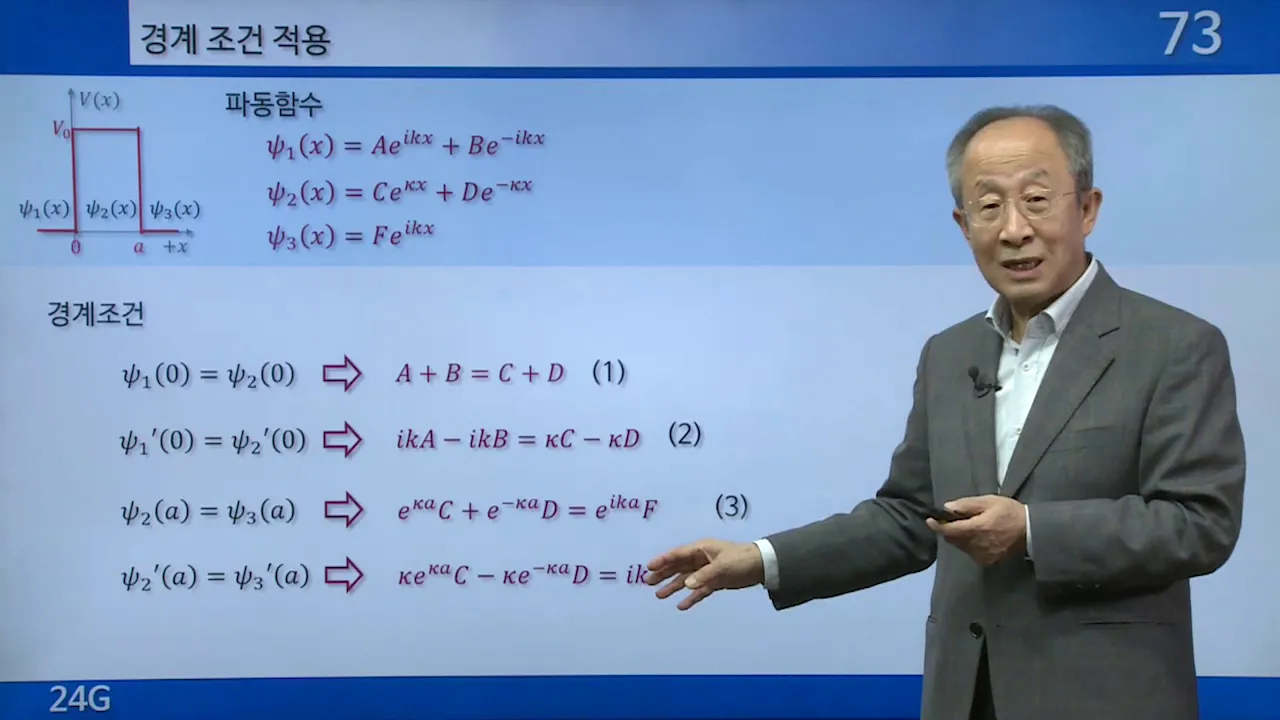
인하대물리2 24G퍼텐셜 장벽 / 터널효과
5.3K
In the classical world, a potential barrier is like a hill or mountain. When an object (like a cart) approaches a barrier, if its kinetic energy is less than the potential energy of the barrier, it cannot cross and will roll back down. If the kinetic energy is greater than the potential energy, it can cross the barrier. This is the classical understanding of potential barriers.
Click to watch →

1 Rectangular potential barrier classical physics
124
In classical mechanics, a particle's total energy E equals kinetic energy plus potential energy V(x). For a rectangular barrier of height V₀, if E < V₀, the kinetic energy becomes negative within the barrier region, which is physically impossible. Therefore, the particle cannot penetrate the barrier and must be reflected. The force is derived from F = -dV/dx, producing Dirac delta functions at the barrier edges that repel the particle. This classical picture shows no penetration when energy is insufficient.
Click to watch →
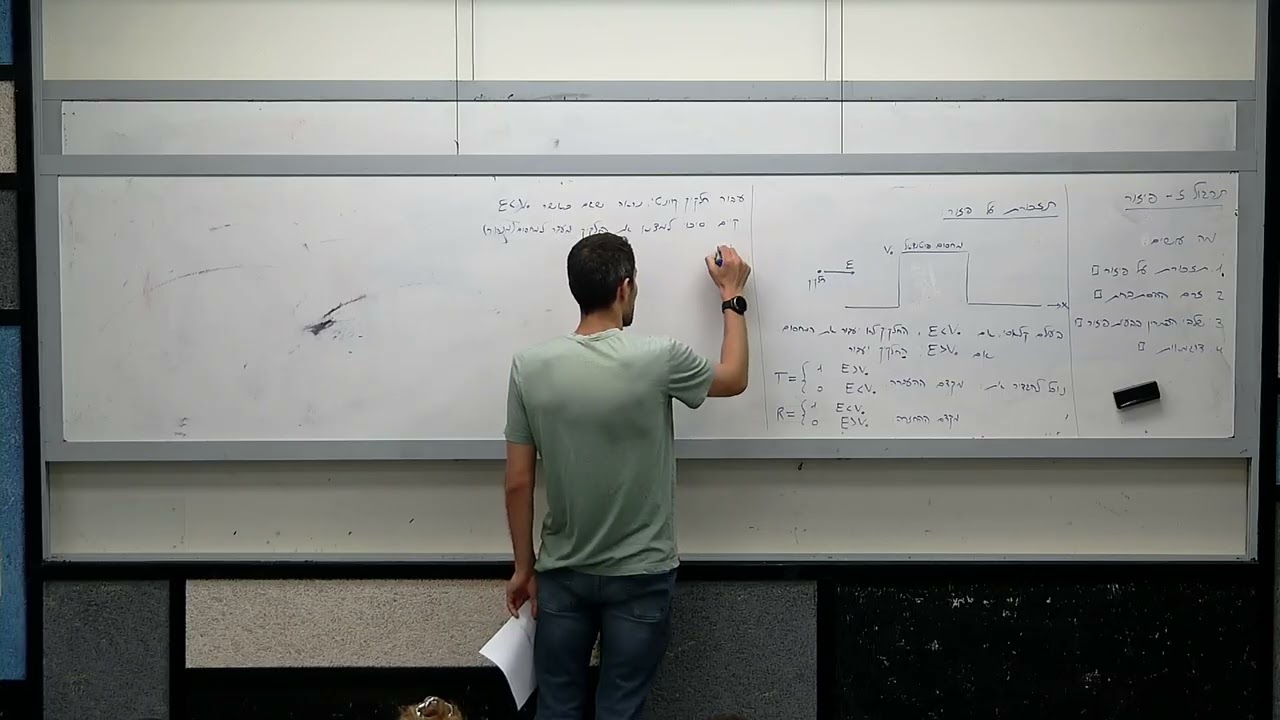
תורת הקוונטים 1- תרגול 5
101
In classical mechanics, a particle approaching a potential barrier behaves deterministically: if the particle's energy E is less than the barrier height V₀, it will be reflected back and cannot pass through; if E is greater than V₀, it will pass through the barrier. This is the classical expectation that quantum mechanics will later modify.
Click to watch →
Deep Dive
The wavefunction and probability density: Grasping Born's interpretation that a particle's state is described by a wavefunction, and the square of its amplitude represents the probability of finding the particle at a given location.
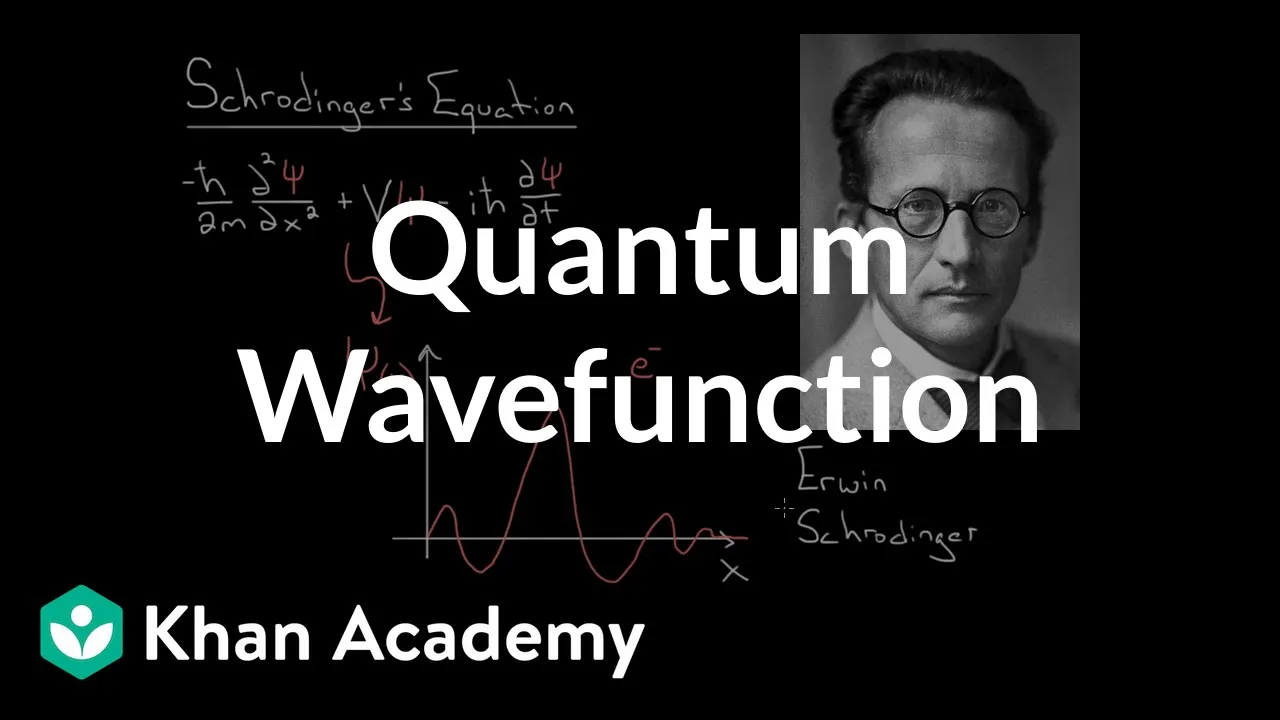
Quantum Wavefunction | Quantum physics | Physics | Khan Academy
491.9K
The quantum wavefunction (ψ) is a mathematical description of a particle's state, where the square of its absolute value (|ψ|²) gives the probability density of finding the particle at a specific location in space; while Schrödinger's equation provides the mathematical framework to calculate this wavefunction, Max Born's interpretation established that it represents probabilities rather than physical charge density, and though physicists still debate the deeper meaning of what is 'waving,' the practical application of using |ψ|² to predict measurement outcomes has enabled significant progress in quantum mechanics over the past century.
Click to watch →

الفصل السادس| الفيزياء الحديثة | نظرية الكم ومبدأ اللادقة| محاضرة 9
28K
The wave function is the fundamental quantity in quantum mechanics, a mathematical expression whose variations form matter waves. It describes the quantum state of a particle at a specific point in space and time. The probability density, which is the probability per unit volume, is proportional to the square of the absolute value of the wave function. This means the probability of finding a particle at a specific location is directly related to the square of the wave function's magnitude at that point.
Click to watch →

عبد العماد الاعرجي للفيزياء السادس العلمي / الفصل السادس / المحاضرة السادسة / الميكانيك الكمي
276
The wave function (دالة الموجة ابساي) is a mathematical quantity that describes the quantum state of a particle. The changes in the wave function create a 'matter wave' (موجة مادية). The magnitude of the wave function depends on the probability of finding the particle at a specific point in space at a given time. Probability density (كثافة الاحتمالية) is the probability of finding a particle in a specific volume element of space, directly proportional to the square of the absolute value of the wave function (|ψ|²). This is why it depends on the square of the absolute value rather than the wave function itself, because the square of the absolute value is always positive and cannot be zero, ensuring that any point in space has some probability of containing the particle.
Click to watch →

فيزياء السادس العلمي | الفصل السادس | المحاضرة 8 | مفهوم ميكانيك الكم و دالة الموجة - منهج 2025
52.8K
The wave function is a quantity whose changes form matter waves and is expressed as a mathematical formula. The value of the wave function at a specific point in space and time is related to the probability of finding the particle at that location. Probability density is the probability per unit volume of finding a particle described by the wave function. The probability density is directly proportional to the square of the wave function at a given point in space and time.
Click to watch →

الفصل السادس/الفيزياء الحديثة/المحاضرة 8/فيزياء السادس العلمي
136
The wave function (ψ) is a mathematical quantity whose variations form matter waves. It is related to the probability of finding a particle at a specific location and time. Probability density is the probability per unit volume for finding a particle described by a wave function at a specific point in space, calculated as |ψ|². When |ψ|² is large, the probability of finding the particle is high; when small, the probability is low; when zero, the particle cannot exist at that location.
Click to watch →
Deep Dive
Introduction to the Schrödinger Equation: Familiarity with the fundamental equation of quantum mechanics that describes how the quantum state of a physical system changes with time.

Schrodinger Equation. Get the Deepest Understanding.
368.7K
The Schrödinger equation is a second-order partial differential equation whose solution is the wave function Ψ(r,t). Unlike classical mechanics which determines trajectories r(t) for predicting particle positions, quantum mechanics requires the wave function approach because particles exhibit wave-particle duality. In classical mechanics, Newton's second law F=ma determines trajectories for everyday objects like planets and projectiles. However, in the atomic realm, particles like electrons cannot have precisely determined positions due to their wave nature, making trajectory-based descriptions impossible. The wave function approach, developed through the Schrödinger equation, allows humans to control the microcosm, enabling technologies like lasers and scanning tunneling microscopes.
Click to watch →
Introduction to Quantum Mechanics: Schrodinger Equation
151.3K
The Schrödinger equation (iℏ∂ψ/∂t = -ℏ²/2m ∂²ψ/∂x² + Vψ) is the fundamental equation of quantum mechanics that replaces Newton's second law by solving for the wavefunction ψ instead of position; unlike classical mechanics where particles have definite positions, quantum mechanics describes particles through probability distributions where the square of the wavefunction's norm gives the probability density, and upon measurement, the wavefunction collapses to a delta function at the measured position while maintaining normalization over time.
Click to watch →
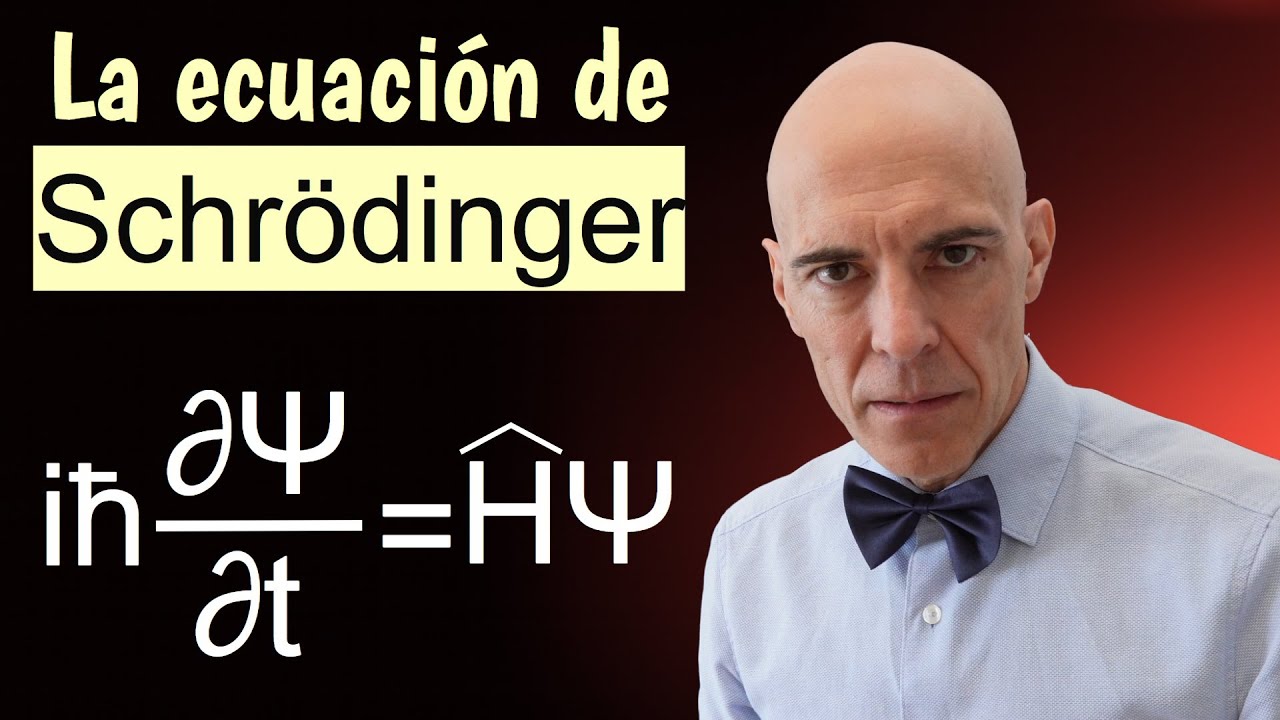
Introducción a la ecuación de Schrödinger
55.1K
The Schrödinger equation is the fundamental equation of quantum mechanics, describing how the quantum state of a physical system changes over time. Unlike Newton's second law (F=ma), which deterministically predicts particle positions, the Schrödinger equation uses a complex-valued wave function (ψ) where the square of its absolute value represents the probability density of finding a particle at a given position. The equation incorporates the reduced Planck constant (ℏ), particle mass, and potential energy function, providing a probabilistic framework for understanding quantum phenomena such as wave-particle duality and energy quantization.
Click to watch →
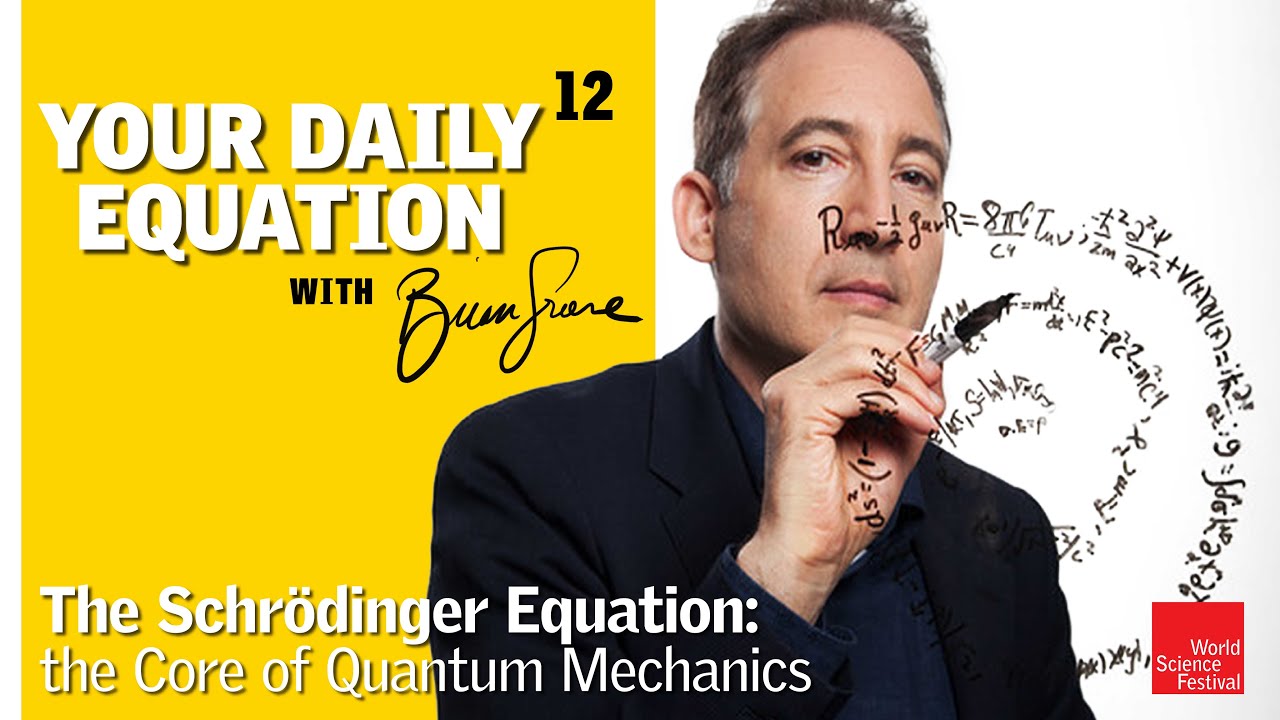
Your Daily Equation #12: The Schrödinger Equation--the Core of Quantum Mechanics
123K
Schrödinger's equation is the fundamental equation of quantum mechanics that describes how the probability wave (wave function) of a particle evolves over time; it is derived by connecting the mathematical properties of waves (spatial derivatives relate to momentum, temporal derivatives relate to energy) with physical quantities through the relationships p = ħk and E = ħω, leading to the equation iħ(∂ψ/∂t) = -(ħ²/2m)(∂²ψ/∂x²) + V(x)ψ, which successfully predicts experimental results for quantum systems.
Click to watch →

What is The Schrödinger Equation, Exactly?
1.6M
The Schrödinger equation is the fundamental equation of quantum mechanics that describes how quantum systems evolve over time; it uses a wave function (represented by the Greek letter psi, ψ) to provide the probabilities of finding a particle at different locations, rather than predicting exact positions, and reveals that quantum particles exist in superposition until measured, with their energy levels being quantized (discrete) rather than continuous due to the wave-like nature of probability distributions.
Click to watch →
Prerequisite Knowledge
- Concept 01Wave-particle duality: Understanding that subatomic particles exhibit both wave-like and particle-like properties, which is essential to conceptualizing wave packets.
- Concept 02Classical potential energy barriers: Knowing how classical physics dictates that a particle cannot cross a barrier if its total energy is less than the potential energy of the barrier.
- Concept 03The wavefunction and probability density: Grasping Born's interpretation that a particle's state is described by a wavefunction, and the square of its amplitude represents the probability of finding the particle at a given location.
- Concept 04Introduction to the Schrödinger Equation: Familiarity with the fundamental equation of quantum mechanics that describes how the quantum state of a physical system changes with time.
Subsequent Learning
- Step 01Scanning Tunneling Microscopy (STM): Exploring how quantum tunneling is applied practically to image materials at the atomic level by measuring tunneling currents.
- Step 02Stellar nucleosynthesis and the Coulomb barrier: Investigating the detailed nuclear physics of how protons overcome electrostatic repulsion to fuse inside stars.
- Step 03Alpha decay in radioactive nuclei: Studying Gamow's theory of alpha decay, which historically provided the first major validation of quantum tunneling.
- Step 04Semiconductor devices and nanotechnology: Examining how quantum tunneling enables flash memory and tunnel diodes, as well as how it poses limitations on the miniaturization of silicon transistors.
Energy limit
Quantum shift
Tunneling chance
Mid-barrier find
Energy limit
0:02Playing Section
- 1
Classical ball drop limits height by energy conservation.
- 2
Barrier prevents crossing without sufficient energy boost.
The Bohmian (Pilot-Wave) Interpretation of Tunneling
While the standard Copenhagen interpretation describes quantum tunneling as a probabilistic event where a particle lacks a definite path and seemingly "teleports" through a barrier, Bohmian mechanics (pilot-wave theory) offers a deterministic counterpoint. In this alternative framework, particles always possess precise positions and trajectories. Instead of vanishing and reappearing, a particle is guided by a real pilot wave. The interaction between this wave and the barrier creates a quantum potential that physically guides the particle through. This perspective challenges standard quantum indeterminacy, offering a concrete, trajectory-based explanation for the tunneling phenomenon.
Deep Dive
Scanning Tunneling Microscopy (STM): Exploring how quantum tunneling is applied practically to image materials at the atomic level by measuring tunneling currents.
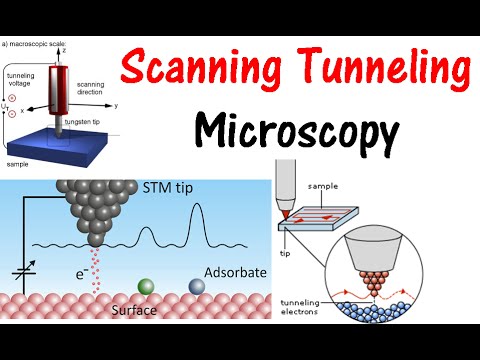
Scanning tunneling microscopy
291.2K
Scanning tunneling microscopy (STM) works by bringing a sharp tip with a single atom at its end extremely close to a metal surface, where quantum tunneling allows electrons to pass through the gap between the tip and surface when a small voltage is applied; the tunneling current changes rapidly with distance, enabling atomic-resolution imaging as the tip scans across the surface while maintaining constant current through feedback-controlled vertical movement.
Click to watch →

SCANNING TUNNELLING MICROSCOPE || SCANNING TUNNELLING MICROSCOPY || STM || WITH EXAM NOTES ||
72.7K
The Scanning Tunneling Microscope (STM) is an instrument that images surfaces at the atomic level using quantum mechanical tunneling of electrons between a sharp metallic tip and a sample surface, invented by Gerd Binnig and Heinrich Rohrer in 1981 and awarded the Nobel Prize in Physics in 1986; it works by applying a voltage between the tip and sample, causing electrons to tunnel through the insulating barrier when they are extremely close (on the order of angstroms), with the tunneling current depending exponentially on the distance, allowing the microscope to create 3D topographic images by either maintaining constant current while scanning or keeping constant height while measuring current variations.
Click to watch →

Cómo el Microscopio Más Potente del Mundo acabó en España
2.4M
The Scanning Tunneling Microscope (STM) emerged from IBM Zurich laboratories through the collaboration of Gerd Binnig and Heinrich Rohrer. Spanish researchers gained access through personal connections: Nicolás García persuaded Rohrer to bring an STM to Spain, and Arturo Baró trained directly with Binnig and technician Christoph Gerber. The STM operates on quantum tunneling principles, using a probe tip just one atom thick. Three piezoelectric bars enable nanometer-scale precision movement. The tip scans surfaces while maintaining constant tunneling current, creating atomic-resolution images. Different atomic species produce distinct tunneling currents, providing chemical contrast. Achieving atomic resolution requires ultra-high vacuum and extreme vibration isolation. The STM solved the decades-old mystery of silicon surface reconstruction, revealing the complex 7x7 pattern that earned Binnig and Rohrer the 1986 Nobel Prize.
Click to watch →

走査型プロ-ブ顕微鏡走査型トンネル顕微鏡とは
165
Scanning Tunneling Microscopy (STM) is a scanning probe microscopy technique that uses an extremely sharp conductive probe positioned approximately 1 nanometer from a material surface; when a small bias voltage (around 0.5V) is applied, electrons tunnel through the quantum mechanical barrier between the probe and surface, creating a tunneling current that changes exponentially with distance (a 0.1nm change in distance causes a 10-fold change in current). This exponential relationship allows the system to maintain constant tunneling current by precisely controlling the probe height via piezoelectric elements, achieving atomic-level resolution (0.01nm precision) and enabling direct observation of surface atomic structures at the quantum mechanical level.
Click to watch →

Il Sogno di FEYNMAN: Il Microscopio a Scansione TUNNEL per spostare i singoli ATOMI!
5.8K
Richard Feynman envisioned manipulating atoms like building blocks, a dream realized through the scanning tunneling microscope (STM). Invented by Gerd Binnig and Heinrich Rohrer in 1981 and earning them the 1986 Nobel Prize, the STM represents a window into the quantum world. The instrument consists of a fine metallic tip positioned extremely close to a sample surface, separated by an insulating barrier (typically vacuum at 10^-10 mbar). When a small voltage is applied, quantum tunneling occurs, allowing electrons to pass through the barrier and generate measurable currents. This remarkable device achieves atomic resolution by exploiting the exponential sensitivity of tunneling current to distance—fluctuations of just one angstrom cause current changes of approximately tenfold.
Click to watch →
Deep Dive
Stellar nucleosynthesis and the Coulomb barrier: Investigating the detailed nuclear physics of how protons overcome electrostatic repulsion to fuse inside stars.

Coulomb barrier & other critical factors
1.9K
Nucleosynthesis describes how lighter elements fuse to form progressively heavier elements in stars, starting from protons and neutrons. The sequence progresses through deuterium formation, helium-3 creation, and eventual helium-4 production. The triple-alpha reaction produces carbon-12 and oxygen-16, essential for life. The Coulomb barrier represents electrostatic repulsion between positively charged nuclei, calculated using Coulomb's law. For deuterium-tritium fusion, this barrier is approximately 0.1 MeV—the smallest among fusion reactions. Helium-4 possesses unusually high binding energy per nucleon because all four nucleons can occupy the ground state simultaneously, making it the most stable product and the preferred fusion reaction pathway.
Click to watch →

Lec 18: Gamow peak and Electron screening effect
2K
At stellar temperatures below 10 gigakelvin, nuclear reactions proceed via quantum tunneling rather than classical mechanisms because energy remains below the Coulomb barrier. The gamma peak centroid shifts to higher energies with increasing nuclear charges, while peak area decreases rapidly. Reactions with smallest Coulomb barriers dominate stellar energy production and rapid nuclear consumption, establishing the sequential burning stages observed in stars.
Click to watch →

Lec 16: Non-resonant charged particle induced reactions
2.3K
For nuclear fusion to occur between charged particles like protons, they must overcome the Coulomb barrier—the electrostatic repulsion preventing close approach. For proton-proton fusion, this barrier requires approximately 550 keV, corresponding to 10^9 Kelvin. Classical physics predicts that at such temperatures, all protons would simultaneously fuse, causing catastrophic stellar explosions. However, no such explosions are observed. At lower temperatures (T = 0.01 Giga Kelvin), the average thermal energy kT ≈ 0.86 keV is far below the barrier. Using Maxwell-Boltzmann statistics, the ratio of particles with 550 keV to those with 0.86 keV is 10^(-275)—insufficient to explain stellar energy production. This contradiction demonstrates that classical physics cannot explain stellar nuclear reactions.
Click to watch →

Astrofisica nucleare: fusioni nucleari nelle stelle
156
When two positively charged nuclei approach, they experience a repulsive Coulomb potential creating a barrier. At stellar temperatures, this barrier exceeds nuclear kinetic energy, making fusion seemingly impossible. Quantum tunneling allows nuclei to pass through this barrier with non-zero probability, enabling fusion despite electrostatic repulsion. The reaction rate depends on two competing factors: the Maxwell-Boltzmann energy distribution (decreasing exponentially with energy) and tunneling probability (increasing with energy). Their product creates the Gamow peak, an optimal energy where reaction rates are maximized. This energy represents the compromise between having enough particles with sufficient energy and high tunneling probability.
Click to watch →
Quantenmechanik für Einsteiger | Harald Lesch
3.8M
Stars produce energy through nuclear fusion, where atomic nuclei combine to form heavier elements. In classical physics, like-charged nuclei repel each other and cannot fuse. However, quantum tunneling allows nuclei to overcome this repulsion by having a non-zero probability of being close enough together despite the energy barrier. This quantum mechanical effect enables fusion reactions that power stars and create all elements heavier than hydrogen and helium.
Click to watch →
Deep Dive
Alpha decay in radioactive nuclei: Studying Gamow's theory of alpha decay, which historically provided the first major validation of quantum tunneling.

Radyoaktivite
286K
Alpha decay is a type of radioactive decay where an unstable nucleus emits an alpha particle, which is a helium nucleus (2 protons and 2 neutrons, represented as ⁴He²⁺). The parent nucleus loses 4 mass units and 2 atomic numbers. Alpha particles are the slowest of all radiation types, are positively charged, and are easily stopped by materials. They have high ionizing power but low penetrating power.
Click to watch →

43) Atom Fiziği - Radyoaktif Işıma Alfa Beta ve Gama Işımaları ( 75. Gün )
110.3K
Alpha decay is a type of radioactive decay where an unstable nucleus emits an alpha particle, which consists of 2 protons and 2 neutrons (essentially a helium nucleus). During alpha decay, the parent nucleus loses 2 protons and 2 neutrons, resulting in a decrease of 4 in mass number and 2 in atomic number. Alpha particles have low penetrating power and can be stopped by a thin sheet of paper or human skin. This decay occurs in heavy nuclei to reduce their size and move toward the band of stability.
Click to watch →
![فيزياء السادس العلمي || الفيزياء النووية || المحاضرة [ 3 ]](https://i.ytimg.com/vi/GY_JO4xPL4s/maxresdefault.jpg)
فيزياء السادس العلمي || الفيزياء النووية || المحاضرة [ 3 ]
374K
Radioactive decay is the process by which unstable atomic nuclei transform into more stable configurations, particularly in heavy elements. There are three main types: Alpha decay (emission of helium nuclei), Beta decay (emission of electrons/positrons), and Gamma decay (emission of high-energy photons). Alpha decay occurs when unstable nuclei emit alpha particles (helium nuclei with 2 protons and 2 neutrons) to reduce mass and volume. The energy released (Qα) is calculated using Qα = (m_parent - m_daughter - m_alpha) × 931 MeV/u. Nuclear equations must be balanced by conserving atomic and mass numbers. A nucleus undergoes spontaneous alpha decay only if Qα > 0, ensuring the process releases energy and is energetically favorable.
Click to watch →

الفصل التاسع || الفيزياء النووية || فيزياء السادس علمي
74.5K
Alpha decay is a type of radioactive decay where an unstable nucleus emits an alpha particle (helium nucleus with 2 protons and 2 neutrons, charge +2). Alpha decay occurs when nuclei have relatively large mass and volume. The parent nucleus transforms into a daughter nucleus with mass number decreased by 4 and atomic number decreased by 2. Nuclear equations must be balanced with equal mass and atomic numbers on both sides.
Click to watch →
☢️الوحدة 05 :التحولات النووية |الحصة03 مخطط سيغري N-Z 🥇🔥
37.3K
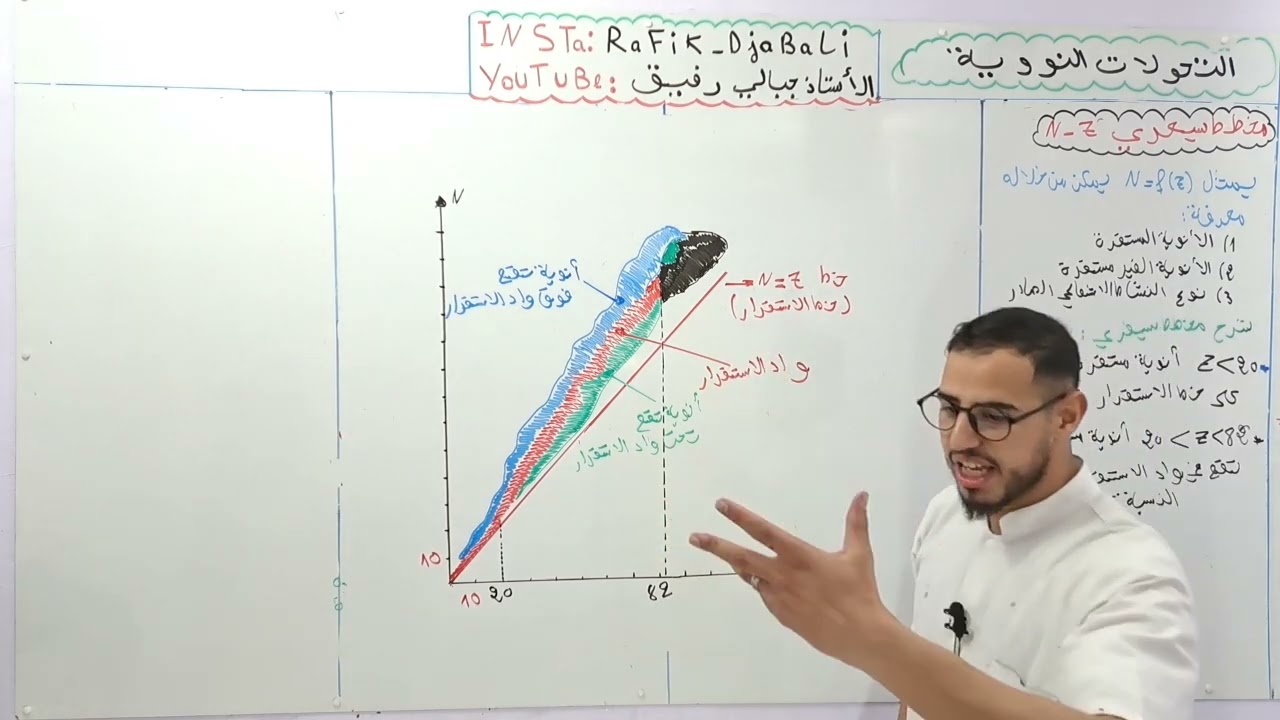
Alpha decay (صدور اشعاع الفا) occurs in heavy nuclei with more than 200 nucleons. These nuclei are unstable due to their large size and high mass. In alpha decay, the nucleus emits an alpha particle, which consists of 2 protons and 2 neutrons (equivalent to a helium-4 nucleus). This emission reduces the atomic number by 2 and the mass number by 4, significantly decreasing the size and mass of the nucleus. Alpha decay is characteristic of heavy nuclei located in the region of the Segrè chart where Z > 82 (bismuth).
Click to watch →
Deep Dive
Semiconductor devices and nanotechnology: Examining how quantum tunneling enables flash memory and tunnel diodes, as well as how it poses limitations on the miniaturization of silicon transistors.

2017 고려대 전공체험강의실 - 공과대학 전기전자공학부
21.3K
Semiconductor and nanotechnology form the foundation of modern electronic devices. These technologies enable the creation of memory devices, sensors, and other electronic components that power contemporary technology. Semiconductors serve as the bridge between the physical world and the digital world, enabling the miniaturization and functionality of modern electronic systems.
Click to watch →

NANOTECNOLOGÍA, el LEGADO de Richard FEYNMAN l Hora GAUSSIANA en EXCLUSIVA desde RUSIA
4K
The semiconductor industry represents the largest application area of nanotechnology. Semiconductors are essential components in virtually all modern electronic devices, including smartphones, satellites, laptops, and aircraft. The development of nanotechnology has enabled the creation of smaller, more efficient, and more powerful electronic devices. The industry continues to drive innovation in nanotechnology, creating demand for professionals with specialized knowledge in this field.
Click to watch →
class 12 physics chapter 14 Semiconductor( Extrinsic semiconductor - n- type & p- type) explained p3
249
Nanotechnology enables the creation of semiconductor devices at the nanoscale, where quantum effects become significant. Nanoscale transistors, quantum dots, and nanowires exhibit properties different from bulk materials. This technology is driving the development of faster, smaller, and more energy-efficient electronic devices.
Click to watch →

Semiconductor Industry for Physics Students and CeNSE Department IISC
5.2K
The semiconductor industry is one of the most trending fields in technology and science, expected to grow exponentially. Nanotechnology operates at the nanoscale, smaller than the diameter of a human hair (100-200 micrometers), where devices are thinner than hair and require specialized engineering approaches. Chip manufacturing involves placing millions of transistors in micrometer-scale spaces, with companies like TSMC and Intel leading this field. Two-dimensional materials (atomic layers with no height) can replace silicon in specific applications where silicon performs poorly, such as gallium nitride for energy efficiency and graphene for unique electrical properties. These materials exhibit exotic physics phenomena like transitioning between insulator and superconductor states. MEMS devices combine mechanical motion with electronic signals, enabling applications like mobile phone orientation sensors and 5G filters. Optoelectronics combines optical and electronic properties, enabling applications like water purification using light, UV detectors for missile detection, and optical communication systems. Nanofabrication requires clean rooms because dust particles at the nanoscale can be as large as the devices being manufactured. A Class 100 clean room has only 100 dust particles greater than one micrometer per liter of air, compared to approximately 100,000 particles in normal environments. The National Nano Fabrication Center (NNFC) at IISc Bangalore, inaugurated in 2014, provides Class 1000 clean rooms overall with Class 100 for lithography. The facility has 50-70 essential tools including electron and UV lithography, etching equipment, and various measurement instruments. Characterization facilities (MNCf) provide over 50-72 measurement tools for studying nanomaterial properties, including optical benches, microscopes, Raman spectroscopy, XRD, and scanning tunneling microscopy. Packaging labs are essential for connecting nanoscale devices to power supplies, involving gold wires (25 micrometers thick) to connect devices to power supplies like lock-in amplifiers and source meters. PCB design and microcontroller programming are also taught, with dedicated personnel available.
Click to watch →

As Foxconn-Vedanta deal snaps, a look at semiconductors & 'design giant' India’s 40-yr chip struggle
158.7K
Semiconductors are materials that conduct electricity better than insulators but worse than conductors like copper. Silicon serves as the primary semiconductor material, enabling electronic circuitry to be printed onto wafers. Modern microchips operate at nanoscale dimensions: human hair is 90,000 nanometers, viruses are 14 nanometers, and current advanced chips reach 2 nanometers—smaller than DNA molecules. This extreme miniaturization allows massive computing power to fit into tiny devices like smartphones, revolutionizing technology across all sectors.
Click to watch →
Energy limit
Quantum shift
Tunneling chance
Mid-barrier find
Energy limit
0:02- 1
Classical ball drop limits height by energy conservation.
- 2
Barrier prevents crossing without sufficient energy boost.
The Bohmian (Pilot-Wave) Interpretation of Tunneling
While the standard Copenhagen interpretation describes quantum tunneling as a probabilistic event where a particle lacks a definite path and seemingly "teleports" through a barrier, Bohmian mechanics (pilot-wave theory) offers a deterministic counterpoint. In this alternative framework, particles always possess precise positions and trajectories. Instead of vanishing and reappearing, a particle is guided by a real pilot wave. The interaction between this wave and the barrier creates a quantum potential that physically guides the particle through. This perspective challenges standard quantum indeterminacy, offering a concrete, trajectory-based explanation for the tunneling phenomenon.
Wave-particle duality: Understanding that subatomic particles exhibit both wave-like and particle-like properties, which is essential to conceptualizing wave packets.
Classical potential energy barriers: Knowing how classical physics dictates that a particle cannot cross a barrier if its total energy is less than the potential energy of the barrier.
The wavefunction and probability density: Grasping Born's interpretation that a particle's state is described by a wavefunction, and the square of its amplitude represents the probability of finding the particle at a given location.
Introduction to the Schrödinger Equation: Familiarity with the fundamental equation of quantum mechanics that describes how the quantum state of a physical system changes with time.
Scanning Tunneling Microscopy (STM): Exploring how quantum tunneling is applied practically to image materials at the atomic level by measuring tunneling currents.
Stellar nucleosynthesis and the Coulomb barrier: Investigating the detailed nuclear physics of how protons overcome electrostatic repulsion to fuse inside stars.
Alpha decay in radioactive nuclei: Studying Gamow's theory of alpha decay, which historically provided the first major validation of quantum tunneling.
Semiconductor devices and nanotechnology: Examining how quantum tunneling enables flash memory and tunnel diodes, as well as how it poses limitations on the miniaturization of silicon transistors.
2.5M views19.3Klikes1:05@MinutePhysicsOriginal Release: 2011-08-14
Suppose you drop a ball down the side of a valley - classical wisdom tells us that when the ball rolls up the hill on the other side, it can't go any higher than the height from which you dropped it - that's conservation of energy!
Even if there's a nice big long slope to roll down on the far side of the mountain, the ball just can't get there - unless you give it enough energy to get over the barrier.
But in quantum mechanics, things work a little differently.
You see, the quantum world is probabilistic, so if you release a particle in a valley, chances are the next time you see it, it'll still be somewhere in that valley.
But if there's a nice big slope to roll down on the far side of the mountain… well, that's a place the particle would really like to be - and it turns out there's also a small chance that's where you'll find it!
If this isn't crazy enough, it's even possible you'll find the particle in the middle of the mountain… and in real life this means that an electron sometimes hangs around inside the nucleus of an atom!
Up Next

36:49
Physics of Computer Memory: SRAM, DRAM, SSD, HDD Explained
@TerraPhysica
1.5K views•2024-03-10

22:39
Fluorescence & Jablonski Diagram | Molecular Photophysics
@yairmeiry
192.2K views•2012-01-12
2:11
Einstein's Proof of E=mc²: Special Relativity Explained
@MinutePhysics
6.2M views•2012-03-29

27:14
Entropy and the Second Law of Thermodynamics Explained
@veritasium
27.5M views•2023-07-01
Related Study Plans & Knowledge Roadmaps
Structured learning paths in Physics
physics
Analytical Mechanics: Lagrangian & Hamiltonian
01Mathematical Foundations: Calculus of Variations
02From Newtonian Mechanics to Constraint Dynamics
03The Principle of Least Action & Lagrangian Mechanics
+ 3 more learning modules
28h6 modules
Explore Roadmap
physics
General Relativity (Spacetime & Cosmology)
01Foundations of Relativity: Special Relativity
02The Geometry of Spacetime: Equivalence Principle & Curvature
03Einstein's Field Equations: The Mathematics of Gravity
+ 2 more learning modules
55h5 modules
Explore Roadmap
physics
Chaos Theory: Pendulums, Bifurcation & Limits
01Foundations of Classical Mechanics and Pendulums
02The Transition to Nonlinearity and the Double Pendulum
03Core Principles of Deterministic Chaos
+ 3 more learning modules
18h6 modules
Explore Roadmap
physics
Optics (Lenses, Wavefronts & Instruments)
01Foundations of Light and Geometrical Optics
02Mirrors, Lenses, and Image Formation
03Wave Optics: Wavefronts and Interference
+ 2 more learning modules
28h5 modules
Explore Roadmap