















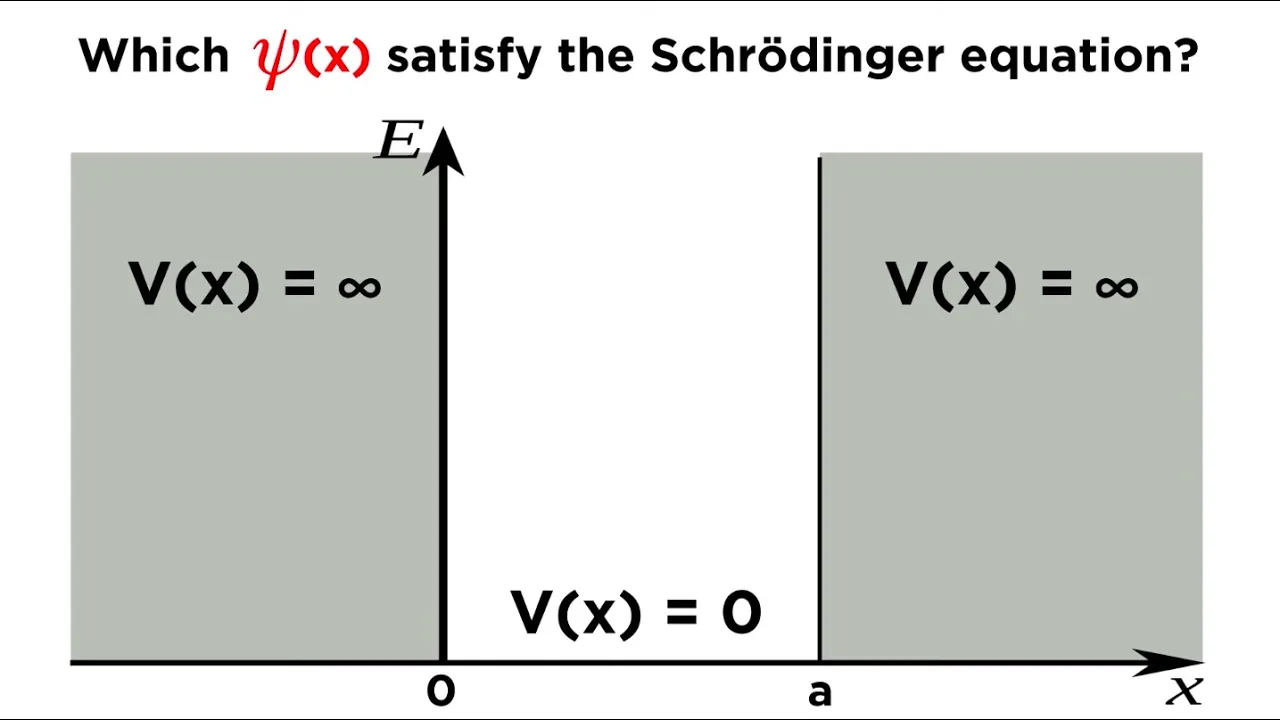

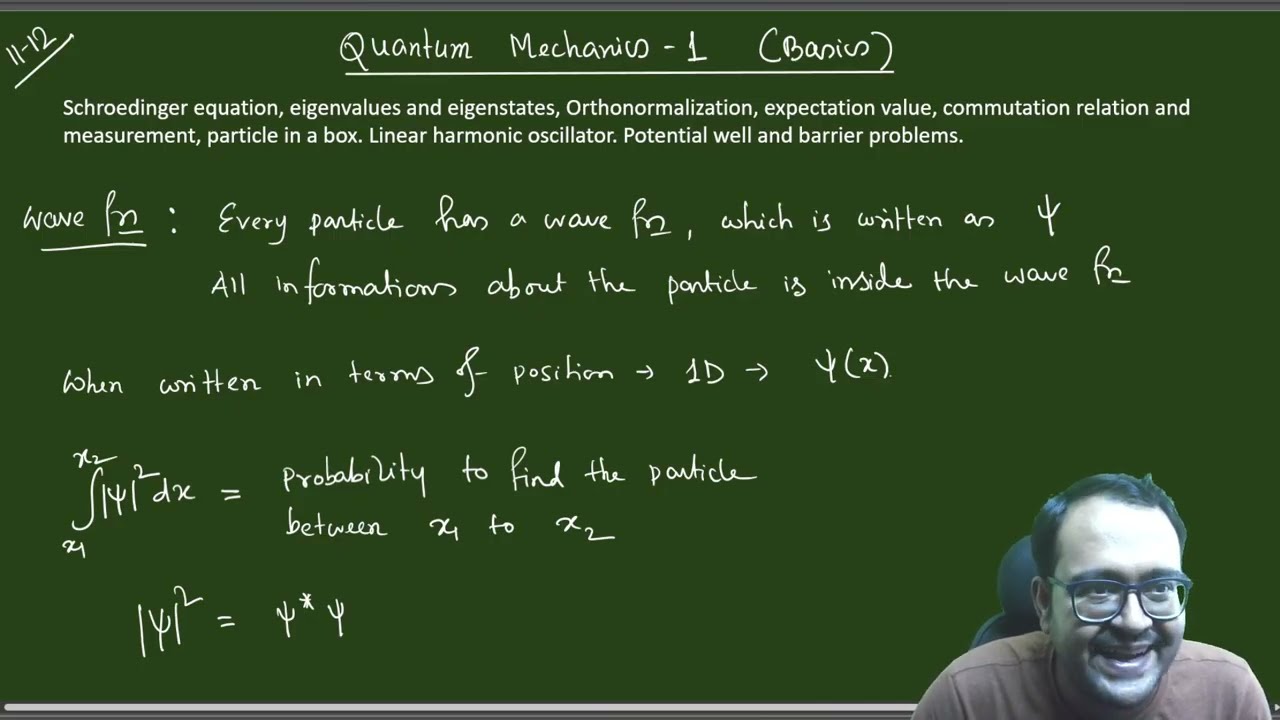










The quantum wavefunction (ψ) is a mathematical description of a particle's state, where the square of its absolute value (|ψ|²) gives the probability density of finding the particle at a specific location in space; while Schrödinger's equation provides the mathematical framework to calculate this wavefunction, Max Born's interpretation established that it represents probabilities rather than physical charge density, and though physicists still debate the deeper meaning of what is 'waving,' the practical application of using |ψ|² to predict measurement outcomes has enabled significant progress in quantum mechanics over the past century.
Quantum Wavefunction Explained | Quantum Physics | Khan Academy
Added:Understanding of wave-particle duality, specifically the de Broglie hypothesis that matter can exhibit wave-like behavior.
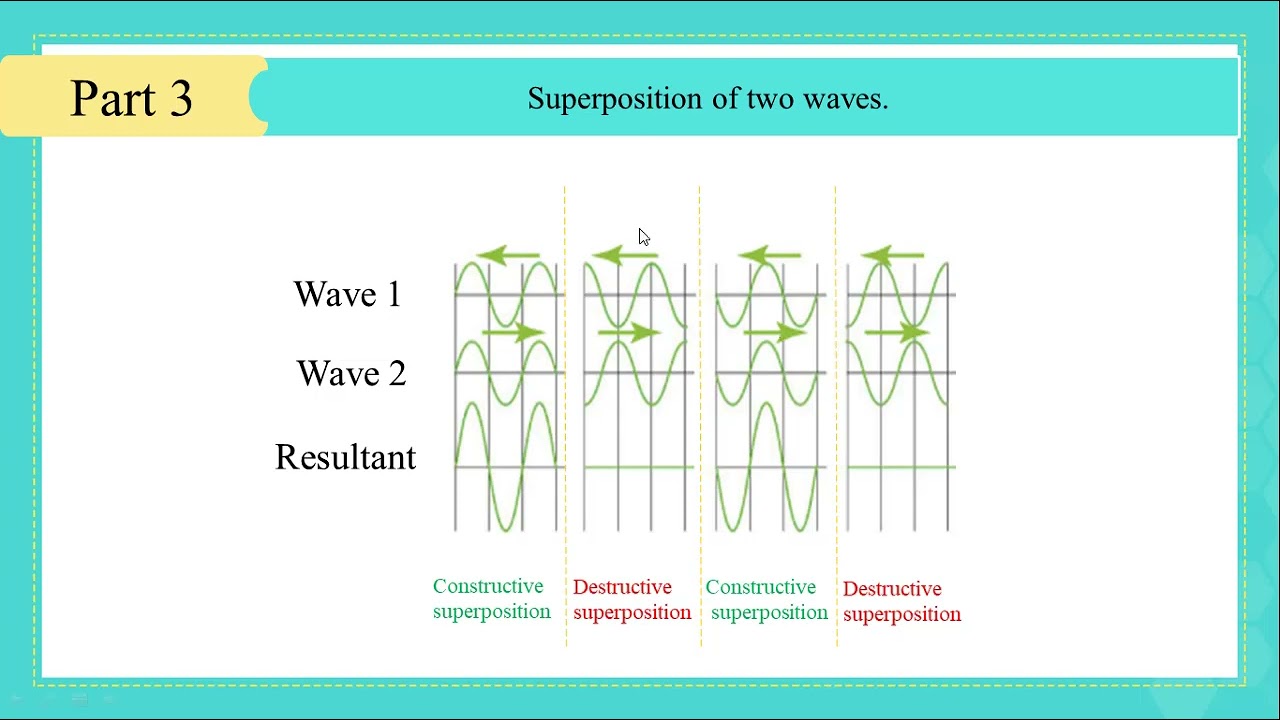
Basic wave mechanics, including concepts of amplitude, wavelength, phase, and the principle of superposition.
Familiarity with classical energy concepts, specifically the distinction between kinetic energy and potential energy.
Basic probability concepts, particularly the difference between a probability amplitude and a probability density.
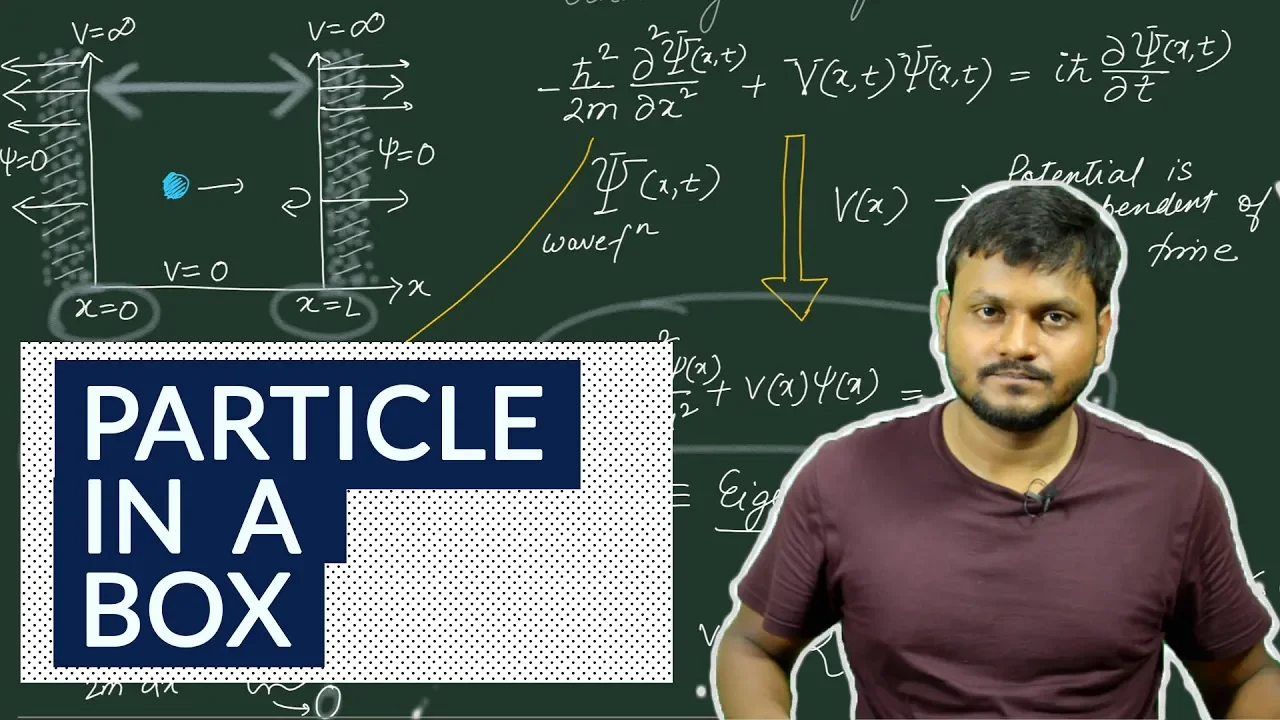
Solving the Schrödinger equation for simple, idealized systems like the 'Particle in a Box' (infinite potential well).
Understanding quantum operators (such as the Hamiltonian and momentum operators) and how they extract physical observables from the wavefunction.
Exploring quantum measurement theory, wavefunction collapse, and the Copenhagen interpretation.
Investigating quantum tunneling, a direct consequence of the wavefunction's behavior at potential barriers, and its applications in technology like flash memory.
491.9K views10.8Klikes10:11Original Release: 2018-06-25
- [Instructor] So when people first showed that matter particles like electrons can have wavelengths and when DeBroglie showed that the wavelength is Planck's constant over the momentum, people were like cool, it's pretty sweet.
But you know someone was like wait a minute, if this particle has wavelike properties and it has a wavelength, what exactly is waving?
What is this wave we're even talking about?
Conceptually it's a little strange.
I mean a water wave, we know what that is.
It's a bunch of water that's oscillating up and down.
A wave on a string, we know what that is.
This string itself is moving up and down and it extends through space.
But it's hard to imagine, how is this electron having a wavelength and what is the actual wave itself?
So physicists were grappling with this issue, trying to conceptually understand how to describe the wave of the electron.
They wanted to do two things.
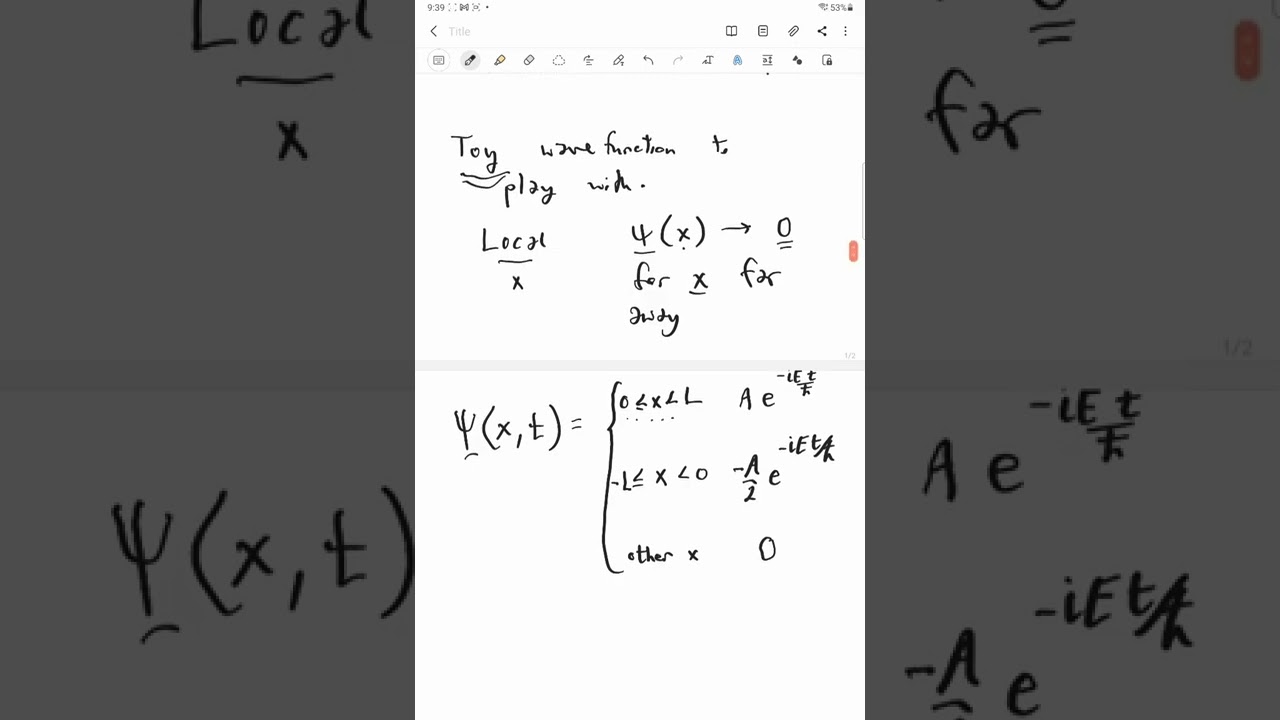
They wanted a mathematical description for the shape of that wave, and that's called the wave function.
So this wave function gives you a mathematical description for what the shape of the wave is.
So different electron systems are gonna have different wave functions, and this is psi, it's the symbol for the wave function.
So this is psi, the psi symbol.
It's a function of x.
So at different points in x, it may have a large value, it may have a small value.
This function would give you the mathematical shape of this wave.
So that was one of the things they were trying to determine.
But they also wanted to interpret it.
Like what does this wave function even mean?
So we've got two problems.
We want a mathematical description of the wave and we wanna interpret what does this wave even mean.
Now the person that gave us the mathematical description of this wave function was Erwin Schrodinger.
So Schrodinger is this guy right here.
Schrodinger's right here.
He wrote down Schrodinger's Equation, and his name now is basically synonymous with quantum mechanics because this is arguably the most important equation in all of quantum mechanics.
There's a bunch of partial derivatives in here and Planck's constants, but the important thing is that it's got the wave function in here.
Now if you've never seen partial derivatives or calculus, it's okay.
All you need to know for our purposes today in this video is that this equation is a way to crank out the mathematical wave function.
What is this function that gives us the shape of the wave as a function of x?
And you could imagine plotting this on some graph.
So once you solve for this psi as a function of x, you could plot what this looks like.
Maybe it looks something like this, and who knows, it could do all kinds of stuff.
Maybe it looks like that.
But Schrodinger's Equation is the way you can get this wave function.
So Schrodinger gave us a way to get the mathematical wave function, but we also wanted to interpret it.
What does this even mean?
To say that this wave function represents the electrons is still strange.
What does that mean?
Schrodinger tried to interpret it this way.
He said, okay maybe this electron really is like smudged out in space and its charge is kinda distributed in different places.
Schrodinger wanted to interpret this wave function as charge density, and I mean it's kind of a reasonable thing to do.
The way you get a water wave is by having water spread out through space.
So maybe the way you get an electron wave is to have the charge of the electron spread out through space.
But this description didn't work so well, which is kinda strange.
Schrodinger invented this equation.
He came up with this equation, but he couldn't even interpret what he was describing correctly.
It took someone else.
It took a guy named Max Born to give us the interpretation we go with now for this wave function.
Max Born said no, don't interpret it as the charge density.
What you should do is interpret this psi is giving you a way to get the probability of finding the electron at a given point in space.
So Max Born said this, if you find your psi, like he said go ahead and use Schrodinger's equation, use it, get psi.
Once you have psi, what you do is you square this function.
So take the absolute value, square it, and what that's gonna give you is the probability of finding the electron at a given point.
Now technically it's the probability density, but for our purposes, you can pretty much just think about this as the probability of finding the electron at a given point.
So if this was our wave function in other words, Max Born would tell us that points where it's zero, these points right here where the value is zero, there is a zero percent chance you're gonna find the electron there.
Points where there's a large value of psi, be it positive or negative, there's gonna be a large probability of finding the electron at that point.
And we could say the odds of finding the electron at a given point here are gonna be largest for this value of x right here because that's the point for which the wave function has the greatest magnitude.
But you won't necessarily find the electron there.
If you repeat this experiment over and over, you may find the electron here once, you may find it over here, you may find it there next time.
You have to keep taking measurements, and if you keep taking measurements, you'll get this distribution where you find a lot of 'em here, a lot of 'em there, a lot of 'em here, and a lot of 'em here, always where there's these peaks you get more of them than you would have at other points where the values are smaller.
You build up a distribution that's represented by this wave function.
So the wave function does not tell you where the electron's gonna be.
It just gives you the probability, and technically the square of it gives you the probability of finding the electron somewhere.
So even at points down here where the wave function has a negative value, I mean you can't have a negative probability.
You square that value.
That gives you the probability of finding the electron in that region.
So in other words, let's get rid of all this.
Let's say we solved some Schrodinger equation or we were just handed a wave function and we were told it looks like this and we were asked, where are you most likely to find the electron?
Well the value of the wave function is greatest at this point here, so you'd be most likely to find the electron in this region right here.
You'd have no shot of finding it right there.
You'd have pretty good odds of finding it right here or right here, but you'd have the greatest chance of finding it in this region right here.
So you'd have to repeat this measurement many times.
In quantum mechanics, one measurement doesn't verify that you've got the right wave function.
Because if I do one experiment and measure one electron, boop I might find the electron right there.
That doesn't really tell me anything.
I have to repeat this over and over to make sure the relative frequency of where I'm finding electrons matches the wave function I'm using to model that electron system.
So that's what the wave function is.
That's what it can do for you, although if I were you, I'd still be unsatisfied.
I'd be like, wait a minute, okay, that's fine and good.
Wave function can give us the probability or the probability density of finding the electron in a given region, but we haven't answered the question, what is waving here and what exactly is this wave function?
Is this a physical object sort of like a water wave or even an electromagnetic wave?
Or is this just some mathematical trickery that we're using that has no physical interpretation other than giving us information about where the electron's gonna be?
And I've got good news and bad news.
The bad news is that people still don't agree on how to interpret this wave function.
Yes they know that the square of it gives you the probability of finding the electron in some region, but people differ on how they're supposed to interpret it past that point.
For instance, is this wave function the wave function of a single electron or is this wave function really the wave function of a system, an ensemble of electrons, all similarly prepared that you're gonna do the experiment on?
In other words, does it describe one electron or only describe a system of electrons?
Does it not describe the electron at all but only our measurement of the electron?
And what happens to this wave function when you actually measure the electron?
When you measure the electron you find it somewhere, and at that moment there's no chance of finding it over here at all.
So does the act of measuring the electron cause some catastrophic collapse in this wave function that's not described by Schrodinger's Equation?
These and many more questions are still debated and not completely understood.
That's the bad news.
The good news is that we don't really need to understand that to make progress.
Everyone knows how to use the wave function to get the probabilities of measurements.
You can have your favorite interpretation, but luckily pretty much regardless of how you interpret this wave function, as long as you're using it correctly to get the probabilities of measurements, you can continue making progress, testing different models, and correlating data to the measurements that people make in the lab.
Now I'm not saying that interpretations of this wave function are not important.
People have tried cracking this nut for over 100 years, and it's resisted.
Maybe that's because it's a waste of time or maybe it's because the difficulty of figuring this out is so great that whoever does it will go down in history as one of the great physicists of all time.
It's hard to tell right now, but what's undebatable is for about 100 years now, we've been able to make progress with quantum mechanics even though we differ on how exactly to interpret what this wave function really represents.
So recapping the wave function gives you the probability of finding a particle in that region of space, specifically the square of the wave function gives you the probability density of finding a particle at that point in space.
This almost everyone has agreed upon.
Whether the wave function has deeper implications besides this, people differ, but that hasn't yet stopped us from applying quantum mechanics correctly in a variety of different scenarios.
Up Next

11:20
Schrödinger's Cat Explained: What It Really Means in Quantum Physics
@physicsgirl
547.4K views•2021-12-16

12:53
21cm Hyperfine Transition in Neutral Hydrogen: Radio Astronomy Basics
@AaronRobertParsons
12.4K views•2011-10-13
14:45
Simple Pendulum Period: Physics Tutorial
@khanacademyphysics7609
384.2K views•2016-07-29

27:14
Entropy and the Second Law of Thermodynamics Explained
@veritasium
27.5M views•2023-07-01
Related Study Plans & Knowledge Roadmaps
Structured learning paths in Physics
physics
Nuclear Physics (Decay, Fission & Reactors)
01Atomic Structure and the Binding Force
02Radioactive Decay and Half-Life
03Nuclear Fission Mechanics and Chain Reactions
+ 2 more learning modules
12h5 modules
Explore Roadmap
physics
Soft Matter (Polymers, Colloids & Rheology)
01Foundations of Soft Matter & Thermal Forces
02Polymer Physics and Macromolecules
03Colloids, Surfactants, and Self-Assembly
+ 2 more learning modules
38h5 modules
Explore Roadmap
physics
Analytical Mechanics: Lagrangian & Hamiltonian
01Mathematical Foundations: Calculus of Variations
02From Newtonian Mechanics to Constraint Dynamics
03The Principle of Least Action & Lagrangian Mechanics
+ 3 more learning modules
28h6 modules
Explore Roadmap
physics
General Relativity (Spacetime & Cosmology)
01Foundations of Relativity: Special Relativity
02The Geometry of Spacetime: Equivalence Principle & Curvature
03Einstein's Field Equations: The Mathematics of Gravity
+ 2 more learning modules
55h5 modules
Explore Roadmap