


![(AGT1E1) [Game Theory] Strategic (normal) Form Games: Definitions](https://i.ytimg.com/vi_webp/tNZoXBTLu7g/maxresdefault.webp)


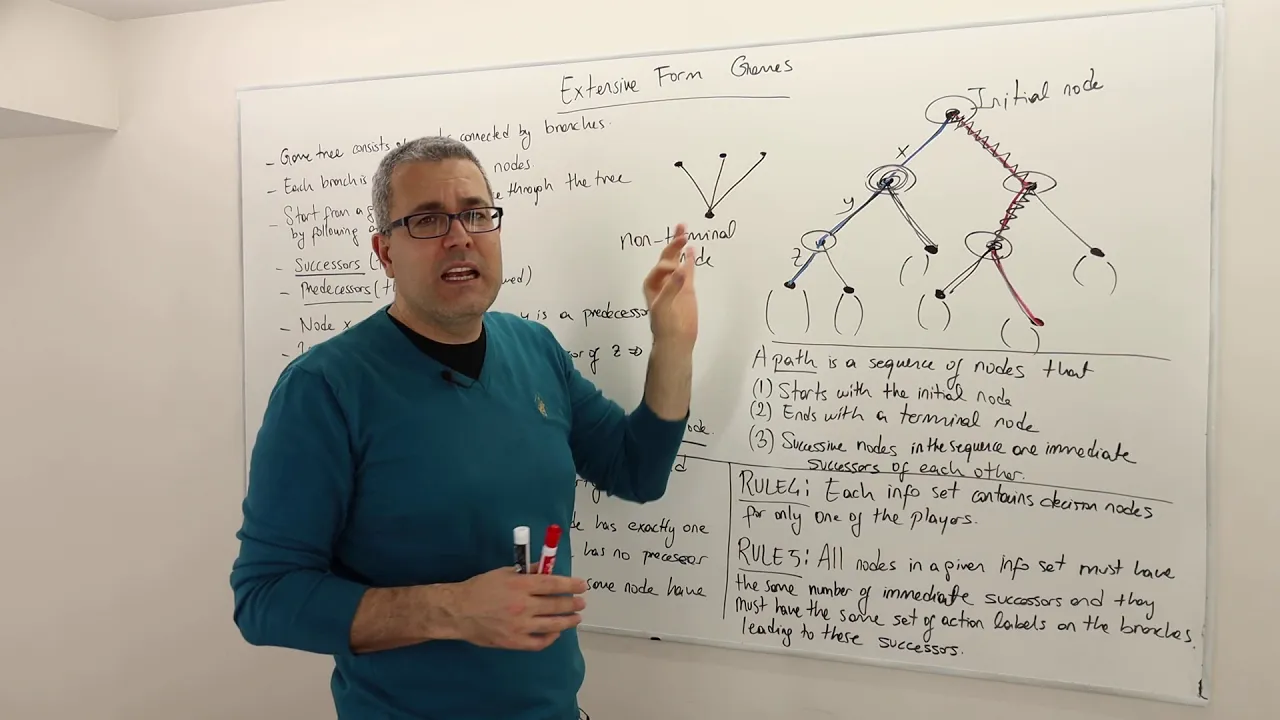

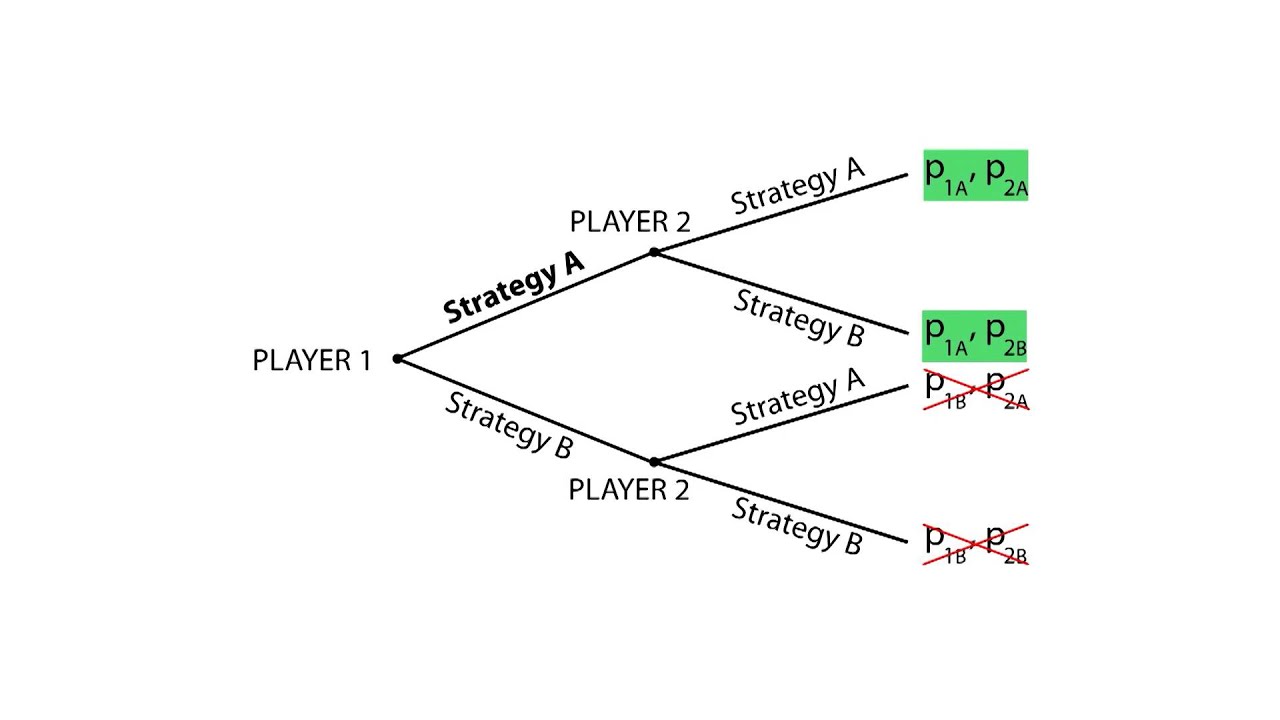



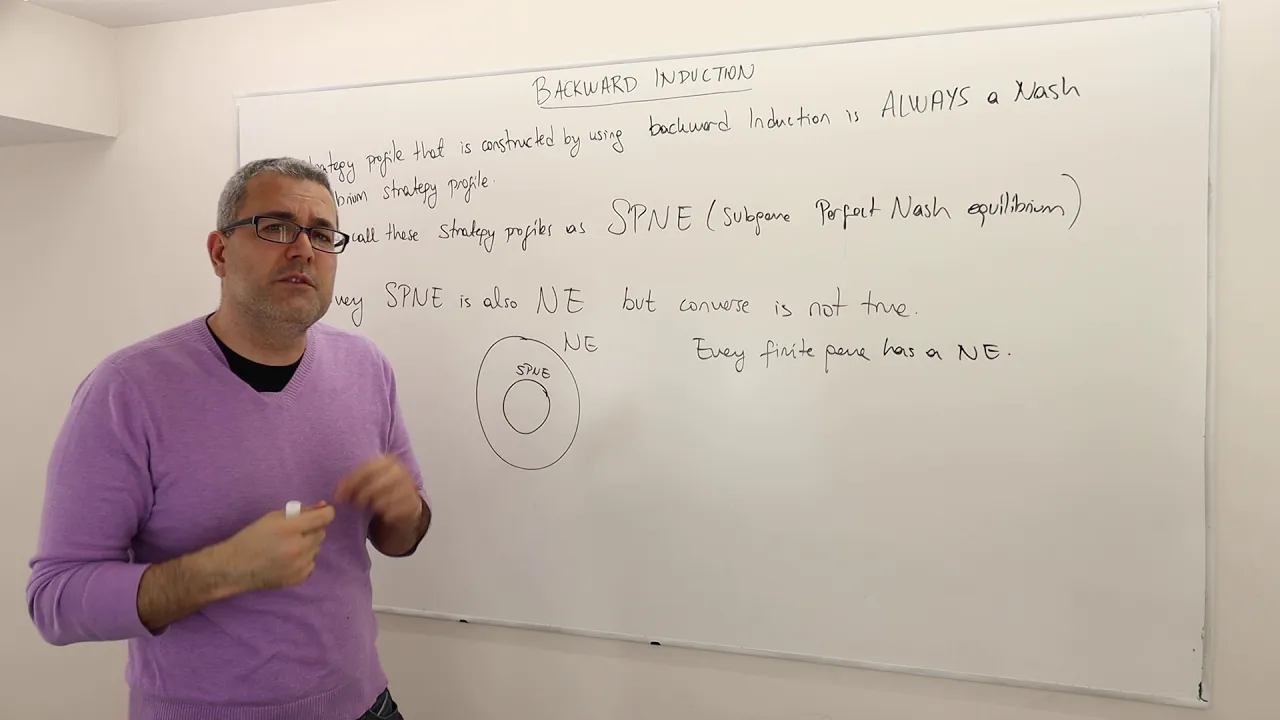




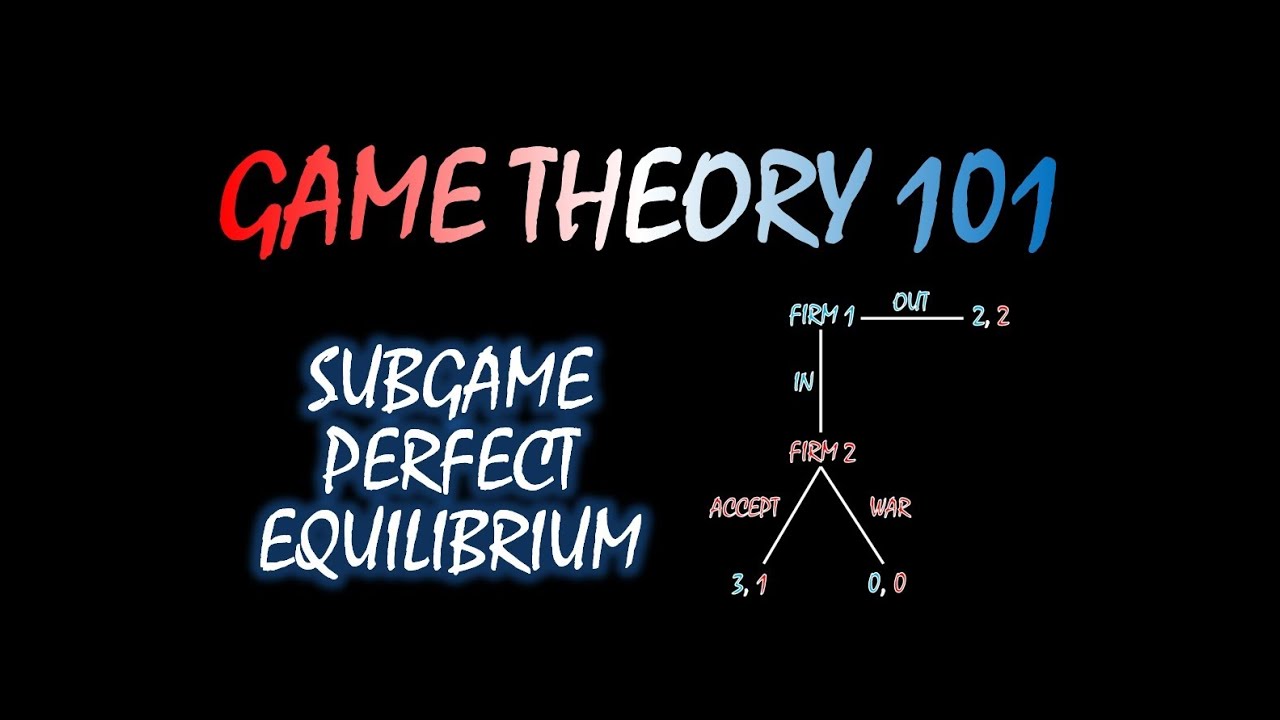



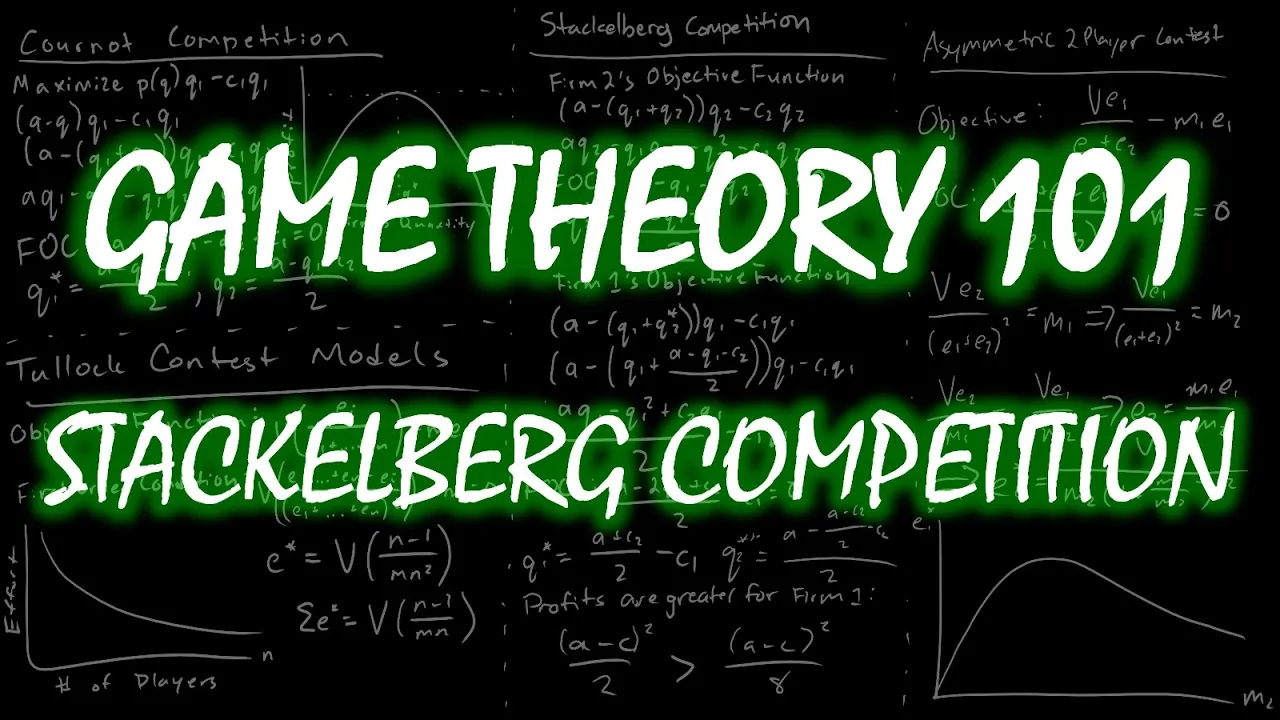



Backwards induction is a solution method for sequential move games where you start at the end of the game tree and work backwards, eliminating dominated strategies at each decision node to determine the subgame perfect equilibrium; players make optimal choices based on anticipating future players' rational responses, which may mean they cannot achieve their most preferred outcomes even if they desire them.
Backward Induction in Game Trees: Sequential Move Game Theory
Added:Fundamental concepts of Game Theory, including players, actions, strategies, and payoffs.
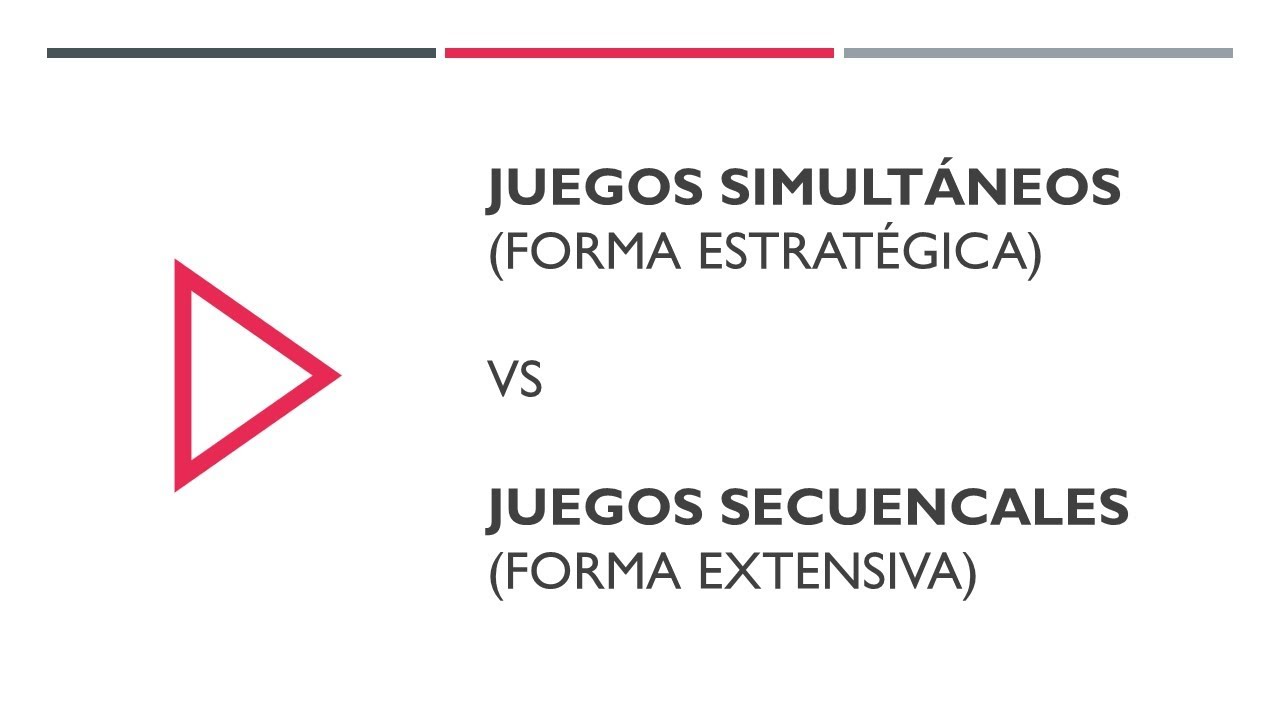
The basic distinction between simultaneous-move games and sequential-move games.
How to read and interpret extensive form representations of games, such as game trees, decision nodes, and terminal payoff branches.
The assumption of player rationality, specifically the principle that players aim to maximize their individual utility or payoffs.
Formalizing the concept of Subgame Perfect Nash Equilibrium (SPNE) as a refinement of Nash Equilibrium.
Analyzing dynamic games of imperfect information, where players cannot observe previous moves (represented by non-trivial information sets).
Understanding the strategic concept of credible versus incredible threats and promises in sequential interactions.
Exploring advanced economic models of sequential moves, such as Stackelberg competition (leadership models) and sequential bargaining games.
Transitioning to games of incomplete information and the concept of Perfect Bayesian Equilibrium.
127.8K views3.3Klikes8:27Original Release: 2021-08-26
i'm going to show you how to solve a game tree using backwards induction and this is basically just a way of setting up a sequential moves game where one player moves the other observes their move and then makes their own move etc etc and this sort of format the game tree format is also referred to as extensive form now first of all i just want to set up this particular game we have three players in this game jenny voldemort and harry and jenny is deciding should i run or should i hide voldemort is observing what she does and deciding should i bring my pet snake along with me or not bring my pet snake and then harry is observing what both of them did and then at that point he's deciding do i bring my cloak or do i not bring my cloak that's the game and of course we can number our players from left to right just like we always do player one player two player three and that allows us to interpret the final payoffs as player ones payoff player two's payoff and player threes payoff where i've color coded this but usually you're not going to get the nice color coding so let's get started all right there's actually one thing i want to do before i start and i'm doing this just to make some points so if jenny is looking forward into this game and she's looking at all of her payoffs she's going to see this 25 payoff down here and say oh i would love to get to that 25 payoff and same thing voldemort is going to look um through this and he's going to say looking at my payoffs i really want to get this 25 payoff and harry of course will do the same thing now the point i'm making about this is that these players actually have no control over getting to the payoffs they want and you'll understand that in a second so what's the process process of backwards induction is to start at the end of the game where we're going to solve every last node first so this is the last node since there's no other decisions after it and we're going to look at this node and ask ourselves if harry finds himself at this node what decision will he make and we can see that if he brings the cloak he gets a payoff of negative 5 if he doesn't bring the cloak he gets a payoff of 12 he prefers the 12. so if we get to this node we know we will never reach this this outcome so we can actually cross it out so well actually jenny and voldemort also don't like that but we know even if they loved that even if jenny had a payoff of 100 up here she would never be able to reach that node because we know if harry gets to this node he is not going to bring his cloak and that's the key logic here so we'll solve every single end node which in this case is all harry's if harry ends up here he's going to look at the negative 10 his payoff if he chooses cloak and he'll look at the eight his payoff if he doesn't bring his cloak he prefers the payoff of eight so he crosses so so everybody is going to cross out that end node as being something that will never be reached and then we do the same thing for his other two nodes all right now we have four end nodes left in the game and we can move one step backwards so we're going to move to voldemort's decision and voldemort is going to say if i choose to bring my snake then we're going to end up here for sure my payoff is negative 15.
if i choose not to bring my snake we know we're going to end up down here and my payoff is negative 9. he prefers the negative 9 more than the negative 15 so he will choose not to bring a snake if he ends up at this node meaning this node will never be reached regardless of how much jenny likes that payoff of 15.
and then we do the same thing down here if voldemort brings his snake he knows he'll get a payoff of 18 because we're going to end up here if he doesn't bring his snake he knows we're going to end up down here with a payoff of negative 5.
so if voldemort finds himself at this node he will choose to bring his snake meaning this end node will never be reached even though this was actually jenny's favorite end node she knows if she uses backwards induction that even if she chooses hyde there's never going to be a situation where voldemort will choose not to bring a snake voldemort will bring his snake in response to her hide down here so now we're left with two possible end nodes and we move back one step to the beginning of the game to jenny's choice and she's deciding do i run or do i hide and if she runs she knows for sure based on voldemort's decision and harry's decision if they're using backwards induction that will end up over here and she'll get a payoff of 10.
if she chooses to hide then she knows exactly how things are going to play out she knows voldemort will choose to bring a snake harry will choose to bring his cloak and her payoff will be negative five in that case so she likes the 10 better than the negative five so she's not going to choose to hide and therefore the solution to this game is for ginny to run voldemort to not bring his snake and for harry to not bring his cloak and this will be the final payoffs for the three players in that game let's do one more example all right this is going to be an example of capture the flag where there are two players left and you're trying to decide uh what to do what your move right now should be given that the other player is going to observe your move and respond so the three options are you play defense you just sort of hold your fort and sort of try to follow them to stop them from coming in you guard your flag or you play offense and the other player has the same three options so of course we're going to solve this using backwards induction by identifying the nodes at the very end of the game that lead to the payoffs and seeing what will the player do in each of these cases so if player 2 is sitting here player looks at the possible options and the payoffs here are going to be 0 10 and 0 so if you choose defense then player 2 will definitely choose offense so we will never reach these and once again if you guard if you as player one guard we know using backwards induction that player two will look at these three options and between the zero the nine and the zero player two is going to choose offense and so we will never reach these two situations if you choose to guard the other player will choose offense and then at this one we can look at the payoffs and notice that player two is choosing between the one the five and the two player two chooses the five that's offense and therefore we will never reach these so we actually noticed that offense is a dominant strategy for the other player now you have to decide your best strategy so if you choose defense you get negative eight if you guard your expected value is negative four if you choose offense your expected value is five so the best of those three is of course the five and what's going to happen is both players will play offense now the actual payoffs at the end here are going to depend on which of these last two players is a better runner which of the last two players is better at sort of sneaking up on the other and running around them like the payoffs are determined by the actual skill set of the two people involved and maybe also the terrain or something like that but in any case that's backwards induction that's two examples of how you use backwards induction to solve a game tree it's an excellent tool for sequential moves games in game theory
Up Next
14:25
Subgame Perfect Equilibrium in Extensive Form Games Explained
@selcukozyurt
4.1K views•2021-01-18
4:43
Elliptic Curve Cryptography Explained: ECC, ECDSA, ECDH
@PracticalNetworking
28.5K views•2024-10-21

10:18
Mixed Strategies Nash Equilibrium: Intuition & Game Theory Logic Explained
@AshleyHodgson
71.9K views•2021-12-30

6:00
The Mathematical Impossibility of Accurate World Maps
@Vox
23.3M views•2016-12-02
Related Study Plans & Knowledge Roadmaps
Structured learning paths in Mathematics
mathematics
Tensor Calculus: Vectors to Riemann Curvature
01Mathematical Foundations: Linear Algebra & Calculus
02Covectors, Dual Spaces, and Tensor Basics
03The Metric Tensor and Index Gymnastics
+ 2 more learning modules
40h5 modules
Explore Roadmap
mathematics
Gödel's Incompleteness: Logic, Proofs & Limits
01Introduction to Formal Systems & Hilbert's Dream
02Set Theory, Cardinality, and Cantor's Diagonal Argument
03Arithmetization and Gödel Numbering
+ 2 more learning modules
14h5 modules
Explore Roadmap
mathematics
Galois Theory: Fields, Groups & Solvability
01Foundations of Abstract Algebra: Groups & Fields
02Polynomials & Field Extensions
03Splitting Fields & Symmetries
+ 2 more learning modules
24h5 modules
Explore Roadmap
mathematics
Non-Euclidean Geometry: Models & Geodesics
01Euclid's Fifth Postulate and the Birth of New Geometries
02Hyperbolic Space and the Poincaré Disk Model
03Geodesics: Defining Straight Lines in Curved Spaces
+ 2 more learning modules
15h5 modules
Explore Roadmap