
















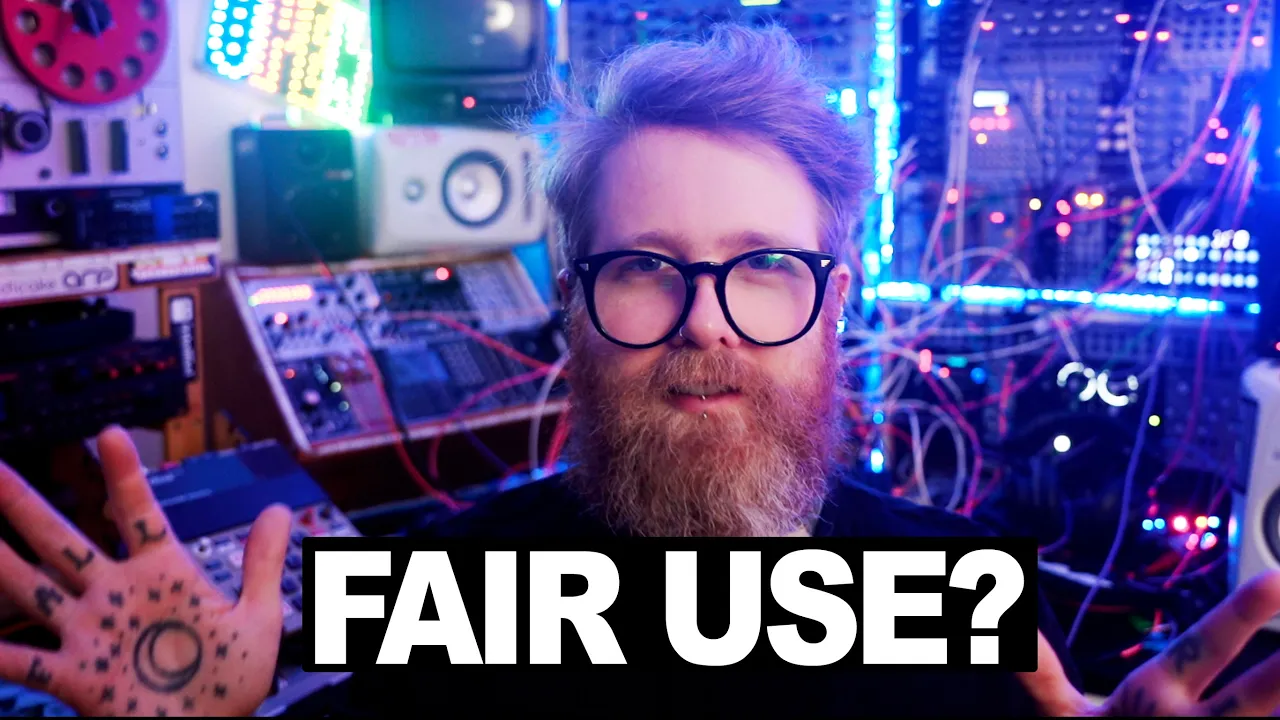



Fair Use is a legal doctrine that allows limited use of copyrighted material without permission under specific circumstances, but it is determined by courts through a holistic assessment of factors including whether the use is transformative, the amount of material used, and whether it affects the copyright owner's market, rather than by automated systems or YouTube itself; there is no minimum duration threshold for Fair Use protection, and creators should seek legal advice when asserting Fair Use claims.
Understanding Fair Use on YouTube: Copyright Law Explained
Added:The basic concept of Intellectual Property (IP) and how it differs from physical property rights.
Fundamental principles of copyright law, including what constitutes an original work of authorship and when copyright protection begins.
The distinction between public domain, licensed content, and copyrighted material.
An overview of digital platforms' legal obligations under copyright law, specifically the Digital Millennium Copyright Act (DMCA).
An in-depth analysis of landmark judicial cases that legally defined the 'four factors' of Fair Use (such as Campbell v. Acuff-Rose Music).
How YouTube's automated Content ID system operates and how its algorithms differ from actual statutory copyright law.
The practical steps and legal procedures for filing a copyright counter-notification or disputing a Content ID claim on YouTube.
Best practices for content creators to locate and legally utilize Creative Commons licenses and royalty-free media.
The application of transformative use principles in modern digital media formats like reaction videos, video essays, and parodies.
2.1M views39.8Klikes5:12Original Release: 2019-10-08
Hi, I'm Sari, here to answer your copyright questions.
Today's topic is Fair Use.
COPYRIGHT. FAIR USE.
First, what is Fair Use?
Fair Use allows you to reuse copyright-protected material under certain circumstances without getting permission from the copyright owner.
Fair Use is an exception to copyright law and is not determined by YouTube.
Let me say that again.
YouTube does not decide what is Fair Use, and what isn't.
Only the court can do that.
What counts as Fair Use?
Different countries have different rules about when it's okay to use material without the copyright owner's permission.
In some countries, it's not even called Fair Use.
For example, in the UK, it's referred to as fair dealing.
Aside from what your country calls it, courts usually focus on whether your use of another person's song or video is transformative.
Basically, they're asking if you added new expression or meaning to the original work or if it basically copies the original.
For example, in the US, content that might be considered Fair Use includes commentary, criticism, or news reporting.
Also, keep in mind that just because you say something is Fair Use, give credit to the copyright owner or add a disclaimer like "no infringement intended," it does not mean that you're protected.
How is Fair Use determined by law?
Determining Fair Use is never a cut-and-dry process.
In the US, Fair Use can only be determined in court by a judge.
The judge will look at your case overall based on a few different factors.
Here are a few things to keep in mind based on what the courts look at.
You're less likely to qualify for Fair Use if your video merely copies someone else's and adds nothing else.
If you're trying to monetize your video.
If you're using fictional copyrighted material rather than factual material.
If you borrowed a large amount of material rather than a small portion.
If the main focus of your video is the copyright-protected material.
Or, if your use of the material harms the copyright owner's ability to profit from their original work.
So, all of these are helpful factors to consider when thinking about Fair Use.
But, also keep in mind there is no guarantee that you'll qualify for Fair Use just because you take these factors into account.
For example, just because you don't monetize your video or if you only use a small portion of the copyrighted material, that does not mean you automatically qualify for Fair Use.
Again, the courts look at everything holistically and there's always a risk involved when using someone else's copyrighted work.
Think carefully about all of these factors and get legal advice if needed.
Companies are claiming just a few seconds of a video.
How is that not abuse?
One of the biggest myths about Fair Use is that there's a minimum amount of time you're allowed to use someone else's copyrighted work.
But despite what some people might think, there is no duration which you can use someone else's content that is automatically protected under Fair Use.
In fact, courts have rejected Fair Use arguments for songs that only sampled a few seconds of someone else's work.
So if you're using any amount of content that you don't own even a few seconds you're taking a risk of receiving a claim or a takedown.
You have the right to argue Fair Use but only courts, not YouTube, can ultimately decide whether the use of someone else's content is protected under Fair Use.
Because of this, our approach has been to empower creators to remove claim content whenever possible if they feel that it isn't adding significant value to their video.
That's why we've built tools to help you easily identify the content being claimed in your video and remove or swap out claimed music with copyright-safe tracks from the free YouTube audio library.
We're also now requiring claimants to add timestamps to these claims so you know exactly which piece of your video is being claimed.
We've also updated our editing tools so that when you remove the content manually claimed in your video the claim is automatically released restoring monetization to your video if you were previously monetizing.
Why does my content, which is clearly Fair Use keep getting claimed by Content ID?
Automated systems like Content ID can't determine Fair Use which is a subjective case-by-case decision that can only be made by a court.
While YouTube can't arbitrate Fair Use disputes and automated systems like Content ID can't account for Fair Use this doesn't mean that Fair Use can't exist on YouTube.
If you're a creator, you should avoid relying on Fair Use unless you understand how the rules work and you're prepared to defend your position through the Content ID dispute process and potentially the counter-notification process.
This forces the claimant to withdraw or to file a lawsuit.
This isn't a decision that should be taken lightly or without legal advice.
But it is the most powerful step you can take if you want to pursue a Fair Use defense.
and will force the most thoughtful review from the claimant.
And that's it for Fair Use.
Check out more info in our Help Center, linked in the description below.
And be sure to check out the other videos in our copyright series linked here.
Bye!
YOUTUBE CREATORS CHANNEL
Up Next

2:12
How YouTube Content ID Works A Fair Use Analysis
@azeddinelabidi2910
5.7K views•2013-04-18

26:22
Walking in the City: Urban Rituals and the Flâneur in Contemporary India
@PSBTIndia
1.9K views•2016-08-02

9:49
FastAPI vs Flask vs Django: Choosing the Right Python Web Framework
@TechWithTim
302.5K views•2024-05-26

1:42
Game of Thrones Opening Credits: A Cinematic Analysis
@gameofthrones
46.3M views•2011-04-18
Related Study Plans & Knowledge Roadmaps
Structured learning paths in General & Interdisciplinary Studies
general-studies
Artificial Light: History, Tech & Human Impact
01The Pre-Electric Era: Fire, Oil, and Gas Lighting
02The Incandescent Revolution and Grid Electrification
03Gas Discharge and Fluorescent Illumination
+ 3 more learning modules
14h6 modules
Explore Roadmap
general-studies
Elevator Engineering: History, Physics & Cities
01From Hoists to Safety Brakes: The Dawn of Vertical Lift
02Hydraulic vs. Traction: The Engineering Physics of Elevators
03Modern Speed, Safety, and Algorithms
+ 2 more learning modules
12h5 modules
Explore Roadmap
general-studies
Rubber: Material Science, History & Geopolitics
01Origins of Natural Rubber & Mesoamerican History
02The Chemistry of Natural Rubber & Vulcanization
03The Geopolitics of the Rubber Boom & Colonization
+ 2 more learning modules
12h5 modules
Explore Roadmap
general-studies
Containerization: Evolution, Logistics & Trade
01Ancient Trade & Bulk Cargo: Amphorae to Barrels
02The Industrial Revolution & Cardboard Packaging
03The Containerization Revolution: Malcom McLean
+ 2 more learning modules
12h5 modules
Explore Roadmap