



















![세계 최고 '복지국가'의 실체? 아프면 지옥에 빠지는 나라, 스웨덴 [손진석의 머니워치 EP.09]](https://i.ytimg.com/vi/lMCZS1NF_No/maxresdefault.jpg)











Canada's single-payer healthcare system provides universal coverage through public funding with provincial spending decisions, covering approximately 70% of healthcare costs while leaving 30% to private spending for services like prescription drugs, dentistry, and optometry; despite common misconceptions about long wait times and doctor shortages, evidence shows most Canadian physicians report higher job satisfaction than American doctors, and research indicates that only a small percentage of Canadians actually seek care in the United States, with most border visits being emergencies rather than elective procedures.
Canada's Single-Payer Healthcare System: An Analysis
Added:Understanding the basic distinction between single-payer, multi-payer, and socialized medicine healthcare models.
Familiarity with the structure of the U.S. healthcare system, including private insurance, employer-sponsored plans, Medicare, and Medicaid.
Basic concepts of health economics, such as risk pooling, universal coverage, and public versus private financing.
The constitutional division of power in Canada, specifically how healthcare is provincially administered but federally regulated through the Canada Health Act.
In-depth comparative analysis of global healthcare models, such as the Beveridge Model (UK) and the Bismarck Model (Germany).
Evaluation of policy solutions for managing wait times and resource allocation in publicly funded healthcare systems.
The debate surrounding 'two-tier' healthcare systems and the socio-economic impacts of introducing private options alongside public systems.
Analysis of proposed U.S. healthcare reform policies, such as 'Medicare for All' or the introduction of a public option, and their implementation challenges.
753.1K views11.4Klikes7:24Original Release: 2014-02-23
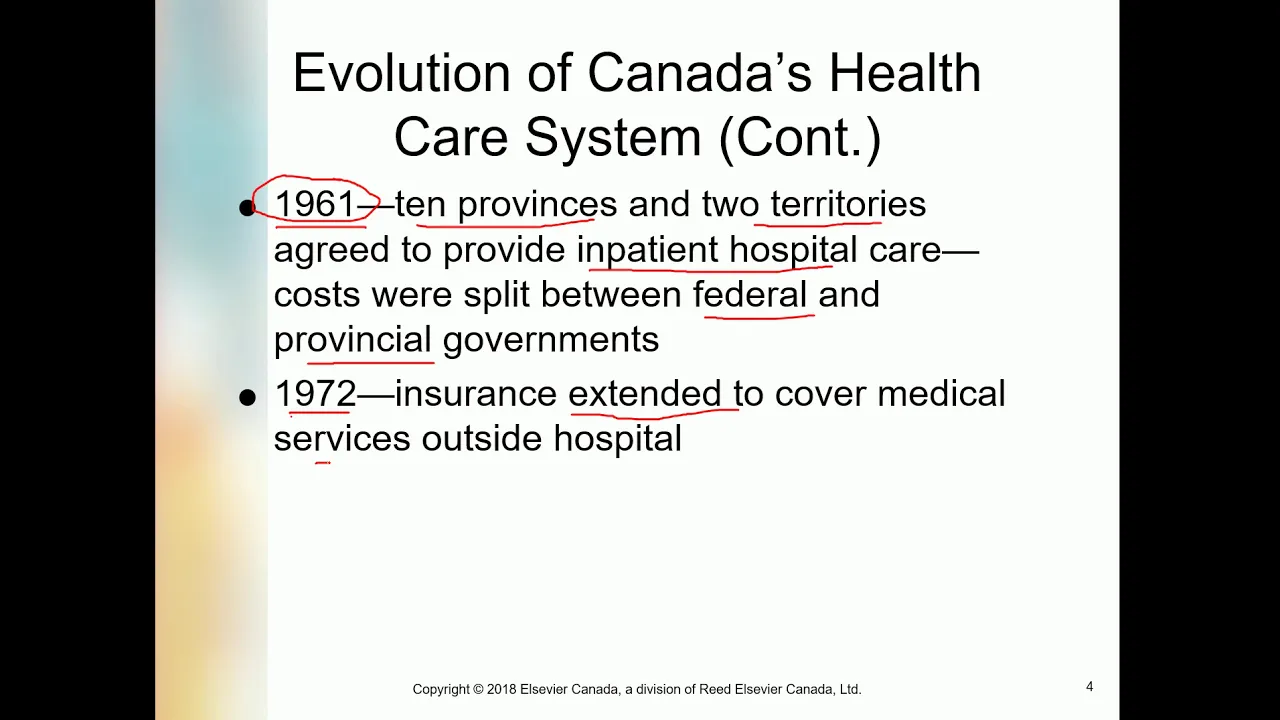
some of them clear to me why so many people in the United States are so worried about the health care system in Canada sure they have a single-payer system but we sort of do to both their system and ours are called Medicare the biggest difference is that there's covers everyone and ours only covers the elderly here in the United States single-payer health care as American as apple pie if you're 65 but a communistic tyrannical end of freedom if you're 64 Canada however has no such problem they're all in for Medicare and their system is the topic of this week's healthcare triage pretty much all Canadians receive their health care coverage through public funding with spending decisions made at the province level most healthcare is free to those who use it with no money out-of-pocket medically necessary care is covered including maternity care and infertility treatments the government pays for about 70 percent of total health care spending the other 30% is private spending most of that is for drugs dentists than optometry which aren't covered by the government program most Canadians buy supplemental private insurance through their jobs to cover the cost of things not covered by their Medicare most hospitals are publicly funded and they're required to operate under a fixed budget this is one of the ways that Canada controls its health care spending but most family physicians are private and most actually operate on a fee-for-service basis this is what makes them a single-payer system but not a socialized medicine system public spending but private delivery system and doctors do pretty well there in 2012 the average doctors income before taxes was about 225,000 Canadian dollars generalists make a bit less specialists make a bit more Canada negotiates at a federal level for its drugs this is another way that it controls spending Canada has somewhat of a reputation for wait times there are days when it feels like everyone I talked to knows someone who's just been screwed by the Canadian healthcare system data however don't support this assertion Canada is quite good about being transparent about its wait times you and I mean any of you can go to official websites and see the average wait times for all kinds of things just by using the internet go ahead give it a try we put a link in the video info below by the way I challenge you to try to find out this kind of information in the United States most people just assume the u.s. is better when it's often not moreover most of the wait times in Canada for things that are elective they may be longer than some would like but they're not in any way life-threatening but why are their wait times at all because limiting supply is cost-effective Canada spends remarkably little on health care which leaves the country more money to spend on lots of other things they also focus more on outcomes that matter to health and less on process measures like how fast can you get an optional MRI then other countries do and if Canadians really cared on mass about fixing these things they would do so I encourage you to go read my series on quality again link in the video info section see how Canada really compares to other countries you might be surprised while I have your attention though let's go over some myths about the Canadian health care system one doctors in Canada are flocking to the United States to practice every time I talk about health care policy with physicians one inevitably tells me the doctor he or she knows who ran away from Canada to practice in the United States evidently there's a general perception that practicing in the United States is much more satisfying than in countries such as Canada but survey after survey shows us that's not the case Doc's in Canada like working there much more than doctors like working here there are data on immigration the Canadian Institute for health information keeps track of doctors moving in and out of Canada when immigration spiked 400 to 500 doctors were leaving Canada for the United States in a year there are more than 800,000 physicians in the u.s. right now so I'm skeptical that every doctor who claims to know one of these em agrees actually does but it turns out that in 2003 net emigration became net immigration into Canada let me say that again more doctors were moving into Canada then we're moving out to Canadians flock to the United States to get care many people in the United States believe that people in Canada frustrated by wait times and rationing come to the United States for care these are almost always anecdotal stories and you should know by now how much stock I put in anecdotes as always when we can we should turn to evidence and research and on this topic it does exist the most comprehensive work I've seen on this topic was published in a manuscript in the peer-reviewed journal health affairs that study looked at how Canadians cross the border for care and the authors used a number of different methods to try and answer the question first they surveyed the United States border facilities in Michigan New York and Washington it makes sense the Canadians crossing the border for care would favor sites close by right it turns out that about 80% of such facilities saw fewer than one Canadian per month about 40 percent saw none in the prior year and when looking at the reasons for visits more than 80 percent were emergencies or urgent visits in other words tourists who had to go to the emergency room for a broken leg or something only about 19 percent of those already few visits were for elective purposes next they surveyed America's best hospitals because of Canadians were going to travel for care they'd be more likely to go to the most well-known and highest quality facilities right only one of the surveyed hospitals saw more than 60 Canadians in one year and again that included both emergencies and elective care finally they examined data from the 18,000 Canadians who participated in the National Population Health Survey in the previous year only 90 of those 18,000 Canadians and received care in the United States only 20 of them had done so electively look I'm not denying that some people with means might come to the United States for care if I needed a heart-lung transplant there's no place I'd rather be but for the vast vast majority of people that's not happening you shouldn't use the anecdote describing these things at a population level this study showed three different methodologies all with solid rationales behind them all showing that this meme is mostly apocryphal maybe that's why the manuscript was titled phantoms in the snow three Canada has longer wait times because they're a single-payer system when people want to demonize single-payer systems like Canada they always wind up going after rationing and more often than you'd think they talk about things like hip replacements or cataract surgeries stories about rationing aren't true Canadian doctors don't deny hip replacements to the elderly but there's more do you know who gets most of the hip replacements in the United States the elderly do you know who pays for care for the elderly in the United States Medicare do you know what Medicare is a single-payer system Canada isn't some dictatorship they aren't oppressed in 1966 the democratically elected government enacted their single-payer system since then as a country they've made a conscious decision to hold down spending one of the ways they do that is by limiting supply mostly for elective things which can create wait times their outcomes are otherwise comparable to ours please understand the wait times can be overcome they could spend more they don't want to we can choose to dislike wait times in principle but they're a byproduct of Canada's choice to be fiscally conservative they chose this those in the United States who are concerned about health care spending and what it means or the economy might respect that course of action but instead we attack that's our problem not theirs
Up Next

3:55
The Iron Triangle of Healthcare: Balancing Access, Cost, and Quality
@thehealthcareprofessor8521
3.2K views•2022-05-01

5:07
Impact of Yuan in Indo-Russian Trade Amid Sanctions
@WION
261.9K views•2022-07-01

6:52
The RAND Health Insurance Experiment: Moral Hazard Explained
@healthcaretriage
105.8K views•2014-01-07

113:18
The Age of Easy Money: Fed & Inflation | Full Documentary
@frontline
21.2M views•2023-03-15
Related Study Plans & Knowledge Roadmaps
Structured learning paths in Economics
economics
Sovereign Debt: Defaults, IMF & Restructuring
01Introduction to Sovereign Debt & Government Bonds
02Debt Sustainability & Credit Ratings
03Anatomy and History of Debt Crises
+ 2 more learning modules
12h5 modules
Explore Roadmap
economics
Market Design: Matching Theory & Gale-Shapley
01Introduction to Market Design and Price-Free Markets
02Two-Sided Matching & The Gale-Shapley Algorithm
03School Choice Systems and Mechanism Design
+ 2 more learning modules
10h5 modules
Explore Roadmap
economics
Impossible Trinity: Forex, Capital & Policy
01Introduction to Monetary Policy and Central Banking
02Exchange Rates and International Capital Flows
03The Mundell-Fleming Model
+ 2 more learning modules
8h5 modules
Explore Roadmap
economics
Healthcare Economics: Market Failures & Systems
01Introduction to Healthcare Markets and Market Failure
02Asymmetric Information and Adverse Selection
03Moral Hazard and Insurance Design
+ 2 more learning modules
12h5 modules
Explore Roadmap