













Professor Christopher Sprigman argues that Congress has plenary power under Article III of the Constitution to strip the Supreme Court's jurisdiction over specific constitutional issues, thereby shifting decision-making from courts to voters and loosening the constitutional 'straitjacket' that limits democratic change. This proposal addresses the problem of excessive judicial power in American constitutionalism, where the Supreme Court's unaccountable role in interpreting the Constitution creates an 'all-or-nothing' system that prevents democratic deliberation on contentious issues like campaign finance, abortion, and affirmative action. Sprigman contends that this approach, while politically challenging, is constitutionally sound and would allow for more popular constitutionalism by enabling Congress to move specific constitutional questions from courts to the political process.
Supreme Court Jurisdiction Stripping and the Future of Democracy
Added:welcome back to supreme myths um today is monday we are still in the early stages of the biden administration um but today we're going to talk first a little about current events and then a lot about the supreme court i am extremely pleased to have as my guest christopher john sprigmann the murray and kathleen bring professor of law at nyu i kind of wish it was bing because my kids would like that from friends um chris is an expert on uh really a lot of different things which is kind of cool about him and a trust expert intellectual property expert he has become a constitutional law expert and made my favorite constitutional law expert of the last 10 years that's because he agrees with me about a lot of things and we'll get into that in a minute uh most of my guests chris have disagreed with me about most things so this will be fun um he's written numerous books numerous articles um but his latest is i think really important um they're all important but this one's important to me it's called it's an nyu and it's called congress's article three power and the process of constitutional change which is a great title for an article chris welcome so glad to have you eric thanks for having me on i appreciate it it's my pleasure and i've actually i've actually been in the space you're sitting at and it is a i visited you in brooklyn it is a beautiful space and as a kid who grew up in long island when brooklyn wasn't really so nice that day we had um walking around brooklyn was really nice and special i have to admit it was fun yeah this is pre-pandemic times when you just walk around freely and have fun in brooklyn yeah it was fun um all right before we get to supreme court and jurisdiction stripping and all of that current events for a minute are you as confident as most other progressives seem to be that we should definitely have an impeachment trial for trump because i'm only about 60 sure i am not 100 sure like everybody else yeah so i guess i'm one of those people who believes that there have to be consequences for bad actions and i think one of the real problems that we have in this country is that consequences are increasingly only for the little people so you know donald trump calls essentially for an insurrection in not so many words people pay attention to him they heed his call they go and they do what they do there have to be some consequences other than having him go to mar-a-lago and play golf um you know i i could mention other people so rod rosenstein at the department of justice the deputy attorney general there's there's an inspector general's report that suggests that rosenstein told us attorneys in the border region that they had to enforce the child separation policy they had to prosecute migrant parents regardless of the age of their children rosenstein's at king and spaulding as a partner you know no consequences so far um for that kind of behavior so you know i i think there's a huge issue um does it have to be impeachment i mean i'm not sure what else it is at this point i think for what i have to say i'm very sympathetic to the consequences idea especially because the two authors of the infamous torture memo one is a tenured law professor at berkeley and one is a federal judge of all things they suffer not only they not suffer consequences it seems like they were kind of rewarded for what they did and that's insane so i agree with that right there's elite you know a disturbing amount of elite impunity in this country and it it it it is part i think of why we got trump in the first place so it's this is hard to prove but i tend to have i have the feeling that you know people lived through the financial crisis there were a lot of consequences for ordinary people people who lost their homes people who lost their jobs people who suffered family breakup as a result um terrible the bankers who helped to engineer all this there were virtually no consequences for them and you know that was during the obama administration i think a lot of people got the impression that you know failure of consequence for elites was a project of our elites and so they elected someone i i this doesn't explain everything but i think it explains some of it they elected someone who they thought would kind of break up that that that tendency i mean he didn't obviously but that's what people thought and maybe even made it a lot worse which is which is terrible right where i'm coming from and it's an emotional thing i think you're right but my emotional side tells me not my logical analytical side so i'm not sure which to listen to to be honest but my emotional side says it is so wonderful to be done with him and rid of him yes and i'm a little nervous about two weeks or one week or five days or two days or whatever it's going to be focusing on this and then chris we don't get a conviction see i'm worried about doing this and not getting a conviction and then all the worries you have are magnified again right worried about that too i'm worried about the fact that the republican party seemed to have a few days where there was a slight bit of soul searching and they very quickly recovered from that it went back to you know their field due to donald trump as far as i can see so the people who are most likely to suffer consequences are people like liz cheney who actually took a stand right um that's discouraging and i worry about what you're saying and the one thing i will say is the only thing i'm sure about is that it's impossible to be sure here we're so far away from anything that is precedented that we understand that we can kind of choreograph in advance that i think we're all just exercising our judgment and that's basically what we're doing i agree with that that's fair one last question about this so on twitter um i have been extremely vocal about leonard leo first where is he so for people who don't know he was the executive vice president but basically head of the fairless society in 2016 and when trump won the primary he absolutely helped trump get elected he helped prepare the list of judges obviously trump didn't know originalism from you know any other kind of ism so so his speech is about scalia dying and replacing him with and that's all then and leo all the way down and then he went to work for trump directly we don't even have to guess he went to work for him directly to pick judges and and then he came out of that return to the federal society and now it's unclear what his status is at the but shouldn't they issue some kind of formal we were wrong we're sorry it was a bad decision at the time we apologize like shouldn't that happen so there are two things going on here one i think is relatively superficial the other is deep the superficial thing is i think the federal society feels that the niceties have been observed by which i mean that the federalist society as such has not done any of this work it's just the federalist society people have done this work outside of the scope of the society so whether all the niceties have been observed is a really great question but that that's the superficial question the deep question is whether in fact you know the federal society membership feels that a mistake has been made i from what i see um i have lots of acquaintances and friends who are conservative and who are federal society members and i i see them split in much the same way the republican party is split and some of them believing this was a mistake it wasn't worth it to get all these judges to get these tax cuts what what the the destruction you know of our norms of our laws right some thinking well like yeah bad things happened but you know we can we can repair that move forward in the meantime we got a bunch of goodies um i get the sense that in the republican party as a whole the the trumpest forces are in the short term going to win that battle um that the republican party is going to move forward as a trumpist party in part because they are very afraid that if they don't that trump will organize a party that will move forward as the trumpist party and that will consign the republican party to also iran's status so that the threat is so real to them that i think the republican party i mean i don't know but i i suspect in the short term at least they're likely to go that way will the federal society go with the republican party on this i mean i don't i don't know i think it's a closer question there so what's one last point on that i i agree with everything you just said the law professors i know in the federalist society think it was a mistake i think the lawyers and rank and file i'm not quite as sure i would settle for just something like all right so we misjudged the guy and made maybe his destruction of our norms won't any any public statement but to just let leonard leo disappear and he's basically disappeared as far as i can tell and he really is the guy he and megan together are the guys anyway i i personally i want some atonement but i guess it's not it's not going to happen but if it happens it's going to happen a long time in the future yeah um it's going to happen in the way that you know to some degree the republican party has atoned for the southern strategy yes it's not a full atonement yes it's not an explicit atonement but i think within the republican party it's it's it's understood that the southern strategy came at a terrific long-term cost to the party into the country right all right all right now we're going to start talking about your article which i really want to promote um but i want to get there in a longer way so sure i think i understand you came to teaching constitutional law relatively late in in your career is that right no i mean i came to law teaching relatively late in my career i was i was 38 when i became a law professor which is older than a lot of people are when they first start but i before i was a law professor i had i had clerked both in the u.s on the ninth circuit and then i clerked in south africa for the constitutional court there i taught constitutional law in south africa um and i became very interested in and started to write about comparative constitutional law when i came back to the states um i took a job at the justice department and then i i took a job at a law firm and then i went to stanford to transition into academia i was really focused on ip there was a lot of stuff i wanted to say there and when i went to virginia which was my first job i started teaching first year con law among other things and it pretty quickly became clear to me that there was a bit of a cultural divide between the way i felt about the discipline and what the students expected me to feel about the discipline i i tried very hard not to um uh communicate to them explicitly how i felt a lot of about a lot of con law doctrines in the the history of the discipline but i i think it leaked through a little bit my students generally i think appreciated the course but i i do think i was robbing them a little bit of something which was some some of the romance of the field when you said the romance do you mean being critical or do you mean well i'm not sure what you mean by romance i think the romance is something like students come to constitutional law thinking this is going to be the most fulfilling intellectual but also moral content they get in law school so they're they're going to see the law at its best in in terms of its basically it's technical aspect but they're also going to see the law kind of vindicating you know the right point of view on great moral questions and with respect to both the kind of technical elegance of khan law which is often lacking it's often pretty clunky and transparently political and with respect to the moral content which is deeply mixed um i think students i was worried i was disappointing them i had a hard time kind of dressing it up so you tweeted something out that led to the the most uh uh tagged blog post i've ever written or whatever the right word is for versus someone who goes to a blog post blog post page you tweeted one something about constitutional law being all made-up stuff and then i wrote a blog post about that statement that really it is my most successful blog post ever when you said it was all made up what do you mean what do you mean by that so i don't think it's all made up but i think in very important respects it is so so for example first amendment jurisprudence i think if you follow the arc of first amendment jurisprudence you see various theories about what speech is and what important speech is and what protected speech is kind of working their way out in the court's opinions um none of that comes from the first amendment right it's there there isn't a coherent originalist account of the first amendment there's certainly not a coherent text list account of the first amendment that you can actually implement so you know justice black had an account which is congress shall make no law bridging the freedom of speech and he really meant no law that can't be right because you know copyright law and abridges the freedom of federal court federal perjury law conspiracy law right so we we can't actually have that as the the rule um so there's always i think in first amendment jurisprudence essentially been um kind of entrepreneurship going on so that the court essentially makes rules it remakes rules and you know commercial speech has certain status 50 years ago not much protection now it has virtually not not quite equivalent but approaching equivalent protection to political speech right is art protected is it not protected right there's there's always these questions and the court is essentially kind of bootstrapping itself into a theory okay um right and i think what you just described this for in first amendment law is true for due process equal protection the whole thing and i don't know that much about the fourth through eighth amendments but people i talk to say they're even worse so i don't you know i mean the story of due process is a great example so that you know the the real question is is due process really only that process or is it also about substance court fairly early on says it's about substance what's the substance the substance is a slave owner's substantive interest in a property of the human that he owns for the non-lawyers chris is referring to the dred scott case in 1857 right and that's that's of course a wicked a thoroughly evil understanding of what due process is um the court then you know later reacts that there's a great national convulsion there's you know the the country changes that due process comes on the scene again in the in the early 1900s in the guise of freedom of contract right so this is the kind of lochner line of cases so and if you think about it it makes some sense so the first appearance of due process is you can own someone else's labor and the second appearance due process is no no no no only you can own your labor but of course that that while that might seem in the abstract to be a an admirable principle it actually turns rancid very quickly so your ownership of your labor means that the state legislatures can't for example set um maximum hours rules to prevent you from you know dropping debt on the job or getting injured on the job you're exhausted um so you know the theory is essentially um holy kind of generated from the mind of judges it doesn't doesn't actually come from anywhere else right and that's that's i thought where you meant when you said it was all made up and that's what i've been saying for for a long time and i really don't know any litigated area of constitutional law where there's that's not true the commerce clause goes back and forth all the time you know all right so this article that you've written um we'll get to jurisdiction stripping in a minute what problem are you trying to solve chris what what what what what major issue out there is this article um directed to so the the major issue i i think is the balance between democracy and constitutionalism so we are it's a huge issue right so in this country we are conditioned to think of democracy and constitutionalism as kind of working hand in glove so there is no democracy without constitutionalism there is no constitutionalism without democracy actually both of those things aren't right but this is kind of our mythos and we don't get a sense that um the constitution and democracy kind of butt heads but the truth is they do they do all the time democracy is in a sense limited by constitutionalism the question always is to what degree i i think what happened to me in my life is when i went abroad and worked in a foreign jurisdiction and really learned a foreign country's constitution from scratch and participated in kind of the early germination of their constitutional law both as a teacher and as a clerk i came to see that you know there's a spectrum around the world of countries that balance democracy with constitutionalism and we here in the united states are to be frank extremists we lie on one tail of that distribution we are on the tail that interferes the most with democracy on behalf of a constitution that is both very old and very terse and is enforced by an institution the supreme court which is essentially unaccountable democratically so we are we are an extreme outlier in that family of constitutional democracies and that that's the thing that i wanted to get across and i also wanted to get across if we wanted to shift it what could we do so so and we'll get to your remedy for that in a second so your colleague and my friend barry friedman who um by the way once when i was a very young professor and he was already established snuck into my federal course class and asked some questions which was at the time extremely nerve-wracking for me because i had but anyway your colleague and my friend barry freeman i think has a whole theory of constitutionalism in america that's kind of dialogic is what he called it i think but then in fact i don't agree with this i love fair i love barry and i don't agree with this theory um whereas it's really the court talking to the congress and the court talking to the people and the people talking to the president and it all works out not all the time but much of the time because the court although the court has some limits in what it can do as a practical matter um right and so i'm curious how much of that you think is accurate and i want you to i don't want you to you know to to get your colleague mad at you but i am curious how much you think that is accurate it doesn't it doesn't do it for me in terms of justifying the court's power but i'm wondering if it does it for you it doesn't do it for me either so i think i i love barrier to death and i think this idea has some validity but i think it it's constrained it it basically explains why the court just doesn't dictate it explains at the outer limits what what what are the what are the boundaries of the court's power but for example let's let's take the court's first amendment jurisprudence with respect to campaign finance contributions so again the court just spins that up out of whole cloth there is nothing there's no guidance in the constitution there's no guidance certainly in our history that would suggest what those limits should be the court essentially just jins up and then imposes a theory and this theory has enormously powerful consequences it shapes the way our democratic politics runs so you know does that mean that the court is constrained yeah the court's constrained but think of how the court has constrained our democracy right it has it has cemented in place as a matter of constitutional law a particular way that we've come to run our democracy a way which by the way is again extremist right we we have you know a system for money and politics that most you know affluent democratic nations don't have they have many more uh controls than we do that that seems to me to be an overweening power that in the long term is barely constrained yeah the way i put that before i agree with that we're going to agree a lot so i agree with that 100 percent um the way i put it is the only real constraint on the court is what they think they can get away with and that actually has come up in america i mean marbury versus madison the reason margaret didn't get his commission was because marshall didn't think that jefferson would do it um and i think we've had other situations similar to that in our but that constraint is not the one barry's talking about i don't think and it's and it's and it's not much of a constraint all right so we both agree that the court plays much too much uh a much too larger role in our democracy and the question and stops democracy from work um i mean the campaign finance reform is is really just made up stuff that that robertson kennedy believed even rehnquist didn't believe that o'connor didn't believe it as much this is a kennedy roberts fabrication is what it is um all right so tell me about your article where do you start and and how do we maybe try to get the wheels rolling so people will accept there's a possible fix to all this well so just think of the classical understanding of judicial review in this country as it's developed so there's a power of judicial view that allows the court to strike down laws the striking down is in a sense self-executing the law basically ceases to exist once struck down that by the way is extremist as well lots of countries you know the court issues an opinion but the legislature has to act right right we don't have that right and again this none of this is detailed in the constitution this is all essentially bootstrapped out of a very bare text so what what struck me is that um there are two ways essentially to address this one is the article five amendment process which is also extremist it requires an enormous super majority to be put together to get any constitutional change so if you think the constitution as you know the constitution is a garment ours is a straitjacket it fits extremely tightly it's incredibly difficult to unlock um so i'm looking at the text and i'm thinking well you know what's interesting is in article three there's there's some text that suggests that there there is a way to change the constitution that that is not an amendment it's something short of that um it doesn't require a super majority and that is the article three text that makes clear that congress has essentially plenary control over both the existence of and the jurisdiction of the lower federal courts and importantly it has the power to make exceptions to the appellate jurisdiction of the supreme court so what does that mean in practice what that means is that congress let's take campaign finance because we've been talking about that let's say congress thinks you know this interpretation of the first amendment is basically screwing up our democracy and we've got to do something about it and they'd be right they'd be right but go ahead right so so they legislate and they attach that legislation a provision that says the court will not review this for first amendment you know uh constitutionality so that's a that's an exception to the supreme court's jurisdiction they can also remove the jurisdiction of the lower federal courts in the in the statute so what does that mean that means that if the courts respect what congress has done congress has exercised what i call its article 3 power to take a decision about constitutionality and move it from courts to voters and what do i mean by that if voters don't like either the removal of federal jurisdiction or they don't like the regulations they can discipline congress in the way that voters do politically through the ballot box that's the function that i think article 3 actuates this this kind of removal or or repositioning of accountability for specific issues not not across the board but specifically in our example for campaign finance law from courts to voters that is a way of kind of loosening the constitutional straitjacket of resetting in a subtle way the boundary between democracy and constitutionalism in favor of a bit more democracy a bit more constrained constitutionalism or at least a bit more constrained judge-centered constitutionalism this is this is a way of kind of installing a bit of popular constitutionalism and subtracting a bit from judicial constitutionalism what what so attracted me to this article at first and to these ideas um not only on the merits i agree with you but also kind of selfishly a little bit on my part if you're if someone if you believe in text and you believe in original meaning then you have to agree with this and that's and and by the way i so i've been teaching federal courts for 30 years it's a long time when i first started teaching federal courts conservatives agreed with you and liberals disagreed with you and i'm guessing that would be flipped today but right probably well so i think it's a little complicated because uh right at one time liberals really feared this because what were they doing they were building a kind of rights revolution and what they really feared was the kind of rights revolution being undermined by like pesky voters who really didn't want all these rights and so they envisioned congress basically using jurisdiction stripping to take the courts out of it when the when the rights revolution was really a judicial mission now that's been over for a long time right the courts have not been you know in the vanguard of a rights revolution for what like 35 years that's one exception right gay marriage so so so so that's for the most part been over but i think a lot of law professors on the left haven't yet adjusted or they haven't loved judicial supremacy yeah on the right the story's a little different so there's a there's there's on the right a at one time there was a fervor for this so and i'll mention the name of chief justice roberts who when chief justice roberts was at the justice department there were a raft of kind of right-wing bills before congress that for example liberalized rules about school prayer meaning allowing school prayer in public schools and stripping the court's jurisdiction to review that the justice department at the time ted olson and chief justice roberts were both at the justice department ted olson wrote a memo saying we should oppose this jurisdiction stripping it's it's a principled position to oppose this because we we want you know the rule of law and chief justice roberts wrote a counter memo basically saying no we you know this we should we should align with democracy here um uh it's interesting so i think in the years since as conservatives have kind of asserted control over the federal judiciary and what you get is a kind of rights revolution in reverse where suddenly you know the prospect of the courts reviving a non-delegation doctrine to limit the administrative state or reviving a kind of first amendment a substantive limit on a lot of government action suddenly um this past support for jurisdiction stripping is being very much soft-pedaled so it's kind of interesting yeah i i agree with all that but i do want to make the point that the text of the constitution unambiguously and unequivocally gives congress this power and the madisonian compromise was to some degree all about this it's congress to decide whether to have lower federal courts and it's for congress to decide whether we need lower federal courts and it's for congress to decide how they're structured and the amended controversy requirement is an example of that right now it's 75 000 it could be 150 200 whatever it's up to congress and i think your article is very very um well it's very very sophisticated and and and and and is at a very high level but at bottom if one's a texturalist or an originalist or both they have to agree with this in my opinion i well i think they have to go a certain distance toward agreeing with it but i think there are limits and i try to a couple of things that i i think are a little bit more subtle that are that are worth thinking about one so at bottom i agree with you that the constitution is pretty clear on this so congress has plenary power to create or to not create lower federal courts it has fire power to control their jurisdiction um that was clear right from the beginning the 1789 judiciary act there was no general federal question jurisdiction right lower federal and the very first law passed by congress too right so right from the start right so um both in terms of the text and in terms of the history everything aligns um in terms of the exceptions clause so congress makes exceptions to the supreme court's appellate jurisdiction over history these exceptions have been enforced um so again there isn't much question the question arises when so for example in in your in the example we've been talking about let's say congress legislates to uh provide a different set of rules for campaign finance than the court has blessed tier 24.
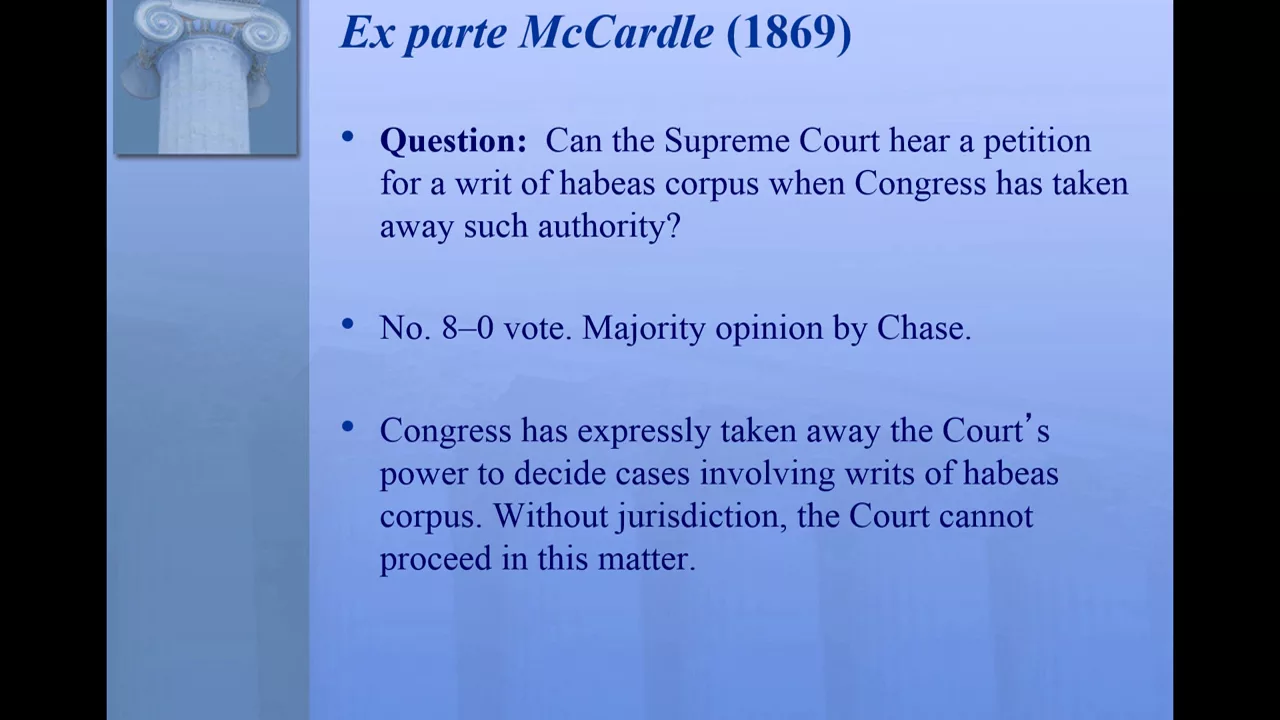
so then you know the question is can congress strip federal jurisdiction in an instance where to do so would be to in a sense override a constitutional rule that has been established by the court and there i think the the constitution is not clear because you know we have the first amendment but we also have article three so which one overrides it's the first amendment override article three does article three overwrite the first amendment my argument is you know realistically if congress wants to use article 3 in this way it can do so agree that so much of constitutionalism is simply what's possible if the institution with the power actually acts and at the end of the day it's congress who has the power supreme court can't even pay its own rent if congress wishes to to to enforce the primacy of article 3 it can do so it's just it it's politically costly potentially right but constitutionally i think it's a pretty straight shot i think i'm not sure i'm sure i'll be checked on this but i think there's a line from the musical evita politics is the art of the possible i think that's right and and i agree with you that if congress had the political will to do this you know congress abolished the 1801 term of the supreme court now i'm not saying it can do that today but think about that as an original matter they told the court you cannot meet much less you can't meet to decide certain cases you know um so and there was this debate i think in the 50s or 60s i forget um between two very famous scholars and and a theory arose from all that called the essential functions thesis which if one is a living constitutionalist i think is a fair thing to do if one's a textualist and an originalist i don't think it's a fair thing to do but you will get pushback on that essential functions thesis so why don't you sure so i spend a bit of time in the paper on this i think it is worth spending time on because i i think it shows the kind of machinery of constitutional law at work and what do i mean by that so there's text in the constitution that makes it pretty clear that congress has this power to shape the federal court's jurisdiction there's a long history of the congress doing precisely that in the 1789 judiciary act and thereafter there are exercises of the exceptions clause that are important exercises of the exceptions clause for example an ex parte mcardle the removal of certain behaviors jurisdiction right so we have a rich history so how does the con law uh establishment react to that so part of it reacts by saying well things have changed so in our uh constitutional democracy as it's developed the supreme court has come to have this constitutional role that is essential right and that means essentially that every constitutional rights claim has to have a judicial remedy and if you remove that judicial remedy that violates the constitution now you know that that's not from the constitution that that's a kind of interpolation based on historical change over time to a certain extent i would okay i i'm even willing to buy the model but but the corollary to the model is that you know what you built what congress built congress can dismantle right so if if congress wishes to turn the supreme court from something that has like a tiny little original jurisdiction into something that's overwhelming it can do so but why is that a one-way ratchet right so i i i asked that in the paper and that you know brings on i think the question of how the two-way ratchet would work and that's where i say that's what article three is there to do um again it's not it's not that congress can simply um do this willy-nilly it's that there's a political process bicameralism presentment that must be respected those especially given our constitutional culture impose very stringent limits on congress's ability to do this but if congress is determined and that determination lasts over time to reset the boundaries article 3 allows us to do so and i i have to say i have to add that i really do think history supports you on this which is important to me not because obviously i'm an originalist because i think when smart people think about something and come up with something we should pay attention to it and alexander hamilton was really worried about the argument before the constitution that this will make the supreme court too strong it'll give them a veto over everything and we and we should not ratify the con and his answer was very simple his answer was first they'll do it rarely which of course didn't turn out to be true but but as importantly they have no person sword and he knew that and and they knew that and they expected congress to play exactly the role that you're talking about i think they expected congress to play exactly that role and what's getting in the way of that is actually the growth of this mythology about the centrality of judicially enforced rights to our the survival the thriving of our constitutional democracy so part of the mission of the paper is to say you know at the end of the day and i think the trump administration has shown us this courts are actually not that effective in enforcing democratic norms or in guaranteeing rights if the underlying democratic culture is diseased um the surest protection for people against tyranny against you know inequality is democracy that that is something i think we're rediscovering at the moment i hope we're rediscovering it because i i think you know to some degree lawyers and especially law professors are responsible for obscuring that truth i agree with that so let's let's talk about so so let me just say i agree there's a matter of text history and policy i think your proposal to give congress this power is extremely sound and i like it a lot but let's talk politics for a minute sure so so next year congress finds a way at least to to put a damper in the supreme court's non-originalist a textual judicial creativity about campaign finance reform which no other democracy in the world comes even close to following we should think about that for a minute too but leave that aside um however after the 2022 midterms um and then the 2024 election we have a republican senate a republican house and republican president and they de facto overrule or burgerfel the same-sex marriage case by saying no lower courts will have jurisdiction over this supreme court won't have jurisdiction and now georgia makes same-sex marriage unconstitutional again which by the way as a political matter is not going to happen because the this generate but let's assume that it could happen um isn't that a worry aren't you concerned about that of course i mean so the point of article 3 is it doesn't come with a democratic or republican label it can be used by parties in power the break on use of article three in the way that you suggest is politics so what you're talking about right now like aren't you afraid of over burka fell aren't you afraid of bro right being you know overturned by a future congress and sure but the answer to that is this is the hard work of politics right so to some degree judge-centered constitutionalism gives us the illusion that we can take these issues off the table that we can settle them and that we can mandate a rule and that rule is going to be stable that is an illusion it's actually a pernicious illusion and i would again row is a great example so you know in the 70s early 70s people think well now this issue's off the table this issue wasn't off the table for five minutes right what what happened was the court ruled in row and this led very directly to a kind of upsurge in the political potency of the anti-choice pro-life whatever label you want to give it movement to the point where our politics have been driven to an extent that i think people still have a hard time getting their heads around our politics what it means to be a conservative has been driven by opposition to roe it has been a organizing locus it has been a funding locus it has been the battle flag that changed our politics very profoundly in ways that i think at the end of the day we didn't get the issue taken off the table it's not clear that you know we didn't suffer in a lot of other ways so for example you know alliances between catholics and liberals on many issues were impossible because of the church's opposition to abortion and if you look at catholic social welfare thinking it it is on on labor rights on the rights of immigrants on the rights of the poor very much alive and the death penalty and correct yeah i said all that on twitter uh last week was the was the anniversary of roe and i said all of that on twitter and and i eve and i think i used the phrase judicially judicially protected uh women's reproductive rights has been only minimal because rich women always got abortions poor women still can't get abortions and all that stuff boy the pushback from the left that i got you wouldn't believe i mean just attack attack attack and but i think they all missed the point which was the point you just made which is every other issue feminists and liberals and progressives care about roe killed and it's not a hurt deep except for same-sex marriage and and whether you're pro-choice or anti-choice or pro-life the supreme court shouldn't play that bigger role that's all the supreme court it made it so much worse i think yeah i just want to i just want to focus on one thing that i think you know has to be dealt with which is the idea that you know it's easy for like an older white guy to say this because we don't have anything directly at stake and of course that is true yeah it's true and there's there's no denying it the question is you know once you get once you acknowledge that what what can you say about the future of reproductive rights and i think we are at a threshold now where the court is likely we don't know we can't tell the future with 100 certainty but it seems likely that the six three conservative majority on the court newly bolstered by amy coney barrett who is of course very strongly anti-abortion in her personal views that that court is going to chip away is going to reduce over time protections for abortion that that is going to be essentially the the fruits of 30 plus years of organizing on the right to take control of the federal judiciary so you know facing that the question is what do people do now and i think the answer is going to be that there is a working majority in this country for pro-choice policies and that that that through democratic processes i i very much hope that that that majority will will prevail but it'll take some time we agree on that i i do want to address your white you know mike your case middle age in my case old um i'm 62. uh white male perspective on this um i have worked very closely with planned parenthood now for 15 years and um in a number of different ways i am pro-choice all the way down everybody knows that um i have three daughters and i one's 29 but the other two are younger and i i want a world erin and i once wrote an op-ed on this orange sherman skin like i want a world where those daughters have control over their reproductive choices that's my policy position it's not clear to me at all that that world is going to be um for them is going to work better for them because of the supreme court and i've been talking to planned parenthood for a decade about how a lot of your money needs to go to lobbying and go to the middle schools and the high schools and chris this is a huge issue because my 12 and 11 year old girl girls 13 and 12 year old girls they their friends are the idea of discriminating against gays and lesbians to all of their friends is out of the question it's not it's not even a debate like lgbtq equality is just there no i'm in atlanta i'm not in oklahoma but still i think that's reasonably true but they are divided on abortion you can find a lot of kids 14 15 16 who are whose parents were very anti-choice and now they're and now they're divided those of us who are for reproductive rights for women need to find a way to to get into the schools and deal with them not deal with unelected life tenured lawyers in washington it just seems to me everything you're saying is right i guess my only point is you know as a man i do have less at stake sure that is just undeniable and so i have an easier time sure and i acknowledge this kind of pulling myself away from you know the feelings that i have about this and thinking somewhat dispassionately about you know is what to do about the courts um i it's easier for me and i acknowledge that and you know i i do hope nonetheless that people understand um that at the end of the day um rights are not made by courts they're they're made by people and you know but rights are something we create it's it's a statement about the kind of society we want to have and the the the forum where that's going to happen more and more is is the legislature i think just descriptively i agree and and that's why i agree eventually we'll get to a place i hope where women have this poor middle class and rich women have this right and we don't strip all taxpayer funding from medicaid for abortions but to get to that world i think we have to lose roe and casey and i know that's easy for me to say as a but i think there'll be better conditions for women in the long run if we do that that's the only point i'm making and that i'm relatively sure that that that's true there are other issues that raise your question it's an interesting one so let's take affirmative action um after 30 years of admissions committees and hiring committees and studying the issue it's very easy for me to say that justice thomas is wrong when he talks about stigmatization and he talks about the negative effects of affirmative action and if i'm talking to a person of color about that i'm going to be humble about my thoughts about on the other hand i know that if georgia state law school could use a quota we would do better and the only reason we can't use a quota is because of the supreme court and that seems very wrong to me i don't think i have to step back from that conversation and say of course i'm not a person of color i think i think there is some humility involved in all of these issues um but i want what's best i think for everybody as do you as do they so i don't i don't i don't my i don't know i just the sister comes up in other places other than abortion yeah look i i just feel in these issues i mean identity politics is a real phenomenon and it's it's it's not something that i think has um no proper role in the debate i do think that your perspective is formed very powerfully by your own personal experience and this has a lot to do with your race and your gender so and your social class you know we don't pay a ton of attention to social class but i also think that has a lot of degree okay but there is a concern here that i think involves all of us which is how do we how do we like make the rules in a democratic constitutional state right so so how do we make decisions um how much as citizens do we subcontract out to lawyers and judges just fancy lawyers and how much of the decision-making in the society comes from our own moral reasoning our own political activism so so again just getting back to the moment i think what's really startling to me and actually kind of heartening to me about the way things have gone over the last four years is that the courts did very little to constrain donald trump actually congress didn't do a lot to constrain donald trump because of the partisan component makeup of the senate what what constrained donald trump in the end i think was was elections right the the the democrats winning the house and then the democrats winning the senate that in the end constrained donald trump plus activism on the left so there's there's a bunch of writing now about how prepared the left was and how organized the left was for donald trump's attempt to steal the election and the organized left did a lot to stop that deal right uh that that is impressive um that's the kind of attitude that the attitude of you know democracy is really just decisions made by people not decisions made by elites that i think is heartening to me and and it is very much what i'm trying to get at in this article yeah and i think you do a great job of that chris and i again i the articles in the nyu law review i think it's most current edition and i hope everybody likes that i want to circle before we finish i'd like to circle back because um you have such a great international experience uh and what so whenever whenever not whenever but often when law schools have symposia about free speech in america compared to other countries i'm the guy they call because i'm a european on free speech i believe in free speech but i just don't think it's the all be all and end all that america does um right what i want to get to know something a little different so from 2006 when justice o'connor resigned and lito and roberts came on 2005 until 2018 which is 13 years our country's decisions on campaign finance reform abortion affirmative action gun rights all of that stuff was really in the hands of one man justice kennedy he was always i mean he was 95 percent five four con law cases or something like that and when he wasn't in the majority it was a case not that many people cared about how would you explain to people in europe that we had a country where for 15 years one man's views on these issues were really the reason we have citizens united is because of anthony kennedy the reason we have hellers although scalia wrote it if kennedy doesn't go along with him it's not there um same thing for shelby county the disaster that that was that can't be a good system right i mean it just can't be and for and actually if you go back to if you go back to 1986 it's o'connor and kennedy for like three decades one of them is always in the majority every time almost always in five four cases so in a lot of countries people would have a very hard time understanding how that could possibly be right uh so but let me just give you an example so how different yeah constitutional democracy is in some other places in terms of the balance between judicial power and legislative power okay so in south africa in germany in canada those constitutions have something in common which is they have a list of rights but then they also have something called the limitations clause and this this is a constitutive of a very different approach to constitutional interpretation than the one that we take in the states so let me give you a concrete example when i first got to south africa i started clerking and there was a case the mystery case m-i-s-t-r-y it involved a doctor who had been arrested for distributing outside the rules of the south african medicines council a a skin lightening cream he he distributed without a prescription which was legal he'd been arrested that his office had been searched and there was a question whether the search was lawful whether the the proper process had been complied with and when i saw a draft of the opinion i noticed something which was um so different from how an american court would undertake this so an american court would say okay is the search reasonable right um and there would be a whole kind of historical analysis of what reasonable meant and um the the the con the court would issue a constitutional ruling which which meant that to change the rules about search and seizure that the legislature would actually have to amend the constitution right because whatever the court does is a reading of like the ambit of the fourth amendment the south african court doesn't work that way okay this is the constitutional court they do constitutional law but they do constitutional law with a bit more subtlety so here's how they work they look at the rule in the constitution and they say well it violates the rule the question then is is the are the rules that the legislature sets up or the administrative agency sets up are those permissible limitations of the rule and in in pronouncing on what a permissible limitation is the court typically rules very narrowly such that if it finds the limitation manifestly you know unsuited right for a free open democratic society the legislature can like adjust it a little bit it doesn't have to amend the constitution it just changes the legislation a bit and tries again this means that um this the constitutional court's rulings and this is true of the german constitutional court this is true the canadian constitutional court they they strike much more narrowly they they preempt much less democratic action than the typical ruling in the fourth amendment area of the supreme court of the united states this isn't just um different politics on the court this is a completely different methodology that is that is baked into modern constitutions and part of the reason it's baked into modern constitutions is they look at ours and they think man this is way too manichaean right this is way too much all or nothing right um we need you know the dialogue that barry's talking about we need more of that and to to do that they've adopted a very different model yeah i always thought that the the dialogue barry talks about you know my kids and i can have a dialogue but what time they go to bed but i'm the final decision maker and in america that's how the constitution that's how the court works and it shouldn't be that way because we're not children unlike my children we're not children um everything you just said i have to be selfish for a minute i hope you don't mind about this but i i think a serious reason for all of this is because people in other countries have some understanding that although it's called a constitutional court in germany and it's really not a court and they understand the difference between their constitutional court and and courts that decide you know civil actions and criminal action right um the idea that our supreme court is truly supposed to be a court in deciding whether or not affirmative action abortion campaign finance reform is going to be allowed is not something courts really do and if we could just recognize that it's really in that role a veto council of some kind um we might make some headway into your kind of proposals but yeah but but people still really think they're judges like you know state superior court judges and they're not they yeah and especially because so i don't know how many americans have actually read a foreign constitution but if you read the constitution of germany if you read the constitution of south africa these are much more detailed constitutions modern constitutions especially with respect to the structure of government how government runs are much more prescriptive than our constitution so we have a court that people think of as a court you know doing court-like things without essentially the materials to do court like yes right yes we're kind of we're kind of doing it on both hands yes we're both setting them up and kind of depriving them of guidance so um it is odd and what what's odd to me still years after my experience in south africa is how difficult americans find it to imagine that the way that they do things isn't the only way so for example you know marbury versus madison the idea that judicial review of the particular kind we have is is is kind of a necessary incident of a written constitution well no it's not and just empirically if you look around there are lots of other countries that have written constitutions they're democratic constitutional states rights regarding liberal decent affluent they do it differently in the netherlands there is no judicial review in switzerland this judicial view only of cantonal law but not national law in the uk you know there's there's the house awards which the supreme court issues a a ruling and and the parliament may enact it into law or may not right it's rulings are not self-executing there's a whole plethora of different arrangements that we could we could refer to but we we don't we are stuck in this bubble i hate to say this bubble of american self-regard that over time just looks more and more inappropriate to our place in the world the uh well i can't say it much better than that they are any better than that the example i always give i think england has a reasonably robust democracy and free speech and they don't allow campaign ads for 30 days or 60 days or ever i think prior so now i'm not suggesting as a policy matter i would pick that although i might but the point is we are nine justices away from from allowing i mean i don't think any of the liberal justices would allow a law that said no tv ads for politicians in the 60 days prior to a campaign why are we so sure we're right about that i mean england's a pretty good country they have a lot of free speech i mean it's the bubble you're not only sure we're right about that but we're not willing to allow experimentation right so there's no sense in which because we have this kind of all or nothing rule that you know we can have some kind of right uh try at something else we just can't right so look i i get it i think that the the us has a long history now of this you know all or nothing style of judicial review this is going to be a very difficult thing to displace if it ever gets displaced but i mean someone's got to say something because it is part of our current problem right the the part of the current problem can be stated very simply what has the gop been doing why were they so eager to hold on to power because they feel that their political coalition is passing away and what they want to do is they want through the federal judiciary to cement and place their political preferences on a wide range of issues that is deeply deeply disturbing if you even democracy at all that is that that is what our dedication to this all or nothing style of judicial review that is what it has brought us to and ironically when with this justice scalia justice scalia's dissent in the casey abortion decision says everything you just now he was a hypocrite and he didn't live with it but you know he he has casey descent and then he would strike down law he struck down over 140 laws in his career but his point in that dissent is very similar to the point you just made and something he used to say all the time is judicial review is about looking backwards which it is in theory you have an old document from and so my my political narrative about the court on principle just my politics is it is by definition anti-progressive by definition pro-status quo the republican party trying to cement 1950s american values in 2020 through the federal judiciary is an insane way to run a country and we need to change it and your your article um i hope gets part of a serious conversation about the problem and what to do about it so thank you for writing it i hope so too thank you for having me on i really appreciate it thank you for being here chris and it's always great to see you and i when kova is over we're going to see each other in person i hope so soon thanks chris take care now thank
Up Next

Social Justice in European Constitutional Courts | Jasna Omejec
@المنتدىالبرلمانيللعدالةالاجتما
180 views•2016-02-20

US Secondary Sanctions Impact on EU Businesses and Blocking Legislation
@Bureauvandijk
1.6K views•2019-03-20
Forensic Phonetics: Speaker Identification in Legal Cases
@nptel-nociitm9240
539 views•2025-03-19

Police Interrogation Tactics: False Confessions & Legal Reform
@LastWeekTonight
7M views•2022-04-18
Related Study Plans & Knowledge Roadmaps
Structured learning paths in Law