






















In Einstein's special relativity, the causal structure of spacetime is geometrically encoded through hyperbolic contours called world lines, where the spacetime interval represents an invariant measure of causal separation between events; these hyperbolas define the light cone structure that determines which events can influence each other, with the forward light cone representing causally accessible future events and the backward light cone representing causally accessible past events, while faster-than-light travel would reverse the direction of causality.
Spacetime Geometry and the Causal Structure of Relativity
Added:Basic Special Relativity, including the constancy of the speed of light and the invariant spacetime interval.
The concept of light cones and the classification of intervals into timelike, spacelike, and null paths.
Fundamental principles of General Relativity, particularly how matter and energy curve the geometry of spacetime.
An introductory understanding of metric tensors, which mathematically define distances and geometry in a manifold.
Penrose-Carter diagrams, which are used to analyze the global causal structure of infinite spacetimes in a finite representation.
The physics of Closed Timelike Curves (CTCs) and the theoretical limits of time travel, such as the Chronology Protection Conjecture.
Black hole event horizons and causal boundaries, leading to the study of black hole thermodynamics and the information paradox.
The Penrose-Hawking Singularity Theorems, which utilize causal structure to demonstrate the inevitability of gravitational singularities.
Causal Set Theory and Causal Dynamical Triangulations, which explore causality at the quantum gravity scale.
1.7M views33.5Klikes16:07Original Release: 2017-02-02
This episode is sponsored by Audible.
The special theory of relativity tells us that one person's past may be another's future.
When time is relative, paradoxes threaten.
Today, we peer deeper into Einstein's theory to find that the immutable ordering of cause and effect emerges when we discover the causal geography of spacetime.
Recently, we've been talking about the weirdness of spacetime in the vicinity of a black hole's event horizon.
Very soon, we'll be dropping below that horizon to peer at the interior of the black hole.
There, space and time switch roles, but to truly understand that bizarre statement, we need to think a little bit more about how the flow of time is described in relativity.
Today, we're going to look at the amazing geometric structure that time, or more accurately causality, imprints on the fabric of spacetime.
First, let's recap a little bit of Einstein's special theory of relativity.
There are two previous episodes in particular that will be useful here if you find you need more background.
Special relativity tells us that our experience of both distance and time are, well, relative.
If I accelerate my rocket ship to half the speed of light, the distance I need to travel to a neighboring star shrinks dramatically from my point of view.
An observer I leave behind with an amazing telescope, observes me traveling the entire original distance but will perceive my clock as having slowed.
The combination of this length contraction and time dilation allows both moving and stationary observers to agree on how much older every one looks at the end of the journey.
Everyone agrees on the number of ticks that occurred on everyone else's clock.
They just don't agree on the duration of all of those ticks.
Reminder-- time measured by a moving observer on their own clock is called proper time, but counting those clock ticks isn't the best way for everyone to agree on spacetime relationships.
There's this thing called the spacetime interval that relates observer dependent perspectives on the length and duration of any journey that all observers will agree on, even if they don't agree on the delta x and delta t of that journey.
We've talked about it before, but it's a tricky concept to understand intuitively.
But we want that intuition because, more than proper time, the spacetime interval defines the flow of causality.
In relativity, 3D space and 1D time become a 4D entity called spacetime.
To preserve our sanity, we represent this on a spacetime diagram plotting time and only one dimension of space.
We'll see our causal geometry emerge plain as day, even in this simplified picture.
There is no standing still on a spacetime diagram.
If I don't move through space, I still travel forward in time at a speed of exactly one second per second according to my proper time clock.
Motion at a constant velocity appears as a sloped line, and the time axis is scaled so that the speed of light is a 45 degree line.
Now, let's say we have a group of spacetime travelers.
They start at the origin, where x and t equals 0.
They race away to the left and the right for five seconds according to their own watches.
They all travel at different speeds, some close to the speed of light, but never faster.
The path they cut through spacetime is called their world line.
My world line is only through time, and the tick marks on the time axis correspond to my own proper time clock ticks.
The faster a traveler moves, the longer their world line.
That's not just because of their speed, though.
To me, their clocks tick slow.
They time their journey on these slow clocks, so I perceive them traveling for longer.
Accounting for this, we find that our spacetime travelers are arranged on a curve that looks like this.
This shape is a hyperbola.
Drawing a connecting line at the tick of every traveler's proper time clock gives a set of nested hyperbola, but these aren't just a pretty pattern.
These curves are kind of the contours defining the gradient of causality down which time flows, and etched into spacetime by the equations of special relativity.
To understand why, we need to see how these proper time contours appear to other spacetime travelers.
Instead of doing that with equations, we can see it with geometry.
First, we need to draw the spacetime diagram from the perspective of one of the other travelers.
To transform the diagram, we need to figure out what they see as their space and time axes.
Time is easy.
They see themselves as stationary, so their time axis is just their own constant velocity world line.
And their x-axis?
Well, from my stationary point of view, I define my x-axis as a long string of spacetime events at different distances, but that all occur simultaneously at time t equals 0.
To observe those points, I just wait around until their light had time to reach me.
At every future tick of my clock, a signal arrives from the left and the right, and I use that to build up a set of simultaneous events, defining my t equals 0 x-axis.
Our traveler does the same thing, but from my point of view, their clock is slow, so I see them register signals at a different rate.
At the same time, they're moving away from the signals coming from the left and towards the ones originating on the right, affecting which signals are seen at a given instant.
The traveler infers a set of simultaneous events that, to me, are not simultaneous, but there is no preferred reference frame.
Their sloped x-axis is right for them.
Even just doing this graphically, we see that the traveler's x-axis is rotated by the same angle as their time axis.
That comes from insisting that we all see the same speed of light, 45 degrees on the spacetime diagram.
Moving between these reference frames is now a simple matter of squaring up our traveler's axes.
In fact, we grid up the diagram with a set of lines parallel to these new axes and square up everything while maintaining our intersection points.
My world line is now speeding off to the left, while our traveler is motionless.
We just performed a Lorentz transformation, but using geometry rather than math.
This transformation allows you to calculate how properties, like distance, time, velocity, even mass and energy, shift between reference frames.
But check out what happens if I attach pins to all of the intersections when I transform between frames.
They trace out hyperbola.
Those intersections represent locations of spacetime events relative to the origin.
They will always land on the same hyperbola, no matter the observer's reference frame.
I told you that these contours show where clocks moving from the origin reach the same proper time count, but more generally, each represents a single value for the spacetime interval.
The delta x and delta t of the event at the end point of a traveler's world line might change depending on who is watching, but the hyperbolic contour that they landed on, the spacetime interval, will not.
This is because the spacetime interval itself comes directly from the Lorentz transformation, as the only measurement of spacetime separation that is unchanging or invariant under that transformation.
Now, we can finally get to why this thing is so important and what it really represents.
It may seem counter-intuitive that an event very close to the origin in both space and time can be separated from that origin by the same spacetime interval as an event that is very distant in both space and time.
The hyperbolic shape seems to demand that, but remember, it takes the same amount of proper time to travel from the origin to a nearby near-future event compared to a distant far future event on the same contour.
From the point of view of a particle communicating some causal influence, those points are equivalent.
The spacetime interval tracks this causal proximity.
We can think of these lines as contours on a sort of causal geography.
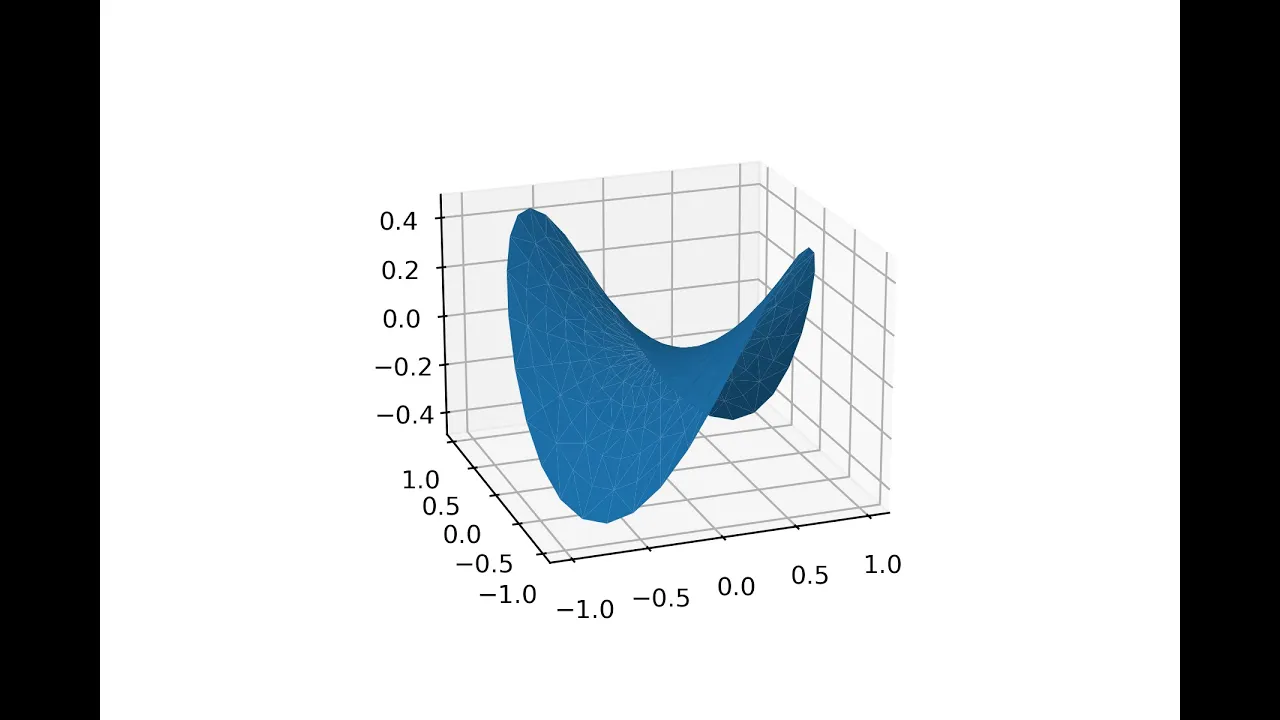
The way I define the spacetime interval, it becomes increasingly negative in the forward time direction, so we can represent this as a valley dropping away from me here at the origin.
I naturally slide through time by the steepest path, straight down.
I can change that path by expanding energy to change my velocity, although doing so realigns the contours so I always slide down the steepest path.
There's no point anywhere downhill that I can't reach as long as I can get close enough to the speed of light.
In fact, the nearest downhill contour defines the forward light cone for anyone anywhere on the spacetime diagram.
But uphill is impossible as long as the cosmic speed limit is maintained.
Breaking that speed limit and sliding uphill are equivalent.
To reverse the direction of your changing spacetime interval is to reverse the direction of causality, to travel backwards in time.
The spacetime diagram we looked at today was for a flat or Minkowski space, in which faster than light travel is the only way to flip your space time interval.
But in the crazy curved space within a black hole, it gets flipped for you.
We'll soon see how this requirement of a forward causal evolution leads to some incredible predictions when we try to calculate the sub event horizon interval of spacetime.
A big thank you to Audible for sponsoring today's episode, and also for making it possible for me to research spacetime while riding crowded New York subways.
Lately, I've been zoning out to Audible books from two other New Yorkers.
Janna Levin's "Black Hole Blues" is a wonderful take on the new window that gravitational waves are opening on our universe.
Also, Caleb Scharf's "Gravity's Engines" gets into my favorite space things of all-- quasars, and especially how important they are in the evolution of the universe.
Check them out, for free if you like, at audible.com/spacetime for your free 30 day trial.
"Space Time" is possible only through your support.
Watching is, of course, a huge help, so thanks for tuning in.
But an extra thanks is warranted to our Patreon supporters who throw in a few bucks each month to help us cover the costs.
And an extra, extra thanks to David Nicholas, who's supporting us at the big bang level.
David, we're naming an entire galaxy after you.
It's a beautiful barred spiral galaxy in the Fornax cluster.
It'll be called David.
We skipped comments last week because I was at the beach, so today, we're tackling both phantom singularity and quasars.
Michael Lloyd asks, "Is the calculated infinite density of the core of a black hole an artifact of the limitations of three dimensional mathematics?"
Well, maybe, sort of.
One way out of the mathematical singularity at the center of black holes is with string theory, which proposes that particles that we see in regular 4D spacetime result from oscillations within many more coiled dimensions, so-called strings.
One idea is that the inside of an event horizon is composed of a ball of raw strings, a so-called fuzzball, and that no infinite density exists.
We'll get back to this another time.
Jose Hernandez says that, for a mathematician, infinity is just a number.
For a physicist, it means madness.
Not true-- everyone goes mad thinking about infinities.
Mathematician Georg Cantor invented set theory, the mathematics we use to study different types of infinity.
He was in and out of sanitariums throughout his later life.
Joan Eunice asks whether there's a spot near a quasar where a stable orbit could be created, and what would time dilation be like there?
Well, the smallest stable orbit around a black hole is the so-called innermost stable circular orbit.
It's three times the Schwarzschild shield radius for a non-rotating black hole.
Below that, accreting material spirals into the black hole very quickly, and yeah, time dilation would be significant there.
We actually do see the effect of time dilation in some of the x-ray light coming from right near the black hole.
Ion atoms, orbiting at around 10 times the Schwarzschild shield radius, undergo an extremely energetic electron transition that produces X-rays at a very particular frequency, the ion K-alpha emission line.
We see that these x-rays are stretched out as they climb out of the black hole's gravitational well.
That gravitational redshift is the same thing as gravitational time dilation.
Mike Cammiso asks whether nuclear fusion occurs inside accretion disks.
Well, although quasar accretion disks can reach some pretty crazy temperatures, they aren't particularly dense.
Stars are so good at fusion, in part, because they're the cause of creating high densities.
That said, it may be that parts of the accretion disks sometimes become gravitationally unstable and collapse, in which case you might get some weird stardust-like activity and some fusion.
But accretion disks are very poorly understood because they're too small to take images of, so this is all speculation.
Bikram Sao asks how large the original star must have been to produce a supermassive black hole.
Well, the answer is probably very large, but nowhere near the mass of the SMBHs that we see today.
These giant black holes have been growing since the dawn of time by creating gas and by merging with other black holes.
The original seed black holes may have been left over by the deaths of an insanely large first generation of stars, perhaps thousands of times the mass of the sun.
But by now, some of those have grown to billions of times the mass of the sun.
Cinestar Productions has a story for us.
"When my dad was in college, he needed one of those easy classes for credit, so he took a class on quasars and black holes in the universe.
He was not a science student.
He took the class on astrophysics because he thought it would be easy.
Facepalm."
I hear you.
And to all my students in Astronomy 101 this semester, no, we're not learning about the star signs.
Yes, it's going to be harder than you thought.
Yes, there is a curve.
No, watching "Space Time" doesn't count as extra credit, but it can't hurt.
Right?
Up Next

6:51
Nuclear Fusion Explained: How Stars Create Elements
@ScienceAsylum
160.1K views•2016-11-28

12:53
21cm Hyperfine Transition in Neutral Hydrogen: Radio Astronomy Basics
@AaronRobertParsons
12.4K views•2011-10-13
6:59
Understanding Geodesics and Curvature in Spacetime: Clarifying Parallel Transport
@pbsspacetime
341.3K views•2015-07-08

27:14
Entropy and the Second Law of Thermodynamics Explained
@veritasium
27.5M views•2023-07-01
Related Study Plans & Knowledge Roadmaps
Structured learning paths in Physics
physics
Nuclear Physics (Decay, Fission & Reactors)
01Atomic Structure and the Binding Force
02Radioactive Decay and Half-Life
03Nuclear Fission Mechanics and Chain Reactions
+ 2 more learning modules
12h5 modules
Explore Roadmap
physics
Soft Matter (Polymers, Colloids & Rheology)
01Foundations of Soft Matter & Thermal Forces
02Polymer Physics and Macromolecules
03Colloids, Surfactants, and Self-Assembly
+ 2 more learning modules
38h5 modules
Explore Roadmap
physics
Analytical Mechanics: Lagrangian & Hamiltonian
01Mathematical Foundations: Calculus of Variations
02From Newtonian Mechanics to Constraint Dynamics
03The Principle of Least Action & Lagrangian Mechanics
+ 3 more learning modules
28h6 modules
Explore Roadmap
physics
General Relativity (Spacetime & Cosmology)
01Foundations of Relativity: Special Relativity
02The Geometry of Spacetime: Equivalence Principle & Curvature
03Einstein's Field Equations: The Mathematics of Gravity
+ 2 more learning modules
55h5 modules
Explore Roadmap