



























Futuristic architecture encompasses diverse styles reflecting humanity's hopes and fears about the future, including Retro-Futurism (1950s optimism with chrome and flying saucers), Megastructure (vast self-sufficient cities), High-Tech (computer-designed organic forms), Brutalist Futurism (oppressive concrete structures), Cyberpunk (high-tech urban decay), Minimalist Utopia (sterile perfection), Orbital (space stations), Solarpunk (sustainable nature-tech integration), Post-Apocalyptic (scavenged survival), Off-World Colonist (alien planet habitats), Aquatic (deep-sea engineering), Nomadic (mobile cities), Bio-Mechanical (organic-synthetic hybrids), and Stellar Engineering (cosmic megastructures).
Futuristic Architecture Styles Explained: Conceptual Evolution (2024)
Added:The history of 20th-century architectural movements, particularly Modernism and Postmodernism, which serve as the baseline for stylistic evolution.
The foundational Italian Futurist movement of the early 20th century and its focus on speed, technology, and industrialization.
The concept of utopianism in urban planning and how architectural design historically reflects societal hopes, anxieties, and ideologies.
Basic familiarity with CAD (Computer-Aided Design) and the paradigm shift from physical drafting to digital modeling.
Parametricism and computational design, exploring how algorithms and generative software are used to construct complex, futuristic structures.
Virtual and Metaverse architecture, analyzing spatial design principles when freed from physical gravity, material costs, and structural engineering limits.
Speculative and critical architecture, using visionary design as a medium to debate future climate, technological, and socioeconomic scenarios.
Regenerative architecture and Solarpunk design, studying how sci-fi ecological ideals are translated into real-world, self-sustaining building technologies.
54K views2.6Klikes10:33Original Release: 2025-07-13
Retro-Futurism This is the future as imagined by the past, a style born from the post-war optimism and Atomic Age faith in technology.
Architecturally, it's defined by the aesthetics of the 1950s and 60s, featuring sweeping Googie-style curves, dramatic fins, and flying saucer shapes.
Materials like chrome, glass, and vibrantly colored plastic are used everywhere.
The overall feeling is one of clean, automated cheerfulness a world of flying cars, personal jetpacks, and robot maids, famously seen in The Jetsons and the original design of Disneyland's Tomorrowland.
Megastructure This style is defined by its almost incomprehensible scale, envisioning buildings so large they contain entire cities within a single, continuous structure.
It’s an architecture of consolidation, often appearing as immense, self-sufficient pyramids, sprawling arcologies, or networks of towers connected by sky-bridges.
Popularized by real-world movements like Japanese Metabolism, the core idea is a modular framework that can grow and adapt over time.
While awe-inspiring, the sheer scale can also feel overwhelming and dehumanizing, perfectly captured by the Tyrell Corporation's pyramid in Blade Runner.
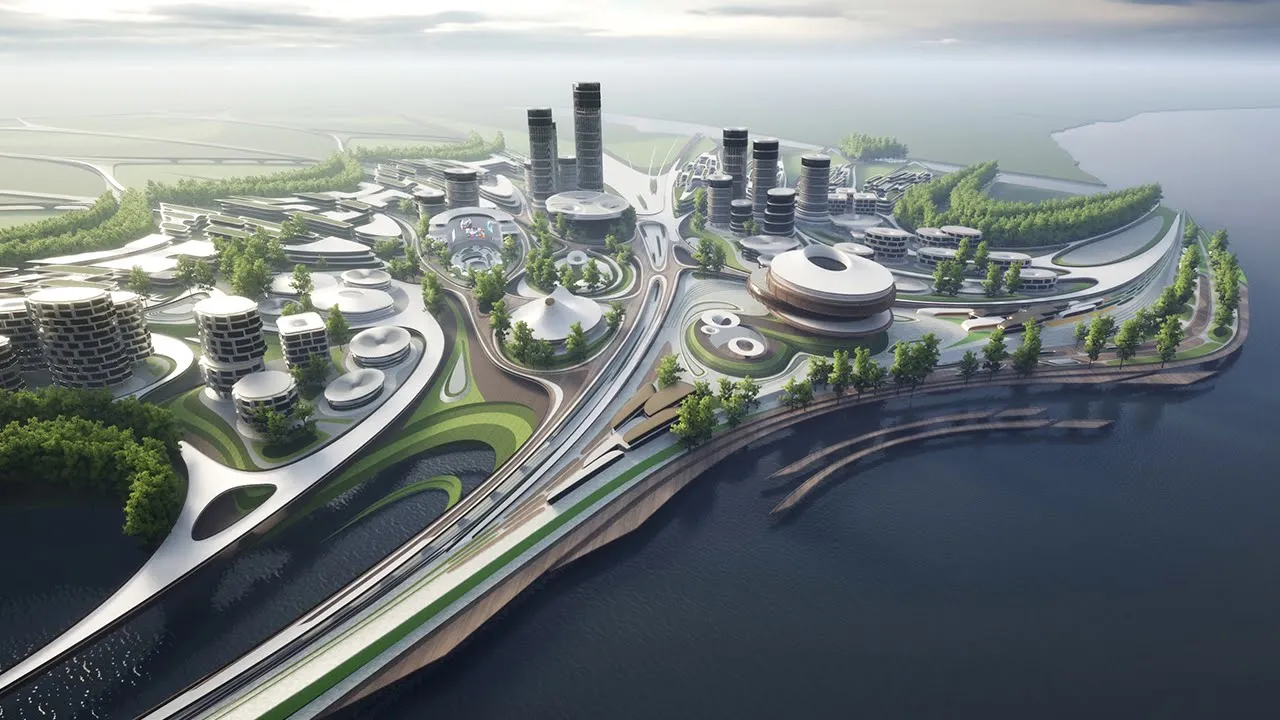
High-Tech This is the sleek, sophisticated vision of the near-future that is actually being built right now.
Championed by architects like Zaha Hadid and Santiago Calatrava, this style is defined by complex, fluid, and non-rectangular forms that are designed with the help of powerful computer algorithms.
The aesthetic is often inspired by organic systems, featuring skeletal structures, curving shells, and flowing lines that seem to defy gravity.
The feeling is one of dynamic, sophisticated motion, creating buildings that look almost alien and alive, using advanced materials to make the impossible possible.
Brutalist Futurism This is the architectural language of power, permanence, and oppression.
Using massive, raw, unfinished concrete forms, this style creates a future that feels heavy, unyielding, and inhuman.
The aesthetic is defined by monolithic shapes, fortress-like walls, and small, deep-set windows that offer little warmth or welcome.
In science fiction, Brutalism is the go-to style for totalitarian governments, corporate security headquarters, and ancient, imposing alien structures, as seen in the stark buildings of Blade Runner 2049 and the monumental structures of Arrakeen in Dune.
Cyberpunk This is the architecture of a high-tech, low-life future, where technological advancement has not resulted in a better society.
Cyberpunk is defined by extreme urban density and a chaotic fusion of advanced technology and urban decay.
Massive skyscrapers, often corporate-owned, are covered in a cacophony of glaring holographic advertisements and neon signs.
Far below, the street level is dark, over-crowded, and perpetually rain-slicked a vertical slum where the architecture itself feels like a cage, famously visualized in Blade Runner and Cyberpunk 2077.
Minimalist Utopia This is the architectural style of a future where all messiness has been engineered away, often with an unnerving, oppressive calm.
It is defined by vast, empty spaces, seamless white or grey surfaces, and a complete and total lack of ornamentation or personal expression.
The forms are often monolithic and perfectly geometric, creating a sense of serene, sterile beauty.
Seen in films like Gattaca and THX 1138, this style uses its pristine perfection to suggest a society where individuality and emotion have been sacrificed for total order and control.
Orbital This is the architecture of the elite escaping a troubled Earth.
The style is defined by pristine, gravity-defying structures, most often in the form of massive, rotating torus stations or rings that create artificial gravity.
The interiors are the opposite of the crowded planet below: spacious, sunlit, and filled with lush, manicured parks and luxury villas, all with panoramic views of space.
It is the clean, exclusive, and segregated future of the 1%, as perfectly depicted in the film Elysium.
Solarpunk This is the optimistic, utopian counterpoint to Cyberpunk, envisioning a future where technology and nature have merged.
This style is defined by buildings that act like living organisms, integrating plant life directly into their design.
It features skyscrapers covered in "living walls" of vegetation, terraces overflowing with trees, vertical farms that feed the population, and structures that generate their own clean energy.
The Solarpunk aesthetic is lush, green, and sustainable, presenting a hopeful future of symbiotic harmony.
Post-Apocalyptic This is the architecture of pure survival.
Arising after a societal collapse, this style is not designed, but scavenged and cobbled together.
It is defined by its ad-hoc, utilitarian construction, using materials salvaged from the "old world" shipping containers, scrap metal, car parts, and the concrete ruins of former buildings.
Structures are often heavily fortified, modular, and chaotic, reflecting a world of constant threat.
It is the pragmatic and ingenious style of necessity seen in worlds like Mad Max and Fallout.
Off-World Colonist This is an architectural style born from the harsh necessities of surviving on a hostile alien planet.
It is defined by its modularity and functionality, with a focus on life-support systems above all else.
The most common forms are prefabricated habitats, inflatable structures, and geodesic domes assembled on-site, often partially buried for protection.
The aesthetic is purely utilitarian and industrial, prioritizing airlocks, reinforced viewports, and hydroponic labs over any kind of decoration.
Aquatic This is the architecture of humanity's expansion into the oceans, our own planet's "final frontier."
Defined by the immense pressures of the deep, this style relies on spheres, domes, and reinforced, curving hulls to maintain structural integrity.
The aesthetic is often inspired by deep-sea life, featuring bioluminescent lighting and structures that anchor to the seabed.
It is a style that blends advanced, high-pressure engineering with the strange, alien beauty of the underwater world, as seen in BioShock or The Abyss.
Nomadic This is architecture that has broken free from the land, defined by massive, self-propelled structures that roam the landscape or skies.
This is a style of pure function and movement on a city-wide scale.
The visual form can vary wildly, from the resource-devouring "traction cities" of Mortal Engines to the functional Sandcrawlers of Star Wars or the whimsical, shambling castle in Howl's Moving Castle.
In all cases, the city is a machine.
Bio-Mechanical This is architecture that is grown, not built, blurring the line between biology and structure in an unsettling way.
Popularized by the art of H.R. Giger, this style is defined by organic, skeletal forms, ribbed tunnels, chitinous shells, and unsettling, sinuous curves.
It feels both deeply complex and fundamentally non-human, as if you are walking inside the body of a creature.
It is the architecture of alien hives or parasitic organisms, famously seen in the Alien franchise.
Stellar Engineering This is architecture on a cosmic scale, built by god-like civilizations to harness the power of stars.
This high-concept style includes theoretical megastructures like Dyson Spheres that completely encase a star, or Ringworlds that create artificial planets miles wide and millions of miles long.
The aesthetic is one of unimaginable scale and pure energy, often appearing as structures made of light, force fields, or exotic matter that defy conventional physics.
Cyberspace This is the architecture of non-physical, virtual worlds.
Freed from the laws of physics and material constraints, this style is defined by impossible geometry, glowing lines of light, and surfaces that can glitch, transform, or dissolve instantaneously.
It is the world of data streams, abstract grids, endless voids, and luminous structures that represent information itself.
It is the pure, schematic architecture of the digital realm, as seen in films like Tron and The Matrix.
So, from Minimalist Utopia to the chaos of a Post-Apocalyptic world, the architecture of the future is really a mirror for our present hopes and fears.
But I want to hear from you.
Which of these futures feels most likely?
And which style is your personal favorite?
Let me know in the comments.
If you'd like to explore more architectural styles, both real and imagined, be sure to like this video and subscribe to the channel.
Thank you for watching.
Up Next
16:42
Future Megacities: Architecture and Urban Design in Sci-Fi Films
@DamiLeeArch
2.6M views•2022-11-11

12:54
Triumph of Orthodoxy Icon: Byzantine Art & History Explained
@BenCallan
2.1K views•2024-08-06

9:49
FastAPI vs Flask vs Django: Choosing the Right Python Web Framework
@TechWithTim
302.5K views•2024-05-26

1:42
Game of Thrones Opening Credits: A Cinematic Analysis
@gameofthrones
46.3M views•2011-04-18
Related Study Plans & Knowledge Roadmaps
Structured learning paths in General & Interdisciplinary Studies
general-studies
Elevator Engineering: History, Physics & Cities
01From Hoists to Safety Brakes: The Dawn of Vertical Lift
02Hydraulic vs. Traction: The Engineering Physics of Elevators
03Modern Speed, Safety, and Algorithms
+ 2 more learning modules
12h5 modules
Explore Roadmap
general-studies
Rubber: Material Science, History & Geopolitics
01Origins of Natural Rubber & Mesoamerican History
02The Chemistry of Natural Rubber & Vulcanization
03The Geopolitics of the Rubber Boom & Colonization
+ 2 more learning modules
12h5 modules
Explore Roadmap
general-studies
Containerization: Evolution, Logistics & Trade
01Ancient Trade & Bulk Cargo: Amphorae to Barrels
02The Industrial Revolution & Cardboard Packaging
03The Containerization Revolution: Malcom McLean
+ 2 more learning modules
12h5 modules
Explore Roadmap
general-studies
Textile Tech: Evolution, Labor & Global Impact
01Pre-Industrial Textiles: Handloom & Cottage Industry
02Mechanization: The Spinning Jenny to the Power Loom
03The Factory System & Global Labor Transformation
+ 2 more learning modules
10h5 modules
Explore Roadmap