


















D'Alembert's principle, formulated by 18th-century French mathematician Jean le Rond d'Alembert, is an alternative formulation of Newton's second law that transforms dynamic problems into static equilibrium problems by introducing an inertial force (-ma) opposite to the acceleration, thereby simplifying calculations using statics formulas.
D'Alembert's Principle: Dynamics to Statics Explained
Added:Newton's Laws of Motion, specifically the formulation of the second law (F = ma) for particles and rigid bodies.
The principles of static equilibrium, where the net force and net torque acting on a system are equal to zero.
The concept of virtual work and virtual displacement, which serves as the mathematical foundation for D'Alembert's formulation.
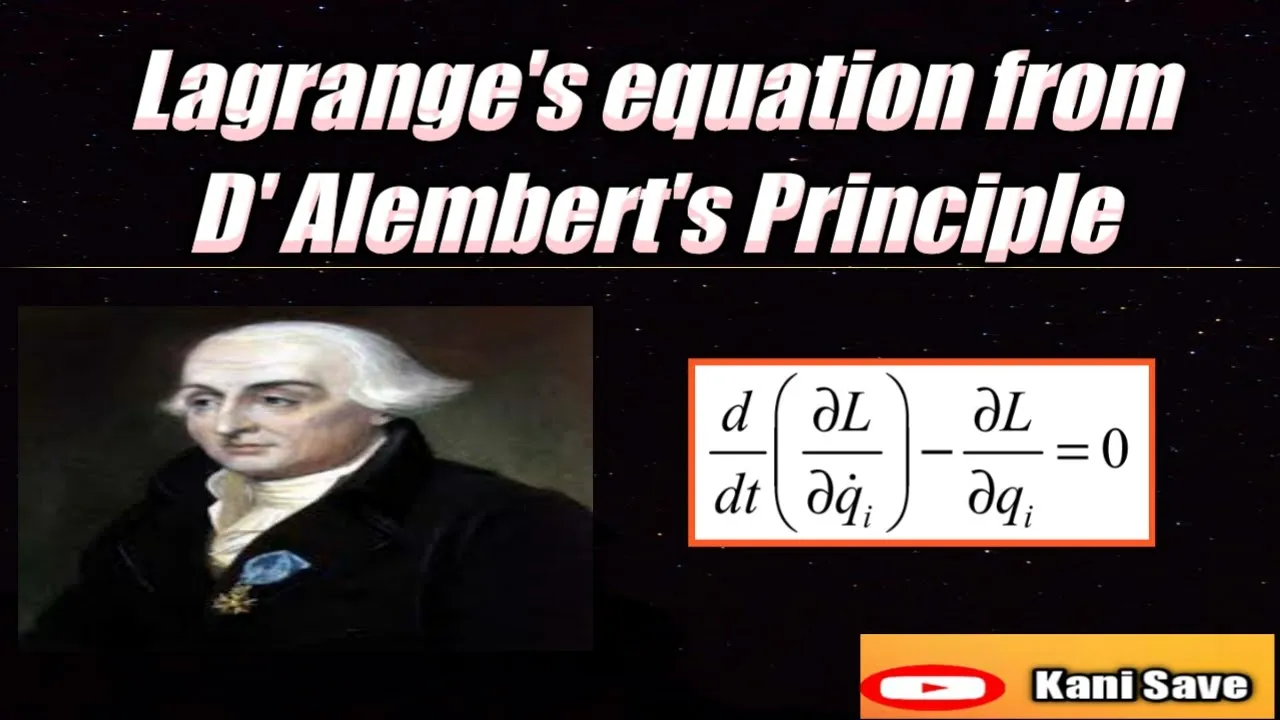
Derivation of Lagrange's Equations of motion from D'Alembert's Principle.
Understanding generalized coordinates, degrees of freedom, and constraint forces (holonomic vs. non-holonomic constraints).
Hamilton's Principle and the application of the Calculus of Variations to classical mechanics.
Practical application in multi-body dynamics, robotic manipulator kinematics, and structural analysis under dynamic loads.
73.5K views931likes3:39Original Release: 2022-05-13
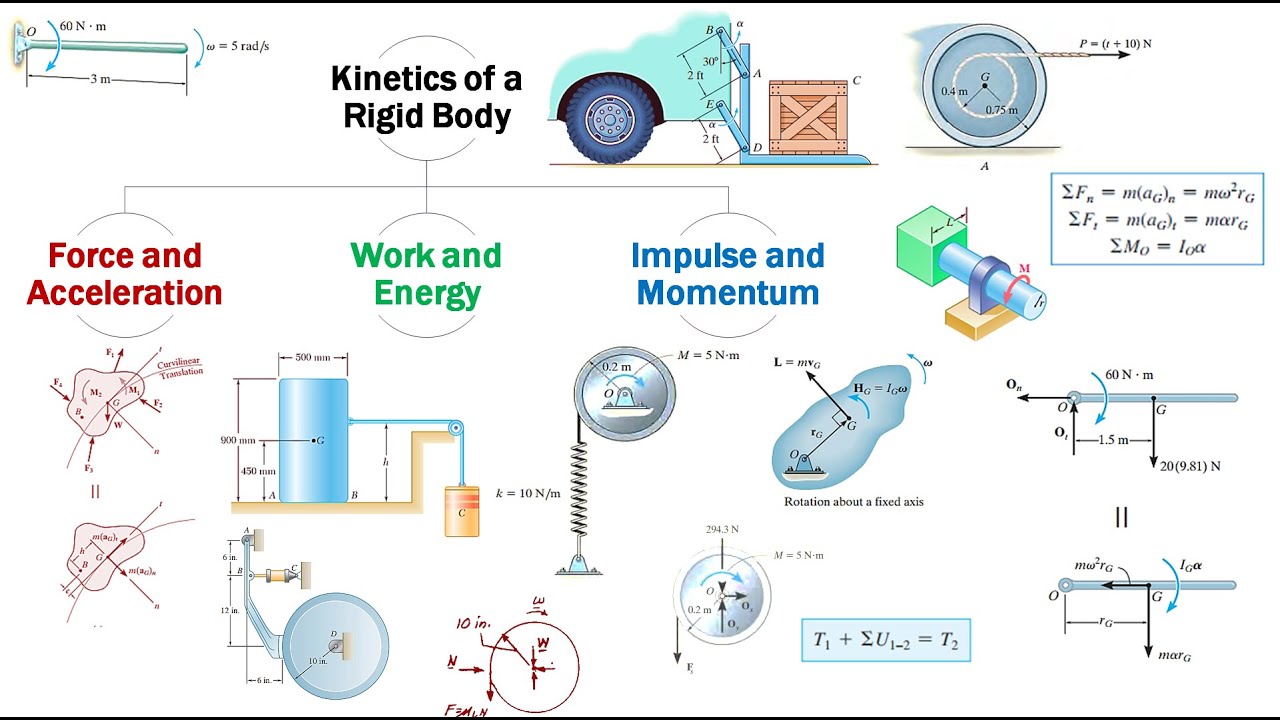
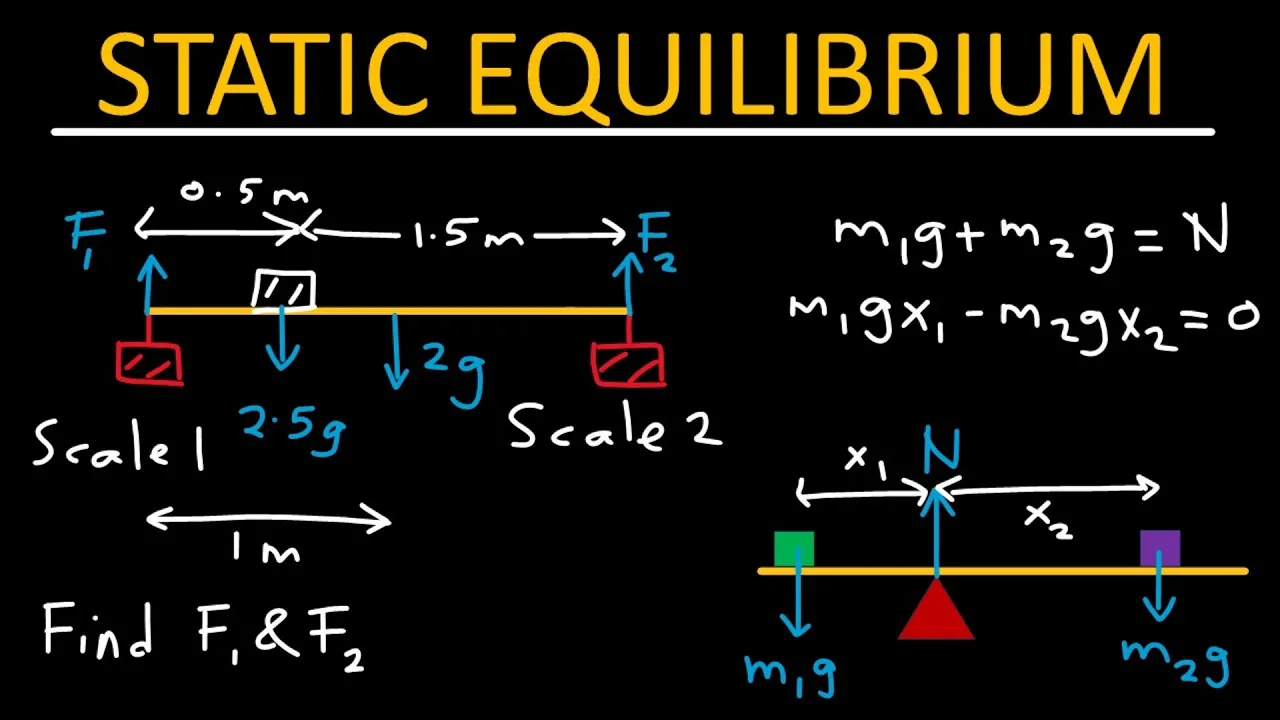
so in this video we will look at d lembert's principle d alambit's principle is an alternative form of newton's second law of motion it is given by 18th century french polymath john d ron d alambert in effect the principle reduces a problem in dynamics to a problem in statics to give you an example of dynamics and statics the mobile you are holding to watch this video or a laptop kept on a table is in static equilibrium which means it is static there are a lot of forces acting on the laptop or mobile but it is in the same position without any movement dynamics on the other hand are all sorts of movement you see for example let's say some guy is pushing a carton box the box is under some force and it is also in motion due to that force this is dynamics it is always easy to analyze the problem and solve if it is a problem of statics and not dynamics because dynamics involve lot of parameters which complicates the solution so d alembert's principle helps us in reducing the problem in dynamics into statics now how do we understand this principle we will start from newton's second law the second law states that the force f acting on a body is equal to the product of mass m and acceleration of the body a or f is equal to m a m a is the force behind the motion of the box here now according to d lambda's principle we need to consider this whole system and apply another force minus m a in the opposite direction of the original force m a this will bring the system into a static equilibrium the force minus m a is called as inertial force in d lambda's form the force f plus the negative of the mass m times acceleration a of the body is equal to zero f plus minus m a is equal to zero in other words the body is in equilibrium under the action of the real force f and the fictious force minus m a the fictious force is also called as the inertial force or a reversed effective force so d alhambert's principle states that the resultant force acting on a body together with reversed effective force or inertia force are in equilibrium d lombard's law simplifies the calculation by reducing the problem into a static equilibrium problem you may not understand it completely now but when you apply it in problems you will come to know however the bottom line problem will be a static problem and all the formulas of statics can be applied this is all about d allen words principle
Up Next
18:22
Euler-Lagrange Equation Explained Intuitively | Lagrangian Mechanics
@EugeneKhutoryansky
444.8K views•2018-11-18

12:53
21cm Hyperfine Transition in Neutral Hydrogen: Radio Astronomy Basics
@AaronRobertParsons
12.4K views•2011-10-13

32:32
NMR Spin Physics I: Zeeman Effect, Resonance Condition & Larmor Frequency
@nptel-indianinstituteofsci8064
2.3K views•2024-01-17

27:14
Entropy and the Second Law of Thermodynamics Explained
@veritasium
27.5M views•2023-07-01
Related Study Plans & Knowledge Roadmaps
Structured learning paths in Physics
physics
Nuclear Physics (Decay, Fission & Reactors)
01Atomic Structure and the Binding Force
02Radioactive Decay and Half-Life
03Nuclear Fission Mechanics and Chain Reactions
+ 2 more learning modules
12h5 modules
Explore Roadmap
physics
Soft Matter (Polymers, Colloids & Rheology)
01Foundations of Soft Matter & Thermal Forces
02Polymer Physics and Macromolecules
03Colloids, Surfactants, and Self-Assembly
+ 2 more learning modules
38h5 modules
Explore Roadmap
physics
Analytical Mechanics: Lagrangian & Hamiltonian
01Mathematical Foundations: Calculus of Variations
02From Newtonian Mechanics to Constraint Dynamics
03The Principle of Least Action & Lagrangian Mechanics
+ 3 more learning modules
28h6 modules
Explore Roadmap
physics
General Relativity (Spacetime & Cosmology)
01Foundations of Relativity: Special Relativity
02The Geometry of Spacetime: Equivalence Principle & Curvature
03Einstein's Field Equations: The Mathematics of Gravity
+ 2 more learning modules
55h5 modules
Explore Roadmap