
























The Doppler effect describes how the observed frequency of waves changes when the source moves relative to the observer; for sound, approaching sources produce higher frequencies (blue shift) while receding sources produce lower frequencies (red shift), and this principle extends to electromagnetic waves where astronomers use spectral line shifts to measure radial velocities, determine orbital parameters, and identify compact objects like neutron stars (typically ~1.4 solar masses) and black holes (masses exceeding 3 solar masses) in binary star systems.
Doppler Effect, Binary Stars, Neutron Stars & Black Holes | 8.01x Lecture 23
Added:Basic wave mechanics, including concepts of wavelength, frequency, and the classical Doppler effect for sound waves.
Newtonian mechanics and circular motion, specifically centripetal acceleration and orbital velocity.
Newton's Law of Universal Gravitation and Kepler's laws of planetary motion.
The principles of conservation of energy and conservation of angular momentum.
Einstein's General Theory of Relativity, focusing on gravitational redshift and the warping of spacetime around massive objects.
The physics of accretion disks and X-ray binary systems to understand how matter behaves when falling into a compact object.
Doppler spectroscopy (radial velocity method) and its application in modern astronomy to discover exoplanets.
Gravitational wave astronomy, specifically studying the mergers of binary black holes and neutron stars as detected by LIGO.
134.5K views2.1Klikes49:59Original Release: 2015-02-08
The speed of sound is 340 meters per second-- it depends a little bit on the temperature-- about 770 miles per hour.
When I speak to you, my sound reaches you with that speed.
I produce a certain frequency here, a certain number of oscillations per second.
They reach you, your eardrum starts to oscillate with the same frequency and you hear that tone.
I have here a tuning fork which oscillates 440 times per second.
(tuning fork produces medium-pitched tone) Your eardrum oscillates 440 times per second-- you hear this tone.
Here I have 256 oscillations per second.
(metal rod emits lower tone) Your eardrum is now shaking, going back and forth 256 times per second.
If you stay where you are and you don't move and I move these tuning forks, you will hear a different frequency and that's what we call Doppler effect.
If my sound source approaches you, you will hear a frequency f prime which is larger than the frequency of the tuning fork.
If it moves away from you, which I will call receding, then f prime equals lower... lower frequency.
For instance, I move to you a sound source-- I call that a transmitter-- with a speed of about one meters per second.
Transmitter is the sound transmitter.
Then if it approaches you here, you will hear f prime, which is 1.003 times f.
This three here is the one part out of 340 that you get an increase in frequency.
If I move it away from you, then f prime would be 0.997 times the frequency of the source itself.
You stay where you are.
I have here a tuning fork which generates 4,000 hertz, a very high frequency.
If I move it to you with the speed of one meter per second, which I can do, then you get an increase in pitch of 0.3%.
That makes it 4,012 hertz.
And when I move it away from you there is a decrease of 0.3%.
And you can clearly hear that difference.
I will first make you listen to the 4,000 hertz without my moving.
(tuning fork produces very high pitched tone) Can you hear it? Very high frequency.
Is it painful, really?
High frequency.
Most of you are young enough you should be able to hear 4,000 hertz.
Okay, now I am going to move it to you one meter per second and away from you.
(high tone goes up and down slightly in pitch) Did you hear it? Once more.
(tone goes up and down quickly again) (class laughs) When it comes to you, it's clear that the frequency goes up, and when it moves away from you, the frequency is down.
Now imagine that I'm going to rotate the sound source around in a circle.
Now the sound that you receive, the frequency that you receive will change in a sinusoidal fashion.
If this is that circle, and this is the radius of that circle, and if you are here in the plane of the circle, then when the source comes straight to you with the velocity v-- let's say it's a uniform circular motion-- f prime will be larger than f and it will, in this case, reach a maximum.
When it is at 90 degrees relative to you-- I don't have to give it a vector notation-- f prime equals f.
When it moves away from you, f prime is smaller than f, you hear a minimum.
And when it is here again-- when the angle between the velocity and your direction is again 90 degrees-- then f prime equals f again.
And so this phenomenon is called the Doppler effect.
So if I twirl it around, you will hear a sinusoidal fluctuation in f prime.
Suppose I plot, as a function of time, f prime the way you will receive it-- you sit still, but I'm going to move the sound source around like this.
Then you will have a curve that looks something like this: some sinusoidal-cosinusoidal fluctuation of f prime.
This will be the value f produced by the sound source itself.
This will be f prime maximum and this will be f prime minimum.
If you could record this, there is an amazing number of things that you can deduce from this curve.
First of all, you can take... You can measure f prime max divided by F, because you see this curve, so you know what f is here, you see what f prime max is, and that should allow you to retrieve immediately v velocity of the transmitter.
If that number were 1.003, then you know that the speed in the orbit was one meter per second.
So this ratio immediately gives you the transmitter velocity.
This time separation gives you immediately the period of rotation, but since two pi R-- if R is the radius divided by the velocity of the transmitter-- since that is the... oh, I can reverse it, it doesn't matter.
Two pi R divided by the time to go around is the velocity of the transmitter.
Since you know the velocity of the transmitter from this ratio since you know the period, which is this, you now also find the radius R.
So from that curve-- and keep that with you, because it's going to be important in what follows-- we can derive three things: the radius, the period of rotation and the speed of the object as I twirl it around.
I have here what we call a wind organ.
When I twirl this around, it produces a particular tone.
We will talk later about 801 why it produces a particular tone.
Sometimes you hear two tones.
I'll try to make you hear only one.
And as I swirl it around, the sound is coming... the sound source, the transmitter is coming to you.
This, when it goes like this, it's 90-degree angle so you should not hear any Doppler shift.
When it is here, it's moved away from you and so you hear a sinusoidal change in f prime.
Try to hear that.
(wind organ producing tone that changes pitch) Can you hear, when it's coming to you, that it's higher-pitched than when it's going away from you?
Can you hear that?
Just say no if you don't hear it.
Not very clear.
(wind organ again producing varying tone) For me, it's impossible to hear because I'm standing right under it, of course.
Well, I tried.
I now want to change to electromagnetic waves.
Electromagnetic waves travel with the speed of light, which is 300,000 kilometers per second.
And if you want to treat that correctly, you would have to use special relativity.
In the case of sound, I stressed repeatedly that you in the audience should not move but that the sound source is moving.
In the case of electromagnetic radiation when you deal with the speed of light, you don't have to ask that question.
It is a meaningless question in special relativity.
To ask whether you are moving relative to me or whether I am moving relative to you, it doesn't matter.
All that matters in special relativity is the relative motion, so you can always think of yourself as standing still and make the source of electromagnetic radiation move to you, or away from you, relative to you.
Electromagnetic radiation is optical light, infrared, ultraviolet, radio, x-rays, gamma rays.
All of that is electromagnetic radiation.
If the velocity of the source of electromagnetic radiation-- the transmitter-- if that is way, way smaller than the speed of light, then it is very easy to predict the change in frequency due to Doppler shift.
Let this be the transmitter which produces frequency f, and here is the receiver which receives the frequency f prime.
And let the velocity of the source of electromagnetic radiation be v-- I could put transmitter here, but we can drop that index-- and let this angle be theta.
Then this is the component in your direction-- we call that the radial component-- which is v cosine theta.
So I delete the tr.
This is just the velocity of the source relative to you at that angle.
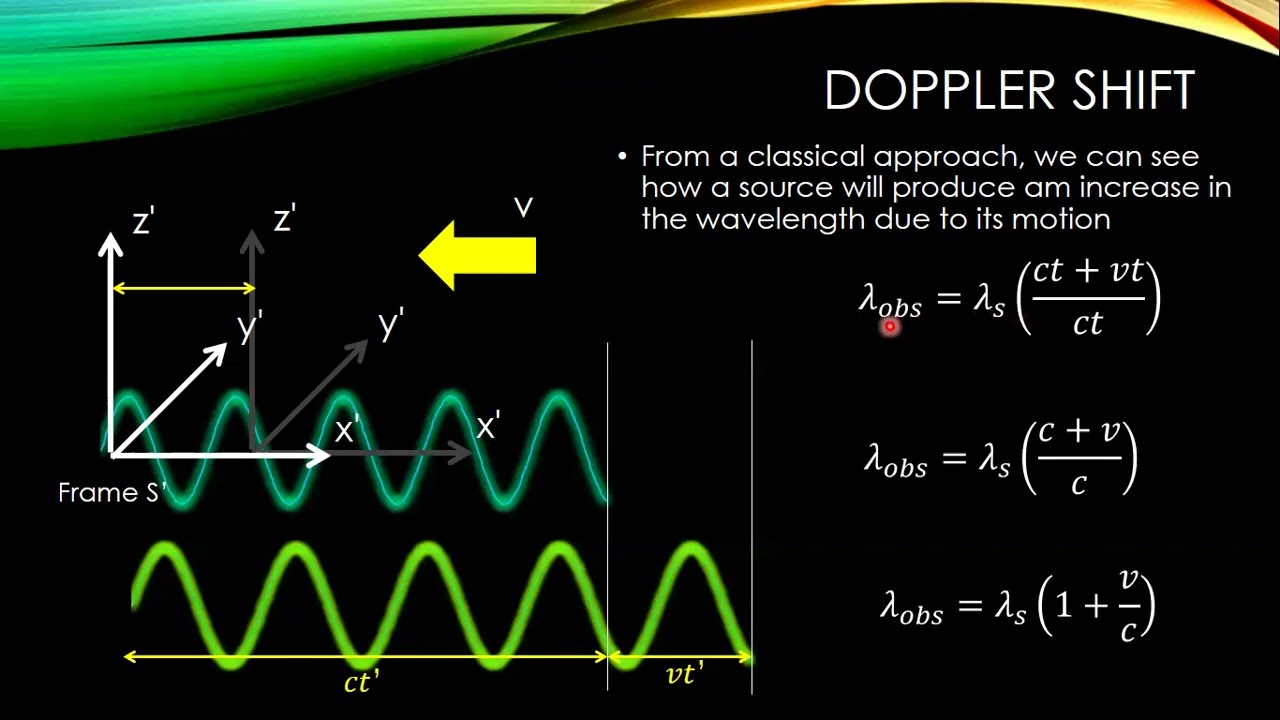
If now we want to know what f prime is, then f prime equals f times one plus v over c times the cosine of theta.
What matters is only the radial component of the velocity.
This is the radial component.
If theta is 90 degrees, just like we had with sound, then f prime equals f.
So 90 degrees, the cosine of theta is zero, f prime equals f.
If theta is smaller than 90 degrees, then it's coming towards you, then f prime equals larger than f.
If theta equals larger than 90 degrees, it's going away from you, then f prime equals smaller than f.
You would get a similar equation for sound by replacing this c by the speed of sound.
But I want to stress that this only holds for electromagnetic radiation if v over c is much, much smaller than one.
Now, when we deal with sound, there is something mechanically oscillating.
Something is vibrating.
With electromagnetic radiation, charges are vibrating.
Electrons are vibrating, and they are vibrating with a certain frequency, and that means there is a certain period of one oscillation.
And that period of one oscillation is, of course, one over the frequency.
I can ask myself now the question, how far does electromagnetic radiation, how far does light travel in the time of one period capital T?
Well, it goes with the speed of light, so in T seconds, it moves a distance cT.
And that distance we call the wavelength of electromagnetic radiation, lambda equals cT, for which you can also write c divided by F.
So this is the wavelength of the electromagnetic radiation-- the speed of light, 300,000 kilometers per second-- the period of one oscillation, say, of the electrons, and this is the frequency, which you can give in hertz.
I could give you a specific example.
I, for instance, can take a period T of two times ten to the minus 15 seconds.
That would give me a wavelength of about six times ten to the minus seven meters-- six times ten to the minus seven meters-- and that you would experience as red light.
If I make the period shorter-- say, 1.3 times ten to the minus 15 seconds-- I get a shorter wavelength.
I get four times ten to the minus seven meters, and you would experience that as blue light.
In astronomy, in optical astronomy we cannot measure the period or the frequency of optical light.
All we can measure is the wavelength.
And so if I want to use this equation, then I have to replace f prime by c divided by lambda prime and f I have to replace by c divided by lambda.
And when I do that, I get the following result.
I get lambda prime equals lambda times one minus v over c cosine theta.
If this is a plus, this is a minus.
Check that for yourself.
You have to use the Taylor expansion, namely that v over c is much, much smaller than one.
So you can see now if the object comes to you, in other words, if f prime is larger than f, if the frequency is higher, then the wavelength will be smaller.
And so let me write that down.
When the cosine of theta... so the object is coming to you-- when the cosine of theta is larger than zero, the object is approaching you, then the wavelength lambda prime will be less than lambda.
And that has a name-- we call that blue shift.
And the reason why we call that blue shift is that if the wavelengths become shorter, it moves towards the blue end of the spectrum, because blue has a lower wavelength than red.
If cosine theta is negative, then the object is receding from you, then lambda prime is larger than lambda, and we call that red shift.
These are the terms that astronomers use all the time.
When you make a spectrum of a star-- you can do that using prisms or by other means-- and you look at the light intensity as a function of wavelength-- so here is the light intensity as a function of wavelength-- then you may expect to see some kind of a continuum.
But, in fact, what you do see is... Superimposed on a continuum you see sometimes very sharp absorption lines-- black, missing light, called absorption lines And these absorption lines correspond to elements in the atmosphere of the star.
In fact, if you see the absorption lines, you can tell what kind of elements are present in the star.
Some are very characteristic absorption lines for hydrogen, some for calcium, some for silicon, some for magnesium and so on.
It's actually interesting that when you look at the spectrum of the sun-- when people did that first, when they had the means of doing that, they found absorption lines in the spectrum of the sun which could not be identified.
They had never been seen here on Earth, these lines, and so they called these lines after the sun.
The sun is Helios, and so they called it helium.
So helium was first discovered on the sun before it was later discovered on Earth by looking at the absorption lines of the solar spectrum.
If a star moves to you, then all the lines-- every single line-- will be blue-shifted.
And if the star moves away from you, all the lines will be red-shifted.
If you take an example: With lambda prime divided by lambda and you pick any one of those lines-- it doesn't matter which you pick because they will all do exactly the same.
If this were, for instance, 1.00333-- I just pick a very nice number; that means lambda prime, as you see, is larger than lambda; the wavelengths get longer, so we have a red shift-- and you substitute that in that equation, then you'll find that the velocity at which that star is moving relative to you-- that gives you immediately the answer there-- equals minus 0.00333 times the speed of light, c, and that is minus 100 kilometers per second.
And the minus, then, reminds you that the object is receding from you.
So that gives you a red shift.
I just wrote down that the velocity v is minus 100 kilometers per second.
It's, of course, v cosine theta that is minus 100 kilometers per second.
It's the radial velocity-- that's all you can measure.
You have no information on theta.
So it is this component, v cosine theta-- which we call the radial velocity-- that is minus 100 kilometers per second.
Half of all the stars in the sky are binaries, and so when you look at the spectra, you will see them go around each other.
And so you, in principle, can measure the red shifts and the blue shifts as they go around each other.
You see Doppler effect.
If they come to you, you see blue shift.
If they go away from you, you see red shift.
So, in principle, you can determine for each one of those stars the velocity in orbit, the radius of their orbit and, of course, the period of the binary system.
So it's an extremely powerful tool in astronomy if you have a binary system, when the stars exactly do this, to determine all these quantities that you would like to know.
I first would like to show you now some slides.
The first slide... oh, I have to lower the screen, by the way.
That would help, wouldn't it?
(chuckles) The first slide is a spectrum made in the laboratory of hydrogen, helium and calcium and sodium.
It shows you emission lines, no absorption lines.
These lines are produced by lamps, and the frequencies are very well known.
Here you see the famous sodium yellow lines.
So here is the red part of the spectrum and there is the blue part of the spectrum.
So we know these frequencies, we know these wavelengths very well.
And here you see the spectrum of the sun with all these absorption lines that I mentioned to you.
It's plastered with absorption lines, and each of them can be identified.
These are due to calcium, iron, hydrogen and so on.
Here is the blue part of the spectrum, here is the green part, the green part, and here is the red part of the spectrum.
And here you see the basic idea behind a binary system.
Suppose you have a binary system that only one star is visible and the other one is invisible and the one star shows you three clear absorption lines.
Then as the star moves around the center of mass, you see that all these lines drift in unison.
And out of this information you get the radius, the velocity and the period, assuming that you are on Earth in the plane of the orbit of the stars.
If you have a binary system whereby both stars are visible so you get the spectrum of both stars, then you see the Doppler shift of both stars in the spectrum.
Here we have a simple case that we only have two absorption lines, not to confuse the issue, and so in one... in the case of one star, the shift will be towards the left of the two lines, but the other star, the shift will be to the right, because if you have a binary system when one star comes to you, the other star goes away from you, and vice versa.
So now you are very lucky, now you have an ideal situation that you can find for both stars the radius of the orbit, the velocity in orbit and the period for each star, which, of course, is the same for both.
And here you see real data.
You see here, first of all, the emission lines which are measured in the laboratory that I just showed you.
They are always done simultaneously with the measurements.
You always must be sure that you have a good calibration of your wavelength.
And this spectrum a, the top spectrum, is of a star, a binary system, that has a period of 20.5 days.
And you see here single lines, if you have good eyes.
That means at this very moment both stars move relative to you at angles of 90 degrees, so you don't see any Doppler shift.
But now look here.
Later in time, you see that this line has split in two lines and this one has also split in two lines.
Clearly, one component is coming to you and the other component is moving away from you.
And so you get all this useful information in astronomy by making the Doppler shift measurements of binary systems.
I want to pursue the idea of binary stars.
They give us not only the information that we want regarding the orbits, but there is even more that we can get out of it which is even more exciting.
So I will remind you what a binary system looks like.
Remember exam... the second exam.
I'm sure you will never forget that second exam and maybe never forgive me for that.
Binary system: star one, radius r1, mass m1, velocity v1, and star two-- going about their common center of mass-- mass m2, radius r2 and velocity v2.
m1 r1 equals m2 r2.
That's the way the center of mass is defined.
Imagine that you as an observer are somewhere in the plane of this orbit, and you are here.
And you are observing the system going around.
Kepler's Third Law, which you derived on your exam as well as on an assignment: the period squared equals four pi squared times r1 plus r2 to the power three.
divided by G times m1 plus m2.
Let me check that to make sure I have that right.
Yes, that is correct.
Imagine now you can make the Doppler shift measurements of both stars.
You make the Doppler shift measurement of star number one, so you measure lambda one prime as a function of time.
Out of that pops immediately the period of rotation.
Out of that pops the velocity, as we discussed.
Out of that pops the radius, r1.
And now you measure the Doppler shift of star two as a function of time.
Out of that pops the period which, of course, better be the same.
Out of that pops its velocity in orbit and out of it pops its radius.
All these things come out of the Doppler shift measurements, but if you know r1 and you know r2, then you also know r1 plus r2, so you know this part in Kepler's Third Law.
Since you also know the periods, you can find what m1 plus m2 is.
So now you get an extra bonus.
You know now what the sum of the mass of the two stars is in the binary system, but you also know that m1 r1 is m2 r2.
So now you have two equations.
You know what m1 plus m2 is and you know this equation, and you can solve for m1 and m2, which is an amazing thing when you come to think of it.
So we finally end up with the mass of star one and the mass of star two.
All this comes out of Doppler shift measurements: the velocities, the radii, the periods and even the masses of these objects.
Now, if you as an observer on Earth are not exactly in the plane of the orbit, then the situation is a little bit more complicated, and I will not discuss that here today because, in principle, it doesn't affect the idea behind Doppler shift.
But for astronomers, it is very important.
It's really a nuisance, but I will not discuss that in any detail.
I want to discuss a fascinating application that we have in x-ray astronomy.
Namely, we have x-ray binaries.
What is an x-ray binary?
Well, it is a binary system.
This is a star not unlike our sun.
It has as certain mass, has a certain radius, and it is in orbit, let's say, with a neutron star, even though it could be a black hole.
But for now, let's just assume it is a neutron star.
And if these two masses are the same, which I only use for the sake of simplicity-- in practice, they could be very different-- then there is a point between these two, right in the middle, whereby the gravitational pull in one direction is the same as the gravitational pull in the other direction.
And we call that the inner Lagrangian point.
In other words, if you were there, the neutron star would pull at you with exactly the same force as the other star.
So you wouldn't know where to go.
If this inner Legrangian point lies below the surface of this star, that means if the stars are a little closer than I have drawn them here, then the matter of this star will fall towards the neutron star, because the pull in this direction is, then, larger than the pull in this direction.
Now, of course, this system is a binary system.
They go around in the plane of the blackboard, say, and so this matter cannot fall radially in but it will fall in and spiral in and forms what we call an accretion disk around the neutron star.
This is called the accretor and this is called the donor.
There is mass transfer from the donor to the neutron star.
Oops, I just noticed I misspelled the word "accretion."
There is an "r" in "accretion."
And as that occurs, there is a tremendous amount of energy that is released.
I want to blow up the neutron star.
Very simple 801 considerations, now.
What comes is extremely pedestrian.
This is the mass of the neutron star and this is the radius of the neutron star.
And I take a little bit of matter m, and I drop it from a large distance onto the neutron star.
At what speed will that little piece of matter reach the neutron star?
You should almost be able to close your eyes and give me that answer right now.
The kinetic energy when it reaches the neutron star equals one-half m v squared.
That is the speed at which it will crash onto the neutron star, and that must be mM neutron star G divided by the radius of the neutron star.
You always lose your m, and so you find that the speed at which it reaches the neutron star is the square root of two M neutron star times G divided by R neutron star.
You should remember this equation.
This was the equation that we had for escape velocity.
If you were here, and you go back to infinity, you reach exactly that speed, so if you fall in from infinity that is exactly the speed at which you reach the neutron star.
It should obviously be the same number.
And you don't really have to be infinitely far away; you just have to be much further away than the radius of the neutron star.
When this matter crashes onto the neutron star, the kinetic energy that is released is one-half mv squared.
It is converted to heat, and to give you some feeling for the incredible power of a neutron star, if you make this little m as little as ten grams-- think of it as a pretty full-sized marshmallow-- and you throw a marshmallow from a large distance onto a neutron star, the energy that is released is comparable to the atomic bomb that was used on Hiroshima.
A ten-gram object thrown onto a neutron star-- the reason being that this velocity becomes enormously high.
If you put in for the neutron star a mass of about three times ten to the 30th kilograms, and you take for the radius of the neutron star about ten kilometers, you will find that that velocity becomes about two times ten to the eighth meters per second, which is about 70% of the speed of light.
And because of this enormous speed-- one-half mv squared is horrendously high-- it is a conversion of gravitational potential energy to kinetic energy and then ultimately to heat.
Now, nature is transferring mass at an extraordinarily high rate in many of these binary systems.
There are several hundreds in our own galaxy.
The mass transfer rate, which I call dm/dt-- so that is the transfer rate from the donor onto the neutron star-- that transfer rate is roughly ten to the 14th kilograms per second.
It is ahorrendous mass transfer rate.
You can calculate-- by multiplying it with one-half v squared-- how many joules per second are released in the form of kinetic energy.
That means in the form of heat.
And I call that the power of that neutron star, and that, then, for this mass transfer rate, that's about two times ten to the 30th joules per second, which is watts.
And that is about 5,000 times larger than the power of our own sun.
But the temperature of this neutron star-- because of this enormous amount of energy released, the temperature would reach values of about ten million degrees Kelvin, and at that high temperature, the neutron star would emit almost exclusively x-rays.
You and I are very cold bodies, only 300 degrees Kelvin.
We radiate electromagnetic radiation in the infrared part of the spectrum.
We have warm bodies.
When you hold someone in your arms, you can feel that.
If I would heat you up to 3,000 degrees Kelvin, you would become red-hot.
And you actually... we could turn the light off and I would see you.
You're just emitting red light.
If I would heat you up to three million degrees, you would start to begin to radiate in x-rays.
You may not like it, but that's a detail, of course.
So I want you to appreciate the fact that the... the kind of radiation that you get depends strongly on the temperature, and at ten million degrees you're dealing almost exclusively with x-rays.
So these binary systems are very potent sources of x-rays.
The neutron stars rotate around, we discussed that earlier-- conservation of angular momentum-- and they have strong magnetic fields.
The matter that falls onto the neutron star already heats up during the infall because there is gravitational potential energy released, and so the matter is so hot that, in general, it's highly ionized.
And highly ionized material cannot reach a magnetic neutron star in all locations that it prefers to do so.
In 802, you will learn why that's the case.
However, the matter can reach the neutron star at the magnetic poles.
And so what you're going to see now is you're going to have a neutron star with magnetic poles, so the matter streams in onto the magnetic poles, which gives you two hot spots.
And if the axis of rotation doesn't coincide with the line through the two hot spots, if the neutron star rotates, you're going to see x-ray pulsations.
When the hot spot is here, you will see x-rays, and when the hot spot is here, you will not see x-rays.
And so we observe from these systems x-ray pulsations.
Now think of the following.
The x-ray pulsations are a clock.
It is the clock of the rotating neutron star.
If the neutron star in a binary system-- because all of these are in a binary system, these x-ray binaries-- if it's coming to you, you see Doppler shift.
The ticks of the clock come a little closer together.
If the neutron star moves away from you, the ticks of the clocks are a little bit further apart.
That is exactly what Doppler shift is all about.
So by timing the pulses of the x-rays, you can get a handle on the Doppler shift of the neutron star.
That means you can get the speed of the neutron star, you can get the radius of the orbit, and you can get the period, just like we discussed before.
But now you take an optical... The x-ray observations, by the way, have to be made from outside the Earth's atmosphere, because x-rays are absorbed by the Earth's atmosphere.
Now you take an optical telescope and you look from the ground, and now you see the optical spectrum of the donor.
And what do you see in the donor?
You see these absorption lines.
And as the donor moves around the center of mass, these absorption lines move back and forth.
The Doppler shift of the donor.
So you know the velocity of the donor, you know the radius of the orbit, and you know the period.
So now we have a situation that I just described earlier that you have the Doppler shift of both objects, and remember, I told you that you also get the masses.
You get the mass of the donor and the mass of the accretor.
Before I go ahead, let me show you some slides.
So we have to lower this again, if that's possible-- yep.
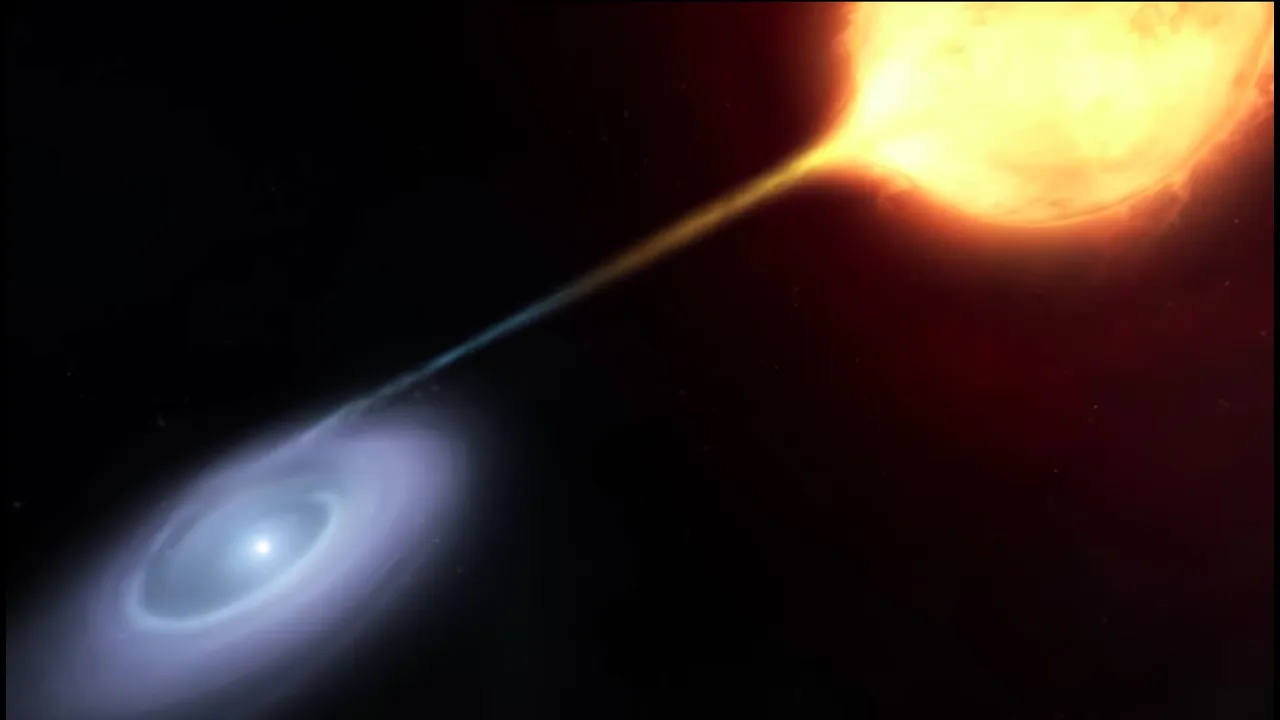
I want to show you an artist's conception of such a binary system.
So this is what it may look like.
You see the donor there and you see the neutron star right here, so small, of course, that it's invisible.
And this is the accretion disk.
Swirls in, the matter ends up on the neutron star.
And this is another view that gives you an idea of the donor and then the swirl of matter, and then it swirls in and ends up here on the neutron star.
And here you see data that were obtained in 1971.
It's clear evidence for the existence of these rotating neutron stars with these x-ray hot spots.
You see here the observed x-ray intensity as a function of time.
And the actual data are these very thin lines.
And this bold line was drawn over by the authors to convince you that you see a signal which is highly periodic.
The time from here to here is 1.24 seconds.
This object was called Hercules X-1.
So this is one of the magnetic poles and this is the other magnetic pole.
One magnetic pole and the other magnetic pole.
So you see here unmistakably the rotation of the neutron star and the x-ray pulsations.
Here you see data from the same object, but now the time scale is very different.
From here to here, this is two days.
And when you look at this data alone, forget this for now, notice that you see the source is active in x-rays-- the 1.42-second oscillations you cannot see, of course, anymore because the time scale is different, but notice here there are no x-rays at all: 1.7 days later, no x-rays at all.
1.7 days later, no x-rays at all.
And so what you're looking at here are what we call x-ray eclipses.
When the neutron star moves behind the donor star, all the x-rays are absorbed by the donor star and you get x-ray eclipses.
In other words, you get... Independently from the Doppler shift you also get the period of the orbit by the x-ray eclipses.
And this really changed our whole concept of astronomy, the existence of these neutron star binaries.
And now comes a part, what are the masses of these objects?
I already alluded you to the idea of the possibility that there may be black holes.
All the mass measurements that have been done to date of these neutron stars where you see the pulsations... all of them are very close to 1.4 solar mass.
And there's a good reason for that-- that's not an accident.
In 1930, the physicist Chandrasekhar predicted that white dwarfs could not exist if their mass is larger than 1.4 solar mass.
It was a quantum mechanical calculation for which he received in 1983 the Nobel Prize.
Remember we discussed white dwarfs earlier.
A white dwarf has about a radius of 10,000 kilometers, about the same as the Earth.
And imagine that you have a white dwarf, and you add matter to the white dwarf and you pass the 1.4-solar-mass mark.
Then the white dwarf will collapse and becomes a neutron star.
And so when we measure the masses of neutron stars, it turns out, maybe somewhat by surprise, that they're all very close to 1.4.
If you could add more matter to the neutron star by accreting more and more matter and you reach the point that the neutron star becomes as massive as three times the mass of the sun, we believe that the neutron star can no longer support itself and becomes a black hole.
And so now comes the question, what is a black hole?
A black hole is the most bizarre object that you can imagine, and it is something that you want to stay away from, too.
A black hole has no size, unlike a neutron star.
It has no size, but it does have mass, and it has a lot of mass-- three times the mass of the sun, ten times the mass of the sun, a hundred times the mass of the sun.
So it has mass, but it has no size.
We identify around the black hole a sphere with radius R which we call the event horizon.
Imagine you are at the event horizon and you want to get away from the black hole.
What kind of speed do you need?
You should be able to give me that answer immediately.
The escape velocity must be 2 MG divided by the radius of that event horizon.
In other words, the radius of the event horizon itself equals 2 MG divided by c squared.
If you tell me what m is, I will tell you what the radius of the event horizon is.
I went a little fast here.
I skipped an important step.
v is the escape velocity from the event horizon, which is at a distance capital R from the mass M.
So we see that here.
Now, this escape velocity can never be larger than the speed of light, so the maximum value possible is c.
And if now you look at this part of this equation and you take the radius on one side, you'll get that the radius of the event horizon equals 2 MG divided by c squared, and that's how I found that equation.
Sorry that I went a little too fast.
If M is the mass of the Earth, the radius of the event horizon is one centimeter.
If M is the mass of the sun, the radius of the event horizon is three kilometers.
If M is three times the mass of the sun, the radius of the event horizon would become nine kilometers.
Because it scales linearly with the mass.
If you were inside the event horizon, you could never escape the black hole because you would need a speed which is larger than the speed of light.
Therefore, you can never escape from inside the event horizon.
Nothing can get out of it, not x-rays, no radio emission, no light, nothing.
Once you're inside the event horizon, you've had it.
You cannot escape it.
And so the question now that comes up: Can we see x-rays from a black hole?
Because if nothing can come out of a black hole, how can we see x-rays?
And the answer is yes, we can, because as long as the matter that swirls in is outside the event horizon, it would still be very hot.
Because gravitational potential energy would already have been released, it would be very hot and it would emit x-rays.
So we can see x-rays outside the event horizon.
You will never see pulsations, because a black hole has no surface, like a neutron star.
So there's no such thing as two hot spots which rotate around.
And so now comes the problem for astronomers: How can you determine the mass of the accretor if the accretor is not a pulsating neutron star but if the accretor is a black hole?
Well, you can only now measure the Doppler shift of the donor, because the donor, in general, is quite well visible.
It's an optical star.
But you will not be able to measure the Doppler shift of the black hole-- no pulsations.
If, however, an astronomer can make an estimate of the mass of that donor, then you will find the mass of the accretor.
In other words, instead of having the Doppler shift measurements of both stars-- the neutron star and the donor star, which gives you the mass of two stars-- now you have to settle for the Doppler shift of only the donor and the mass of the donor itself.
And if you have a reasonable idea of what that mass will be, then you can find the mass of the accretor.
And there is a very famous case that was the first one discovered in the early '70s, which is called Cygnus X-1.
Cygnus X-1 is an x-ray binary which has an orbital period of 5.6 days.
The Doppler shift measurements of the donor were made, and astronomers simply looking at the spectrum-- at the absorption lines and the structure of the absorption lines and the kind of absorption lines-- were able to say, "Yeah, the mass of the donor is probably approximately 30 solar masses."
And with that information and with the Doppler shift, you can now arrive at the mass of the accretor, and that is, in this case... oh, by the way there is an r missing in the word "accretion" there-- that mass turns out to be about 15 solar masses.
Now, when this was found in the early '70s, most people concluded this has to be a black hole.
It is a very compact object.
Otherwise it wouldn't emit x-rays in the first place.
And clearly, if the mass of that compact object is way larger than three solar masses, then there is no doubt in our minds that this is a black hole.
Since that time, many black hole x-ray binaries have been discovered.
So, if I summarize, the amazing thing is from studying the Doppler shift of binary systems like x-ray binaries, you can derive the orbital parameters, orbital radius, orbital periods, the speed of the stars in orbit, but you can also find the masses.
And whenever you make a measurement of the mass when it is a neutron star when you see the x-ray pulsations, you almost always find that it is very close to 1.4 times the mass of the sun.
But in a few cases, you will find that the mass is substantially larger.
Admittedly you have to do without the Doppler shift, then, of the accretor, but you have to use some other information, and then you can conclude in most cases with pretty good confidence that you're dealing with something like... bizarre as a black hole, which you can only define the event horizon... And you can never escape a black hole when you're inside the event horizon, because that is when the escape velocity would be larger than the speed of light.
So this is the escape velocity.
If you set that equal to c, then you can solve for the radius of the event horizon, and out of it pops this equation.
I would like to show you now a slide of Cygnus X-1, which is the oldest known black hole x-ray binary.
I have to lower the screen.
And there it comes.
This was really a bombshell when this was discovered.
I still remember reading that first publication.
Two people discovered this independently, by the way.
They came independently to the same conclusion.
Tom Bolton and it was Paul Merlin-- two independent groups.
All right, here is an optical picture-- it is a negative, so you see the stars dark and you see the sky bright-- and right here is the star that is Cygnus X-1.
It is the donor.
It is a very large star, a supergiant, huge radius, and it is believed to have a mass of 30 times that of the sun.
You see here the close-up.
This is not the companion, believe me.
This is just an image of that star.
The position was... it was hard to get an accurate position.
Various groups made a major contribution to finding the position.
One of the rocket flights of MIT found a position that is quite precise and there was no doubt later... When the orbital period was found of 5.6 days, there was no doubt that this was the x-ray source.
And so this is a system whereby you can only see the donor in the optical light.
You can measure the Doppler shift of the donor, and by looking at the spectrum of this star alone, you come to the conclusion that the mass must be about 30 solar masses, and then you can argue that the invisible x-ray source must be a black hole.
Up Next
11:31
Discovery of the Solar CNO Fusion Cycle Confirmed
@whatdamath
219.3K views•2020-12-06

12:53
21cm Hyperfine Transition in Neutral Hydrogen: Radio Astronomy Basics
@AaronRobertParsons
12.4K views•2011-10-13

49:34
Magnetic Levitation & Superconductivity: Physics Lecture 19
@lecturesbywalterlewin.they9259
1.1M views•2015-02-14

27:14
Entropy and the Second Law of Thermodynamics Explained
@veritasium
27.5M views•2023-07-01
Related Study Plans & Knowledge Roadmaps
Structured learning paths in Physics
physics
Nuclear Physics (Decay, Fission & Reactors)
01Atomic Structure and the Binding Force
02Radioactive Decay and Half-Life
03Nuclear Fission Mechanics and Chain Reactions
+ 2 more learning modules
12h5 modules
Explore Roadmap
physics
Soft Matter (Polymers, Colloids & Rheology)
01Foundations of Soft Matter & Thermal Forces
02Polymer Physics and Macromolecules
03Colloids, Surfactants, and Self-Assembly
+ 2 more learning modules
38h5 modules
Explore Roadmap
physics
Analytical Mechanics: Lagrangian & Hamiltonian
01Mathematical Foundations: Calculus of Variations
02From Newtonian Mechanics to Constraint Dynamics
03The Principle of Least Action & Lagrangian Mechanics
+ 3 more learning modules
28h6 modules
Explore Roadmap
physics
General Relativity (Spacetime & Cosmology)
01Foundations of Relativity: Special Relativity
02The Geometry of Spacetime: Equivalence Principle & Curvature
03Einstein's Field Equations: The Mathematics of Gravity
+ 2 more learning modules
55h5 modules
Explore Roadmap