















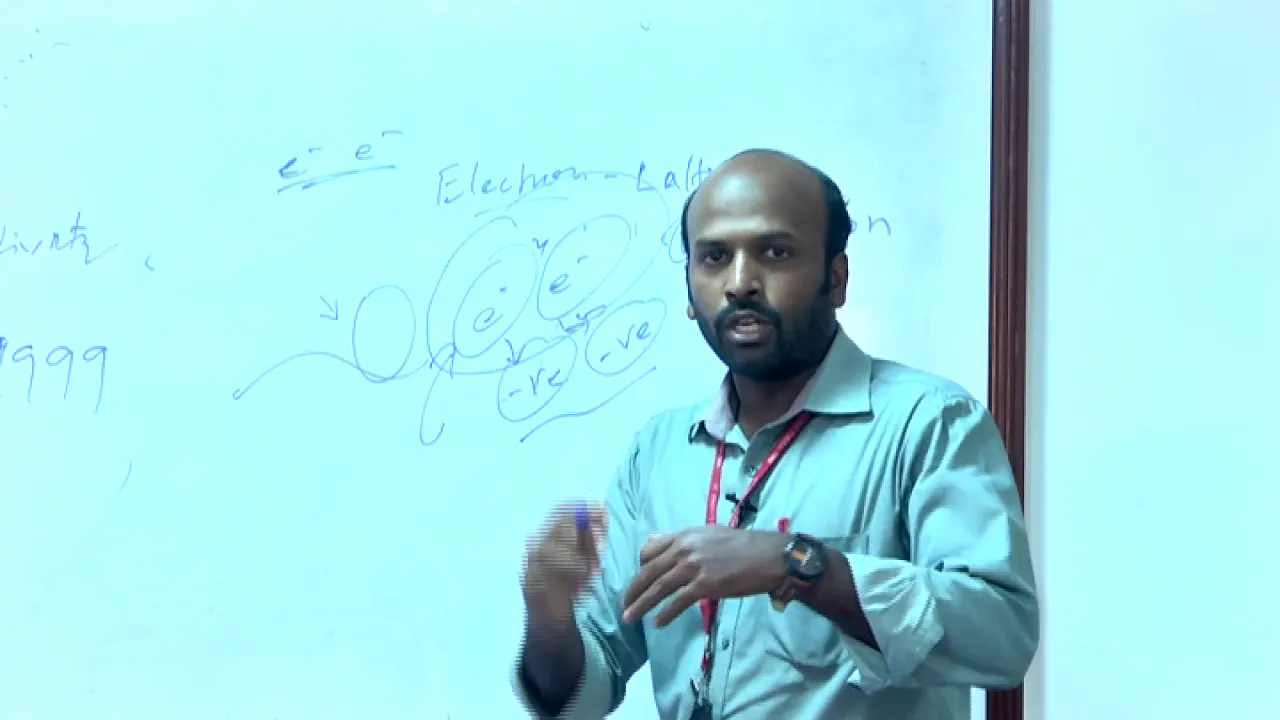
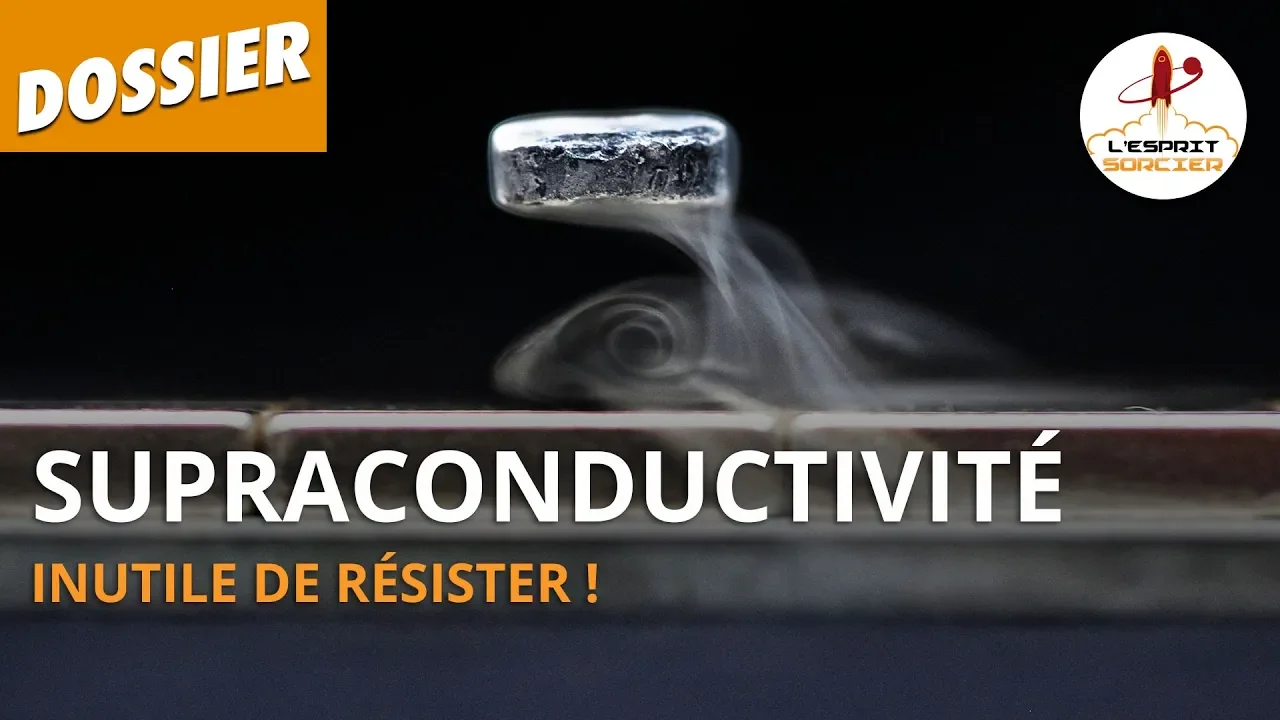












Magnetic levitation occurs when magnetic pressure, given by B²/(2μ₀), creates a repulsive force that counteracts gravity; superconductors achieve perfect diamagnetism through the Meissner effect, expelling all magnetic fields and enabling stable levitation without energy dissipation, unlike conventional electromagnetic levitation which requires continuous motion to maintain eddy currents.
Magnetic Levitation & Superconductivity: Physics Lecture 19
Added:Fundamentals of Magnetism: Understanding magnetic fields, magnetic poles, and magnetic forces on moving charges (Lorentz force).
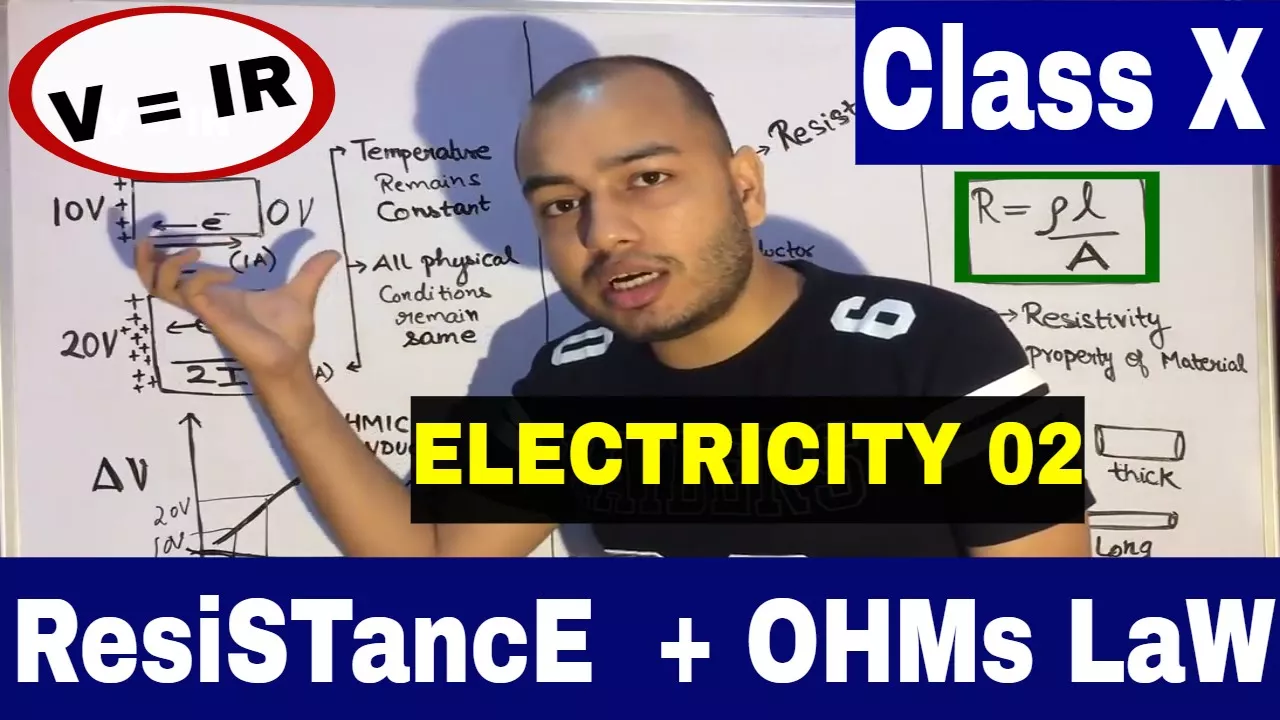
Electrical Resistance and Ohm's Law: The basic principles of how electrical current flows through conductors and the nature of electrical resistance.
Faraday's Law of Induction: How changing magnetic fields induce electromotive force (EMF) and electric currents in closed circuits.
Basic Thermodynamics: Familiarity with temperature scales (especially Kelvin) and how materials behave at low temperatures.
The Meissner Effect and Flux Pinning: The quantum mechanical phenomena behind how superconductors expel magnetic fields to achieve stable levitation.
BCS Theory (Bardeen-Cooper-Schrieffer): The microscopic physics explaining how Cooper pairs of electrons flow without resistance.
Type I vs. Type II Superconductors: Comparing material properties, critical magnetic fields, and the ongoing research into high-temperature superconductors.
Engineering Applications of Superconducting Magnets: Analyzing real-world applications in MRI machines, particle accelerators (LHC), and Maglev propulsion systems.
Josephson Junctions and SQUIDs: Advanced applications of superconductivity in quantum computing and high-precision magnetic field sensors.
1.1M views10.4Klikes49:34Original Release: 2015-02-14
You have ten days left for your motor, so that's a nice project for Spring Break.
I'll give you some hints.
Keep the friction of your rotor as low as you can.
You can't use any oil, of course, that's not allowed.
Balance your rotor to the best you can.
And try to avoid that the rotor begins to bounce, begins to vibrate, because when it vibrates it loses contact with the current when it needs it so there's not torque.
How will we test your motors?
We do that with a stroboscope and I've decided to demonstrate to you how we're going to do that.
That's probably the best thing to do.
We here have a disk and we're going to rotate the disk at thousand RPM.
Let's assume that is your motor.
And we're going to strobe it with a strobe light until it stands still.
In this case-- I have set the strobe-- so that it will stand still, roughly.
And the strobe is now going at five hundred RPM and the motor is going at thousand RPM.
So this clearly is not the rotation rate of your motor.
In fact, your motor goes twice around between the blinks.
And we'd have no way of knowing that, so we double the frequency.
I'm trying to double it now, double the frequency of the blinking of the strobe light.
And now it stands still again.
So now we may think that your motor is going thousand RPM, but we don't know yet.
Maybe it's going three thousand R- two thousand RPM.
Maybe three thousand RPM.
So what are we going to do now, we're going to double the frequency.
And so we go now with the strobe light to two thousand RPM.
And what we see now, is-- we see a double image.
So two thousand RPM is out and any multiple of two thousand RPM is out.
So four thousand RPM is out, six thousand and eight thousand is out.
But what is not yet out is three thousand and five thousand and seven thousand.
So we would have to test for that.
On the other hand, I told you already that this motor is going one thousand RPM, so there's no sense us testing that now.
But during the actual contest, of course, we will continue all the way until we are convinced that we have the right RPM for your motor.
And so that's the way we will do it.
We will put a little bit of white paint on one side of your rotor, so that's the way it will be done.
Of course, if your motor is highly unstable in terms of rotation rates, it will not be easy to get a right, correct number.
I want to talk with you about the heart.
The heart, our heart has four chambers.
Looks sort of like this.
The left atrium and the right atrium.
Maybe this is why it's-- this is why it's called the heart.
And here is the left and the ri- and the right ventricle.
And here is the aorta.
The sole purpose of the heart is to pump blood.
About five quarts per minute, which is seventy-five gallons per hour, which is seventy barrels per day, which is about two million barrels in seventy-five years.
And it pumps about seventy times per minute.
If the blood to your brain stops for about five seconds, you lose consciousness.
So it's five skips of the heartbeat and you're down on the floor.
And four minutes later, permanent brain damage.
The way the heart works is absolutely mind-boggling.
Extremely complicated.
Nature had one billion years to design it, but nevertheless it's impressive.
Each heart cell is a mini chemical battery and it pumps ions in or out as it pleases.
In the normal state, each heart cell is minus eighty millivolts on the inside relative to the outside.
There are some cells which are called pacemaker cells.
They are located in a very small area, about one square millimeter, near the atrium, the right atrium and they change their potential from minus eighty millivolts to plus twenty millivolts.
Now why they do that is a different story, which I will not address.
Once they go to plus twenty millivolts, the neighboring cells follow and a wave propagates over the heart.
I'll make you a drawing shortly.
So the wave first moves over the atrial chambers and then over the ventricle chambers.
And when the cells are at plus twenty millivolts inside relative to the outside, they contract.
So they form a muscle.
The whole heart is one big muscle.
And after about two tenths of a second, the cells return to minus eighty millivolts and this wave goes from below to above.
And then the whole thing waits again for another message from the pacemaker cells.
Takes about one second and then the whole process starts all over.
Now I want to be more precise.
Here is one heart cell.
So this is about ten microns in size.
And this cell has eighty millivolts with respect to the outside.
So that means it has repelled positive ions and so the inside is negative.
And there is no E field here outside, because if you put a Gaussian surface around here, there is no net charge inside.
But there is, of course, a electric field across the walls here, from plus to minus.
Now the depolarization, which is the change to the plus twenty millivolt state, starts, and it starts from above.
And I will assume now that it is not plus twenty but zero millivolts, and it's easier to see.
If we have this cell and the wave is, say, halfway down-- and this is now zero millivolts, then there is no longer minus charge here and no longer plus charge here, because zero millivolts relative to the outside world.
So there is no electric field across here anymore.
In other words, what the cell has done, it has moved positive ions back in.
But here the situation is still as it was before, so this is still at your minus eighty millivolts.
And if you look now, you have here a minus layer on top of a positive layer.
Positive here, minus on top.
And that creates an electric field, which has roughly the shape of a electric dipole.
It has this shape.
So as the wave goes through the cells, only then do they create a dipole.
And we call this the depolarization.
A little later in time, when this wave has passed, the whole thing is plus twenty millivolts.
I chose zero here, but it really goes to plus twenty.
This is just easier to explain.
So that means that now the inside is plus, so positive ions are now inside, negative ions are outside and the E field here is again zero.
Now there is the repolarization wave, which comes from below, when it goes back to minus eighty millivolts.
And I will again do the same trick that I did before; I will just assume the wave is halfway, that it is not minus eighty but that it is zero millivolts.
So there are no charges here, but the charges here are unchanged.
So what do you have now here?
You have a minus layer on top of a plus layer.
So you have exactly what you had before.
So again you get an electric field, [unintelligible] electric dipole field, which has again the same shape.
So what's going to happen is the depolarization wave is going to run down, leaves behind here the cells at plus twenty millivolts, when they are contracted, so this part of the heart has already pumped, and it moves down.
And only the cells where the depolarization occurs, that's only the ones on the ring, contribute to that electric dipole field.
If there is no wave, which is sizeable fraction of the heart, of the cycle, there is no wave, then there is no electric dipole field.
And when the repolarization goes in the other direction, when the heart relaxes because the cells go back to minus eighty millivolts then again there is an electric dipole field, but only from the cells through which the repolarization wave moves.
And you can very easily see that the electric dipole fields of all these cells here support each other.
So you get a dipole field from the heart.
And so if I make you look at your heart-- so this is you-- this is your body-- your legs-- and this is your arms and here is your heart-- and there goes this wave.
And so here is your electric field that is generated while the wave is going, either depolarization down or repolarization up.
But if there is an electric field, there's going to be a potential difference between different parts of your body.
You look here at your belly button, and you follow this electric field line at your head, there is an E field.
The integral E dot d l gives you a potential difference.
And so now you see that there're going to be potential differences between the various parts of your body.
And that's the idea behind an electrocardiogram.
Typically there are twelve electrodes attached to arms, legs, head, and chest to get as much information about the heart as we can.
And the maximum potential difference between two electrodes, in general, is not more than about two to three millivolts.
I'd like to show you a healthy heart cardiogram, of a healthy person.
I have that here.
The time here is about one second and from here to here is about one millivolt.
The P wave, we call this the P wave-- that is observed when the atrium is being depolarized, so when the depolarization wave goes over the atrium.
A little later it goes over the ventricle and you get a larger potential difference because there is more muscle in the ventricle.
So that's why this R wave is higher.
The T wave is the repolarization, when the wave goes back over the ventricles.
The dipole field is in the same direction, remember.
That's the T wave.
It's not known, at least it wasn't known recent-- until recently, what causes the U wave.
I talked to a heart expert about this, Professor Cohen at MIT, and I was surprised to learn that it's not known what the U wave is about.
Not everyone's cardiogram looks as healthy as this one.
There is a terrible disease, which four hundred thousand people die of per year in the United States, which is known as ventricular fibrillation, also known as sudden death.
The ventricles fire without any message from the pace wave, pacemaker wave and there is random, non-synchronous depolarization.
So the heart doesn't pump anymore, in five seconds you lose consciousness, on the floor and in four minutes you, um, have permanent brain damage.
In hospitals, heart patients are being monitored, and as soon as it's noticed that there is something wrong like this, so severe as the fibrillation, ventricular fibrillation, then they apply electric shock treatment.
So you have to be fast, you only have a few minutes-- before you get brain damage.
And three thousand volts is applied, one amperes, for about a tenth of a second.
Large plates are being used on each side of the chest.
And this, of course, is enough to kill the patient.
But it makes little difference, because the patient would have died anyhow.
Heart patients can also get synchronization problems and then-- they implant a pacemaker, that's a circuit.
And this pacemaker takes over the role from the pacemaker cells.
When the heartbeat rate falls below a certain rate, the artificial pacemaker takes over.
About ten milliamperes for half a millisecond, and it does it sixty times per minute.
And so it triggers, then, the depolarization wave.
These pacemakers are susceptible to influences from the outside world and one person's pacemaker stopped, for instance, every ten seconds due to a radar sweep from a police car.
It's also possible that you get a built-in defibrillator, in other words, a system that gives you electric shocks when sudden death might otherwise occur.
So it senses that something is wrong, that the ventricle is going to fibrillation, and then it applies, all by itself, six hundred fifty volts, about five and a half milliseconds, up to five to ten amperes.
And that's not enough to kill the patient and the whole idea is sort of a wake-up call to the heart to get it back into synchronization, to get this depolarization wave being synchronized again.
So clearly I would like to show now a heart cardiogram of a student and I prefer to have a healthy one to avoid some difficulties.
You feel strong? You a healthy person?
You don't mind volunteering?
Tight pants, we have to do something about.
OK, why don't you sit down.
[laughter] Well, there's nothing I-- come in.
We'll, we'll, we will, we'll, we'll find a way.
All right, so we have to attach-- we don't have twelve electrodes, we only use three.
And the first one-- that's why I was worried about your tight pants.
Can you roll them up a little? OK.
Oh, this one goes here.
Let's hope that it makes good contact.
Now the others go on your arm and we need very good electrical contact and therefore we put some conducting grease on there.
It will make it a little-- it will make it a bit of a mess, but we'll give you a chance later to clean up.
So let's first put this one-- you're relaxed, right? Yes, of course.
So can you roll up your sleeve there?
Very good.
And mayb-- oh, oh, and maybe you can put this over your arm, yeah, over your-- yeah, that's good... High up.
Oh man, boy, you have muscles.
[laughter] All right, just relax.
If it hurts a little, oh well, that's the way it is.
[laughter] We need, we ne-- we need good contact.
OK, now your other arm.
Again, a little bit of gooky stuff.
Oh, you need another rubber band, so put it around your arm high up.
That's good, yeah.
All right.
So now it's very important that you relax, because when you start moving, the other muscle cells will also produce electric dipole fields.
And that we don't want, because then that will be overpowering.
All right.
I'm going to take-- make you take a look at this.
Yeah? Everything OK?
So I'm going to change the light situation so that you can see shortly there what's coming up.
Oh, man.
What a da- oh gee, look at this.
Oh, gee.
Oh, look! I see your-- I don't see your P wave.
[laughter] But you have an amazing T wave, right-- no, no, you have an amazing R wave!
It looks like your R wave is in the wrong direction.
[laughter] You feel OK though, right?
Yeah, I can't see your P wave.
Well, maybe some people survive without P waves.
[laughter] It's a certainly an unusual, an unusual heart, but if you tell me that you are healthy, then I'll take your word for that.
I think it would be nice if you show class now, why don't you just stand up for a while, let your other muscles begin to act and they will see then-- just stand up.
You will see-- move a little bit your arms.
Move your arms.
You see? Now you get the electric dipole field from the other muscles in the body-- [laughter] which contract-- [laughter] This is even more interesting than your heart, man.
[laughter] All right, sit down again and let's take it off.
And then you can clean up.
Looks good.
Yeah.
Heart cardiograms are not so easy to interpret.
But I think you're looking fine.
And you feel all right, right? That's important.
So thank you very much for volunteering, very courageous.
[applause] Yeah, make sure you clean that stuff off, huh.
It's water-soluble, so it's not so bad.
What is your name, by the way?
Danny.
You were great, Danny.
[laughter] And now I want to talk about Aurora Borealis.
If we have a magnetic field-- and we have a charged particle, let's say-- make it plus and the velocity of that charged particle is in this direction, then the force on that charged particle, the Lorenz force, equals q times v cross B.
I'm going to decompose this velocity now into one component parallel to the magnetic field and into a component perpendicular to the magnetic field, so the vectorial sum of these two is v.
And so I can rewrite this as q times v parallel plus v perpendicular crossed with B.
But v parallel crossed with v is zero, because the angle is either zero degrees or hundred eighty degrees, so the sine of the angle is zero.
And so the force is exclusively determined by this term.
It's by the perpendicular component.
And so what is going to happen, this charged particle is going to circle around.
But then it continues to go in this direction with that velocity v parallel.
And so you are going to see a path like this.
Whereby this radius R of that circle, that radius, I still remember it from the lecture when we discussed that, that was m v divided by q B, but the v now is of course the perpendicular component-- divided by q B-- and then in this direction it continues unaltered with the velocity which is the parallel component.
Magnetic field of the earth, it's not a straight line but is curved and so charged particles can spiral around the magnetic field and follow the magnetic field lines and they come down on Earth where the magnetic field lines enter, which is near the magnetic poles.
The sun emits a plasma.
Plasma is highly ionized electrons and protons.
We call that the solar wind.
Sometimes it's strong, sometimes it's weak.
And when it reaches the Earth, it ionizes the upper atmosphere of the Earth, and then it produces light.
The light is very faint, can only be seen at night.
And that light is called Aurora and we here call it Northern Lights, but I'm sure that people in the southern hemisphere, they call it Southern Lights.
When the sun is very active, it can be breathtaking, really absolutely fabulous.
The Aurora can change very fast, on time scales of seconds to minutes.
And it is, of course, strongest near the magnetic poles, and so you r- rarely ever see it in Boston.
It can have very bright colors, red, green, white is the most common.
And the color that you will see depends on the energy of the charged particles as they come in.
But it also depends on whether the nitrogen molecules in the atmosphere or the oxygen molecules are being excited.
Also depends on at what height, what height in the atmosphere the ionization occurs.
I've seen it quite a few times in my life.
I did hiking in the Adirondacks where I saw it.
I've seen it from Calgary in Canada.
But whenever I fly to Europe and flights are always at night, I always ask for a window seat on the left side of the plane, and that's the reason.
So that I can look to the north and a few times have I seen spectacular Aurora from the plane.
I want to show you some slides.
If you visit the 802 website I made some links for you to some fabulous slides of Aurora.
But now I want to show you a few that I have here.
Can I have the first slide?
This is, um, white Aurora, and like a nice curtain.
Not so uncommon.
Can change on time scales of minutes to seconds.
As I said, you can only see it at night.
It's very faint.
The next slide?
You see another remarkable example of Aurora, white Aurora.
Strange shapes, very unpredictable.
And the moving, it's like looking at a movie when you actually see Aurora.
The next one is red Aurora, like a wonderful curtain coming down.
For reasons that are not so easy to understand, maximum light comes from a ring which is-- which has a radius of about five hundred kilometers from the magnetic pole.
And the next slide shows you a picture taken from a satellite which is three Earth radii away from the Earth.
This is taken in ultraviolet light.
And you see beautiful this, this ring.
So this radius is roughly five hundred kilometers and here is one of the magnetic poles.
I don't know whether it's the North Pole or the South Magnetic Pole.
And the next slide shows you something similar.
If you look only at these four, they are taken twelve minutes apart, again in UV and you see here a crossbar.
I don't know how to explain that crossbar.
It's called Theta Aurora.
Obviously why theta goes without saying, right.
Amazing.
And this is sort of-- these are twelve minutes apart, so that gives you also an idea how fast this can change.
Over here it's very dark and here it's very bright.
So the changes are quite dramatic.
Now I want to talk about superconductivity.
Superconductivity was discovered by a Dutch physicist.
His name was Kamerlingh Onnes.
And he discovered that if you cool mercury to something like four degrees Kelvin-- he used liquid helium for that, in fact he actually discovered how to make liquid helium.
That was the incredible thing.
And then he used the liquid helium to cool down substances, among them mercury and he discovered that mercury would lose completely all its resistivity.
So the electrical resistance would go down to zero.
And he got the Nobel Prize for that in 1913.
You can only understand superconductivity with quantum mechanics and even quantum mechanics has a major problem nowadays to understand all the phenomenon about superconductivity.
The problem started in 1986, when two scientists in Zurich, Muller and Bednorz, discovered that certain alloys can be made superconducting at a temperature as high as thirty-five degrees Kelvin.
And theorists earlier had proven that it was impossible to ever get superconductivity at thirty-five degrees Kelvin.
And so this was such a splash in the community that these guys got the Nobel Prize within one year.
In 1978 they got the Nobel Prize.
I don't think there's any other example that I recall whereby a discovery was made and within one year the Nobel Prize was awarded.
And theorists still cannot explain today fully why there is what's called high-temperature superconductivity.
The record today, I checked that yesterday with Professor Lee at MIT, the record is now hundred thirty-five degrees Kelvin.
So certain alloys can be made superconducting at hundred thirty-five degrees Kelvin.
And since you probably know that liquid nitrogen has a temperature of seventy-seven degrees Kelvin, anyone can now play nowadays with superconducting materials, even high schools, because liquid nitrogen is very easy to come by.
If you make power lines out of superconducting material, there would be no loss of energy.
People are thinking about that.
You can imagine how costly it might be, but in principle you could transport electric energy without any loss, without any omega losses.
No I squared R, because R is zero.
Also, if you have zero resistance in a material, you can run extremely high current through it and you can therefore get very strong magnetic fields.
And using superconducting coils, you can get very strong magnetic fields, and these colliders that we talked about earlier, these atom-smashers like we have at Fermilab and in Geneva, they are going to make use of superconducting coils to get magnetic fields as high as six tesla or so, or even higher.
No electric field can exist in a superconductor.
And you can very easily see that, because if there were an electric field-- if this is a superconductor and there is an electric field, say, in this direction, there would be a potential difference over the superconductor.
And Ohm's Law, V equals I R, tells you then immediately that if this is not zero but if this is zero that I would go to infinity.
So you cannot have any electric field in a superconductor.
If I approach a superconducting disk or material with a magnet-- say this is the north pole and this is the south pole, so we have a magnetic field configuration roughly like so.
If I approach this superconducting material, then the EMF generated in here because of Faraday's Law, because there's a change in the magnetic flux coming off, that EMF must remain zero, because you cannot have an electric field inside a superconductor.
And this, of course, is I R.
So R is also zero.
So I now can have any value, completely legitimate.
So you can have a huge current inside the superconductor, but no EMF.
And so as you approach with this magnet, eddy currents are going to run inside the superconductor in such a way that d phi d t, the flux change in here, is always zero.
And so these eddy currents will flow to never allow any magnetic flux, because there was no magnetic flux to start with when the magnet was high up, so there can never be any change.
And so the eddy c- currents create a magnetic field themselves, which, if you vectorially add them to this magnetic field, will always make sure that there is no net magnetic field inside the superconductor.
And so if you now make a drawing of the, of the two fields, the one that is produced by the eddy currents and the one that is produced by the magnet, when the magnet comes very close-- so here is north and here is south, and here is your superconductor-- then the superposition of those two fields then, effectively comes down to the fact that this magnetic field is completely repelled-- that's another way of looking at it.
You get a squeezed field here.
But that is the superposition of two magnetic fields, one produced by the eddy currents and one from the-- the magnet.
And whenever you have here such a squeezed magnetic field, there is magnetic pressure.
We know why there is magnetic pressure, because north and north poles repel each other, but we never expressed that in terms of a quantity.
And the magnetic pressure equals B squared, which is the magnetic field strength, divided by-- is it two? Yeah, two mu zero, divided by two mu zero.
I'll get back to this a little later in the lecture.
And this is pressure, so this is in newtons per square meter.
This is not entirely new, this idea of pressure, because you may have seen at people's desks-- nice conversation piece.
You have here a-- a magnet and you have here a magnet and this is a-- a wooden stick.
There's a hole in here and there's a hole in here.
This is north pole, south pole, north pole, south pole and they repel each other.
That's magnetic pressure.
It's the same thing.
And if you drew the magnetic field configurations here, go like this, that's the magnetic field from this magnet and this would be the magnetic field from that magnet.
We get the same idea.
You get magnetic pressure there.
If I rotate this magnet here, so th-- first of all, the magnet is repelled, which is in a way a form of levitation and we're going to show you that.
The magnet is just pushed up by the superconductor, is the way you can look at it.
But if you start rotating it, for instance, around with the south pole here or the south pole there or the north pole there, the eddy currents will instantaneously adjust to always repel that magnet.
So even if you rotate it, it would still hang there, levitated, rotating.
What is not so easy to understand is why the whole thing is so very stable.
As you will shortly see, it's quite stable.
So I'm going to show you there this superconducting idea.
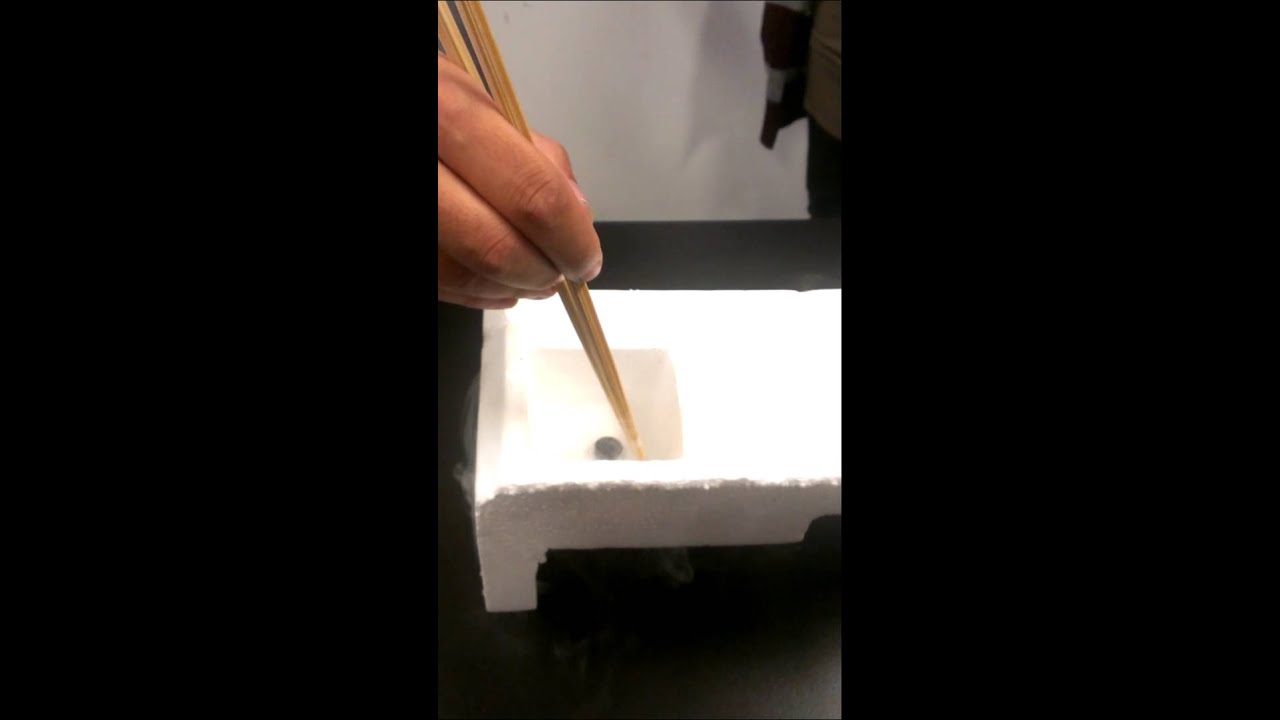
I first have to top it off with some liquid nitrogen, so let me do that when we still have full lights.
Oh boy.
Good.
So I have to top it off.
And this disk, which is about an inch in diameter, going to be superconducting.
I can even tell you what kind of material it is.
It is a copper oxide mixed with yttrium and barium, and it becomes superconducting at ninety degrees Kelvin.
And liquid nitrogen is seventy-seven degrees.
So we're going to put a small magnet on top, which we will levitate.
For that, we're going to have the following light situation.
And of course you want to see it also, don't you.
And you want some light.
So there you see the disk, which is-- should be superconducting now.
And here comes my little magnet.
So there is no magnetic flux going through there.
It itself is not a magnet.
But now I'm going to come close with a magnet and the eddy currents go nuts in there, and it just floats on top.
It's amazing, isn't it.
So this is magnetic levitation and you can rotate it around and the eddy currents adjust instantaneously.
And there it is.
Yah, you've all seen it, clear enough.
OK, let me get the-- rescue my magnet.
Imagine in the days of Kamerlingh Onnes it took four degrees Kelvin to have anything superconductive and now you can do it as easy as that.
There are other forms of magnetic levitation.
One going to be very promising in our economy, we hope and that is magnetic levitation can be used for trains.
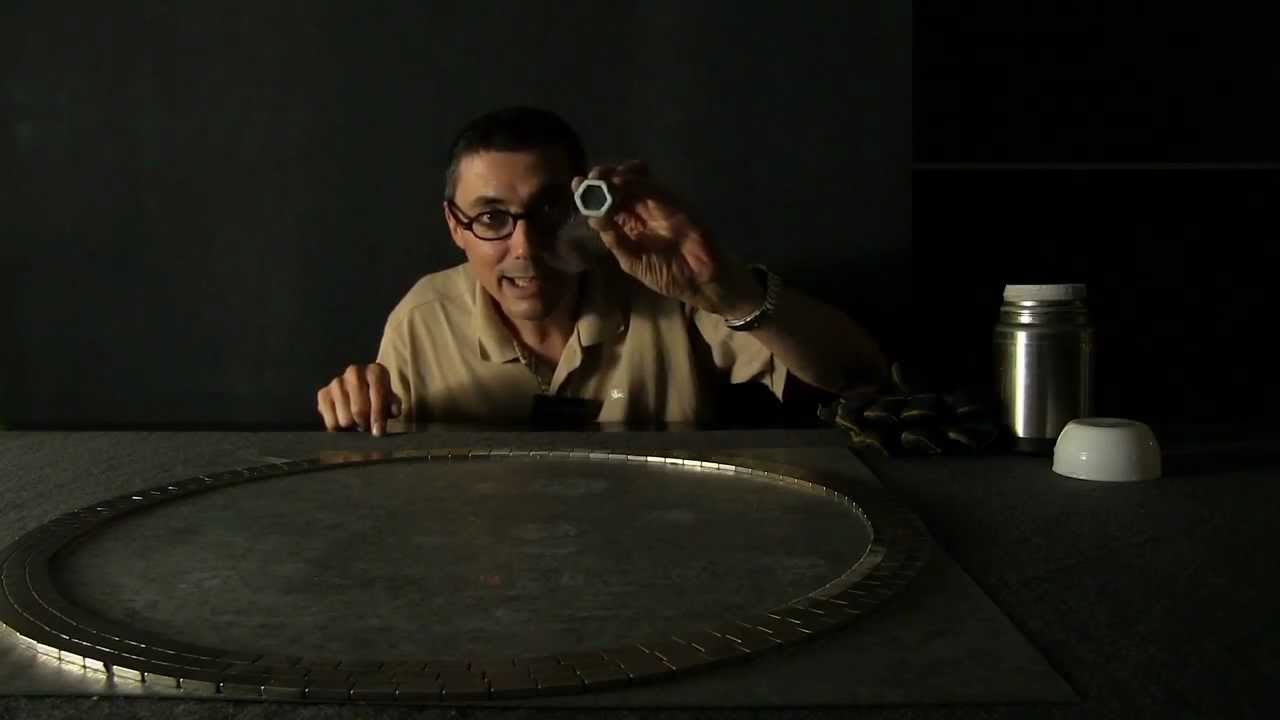
If you have a magnet and you move it fast over a conducting surface, then you also get levitation.
You have to move it though, whereas there, you don't have to move it.
See, if you let that magnet just go, if you don't move it anymore, then there is an eddy current going on, but the eddy current never dissipates any heat.
There is no I squared R because R is zero.
So you never lose the eddy current.
That's different with what is coming now.
Now I have a-- a magnet.
Here is north and here is south.
So we have a magnetic field sort of like this.
And I'm going to move it over a plate, over a conducting plate, and I'll put the plate here.
And as it comes over this conducting plate, the magnetic flux through that plate will change Mr. Faralow s-- Mr. Faraday says-- actually, it's Mr. Lenz who says, "I don't like that."
And so they're going to run an eddy current in here and the eddy current will undoubtedly go in this direction as it comes over here.
And this current ring now will produce a magnetic field in this direction.
And look what you have.
You have again this is the north pole of this eddy current and this is the south pole.
North pole repels north pole.
And so if this has a high enough speed so that the change of the magnetic flux, the d phi d t is high enough, the train can float.
Tens of tons of weight can be made to float.
And the reason why in this case the train has to keep going, that if the train stops the eddy current will die out.
There's no longer the d phi d t but there is resistance in this conductor and so you get Ohmic dissipation.
You get I squared R.
You get heat in here.
And so then the train will just plunge down.
And that's not the case with the superconductor because you don't dissipate any heat in the superconductor because the superconductor has no resistance.
So the idea is the same, but you see now why you have to keep this one going and why there you don't.
And so again you get a squeezed magnetic field, like you have there and so you get magnetic pressure Japan and Germany are really the leaders in the world in the technology of, uh, maglevs-- that's what these trains are called.
United States is trying to catch up.
There's an enormous reduction in friction if you can have a train that is not in contact with the rails.
In fact, speeds have been recorded up to three hundred forty miles per hour.
Both Germany and Japan have test trains, prototypes, in operation.
United States has made a commitment to build a maglev train to go from Washington DC, back and forth to Baltimore, should be ready in the year 2007.
The costs per mile are about thirty million dollars per mile.
Now that make strike as high, but keep in mind that if you build a four-way highway, that's also thirty million dollars per mile.
So it's no more expensive than a four-way highway.
And again, when you visit the 802 website, I made several links to maglev sites.
I advise you to take a look.
Now there is a third form of magnetic levitation whereby we don't need any speed and we don't need any superconductors but we use AC, we use alternating current.
And that's also easy to see now.
Here is such a coil and we run AC through it.
So at one particular moment in time, let's say the magnetic field is like so, and maybe is increasing.
And then of course the magnetic field turns around, up, down, up, down, because it's AC.
Now I have here a conducting plate and I put this above this plate.
But now I have this continuous magnetic field change, so I have a continuous change of magnetic flux in that plate.
So as this magnetic flux, as the B field down is increasing, you're going to get an eddy current running in this direction which will create the magnetic field in that direction.
And you're back where you were.
You again have north pole, north pole, south pole, south pole.
So again, the eddy current in the conducting plate is responsible for a magnetic field and the two repel each other.
So a little later in time, the magnetic field strength will decrease.
When that happens, the eddy current will reverse direction, and the two will attract each other.
And so you will think now it seems quite reasonable that half the time they will attract each other and the other half of the time they will repel each other.
That, however, is not the case.
There will be a net repelling force.
And why that is, I will explain to you during the next lecture.
But I want to demonstrate it now.
I have here such a coil, about an area of about one square foot.
I can simply run hundred ten volts, sixty hertz AC.
I switch th-- turn this on.
This goes into hundred ten volt outlet and I increase the current.
It starts to float.
No high-speed train, nothing superconducting.
What do you think will happen when I turn it over?
Excuse me?
Of course it will float again.
The ed-- the eddy currents adjust themselves at any moment in time and they will always make it float.
So this is another interesting form of magnetic levitation.
So we have the superconducting way, whereby there is no dissipation in the disk, so those currents never die out.
Then you have the case of the train, if I call that the train, the magnetic levitation, whereby you have to keep the speed going, because if you don't have the speed then you don't have enough magnetic flux changes in the surface and so you don't have the eddy currents.
The eddy currents would die, you get heat dissipation.
And then there is the third case here, whereby you simply have a changing magnetic field in the coil with AC, which then creates the changing eddy currents.
So now we come to the levitation of a woman.
How do we levitate a woman?
Well, the secret must be in that equation.
V is B squared divided by two mu zero.
We have a coil which is about one square foot, so the area of that coil is about oh point one square meters.
And so our goal was that we should be able to lift, let's say, a two hundred pounder, to give ourselves a little bit of leeway.
And so we calculated that if the magnetic field, B, is about fifteen hundred gauss, which is about oh point one five tesla, that we would get very close.
We know that mu zero is four pi times ten to the minus seven in SI units.
And so you can calculate now what the force is on this area.
The force is of course the pressure times the area, assuming that the magnetic field is uniform.
And so you're going to get that this force is going to be B squared, which is oh point one five squared, divide by two, divide by four pi, times ten to the seventh, multiplied by the area, which is oh point one square meter and you find that this is about nine hundred newtons.
Ninety kilograms, as I said, a two hundred pounder.
Then we tried to get this magnetic field, and believe me, Marcos and I and Bill, we really tried, but there was a problem, because we needed enormously high currents to get these magnetic fields.
And at these very high currents, our circuit breakers would go every time.
So we called up the physical plant, and they said, "Yeah, what do you expect, man?
You need several hundred amperes.
You think we can get seven hundred-- several hundred amperes out of this system?
You have to redesign MIT for that."
So it was very disappointing for us.
So the best we could do was the strongest current that we could generate, we could only get a magnetic field of about three hundred and fifty gauss, which is four times lower.
And the tragedy has it that the magnetic pressure goes with B squared, so that makes it sixteen times lower.
So the two hundred pounder now becomes a twelve pounder.
But that's the reason why when some women wrote me very nice email yesterday because they volunteered, why I had to say, "Thanks, but no thanks."
But I want to keep my promise.
I said I was going to levitate a woman and I will.
And here she is.
[laughter] And as far as we know, it is a woman.
[laughter] OK, give her some room.
She deserves-- we ready for that?
And there she goes.
I levitated a woman.
[laughter] Have a great Spring Break.
[applause]
Up Next

7:49
Cosmic Rays: Explaining the Universe's High-Energy Particles
@physicsgirl
219.6K views•2017-06-21

12:53
21cm Hyperfine Transition in Neutral Hydrogen: Radio Astronomy Basics
@AaronRobertParsons
12.4K views•2011-10-13

49:59
Doppler Effect, Binary Stars, Neutron Stars & Black Holes | 8.01x Lecture 23
@lecturesbywalterlewin.they9259
134.5K views•2015-02-08

27:14
Entropy and the Second Law of Thermodynamics Explained
@veritasium
27.5M views•2023-07-01
Related Study Plans & Knowledge Roadmaps
Structured learning paths in Physics
physics
Nuclear Physics (Decay, Fission & Reactors)
01Atomic Structure and the Binding Force
02Radioactive Decay and Half-Life
03Nuclear Fission Mechanics and Chain Reactions
+ 2 more learning modules
12h5 modules
Explore Roadmap
physics
Soft Matter (Polymers, Colloids & Rheology)
01Foundations of Soft Matter & Thermal Forces
02Polymer Physics and Macromolecules
03Colloids, Surfactants, and Self-Assembly
+ 2 more learning modules
38h5 modules
Explore Roadmap
physics
Analytical Mechanics: Lagrangian & Hamiltonian
01Mathematical Foundations: Calculus of Variations
02From Newtonian Mechanics to Constraint Dynamics
03The Principle of Least Action & Lagrangian Mechanics
+ 3 more learning modules
28h6 modules
Explore Roadmap
physics
General Relativity (Spacetime & Cosmology)
01Foundations of Relativity: Special Relativity
02The Geometry of Spacetime: Equivalence Principle & Curvature
03Einstein's Field Equations: The Mathematics of Gravity
+ 2 more learning modules
55h5 modules
Explore Roadmap