


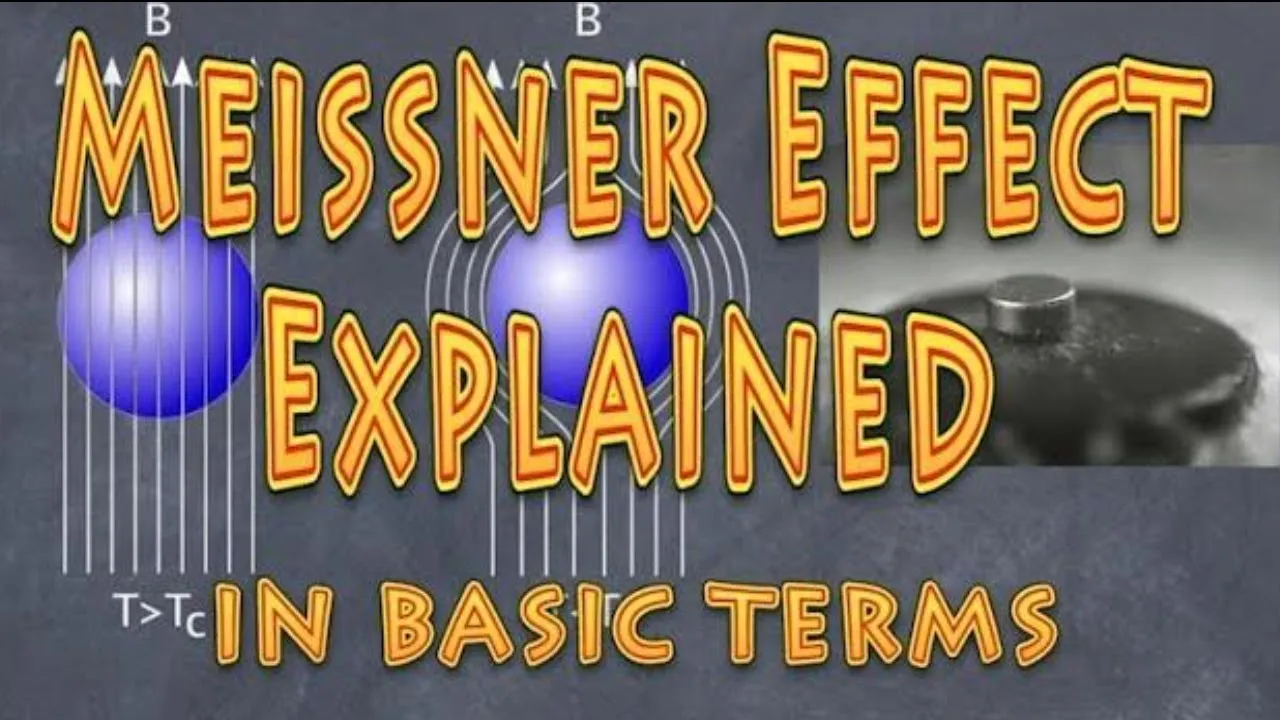













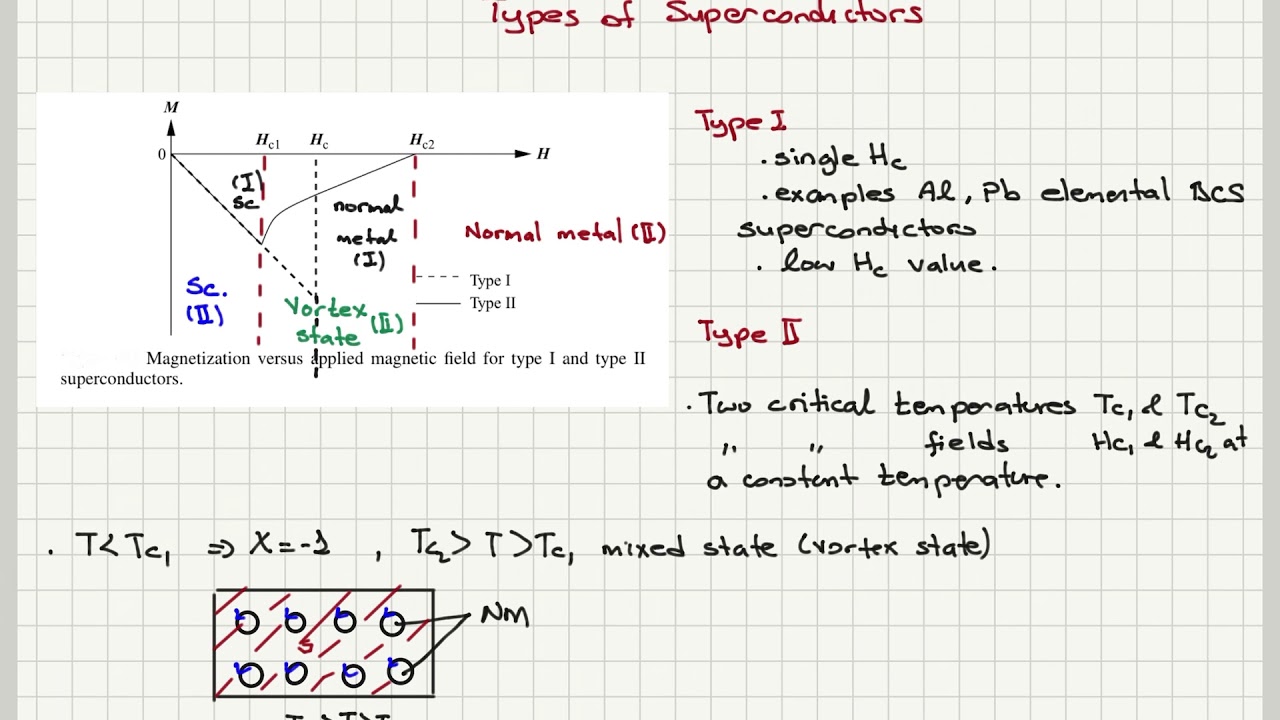






Type I superconductors lose their superconductivity abruptly at a single critical magnetic field (HC), making them 'soft superconductors' that obey the Meissner effect; examples include aluminum (HC = 0.0105 T) and zinc (HC = 0.054 T). In contrast, Type II superconductors gradually lose superconductivity at two critical magnetic fields (HC1 and HC2), with a vortex or intermediate state existing between these values, earning them the designation of 'hard superconductors'; examples include niobium-titanium (HC1 = 59,000 T, HC2 = 84,000 T) and cobalt oxide (CoO2).
Difference Between Type I and Type II Superconductors Explained
Added:The basic definition of superconductivity, including critical temperature (Tc) and zero electrical resistance.
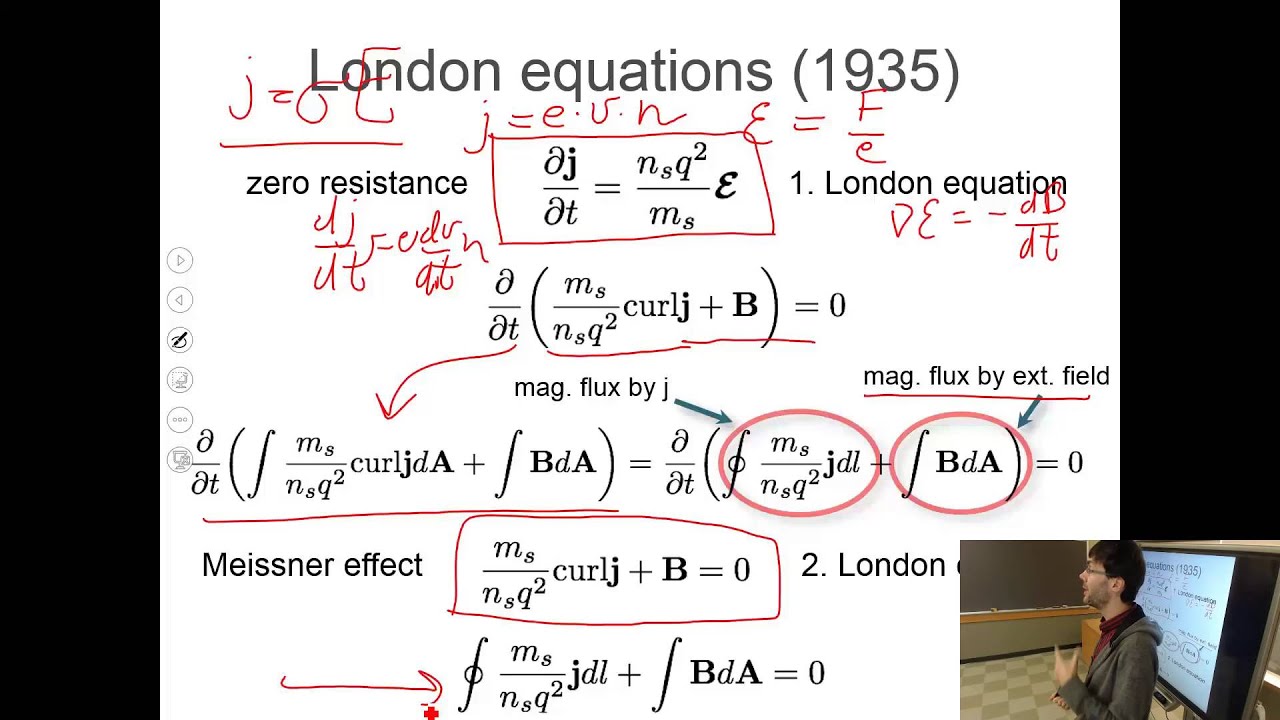
The Meissner Effect, which describes how a superconductor expels external magnetic fields.
Fundamental electromagnetism concepts, specifically magnetic flux, magnetic field intensity (H), and magnetization.
The concept of critical magnetic field (Hc), above which superconducting properties are lost.
The phenomenon of flux pinning (quantum locking) and the mixed/vortex state in Type II superconductors.
High-Temperature Superconductivity (HTS) and why these complex materials are classified as Type II.
Ginzburg-Landau Theory, specifically the Ginzburg-Landau parameter (kappa) that mathematically defines the boundary between Type I and Type II.
Real-world engineering applications of Type II superconductors in MRI machines, fusion reactors (Tokamaks), and Maglev trains.
79.3K views940likes4:44Original Release: 2013-06-16
okay let us discuss the difference between type one and type two superconductors depending on their magnetic behavior in an external magnetic field superconductors are classified into following two groups first one is type 1 superconductor and second one is type two superconductor let us first discuss the type one superconductors let us discuss the graph between M that is intensity of magne and H that is applied magnetic field here a superconductor is placed under the influence of external magnetic field you can see from the graph that at Point a super conductivity loses abruptly to zero that is at HC and by definition HC known as critical magnetic field that is that value of magnetic field at which a superconductor becomes uh conductor so basically points to remember or properties to remember here are type one super conductors when placed in magnetic field H it loses its super conductivity abruptly at critical magnetic field because type 1 superconductor loses super conductivity abruptly or easily they also known as soft superconductors they obey mesner effect so so we can see the example of uh type 1 superconductors as aluminium that is critical magnetic field is 0105 Tesla zinc 054 Tesla now let us discuss the type two superconductor here the graph is again between the same two parameters that is M intensity of magnetization and H but clearly you can see the uh difference between type 1 and type two superconductors at Point a type two superconductors starts to lose its super conductivity at at C1 where atc1 is known as lower critical magnetic field and it completely lose its super conductivity at scc2 that is upper critical magnetic field so you can see that type two superconductor loses it super conductivity gradually not easily therefore they are also known as hard superconductors the state in between hc1 and hc2 is known as Vortex or intermediate State and type two superconductors also obey measner effect example babi3 critical magnetic feied is 59,000 Tesla cosi2 critical magnetic fied is 8400 Tesla and I hope that uh you you have understood the difference between type one and type two superconductors in case of any doubt you can leave your doubt you can leave your comment in the comment section now because I'm in India so it is my duty to speak uh in my mother tongue and uh mix with the English so I will not speak in Hindi plus English that is English now type one or type two superconductors basically super type one superconductors super super superu measure effect example Alum zinc zinc critical magnetic field is 05 for Tesla type two superconductors critical magnetic field hc1 superity lose orc2 that is upper critical magne field completely lose1 and Vortex or intermediate State because type two superconductor super conductivity gradually therefore hard superconductors they also be meas effect example babi3 coi2 so thank you thanks a lot thank you
Up Next

9:10
Basic Electricity: Resistance and Ohm's Law Explained
@Afrotechmods
2.7M views•2016-11-07

12:53
21cm Hyperfine Transition in Neutral Hydrogen: Radio Astronomy Basics
@AaronRobertParsons
12.4K views•2011-10-13

32:32
NMR Spin Physics I: Zeeman Effect, Resonance Condition & Larmor Frequency
@nptel-indianinstituteofsci8064
2.3K views•2024-01-17

27:14
Entropy and the Second Law of Thermodynamics Explained
@veritasium
27.5M views•2023-07-01
Related Study Plans & Knowledge Roadmaps
Structured learning paths in Physics
physics
Nuclear Physics (Decay, Fission & Reactors)
01Atomic Structure and the Binding Force
02Radioactive Decay and Half-Life
03Nuclear Fission Mechanics and Chain Reactions
+ 2 more learning modules
12h5 modules
Explore Roadmap
physics
Soft Matter (Polymers, Colloids & Rheology)
01Foundations of Soft Matter & Thermal Forces
02Polymer Physics and Macromolecules
03Colloids, Surfactants, and Self-Assembly
+ 2 more learning modules
38h5 modules
Explore Roadmap
physics
Analytical Mechanics: Lagrangian & Hamiltonian
01Mathematical Foundations: Calculus of Variations
02From Newtonian Mechanics to Constraint Dynamics
03The Principle of Least Action & Lagrangian Mechanics
+ 3 more learning modules
28h6 modules
Explore Roadmap
physics
General Relativity (Spacetime & Cosmology)
01Foundations of Relativity: Special Relativity
02The Geometry of Spacetime: Equivalence Principle & Curvature
03Einstein's Field Equations: The Mathematics of Gravity
+ 2 more learning modules
55h5 modules
Explore Roadmap