



![[International Trade] Ricardian Model | Part 2 | Autarky and Free Trade Equilibrium Price | 4 |](https://i.ytimg.com/vi/Yv7SpinwhSA/maxresdefault.jpg)












![[DUE] Ôn tập lần cuối để đi thi Kinh tế quốc tế International Economics | DUE learning Yennganami](https://i.ytimg.com/vi_webp/0c49jSDjoG0/maxresdefault.webp)









Tariffs and quotas are trade barriers that achieve similar market outcomes (same equilibrium price, domestic supply, and import quantity) but differ fundamentally in revenue distribution: tariffs generate government revenue while quotas create quota rents. Quota rents can be distributed through government auctions (equivalent to tariffs), allocation to domestic firms (generating rent-seeking behavior and excess capacity), or allocation to foreign firms/governments (as in voluntary export restraints). Additionally, quotas tend to encourage suppliers to produce higher-quality goods as a way to 'evade' the quota limit, whereas tariffs apply proportionally across quality levels.
Tariffs vs. Quotas: Trade Policy & Rent-Seeking Effects
Added:Fundamentals of supply and demand analysis, including how to measure consumer surplus, producer surplus, and deadweight loss in a market diagram.
The baseline economics of free trade versus autarky, specifically how opening a domestic market to international trade shifts prices and quantities.
An introductory understanding of a tariff as a tax on imported goods and its basic impact on domestic price and import volume.
The fundamental concept of economic 'rent'—the surplus value earned by producers or resource owners above their opportunity cost.
The political economy of trade protectionism, exploring why governments might politically prefer quotas over tariffs despite identical welfare losses.
Other forms of non-tariff barriers (NTBs) such as Voluntary Export Restraints (VERs), local content requirements, and technical barriers to trade.
The role of the World Trade Organization (WTO) in monitoring trade policies and its historical efforts to convert quotas into tariff equivalents.
Empirical case studies of rent-seeking behavior, such as lobbying efforts in agricultural trade (e.g., the U.S. sugar quota system).
70.2K views394likes14:13Original Release: 2015-09-16
Today, we're going to compare tariffs with quotas and also show you how to analyze quotas using supply and demand.
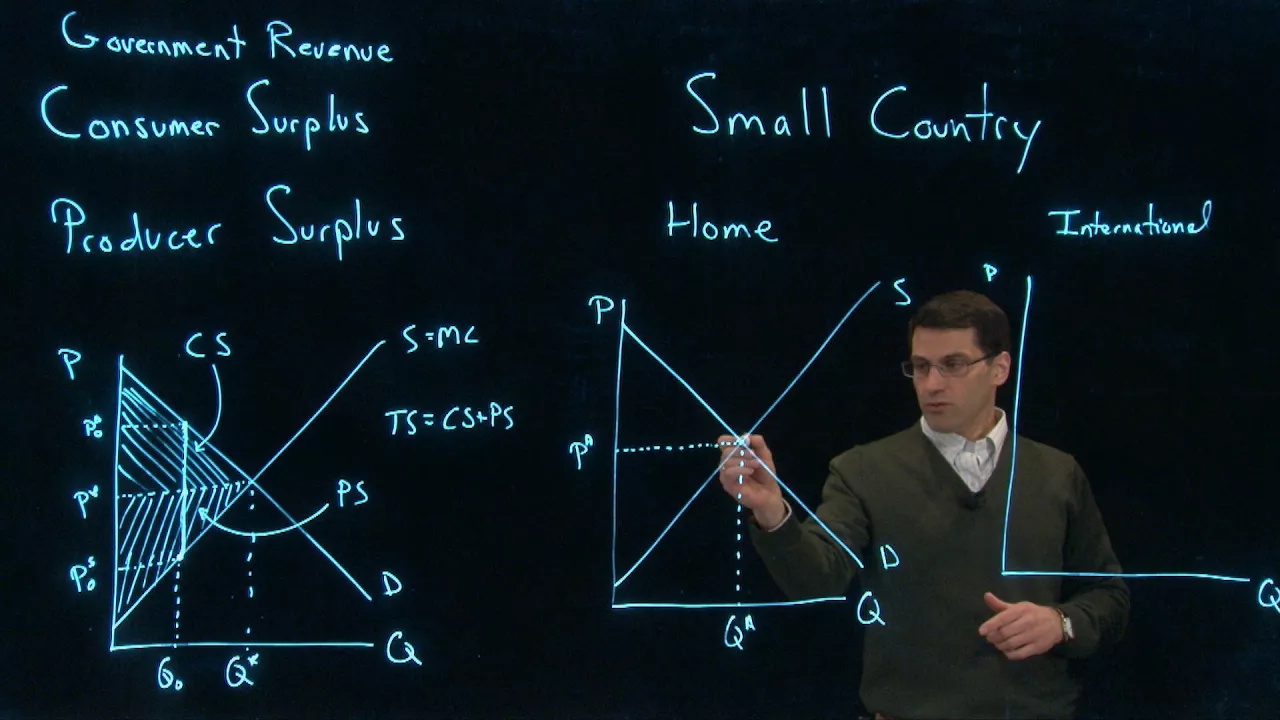
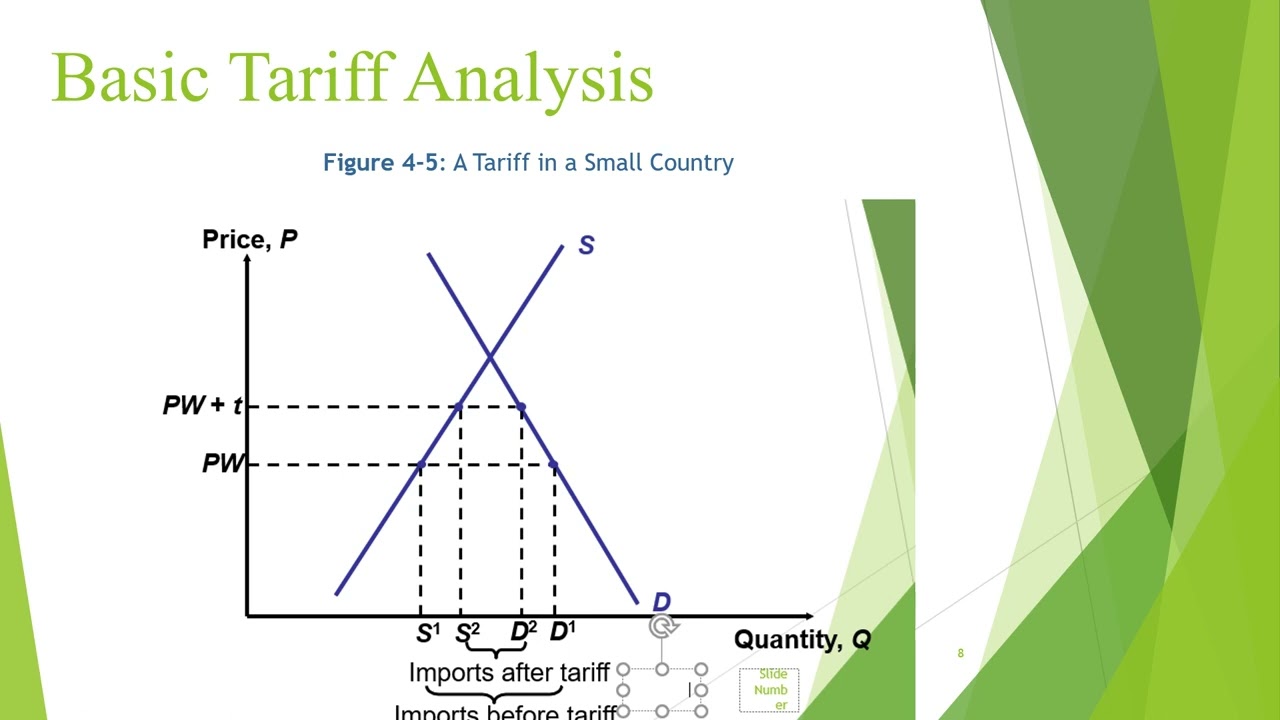
Let's briefly review our theory of international trade with demand and supply.
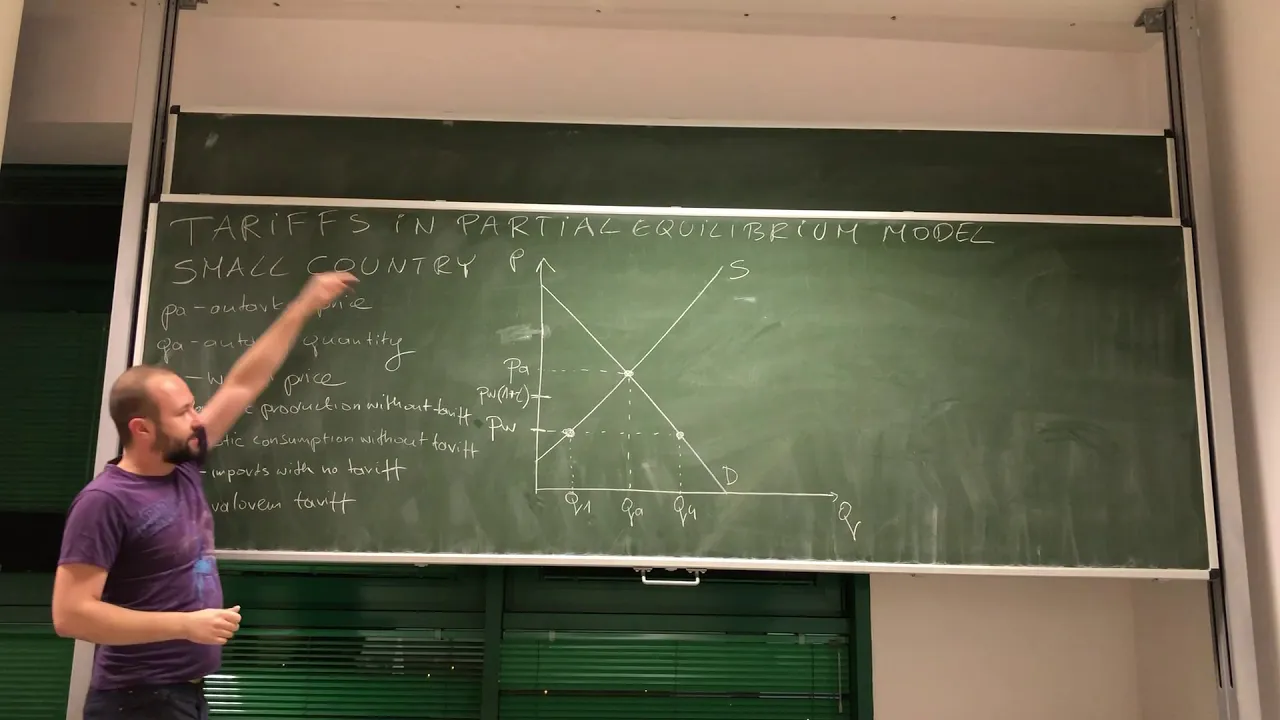
So if a country can buy as much as it wants at the world price, the equilibrium, the free trade equilibrium, has this quantity demanded, this quantity will be supplied domestically.
The difference between the quantity demanded and the quantity supplied domestically is imports.
If we now add on a tariff; that's a tax which shifts the world supply curve up; the new equilibrium is here, less is demanded because the price is higher, we have domestic production increases.
So our quantity of imports falls.
And our tariff revenues; that's simply the tariff rate times the quantity of imports, gives us the tariff revenues which go to the government.
OK, now lets now apply this to a quota.
OK, so here's our tariff diagram.
We want to compare with a quota, so let's eliminate, let's clean up our diagram.
I'm just going to leave some faint lines in here to remind us of where the tariff was and to remind us of how much imports were under the tariff.
Now, we want to compare with a quota, but, what size quota? A big one, a small one?
To be fair, let's compare the tariff with a quota which brings in exactly the same quantity of imports.
So, instead, remember this is the imports under the tariff, so let's compare with a quota which has the same quantity of imports.
Now how do we analyze this quota?
Well, what we can think of the quota as doing as subtracting -- this quantity from the domestic demand curve.
So we can think about the quota as shifting back the domestic demand curve.
So the domestic suppliers will be able to choose how much to supply out of the domestic demand after the quota has been taken out, as it were.
So the domestic demand curve is going to shift back by the amount of the quota.
This distance here is the same as this distance here, just the quantity of the quota.
That means the domestic demand curve will go here.
And, now, what do we see?
Well, how much will the domestic suppliers choose to produce from this new domestic demand curve?
Well, we find the equilibrium where domestic demand is equal to domestic supply, so here is the quantity which will be supplied domestically, -- under the quota.
If we add to that, now, -- the amount which is imported; here is the quantity which is demanded or consumed under the quota, and what we see is the equilibrium is exactly the same.
The price of the product will be the same, the amount imported, by definition, is the same, -- the quantity supplied domestically is the same.
The only difference is, now, there's no revenues, there's no tariff revenues.
Instead, we have these quota rents.
Notice that -- the cost of producing this good, -- by the world suppliers, is less than the price the good sells for in the domestic economy.
So, the difference between the price and the cost, times the quantity gives what we call these, -- what we call quota rents.
And, now, I want to discuss who gets these quota rents?
Where do they go? Who earns these quota rents?
So let's take a look at that.
So we know that with a tariff, the domestic government gets the revenues.
Who gets the quota rents?
There are really three possibilities.
First, a government could auction the right to import to the domestic firms.
That right would give domestic firms the right to buy the quota amount on the world market, at the low world-price, and sell in the domestic market at the high domestic price.
That right is worth quite a bit because you are buying low and selling high.
So if this right were auctioned off, the auction revenues would flow to the government, and the government would end up with just as much revenues as if there were a tariff.
So this situation would be perfectly equivalent to a tariff.
Surprisingly, it's rarely used.
Australia and New Zealand have done this occasionally, not so much today, but, around the world, this is rarely done, auctioning off the right to import is quite rare.
What is more common is to give the right to import to domestic firms.
Now, again, remember that you're giving these domestic firms the right to buy low and sell high.
And that's worth a lot.
In fact, Anne Krueger, in 1974, calculated that in India, the rents from the import licenses were around 5% of GDP, and in Turkey, the rents from the import licenses were about 15% of GDP.
Really big numbers.
Now, if you were giving away 15% of GDP, that's going to encourage firms to really compete to get those rents.
And this, in fact, is where the idea of rent-seeking comes from.
The idea of rent-seeking is competition to obtain rents which dissipates the rents.
So, in trying to get the rents, these firms spend a lot of money on lobbying, on paying bribes, on waiting, you know, in various capacities to try and get these rents and the renter dissipated away, wasted away.
Another way that these rents can be dissipated is through excess capacity.
So, for example, suppose that the government says, "We're going to give these rents away in proportion to how much domestic firms are already producing."
In that case, this gives domestic firms an incentive to produce overcapacity, to produce excess capacity.
So you get wasted investment in capacity which is designed simply to grab up those rents.
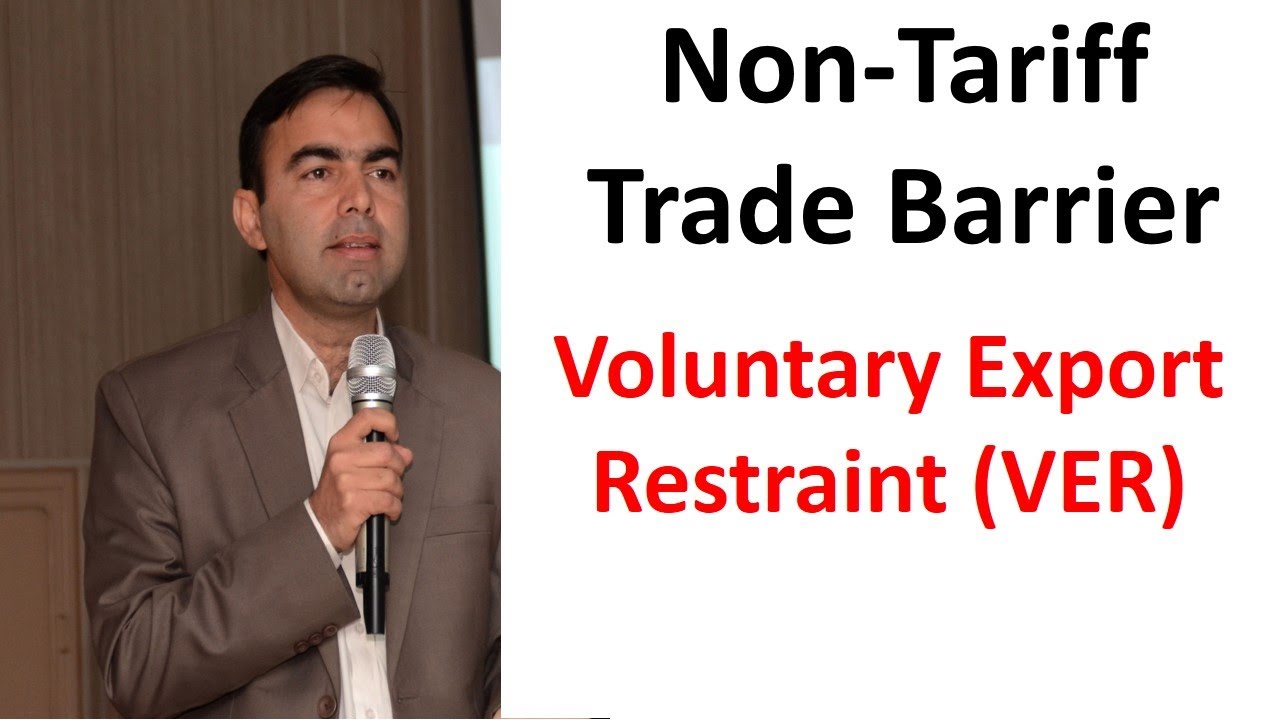
Third thing which is often done, is surprisingly again, but to give the rights, not to domestic firms, but to foreign firms or governments.
This was done by the Reagan administration in the 1980s for example, under the so-called voluntary export restraints, under which Japanese automakers voluntarily agreed to send fewer cars to the United States.
Now, why would they do that?
Or why would the government? Of course, this really wasn't voluntary.
Why would the government give away these rents to foreign firms, instead of keeping the rents themselves, instead of giving the domestic firms, they give the rents to foreign firms.
Well, one reason is that -- the Japanese automakers might have complained bitterly and might have lobbied extensively against a tariff because that does them no good whatsoever.
On the other hand, a quota, -- which is given to the Japanese firms, gives them the quota rents.
So they're going to be much less against protectionism when it comes in the forms of a quota, which goes to them, rather than in the form of -- a tariff, the revenues of which would go to the domestic government.
How is the quota divided in the foreign country?
Well again, it's the foreign government or the foreign firms which somehow must agree how to split up the right to import into the domestic economy, into, say, the United States.
And this can create foreign rent-seeking.
This is another reason, by the way, why -- some large Japanese automakers who, perhaps, are worried about some upstart Japanese firms undercutting them; they may again really want a quota, because it cements their position.
It makes it harder for other firms in Japan to compete against them by coming into the U.S. market because they have wrapped up that quota, they've grabbed up that quota.
Okay, those are the main issues with the quota rents.
Let's look at a few complications.
When we draw supply and demand curve, we're implicitly assuming that "the good" is well defined.
Something like #2 hard red winter wheat.
Things get more complicated when the good could come in different qualities.
When we think about cars, for example, there's a wide variety of qualities.
And, in this case, not only can tariffs and quotas be suddenly different, but the two main types of tariffs, their percentage tax or tariff like 10%, also called an ad valorem tariff, can have a different effect than the unit tax or the unit tariff, the $10 tariff.
For example, -- let's suppose that the good costs $100.
If it's very well-defined, than a 10% tax, or tariff, it's going to have the same effects as a $10 per unit tariff.
However, if the good comes in a variety of qualities, then these two tariffs can have different effects.
To understand this, let's think about quality as being more stuff.
So think about a higher quality car like a Lexus as simply being twice the car that a Corolla is.
The Lexus has twice as much car-ness in it.
Well, in this case, -- if we have a 10% tax, -- well, the Lexus is twice as much -- of 10%, is twice as much car, so there's no real difference between importing two Corollas, paying two taxes of 10%, or one Lexus and paying one tax of 10%.
Those are the same thing, so there's really no bias.
On the other hand, suppose that we have a per car tax.
Well, in that case, a per car tax of $1000, let's say; that's a much bigger increase in the price of a Corolla than it is in the price of a Lexus.
So a per unit tax, a per car tax will tend to encourage suppliers to supply the higher-quality goods, because the percentage increase in the price to the consumer will be less.
With the quota, this is even more the case.
So imagine that we have, -- we're only allowed to import 1000 cars.
Well, in this case, you'd much rather import the Lexuses than the Corollas.
One way of thinking about this is that, -- by importing the Lexuses, in a way, you're almost evading the quota because you're only allowed a thousand cars, but since the Lexus is twice a Corolla, has twice as much car-ness, it's like you're importing more.
It's like sneaking under the quota.
So what will happen is that a quota will tend to -- encourage the suppliers, in this case the automakers, to supply more high-quality goods.
And in fact, what we had in the 1980s, the voluntary export restraints against Japanese automobiles, this is precisely the time that the Japanese suppliers started to move into the higher quality production, started to produce the Lexuses and so forth.
So a quota, when quality is a variable, will tend to push the suppliers into producing higher quality.
So Bhagwati first showed the equivalence of tariffs and quotas under competition.
He later showed that there could be differences under monopoly or other market structures.
For some of those differences, you can look at the textbook by Bhagwati and Srinivasan, "Lectures on International Trade".
The whole issue of taxes and quality is a very large one.
I'm just going to mention a few classic articles here.
Yoram Barzel's article, "An Alternative Approach to the Analysis of Taxation".
Remember that tariff is just a tax on imports, so this literature applies both to tariffs and to taxes.
Tyler and I actually wrote a fun related piece on the Alchian and Allen theorem.
And Kay and Keen have a piece looking at product quality -- under a specific or unit taxes and ad valorem or percentage taxes.
I pointed out that a quota will tend to encourage foreign firms to invest in more quality, to ship higher-quality goods, because it's sort of a way of evading the quota in some sense.
This is shown empirically by Robert Feenstra, looking at the trade restraints on Japanese automobiles in the 1980s.
This is a very good piece.
The idea of rent-seeking -- was, the term rent-seeking was first coined by Anne Krueger who had those phenomenal statistics on the value of import licenses.
That's in this piece, "The Political Economy of the Rent-Seeking Society".
The idea of rent-seeking is more general and was first developed by Gordon Tullock.
Krueger sort of thought that rent-seeking only applied to licenses, Tullock shows it's a much bigger idea.
It applies to tariffs, it applies to monopoly, it applies to many other issues as well.
This is really a very important classic article by Tullock.
You can find it in the Western Economic Journal, but -- it's also available elsewhere on the web as well.
Thanks.
Up Next

12:58
Import Quotas Welfare Analysis: Consumer & Producer Surplus
@talkboardau
24K views•2014-01-16
5:07
Impact of Yuan in Indo-Russian Trade Amid Sanctions
@WION
261.9K views•2022-07-01
12:31
Subsidies Explained: Incidence, Elasticity & Deadweight Loss
@MarginalRevolutionUniversity
325.4K views•2015-01-28

113:18
The Age of Easy Money: Fed & Inflation | Full Documentary
@frontline
21.2M views•2023-03-15
Related Study Plans & Knowledge Roadmaps
Structured learning paths in Economics
economics
Sovereign Debt: Defaults, IMF & Restructuring
01Introduction to Sovereign Debt & Government Bonds
02Debt Sustainability & Credit Ratings
03Anatomy and History of Debt Crises
+ 2 more learning modules
12h5 modules
Explore Roadmap
economics
Market Design: Matching Theory & Gale-Shapley
01Introduction to Market Design and Price-Free Markets
02Two-Sided Matching & The Gale-Shapley Algorithm
03School Choice Systems and Mechanism Design
+ 2 more learning modules
10h5 modules
Explore Roadmap
economics
Impossible Trinity: Forex, Capital & Policy
01Introduction to Monetary Policy and Central Banking
02Exchange Rates and International Capital Flows
03The Mundell-Fleming Model
+ 2 more learning modules
8h5 modules
Explore Roadmap
economics
Healthcare Economics: Market Failures & Systems
01Introduction to Healthcare Markets and Market Failure
02Asymmetric Information and Adverse Selection
03Moral Hazard and Insurance Design
+ 2 more learning modules
12h5 modules
Explore Roadmap