








![[International Trade] Ricardian Model | Part 2 | Autarky and Free Trade Equilibrium Price | 4 |](https://i.ytimg.com/vi/Yv7SpinwhSA/maxresdefault.jpg)




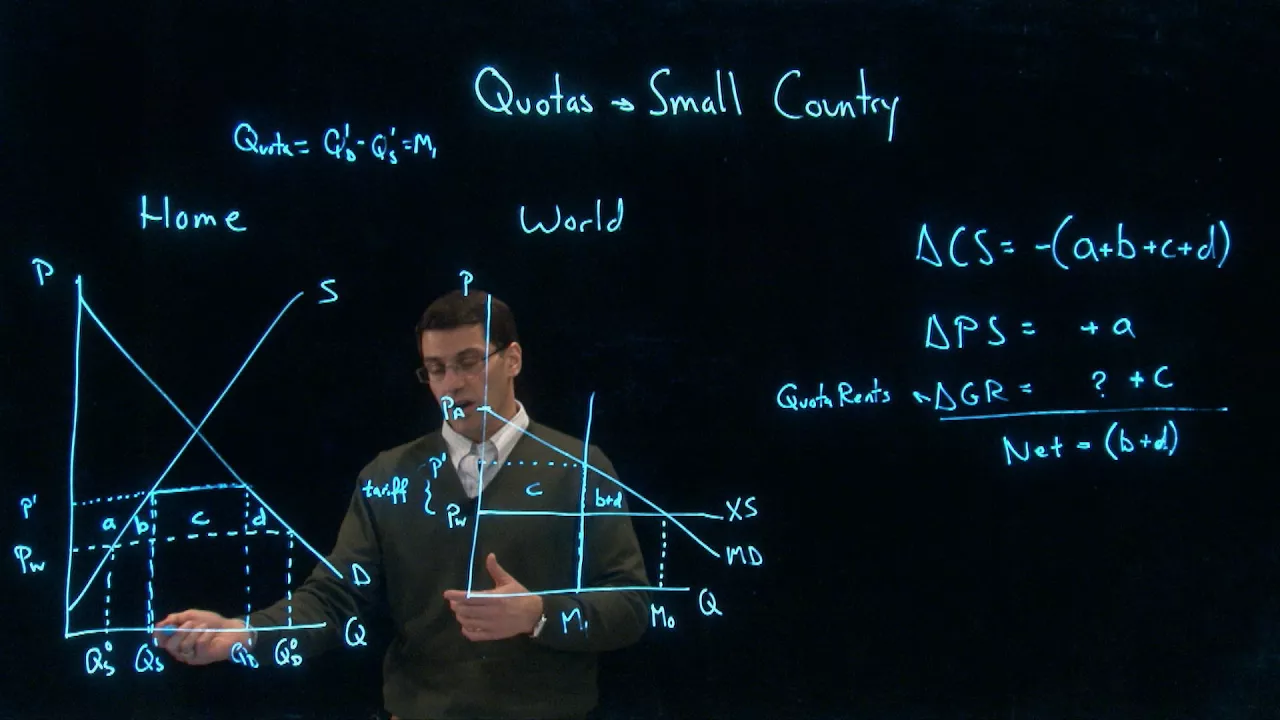







Import quotas raise domestic prices above world levels, reducing consumer surplus (A+B) while increasing producer surplus (H+C) and creating license holder surplus (E+F); however, the total welfare loss (deadweight loss) equals areas D and G, representing inefficiencies from resources misallocated to inefficient producers and consumers priced out of the market, making trade liberalization preferable for maximizing societal welfare.
Import Quotas Welfare Analysis: Consumer & Producer Surplus
Added:Understanding of basic supply and demand curves, including how equilibrium price and quantity are determined in both domestic and international markets.
The concepts of Consumer Surplus (CS) and Producer Surplus (PS), and how they are represented graphically as areas under the demand and supply curves.
The concept of Deadweight Loss (DWL) as a graphical and economic measure of market inefficiency and welfare loss.
The fundamental difference between an autarky (closed economy) equilibrium and a free trade (open economy) equilibrium.
A comparative welfare analysis of tariffs versus import quotas, specifically comparing government revenue generation to quota rents.
The study of quota license allocation methods (e.g., government auctions, historical allocation, or rent-seeking) and how they determine who captures the quota rent.
Exploration of Voluntary Export Restraints (VERs) as a specific political-economic variation of import quotas where foreign countries limit their own exports.
Advanced analysis of rent-seeking behavior and how lobbying efforts to secure quota licenses can lead to additional social waste beyond standard deadweight loss.
24K views99likes12:58Original Release: 2014-01-16
we're gonna use welfare analysis in this video and to evaluate the effects of an import quota in domestic markets they're gonna use the market for shirts I want to look at the before and after effects and the change on consumer surplus producer surplus license holder surplus and total surplus after an introduction of an import quota so initially as we can see the world price is below the domestic equilibrium price here so the world.press of shirts is lower and so with that without any governor restrictions people will tend to import at this lower price so this being the equilibrium with that any trade with their trade this here baby equilibrium with trade but without any government intervention equilibrium with trade but with that government intervention now we're gonna look at how an introduction of import quota will actually change this market for a bet let's just clear this up so that this graph doesn't get too messy so but we now realize we've noted that the equilibrium price and the equilibrium quantity with that trade is here with that international competitors is here and with international trade is here and so at this price or talked about previously is that the quantity supplied domestically is at Q s the quantity demanded is here acute it at this world price produces domestically aren't willing to supply that much because their production cost because whatever efficiency raisin they aren't able to supply at this demand here as this as demand exceeds supply we can see that to make up for this shortage suppliers will improve however if the government introduces import quotas this would mean that the amount of imports would decrease so let's assume that the government intranets introduces this import quota of this much we will see that the import or the amount imported will actually decrease from QD and Q s the decent ranked unique us to this new point here however what this also suggests is that because there is an importer license holders are actually able to bump up their press so we're just gonna look at this magnitude yeah and move it up so that demand and supply meet at the same magnitude there so as a result what we will see is that because there is to an excess in demand to supply that means domestic producers who are able to produce at a lower cost than this demand one would then enter the market so domestic sellers of the good are now better off with this import quota so now this is domestic supply with the quota so this apply line is actually pretty strange now it goes like this and be shown in pink forgive the the messiness but you can spit like that and so here domestic suppliers are willing to supply at this line the original domestic supply line then we have the import the the difference between us and you this new import at the this is called this Qi being the quantity we are able to import and then the domestic supplier will continue as those who are willing to supply at that price or supply at that price so the price with the quarter now that there is a quota has actually increased because there is a limited amount people can actually producers can actually purchase overseas and so as a result the price of inputs would actually increase as a result this is the world press you world press it imports winter quarters with import quotas right so what this suggests is that as we can see because the quantity available to import is only this much they've actually bumped off the press and so this magnitude here is the same as this magnitude there I shall just increase the price so that's the amount that we are able to import so we're now going and able to import the difference between the quantity demanded and the quantity supplied we're only able to import this the difference here all right with this in mind we're just gonna label all these different triangles now we're gonna look at demand and we're gonna use welfare analysis to see the before after inch the change in welfare in this in this society clip a b c this little triangle here is d e this little triangle here to death again this is G and H ok so before this introduction of the import quarter we can see that the consumer surplus is anything that that consumers are willing to supply above the domestic above the world price lies in the domestic demand line anything along the domestic demand line which is above the world price line so that is given by a plus B plus C plus D plus E Plus F and plus G producer surplus would only be H here because producers that represents the number of producers who are willing to supply at a cost of lower than the world price so H is producer surplus the license holder surplus because there are no import quotas in this market will be zero the total surface we just add consumer surplus and producer surplus up together and we get a plus B plus C plus D plus E F G and H however after we have an import quota we can see that the equilibrium price is actually increased to this one here so the actual price is I should you know buy this orange one yeah and so what this represents is that consumer surface after the quota will only be anything that we are willing to purchase above the reporter price or the new world price with import quotas which is a plus B so this large triangle here is a plus B Nezzer so what you see that the change would be negative C negative D negative B negative F and negative G the producer surplus because that's the world prices increased has also countries from H to H for C so then this is new world price and that's therefore that introduces or encourages more producers domestic vectors apply that because of this increase in world press given this import quota so afterwards you see that producer surplus would be H plus C and the change when in fact the plus C the license holder surplus as we can see is those who had now have the license to import this is very similar to tariffs and said tariffs go to the government this goes to the government this goes to the license holders and so the it is given by the amount they can import now which is given by this distance here and multiply it by the mark-up in price which is that distance there and as we can see this is denoted by the shaded region because also E Plus F it's as a result the change in license holder surface is E Plus F this little rectangular so if we add all this up we can get Tero surface to be a plus a plus B plus C plus E Plus F plus h and now the change have it would be D and G so we lose the ng over that would be negative D - gee so what this suggests is that negative D maybe G is the deadweight loss or the measure inefficiency in this economy if import quotas I introduced and so D represents what the the deadweight loss of D represents the excess of resources utilized in this area of comparative Costas event so excess of resources used by producers who shouldn't actually be producing in this economy or in this market because they are they have comparative cost disadvantage they are inefficiently out there in their resources and we have G here and that deadweight loss or measure of inefficiency represents the excess consumers need to pay so they've actually played that much more and those people along this demand line which kind of Lisbon perform this bit here they actually can't afford to purchase shirts now since the world press has increased given import quotas have reintroduced so the people along this line who are only willing to produce her are only willing to purchase should add only that much above the world press now won't be introduced yet and that represents a loss of consumer satisfaction so overall with import quotas and material living centers are worse off by D&G so with trade liberalisation and this abolition of import quotas suggests that consumers and producers or total total society the entire economy will began by dmg and therefore living centers will be maximized and also opportunity cost and resource allocation would be minimized in that there will be no there will not be an excess in resources use in this area of comparative disadvantage
Up Next

10:23
Economic Impact of Export Subsidies in a Small Country
@momoore1957
72.8K views•2013-09-22
5:07
Impact of Yuan in Indo-Russian Trade Amid Sanctions
@WION
261.9K views•2022-07-01
10:33
Behavioral Economics Explained: Rationality, Nudges, and Risk
@crashcourse
1.1M views•2016-03-12

113:18
The Age of Easy Money: Fed & Inflation | Full Documentary
@frontline
21.2M views•2023-03-15
Related Study Plans & Knowledge Roadmaps
Structured learning paths in Economics
economics
Sovereign Debt: Defaults, IMF & Restructuring
01Introduction to Sovereign Debt & Government Bonds
02Debt Sustainability & Credit Ratings
03Anatomy and History of Debt Crises
+ 2 more learning modules
12h5 modules
Explore Roadmap
economics
Market Design: Matching Theory & Gale-Shapley
01Introduction to Market Design and Price-Free Markets
02Two-Sided Matching & The Gale-Shapley Algorithm
03School Choice Systems and Mechanism Design
+ 2 more learning modules
10h5 modules
Explore Roadmap
economics
Impossible Trinity: Forex, Capital & Policy
01Introduction to Monetary Policy and Central Banking
02Exchange Rates and International Capital Flows
03The Mundell-Fleming Model
+ 2 more learning modules
8h5 modules
Explore Roadmap
economics
Healthcare Economics: Market Failures & Systems
01Introduction to Healthcare Markets and Market Failure
02Asymmetric Information and Adverse Selection
03Moral Hazard and Insurance Design
+ 2 more learning modules
12h5 modules
Explore Roadmap