


![[공기업경제학 기본강의 42] 제15장 국제무역 (2)](https://i.ytimg.com/vi/Gsk93g-sa-o/maxresdefault.jpg)
![שיווי משקל במשק פתוח - יבוא ויצוא [תרגיל 10]](https://i.ytimg.com/vi/ZMcWCkqrQX4/sddefault.jpg)








![[기본강의 122] 제21장 무역정책론 - 관세와 비관세장벽+수출보조금 효과 (P. 659-615)](https://i.ytimg.com/vi/TLPyK1Lzsq0/maxresdefault.jpg)





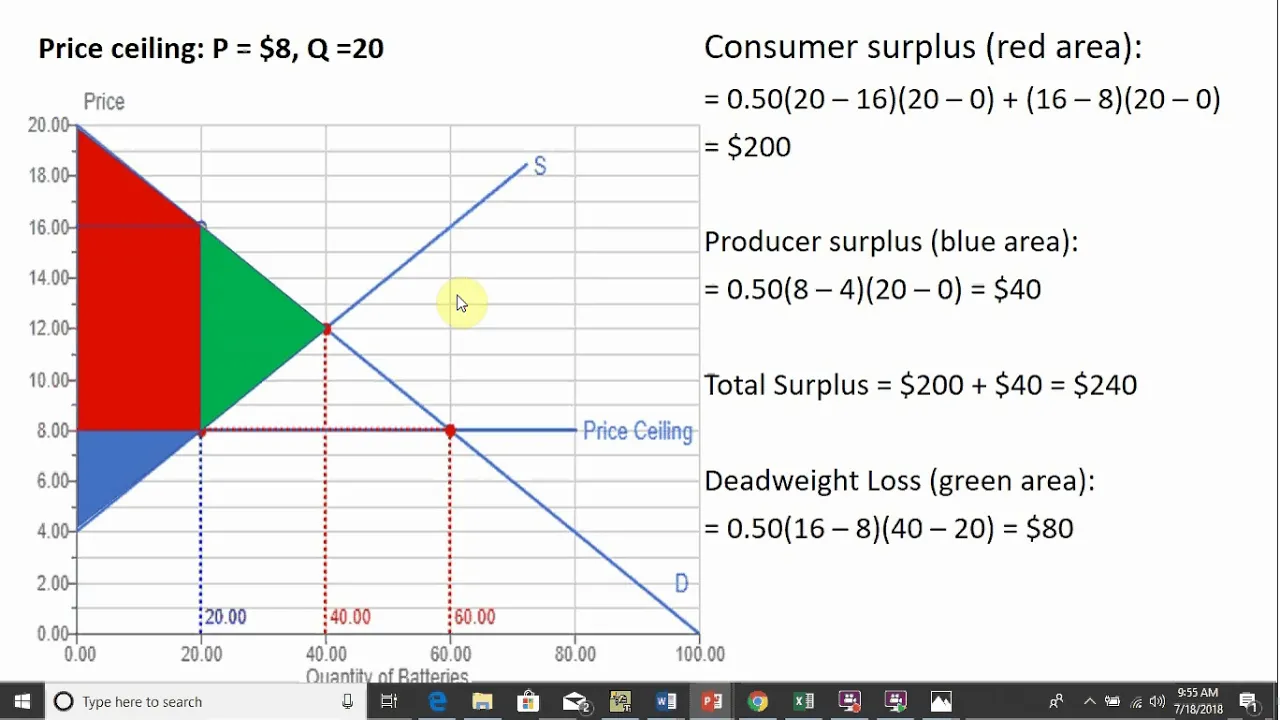
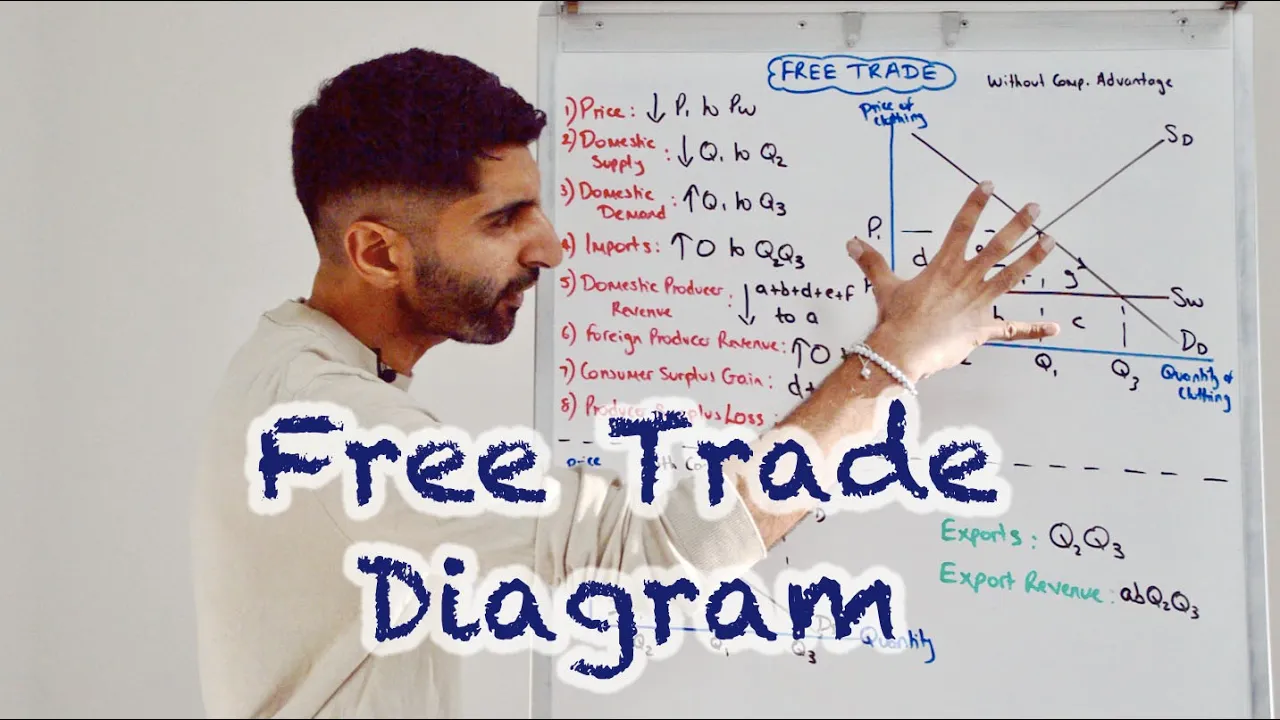
Export subsidies, where governments pay firms to sell products internationally, increase exports but create inefficiencies: domestic prices rise by the full subsidy amount, reducing consumer welfare; the government incurs significant costs; and society experiences deadweight losses (areas B and I) from inefficient resource allocation, as domestic producers sell to international consumers rather than domestic consumers who value the product more, plus inefficient production occurs beyond optimal levels.
Economic Impact of Export Subsidies in a Small Country
Added:The concepts of consumer surplus, producer surplus, and deadweight loss in welfare economics.
The 'small country' assumption in international trade, where the domestic market is a price-taker and cannot influence world prices.
Basic supply and demand analysis under free trade conditions, specifically how export-oriented industries operate when domestic prices match world prices.
The fundamental mechanics of government market interventions, such as taxes and subsidies, and how they shift supply or demand curves.
The economic impact of export subsidies in a 'large country', including terms-of-trade effects and potential optimal subsidy arguments.
A comparative welfare analysis of export subsidies versus import tariffs, import quotas, and voluntary export restraints (VERs).
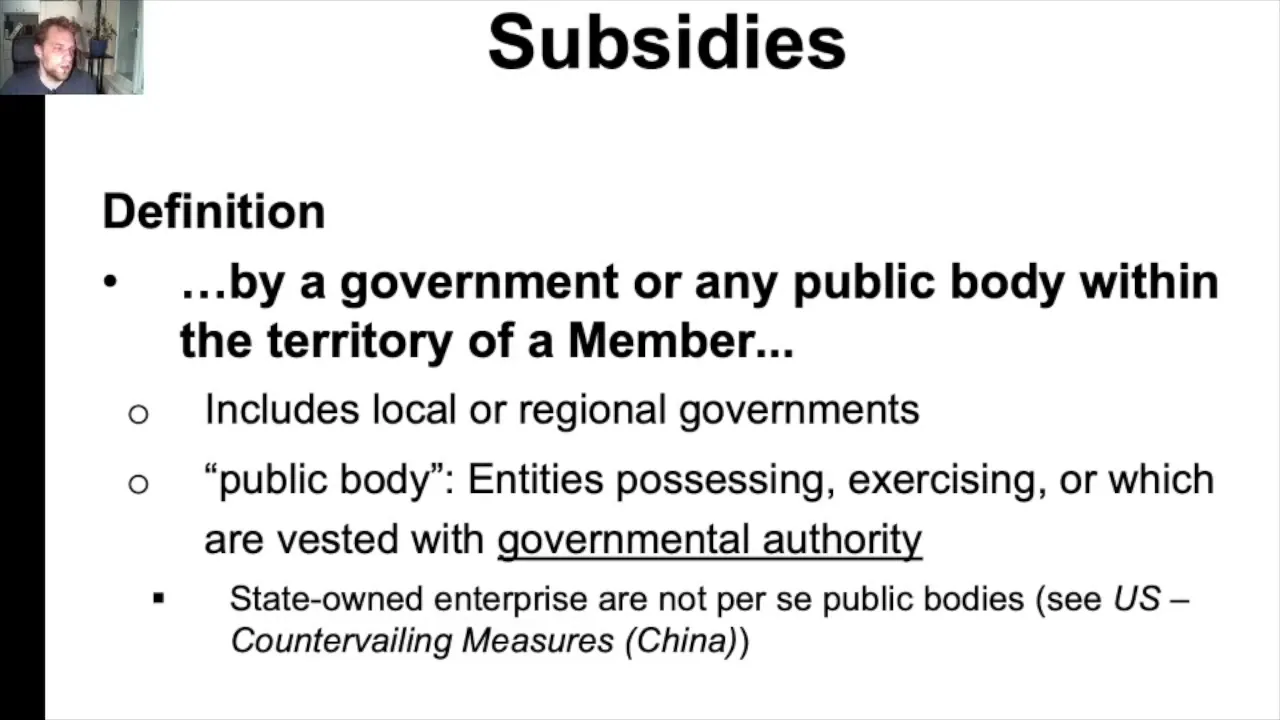
The role of the World Trade Organization (WTO) in regulating subsidies and the mechanics of countervailing duties (CVDs).
Strategic trade policy and game-theoretic models of subsidies in duopolistic international markets (e.g., the Brander-Spencer model).
72.8K views474likes10:23Original Release: 2013-09-22
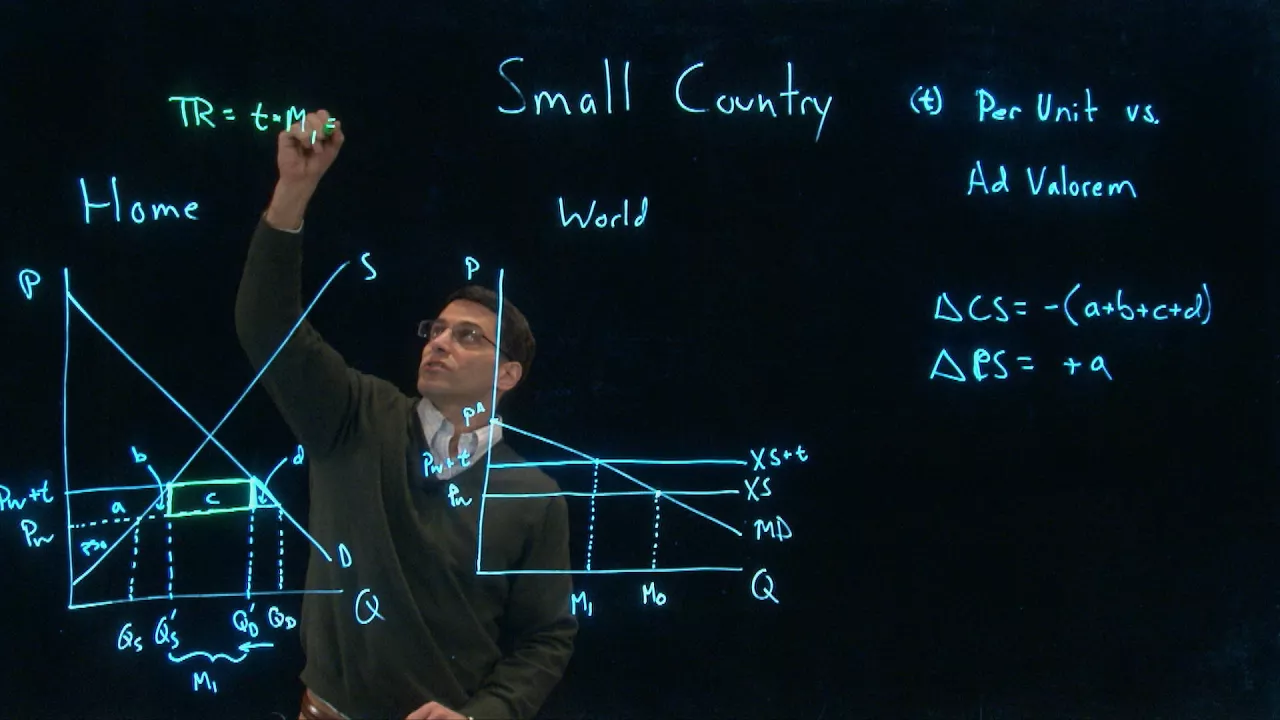
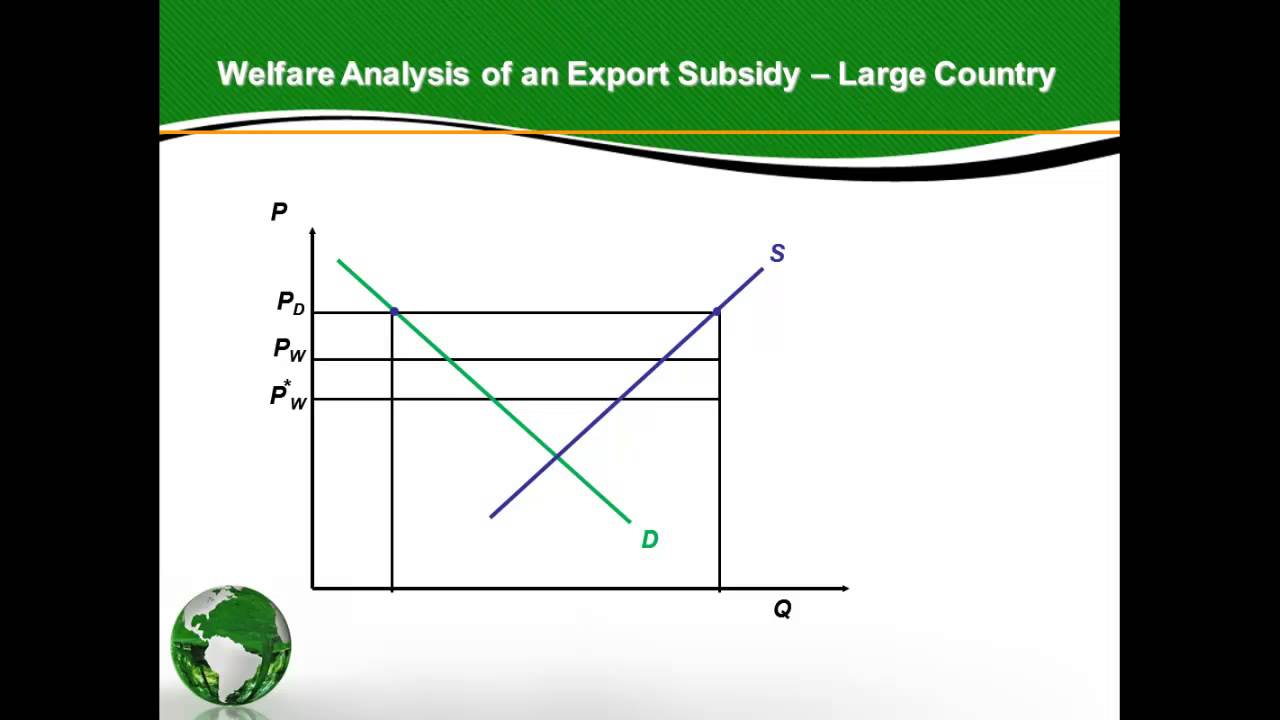
so we also have the possibility of changing uh exports through quite the opposite policy that is to say increasing exports rather than through a subsidy for example an export subsidy which re increases the exports now this is basically just the opposite the export tax when you promote exports by paying exporters by paying firms to sell internationally you clearly have two potential goals at least one is that you've got hard currency earnings that is to say the increased exports can increase the amount of this product that is the revenue of this product sold abroad and this can result in hard currency that is to say convertible currency that can be used to buy imports and other products and sometimes countries have that as a a major goal and so would potentially uh want to subsidize exports in order to gain that uh gain that Advantage you clearly are going to be increasing the amount of production through the export subsidy and that's going to help the companies that produce this product and the workers that are engaged in producing this product so these are two of the the reasons why one might want to pursue export subsidies but as in all policies there's a downside in this case the downside is really the the mirror image to the export tax one you're going to have inefficiencies but in this time it's not going to be because you've you're exporting too little but you're really exporting too much and you have a negative effect on consumers as we will see that the domestic price t tends to rise when you have an export subsidies and you also have to take into account the impact of this export subsidy on the the budget of a domestic government because they've got to pay for this and ultimately taxpayers or or um uh or the government will borrow the money but in one instance or another the there's going to be a downside from the the the the cost of providing the subsidy so we're going to start out with a this is a small country example so once again we have an original world price small countes so no matter what this country does that's going to be the the world price we have an original level of exports q1 to Q2 and now we're providing a subsidy that is to say every unit that is sold abroad is going to get extra an extra check from the government again to go back to our example let's say the price is $100 and the government is now willing to pay $10 to every unit that's exported so every time a a domestic firm sells this product abroad they're going to get $100 from the foreigners plus $10 from the government so that clearly is a benefit to selling this product abroad now what how does that affect domestic prices it's very clear if originally the price domestically was 100 and now firms can get 110 by selling it on the international market because the subsidy domestic consumers will not have access to this product domest domestic firms won't sell it to them unless the domestic consumers are willing to pay 110 now this is assuming of course that you've got homogeneous products but even if you had differentiated products so that you had a domestic and and foreign uh products were slightly different you would have a you would tend to have an increase in the price of the in the domestic Market because of the subsidy to keep it simple we'll keep it as a homogeneous product so the domestic price Rises by the full amount of the subsidy and consequently because there's a higher price for sales at home and sales abroad you're going to have an increase in the amount that's produced domestically and the increase in the price is going to reduce consumption to Q3 so now you have a new level of exports it has been expanded by the subsidy by the payment of selling abroad so let's take a look at the effects on various groups we have a consumer loss the domestic consumers will be hurt by this policy again it's the area defined by the difference in the price over to the demand curve so domestic consumers will be facing higher prices because they have to compete with foreign Consumers Plus the payment by the government domestic producers are going to in have an increase in producer Surplus that's the area defined by the difference in the price over the supply curve that's that area a b CDE e so they clearly like this and now we have an impact on the government and this is going to be equal to the level of new exports which is the difference between Q4 and Q3 and the subsidy rate which is the vertical distance between PW and pw+ s in other words words that's going to be equal to B CDE EI that's the exports Q4 to Q3 multiplied times the subsidy rate so now we've got gains we've got losses and now we do the the simple uh cancelling of gains and losses and what we're left with in the small country is that the net effect is B plus I those are dead weight losses those are losses Beyond any gains that were received by different groups in in the society so once again we can interpret these they have it's not just an are on a graph it has a very intuitive explanation from um um uh with just a little bit of analysis so we have an increase in the amount of exports that comes at the at the um uh at the cost of consumers domestic consumers that q1 to Q3 is now sold abroad so area F the is the world price multiplied times the quantity and so that's the the revenue you get from selling this abroad how much did domestic consumer value this it's the area under the demand curve it's B plus F so what you have is that there is a net loss of B that is to say the amount earned from abroad is not is is exceeded by the loss to the domestic uh consumers now I should note here that the from The Firm standpoint they don't get just f they get f plus the subsidy but we're looking at what you actually earn from on sales abroad and that's how much foreigners pay not what how much you get uh from uh as a check from the government so the net effect is B and essentially this is because the export subsidy means that the the domestic firm is selling to the wrong firms all right to the wrong consumers they're selling to International consumers artificially because of the subsidy rather than the domestic consumers who value it more and are willing to pay more you also have an increase in domestic production from Q2 to Q4 that is a result of the increase in the price uh associated with the U uh with the exports so we've got export Revenue associate associated with that that's Q2 to Q before it's the Box the world price times the quantity how much did it cost to produce that that's the area under the supply curve that's area IH so the total should say total variable production cost is the area under the supply curve IH so that you have a net loss from those exports that is to say I that is the excess of domestic production costs over what you truly earned from these sales abroad not including the the check from the government which again was just a transfer between uh uh domestic taxpayers through the government to producers that's not part of the calculus so we have these two areas B and I and just to uh toh summarize that again B is the cost of selling the product internationally instead of selling it to the domestic consumer I is the inefficient production that is artificially allowed to occur because of the subsidy
Up Next

17:44
CFA Level 1 Economics: Trade Restrictions Tariffs Quotas
@IFT-CFA
47.1K views•2018-01-11
5:07
Impact of Yuan in Indo-Russian Trade Amid Sanctions
@WION
261.9K views•2022-07-01
10:33
Behavioral Economics Explained: Rationality, Nudges, and Risk
@crashcourse
1.1M views•2016-03-12

113:18
The Age of Easy Money: Fed & Inflation | Full Documentary
@frontline
21.2M views•2023-03-15
Related Study Plans & Knowledge Roadmaps
Structured learning paths in Economics
economics
Sovereign Debt: Defaults, IMF & Restructuring
01Introduction to Sovereign Debt & Government Bonds
02Debt Sustainability & Credit Ratings
03Anatomy and History of Debt Crises
+ 2 more learning modules
12h5 modules
Explore Roadmap
economics
Market Design: Matching Theory & Gale-Shapley
01Introduction to Market Design and Price-Free Markets
02Two-Sided Matching & The Gale-Shapley Algorithm
03School Choice Systems and Mechanism Design
+ 2 more learning modules
10h5 modules
Explore Roadmap
economics
Impossible Trinity: Forex, Capital & Policy
01Introduction to Monetary Policy and Central Banking
02Exchange Rates and International Capital Flows
03The Mundell-Fleming Model
+ 2 more learning modules
8h5 modules
Explore Roadmap
economics
Healthcare Economics: Market Failures & Systems
01Introduction to Healthcare Markets and Market Failure
02Asymmetric Information and Adverse Selection
03Moral Hazard and Insurance Design
+ 2 more learning modules
12h5 modules
Explore Roadmap