





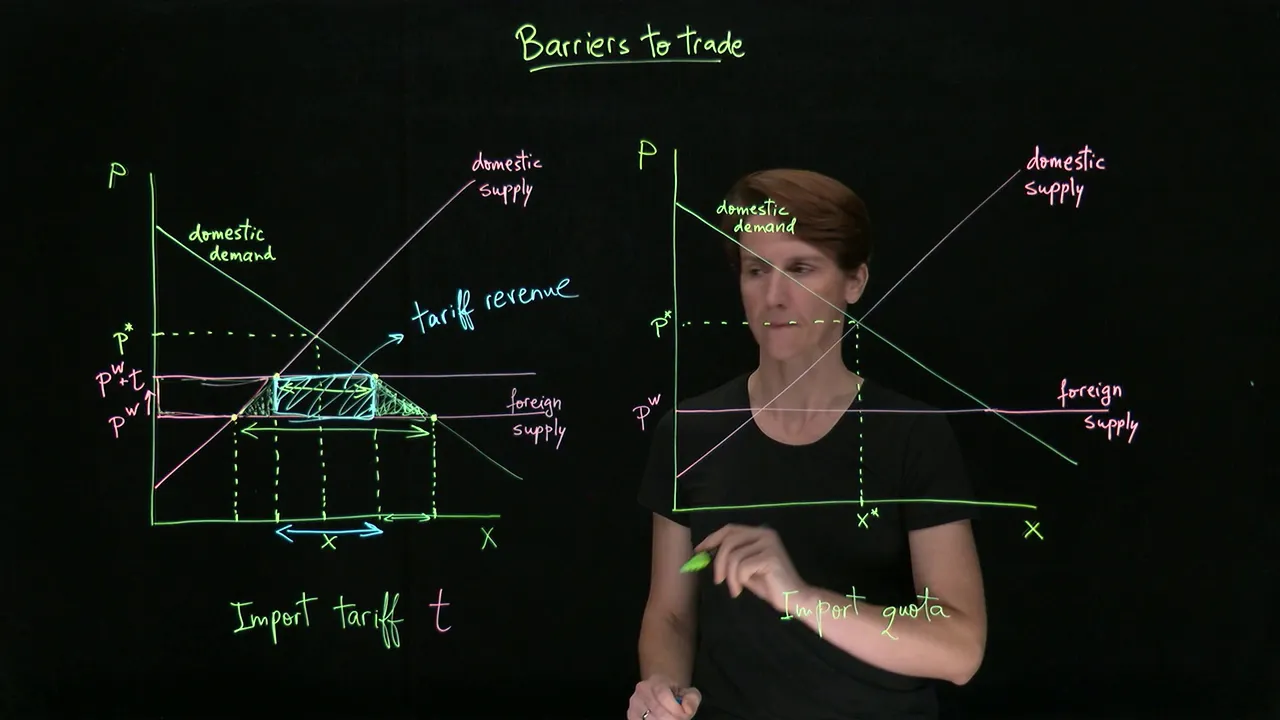






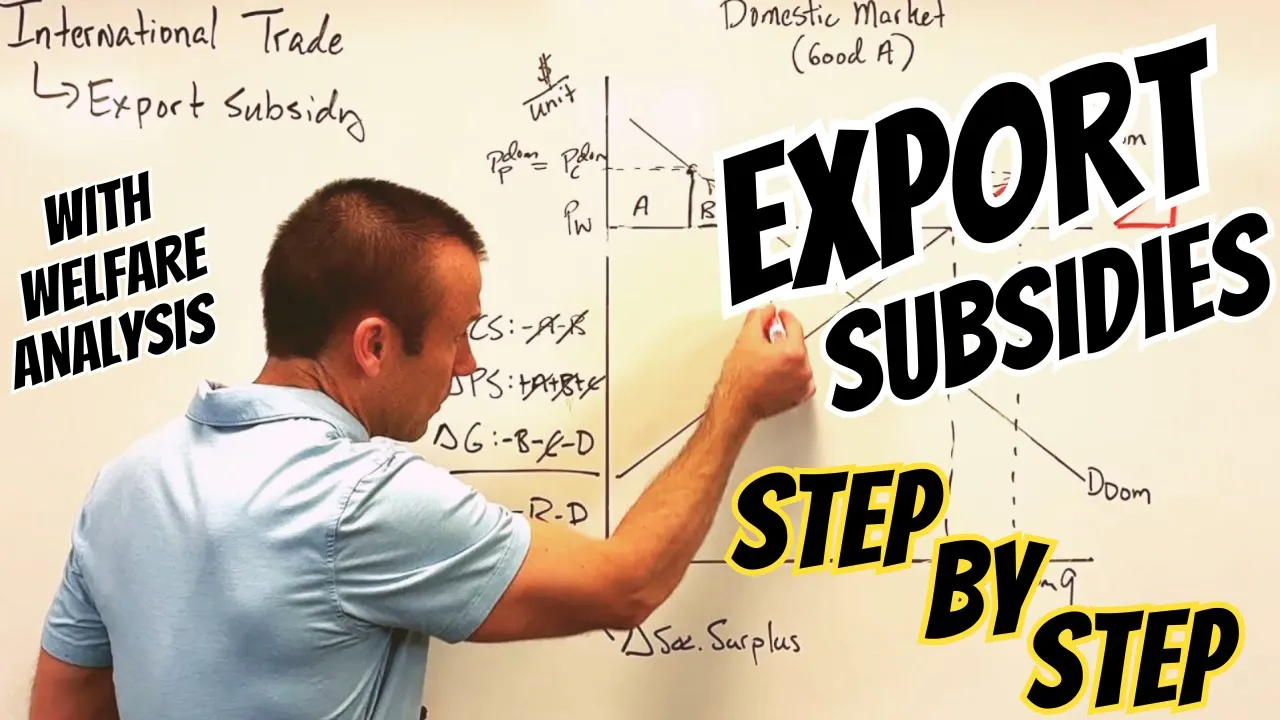








An export subsidy in a large country raises domestic prices while lowering world prices, worsening the country's terms of trade and creating significant welfare losses through production distortion, consumption distortion, and terms of trade deterioration; the total welfare loss (areas B + D + E + F + G) exceeds the benefits, making export subsidies generally welfare-reducing for the country as a whole.
Export Subsidies in a Large Country: Welfare Analysis
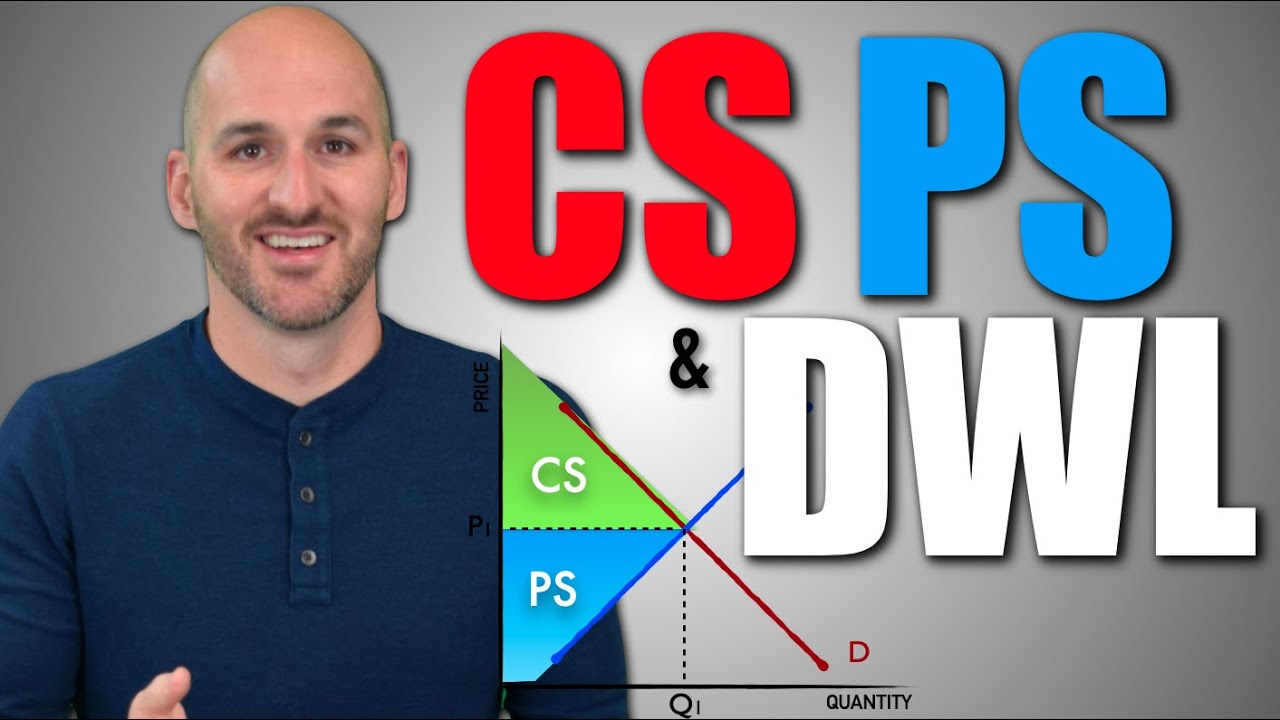
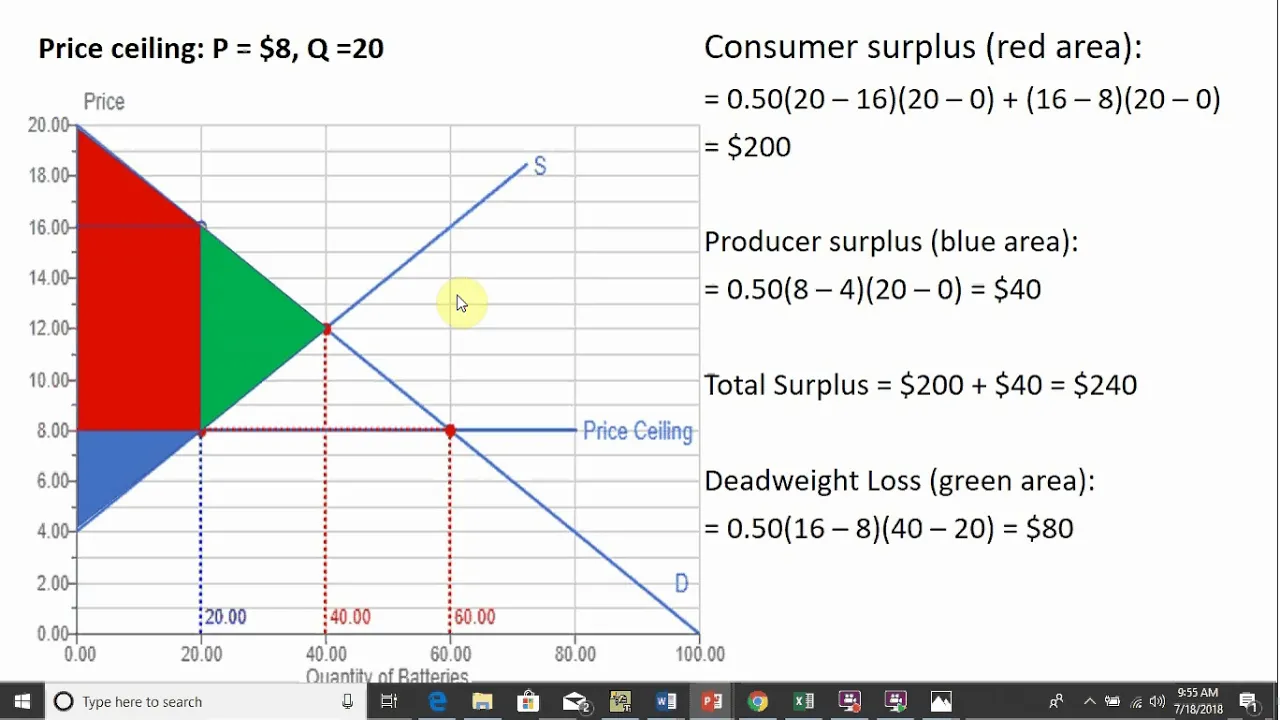
Added:Understanding consumer surplus, producer surplus, and deadweight loss in standard welfare economics.
The trade-theoretic distinction between a 'small country' and a 'large country' regarding their ability to influence terms of trade.
The fundamental mechanics of tariffs and how trade barriers affect domestic and world prices.
An introduction to partial equilibrium analysis in international trade.
The Brander-Spencer model of strategic trade policy, which explores conditions under which export subsidies might shift profits in oligopolistic markets.
Comparing the welfare and price effects of export subsidies with other trade instruments, such as import quotas and voluntary export restraints.
The political economy of trade policy, focusing on why governments implement welfare-reducing subsidies due to special interest groups.
World Trade Organization (WTO) rules and legal frameworks governing subsidies, specifically the Agreement on Subsidies and Countervailing Measures (SCM).
25K views235likes6:54Original Release: 2014-03-18
Hello everyone today we'll discuss export subsidies in a large country and the losses that results from that subsidy What is a subsidy?
or individual that ships a good Well it might be a payment by the government to farm but this particular subsidy is given only for exporting the good it is not given to the producer if the producer sells a product at home in the domestic market So what happens as a result of an export subsidy?
Now if the price of the product was $10 and this was the world price [those] $10 in the rest of the world or in the foreign country, as well as in the domestic country assuming that there is free trade As soon as the export subsidy is given in this country the exporter would decide to export the good gets a subsidy let's say $2 So when the producer tries to export the good he gets a price of $12 but if he decides to sell in the domestic market he only gets the price $10 So that's the distinction between export subsidy & production subsidy Export subsidy is only given if the product is exported to the international market What is this going to do?
Well producers would then have an incentive to export the good rather than sell it in the domestic market The supply of exports increases at the expense of domestic supply First of all, let's see what happens in the world market Well suppose this was our demand and supply in the world market and equilibrium price would be Pw the world price As soon as the large country is given an export subsidy there's an increase in exports to the rest of the world And it's going to have an effect on the prices because the exporting country is a large country and has a large share of the export market So there's an increase in export supply supply has increased Now what that does is it pushes down the world prices to Pw* The new equilibrium point is at 2 So an export subsidy by a large country really pushes down the world prices We want to know what happens within the country the country that's giving the export subsidy [Let's just say] exporting country Let's just review - Pw is the world price [as] beginning to think of a subsidy Pw* is a new world price after the subsidy is given Pd is a domestic price after a subsidy is given The exporting country is open to free trade so it takes Pw as a world price When the government comes in and gives export subsidy what happens in the international market is is that the world prices fall price dropped to Pw* So now Pw* is the new world price What happens at home?
Well at home, producers - if they export the good, they get Pw* + the amount of the subsidy But if they sell it in the domestic market they only get Pw* So they won't sell in the domestic market unless the prices in the domestic market increases to what they get if they export the good So the domestic prices has to rise by the amount of the subsidy So the domestic price would be Pw* plus subsidy which is Pd So this is the new domestic price and this is the amount of exports As you can see exports has increased Now next step is to see what happens to the welfare What is the change in producer surplus?
Well it's the area above the supply function and below the equilibrium price So the price that the producers used to face was Pw Now it has increased to Pd The change in producer surplus is A + B + C That's the producer's gain Producer consumer's loss is A + B the area below the demand function between the price change What about the cost of the export subsidy?
Well that's equal to the amount of exports multiplied by the amount of subsidy because this is a unit subsidy and that will give you the cost of subsidy So it's the amount of exports which is given by this into the amount of subsidy which is given by this [that's] really this area here So the cost of the government subsidy is B + C + D + E + F & GW Well a few things that have happened here One is that the world prices fell If you think about the large countries terms of trade - the terms of trade have declined Now how are terms of trade defined?
Well it's price of exports, or price of imports Now by giving an export subsidy, the large country has decreased the price of exports So now it gets a lower price in the world market, for the good that it exports So this decline is really the terms of trade loss The other thing that has happened is that there has been a change in there in the consumption and production of this good The production has increased and it has increased by this much and the consumption has declined So we have an efficiency loss equal to B this is really the consumption distortion D is the efficiency loss because of production distortion and the terms of trade loss is your E + F + G So you see there has been a decrease in the price of exports So now this level of exports gets a lower price Instead of Pw it gets Pw* So this is your terms of trade loss So what we really see is that when a large country gives export subsidy there's a loss to the country and this loss is measured by B + G + E + F + G That's a large amount of loss as a result of export subsidy So in conclusion an export subsidy raises the prices in the exporting country It lowers the prices in the rest of the world or you can refer to that as the importing country or foreign country It worsens the terms of trade for the exporting country because the price of exports has fallen The cost of this subsidy is much higher than the benefits So it's always welfare reducing for the country as a whole
Up Next

42:26
Free Trade's Broken Promise: Winners, Losers, and Protectionism
@DWDocumentary
2.7M views•2018-06-06
5:07
Impact of Yuan in Indo-Russian Trade Amid Sanctions
@WION
261.9K views•2022-07-01
10:33
Behavioral Economics Explained: Rationality, Nudges, and Risk
@crashcourse
1.1M views•2016-03-12

113:18
The Age of Easy Money: Fed & Inflation | Full Documentary
@frontline
21.2M views•2023-03-15
Related Study Plans & Knowledge Roadmaps
Structured learning paths in Economics
economics
Sovereign Debt: Defaults, IMF & Restructuring
01Introduction to Sovereign Debt & Government Bonds
02Debt Sustainability & Credit Ratings
03Anatomy and History of Debt Crises
+ 2 more learning modules
12h5 modules
Explore Roadmap
economics
Market Design: Matching Theory & Gale-Shapley
01Introduction to Market Design and Price-Free Markets
02Two-Sided Matching & The Gale-Shapley Algorithm
03School Choice Systems and Mechanism Design
+ 2 more learning modules
10h5 modules
Explore Roadmap
economics
Impossible Trinity: Forex, Capital & Policy
01Introduction to Monetary Policy and Central Banking
02Exchange Rates and International Capital Flows
03The Mundell-Fleming Model
+ 2 more learning modules
8h5 modules
Explore Roadmap
economics
Healthcare Economics: Market Failures & Systems
01Introduction to Healthcare Markets and Market Failure
02Asymmetric Information and Adverse Selection
03Moral Hazard and Insurance Design
+ 2 more learning modules
12h5 modules
Explore Roadmap