









![Repaso 2023 II - Comercio internacional 💰 Economía [CICLO FREE]](https://i.ytimg.com/vi/QW69_l-uD_Y/maxresdefault.jpg)



![[기본강의 122] 제21장 무역정책론 - 관세와 비관세장벽+수출보조금 효과 (P. 659-615)](https://i.ytimg.com/vi/TLPyK1Lzsq0/maxresdefault.jpg)

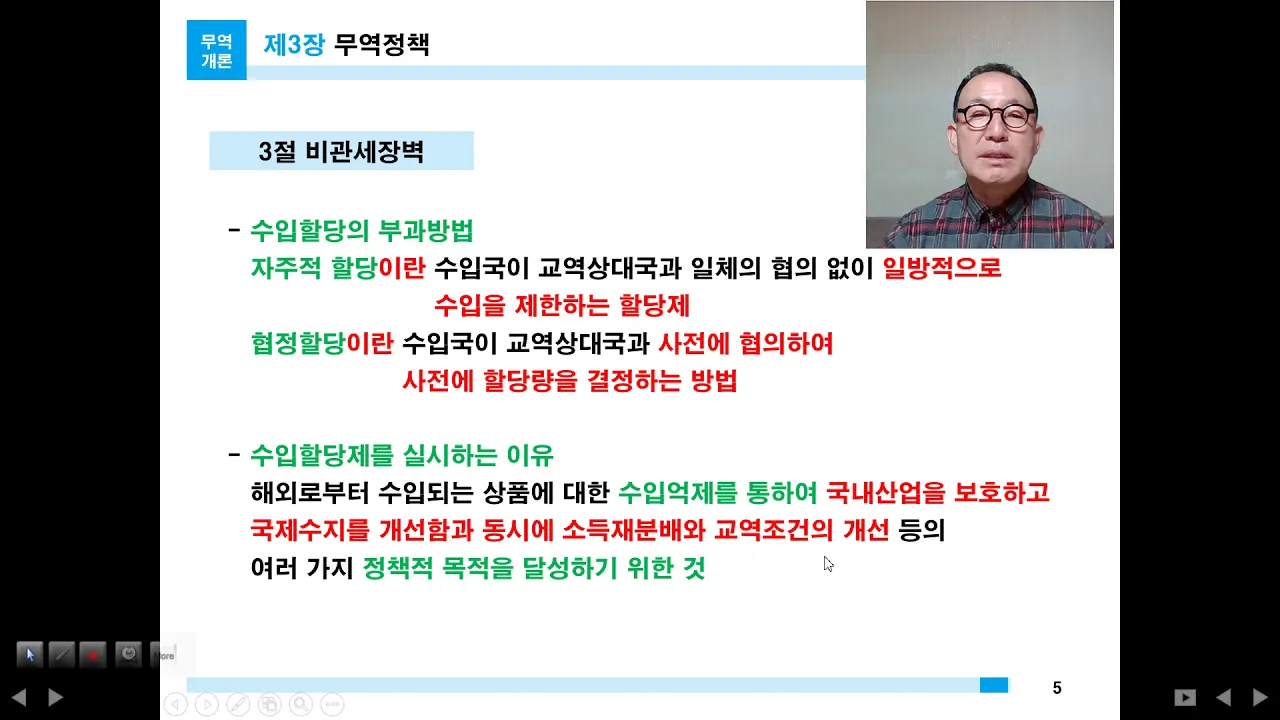











This lecture explains how trade barriers affect national welfare. Tariffs are taxes on imports that increase consumer prices, boost domestic production, and reduce imports, resulting in a loss of consumer surplus and creating deadweight loss (welfare loss) that is not captured by any party. The government gains revenue from tariffs, while producers gain from higher prices. In contrast, quotas limit the absolute amount of imports allowed, potentially allowing exporters to capture economic rent rather than the government. Voluntary export restraints occur when exporting countries voluntarily limit exports, similar to quotas but with the restriction originating from the exporting country rather than the importing country. While tariffs and quotas have similar effects on prices and quantities, the key difference lies in who captures the economic rent—government revenue with tariffs versus potential exporter profits with quotas.
CFA Level 1 Economics: Trade Restrictions Tariffs Quotas
Added:We now come to section three trade capital flows restrictions and agreements. Here we will talk about different kinds of restrictions and agreements.
Let's start with tariffs.
Tariffs are taxes on imported goods collected by the government. The idea is straightforward. Here is a particular country. It imports goods from abroad and for all the goods that are imported there is a certain amount of tax collected by the government.
Tariffs are generally popular in countries where the government finds it difficult to collect taxes from its own people.
The justification for tariffs are generally shown right here. The justification for tariffs are shown here. One is to protect a domestic industry. A country might say that we want to develop the auto industry in our country and to do so we will import high tariffs on cars that are imported.
The objective might also be to reduce the trade deficit. If a given country has low exports and high imports, it will run a large trade deficit and the government might say that we want to discourage imports by increasing the tariffs.
In almost all cases, there is a loss in overall welfare when a government imposes tariffs. And we will understand that by looking at a picture over here in the context of what is called a small country. In this discussion, a small country means that a country is small or the demand for a particular good is small relative to the global demand.
Such a country will be a price taker.
And to understand this, think about a relatively small country like Portugal.
Portugal imports cars from the rest of the world, say from Japan, Germany, etc. But Portugal's imports have no impact on the global price of cars. So we can say that Portugal is a small country. We can also take a country like Brazil which is physically big but Brazil's import of cars probably has no impact on the price of cars in the global market. So in the context of the global auto industry both Brazil and Portugal are small countries.
A large country is one where the imports or the behavior of that particular country has a substantial impact on the price of the good that we are talking about. The United States for example will have a substantial impact on the prices of cars in the global market. If the United States were to import tariffs on car imports, then that would impact the global auto industry. So we can say that the United States is not a price taker in this context.
Most countries tend to be small and that is the scenario that we will first talk about. What we are looking at here is the domestic demand of a small country. Let's say for cars and this is the domestic supply again of cars. If we do not have any trade then this would be the otarchic price and this would be the otarchic quantity based on the intersection of supply and demand. But let's say that we do have free trade and say that the price of cars in the global market is 100. If there is free trade then the country that we are talking about here let's say Portugal can import cars at this price which is the global price. At this particular price the demand for cars will be over here. And let's say that this number is 50,000.
The supply of cars might be 10,000. Which means that the import then would be the difference between these two numbers 50 and 40 which is 40,000.
The government sees these inputs and decides to impose a 50% tariff. If that happens then the price of cars in Portugal becomes 150 because for the consumer he is paying 100 plus effectively the 50 tariff. So his price is 150.
At 150 the domestic production will go up because now the price in the market is 150. So the domestic supply or production goes up to 20. What about the demand? The demand will come down. Say the demand comes down to 40.
Now the amount imported is this distance over here which is 20. So notice that imports go down. But what else is going on over here? Is there any impact to the consumer surplus?
When we had free trade and no tariffs, then the consumer surplus was this entire area over here. In fact, this whole triangle and this connects back with what you saw earlier in economics. In fact, in the first couple of readings where we talked about consumer surplus and producer surplus, consumer surplus means that a consumer is willing to pay this amount indicated by the demand curve which is also the marginal benefit curve. The consumer is only paying 100. So this entire area then represents consumer surplus.
when the tariff is imposed then the price comes up to 150. So this area over here is consumer surplus that has been lost. So there is a substantial reduction in consumer surplus. On the next slide we'll go over an example where you need to calculate the loss in consumer surplus. Where does this consumer surplus go?
Some of it goes to producers. Remember initially our producer surplus was the area below 100 and above this supply curve. So initially this was the producer surplus. Now the price has gone up to 150. So this area over here is an increase in the producer surplus.
What about the government revenue?
The reason for importing tariffs was so that the government can get some revenue and possibly these other reasons also existed but mostly the biggest reason is for the government to get revenue. How much is that revenue? The revenue is equal to the number of cars imported multiplied by the tariff per car. The tariff per car is 50.
The number of cars imported is 20,000.
So this rectangle over here represents the revenue for the government.
These two triangles over here and over here represent the loss in welfare to the country. Why? Because this particular area is lost and it's not going to anyone. If we connect this with material that we saw earlier in economics, this was called the dead weight loss.
And in this particular reading, we are calling it the loss in national welfare.
And that's what we mean by this statement over here that tariffs generally result in a loss in welfare.
Let us now come to the large country situation. And remember a large country is one which is a substantial importer.
It is conceivable that when a large country imposes a tariff then the terms of trade change for example the exporter might then reduce prices recognizing that there is a tariff.
How will this impact the terms of trade?
If you think about the large country as being the United States and the exporter let's say is Japan. If the United States imposes a tariff, it is conceivable that Japan reduces the price of cars. So the terms of trade price of exports over price of imports will go up because if Japan reduces the price of imports then the terms of trade will improve and it is conceivable that the improvement in the terms of trade offset the loss in national welfare.
This will not necessarily happen but it can happen. So recognize that fact. But overall if we combine the impact of Japan and the United States, the net effect considering both countries will be a decrease or loss in welfare.
Now let's work through this particular example and this is example five from the curriculum. I think this material is very testable because effectively what is happening here is that we are testing material from this reading as well as from earlier readings. And if you think about it on your exam there are only 24 questions from economics.
Economics is 10%. So 10% of 240 is 24.
If I were making your exam, then I would look for questions where I can cover multiple readings in one question. And this is one possible area where that can be done. Before you look at the solution, I want you to try and solve this problem.
The first thing that you should do here is create this picture. This is the domestic demand, domestic supply, price on the y-axis, quantity on the x-axis. We are told that assuming there is free trade, then the global price is five. That's this line over here. The domestic demand is 200. The quantity supplied is 110,000.
So those are the two points.
When there is a tariff of 20%, the price goes up to six. The amount produced and supplied internally goes up to 130. The demand comes down from 200 to 170.
Effectively this question gives you all the data that you need. Then what is the loss in consumer surplus? We did this on the previous slide. The loss in consumer surplus is given by this particular area which is a rectangle plus a triangle. The area of the rectangle is 170 * 1 plus this particular triangle half base into height base is 30 into 1 into half which is 15. We have 170 + 15 which is 185,000.
Calculate the gain in producer surplus.
The gain in producer surplus is this particular area. Again you have a rectangle and a triangle. You can come up with that area which is 120,000.
Calculate the gain in government revenue arising from the imposition of the tariff.
The government revenue is given by this particular rectangle which would be 40 multiplied by 1. So this is 40,000 and the dead weight loss or loss in welfare that is the sum of these two triangles.
The answer here is 25,000.
And again I'll emphasize that I think this is an important testable question.
Next we come to quotas. Kotas are limits on the absolute amount of imports allowed over some period and typically that period is a year. From a testability perspective it is important to understand the difference between tariffs and quotas. And notice that I have reproduced the same picture that we had on the previous slides related to tariffs.
Let's say that the government imposes a koto equal to this amount.
Then effectively what will happen is domestic producers will produce this much. The kota amount for imports is this amount. So the society or the consumers will get this quantity. The price which originally was over here.
This is the price assuming free trade would go up to the same price that we had with a tariff. On the surface it seems like kotaas and tariffs are having the same impact. But there is a subtle difference with a tariff. This amount was clearly tariff revenue that was going to the government. With a quot that is not as obvious because potentially what can happen is the exporter can now charge a higher amount and earn this extra profit. That extra profit is called a kota rent. If this does indeed happen, then the loss in national welfare would be this triangle plus the rectangle in the middle plus this triangle over here. With a tariff, the loss in national welfare was only the sum of the two triangles. Having said that, if the government can somehow impose a license fee or create what is called import licenses or sell import licenses and capture this amount, then the revenue for the government will be the same as the revenue in a tariff situation with a voluntary export restraint. We have the exporting country which agrees to limit the exports of a particular good. Just to make sure you understand the distinction between voluntary export restraints and quotas, let's go back to the example of the United States and Japan. Let's say that Japan exports cars to the United States.
An import kota will be one where the United States imposes quotas on how many cars can come in from Japan.
A voluntary export restraint would be where the Japanese government imposes a quot or the Japanese automakers collectively agree on how many cars they will export to the United States.
In many ways the effect will be similar but there is one important distinction.
When there is a voluntary export restraint then this particular economic rent is going to be captured by Japan because in this scenario the United States cannot sell import licenses. The restriction is coming from the Japanese end and this was in fact done by Japan in 1981.
Up Next
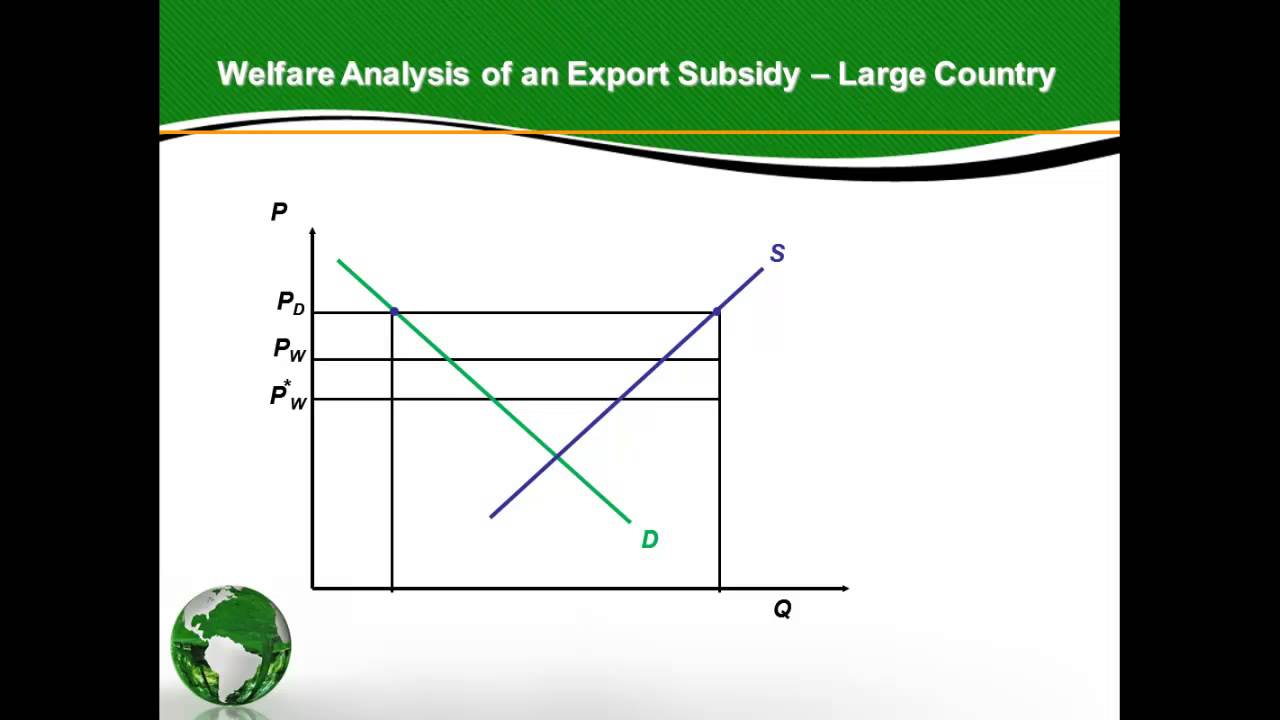
Export Subsidies in a Large Country: Welfare Analysis
@NishaMalhotra
25K views•2014-03-18
Impact of Yuan in Indo-Russian Trade Amid Sanctions
@WION
261.9K views•2022-07-01

CFA Level I Working Capital Management | Liquidity Ratios Explained
@IFT-CFA
43.3K views•2011-09-24

The Age of Easy Money: Fed & Inflation | Full Documentary
@frontline
21.2M views•2023-03-15
Related Study Plans & Knowledge Roadmaps
Structured learning paths in Economics