







![CA Foundation Accounts | One Shot Revision | Part 1 | Theoretical Framework [Jan 2021]](https://i.ytimg.com/vi/W4ZdbMUW0pk/maxresdefault.jpg)










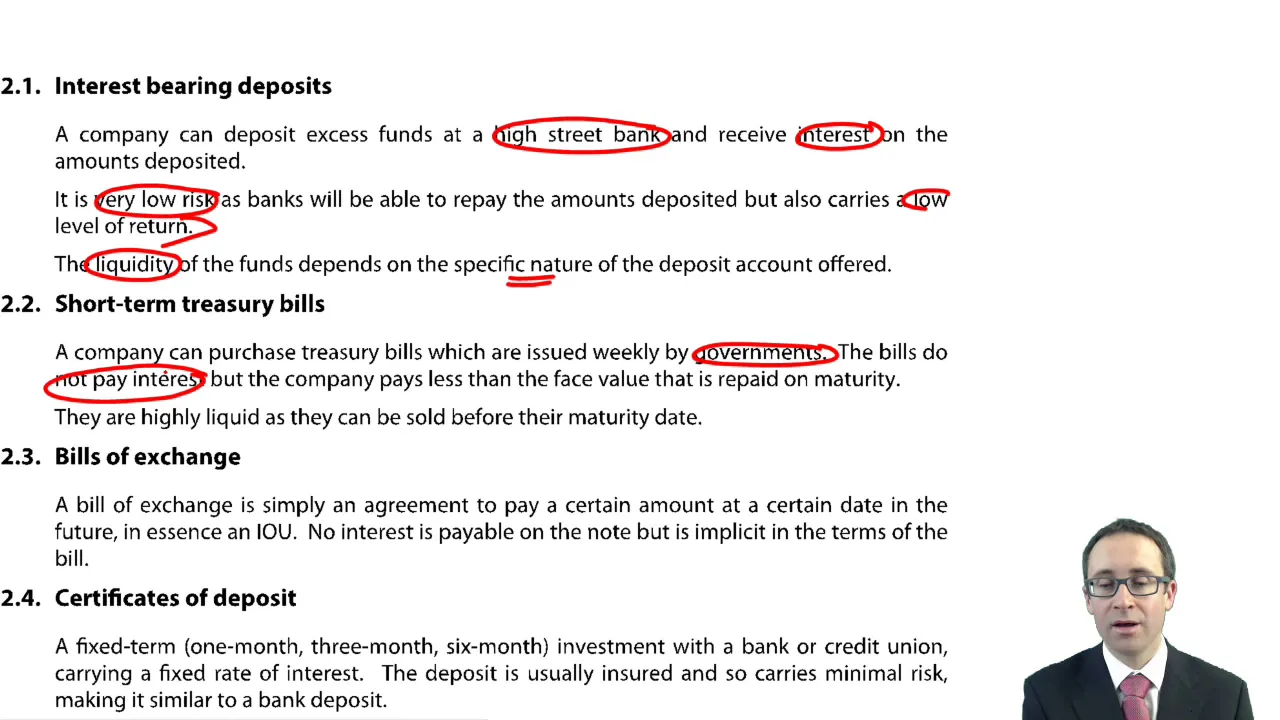












Working Capital Management involves managing a company's current assets (cash, accounts receivable, inventory) and current liabilities to ensure adequate access to funds for day-to-day operations. Key concepts include liquidity (the ability to meet short-term obligations), drags on liquidity (when receipts lag, such as increasing accounts receivable or obsolete inventory), and pulls on liquidity (when payments are made too quickly). Liquidity ratios like the current ratio (current assets/current liabilities) and quick ratio measure a company's ability to meet short-term obligations. The cash conversion cycle (days of receivables + days of inventory - days of payables) indicates how long it takes to convert cash investments to cash proceeds. Effective cash management requires maintaining sufficient cash balances while avoiding excess, investing surplus funds in short-term securities like Treasury bills, and following documented investment policies that balance returns with minimal credit and liquidity risk.
CFA Level I Working Capital Management | Liquidity Ratios Explained
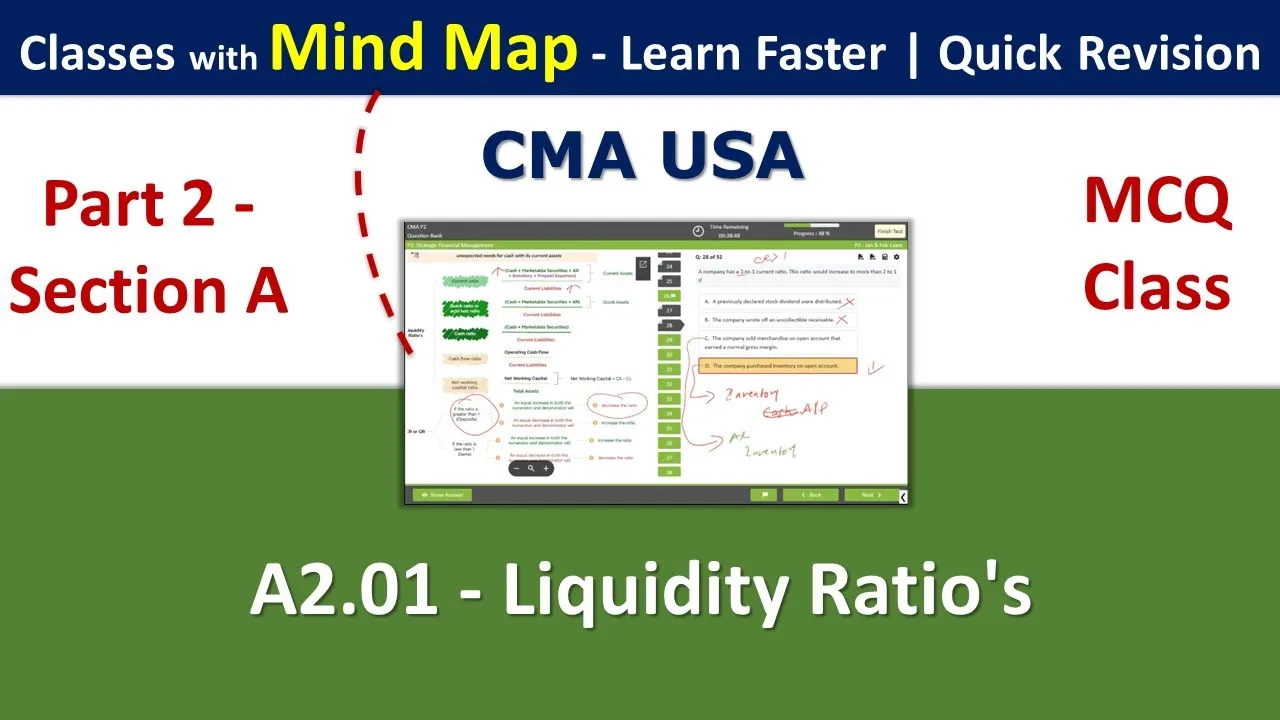
Added:welcome to the CFA level one presentation on working Capital Management so let's first read a few statements that help clarify exactly what working Capital Management means decisions relating to working capital and working capital is your cash your accounts receivable inventory so basically your shortterm or your current assets and your current liabilities so decisions relating to your current assets current liabilities short-term financing Etc are referred to as working Capital Management the goal of effective working Capital Management is to ensure that a company has adequate ready access for the funds necessary for day-to-day operating expenses involves managing the relationship between a firm's short-term assets and short-term liabilities and that is why critical so the definition of working capital if you recall from earlier is your current assets minus current liabilities that's sometimes referred to as your net working capital effective working Capital Management also requires reliable cash forecasts as well as current and accurate information on transactions and Bank balances now this is based on exhibit uh one from the curriculum and this is just illustrating that internal and external factors affect working capital needs I'll just uh outline a few and then the rest I'm sure you can understand there are both internal factors and external factors that impact the need for working capital and how working capital should be maned managed uh company size and growth rate so if you take a company that is growing very fast that will have larger working capital requirements compared to a one compared to a company that is fairly steady and stable organizational structure so here you can imagine let's say that the working Capital Management and cash management of uh centralized firm versus a decentralized firm so let's say that two similar firms are organized differently and both let's say have three divisions but for the centralized firm the working Capital Management is all centralized so essentially working Capital Management is done centrally decentralized everybody has their own every division has its own working Capital Management so clearly the working capital needs in the decentralized environment will be more because every division will need to worry about its safety factor it's buffer and so on whereas here the the since the working capital is centralized then uh overall there will be some efficiencies uh other factors uh external factors in a economy where the banking services are very well developed uh if a company needs funds in a hurry it can easily access funds through the banking sector so where banking services are good the working capital requirement will be lower uh interest rates so where interest rates are low than the working capital that's necessary uh would also be lower because in high interest rate environment it would mean the cost of raising money in a in in a hurry would be very high and hence companies would then try to keep higher working capital so this just gives you an idea that they are both internal factors and external factors which will impact working Capital Management now let's get into some important terms working Capital Management and liquidity go hand inand liquidity is the extent to which a company is able to meet its short-term obligations so if if we if a company cannot meet its short-term obligations then we refer to that as a liquidity issue or a liquidity crisis liquidity management refers to the the ability of an organization to generate cash when and where it is needed companies should manage key sources of liquidity efficiently so what are key sources of uh liquidity the primary sources include your cash balance your Trade Credit So when you buy from your suppliers the credit that you get is Trade Credit and short-term Investment Portfolio any cash that company has or money that a company has that's not needed for daily uh transactions uh should be stored in short-term Investment Portfolio so it should still be fairly liquid more on this later secondary sources include negotiating debt contracts so if a company needs funds and they are not available through primary sources then a company can negotiate a debt contract with a bank or maybe another entity and another possibility is liquidating assets which generally would not be a good thing and finally uh typically a last resort is where a company has to file for bankruptcy protection but uh this is not a good situation to be in you need to understand these terms drags and pulls on liquidity a drag on liquidity is when receipts lag creating a pressure from decreased available funds so what this means is if your accounts receivable or your uncollected receivables if this amount is going up that means that the cash that you are receiving is lower and lower and this ties with uh with what you studied in the reading on cash flow or on the cash flow statement so if you recall when accounts receivables goes up that is a use of cash so a use of cash can be thought of as a drag on liquidity similarly obsolete inventory that means your inventory balances are going up that means you are not selling your inventory which means that you are not getting your cash or the side impact is that inventory is becoming older and potentially you might not even be able to sell it later tight credit means that you are having trouble raising money from the bank or whatever other source you get your money from so all these are collectively referred to as a drag on liquidity pull on liquidity is when payments are made too quickly so this is when cash from your company is leaving quicker than it should or Trade Credit availability is limited requiring companies to spend money before they receive cash from sales so if your accounts payable is uh is decreasing too fast so you're making payments to your suppliers very quickly if your credit limits are reduced or you have low liquidity positions then we refer to this as a um as a pull on liquidity very simply put drag on liquidity means that the money that you are receiving so if there is a drag means this process slows down that's a drag and uh pull on liquidity means that the cash which leaves your company leaves the company too fast so that's the pull on liquidity now it's important to measure liquidity and understand why liquidity is so critical uh liquidity contributes to a company's credit worthiness credit worthiness is the perceived ability of the company or the borrower to pay what is owed on on the borrowing in a timely manner so it allows the company to so when a company's credit worthiness is good and the liquidity position is is good then a company can typically obtain funds at a lower cost in other words one of the factors that a bank will look at when it determines what rate to lend you at is how good your liquidity position is so if your liquidity position is good you can typically negotiate favorable uh interest rates if your liquidity position is bad then your rates might be too high or Banks might refuse to lend money in the first place players uh it also allows you to obtain better terms for your Trade Credit so suppliers are more willing to work with you and happier to give you trade credit if your liquidity position is good generally gives you more flexibility because if you have good liquidity you can exploit profitable opportunities a company that doesn't have a good liquidity situation can't take advantage of a good opportunity when it comes up or uh maybe I should say it's much harder for that company to to take advantage of uh profitable opportunities the less liquid the company the greater the risk it will suffer financial distress so essentially financial distress is where a company cannot meet its obligations liquidity ratios are calculated to measure a company's ability to meet its short-term obligations so let's now look at several liquidity ratios and these should be very familiar because uh we have just completed our topic on financial reporting and Analysis so I won't spend too much time on this just very briefly your current ratio is current assets over current liabilities all else equal High ratio is good with the quick ratio it's most of your current assets with inventory removed again High ratio is good now something slightly different here relative to F in F ratios like receivable turnover were called activity ratios in the context of corporate finance we are calling them liquidity ratios and the way you can think of this is as follows uh from a corporate finance perspective if the receivable turnover is high that means that your cash is coming in fast so that creates better liquidity so that's why we sometimes bundle uh these ratios in bundle them along with liquidity ratios if you recall number of days of receivable is a measure of how many days on average it takes you to collect receivables and that's simply 365 divided receivables turnover similarly inventory turnover the higher the inventory turnover the faster you are selling stuff and the faster you are getting cash and then these are the formulas for the number of days of inventory which should be very familiar if not then this is a good review again formula for payables turnover now unlike all the other ratios where High means faster liquidity payables turnover if your payables turnover is very high that means you are paying your suppliers very fast so all else equal lower is better over here you saw this in qu also your operating cycle is equal to days of inventory plus days of receivables and the average number of days it takes to turn turn raw materials to cash proceeds so that's your operating cycle the cash conversion cycle which is also sometimes called the net operating cycle is equal to average days of receivables plus average days of inventory so this is the same as your operating cycle minus the average days of payable so if you are taking more time to pay your suppliers that means your since this is a minus sign that means your cash conversion cycle becomes lower so essentially it is the length of time it takes to turn the firm's cash investment so this you can think of as the cash paid to suppliers so money out of the company so how long does it take to go from there to uh cash in the form of collections from the sale of inventory so cash to cash cash out to suppliers how long does it take from there till the time you get cash from from your customers High conversion cycle indicates an excessive amount of capital that is tied up in working capital or we should say excessive amount of money or dollars tied up in working capital which is considered undesirable so during process Improvement exercises at large companies or even small companies uh one key metric is what is the cash toach cycle and then companies try to reduce the number of days from cash out to cash in managing the cash position the purpose of managing a firm's daily cash position is to make sure there is sufficient cash in the company that sufficient cash is sometimes called the target balance avoid keeping excess cash balances because of the interest forone by not investing the cash in short-term Securities so if a firm has too much cash then it is foregoing interest which is is not a good thing uh firms often use short-term borrowings to manage their daily cash position so that's just uh FYI investing short-term funds uh a temporary store of funds that are not necessarily needed in a company's daily transaction so let's say that a company has uh 100 million worth of funds cash funds of which let's say 60 million are needed for a day-to-day Transaction what should you do with the remaining 40 the best thing is to invest them in short-term liquid Securities such as T bills these are typically less risky and short maturity most companies working capital portfolios consists of short-term debt Securities government securities shortterm Bank borrowing and corporate obligations so the in Pakistan at least mostly the money would be put in government T bills I would encourage you to to understand the US perspective just take a quick look at exhibit 7 in the curriculum that gives a long list of possible short-term Investments that uh companies in the west might use now this might look like a flashback because you saw these terms bank discount yield money market yield bond market yield so you saw all this stuff in Quant so this is a quick review and why are we doing this here because as we just discussed U your excess cash would be invested in short-term Securities and you when you invest in short-term Securities you need to know what sort of a yield you are getting so let us just see that if you invest in t bills the yield that you will be quoted will be on a discount basis so if you recall the the yield on a discount basis how did we calculate that we calculated that by saying the face value of the tree Bill minus the price that you pay divided by face value so that's the discount percentage multiplied by 360 divided by days to maturity so this is not a perfect measure for reasons that we've talked about before but this is how T bills are quoted and you need to understand that if this this does not look familiar go back and uh look at readings five and six from Quant the money market yield is slightly better this measure so the money market yield is simply the face value minus price divided by Price into 360 divided by number of days and the bond equivalent yield what we basically do with the bond equivalent yield is find the six month yield so the effective six Monon yield and then multiply by two now let's talk about cash management strategy the objective is to earn a reasonable return while taking on very limited credit risk and liquidity risk so credit risk means where you might invest in a security and there is a risk that uh the The Entity where you have invested so you buy a corporate bond if the corporate issuer defaults that risk is called credit risk so clearly you don't want to invest your your important cash in Securities where there is significant credit risk which is why as stated earlier generally companies will invest in t- bills which have no credit risk you also don't want to invest in bonds where there is liquidity risk because uh liquid liquidity risk means that when you want to convert that instrument into Cash uh if it is if you can't do so easily at market price then we refer to that as liquidity risk so point being that you want to invest in Securities where if you want to convert them into cash you can easily do so at market price a company should write an investment policy statement to manage cash effectively so this document is basically saying how cash should be managed it should describe the purpose of the cash management strategy who the the various authorities who can do what what are the limitations for the different uh roles within this uh within the strategy and so on so key point is as long as the strategy is clearly documented that is important in terms of cash management there are two possible categories of strategies one is uh passive strategy the other is active strategy in a passive strategy we simply Define the rules the cash management uh rules and then the and then the cash management department simply follows those predefined rules active strategies might there are different kinds of active strategies and I don't think you need to get into too much detail here uh even the curriculum mentions a few things but doesn't provide too much detail so I think as long as you know the basic Bas terms you are in good shape so within active strategy we have something called a matching strategy which tries to match the timing of cash inflows and outflows then there are other strategies called mismatching strategy laddering strategy all you need to know is that these are within the active category and they are somewhat risky I don't think you need to get into the details of what these are because uh the curriculum says a few things but I don't think it says enough about about what these are so I really doubt that you'll be tested on a detailed understanding of these items
Up Next

The Economics of European Airline Bankruptcies Explained
@Wendoverproductions
3M views•2019-10-08

Impact of Yuan in Indo-Russian Trade Amid Sanctions
@WION
261.9K views•2022-07-01

CFA Level 1 Economics: Trade Restrictions Tariffs Quotas
@IFT-CFA
47.1K views•2018-01-11

The Age of Easy Money: Fed & Inflation | Full Documentary
@frontline
21.2M views•2023-03-15
Related Study Plans & Knowledge Roadmaps
Structured learning paths in Economics