









![Lineweaver-Burk plot (Enzyme Kinetics) - Vmax, Km & [S] - Biochemistry 🧪](https://i.ytimg.com/vi_webp/nivkBZkmu14/maxresdefault.webp)


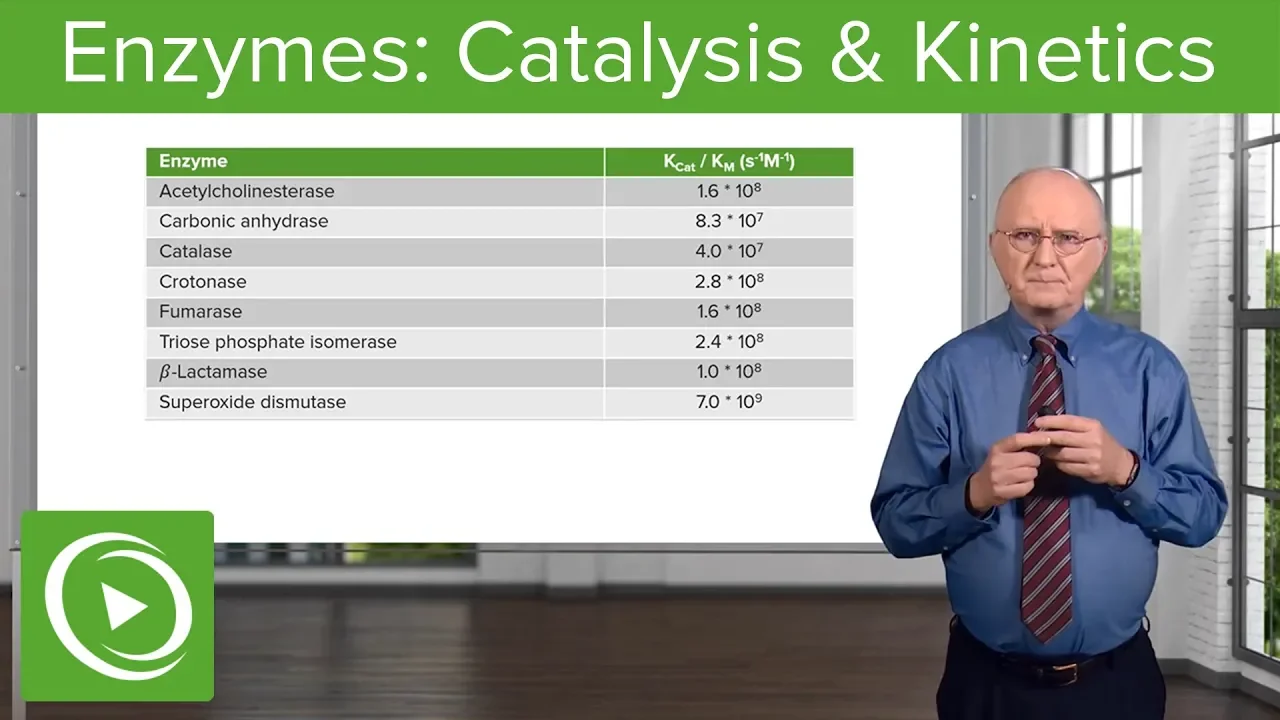


Michaelis-Menten kinetics describes how enzymes catalyze reactions through a series of steps involving substrate binding, conversion to product, and release. The key parameters are: (1) KM (Michaelis constant) - the substrate concentration at which reaction velocity reaches half-maximum, representing the enzyme's affinity for its substrate; lower KM indicates stronger binding; (2) Vmax (maximum velocity) - the maximum rate achieved when all enzyme active sites are saturated with substrate; (3) Kcat (turnover number) - the number of substrate molecules converted to product per enzyme site per unit time, calculated as Vmax divided by enzyme concentration. The specificity constant (Kcat/KM) measures catalytic efficiency by combining binding affinity and turnover rate. These parameters are determined experimentally by measuring initial velocities at various substrate concentrations and plotting them against substrate concentration to find the curve that fits the Michaelis-Menten equation.
Michaelis-Menten Kinetics & Enzyme Activity Units Explained | Biochemistry
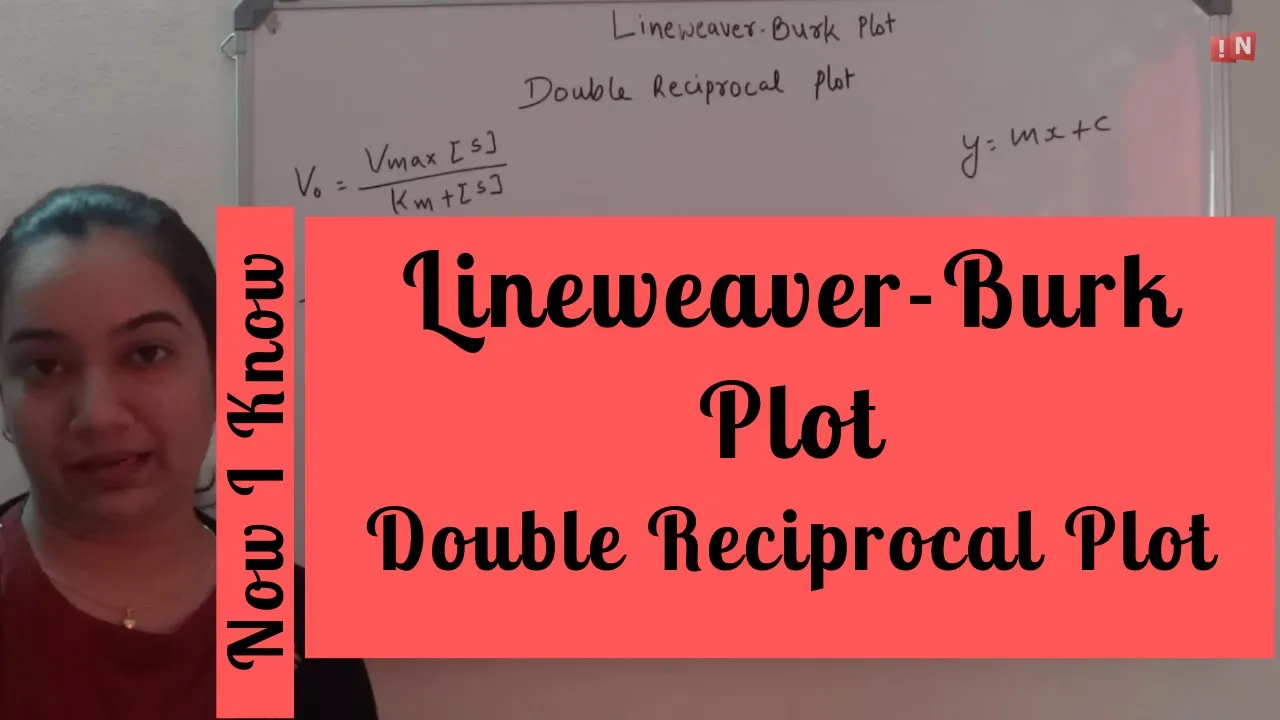
Added:kinetics deals with how fast enzymes work and these thing kinetic schemes can get really really complicated because you can be dealing with lots of different substrates and they can be there's all these different steps and they're converted in all these things and so we often simplify things by thinking in terms of Mela menting kinetics any sticks could stick Snapper snap if a stick Snapper could snap sticks a stick Snapper would snap all the sticks it could snap according to Mela metics I debated whether or not to just remake this whole video or to try to revamp it but I thought you might get a kick out of seeing baby Brie okay well maybe not that baby Brie so I decided to leave parts of it in um revamp other parts add new content and so hopefully you'll forgive me for using some of my grad school content to help now so if we have this example of a stick Snapper and now we want to say okay so our sticks would be something like our substrate so this is the thing that an enzyme is going to act on so our enzyme is going to bind into the substrate and now you have an enzyme substrate complex the substrate the enzyme is then going to break the substrate do the easy part the enzyme is then going to break the substrate and now you have your products or products and so we can Define this relationship where we're talking about the concentrations of the enzyme so the free enzyme the free substrate and the enzyme substrate complex and the products and by measuring these and also measuring the rate at which these products are being formed we can tell information about the enzyme and how the enzyme is acting towards the substrate and in the case of the Snick Snapper analogy how much sticks you're snapping so like how good you are at snapping a stick is going to depend on how well you can bind that stick so the affinity for the substrate this is analog this is a value called the km or the U melus constant so each enzyme is going to have a km towards a particular substrate and that represents um in the most simplistic way how good it is at like binding it and how strongly it'll bind it um as opposed to just like letting it go um or just like not grabbing on to it if it comes by then it's also going to depend on how well it can snap the stick so every time it binds a stick that's going it's then going to be have the chance to snap it and how well good it is at going and actually snapping it um that is defined by this like catalytic um rate constant Kat also called like the turnover number so how many sticks you end up snapping and how fast you're snapping these sticks is going to depend on things like how your the km's how well can you bind on to this and how well can you then turn it over and so we can talk in terms of this km and this K cat in order to kind of talk about like how good an enzyme is towards a very various substrate and we can get information about these by measuring the enzyme kinetics so by measuring like the speed so kinetics is referring to speed and the speed at which the reaction happened the reaction rates are going to depend on those constants the km and the kkat as well as concentration so they're going to depend on things like the concentration of substrate because the more substrate you have then the um the less the km is going to matter and the less substrate you have the more the km is going to matter and in either case the amount of substrate you have is going to influence the amount um the rate of the reaction and then the final rate of the reaction is going to depend on how many of the stick Snappers that you have in there so it's going to depend on the amount of your sticks and so the substrate concentration as well as the amount of stick Snappers so the enzyme concentration those are going to influence your final maximum velosophy the fastest speed that you can work at so um this Vmax and so the V-Max is kind of representing if you had a whole group of stick Snappers and super importantly as we'll get into to get the Vmax you need to have a high concentration of your substrate so that you have every enzyme has its maximum possibility it's not getting held up by not having enough substrate so it's not like you running out of substrate and so we're actually measuring um the maximum velocity we're getting it first we take a we take a whole range of concentrations and this is also um of substrate concentration so we're doing individual uh velocity measurements and then we're going to graph those and use those to find um this Vmax um but so the Vmax is like the maximum speed that you can work at you take a timer go we'll talk about some of the um some of the assumptions we have to make in some of the time constraints that we have to work with so that we're in like the steady state um but if we do this and then we say okay take the amount of sticks that were form that were broken and then we'll look at the time we get this idea of this Vmax so this maximum velocity and then if we were to divide that by the number of Snappers we would get our K cats so our turnover number so like the goodness of the speed at which like a single enzyme copy is working whereas the overall rate is going to depend on how many of those enzymes we have so how many stick Snappers are actually snapping the sticks that's going to influence how many sticks get snapped but at some you're also going to be limited by your substrate concentration because if you have more stick Snappers than you have sticks to snap then you're going to run out of sticks and so it doesn't matter if you add any more of your Snappers you're going to reach this plateau and you're also going to reach a plateau if you have too many sticks to snap and so so basically in that case you're going to saturate your enzyme so each enzyme there's way more sticks than enzymes and so no matter how many more sticks you add you can't speed up and so by taking these examples where we have a really low substrate concentration or we have a really high substrate concentration or we have a really low enzyme concentration or we have a really high enzyme concentration we can use these extremes to kind of simplify the mathematical equations that we're going to use and the mathematical equations that we're going to use are these michis mentin equations one of the key Concepts that's going to come out is that the km that Michela constant that we're talking about in terms of how like the affinity for the substrate um it's mainly the Affinity there's also some other like complicating factors but um you can think of it as like the affinity for a substrate it's similar to but not the same as KD so KD the dissociation constant that's when we're talking about like bind things binding and unbinding and binding and unbinding when we have the km we have to think about things binding and unbinding and then also things binding and then being snapped so being turned into product and we have this constant called the km work out mathematically is equal to the concentration of substrate at which you have your half maximal velocity and so because the remember the half maximal velocity is go the maximal velocity is going to depend on how many six stappers you have but the constants are going to stay constant this km is going to stay constant so the Affinity isn't going to change if you have have changed your number of sticks and similarly the Kat isn't going to change if you change your sticks or the number of your enzymes these are constant things about the enzyme and about the system and so about like in these certain conditions with this substrate and this enzyme these will remain constant even if you change those other things and so by taking into account um these factors we can then determine these constants if we take the same enzyme concentration and we do a range of values of substrate concentrations and measure velocities and then we can plot these out and when we do this we'll see that there's going to be a substrate concentration at which we have a half maximal velocity and this doesn't matter what type what your concentration of enzyme is as well as I mean like unless you're at like really extremes so this is your km is going to be constant so you can measure out of any enzyme concentration but different concentrations of substrates and you get this curve and these are the curves that we see on these Mist menting kinetic graphs in this curve if you have a plateau where you run out of the where you have too many sticks you have more sticks than Snappers way more sticks than Snappers you reach this Plateau where you're at your maximal velocity and the concentration that it took you to get to that half maximal velocity half of that maximal velocity that is going to be your km if you have a higher Affinity that km is going to be lower it's going to take you less of the substrate to actually get to that um halfway point if so something that has a higher an enzy that has like a higher Affinity so like a better is going to be a lower km but the actual velocity is going to then depend also on how fast you're snapping the sticks and how well you can actually turn the sticks over from have like grabbing them to actually turning them into your product and so this is going to be the turnover the catalytic rate constant and so that's going to be your like your K cat and so you can then get the K Cat by dividing the maximal velocity by the concentration of the enzyme that you were using in your assay so sometimes you also see this thing called the specificity constant which is is the K cat over the km sometimes you might see it called like the catalytic efficiency but this can be misleading um it's really it's um I'll tell you more about this and how like but basically it can be misleading if you're trying to use it to compare different enzymes but you can use it to compare the same enzyme with different substrates and see which ones it prefers so I'll tell you about all of this um also some various caveats um things like this as well as things like you might um be introduced to line Weaver Burk plots um which have some problems um that I'll talk about as well as the fact that you have to be measuring in very specific conditions to equations to actually work and that not all enzymes are actually going to obey Kellis men in kinetics you can have things like alisy like we see with hemoglobin binding oxygen where like binding to one subunit influences binding to another and you can have all these complicated enzymatic schemes but at the end of the day um for simple reactions we can take this sck Snapper analogy and put it to use so this is a typical type of graph that you'll see when you're talking about Michaela me in um kinetics and so in this case you have a constant concentration of your enzyme and you're changing the concentration of the substrate and then you're plotting um the initial rate of product formation the B KN and so each of these is representing a separate experiment that you did and these experiments that you're doing there you're measuring the velocity so when we're talking about velocity we're talking about the rate of product formation over time and we'll talk more about how we actually calculate this rate and how these fits into um how we're getting these constants that we're going to get but the key thing is that in order to get those initial velocities we have to do a bunch a bunch of experiments and so we have to take an enzyme and we have to change the product concentration and then we have to measure the formation of the product a key thing is that we need to measure the velocity when we're in this steady state we'll talk more about this steady state later um because the steady state assumption is important for how we understand and how we're able to make simplifications when we're doing our calculation in terms of mathematically the study state is telling us that this enzyme substrate con this enzyme the concentration of this enzyme substrate is going to stay constant so that every time the rate at which the it's formed is the same as the rate at which it is I is um unformed and so it can be unformed by either just releasing it or by changing it into the product and so the steady state assumption is that this is going to stay constant by steady state we're referring to it's kind of like an equilibrium but not so an equilibrium all of this would kind of all the concentrations of all of these various things would have to be um would have to be constant on net and we would have like a closest where nothing is like being added or removed typically um like for here we're dealing with a steady state so this is staying constant but the concentrations of these are changing and so we can have different concentrations of our substrate so we can be losing the substrate and gaining the product but this is staying constant and so we have this steady state where this is staying constant and this is going to be important for simplifying our Michela mening kinetic constants so there's actually a little bit before this early part um and this is called the pre-steady state and so with the pre-steady state um basically where the enzyme grabs up the substrate so there's plenty to go around but there's not much breaking going on because you have to actually like pick up the things um and then you have to so the enzymes are kind of like finding the sticks to break but then they get into their flow and so in this steady state the enzymes are doing the grab break grab break grab break without having to worry about running off about running out and so remember they're also instead in addition to doing the breaking they could also be doing the dropping but then there's another one that they can pick back up um and so there's no concern about running out but eventually you reach this post steady state where you're running out of sticks to Break um and so you your free enzyme concentration starts to go up and your um your bound enzyme goes down and you're not making product anymore because so this is cumulative product form so you reach this plateau and so you want to take the slope of this linear part for it plateaus and this is going to be your initial velocity the V knot um and so this is not the plateau that we're going to talk about when we're finding b max this is just like the plateau at this one concentration of um substrate when we're talking about our Vmax that's going to correspond to running out of um out of like the enzyme as opposed to running out of the substrate so here we're running out of the substrate and here we're running out of the enzyme so we have more substrate than we have enzyme and that is why we're plateauing here and here we're plotting each of these different V zeros from your different reactions and we're figuring out the Vmax and this Vmax is going to be a property that is going to come from this include the km and the Kat and it's also going to involve um the enzyme concentration whereas the km is not going to depend on the concentration of your enzyme and so no matter what concentration of enzyme you you measured at um assuming that it's within reasonable ranges and you're not in weird situations then you're going to have this in the um this V Max is going the half point is going to be um equal to your km the substrate concentration at which you reach that half maximum velocity but your maximum velocity if you had a higher um if you had a higher k um like enzyme concentration your Vmax would be higher but so would your half V-Max and so you're still going to be at the concentration so you could think of kind of just like stretching this up and so this is going to then allow us to figure out these things and note that here we can when we're talking about velocity we're going to be talking about we can talk about the velocity at any one point and so this is the velocity at one point and here you can see that it does matter the substrate concentration does matter but we're talking about the maximum velocity then the substrate concentration doesn't matter because basically you run out when you reach a point where you're at the maximum and you can add more substrate and it's not going to influence anything um but in either case you're going to have this km matter and so let's talk more about what this km actually is so first where does it come from from this work was carried out it was published in 1913 by Leonor melis and mod Menton it was published in German but they did a translation of it in English um so Johnson and goodie um this is a goodie article um they do this translation and also kind of like a modern day interpretation of it um so really good stuff that I always like to bring up mod mention because not many equations are named after women and so it's nice have one of the most important equations in Biochemistry come in part from a woman and she's a phenomenal woman at that so now let's dive into this equation that they came up with so I'm not going to make you actually derive the Michela M equation but I do really highly recommend that you derive the miches mountain equation because I think it's really helpful to figure out kind of where things are coming from and see where this is all coming from and if you want to derive it I have a video on how to derive it and things like this but for now just know that the Mel M con melis Menon equation is coming down to these rate constants you have your Kat your K on your K off and the rate constants remember these are going to be different from your rate so the rate this is going to come from those rate constants and the concentration similarly to how when we talked about like thermodynamics of binding of equilibrium binding thermodynamics and stuff we're talking about like KD and we talked about how we had those rate constants or k on and our K off but the actual rate of your binding is going to depend on the concentration so you had to multiply that by your concentrations similarly the velocity that we're going to see is going to depend on those rate constants but then those rate constants well that's what we talked about with our V with like our kkat so our kkat is a rate constant whereas the velocity is going to be a rate so rate versus rate constant it's really important to keep those that distinction in mind so remember this steady state assumption that's kind of like when we talk about equilibrium thermodynamics and we say that we get to this point where the rate of The Binding is equal to the rate of the unbinding not the rate constants but the rates similarly when we talk about the steady state assumption with the Mela menant equation we're saying that the rate of substrate binding the enzyme is the same as the rate it either unbinds or gets converted into product and we make these conditions where the steady state is assumtion is fairly reasonable where we're measuring in the early beginning we've got plenty of substrate we don't have enough product building up that makes things go backwards or causes weird things so we can make the steady state assumption that the substrate binding the enzyme happens at the same rate it either binds either unbinds or gets converted into product and remember rate not rate constants another kind of the key things that comes from deriving the M Mion equation other than just the joy of mathematics is that it helps you see why we can kind of rearrange things and simplify things to talk about any velocity in terms of the bmax and the way that we can do this is by making this assumption that the total amount of enzyme is equal to the amount of enzyme bound substrate and we can only make that assumption when we have a large excess substrate when we have such a large excess of substrate then the enzyme is going to be able to work at its V Max and in this case then we take our total is equal to the es now we can talk about the velocity at any time in terms of the V Max um and the km rather than having to kind of figure out what proportion of the enzyme is actually substrate bound versus What proportion is free if we know what proport what how much enzyme we put in then we can basically figure out figure out these things so we say that we can bind Kat by dividing the max by the enzyme concentration a slight technicality is that well technically that's your enzyme substrate concentration not your amount of enzyme the threee enzyme or total enzyme but we can make this assumption that all of the enzyme is going to be bound to substrate if we have a ton of substrate and therefore we can say that kkat is going to equal the Vmax divided by the enzyme concentration the total enzyme concentration that is not just divided by the enzyme substrate concentration because we are saying those are the same thing and by making the steady state assumption we're also saying that that es is going to stay constant in the part in the time at which we were measuring the velocity so in these ways we can kind of go back and forth between V Vmax Kat and km so voila the math all works out nice and now don't worry about it so we have a situation where the enzyme bonds a substrate you get this enzyme substrate complex now the enzyme is going to transform that into an enzyme product complex because basically it takes it makes a product it's holding on to that product and it lets the product go now when we do talking about M kinetics we make some simplifications we say we're going to basically ignore the fact that the product could theoretically return to be a substrate we're going to say we're not going to have enough we're going starting the very beginning we're measuring velocity at the very beginning there's not going to be enough product to even like go backwards we're to consider that there's also not going to be a product to bind so it's going to like the release is not going to be really rate limiting the product isn't going to do something weird like inhibit we're talking simplifications so we take an enzyme we give it as much substrate as it needs and we measure its velocity that's how we're going to be doing these K menting kinetics and that's how we're going to figure out kind of how good the enzyme is so we're going to simplify things we ignore that enzyme product complex we ignore the fact that it's reversible to go to the Su from the es to the EP and we consider that the rate limiting step is going to be this K cat it's going to be the kind of we're going to combine the enzyme to product and the en the product release in this one thing and this is all kind of going to be encompassed by our K cats so if we think about this kind of just lumping them together and calling it the K cat so the K cat is going to be our turnover where we're going from the enzyme substr to the enzyme in the release product so again it's a simplification but we can make this simplification for a couple reasons one is that we do these measurements of velocity in the very beginning or not the very very beginning once the enzyme like has enough time to find things but then we have this condition where the enzyme can be working and the product is not going there's not going to be enough product that it could like go backward so the product isn't going to like can't find product to bind and then if it can't find product to bind it can't reverse the bot product binding um we're going to consider that's not going to really reverse the product binding otherwise or the product formation otherwise so we're going to simplify that all now we can consider that our rate limiting step is going to be this turnover and so this is going to be our Kat the Kap this is like how fast one copy of the enzymes working you typically don't have one copy of the enzyme you've got lots of copies of the enzyme and so when you're in the lab and you're measuring your enzyme instead of measuring like that single enzyme and how fast it's working you're going to be measuring just like the velocity of how much all the enzymes in the mixture are working that's going to give you your velocity and if you vary the substrate concentration so that you get to that point where the con where the enzyme has is not limited by substrate so it has as much substrate as it needs so every enzyme can get as much as it wants you're going to reach your maximum velocity or B Max the kind substrate concentration that it takes to do this is your km the more substrate you need in order to reach that the weaker the Affinity basically it's saying that although there's a lot of sticks around you don't really want to grab that much or them that much or if you grab them you let go pretty quick and so you're going to need to keep running into those sticks um and kind of have them forced down your throat or forced into your hands and kept there in order for you to do things and so your cm is going to be higher if you have weaker binding but if you're have tighter binding you're basically even if there aren't that many sticks around just snapping them up and so your km is going to be lower this is just like we saw with our KV in terms of directionality but there's an extra complication with our CM because you also have that it is influenced by that that um turnover to product so the CM is not independent and it's not just about Affinity but we consider it a measurement of affinity as a simplification remember that when we're looking at one of these blocks plots what we're looking at here is you're looking at substrate concentration versus product formation you're looking at a Vmax graph not looking at one of those time graphs so when you're looking at a time graph what's going to happen here is that you have a single substrate concentration and here your Plateau is going to be where you your plateus when you when you run out of your substrates whereas in the this kind of graph you're kind of running out of enzym and the facts that all your enzyme is kind of being used up and that is going to be your plateau in one of these mela's mening graphs and in the when you have one of these single graphs this is like time Mel Menon graph your x-axis is your substrate concentration note that km is coming from this melis mtic graph and it does not depend on the substrate concentration it's kind of like the substrate concentration at which you have something happens that which you have that half maximal velocity so why is this what is happening that is special when you have the k m equal to half of the V Max so the V is just like any velocity like your velocity under these conditions and then your Vmax is going to be the maximum velocity which remember we get when we run out of um when we're basically saturated our enzyme so each enzyme is working at its maximum capacity and then the what happens if our velocity so what we're actually measuring in these conditions is equal to the half of the maximum velocity when we do this we put in half Max half of B Max for our V now these are going to cancel out and then you just do a little math and rearranging things and you get that the km now is equal to the substrate concentration so this is saying that why the km is going to be the concentration at which you get half of your V Max and so the the better the the lower the KNM the less substrate it's going to take you to get to that point how much those individual enzymes like to bind the substrate is not going to depend on how much substrate there is around so the km is not going to depend on the substrate concentration and the K cat isn't going to depend on the substrate concentration how much of the substrate you have is not going to influence how quickly an enzyme can convert that substrate to product the only thing that is going to depend on your substrate concentration is going to be your velocity and so that's why you can measure the velocity at a bunch of different substrate concentrations and this is going to give let you find your um melis menting constants and note that here what you're seeing too is that you want to measure the velocity at this very beginning point or not not this kind of like burst state where things are trying to just find each other but in this steady state part and basically steady state where you have the enzymes doing that grab break grab break grab break without having to worry about without having to worry about running out and then you enter that post steady state where you start to run out and so we don't want to measure here we want to measure right here in this linear range an important thing too is that because this we're in the steady St Zone remember we're saying that the rate of binding is equal to the rate of either dropping it or converting it to product so it's not always just going to grab and convert to product sometimes it's going to drop it and basically the lower the Affinity the more frequently it's going to be dropping it and so this is why you can have you'll have these different velocities at this different substrate concentration because the enzyme has to both has to bind it efficiently effectively has to have this like productive binding or in order to convert it to a product so in all these cases because you're at the very beginning there's enough substrate that the enzyme isn't going to run out until like later we're in the zone where it's not going to run out of the substrate but the lower the substrate concentration is the harder it is for it to be able to like um get enough of that productive binding to have a higher activity so remember you're thinking about kind of like productive binding we've got to bind and convert and what we're measuring here in this linear range is going to be our V KN or your V Zer sometimes you see um called the v0 but it's um the V knot and then you plot all those V knots and then the point at which you're at that half Max is going to be your km and if you take that um that maximum that where the point at which it plose and you divide that by your enzyme concentration you're going to get your K cat if we want to think about kind of like how good an enzyme is for a substrate we need to consider both the km and the K cat we have a value that does this and this is called the specificity constant it's sometimes called the catalytic efficiency and it's the Kat over the km so why do we call the catalytic efficiency well think about your car if you want an efficient car it's going to be able to go a long way and a little bit of G with a little bit of gas and not how much waste left over similarly we want our enzyme to be able to make a little product in without having to have extra waste and we wanted to do it fast and all this great stuff so we want to take into account the Kat and the km so remember that if our km is higher what that's meaning that's like a weaker binding and if our Kat is higher well that's like better turnover so if we look at the specificity constant we have the Kat over the km so if we have weak binding we're going to have the big km and that's going to make our specificity constant lower whereas if we had type binding km would be smaller and that would make our specificity constant bigger what about our K cat well if we're better at turning things over our K cat's going to be bigger if our K cat's bigger sends it on the top our specificity constant is going to be bigger as well so we can use this ter kkat over km and it's really good if you are trying to um analyze the same enzyme with different substrates but it's not so good if you're trying to like compare different enzymes so it can be a bit misleading in that regard and I'm not going to um like make you go into y or anything like that um just know that this specificity constant can be used to kind of compare an enzyme with how good it is for one substrate versus how good it is for another substrate so say it likes one substrate better than the other because it binds one substrate better than the other well what would happen was the one that bound tighter we' have a low would have a lower km if the km was lower the specificity constant would get higher if an enzyme was better with one substrate because it could turn it over faster well then what would happen is your K cap for that substrate would be bigger and therefore your specificity constant for that substrate would be bigger this um this value is should be used cautious um and not be like over interpreted and it's important to look at both the Kat and the km when you are thinking about how an enzyme Works another couple of words of caution um and so um not all enzymes are going to follow Michaela menting kinetics um and so sometimes you might see enzymes that instead they of showing just like that nice um simple Plateau you see something where you have something curvier and this can be indicative of like Cooperative action of some sort such as you see with hemoglobin we binding hemoglobin has these four binding sites for oxygen and once one binds um then the it influences The Binding of the others and so you get this curved shaped line speaking of the shape of lines so we vary the substrate concentration and get the initial velocities from that steady state zone then we plot the those initial velocities against the substrate concentration to find our kinetic constant the km is going to be the concentration that gets us to the half B Max and then our K cat is going to be that b max divided by our enzyme concentration so it might came kind of simple like you just look at this graph you see where where it kind of plateaus and then you take the halfway mark but it's actually kind of harder than that to figure out like where exactly it's going to plateau and things so typically we use a nonlinear regression in order to fit to a curve to the line following the mela's M equation you can do this with the software like graph pad prism as well as some free Alternatives in the olden days and they're still used a lot but they were used a lot more before we had such sophisticated nonlinear regression tools there's this thing called the line Weaver blur Burk plot basically what you do here is instead of doing substrate against your velocity you are doing one over substrate against one over velocity this is going to give you a line and the intercepts the line are going to tell you things so you are going to the minus one over km this is going to be your x intercept and then one over Vmax is going to be your Y intercept problem with these with these is that points that are far from the origin so when you have um so remember this is one over substrate so if you have a really small amount of substrate it's going to be big so when you have a really low amount of um when you have a really small amount of substrate it's going to be a big number over here these ones over here are going to kind of be if you think of physics and like kind of a lever those would be kind of pulling your pulling your curve and they can have a big impact and because you're doing such small substrate concentrations they're also often sources of large error so these can be a problem where they can come in really handy is for trying to figure out what type of inhibition you're using and so we'll talk about inhibition later but inhibition they're basically different types of inhibition and they leave different types of evidence and they can either change your parent um Affinity or change your velocity and so you can kind of because we can see those points on these graphs we can then see those evidence in the in these line wer Burk plots of these different types of Inhibitors but you can also use um nonlinear regression to figure out types of inh enzyme inhibition as well a final note is that when we talk about enzymes we often talk in terms of activity units and activ unit is basically whatever people Define it to be and so it has to be like under these specific conditions then like this buffer or whatever this amount this activity corresponds to like the conversion of one mole of blah blah blah to one mole of blah blah blah in blah blah blah minutes or something and so you have this specific this specific kind of thing that defines the unit but it can be different it well it has to be different for different because different enzymes do the same different things so if you have a stick Snapper would be like it snaps this much sticks snapped in this many minutes whereas if you had a tile layer it would be this many tiles laid in this many minutes that is their activity it's kind of like a measure of just like how much stuff gets done so the more work that gets done the more activity you could say it has but what about like how many en how much enzyme it actually took to do that activity well that gets to a term called your specific activity where you divide the activity or by the amount of total protein so basically you're dividing it by mix protein and what's going to happen now is that if you don't have a lot of you don't need a lot of protein you're G to have a really high specific activity but if you need a lot of protein you're gonna have a really low specific activity and well why might you need why might you have a lower versus a higher well some of that comes down to how pure your enzyme is so if you say they had 20 workers come and they got the job done and you had then you find out that only 10 of the the workers were stick Snappers well then the enzyme would be um better than you kind of thought it was but your Purity was going to be lower and so ultimately you're going to have that your specific activity is going to be lower because your solution is less pure and so you're going to need kind of more workers to get the same amount of things done even though most of those workers weren't actually your enzymes so your specific activity could be lower because your thing is impure or it could be lower because your enzyme is kind of worse but if you're taking the same enzyme it should have the same specific activity unless the enzymes have different purities and so you can compare specific activity between like different en enzyme preps or between a wild type and a mutant and things like this um in order to compare activities but you don't want to compare just the activity you want to compare the specific activity because the activity is going to depend on the concentration of your enzyme this is similar to how we saw that the velocity was going to depend on the enzyme concentration
Up Next

Enzyme Catalytic Efficiency (kcat/Km) Explained
@AKLECTURES
248K views•2015-03-13

Taste Matters: Why We Like the Food We Do | Professor John Prescott
@smagforlivet-video
409 views•2015-12-07

BL21 Expression Strains & Rare Codon Plasmids Explained
@thebumblingbiochemist
2.1K views•2022-05-17

Bacteriophages: Earth's Deadliest Killers and Future Antibiotics
@kurzgesagt
34.6M views•2018-05-13
Related Study Plans & Knowledge Roadmaps
Structured learning paths in Biology