
















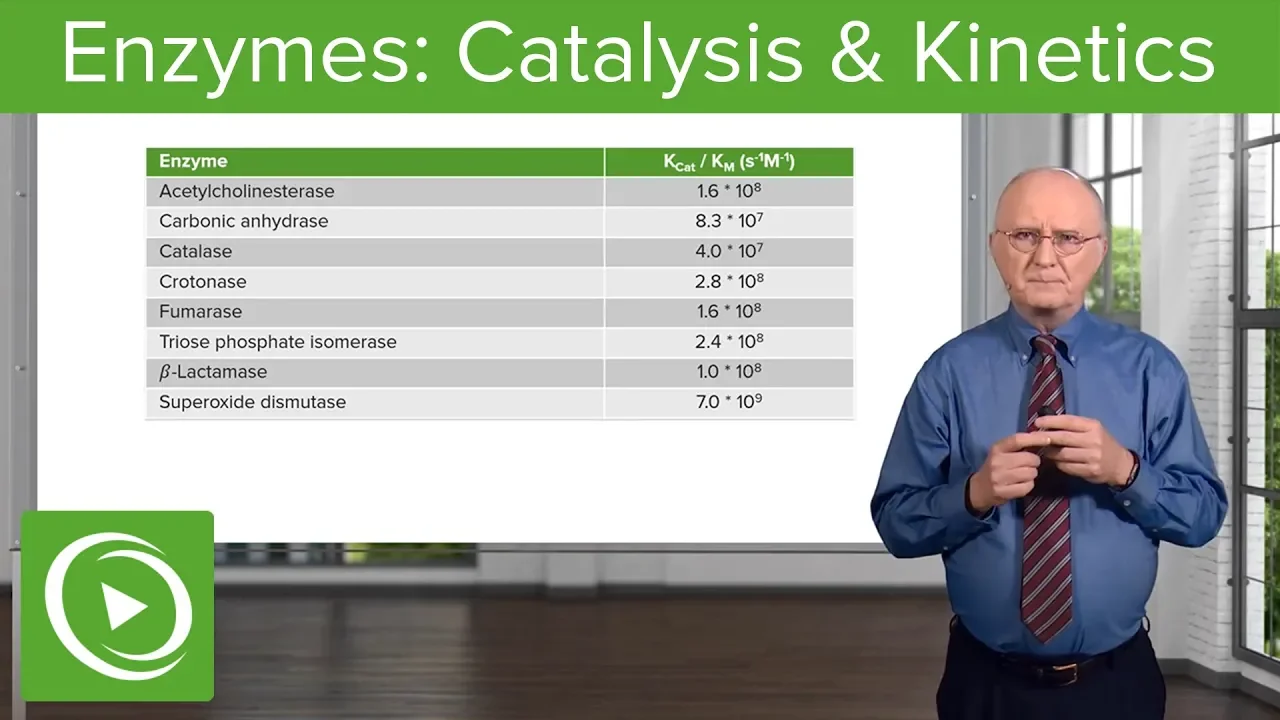


The catalytic efficiency of enzymes is measured by the ratio kcat/Km, which represents the rate at which an enzyme converts substrate to product under physiological conditions where substrate concentration is much lower than the Michaelis constant (Km). This ratio combines the turnover number (kcat) with the substrate binding affinity (Km), providing a comprehensive measure of how effectively an enzyme performs its catalytic function in cellular environments.
Enzyme Catalytic Efficiency (kcat/Km) Explained
Added:Introduction to enzyme kinetics, specifically the Michaelis-Menten model of enzyme-substrate interaction.
Understanding the definition and significance of the Michaelis constant (Km) as a measure of substrate binding affinity.
Understanding the definition of the turnover number (kcat) and what it represents regarding maximum catalytic rate.
Basic chemical kinetics concepts, including reaction rates, rate constants, and rate-limiting steps.
The concept of 'catalytic perfection' and the physical limits of enzyme efficiency imposed by diffusion rates.
Analysis of how different types of enzyme inhibitors (competitive, non-competitive, and uncompetitive) alter kcat and Km values.
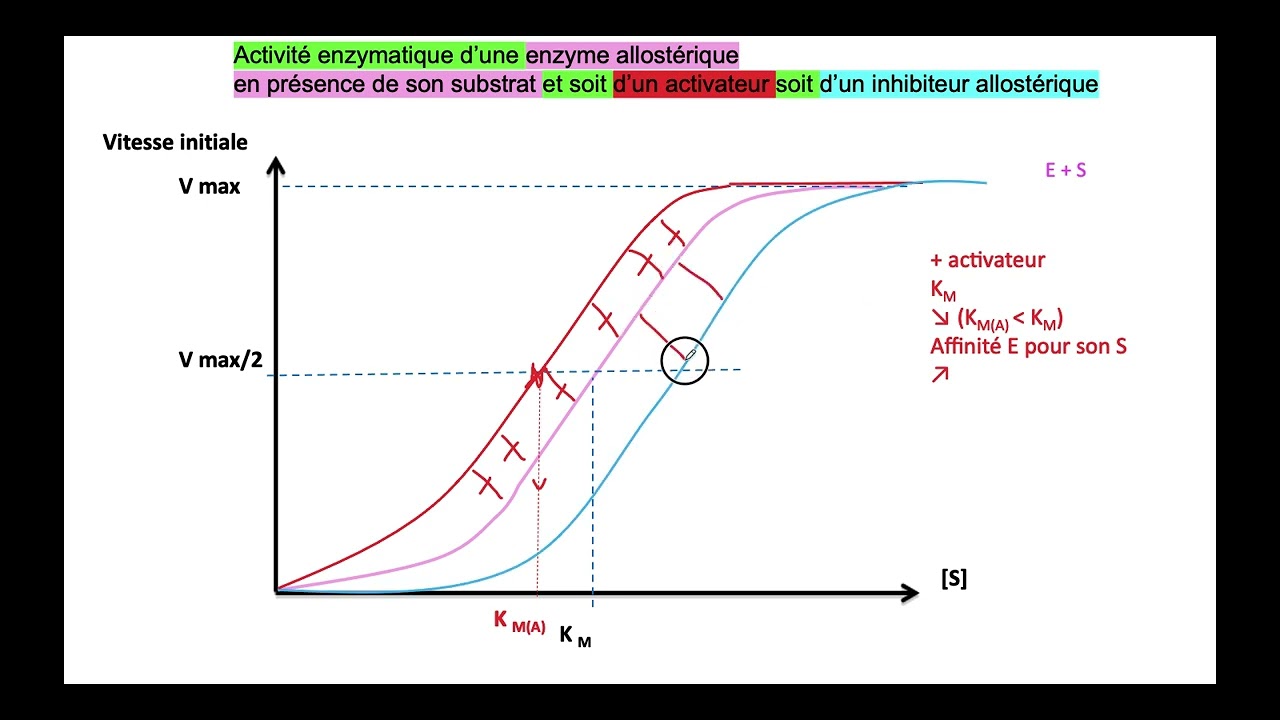
Allosteric regulation and cooperative binding, exploring how some enzymes do not follow standard Michaelis-Menten kinetics.
Practical applications in enzyme engineering and biotechnology, specifically how scientists optimize the kcat/Km ratio for industrial processes or drug design.
248K views2.1Klikes16:07Original Release: 2015-03-13
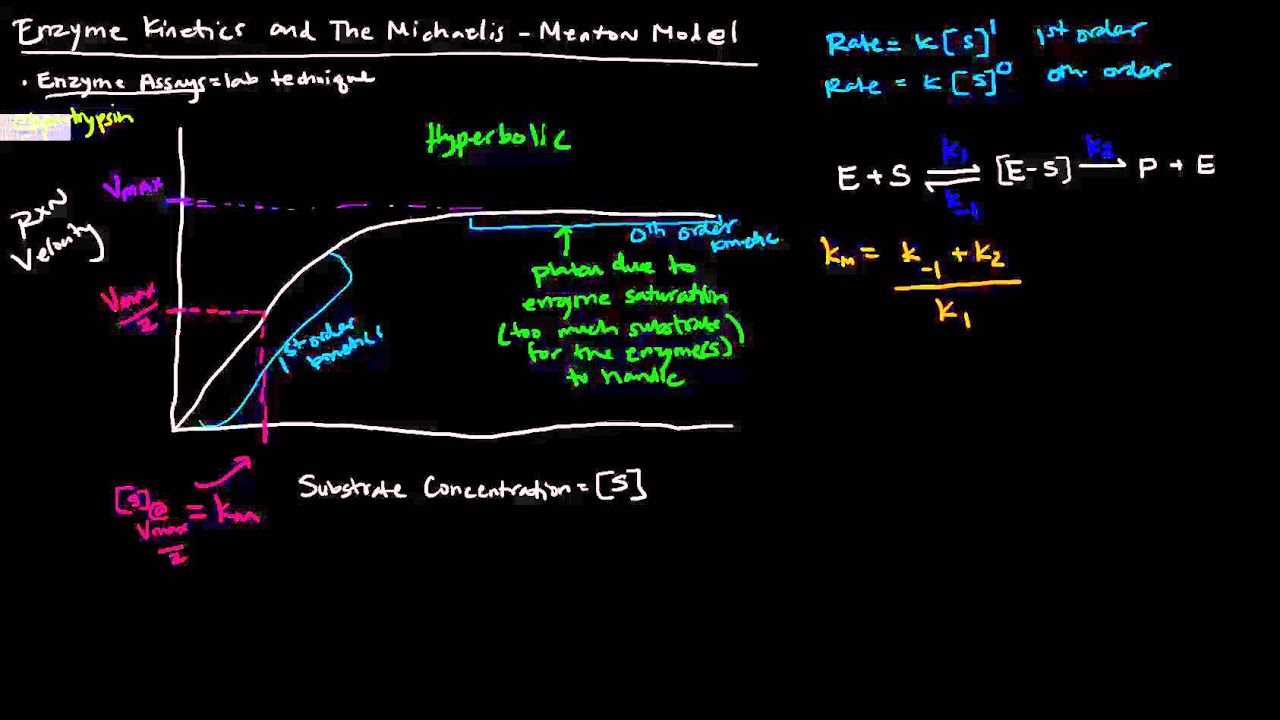
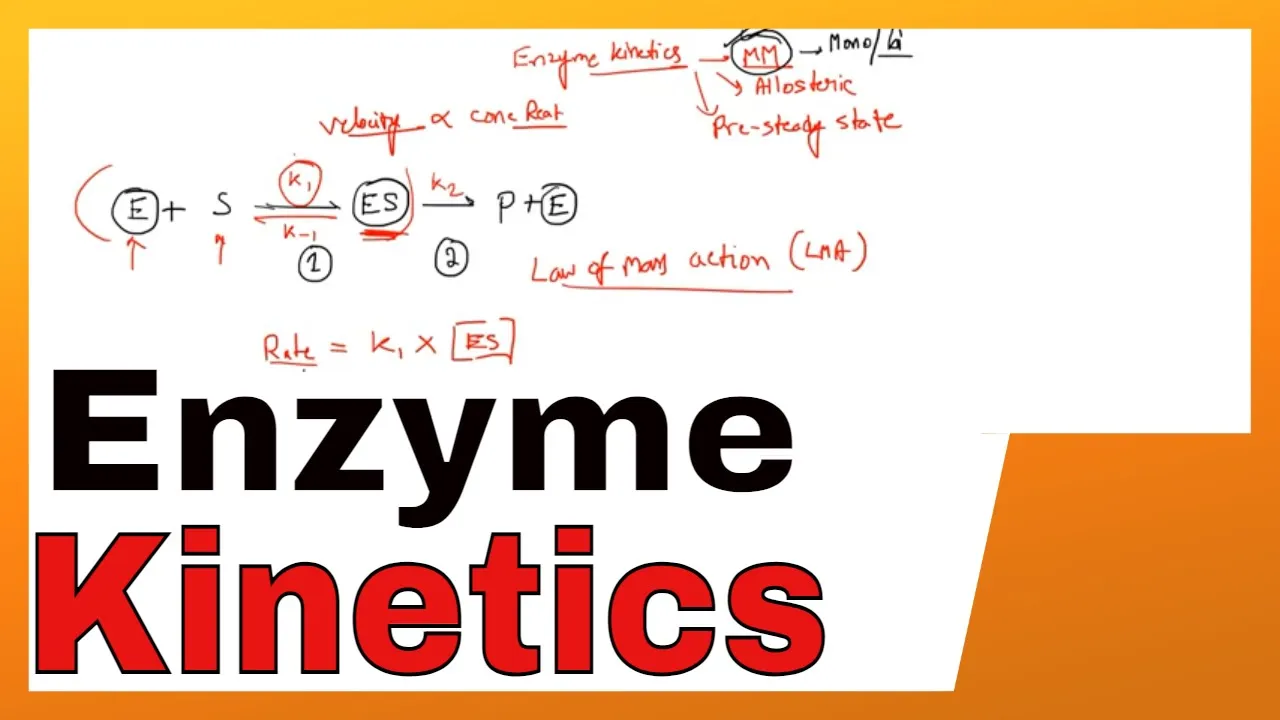
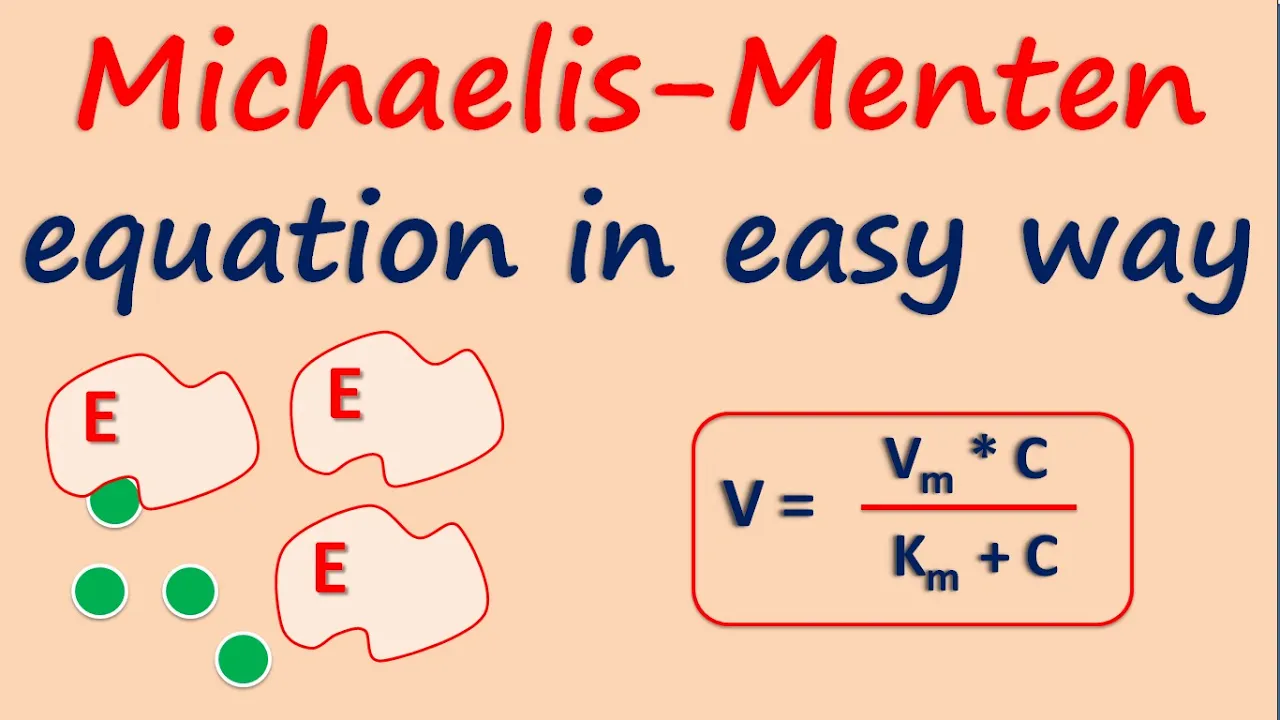
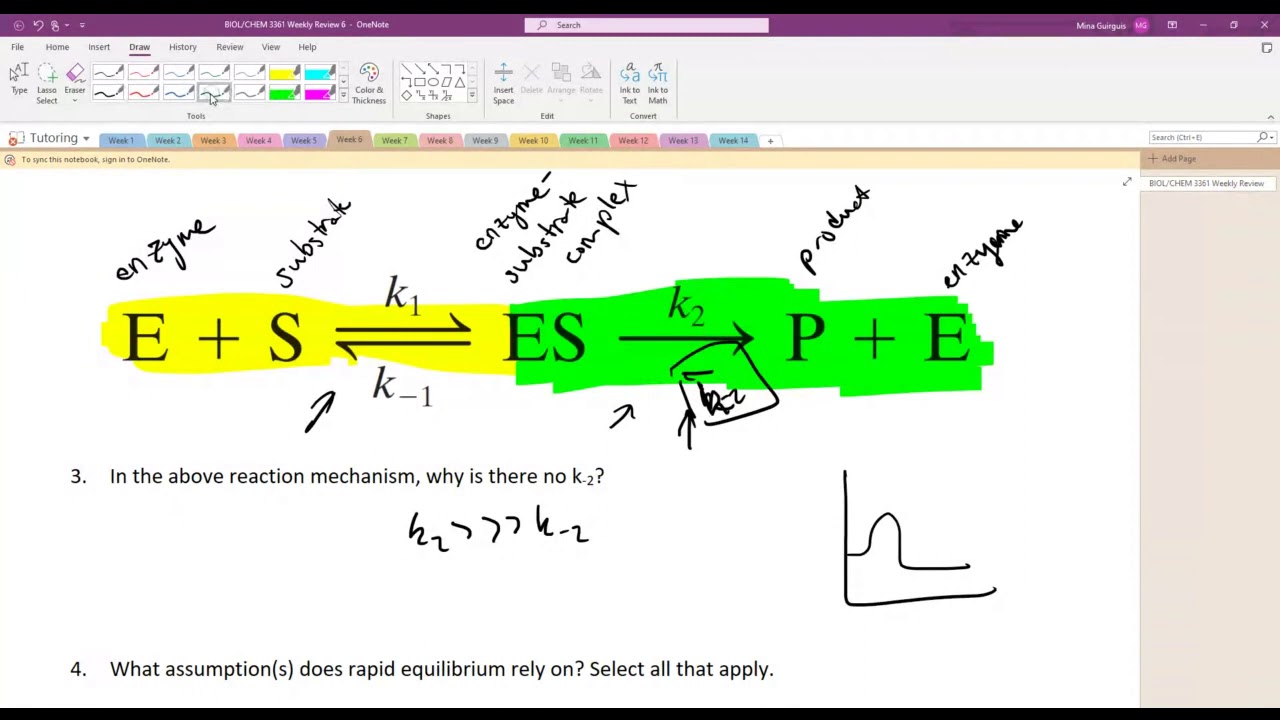
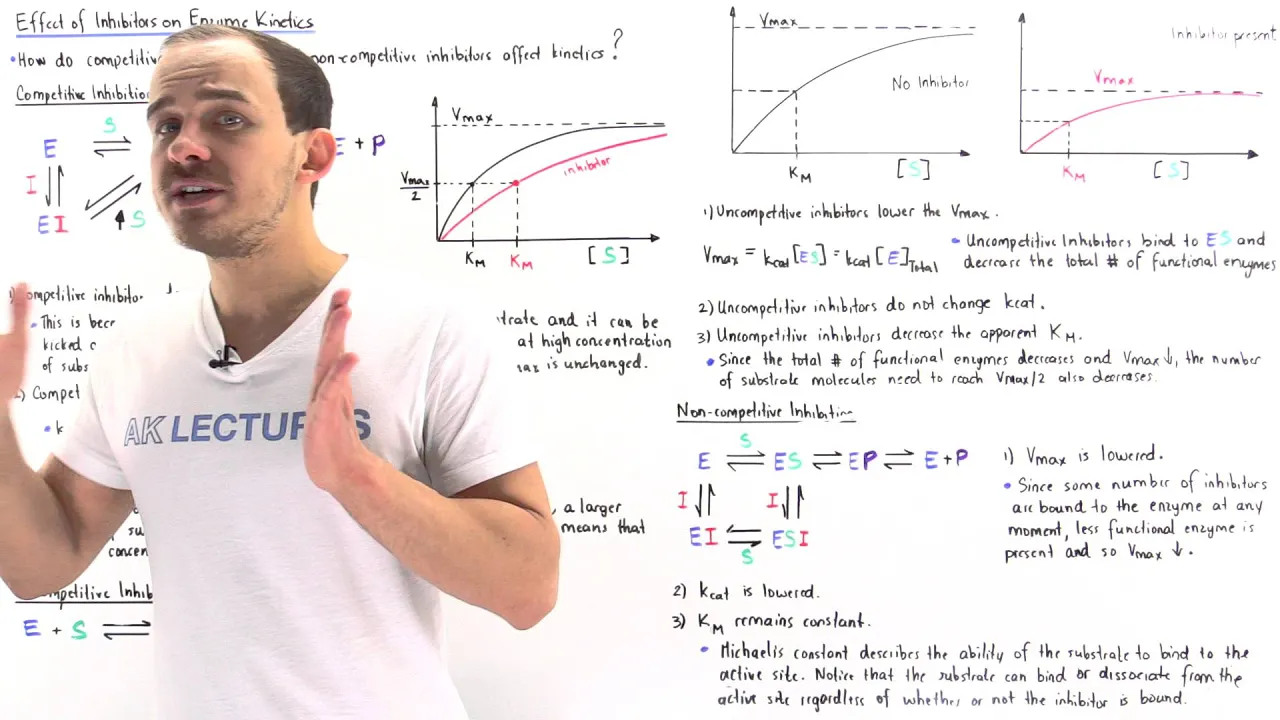
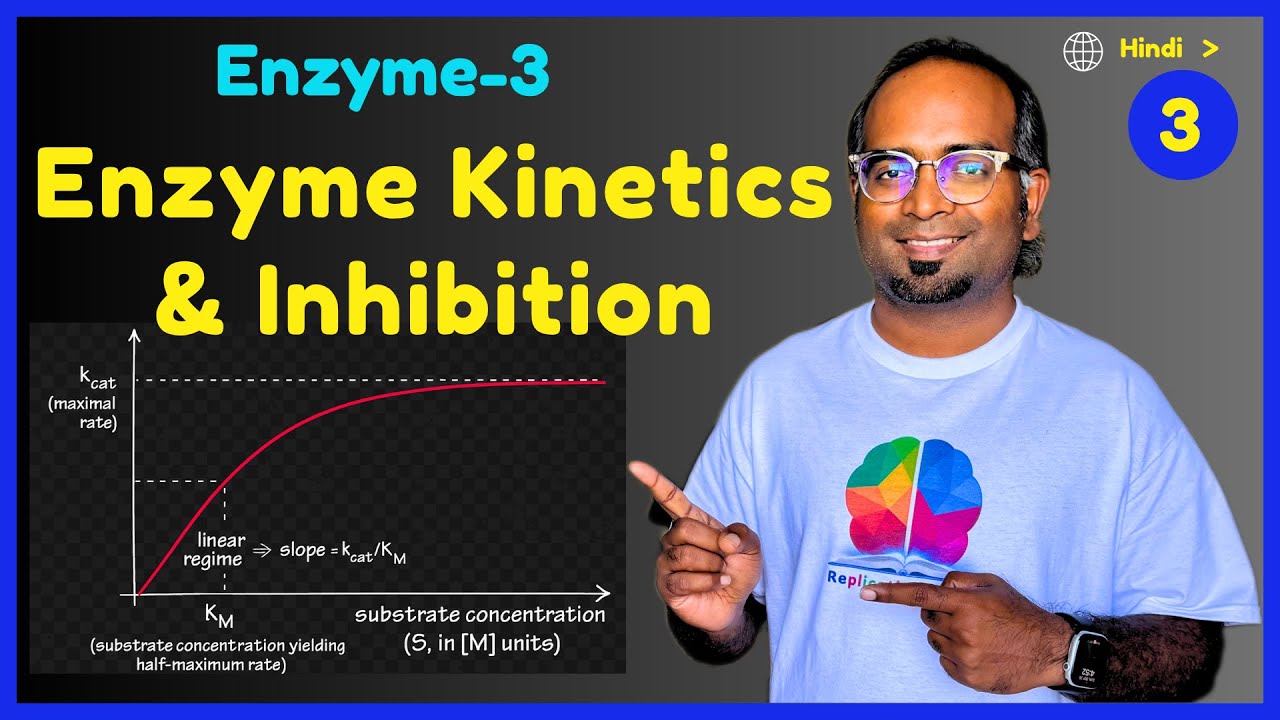
so enzymes inside our cells and inside our body catalyze many different types of biological processes and reactions but how exactly do we actually measure how good of an enzyme we have how do we measure the catalytic efficiency of enzymes found inside our cells and inside our body this will be the focus of this lecture so let's begin by taking a look at the following graph this is the same graph we focused on many times in previous lectures and so on this graph the xaxis is the substate concentration and the Y AIS is the velocity is the rate at which the enzyme actually operates on that specific substrate and what the blue curve describes is how the rate the velocity of that enzyme changes as we increase the subst concentration in the environment so as we increase at the beginning we see that there is a linear increase so that means the velocity is directly proportional to the concentration of s but then the rate slowly begins to decrease the slope decreases and it levels off and eventually it reaches a maximum velocity and that is given by this horizontal green line so that horizontal Green Line describes the maximum possible rate at which the enzyme can operate on that particular substrate and in the previous previous lecture when we discussed the turnover number K cat we basically gave an equation that describes how to actually obtain the maximum velocity so we said that V Max of an enzyme is equal to the product of the turnover number kcat and the concentration the total concentration of the enzyme and this basically describes that situation when all the active sides in our enzyme mixture are filled with the substrate this is when the velocity the rate of the enzyme mixture will be at a maximum so the enzyme operates at a maximum rate when all the active sides are filled and this is given by this equation now if we take a look at the following curve when exactly under what conditions will the blue curve actually reach the maximum velocity well notice as we increase the concentration this blue curve essentially reaches or approaches that maximum velocity ASM totically and what that means is if we continually increase the concentration of s the substrate it will eventually approach and and reach very closely the maximum velocity of that enzyme mixture and so what we see happen is when the concentration of the substrate is very high that is when the value of s the concentration of substrate is much greater than the km value for that enzyme mixture we see that our blue Curve will essentially reach that maximum velocity now remember km is basically the concentration of the substrate at which the enzyme operates at exactly half of the maximum velocity so if km is this X value the concentration of the S then if we check out the y coordinate that will be exactly midway between the zero velocity value and the Vmax value as shown in the following diagram on the following curve so we see that when km is much much smaller than the concentration of the substrate in that environment we see that our enzyme mixture is operating at a maximum velocity and this is equivalent to saying that all the active sides in the enzyme mixture are filled and so the enzyme's velocity is at a maximum now what exactly happens under normal physiological conditions inside our body and inside our cells well typical physiological conditions basically involve a relatively low concentration of substrate so under typical physiological conditions inside our cells the sub subred concentration is usually very low and the subred concentration is usually between zero and the km value and so what that means is the concentration of that substrate under normal conditions is usually much smaller than the km value so if we are to pinpoint where the concentration of that substrate in our cells usually is it's somewhere around let's say this quantity here so it ranges between this x value range here and so what that basically means is inside our cells the efficiency or I should say not the efficiency but the rate the velocity of that enzyme is usually much lower than its maximum velocity so for example if the concentration is somewhere here then the corresponding rate will be somewhere here much smaller than that maximum velocity now what we want to basically explore in this lecture is how to actually measure the catalytic efficiency of the enzyme inside our cell so we want to come up with an equation a rate law that describes how the rate of a particular enzyme catalyze reaction is affected by different types of variables this is what we basically want to explore so as always let's begin with with the same equation that we use to derive the michaus methan equation so this is the equation that describes a general enzyme catalyze reaction at its beginning stages so at the beginning this is the chemical equation that describes any enzyme catalyze reaction so we have an enzyme and and we have a substrate and when they combine when the substrate combines into the active side of the enzyme we for them we form the enzyme substrate complex es and K1 is the rate constant of this reaction now once we form this complex there are two ways that this complex can basically dissociate the substrate if it is not bound very strongly to that active side it can simply dissociate and leave the active side without actually being transformed into the product and this simply means it goes back to form these two reactants and a rate constant in that case is K minus1 but if the substrate is bound strongly to the active side that active side will be able to catalyze and transform that substrate into the product and this is the reaction shown here and K cat is the turnover number we spoke of previously this is the rate constant of this reaction now let's begin by describing the rate law of this reaction going this way so if we're going this way then the rate law is given by V KN the rate of this reaction is equal to K cat this rate constant multiplied by the concentration of the reactant in this case that enzyme substrate complex and let's call this equation number one now if you recall our discussion our derivation of the uh of the michis methan equation we basically used the steady state condition so we assume that the reaction was under steady state conditions so this reaction was under steady state conditions and what that basically means is the intermediate concentration the intermediate being the enzyme substrate complex the intermediate concentration is not changing over time so this concentration remain ains exactly the same even though the concentration of reactants and products over time is changing that's what we mean by a steady state condition and the only way that the concentration of the intermediate is not changing is if the rate of formation of this intermediate is equal to the rate of dissociation if these two rates are equal only then will the concentration of the intermediate be actually the same so under steady state conditions we see that the rate of formation of the enzyme substrate complex is equal to the rate of dissociation now how many reactions actually describe the rate of formation well we only have one reaction that forms this enzyme substrate complex and it's this reaction here that contains the rate constant of K1 so the rate of formation of es is given by this rate law K1 multiplied by the concentration of the enzyme multiplied by the concentration of the substrate now what about the rate of dissociation well here we have two equations that describe the dissociation one dissociates into the product and the one and the other one dissociates back into the enzyme and the substrate so on the left side of the equation we have one term on the right side we have two terms be have because we have these two uh reactions so one of them basically describes let's begin with this one so we have the concentration of the reactant the enzyme substrate complex basically dissociates into this so we save the concentration of enzyme substrate complex multiplied by K minus one and we add it to this reaction so the concentration of the enzyme substrate complex multiplied by K cat this quantity here now notice on the right side this and this appears in these two terms and so we can bring that out of our equation and then we get k minus1 + K cat multiplied by the concentration of es and so now if we solve for kus1 + K cat / K1 we get the following result so we simply rearrange this equation and we get this now this is the quantity that we defined previously as the K and the miches constant so we said that the michaus constant is equal to this ratio here and so now we replace this with the Micha constant and that is equal to this entire quantity here and finally if we take this and we rearrange it and solve for the es concentration we bring this here and km to the bottom we get the following equation let's call this equation two so the concentration of the enzyme substrate complex is equal to the product of these two concentrations divided by the michis constant now what was the entire point of getting equation two well the point was to take equation one and replace the enzyme substrate concentration in terms of these quantities where now we have have the km term and we'll see why the km term will become important in just a moment so now we substitute 2 into one we replace the concentration of es with this entire ratio and this is basically what we are left with so V KN the velocity of that enzyme the rate at which the enzyme catalyzes is equal to K cat ided km multiplied by the concentration of the enzyme multiplied by the concentration of the substrate now we are not yet done now what we basically want to do is we want to assume this same condition that we assumed previously so I said that under normal physiological conditions when the reactions take place inside our cells the concentration of the substrate is much smaller than the concentration of uh than the km value so this is around where the concentration inside our cells is usually at so basically equation three this equation here as we'll see in just a moment can be can be used to give us insight into how enzymes operate under typical physiological conditions that is when the concentration of the substrate is much much smaller than our km value so when where when we're right around here along that x axis so now what can we assume when we basically State the following statement so when the concentration of our substrate is much smaller than km this is the assumption that we can make so let's take a look at the following uh equation so this equation is telling us that that the total amount of enzyme inside our cell inside that environment is equal to the sum of the free enzyme that is not bound to any substrate plus the enzyme that is bound to that substrate now we know that when the concentration of the substrate is very low when we're right here the rate of the enzyme will be low because not much of the substrate will actually be bound to the enzyme and so that means our total is equal to approximately the concentration of the free enzyme because by making this assumption here we're saying that inside our cells we have a very low concentration of s and because we have a low amount of s substrate not too much substrate will be bound to the enzyme and so the majority of the enzyme will exist in its free state not bound to the substrate and that means the total enzyme is equal to approximately the free enzyme because this quantity here can be assumed to be very very small when the concentration of s is low and so this is equation for E total is equal to the free enzyme concentration and now we take equation three and we replace the free enzyme e with our total enzyme e and so once we replace this with this this is the equation that we can now ultimately use to basically study how the enzymes catalyze reactions inside our body under normal physiological conditions when the concentration of s is is is very small is much smaller than the michis constant km so the KN is equal to K C / K and multiplied by the concentration of the enzyme the total concentration enzyme multiplied by the concentration of the substrate now notice one important
Up Next

39:12
Taste Matters: Why We Like the Food We Do | Professor John Prescott
@smagforlivet-video
409 views•2015-12-07
8:34
How to Calculate Vmax and Km from a Lineweaver-Burk Plot
@NigelFrancis
106.4K views•2020-02-05

7:47
Post-Translational Modifications Explained: Types & Functions
@AKLECTURES
136.8K views•2014-09-11

7:08
Bacteriophages: Earth's Deadliest Killers and Future Antibiotics
@kurzgesagt
34.6M views•2018-05-13
Related Study Plans & Knowledge Roadmaps
Structured learning paths in Biology
biology
Analyzing Animal Venoms: Genetics & Pharma
01Molecular Biology & Physiology Foundations
02Venom Evolution & Toxin Gene Recruitment
03Neurotoxins & Ion Channel Pharmacology
+ 2 more learning modules
18h5 modules
Explore Roadmap
biology
RNAi: Biogenesis, RISC & Gene Silencing
01Molecular Biology Foundations: DNA to Protein
02Introduction to RNA Interference (RNAi)
03Molecular Biogenesis of miRNA and siRNA
+ 2 more learning modules
10h5 modules
Explore Roadmap
biology
Mycorrhizae: Signaling, Biophysics & Ecology
01Foundations of Mycorrhizal Symbiosis
02Molecular Signaling and Root Colonization
03Biophysics and Bioenergetics of Nutrient Exchange
+ 1 more learning modules
11h4 modules
Explore Roadmap
biology
Circadian Clocks: TTFL, SCN & Periphery
01Foundations of Molecular Biology & Gene Expression
02Introduction to Chronobiology and Actograms
03The Core TTFL: Molecular Architecture of the Clock
+ 3 more learning modules
14h6 modules
Explore Roadmap