















![Lineweaver-Burk plot (Enzyme Kinetics) - Vmax, Km & [S] - Biochemistry 🧪](https://i.ytimg.com/vi_webp/nivkBZkmu14/maxresdefault.webp)



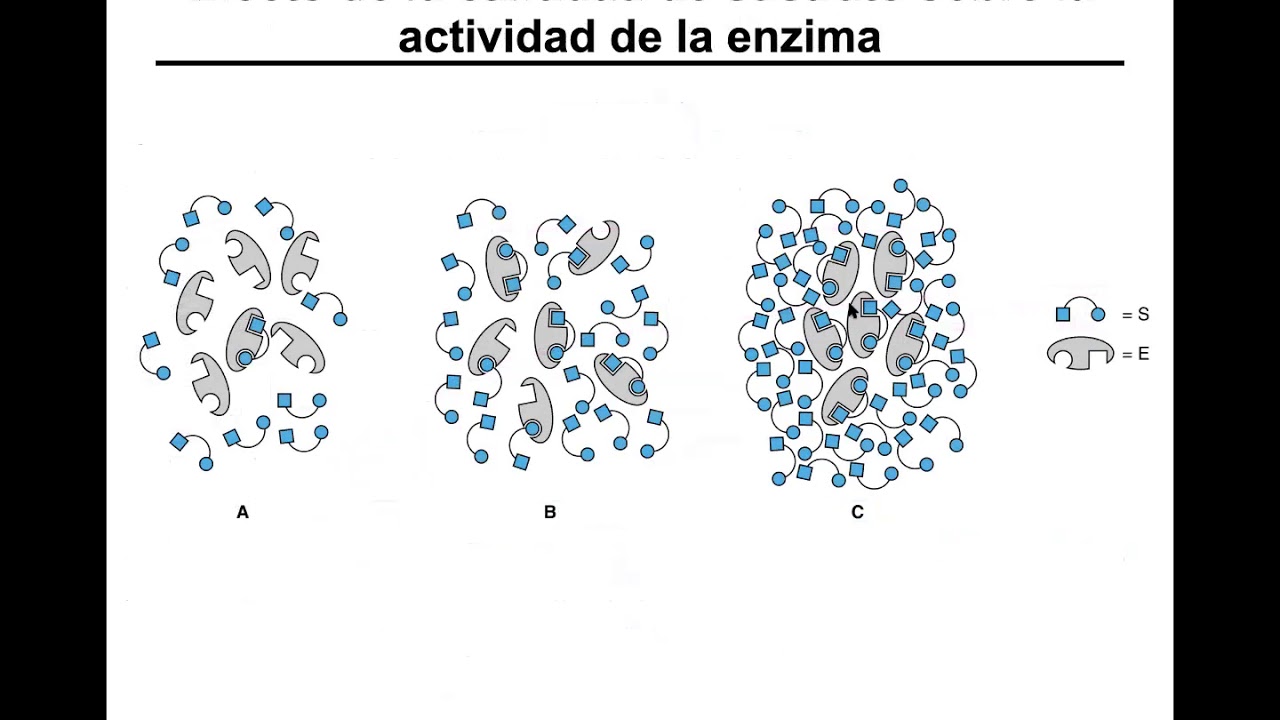



The Michaelis-Menten model describes enzyme kinetics through a hyperbolic relationship between reaction velocity and substrate concentration, where velocity increases with substrate concentration until reaching a plateau (Vmax) when all enzyme active sites are saturated; the Michaelis constant (Km) represents the substrate concentration at which the reaction velocity equals half of Vmax, and serves as a measure of enzyme-substrate affinity, with lower Km indicating higher affinity and higher Km indicating lower affinity.
Enzyme Kinetics and the Michaelis-Menten Model Explained
Added:Fundamental enzyme biology, including the concepts of active sites, substrates, and the formation of the enzyme-substrate (ES) complex.
Basic chemical kinetics, specifically reaction rates, rate laws, and how catalysts lower activation energy.
The concept of chemical equilibrium, reversible reactions, and the steady-state approximation in chemical systems.
Basic mathematical graphing skills, particularly understanding hyperbolic functions and interpreting independent versus dependent variables on a coordinate plane.
Enzyme inhibition mechanisms (competitive, non-competitive, and uncompetitive inhibition) and how they mathematically shift Km and Vmax.
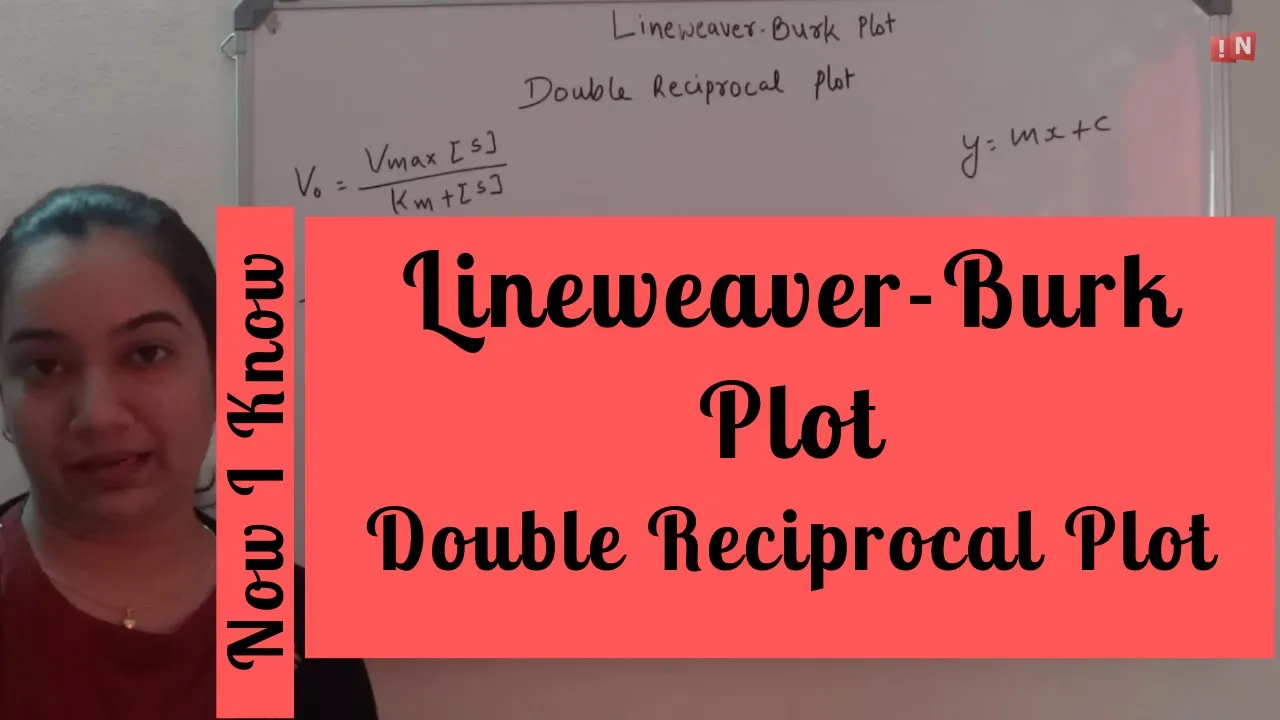
Linear transformations of the Michaelis-Menten equation, specifically the Lineweaver-Burk (double-reciprocal) plot, to experimentally determine kinetic constants.
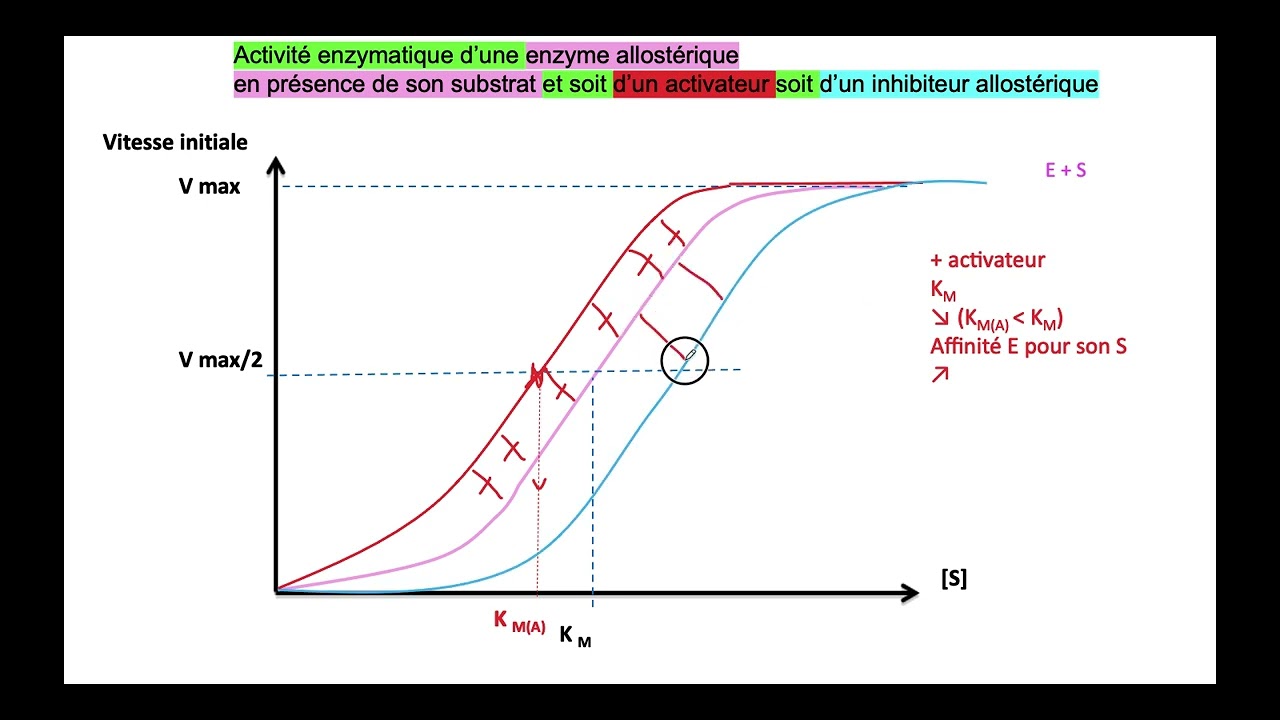
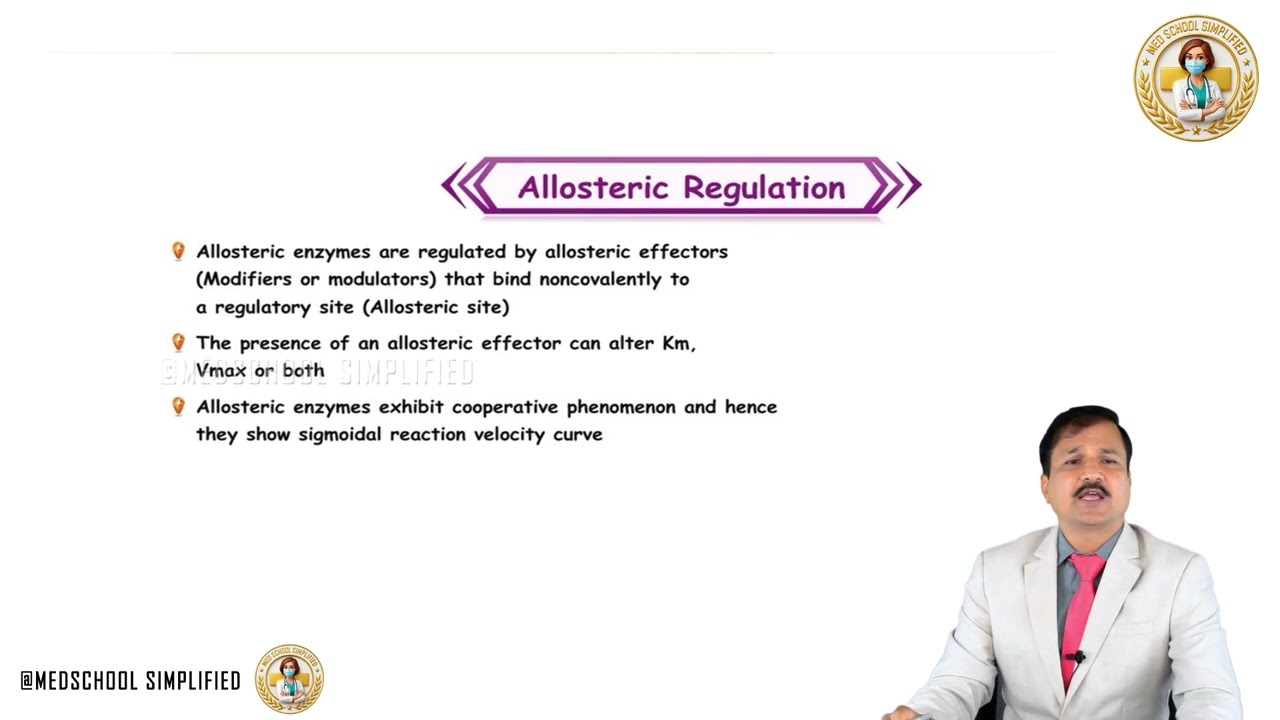
Allosteric regulation and cooperative binding, which deviate from classical Michaelis-Menten kinetics and exhibit sigmoidal velocity curves.
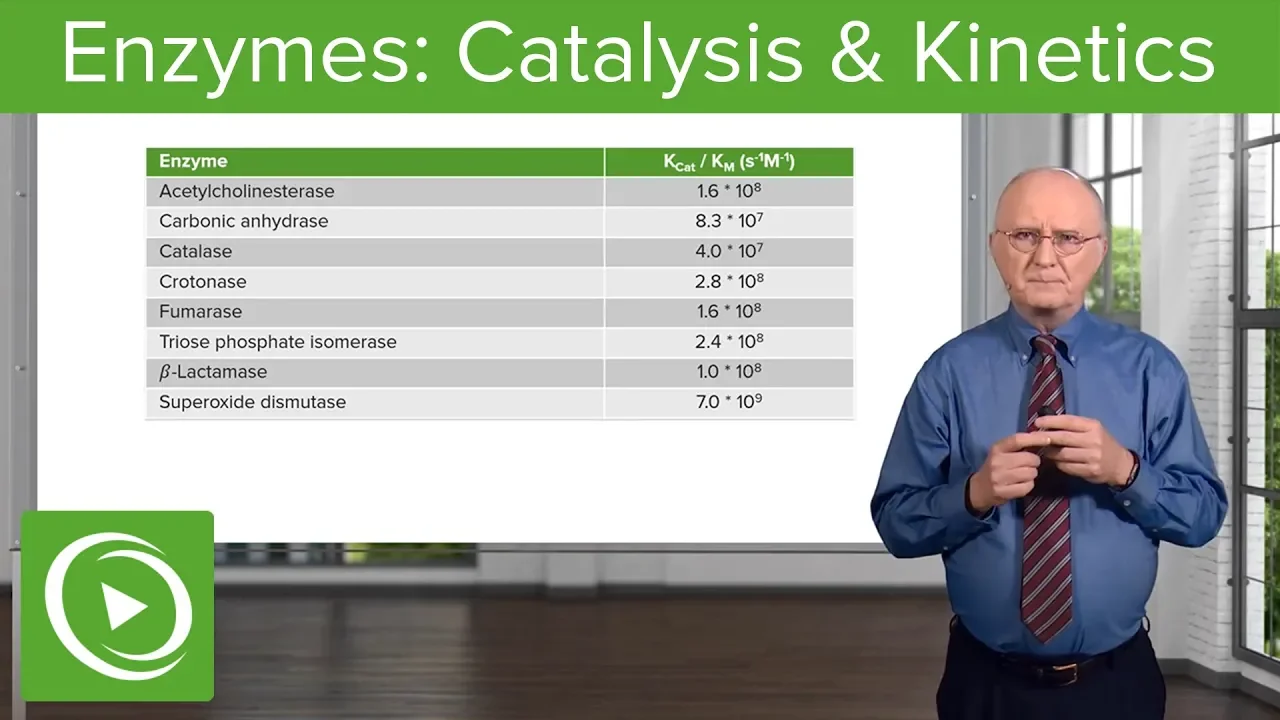
The concept of catalytic efficiency (kcat/Km) and the physiological limits of enzyme performance (kinetic perfection).
Pharmacological applications, such as how transition-state analogs and drugs function as enzyme inhibitors to treat diseases.
333.9K views2.9Klikes16:22Original Release: 2013-10-13
Okay. So in this video I want to talk about enzyme kinetics and the Michaelis Menton model. The Michaelis Menton model. Okay.
So enzyme kinetics really just describes um it's a study of the rates of reactions, right? So if we want to know how fast an enzyme works, we want to find out what that's dependent on. As it turns out, um we want to know, let's say for instance, we want to know how the substrate concentration impacts uh the the reaction velocity. So, what we're going to do here is we're going to have um we're going to plot reaction velocity the y ais and then have substrate concentration on the x axis. Right? And I'm just going to write substrate concentration as um like this. Okay? The s of course standing for substrate. Now, there are these things there are these things called uh enzyme essays or essays. I don't know exactly how to pronounce that. Um but the point is they're a lab technique. Okay, they're a lab technique. Um and I don't really want to write this all down. I don't want to waste too much time. Um but essentially what they do is they allow you to measure um either the appearance of a product or the disappearance of a substrate. In either case, they allow you to measure the rate of a reaction, right? which are or the velocity of the reaction which is what we're trying to you know think about here. Okay.
So let's for for a particular reaction um for instance there's this this example kimotrien is a is a protease which is an enzyme that breaks up proteins. If we graph its uh velocity over over the the substrate concentration what we get is a graph that kind of looks like this. Actually that's a little bit off.
off. Let me do that again. That's a little bit cleaner.
Okay, cool. So, what we've got here is what do we notice here? Well, what happens as we increase substrate concentration? Well, as we increase the substrate concentration, we're having an increase in velocity, but at of the reaction. Um, so what that means, right, at least for a a short period of time, that increasing the substrate concentration increases the reaction velocity. So the enzymes, right, the enzyme in this case, kimotrien, uh, which actually I'll actually spell out for you right here, um, kimotin. Okay, so the velocity at which the enzyme works increases as you increase the substrate concentration, right? But at a certain point we sort of level off here, right? So there's a plateau. Okay. So now beyond a certain point, no matter how much extra substrate you add, the enzyme cannot work any faster, right? So that's its maximum velocity, right? So if we think about that right here, something like that, right? The velocity at which you know you can't go any faster, that's going to be considered the maximum velocity. And that has a particular name, Vmax.
Okay. So, um why is it this happens up here? Why why is there this plateau effect? Um the reason why is um because because you can imagine that if there are a particular number of enzymes, right? Um if there's a small number of substrates, they can just knock through them really quickly. And as you add more, the enzymes have more to work with, so they can work faster.
Um, but at a certain point the enzymes, let's they they they're working as hard as they can, as fast as they can, right?
And they can only keep up with the substrate concentration to a certain point once you once you've basically once all the enzymes are taken, right?
And they're all working at their maximum capacity. You can't you can't, you know, increase their maximum capacity. So, they're going to work at a certain maximum velocity. And no matter how much more substrate you add, there's not going to um the enzymes are not going to work faster. So what we sort of say here is that this plateau, right, this plateau, oops, why did I do that? This plateau is due um to what we call uh enzyme saturation, right? which is just the idea that um there's there's too much substrate for the enzyme to handle the enzyme or enzymes to handle. Okay, so it can only work so fast. That's the maximum uh velocity.
And if if you want to know a little bit of a a few more details um that you'll notice here there's a sort of direct relationship there's like a linear relationship for like this certain point here right um so that that here there that's first order kinetics right and what does that have to do with um that's the whole idea that if we have if we have um if you recall I mentioned in the last video I mentioned the rate laws um being something like this. If a rate law is has a a substrate in first order, then doubling the concentration will double the rate law. Tripping the concentration of the substrate will triple the the the rate. So you're not the rate law, triple the rate. So there's a direct relationship here. So for the that's that a direct relationship is usually just you know um visualized and and represented by this by a line. At a certain point we hear no matter how much we increase the substrate concentration, nothing happens. That's going to be zeroth order kinetics, right? So this is this here is first order right? If we have a rate law for second order or it's not second order excuse me zeroth order. If we have zeroth order then anything raised to the zeroth power is one right? So a substrate concentration if we have if we double the substrate concentration nothing happens to the rate. Right? The rate doesn't change because if no matter what you put in here it's going to end up equaling one. Right? So this is the whole idea that no matter how much substrate you add or increase or decrease whatever it is after a certain point um it's not going to you know increase the the vmax or the maximum velocity because the enzyme is saturated it's working literally as hard as it can. Okay so I mentioned this here vmax and I'm sort of leading this all into the meanton model. there's this idea of of KM and I'll elaborate on what exactly KM is in just a second but oftentimes people talk about KM is equal to Vmax over two and that isn't entirely correct. So the KM how the the way we find it and I I'll elaborate on its definition in a moment. Um when we think about KM we think about Vmax over two right half the Vmax. So if we think about Vmax up here and you know zero being down here somewhere in the middle right that's actually a little bit too high maybe maybe down here whatever anyway at Vmax over two half the Vmax if we go over KM is not equal to Vmax over two what it is equal to it is the substrate concentration at Vax over two so here at Vax over2 two, right? Half the V-max, we have a particular substrate concentration. So there that substrate concentration, oops, that substrate concentration at Vmax over two is equal to the KM. That's what the KM is equal to. And I'll I'll go over more details in just a moment. Okay, so all of this here, this is a hyperbolic equation or a hyperbolic graph. Okay, so I want to note that here. This is a hyperbolic graph.
Okay. So, um why is it hyperbolic? Well, Michaelis and Menton, they sort of dealt with that, figured it out, and they they understood it to a certain degree, and they kind of explained it a little bit.
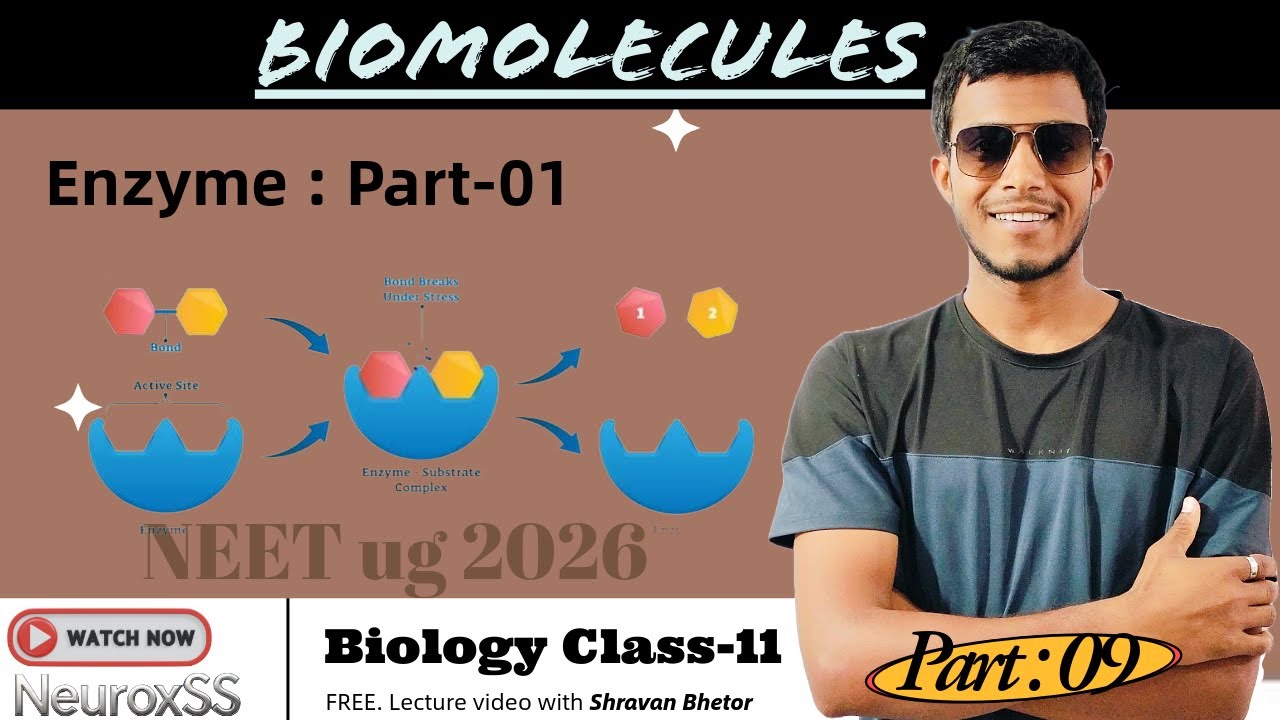
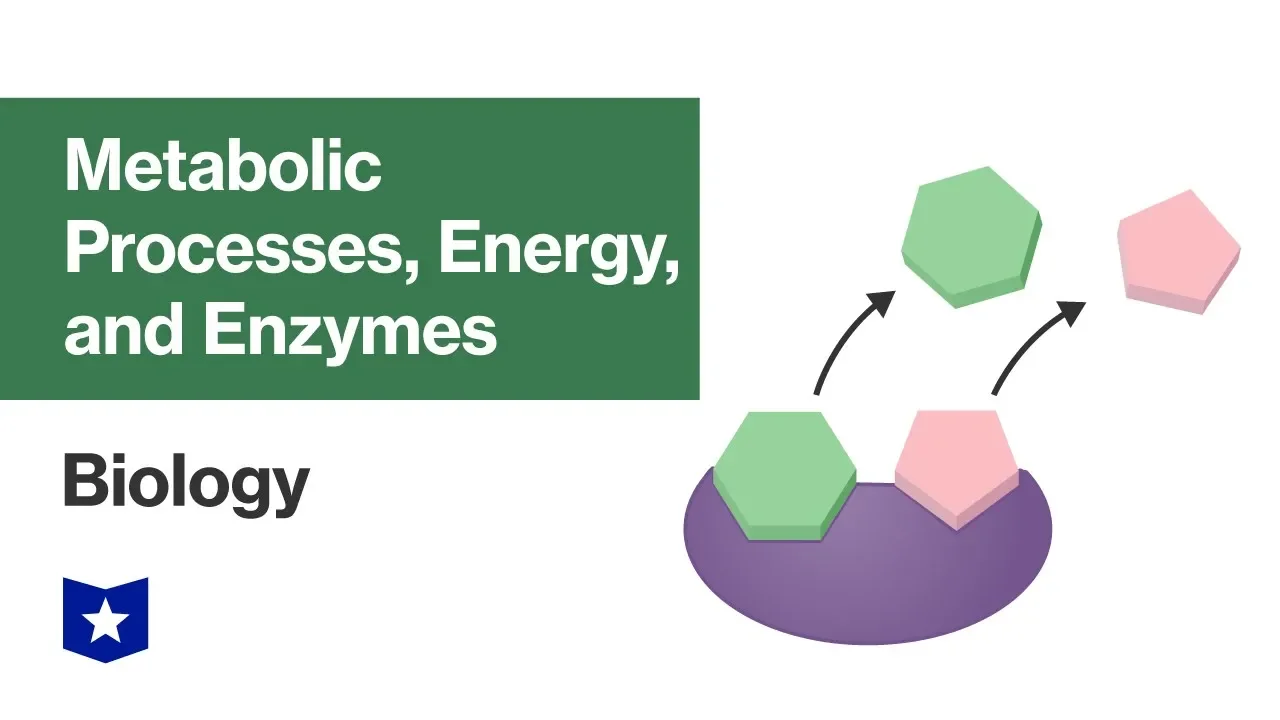
So, their model, let me scroll down a little bit. Actually, I I'll write it in here. Um so, Michael and Minton thought their way through like this. They thought, let's say we have an enzyme denoted by E and we have a substrate, right? Okay, so we add a substrate to an enzyme. Well, what can happen is that enzyme and substrate can come together and form an enzyme substrate complex.
Okay, so because in order for the enzyme to catalyze a reaction, it needs to come to uh the substrate needs to bind at at the active site and they need to, you know, interact. So that when that when they actually interact, that's going to be called the enzyme substrate complex.
And what's supposed to happen is the enzyme and substrate, right, will create a product denoted by P and the enzyme will hop off unchanged, right, back to where it originally was. Okay? Or or this enzyme and substrate complex, if it doesn't go to completion and create a product, they can just dissociate and go right back to being an enzyme and a substrate, the reactants that you began with. Now, each one of these reactions um has has a K or excuse me, a rate constant K associated with it. Let's call this one K1. Let's call this one K2. And let's call this K negative 1 because it's going backwards. Okay. Now what the KM is actually equal to? The KM, the KM is equal to um K K uh -1 + K2 over K1. Now, so what are we talking about here? What what is this? This is kind of confusing, right? So let's let's go over this briefly.
So now um essentially what you'll notice is that K1 and K2 both are rate constants for reactions that involve the dissociation of the enzyme substrate complex or the breaking up of the enzyme substrate complex. So here we have the enzyme substrate complex. K2 describes it breaking up into product and enzyme whereas K negative one also describes the breaking up of the enzyme substrate complex back to ENS. So we can think about this top value sort of representing this idea of the enzyme substrate complex um you know breaking apart.
Okay, the enzyme substrate complex breaking apart and then on the flip side right K negative one or excuse me not K1 K1 right here it describes the formation of the enzyme substrate complex. So that that value sort of describes the enzyme substrate complex either coming together or staying together. Okay. So if we think about that then um what we can kind of understand then is that KM essentially is a measure of affinity and dissociation. Okay. It is a measure of dissociation or affinity of an enzyme for a substrate or an enzyme for an enzyme in a substrate. Now, why is that?
Well, if we think about this top number, right, sort of being, you know, describing the enzyme substrate complex breaking apart and this bottom number being the enzyme substrate complex staying together. Well, then we we can imagine then that if KM is a bigger number, right? If KM is a bigger number, then what we have if we have a high KM, what that means is that this pro this is large number, right? Or excuse me, that's this top number is probably the large number dominating this bottom number. So if there's a large KM, that means that this top number is overpowering this bottom number, which means that the enzyme substrate complex is breaking apart more than it's staying together. Okay? Now, what that means then then that means that there is a so excuse me if if the end if the oh my goodness let me say that all over again. uh if there's a large KM, this top number, right, is is overpowering this bottom number, which essentially means that the enzyme substrate complex um is breaking apart more than it's staying together, which means, right, which you can sort of deduce um or think about as being, you know, um you can imagine that as as saying sort of the same thing as that's a low affinity. for the substrate. The enzyme has a low affinity for the substrate.
Low affinity for the substrate. So a high KM means the enzyme substrate complex don't have a high affinity for each other.
They're breaking apart more than they're staying together. So that means there's a low affinity for a substrate. Right?
So the opposite is true then. So if we have a low KM, if we have a low KM, then that means this top number is not dominating like this bottom number. This bottom number is which is sort of implying that the enzyme substrate complex is staying together more than it's breaking apart. Forgive my my handwriting here.
Um, so what that means if that is that if you have a low KM, that means you have the enzyme has a high affinity for the substrate, right? Because if they're staying together, that if the enzyme and the substrate are staying together, they have a high affinity for each other.
They're very attracted to each other.
Whereas in that if there's a high KM, they have a low affinity for each other because they're breaking apart more often. Okay? So, so um essentially what's going on here is that um this is the idea behind KM.
Okay. And this all plays into the idea um this KM and Vmax are very very important because they are involved in the equation that Michael and Mson figured out as far as the the h which is called the as far as this graph goes which is called the hyperbolic equation which I'll write down here. So the hyperbolic equation is uh V, right? If you want to find V uh for a particular reaction, that's going to equal the Vmax time the substrate concentration over the KM plus the substrate concentration. So, so this is the hyperbolic equation, right? Why is this useful at all? Okay, why do we care about it at all? Well, it's useful because if we know the V-max of a particular reaction and we know the KM, then we can find the velocity at any given substrate concentration that we want. Okay, so I'm going to write that here.
useful because if we know Vmax and KM for a particular enzyme, we can calculate the velocity at any substrate concentration. Okay, so I just wanted to introduce the Mckelis meant model here along with these enzyme kinetics as far as this graph goes. In the next video, I'll talk about more a little bit more details as far as the Mckelis meant model goes and then later I'll talk about the line B plot.
Up Next

28:03
Hormonal Control of Biorhythms | Endocrine Lecture
@IndiaESI
524 views•2022-01-24
50:12
Bacterial Communication: Quorum Sensing and Biofilm Formation Explained
@JHUAAP
12.6K views•2011-06-28

5:35
Enteric Nervous System Explained: The Gut's Brain | Neurobiology Lecture
@alumniu6029
438 views•2018-09-12

7:08
Bacteriophages: Earth's Deadliest Killers and Future Antibiotics
@kurzgesagt
34.6M views•2018-05-13
Related Study Plans & Knowledge Roadmaps
Structured learning paths in Biology
biology
RNAi: Biogenesis, RISC & Gene Silencing
01Molecular Biology Foundations: DNA to Protein
02Introduction to RNA Interference (RNAi)
03Molecular Biogenesis of miRNA and siRNA
+ 2 more learning modules
10h5 modules
Explore Roadmap
biology
Mycorrhizae: Signaling, Biophysics & Ecology
01Foundations of Mycorrhizal Symbiosis
02Molecular Signaling and Root Colonization
03Biophysics and Bioenergetics of Nutrient Exchange
+ 1 more learning modules
11h4 modules
Explore Roadmap
biology
Circadian Clocks: TTFL, SCN & Periphery
01Foundations of Molecular Biology & Gene Expression
02Introduction to Chronobiology and Actograms
03The Core TTFL: Molecular Architecture of the Clock
+ 3 more learning modules
14h6 modules
Explore Roadmap
biology
Population Genetics: Math, Drift & Selection
01Genetic & Probability Foundations
02The Hardy-Weinberg Principle and Baseline Models
03Mathematical Modeling of Natural Selection
+ 3 more learning modules
18h6 modules
Explore Roadmap