














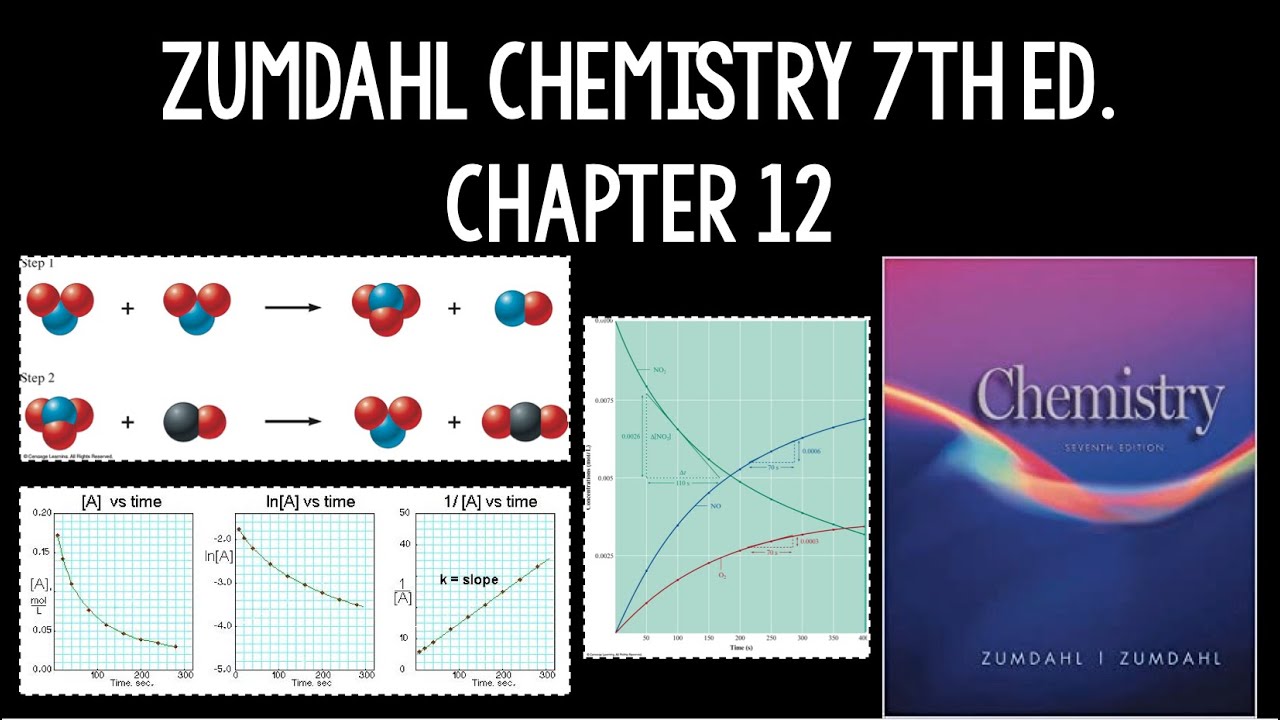






This video explains the integrated rate laws for different reaction orders: for zero-order reactions, the final concentration equals negative kt plus initial concentration; for first-order reactions, the natural log of final concentration equals negative kt plus the natural log of initial concentration; and for second-order reactions, one over final concentration equals positive kt plus one over initial concentration. The rate constant k units follow the general formula M^(1-n) × t^(-1), where n is the reaction order. The half-life equations are: t₁/₂ = [A]₀/(2k) for zero-order, t₁/₂ = ln(2)/k for first-order (independent of concentration), and t₁/₂ = 1/(k[A]₀) for second-order. Graphically, zero-order reactions produce straight lines when plotting concentration versus time, first-order reactions when plotting ln(concentration) versus time, and second-order reactions when plotting 1/concentration versus time.
Integrated Rate Laws Explained: Zero, First, & Second Order Chemical Kinetics
Added:in this video we're going to talk about how to solve integrated rate law problems so if you have a pen and a sheet of paper with you feel free to use them to take down some notes which is going to be useful later on as we work on some problems in this video so let's begin our discussion with the rate law expression for each of these ordered reactions so for zero order reaction the rate is equal to k times a raised to the zero power anything raised to the zero power is one so the rate is simply equal to k a is a reactant so think of a reaction where let's say a turns into b so a is the reactant and b is the product so for a zero order reaction the rate of the reaction doesn't depend on the concentration of the reactant for a first order reaction the rate does depend on the concentration of the reactant its rate is equal to k times a raised to the first power for a second-order reaction the rate is equal to k times a raised to the second power so the order of the reaction is based on the exponent that you see here now for a first order reaction if you double the concentration of a the rate is going to double if you triple the concentration of a the rate is going to triple for a zero-order reaction if you double the concentration of a it's going to have no effect on the rate if you triple the concentration of the reactant a no effect 3 to the 0 power is 1.
for a second-order reaction if you double the concentration of a 2 squared is 4 the rate is going to increase by a factor of 4.
if you triple the concentration of a 3 squared is 9 the rate is going to increase by a factor of 9.
so the order of the reaction or rather the order of the reactant tells you how the concentration will affect the rate the rate of the chemical reaction is most affected by a reactant that is second order compared to a reactant that is first order or even zero order so the higher the order of the reactant the greater its impact will be on the rate of the reaction now let's talk about the units of the rate constant k so the units of k for a zero order reaction is going to be m to the first power times t raised to the negative one now t is the unit of time it could be seconds it could be minutes it could be hours it could be even dates but t is some type of unit of time now for a first order reaction it's going to be m to the zero t to the negative one or simply t to the minus 1.
for a second-order reaction the units of k is going to be m to the negative 1 t to the negative 1.
notice what's happening to the exponent of m as you increase the order of the reactant it's decreasing by one so for a third order reactant it's going to be the units of k will be m to the negative two t to the minus one so we can come up with a general equation that will tell us the units of k given the order of the reaction and here it is it's m raised to the one minus n times t to the negative one so that's the units for k for any order so let's say if it's second order n is two so this is going to be m raised to the one minus two times t to the negative one one minus two is negative one so you get this so this expression is very useful in determining the units of k given the overall order of the reaction now the next topic of discussion is the half-life so the half-life is a unit of time so it's going to be t with a subscript one half and that's the time it takes for the concentration of a reactant to decrease by half of its original amount for a zero-order reaction the half-life is going to be the concentration let me write this better it's going to be the concentration of a more specifically the initial concentration of a divided by 2k for first order reaction the half-life is going to be ln 2 divided by k where k is the rate constant and for second order reaction it's going to be 1 over k times the initial concentration so what you want to gather from this is that the half-life for first order reaction doesn't depend on the initial concentration for a zero-order reaction and a second-order reaction the half-life depends on the initial concentration but for first sort of reaction it's independent of the initial concentration make sure you write that in your notes too because that's a typical test question now in all cases the half-life depends on the rate constant k and notice that k is always in the bottom of the fraction for the half-life equation so that means for all cases as the rate constant increases the half-life will decrease regardless of the order of the reaction if it's zero first or second order now for a zero order reaction if we increase the initial concentration the half-life is going to increase so for a zero-order reaction the half-life is directly proportional to the initial concentration now the reverse is true for a second order reaction if we increase the initial concentration the half-life decreases so the initial concentration in the half-life for a second-order reaction is inversely related for a first order reaction if you try to increase the initial concentration it's going to have no effect on the half-life the half-life is not going to go up it's not going to go down the half-life is independent of the initial concentration for first order reaction now let's talk about the equations for the integrated rate law expression now it's going to be tough fitting in here so i may have to erase it after i write it so hopefully you have a sheet of paper and you can write it down because we're going to refer back to these equations so for a zero order reaction the final concentration is equal to negative kt plus the initial concentration so that's the integrated rate law expression in slope intercept form y corresponds to the final concentration m corresponds to negative k x corresponds to t and b corresponds to the initial concentration so notice that the slope is equal to negative k and the y-intercept is equal to the initial concentration so make sure you write this equation so for the next part i'm going to put the slope because you want to know that as well so for a zero-order reaction the slope is going to be negative k as was mentioned now let's talk about a first order reaction the integrated rate law expression for a first order reaction is the natural log of the final concentration and that's going to equal negative kt plus the natural log of the initial concentration so once again this is in slope intercept form so as you can see the slope is still negative k the y intercept this time is the natural log of the initial concentration so we can write m is equal to negative k for first order reaction now for a second order reaction it's going to be 1 over the final concentration and that's going to equal positive kt plus 1 over the initial concentration so this 2 is in slope-intercept form so we have y is equal to mx plus b so this time the slope is equal to not negative k with positive k and the y intercept is one over the initial concentration so we're going to put m the slope is equal to positive k now the next thing that you need to know is the plot that leads to a straight line graph for a zero-order reaction is simply the concentration versus time for a first order reaction if you plot the natural log versus time you're going to get a straight line and for second order reaction you need to plot one over the concentration versus time the formula pretty much tells you that as well so here's the graph for a zero-order reaction need to have the concentration of a on the y-axis t on the x-axis and the graph is going to look like this because as you can see the slope is negative k is always positive but because the slope is negative k you can see that it's a decreasing function with a straight line now for a first order reaction if you were to plot the natural log of a versus time you would get a similar shape it's going to be a straight line graph with a negative slope for second order reaction if you plot one over a versus time it's different this is going to be a straight line graph going up so as you can see the slope is positive k so that's why it's an increase in linear function number one which of the following could represent the units of the rate constant k for a reaction that is third order overall is it going to be a b c or d so go ahead and take a minute and try this we know the units of k can be represented by this formula m raised to the 1 minus n times t to the minus 1 where n represents the order of the overall reaction so this reaction is third order overall therefore and it's going to be three so it's m raised to the one minus three times t minus one one minus three is negative two so the units for a third order overall reaction should be something to this effect m to the minus two t to the minus one and this corresponds to answer choice c so that's the answer for this problem t could be anything it could be seconds minutes hours days but it's some unit of time raised to minus one number two which of the following straight line plots correspond to a first order reaction so hopefully you have your sheet of notes with you if you haven't memorized it already but let's review the zero-order reaction so if you recall for a zero-order reaction if you plot a versus t you're going to get a straight line graph and the slope of that graph is going to be negative k so a versus t corresponds to a zero order not a first order now for second order reaction the graph one over a versus t produces a straight line plot and the slope for that is not negative k but positive k so we could eliminate answer choice c one over a versus t will not produce a straight-line plot for a first order reaction for a first sort of reaction the graph that we need is ln a versus t it's the natural log versus time when we plot ln a on the y axis time on the x axis we're going to get a straight line plot with a slope of not positive k but negative k so the correct answer is answer let me say that again the correct answer is answer choice d the slope is going to be negative k and the graph is ln a versus t it's not positive k number three which of the following statements is false so let's analyze each choice answer choice a the half-life of a first order reaction is independent of the concentration of the reactant is that true or false so hopefully you have your sheet of notes with you and let's look at the half-life equation for a first order reaction the half-life is equal to the natural log of 2 divided by the rate constant k notice that the initial concentration of a is not part of this equation therefore answer choice a is a true statement the half-life is independent of the initial concentration of the reactant now let's look at answer choice b the rate constant k is inversely related to the half-life of a second-order reaction is that true or false well if you have your sheet of notes with you let's look at the equation so the half-life equation for second order reaction is this it's 1 over k times the initial concentration of a now notice that the rate constant k is in the denominator of the fraction whenever you increase the denominator of a fraction the value of the whole fraction goes down so as we increase the rate constant k the half-life is going to decrease so when k goes up the half-life goes down so this describes an inverse relationship so therefore b is true the rate constant k is inversely proportional to the half-life for a second-order reaction now what about c the half-life of a zero-order reaction is directly proportional to the initial concentration of the reactant is that true or false so let's begin by writing the equation so the half-life equation of a zero-order reaction that's going to be the initial concentration a divided by 2k so we're analyzing the half-life and the initial concentration of the reactant so we're comparing these two notice that the initial concentration of the reactant is in the numerator whenever you increase the numerator of a fraction the value of the fraction goes up if you increase the denominator the value of the fraction goes down so because the initial concentration is in the numerator there is a direct relationship as we increase the initial concentration the half-life is going to increase as well so there's a direct relationship between the two so c is a true statement these two are directly proportional now what about answer choice d the half-life of a zero-order reaction is constant is that true or false so this is the half-life for a zero-order reaction is this value t one-half is a constant so t one-half depends on the initial concentration and k this two is not going to change that's constant k is the rate constant of a reaction the fact that it's a rate constant means that k doesn't change that is if the temperature doesn't change so we're assuming that the temperature remains constant if the temperature is constant then k is going to be constant so at constant temperature k is not going to change now the initial concentration is that constant well the answer is no because the purpose of chemical kinetics is to study how fast reactions are going and if the reaction is going as a changes to b a is going to decrease so as the reaction proceeds the concentration of a will not be constant it's going to decrease over time so if a goes down the half-life is going to go down with it because they're directly related so therefore the half-life of a zero-order reaction is not constant so this is a false statement therefore d is the correct answer choice so note that the half-life of a zero-order reaction and a second-order reaction depends on the initial concentration of a therefore the half-life is not constant for those two because as a decreases the half-life is going to change as a decreases for a zero-order reaction the half-life is going to decrease but as a decreases for a second-order reaction the half-life is going to increase because these two are inversely related now for first order reaction it doesn't depend on the initial concentration so because the half-life is independent of the initial concentration the half-life is constant for first order reaction so answer choice d would be a true statement if this was a first order reaction because ln2 is constant k is constant as long as the temperature doesn't change so the half-life will be constant for a first order reaction but it's not constant for zero order or second-order reaction for the sake of learning let's analyze answer choice e the half-life of a second-order reaction so we're dealing with this equation is inversely proportional to the initial concentration of the reactant we know that's a true statement now when we were analyzing part b we were focused on k anytime you increase the denominator of a fraction the value of the whole fraction goes down so anything on the bottom of the fraction is going to be inversely related to whatever is equal to the entire fraction so as we saw in answer choice b if we increase the rate constant k the half-life of a second-order reaction will decrease because it's on the bottom so those two are inversely related the initial concentration of the reactant is also on the bottom of that fraction therefore if we were to increase the initial concentration of the reactant the half-life would decrease and if we were to decrease the initial concentration of the reactant the half-life would increase so because these two are on the bottom of the fraction they are both inversely related to the half-life for a second-order reaction number four the initial concentration of a reactant in the zero-order reaction is 0.75 the rate constant k is 0.015 m per minute what will be the new concentration of the reactant after 15 minutes so feel free to pause the video if you want to try this problem so we're dealing with a zero-order reaction the straight-line equation for a zero-order reaction is the final concentration is equal to negative kt plus the initial concentration in this problem we're given the rate constant k it's negative 0.015 molarity per minute the time is 15 minutes so that's t let's put that in parentheses and we're given the initial concentration which is 0.75 m our goal is to calculate the final concentration 15 minutes later so we could cancel the unit minutes and so we're going to get the unit in molarity it's going to be negative 0.015 times 15 plus 0.75 so the final concentration after 15 minutes will be 0.525 and it makes sense because as the reaction proceeds the concentration of the reactant should decrease it decreased from 0.75 to 0.525 so that's the answer for part a now let's move on to part b how long will it take the concentration to be reduced to 0.06 m so this time we're looking for t let's write down what we know we know the initial concentration is still 0.75 m we still have the rate constant k is 0.015 molarity per minute and the concentration is going to.06 so that's the final concentration the new final concentration at some time t so we're trying to calculate that time t so let's replace the final concentration with 0.06 m k with 0.015 we're trying to calculate t and then plus the initial concentration of 0.75 so let's do some algebra let's subtract both sides by 0.75 so these will cancel 0.06 minus 0.75 that's negative 0.69 and the units is molarity and then it's going to be equal to negative one 0.015 molarity per minute times t so let's divide by this number so t is going to be negative 0.69 divided by negative 0.015 so t is equal to 46 looking at the units we can see that molarity cancels and t is going to be in minutes so the final answer for part b is 46 minutes it's going to take 46 minutes for the concentration to go from 0.75 to 0.06 m number five calculate the initial concentration of a reactant that took 4.7 minutes for it to reach a final concentration of 0.15 m and we're given the rate constant k so what do you think we need to do here well let's write down what we know so we don't have the initial concentration this is what we're looking for we do know the final concentration that is point 15 m and we know the time that it takes to go from the initial concentration to the final concentration and that is 4.7 minutes and we also know the rate constant k instead of rewriting it i'm just going to highlight this so how can we calculate the initial concentration well first we need to determine which integrated rate law expression we need to use and to do that we need to determine the order of the reaction is this a zero order reaction a first order reaction or a second order reaction so this problem is a little bit harder because we don't know what order the reaction is how do we find out well it turns out that we could find out from the units of k the units of the rate constant k can help us to determine what the order of the reaction is so the formula that we've used before to get the order of the reaction with the units of k is this one now t to the minus one we have that ready that's s minus one so we don't need to worry about that part what we're gonna do is we're gonna set this equal to this part of the unit m to the negative one so that means that one minus n is equal to negative 1 because m equals m our goal is to solve for n n is going to give us the order of the reaction so let's subtract 1 from both sides these will cancel and we'll get negative n is negative one minus one which is negative two multiplying both sides by negative one we get that n is two so we're dealing with a second order reaction here now that we know the order of the reaction we know which integrated rate law to use so this is going to be the equation 1 over a final is equal to positive kt remember the slope of a second order reaction is positive k and then plus one over a initial so now we could solve for this variable let's plug in everything else so a final is point fifteen k is this value here so that's point zero zero two five now we need to be careful because notice that k the rate constant k has the unit seconds here the time is in minutes so let's convert t from minutes to seconds so we have 47 minutes always make sure that the units match and then there's 60 seconds in one minute 47 times 60 is 28 20 seconds so let's put the units here so this was m to the minus one and then s to the minus one and then we're going to multiply that by 28 20 seconds so s and s to negative 1 will cancel so we're going to get m minus 1 here which is 1 over m and this is what we're looking for one divided by point 15 that's 6.6 repeating so it's 6.667 and then.0025 times 2820 that's 7.05 now i need to make a correction because i multiplied 47 minutes instead of 4.7 minutes so it's 4.7 minutes times 60 which is 282 seconds and not 2820 seconds i need to get rid of the zero so that's 282 seconds that should be here now if we multiply these two numbers.0025 times 282 seconds the seconds will cancel but instead of getting 7.05 we should get 0.705 so now let's subtract both sides by 0.705 6.667 minus 0.705 and that's going to be 5.962 and that's equal to 1 over the initial concentration now once you get to this part the quickest way to solve for the initial concentration is to take the reciprocal of both sides of the equation to do that raise both sides to the minus one when you raise this to the minus one the fraction flips it flips from 1 over the initial concentration to the initial concentration over 1 which you could simply write initial concentration of a now here this was 5.962 before when you raise it to the minus one it becomes one over five point nine six two so if we take one and divided by five point nine six two we're gonna get the answer that we're looking for so the initial concentration of a is 0.1677 m so this is the answer to the problem so when you get questions like this if the order of the reaction is not specified take a look at the units of k if you're given the units of the rate constant k you could determine if it's zero order if it's first order or if it's second order now let's move on to our next problem number six the data table below shows the concentration of a reactant with respect to time for a zero order reaction what is the value of the rate constant k now what you need to know is that the rate constant k is equal to the slope of the line if you plot a versus t for a zero-order reaction if you plot this on a graph you should get a straight line so a is on the y-axis time is on the x-axis and it's decreasing which means that the slope is negative and k has to be a positive number so k is equal to the negative slope or slope equals negative k so let's calculate the slope the slope is the change in y divided by the change in x so the y values are concentration values and the x values are time values in this example so let's just pick two numbers let's use first and the last result so the final concentration is 0.16 and the initial concentration is 0.8 the change in time is 40 seconds so 0.16 minus 0.8 that's negative 0.64 divided by 40.
and so it's going to be negative 0.016 molarity per second so that's the slope which means that k is positive 0.016 molarity per second so remember the slope is equal to negative k k is always a positive number number seven what is the half-life for reaction with the rate constant k of.0045 seconds to the minus one so what do you think we need to do here well the first thing that we need to do like the last problem or rather two problems before that is we need to determine the order of the reaction because it's not given to us so like problem five we need to pay attention to the units of k so based on those units s to the minus one what is the order of this reaction so we know the formula is going to be m raised to the one minus n times t to the minus 1. and we're going to set that equal to the units of k so this is a unit of time and the same is true for that but we don't see an m here if you don't see an m it's really m to the zero because anything raised to the zero power is one so what we're going to do is we're gonna set the exponents of m equal to each other so one minus n is equal to zero if we add n to both sides we get that n is equal to one so this is a first order reaction when you don't see units of molarity or moles or liters if you just see time to the negative one that's the indication of a first order reaction so any time the rate constant k has units such as s to minus one minutes to minus one hours to negative one with no molarity no moles no liters you know you're dealing with a first order reaction so now that we know the order of the reaction what formula can we use to calculate the half-life the half-life equation for first order reaction it's equal to the natural log of two divided by the rate constant k the natural log of two is point six nine three one four seven the rate constant k is point zero zero four five with the unit seconds to the minus one so let's go ahead and divide those two numbers so we get that the half-life is approximately 154 seconds based on the unit that we have here so that's how we can calculate the half-life of a first order reaction number eight which of the following straight-line plots correspond to a first order reaction let's look at answer choice a and b both plots have a versus t which corresponds to a zero-order reaction here the slope is positive k and for this one it's negative k now we know for a zero order reaction the slope is negative so answer choice b corresponds to a zero order reaction answer choice a doesn't correspond to anything now for a second-order reaction we're going to get a straight-line plot if we graph one over a versus t and the slope for this one is positive k so answer choice c corresponds to a second order reaction answer choice d is what we're looking for this corresponds to a first order reaction we're plotting ln a versus t and we have the correct slope the slope is negative k so answer choice d is the correct answer for this problem number nine the rate of a certain reaction with units of molarity per second increases by a factor of four when a doubles and increases by a factor of 27 when b triples which of the following represents the units of the rate constant k for this reaction well let's begin by writing a rate law expression so the rate of this reaction is going to equal the rate constant k times the concentration of a raised to some variable times the concentration of b raised to some variable or number now let's focus on a when a increases by a factor of two the rate increases by a factor of four so when a doubles the rate goes up by factor four so would you say it's zero order in a first order in a second order in a or third order in a well two to the what power is four we know that two squared is four so we this tells us that it's second order with respect to a now looking at the second part of the problem it says that when b triples or when it increases by a factor of three the rate of the chemical reaction increases by a factor of 27.
so 3 to the what power is 27 we know that 3 to the third power is 27 3 times 3 times 3 is 27 so it's third order with respect to b now what is the overall order of the reaction the overall order of the reaction is the sum of these two exponents so it's fifth order overall now that we know the overall order of the reaction we could use that shortcut technique to get the units of k recall the units of k is m raised to the 1 minus n where n is the order of the reaction times t raised to minus 1.
so n is n is not four n is five rather and the time is in unit of seconds so this is going to be s to minus one we simply replace t with whatever time unit we see in the reaction rate so it's m raised to the negative four s to minus one let's say this answer so if you were to ever forget this formula here's another way in which you can get to this point so in the rate law expression isolate k to get k by itself we need to divide both sides by this so we're going to get the rate constant k is equal to the rate of the entire reaction divided by a squared times b to the third power so at this point what you want to do is you want to plug in the units the unit for rate is molarity over seconds or you can say molarity times seconds to minus 1.
the unit for a is molarity but it's squared so you can write that as m squared or simply m times m so that's for a for b it's m to the third power so i'm not going to split it for that one the reason why i split this into m times m is because i want to cancel one of the m's so we can see that we have m to the 4 left on the bottom 1 plus 3 is 4.
now we can move this to the top and then we get the units of k as being m to the negative four that's the minus one so you get the same answer as what we got here but this is just simply a shortcut technique but you can always do it this way if you want to if you ever forget now this does not look like any of the answers that we have here so we need to adjust our units molarity is moles over liters this is most the first power leaders to the first power we're going to move liters to the top so m to the first power is moles to the first power times liters to the negative one power now m to the negative four what we're going to do is we're going to write that as m to the first power raised to the negative four because when you raise one exponent by another you need to multiply one times negative four is negative four so now we can replace m to the first power with what we have here because it equals m to the first power so we're going to get moles to the first power times liters to the negative one raised to the minus four now we're going to distribute negative four to these exponents so first we have 1 times negative 4 which is negative 4 and then negative 1 times negative 4 which is positive 4.
and typically the variable with the positive exponent is usually written first so m to the negative four can be rewritten as l to the four times moles to the negative four so now all we need to do is add our second to the minus one so m to the negative four times s to the minus one is liters to the fourth power times moles to the negative fourth power times seconds to the negative one power so we can represent the units of k like this or like that but looking at our answer choices we have it in this form therefore answer choice c is the correct answer number 10 what is the overall order of a reaction with the units liters cube moles to the minus three seconds to the minus one so with this problem we're kind of going backwards here so let's see if we can do this we know that molarity is moles over liters which is the same as moles the first power times liters to the minus one now if we were to raise both sides to the negative one let's say if we were to raise this to the minus one and that's a negative one we'll get that m to the minus one is equal to negative one times negative one is positive one so that's liters to the first power and then one times negative one is negative one moles to the negative one power so you may want to be familiar with these expressions so moles to the first i mean molarity to the first power is most the first power times liters to the negative one but molarity to the negative one is liters to the first power moles to the minus one and in this example notice that liters has a positive exponent so liters cube moles to the negative three what is that equal to well if we take out if we factor out an exponent of three we'll get liters to the first times moles to the negative one raised to the third power so these expressions are equivalent we just factored out three from the exponent now these two are the same so we can replace what's here with m to minus one so we have m to the negative one raised to the third power so this is m to negative three so liters cubed moles to the minus three is m to negative three so now let's write everything that we have here liters cube moles to the minus three s to the minus one that's going to be m to the negative 3 times s to the minus 1.
now let's set this equal to our general equation m raised to the 1 minus n times t to the minus 1.
so we don't need to worry about this we know the time is in seconds what we need to do is set these two equal to each other so we can solve for m so m to the negative 3 is equal to m raised to the 1 minus n now since m is the same we can set the exponents equal to each other so negative three is equal to one minus n and let's subtract both sides by one negative three minus one is negative four if negative four is equal to negative n then we just got to multiply both sides by negative one and we'll get that positive n is equal to four so we can say that this reaction is fourth order overall so answer choice e is the correct answer you
Up Next
Rate Laws Explained: How to Calculate Reaction Orders
@ChadsPrep
220.6K views•2022-01-18
Biocatalysis and Catalysis in Islatravir Synthesis | Merck Webinar
@SCIwheresciencemeetsbusiness
675 views•2020-10-08
Intermolecular Forces: Hydrogen Bonding, Dipole-Dipole, Ion-Dipole
@TheOrganicChemistryTutor
2.5M views•2016-06-17

Edible Water Bottles: A DIY Guide to Sodium Alginate Spherification
@ryan
10.5M views•2019-06-21
Related Study Plans & Knowledge Roadmaps
Structured learning paths in Chemistry