Principles of Photochemistry: Excited-State Dynamics, Molecular Photophysical Processes, and Light-Driven Chemical Reactions
Learning Objectives
By the end of this curriculum, you will be able to:
- Explain the fundamental quantum and physical laws governing light-matter interactions, including the Stark-Einstein and Grotthuss-Draper laws.
- Formulate and apply the Born-Oppenheimer approximation and the Franck-Condon principle to electronic and vibronic transitions.
- Construct and interpret Jablonski diagrams to map radiative (fluorescence, phosphorescence) and non-radiative (internal conversion, intersystem crossing) excited-state decay pathways.
- Analyze the quantitative kinetics of excited states, derive basic rate equations for radiative decay, and evaluate fluorescence quenching via the Stern-Volmer relation.
- Differentiate between photophysical relaxation and photochemical reactions, identifying the mechanistic pathways of key light-driven organic transformations.
- Prerequisites: General Chemistry, Introductory Organic Chemistry, and basic Quantum Mechanics (specifically wave functions, molecular orbital theory, and spin states).
- Estimated Total Study Time: 18 hours
Module 1: Foundations of Light-Matter Interactions
This module introduces the foundational physics and physical chemistry principles that govern how molecules interact with electromagnetic radiation. You will study the basic laws of photochemistry—such as the Grotthuss-Draper and Stark-Einstein laws—alongside the Beer-Lambert law, electronic selection rules, and the quantum nature of electronic absorption.
Recommended Videos

Why this video
This lecture provides an excellent historical and mathematical bridge between basic light absorption and quantitative photochemistry. It clearly explains the Grotthuss-Draper Law (light must be absorbed for photochemistry to occur) and the Stark-Einstein Law of photochemical equivalence (one quantum of light activates one molecule), which are vital prerequisites for evaluating quantum yields in later modules.
Why this video
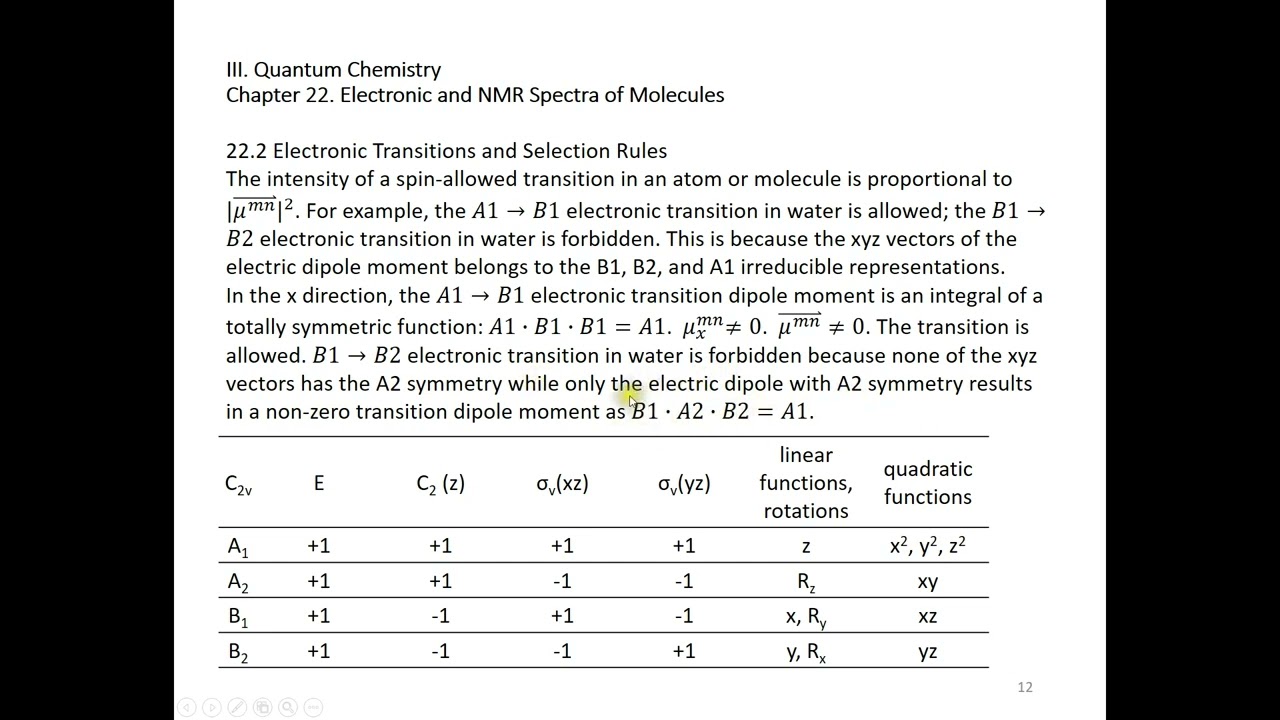
This concise video is a focused mathematical treatment of electronic transition selection rules. It describes why certain electronic configurations can undergo light-induced transitions while others are symmetry- or spin-forbidden, laying the quantum mechanical groundwork for spectroscopic transitions.

Why this video
For a comprehensive physical chemistry perspective, this full-length university lecture integrates electronic spectroscopy, wave numbers, energy scales, and potential energy surfaces. It contrasts the large energy gaps associated with electronic transitions with the much smaller gaps seen in vibrational and rotational levels, establishing how absorption launches a molecule onto an excited state potential energy surface.
Module 1 Knowledge Checkpoint
- State and apply the Stark-Einstein Law of photochemical equivalence.
- Mathematically calculate energy transitions using wave numbers () and relate them to wavelength () and frequency ().
- Explain how transition dipole moments determine whether an electronic transition is spin-allowed or spin-forbidden.
- Define the Beer-Lambert Law and identify the physical factors that limit its linearity at high concentrations.
Module 2: Molecular Orbitals and Electronic States
This module explores the structure of molecular electronic states. You will study how molecular orbitals organize into singlet and triplet states, how the Born-Oppenheimer approximation decouples electronic and nuclear motion, and how the Franck-Condon principle dictates the "vertical" nature of electronic transitions on potential energy diagrams.
Recommended Videos

Why this video
This segment cleanly introduces the Born-Oppenheimer approximation, explaining how the massive disparity in mass between nuclei and electrons allows us to treat electronic transitions as instantaneous vertical movements. It provides a vital bridge between molecular orbital structures and physical potential energy coordinates.
Why this video
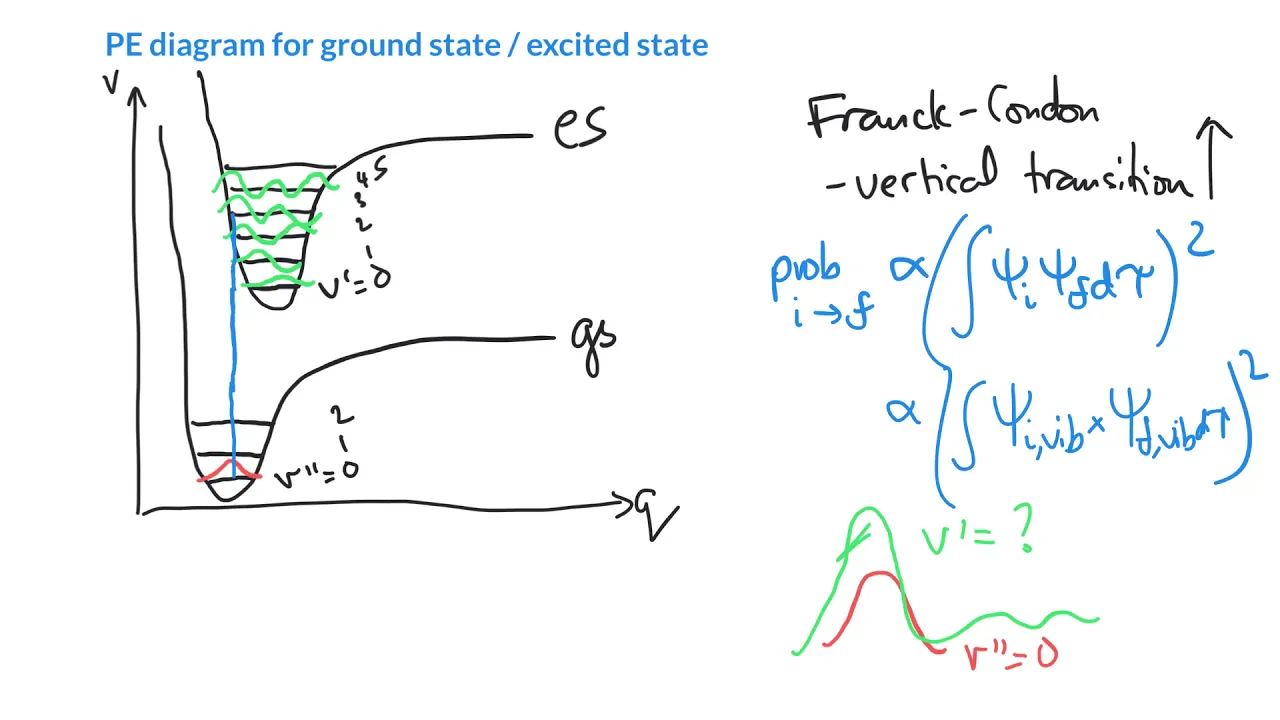
This video offers a highly detailed, graphical walkthrough of the Franck-Condon principle. It clearly demonstrates how electronic transitions occur instantaneously relative to slow nuclear vibrations, leading to "vertical" transitions on Morse potential energy curves.
Why this video
From MIT's physical chemistry series, this highly rigorous lecture provides the quantum-mechanical derivations behind the Franck-Condon principle, focusing on vibronic wavefunctions, overlap integrals (Franck-Condon factors), and how they dictate the intensity of absorption bands.
Module 2 Knowledge Checkpoint
- Define the Born-Oppenheimer approximation and explain why nuclear coordinates are assumed constant during an electronic transition.
- Sketch Morse potential energy curves for ground () and excited () states, clearly identifying a vertical vibronic transition.
- Mathematically explain how the Franck-Condon factor (overlap integral of vibrational wave functions) influences absorption peak intensities.
- Differentiate between singlet states () and triplet states () in terms of total electron spin angular momentum and multiplicity.
Module 3: Photophysical Processes and Jablonski Diagrams
This module maps out the photophysical pathways that an excited molecule can traverse to return to its ground state. Using the Jablonski diagram as a primary tool, you will compare radiative transitions (fluorescence and phosphorescence) with non-radiative relaxation mechanisms (vibrational relaxation, internal conversion, and intersystem crossing).
Recommended Videos

Why this video
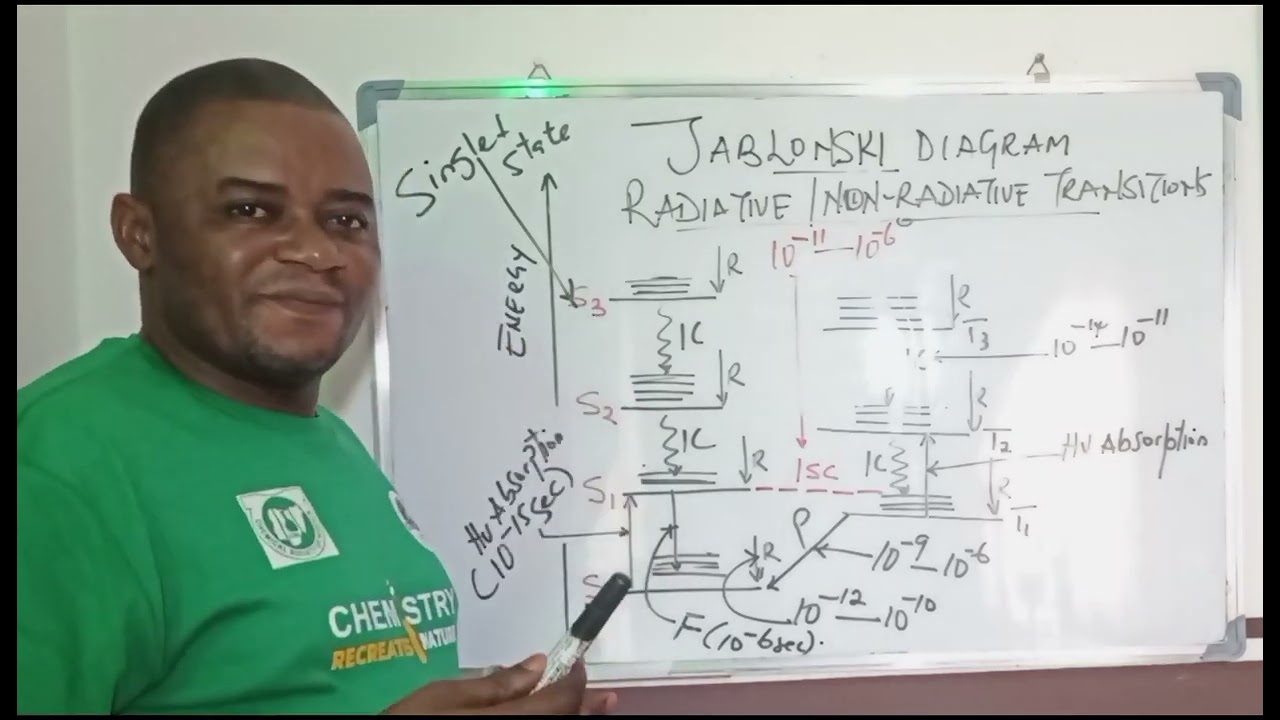
This video is a highly structured, concise, and clear introduction to the Jablonski diagram. It maps out the six principal pathways of excited states (absorption, fluorescence, phosphorescence, internal conversion, intersystem crossing, and vibrational relaxation) on a standard energy scale, outlining their typical timescales.

Why this video
This lecture provides deep context regarding how molecular structure dictates absorption and emission spectra. It links Jablonski diagrams directly to practical fluorophore behaviors, illustrating why emission profiles generally mirror absorption spectra (the mirror-image rule) and why emission is shifted to longer wavelengths (Stokes shift).

Why this video
This detailed blackboard lecture walks through selection rules alongside the Jablonski diagram. It covers the specific spin and symmetry conditions that allow or forbid intersystem crossing () and phosphorescence (), explaining why phosphorescence has a drastically slower rate constant than fluorescence.
Module 3 Knowledge Checkpoint
- Draw a complete Jablonski diagram from memory, representing , , , and states, along with all five relaxation processes.
- Define the Stokes Shift and explain the physical mechanisms (e.g., solvent reorganization, vibrational relaxation) that cause emission to occur at lower energy than absorption.
- Contrast internal conversion (IC) and intersystem crossing (ISC) in terms of spin state changes and typical timescales.
- Explain why phosphorescence lifetimes are orders of magnitude longer ( to seconds) than fluorescence lifetimes ( to seconds).
Module 4: Kinetics of the Excited State & Quenching
This module presents the quantitative chemical kinetics of excited states. You will analyze rates of radiative decay, define and calculate quantum yields, and model the mathematical relationships of collisional (dynamic) fluorescence quenching using the Stern-Volmer equation.
Recommended Videos
Why this video
This comprehensive, graduate-level lecture dives deeply into the mathematical expressions governing fluorescence kinetics, quantum yields (), and excited-state lifetimes. It shows how the observed lifetime () is a function of both radiative and non-radiative rate constants, providing a formal foundation for quantitative photophysics.
Why this video
This problem-solving session offers rapid methods and worked examples for analyzing photophysical kinetics. It walks through actual chemistry competitive exam problems regarding rate constants, quantum yields of intersystem crossing/fluorescence, and how to set up steady-state approximations for excited intermediates.
Content Gap Analysis: Stern-Volmer Derivation
While the included video pool touches on excited-state lifetimes, it lack a complete algebraic derivation of the Stern-Volmer quenching model. To supplement this gap, review the following concepts independently:
The Stern-Volmer relationship describes bimolecular quenching:
- and : Fluorescence intensities in the absence and presence of a quencher .
- : The Stern-Volmer quenching constant.
- : The bimolecular quenching rate constant.
- : The unquenched lifetime of the excited state.
Independent Study Search Query: "Stern-Volmer fluorescence quenching derivation physical chemistry" or "dynamic vs static quenching derivation". Focus on understanding how the steady-state approximation applied to the excited state yields this linear relationship.
Module 4 Knowledge Checkpoint
- Write the kinetic rate law for the decay of an excited state involving radiative decay (), internal conversion (), and intersystem crossing ().
- Define fluorescence quantum yield () both in terms of absorbed/emitted photons and in terms of individual unimolecular rate constants.
- Derivate the Stern-Volmer equation from basic kinetic steps (absorption, radiative decay, non-radiative decay, and collisional quenching).
- Distinguish between static and dynamic (collisional) quenching using temperature dependency and lifetime measurements ().
Module 5: Photochemical Reactions and Applications
In this module, you will cross the boundary from photophysics (where energy is dissipated as heat or light) to photochemistry (where energy breaks and forms chemical bonds). You will study how light-induced electronic transitions change chemical reactivity, alter molecular symmetry rules, and drive organic reactions.
Recommended Videos
Why this video
This lecture formally transitions from photophysical relaxation pathways to chemical outcomes. It contrasts photochemical reactions—which bypass ground-state activation energy barriers by utilizing excited-state electronic configurations—with traditional thermal (dark) reactions.
Why this video
This conceptual video contrasts thermal and photochemical processes. It highlights the role of UV-Visible light (specifically in the 200–800 nm range) in populating high-energy electronic surfaces, which allows reactions to proceed with unique regio- and stereochemical pathways that are forbidden under thermal conditions.
Content Gap Analysis: Organic Photochemistry Mechanisms
The current video pool provides a solid overview of general photochemistry but lacks detailed curly-arrow mechanisms for classic photoreactions such as Norrish Type I and Type II cleavages, or photocatalytic water-splitting mechanisms. Supplement your learning with the following structural details:
- Norrish Type I Cleavage: A homolytic cleavage of the -carbon-carbonyl bond in carbonyl compounds starting from an excited state, yielding two radical intermediates.
- Norrish Type II Cleavage: An intramolecular -hydrogen abstraction by an excited carbonyl oxygen, proceeding through a cyclic six-membered transition state to yield a 1,4-biradical, which subsequently cleaves (yielding an alkene and an enol/ketone) or cyclizes into a cyclobutanol.
Norrish Type II General Pathway:
O O-H O-H
// \ / \ /
R-C CH2 ---> R-C CH2 ---> R-C + H2C=CH2
\ / \ / ||
CH2-CH2 CH2-CH• CH2 (enol)
| |
H-CH2 •CH2 (1,4-biradical)
Independent Study Search Query: "Norrish Type I and II mechanism organic photochemistry" or "semiconductor photocatalysis TiO2 mechanism step-by-step".
Module 5 Knowledge Checkpoint
- Differentiate between a photophysical process and a photochemical process.
- Draw step-by-step radical mechanisms for both Norrish Type I and Norrish Type II reactions, showing all intermediates.
- Explain why photoisomerization (such as the cis-trans isomerization of stilbene) occurs easily upon electronic excitation but is highly hindered in the ground electronic state.
- Explain how a semiconductor photocatalyst (like ) utilizes bandgap excitation to generate electron-hole pairs () for oxidation and reduction reactions.
Course Map
Key People Index
- Theodor Grotthuss (1785–1822) & John William Draper (1811–1882): Formulated the First Law of Photochemistry (the Grotthuss-Draper Law), establishing that light must be absorbed by a chemical substance in order for a photochemical reaction to take place.
- Johannes Stark (1874–1957) & Albert Einstein (1879–1955): Proposed the Second Law of Photochemistry (Stark-Einstein Law of Photochemical Equivalence), introducing quantum mechanics to photochemistry by stating that each absorbed photon (quantum) activates exactly one molecule.
- Max Born (1882–1970) & J. Robert Oppenheimer (1904–1967): Developed the Born-Oppenheimer approximation, allowing the simplification of molecular wavefunctions by mathematically separating nuclear and electronic motions.
- James Franck (1882–1964) & Edward Condon (1902–1974): Formulated the Franck-Condon Principle, explaining the intensity of vibronic transitions through vertical transitions on potential energy curves.
- Aleksander Jabłoński (1898–1980): Developed the Jablonski Diagram, the universally used graphical tool illustrating molecular electronic and vibrational states and their radiative and non-radiative transition pathways.
- Otto Stern (1888–1969) & Max Volmer (1885–1965): Derived the Stern-Volmer equation, which quantitatively describes kinetics of dynamic fluorescence quenching as a function of quencher concentration.
Final Self-Assessment
Complete this comprehensive self-assessment to verify your mastery over the principles of photochemistry.
- Can you convert a light wavelength of into both frequency () and energy per photon ( and )?
- Explain why the absorption spectrum of a polyatomic molecule in solution appears as a broad band rather than sharp atomic-like lines.
- Derive why triplet states are lower in energy than their corresponding singlet states of the same electronic configuration (Hint: Hund's Rule and exchange energy).
- State the physical reason why electronic transitions are represented as vertical straight lines on potential energy coordinate curves.
- Sketch a Jablonski diagram showcasing states and label the transitions of vibrational relaxation, internal conversion, intersystem crossing, fluorescence, and phosphorescence.
- Define the Franck-Condon factor and explain how it mathematically dictates the shape of a vibronic emission progression.
- Express the total rate equation for the depletion of and solve for its analytical concentration profile following delta-pulse excitation.
- Given a Stern-Volmer plot of vs. , how would you calculate the bimolecular quenching rate constant () if you only knew the slope and the unquenched lifetime ()?
- Detail the physical and kinetic distinctions between collisional (dynamic) quenching and static complex formation.
- Predict the major photochemical products of an unsymmetrical dialkyl ketone irradiated with UV light, detailing both the Norrish Type I and Norrish Type II pathways.