












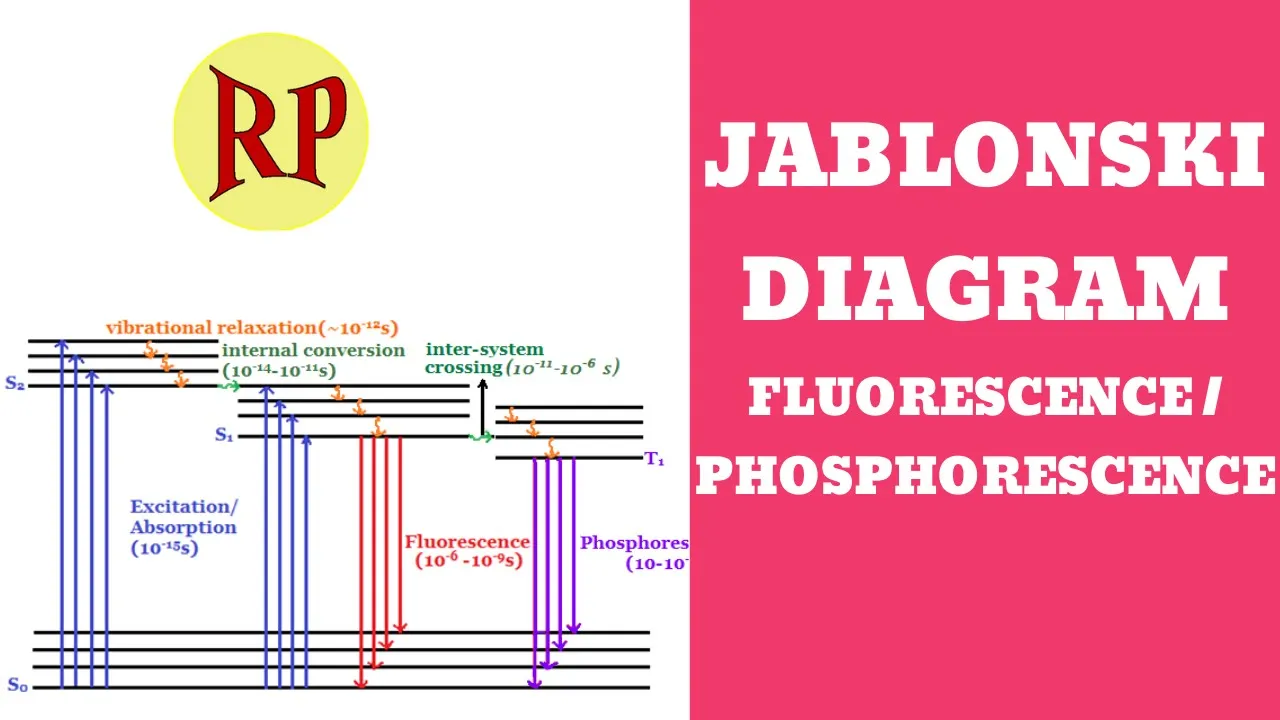

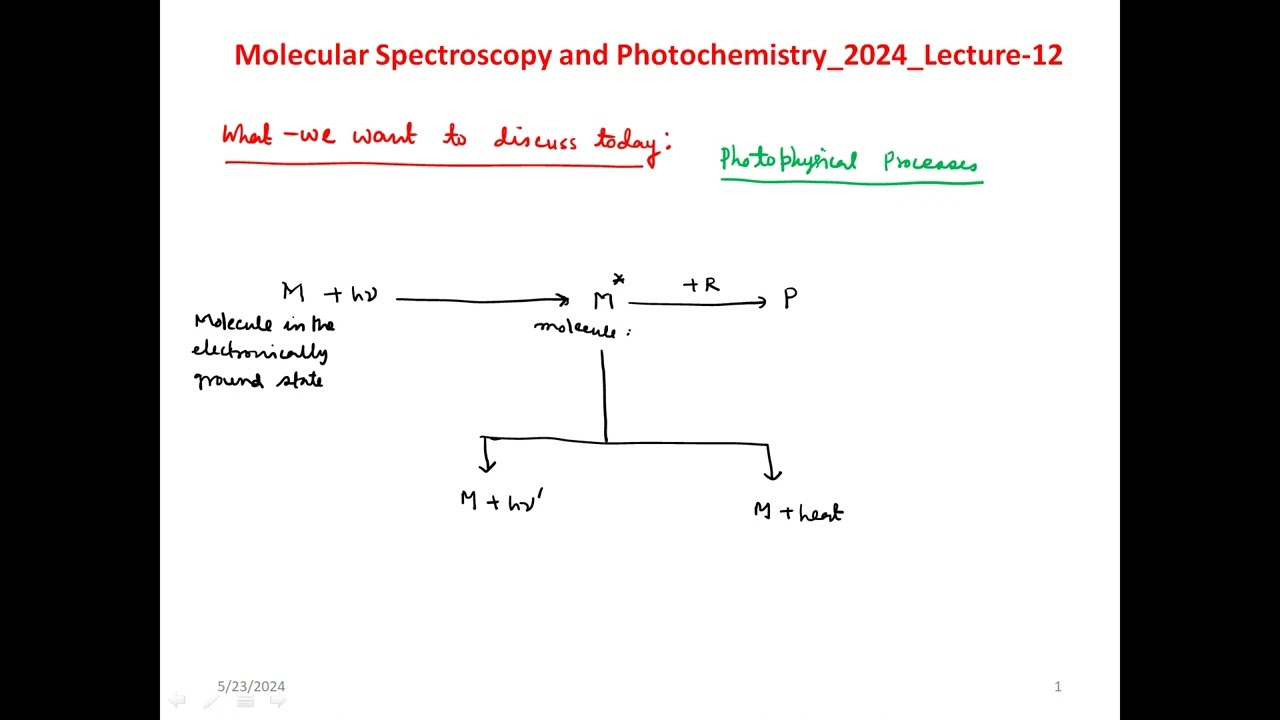




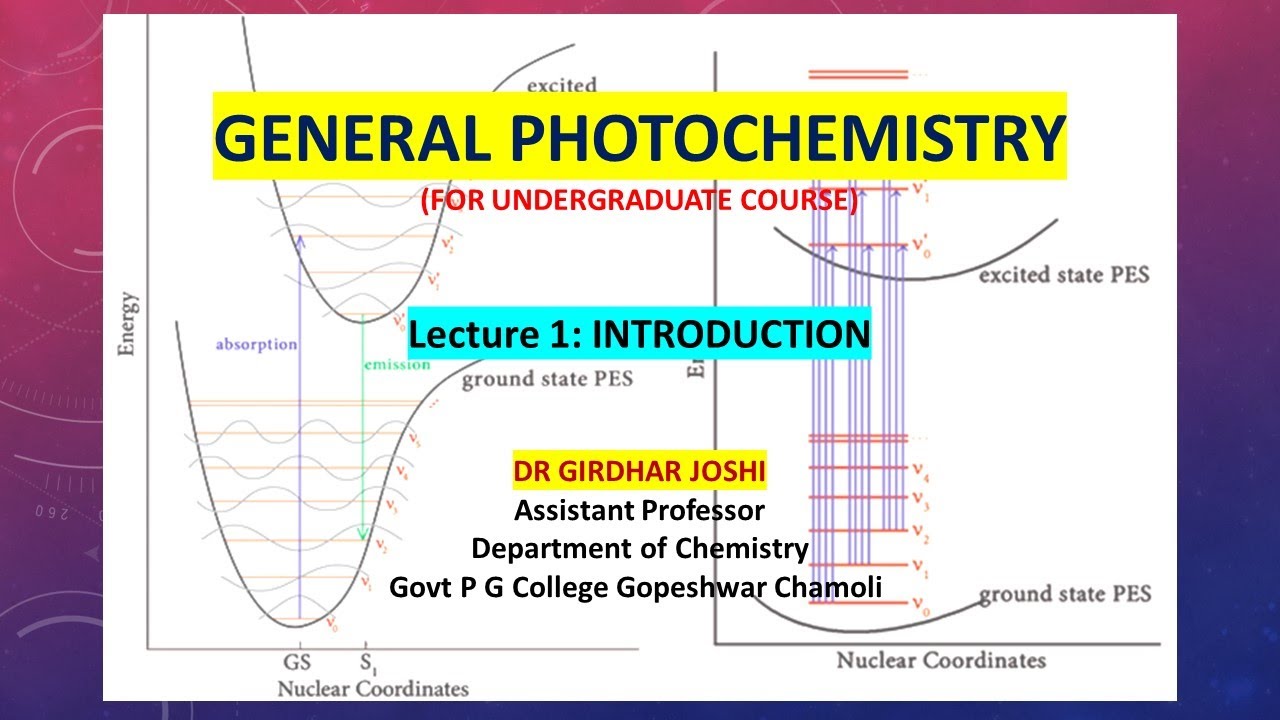
Photochemical reactions are chemical processes induced by electromagnetic radiation (UV or visible light), where molecules absorb light energy causing electrons to transition from ground to excited states. The Jablonski diagram illustrates these electronic states: singlet states (S₀, S₁, S₂) with paired electrons and triplet states (T₁) with parallel spins. Key processes include internal conversion (non-radiative relaxation between vibrational levels), vibrational relaxation, intersystem crossing (spin-flip transition between singlet and triplet states), fluorescence (radiative S₁→S₀ emission, 10⁻⁹-10⁻⁶ s), and phosphorescence (radiative T₁→S₀ emission, 10⁻³-10⁰ s). The essential criteria for photochemical reactions are: (1) the molecule must absorb light, and (2) the radiation energy must match the energy difference between ground and excited states.
Photochemistry Basics: Jablonski Diagram Explained
Added:so hello everyone welcome back to our new organic chemistry Series so here today we are starting about the organic photochemistry so this is the extended version of our radical chemistry course so here we are talking about the photochemical reactions uh photochemical reaction especially in the organic synthesis part okay so basically we have actually divided the photochemistry in the three major segment the first segment is Introduction in the introduction we are talking about the light and chemical bonds then we talking about jabloni diagram this is the heart of the photochemistry and the third we talking about the photochemistry of alken next our the next segment is the photochemistry of carbonal and this particular segment is very much important for your exam point of view because mostly the question has been come from this particular segment out of which we are talking about Nish type 1 and Nish type 2 this reactions are very very important for any kind of competitive exam also we talking about patter no reactions in our third segment we are talking about different photo rearrangement reactions such as the DIY methan rearrangement oxid dii methan rearrangement as a II methan rearrangement and the photo rearrangement so with this we have to now start with our lecture one of this particular course that is uh photochemistry class one introduction and jablonsky diagram now first I want to emphasize you that how light actually influence the chemical reaction first I is talking about the definition of photochemical reaction like a chemical reaction which is induced by electromagnetic radiation more precisely we can say that UV or visible light is known as photochemical reaction that means a molecule is there when the particular molecule is IR radiate by using UV light or visible light so what happened there is a certain changes has been observed basically the one of the particular electron has jumped from from ground state to excited state and that particular uh change is actually reason to show different type of reaction then we can classify that particular reaction as photochemical reaction since it is a photoinduced reactions now what happen that when a molecule is irradiated with a frequency that is nothing but light now light contains different different energy and when the particular energy when the molecule absorb that particular energy and that particular energy is matches the energy difference between the ground state and excited state of that particular molecule then the transition has been observed and that's actually leads to do the photochemical reaction okay now what happened that in a particular organic molecule there is a different different state is there now bonding orbital is there antibonding orbital is there non-bonding orbital is there so the bonding orbital contains the sigma orbital and Pi orbital and the antibonding is obviously Sigma star and Pi star and in between there is a nonbing orbital is there now as the molecule absorb the electromagnetic radiation from that particular light source that is UV light or visible light so what happen that energy is actually lead to do the transition like the electron goes from Sigma to Sigma star or it can go for a pi 2 pi star or we can get a nonbonding to Sigma star non-bonding to Pi star so this type of transition has been observed and this type of transition lead to uh a imbalanced molecular orbital State like in a nor normal molecule like when which is in the bonding orbital State the anti-bonding orbital usually empty but since the particular molecule actually absorb the light from the external source that light that is given by external source to the molecule then some of the electron are actually jumped to the anti or anti-bonding orbital and now the bonding orbital also contains electron antibonding orbital also contains electron and thus the particular molecule has show some kind of peculiar reaction that's why photochemical reaction is not looking like a traditional reactions that is actually observe in a different thermal condition reaction also the photochemical reaction that shows both singlet and triplet State whereas the thermal reaction is only shows a single state reaction now singlet and triplet State now you may think little bit confusing but when you're talking about the jablon diagram just two slides away then we are talking you will understand about that singlet and tri set very clearly so now let us talk about the essential criteria for a molecule to show photochemical reaction now a essential criteria for any kind of molecule to show photochemical reaction is the first is the molecule has the capability to absorb light this is the first essential criteria and second essential criteria is the radiation that is given to the molecule that is the UV radiation or uh visible regation that must match the energy difference of ground state and excited state now here you can see a empirical mot or molecular orbital diagram of any kind of organic molecule and this is the energy scale and here you can see that Sigma and Pi these are the ground state energy uh ground state orbital or we can say the bonding orbital where the sigma bonding orbital has lowered the energy and that's why actually the sigma St having the higher in energy so this typee of energy mixing and lcao that linear combination of atomic orbital is not actually I will discuss here we'll discuss this all the thing in the mot part of our inorganic chemistry part so just understand here that this Sigma have the lowest energy State and that's why its anti-bonding orbital Sigma star having the higher energy State similarly Pi is the much a little higher energy State than Sigma this is also bonding and also the P having a little lower energy than Sigma and in between there is a non-bonding orbital is also there now what happen that when a molecule that is present here then a bonding orbital so when it will actually uh when the particular molecule actually IR radiated by UV radiation what happen this particular electron now goes up to the anti-bonding orbital Sigma star and similarly if any electron are present in the pi orbital and the external light or the electromagnetic radiation energy is just matches with this particular transitional energy then this pi2 byar transition observe similarly if the electrons present in the non-bonding orbital now depending upon the electromagnetic radiation energy now nonbonding to P star transition observed or non-bonding to Sigma star transition is also observed now you may think that why that only Sigma to Sigma star transition has been observed or pi to Pi star transition observe why not Sigma to Pi transition observe or pi to Pi to Sigma star transition why not observe this is because that all of this particular Sigma star or P star they contain their own Symmetry and in the transition there is own rule that call symmetry matching since Sigma and sigma star have the same symmetry then according to the um symmetry matching criteria this transition is favored not for allowed not forbidden whereas the sigma and Pi between Sigma and Pi there is a no symmetry matching is there then that's why this particular transition is forbidden now this thing actually derived from the group Theory as well as the molecular orbital Theory but since we are not dealing with right now just you have to remember this thing that uh because of the not symmetry matching this type of transition hasn't observed and non-bonding non-bonding have their own case like and depending upon their symmetry it actually somewhat matches with the p star and sigma star and that's why this non-b Burning electron are capable to do both transition however Sigma and Pi are not shown all of these transitions they have certain limitation now out of which in our organic chemistry point of view we are mostly focused on these two transition that is the pi to Pi star transition and non-bonding to piar transition because Sigma to Sigma star transition have requires so much energy so normal condition it will not happen however pi2 byar and nonbonding to piar having very lower energy then this type of transition has been observed in a normal photochemical situation now if anyone tell about that what is the uh order of the transitional energy then you can see that Sigma to Sigma star have the highest energy gap and that's why the energy will be much higher then uh non-bonding to Sigma star have the more energy pi to Pi star have the little lesser energy and the less energy is to nonbonding to P star is the lowest energy gap is there that means this particular transition required very less energy so this is the order of transition energy now in organic chemistry point of view you have to know that type of excitation given by the class of organic compounds now here you can find here that Sigma to Sigma star transition which particular organic compound shows Sigma to Sigma star transition basically the alkanes which have only Sigma bond for example CH4 methane methane only have the sigma Bond and that's why actually methane will show that Sigma to Sigma are transition similarly nonbonding to p a transition has been observed between which of the molecule contains a lone pair like alcohol amide ether thioethers this contains oxygen oxygen contains lone pair and that particular lone pairs are mainly present in the non-bonding orbital and this actually shows the nonbonding to Sigma transition Pi P transition has been observed between alkenes carbonal compound and aromatic compound and then comes to the nonbonding to P this is also shown carbonal compound and acid der ative and these two are well studied because these are actually irradiating or this will be happening in presence of uvite or in the visible spectrum okay so now let us talk about some kind of law of photochemistry that you must know the first law is the gr Drapper law GRS deer law said that light must be absorbed by a compound in order for a photochemical reaction to takes place and the Stark Einstein law suggest each photons of light is absorbed by a chemical system where only one molecule is activated for the subsequently reaction now this two laws have no importance in your exam point of view but for your basic understanding you need to learn this two particular law now I will look into the most important thing that for the examination purpose as well as to form your basic understanding that is the jablon diagram and this is the empirical structure of jablonsky diagram now you can see that there is a different different uh diagram is there now I will discuss each one of them this s z s suggest for the singlet State and the S zero State means the ground ground singlet State S1 is the first excited singlet State S2 is the second excited singlet State and S3 is the third excited singlet State now between the two uh uh singlet state that s0 to S1 it uh contains different vibrational State like V1 V2 V3 V4 V5 and so on like so you can say this is all electronic State s0 S1 as well as T1 is also electronic State and here is also T2 is also there and between a T1 and T2 actually there is so many vibrational state is there and the T1 is contains the triplet State and S1 is contains single state now uh what happened that here we can say that this is one electron present here so I just first I will rub all this thing and and this part is very very important you have to understand this particular thing very cautiously okay so I just take a pen so I draw a electron set here in the szo state now when it will be actually irradiating by UV radiation what happen one of the electron are actually show transition from s0 to S1 obviously there is the energy gap must uh energy gap uh will be must be same to the irradiating light energy then it will show a transition and now what happened that initially it was something like this now one of the electrons are actually move here now you can see here that initially the electrons are something like this and after transition you can see the ground state have this electron and the excited is this electron that means the spin of the electron doesn't change here and when actually the transition observed between the s0 to S1 State always remember the the spin is not changing here and that's why actually it is called singlet State now it also have their own quantum number as well as spin quantum number we know that this particular have the plus half spin quantum number and this contains the minus half spin quantum number so if we calculate the total spin of the particular molecule after transition then we can say that s equal to 2 s + 1 now if we add this two plus half and minus of then it will be zero so that means it will be 2 into 0 + 1 that means one the overall spin multiplicity is still one here but however when it will be show at index system Crossing and then what happened that excited electron are contains the spin that got flipped and so what happened that since it is now getting flipped here so now it will look like this so both the spin have the same direction now what happened that since the both are the same direction that means the both are in now plus half since both are in the plus half that means now the spin uh s is small s is this is small s now the small polic is 1 that means now is equal to 2 into 1 + 1 that means three now that means we can say that now the system is in a triplet State now we'll show the more understanding in the next slide here you can see this is the complete jablonsky diagram where it will show a s z State now S zero state contains electrons upon irradiating one of the electron can jump either S1 state or depending upon the energy of the electromagnetic radiation it can jump to the S2 State also now if it is jumped to the S2 State now it will bring back to the S1 state by showing some kind of internal conversion now this green light are actually signifies the absorption now a ground state electron depending upon the energy given by the electromagnetic radiation that is a UV radiation now it can go via different different vibrational state of different different electronic state that is the S1 or S2 and these lines are signifies different different vibrational State now whenever it will go in the S2 State let us imagine that it will go bya S2 State like one of the electron is there and one of the electron is there I just simply cut down this one so what happened that now this will bring back after losing there is a some kind of relaxation takes place uh and then it will show the internal conversion to bring back in the S1 State now since it has come to the S1 State now it will uh it can came into any kind of vibrational state of S1 State okay now this will show the vibrational relaxation to come the S1 v0 State and after that it will show a radiative process to bring back to the ground state and the radiative process actually emits some kind of light and that's called the fluos sense or the particular electron can actually show a IND system Crossing which lead to the spring uh spin flipping of that particular system and it will go via triplet State now what happened that now this particular triplet state will now go via a radiative process which is called the phosphor Ence now with this radiative process the spin actually flip again a spin flipping has been done and now it will come to the the ground state energy that is the S zero state so this is the overall jablonsky diagram now here you can ask one particular question that why there is a no t0 State here where is t0 state you may ask here now you can say now we already know that t0 state means T State means the triplet state where the S is the spin multiplicity is three now if we need a spin multiplicity is three that means your both of the electron are in the same spin now if the ground state contains a t0o state that means uh we can say that both of the electrons have plus half in their spin quantum number and if both are in the plus half in spin quantum number then we can say that between these two particular electron the all of the quantum numbers that is the n l Ms that is the n is the principal quantum number n is the principal quantum number L is the aimal quantum number m is the magnetic quantum number and spin is the spin quantum number both are same for the two electrons now if the uh both of the two electron have the same nlms this is not possible because we know that PO Exclusion Principle says that no two electrons have the same uh Quant all the four set of quantum numbers and if t0 state is exist then what happened that one electron is here one electron is here and both electron have the same quantum numbers and this is not possible and that's why there is a no existence of t0 state and mostly that's why actually the compound present in the ground state in singlet form and after irradiating by the UV radiation depending upon the inter system Crossing or internal conver ver it will show uh triplet state so this will be very very important for your understanding and now we are talking about some approximate time scale for this transition like light absorption transition that is s0 to SN transition it will take 10 to the^ minus 15 second and now the internal conversion internal conversion is between a higher a state to a S1 state in any v0 uh term return is called by relaxation is called internal conversion and it will take a 10^ 14 to 10 minus 11 seconds so you can see that so many less uh time is required to this type of transition then comes to the vibrational relaxation vibrational El within the same uh electronic State or the singlet State there is a different different vibration higher vibrational energy level to lower vibrational energy level relaxation is called the vibrational relaxation so okay so it is vibrational relaxation now it will take a 10 to the^ -2 to 10 the^ - 10 second then it is come to the inter system crossing the inter system Crossing means the singlet state to tripled transition and it takes actually time and you can find that the time is actually much higher then it come to the radiative process furosin and phosphoros furosin that means the S1 v0 state to s0 VN State and it will take 10 - 9 to 10 - 6 second and phosphor it will take much time because in this particular phosphor process the electron spin has been flipped and that's why it takes so many long time and that's why phosphoros has shown uh say so many uh so longer time like for an example you can see the radium based watch you have already actually wear in your childhood also and also in the road side also you have seen some kind of glowing batch that is nothing but radium so this actually show phosphor Ence and it will take to uh come back from the triplet State excited state to singlet ground state is a much longer time that is a 10 Theus 3 to 100 second even sometime takes uh some days also also there is certain non-radiative Decay non-radiated de suggest that single state to ground state sing state but in a higher vibrational State transition Al also the triplet State ground state to singlet ground state in a higher vibrational level transition they are the non-radiative Decay and this also takes a much longer time so I hope this will be clear for you and with this we have to end this particular class so in the next class we are talking about the photosensitization and also we are talking about the photochemistry of alkanes so stay tuned for that particular lecture and thank you for listening
Up Next
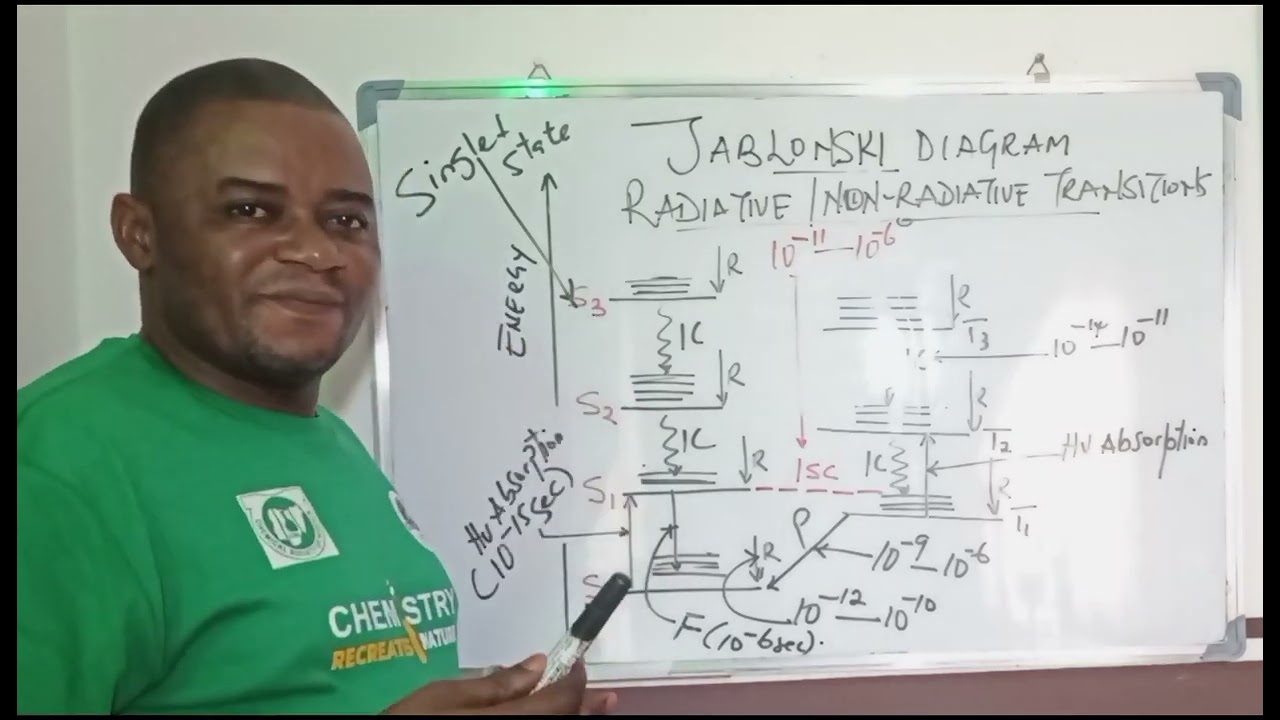
The Jablonski Diagram: Radiative and Non-Radiative Transitions | Photochemistry
@benedictugi8420
262 views•2025-07-15
Biocatalysis and Catalysis in Islatravir Synthesis | Merck Webinar
@SCIwheresciencemeetsbusiness
675 views•2020-10-08
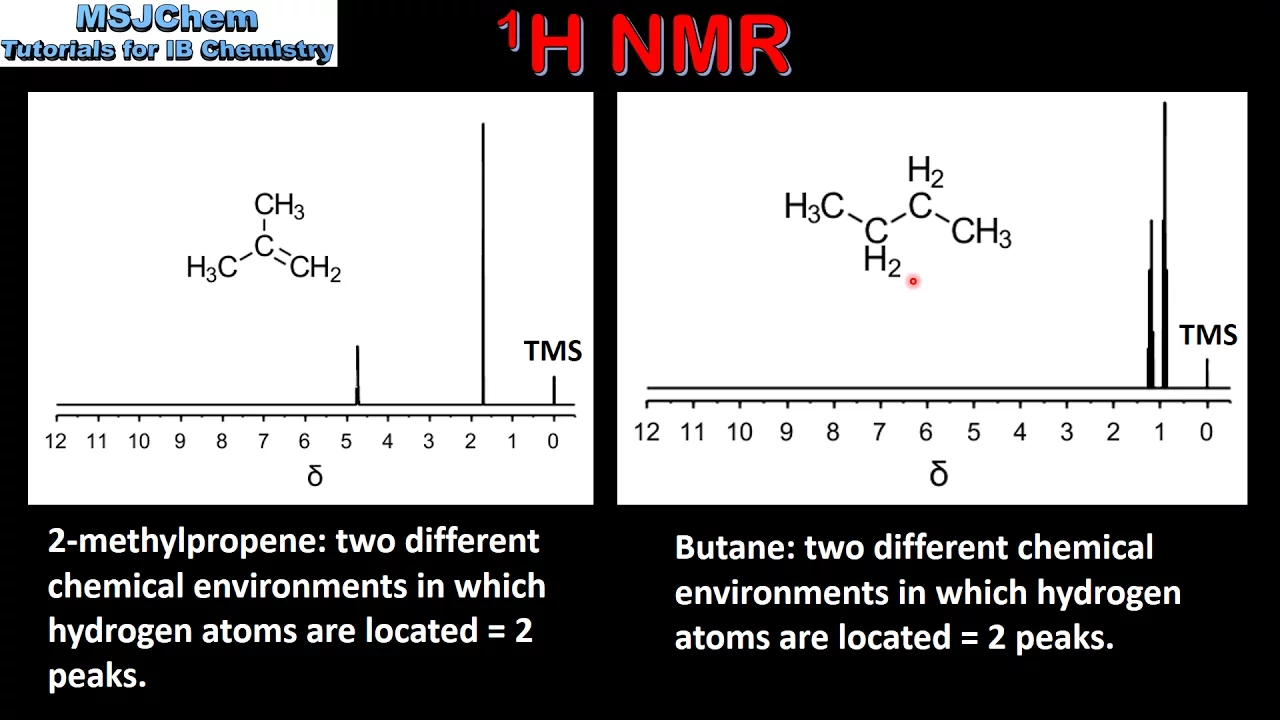
1H NMR: Determining Number of Peaks from Structure
@MSJChem
59.2K views•2017-04-06

Edible Water Bottles: A DIY Guide to Sodium Alginate Spherification
@ryan
10.5M views•2019-06-21
Related Study Plans & Knowledge Roadmaps
Structured learning paths in Chemistry