


![Photochemistry : Introduction to Basic Theory of Photochemical Process [Part 1]](https://i.ytimg.com/vi/2NDOL11d6no/maxresdefault.jpg)








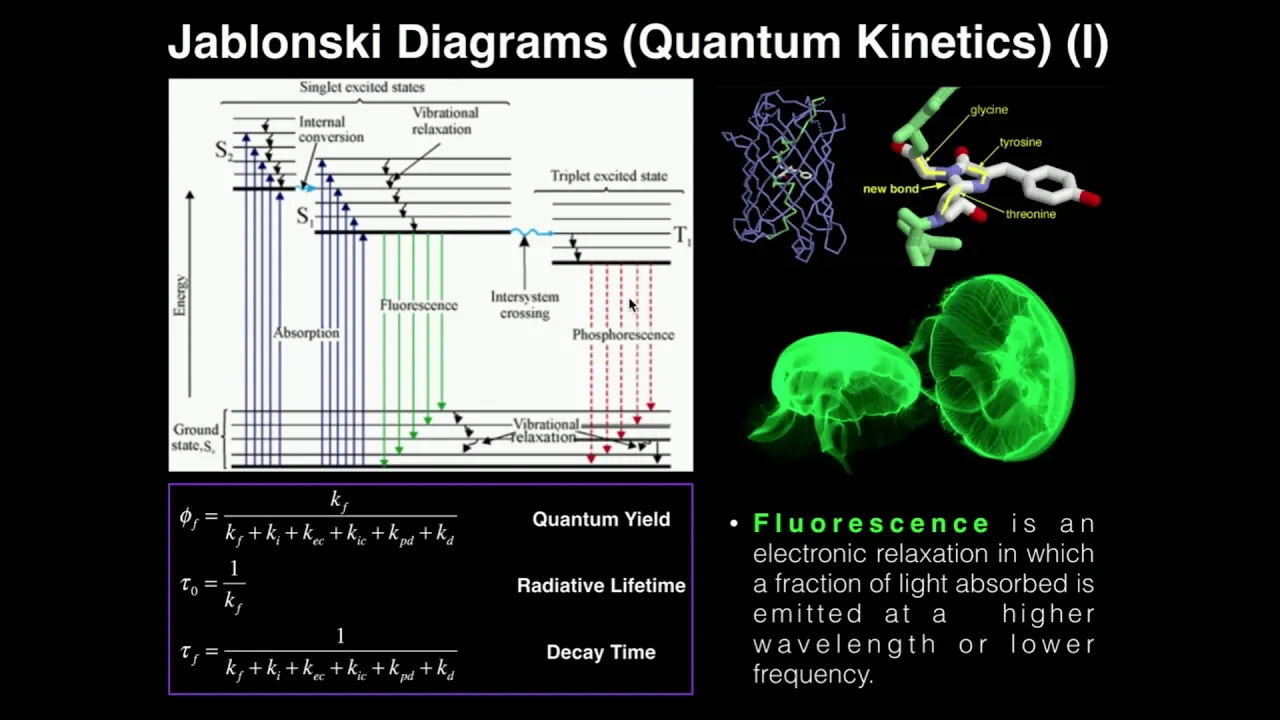
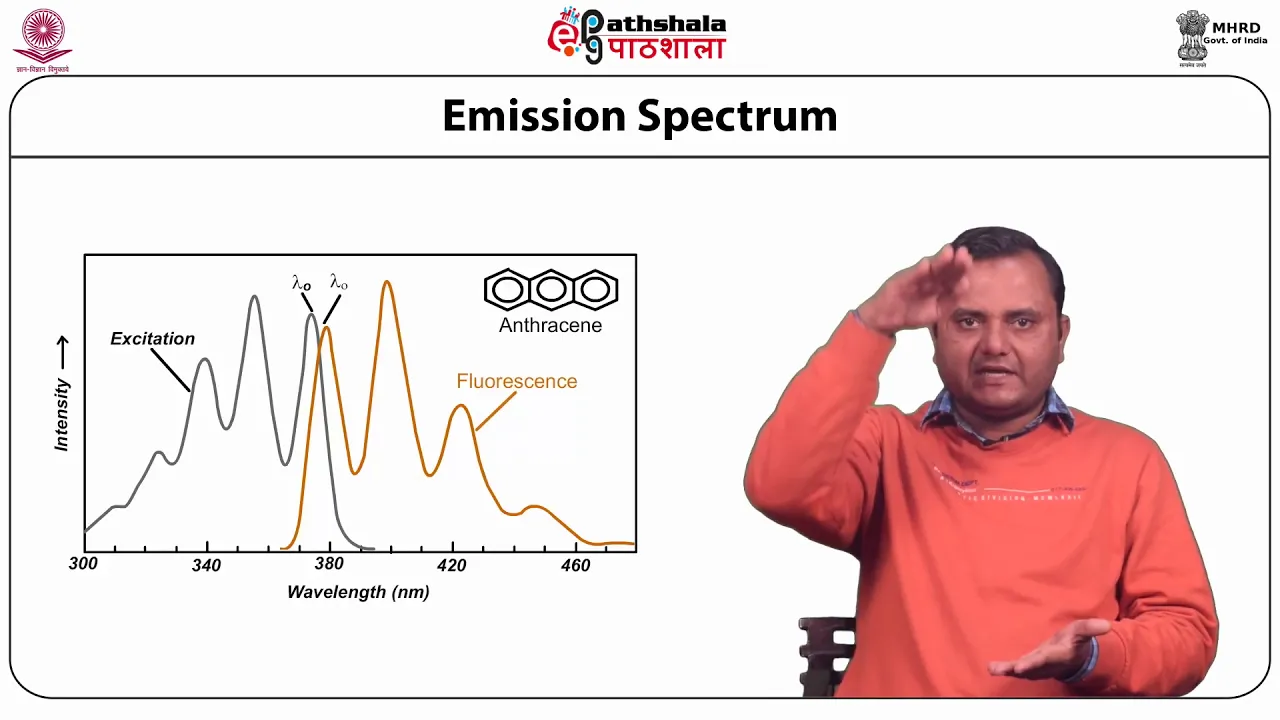









The Jablonski diagram is a visual representation used in photochemistry to illustrate the energy states and transitions of molecules when exposed to light. It depicts singlet states (S0, S1, S2) and triplet states (T0, T1, T2) connected by arrows representing different transition types. Radiative transitions involve the emission of radiation: fluorescence (S1 to S0, occurring in 10^-6 to 10^-8 seconds) and phosphorescence (T1 to S0, occurring in 10^-9 to 10^-6 seconds). Non-radiative transitions involve energy loss without radiation emission: internal conversion (IC, between states of the same spin multiplicity) and intersystem crossing (ISC, between states of different spin multiplicity). Photochemical reactions differ from thermal reactions as they depend on light absorption in the UV-visible region (200-800 nm) rather than heat energy, and can occur with either negative or positive Gibbs free energy.
The Jablonski Diagram: Radiative and Non-Radiative Transitions | Photochemistry
Added:Welcome to yet another class. I'm Dr. B, your chemistry teacher. And today we are going to be discussing the Jablonski diagram. What a sweet and comfortable nickname for someone certainly not me.
All right. So today we are going to be discussing Jablonsky diagram and under Jablonsky diagram we will be talking about radiative and non-radiative transitions.
Now this topic we're talking about here is under what you can comfortably call um photochemistry.
So under photochemical reactions we can discuss comfortably radiative and non radiative transitions using the jablonsky diagram. In discussing it do not forget that in this class you have to share you have to also subscribe. If you go to my YouTube channel Dr. be chemistry chemistry classes or rather science classes. You just need to tap the bell for subscription and whenever these videos come up they will get you will get a notification and do not forget to share. Tell your friends to also do what to also subscribe immediately the videos are shared to them. The first the first Facebook page you also have Dr. B science classes.
When you go there don't forget to follow and when you share you can also ask them to follow as well. And do not also forget to like leave your questions in a form of comments and we will do just this to them. All right. Now when we talk about jablon state diagram but let us first have an overview of what photochemical reactions are. Do you know that photo photochemical reactions are different from thermal reactions.
Photochemical reactions are completely different from thermal reactions. While photochemical reactions have much to do with uh with radiations have much to do with light. Thermal reactions can take place in both light both light and dark and dark uh conditions.
Now the photoic reactions are specifically reactions that uh come about by the presence of light radiation. So here radiations are very pertinent and that is why photochemical reactions are always taking place around the UV visible region of the electromagnetic radiation sorry electromagnetic uh uh table. Now when you look at the MRO you will see that the between about between two 2,000 to 8,000 Armstrong or about 170 to about 320 nanometer you find radiations that are UV or visible ultraviolet or visible and at this region it is believed that when such reactions are released there is a tendency for what for excitation or absorption and possible excitation or activation of molecules described as photons. So usually in photochemical reactions photons are what you expect as the the pertinent molecules that will be experienced.
Now what now why we say why we why we agree that photochemical reactions are quite different from thermal reactions.
You could see that photochemical reactions are at a region of just very light radiations. But thermal reaction need so much of heat for chemical reactions to what to take place. Now photochemical reactions are always being noticed in application everyday application you find photochemical reaction and a very quick one is in the photosynthesis.
Okay so you have heard about photosynthesis where of course plants generate their foods through the mitochondria by using um sunlight and water. The presence of sunlight already let you know that it requires what radiations. It require absorption of radiation and possibly what excitation or activation of photons that come with what that come with such radiations. And that is a typical example of what of photochemical reactions. You can also see them applicable in your current television screens. In your your screens are possibly showing or coming with those lights because of the presence of photochemical reactions that take place there. And also in your fluorescent tubes you could also find photochemical reactions taking place there. And that is because of the presence of phosphllorescent and fluorescent.
So the force fluoresence and fluoresence are actually the consequences of radiative uh transitions and that is applicable in your television screens and also in your u fluorescent tubes.
You can also find this uh this process okay in the synthesis of vitamin D. So when you see when you see the process by vitamin D is being produced okay or is being synthesized the process I mean the the the paramount the paramount implications is from the photochemical what reaction process.
Okay. And you can go on and on and on.
And how about how about in uh in your uh production of of monomers of nylon 6?
How we know that before we know that nylon 6 is the basic monomer in the production of nylons? Capriactan. So capriactan is the synthesis of capriactan which is a basic monomer for nylon 6 is also following the process of photochemical reactions. We can go on and on and on and on. There are some other synthesis of of certain chemicals that involves photochemical reactions.
Now everything about photochemical reactions is embodied in the Jablonsky diagram. You can possibly explain photochemical reaction comfortably if you understand the processes involved in the Jablonsky diagram. And that is why I felt we should talk about it.
All right. Now when you see a typical chemical photochemical reaction, okay, it is it is based on it is based on absorption of radiation. Like I said before, the basic principle of photochemical reaction or photochemistry is on the absorption of radiation. So whenever you have a monochromatic radiation or a monochromatic light, you allow it to pass through a homogeneous mixture. All right? You will notice that the radiation that goes into or goes through that mixture will have three different channels or effect. One is that that radiation that goes to that particular that particular um substance homogeneous mixture of substance will either do what be absorbed or it will be what? It will be transmitted or that radiation will um will rather uh be reflected. Okay. So it's either the radiation is absorbed or that monochromatic light that you put in to that sample is is is transmitted or it is what it is simply reflected. But in photochemistry the radiation that is of importance that we are concerned with is the radiation that is absorbed because it is that radiation that is absorbed that allow for activation. Okay. That activation or excitation of what? of photons in the course of a chemical reaction where you could now have the radiative and non-radiative transitions taking place. So the basic the the I mean the basic analogy here is for you to have radiative transitions or nonrad transitions taking place in the course of a photochemical reaction there must be radiations that are absorbed.
Now we're going to look at the principle of uh photochemistry and also look at um how we can possibly put up the the diagram okay that governs the principle and instrumentation of photochem that borders on photochemistry in our subing classes. But today let us see how we can be able to do justice the jab diagram.
Now something you must understand is that we have just mentioned that radiations that are absorbed are the radiations that allow for what? Allow for activation or excitation of what? Of molecules or photons in a course of a chemical a photochemical reaction. I don't want us to miss the fact that photochemical reactions are reactions who that does not depend on temperature totally. In fact, they depend very less on temperature. Unlike thermal reactions that depend seriously on temperature because they depend on heat, these ones depend on light, not on heat energy, but just on light energy. And you also have to understand that the G free energy that determines continuity of reactions and stability of reactions for photochemical reactions is always negative and positive at the same time. So you you can either have it negative or have it positive. describing the nature of stability in terms of stability or the nature in terms of physibility okay or spontaneity of photochemical reactions unlike in thermal reactions where you can only have thermal reaction showing gives free energy to be what to be negative talking about what talking about spontaneity of such reactions now let us look at the jablon state diagram if you take a look at this diagram you notice that this diagram has some has some letters numbers that are written everywhere around it. But let us take it gently. If you take a look at this, this S that you see here is simply describe as singlet state. Okay? So this S that is seen here is singlet.
This is singlet state. So this is the this is the the the ground state singlet state. This is the first uh the first energy level single state. Second energy level single state. Third energy level single state. And you could have different energy levels as you go.
And then this T that is here is described as a triplet state.
The T is described as a triplet state.
So you also have the triplet state ground energy level. You have the triplet state first energy level until the triplet state third energy level.
And all these states whether single state or triplet state play significant role in describing the jablo diagram where we want to study the excitation or the activation of photons of molecules in the process of chemical chemical reaction. Okay. Now when you take a look at inside here we have arrows written here. So what are these arrows?
Okay. What are these arrows? So these arrows simply means relaxation. The arrows that you see here, this arrow you see here simply means relaxation.
It simply means relaxation.
That what the arrows mean, relaxation.
The IC you find here, look at IC. Look at IC. Look at IC. Look at IC. The IC you find here is simply called internal conversion.
The IC you see here is called internal conversion.
And the ISC that you see here is the inter system crossing. So you can this is the inter system crossing.
Inter system crossing ISC and the IC is simply described as um as your internal conversion. Internal conversion.
Okay.
So I want us to understand what this writing here mean. This is simply single state from the from the ground state energy level for the singlest state energy level and then the first second and the T is the triplet state begin from the ground state to the first energy level up to the third energy level and the arrow means relaxation and then the IC means internal conversion where the IA simply means inter crossing and we're going to see the impact of these things we're talking about here Now when you have when you have a when you have um a molecule or a photon at this energy level which of course is the uh initial the ground state energy level single state energy level and it gains radiation.
against radiation, okay, from the sun or perhaps or from any source that can give us radiation around 200 2,000 to 8,000 armstrong or 170 to 220 nanometer at the UV visible region level. If it acquires such a radiation, it is going to do what? It's going to activate that particular molecule at the ground energy level here to do what? to move and that's why you see we have HV absorption and usually this radiation that will allow for this UV radiation that will allow for the excite sorry the the the molecule at the ground ground state energy level to be excited will take just about 10 rest 15 seconds and that molecule or photon will be excited.
Now as soon as it is excited it moves to where to the first energy level at the single state it might at this point in time decide to do what? Decide to lose energy and fall back to the ground state. Now if the molecule was at the first single state energy level and decide to lose energy or in a process the supply of the UV visible from the UV visible radiation is not that much again to move it to the net energy level and it decides to fall back to the ground state. It is going to emit light and the light is going to emit is what you call fluoresence.
And usually this fluorescent which is the light emitted when a particular um a particular photon or molecule lose energy and decide or lose light and decide to do what or radiation to fall back to the SO is always called what?
Fluorescent. And this fluescent is always called allowed transitions.
They're always called what? Allowed transitions. Now allow transition because the transitions at this point in time takes only about 10^ - 6 or 10^ - 8 seconds for it to occur. So once it goes up from s0 to s1 and loses energy or or radiation immediately it falls within 10 - 6 seconds. So it's as a flash and that is why it is possible for you to have fluorescent bulbs and to also have your television screen showing with the lighting that you see because that fall in transition is that fast and quick that as the molecule continue to fall from the S1 down to the SO they emit that radiation as fast as possible and it gives you a fluoresence.
Now if this particular molecule decides to rise, gain enough energy and rises from here, moves all the way to S_sub_2 or S3, it will definitely again lose radiation and then fall again. If it falls from S3 to S_sub_2 or from S3 to S_sub_1 or from S_sub_2 to S1 certainly not from S1 to S0 the falling from S3 to S1 or S2 to S1 that is at their single state at the different energy level is described as what internal conversion.
So at any point there is a relaxation there is always a b there is always bound to be loss in energy or loss in light radiation and the photon molecule is bound to do or to fall from this energy level to another or from this to one or even from 2 to one and if it falls from 3 to one or 2 to one what kind of transition you experiencing at that point is an internal conversion.
Okay, that's what happened around here.
Now let us look at what happened around here. That is um around this particular region. But before we go there, let us also look at what we see here. There is a process where you can have a crossing a crossing of the photon that loses um energy and decide to fall from a particular higher level to the next.
Sometime there's a crossing and when this particular photon falls from I mean it's activated and excited and it loses energy and then it choose to fall.
If it falls and is said to cross from T1 which is a triplet state down to S0 instead it also emits radiation or light and is called flor fluorescent and usually fluorescent happens around 10^ - 9 to 10^ - 6 seconds but it's not that fast like fluorescent itself.
No wonder it's called fluorescent.
So that is how fluoresence happen. Now you can also see that relaxations are always about 10 rest sorry 10^ -2 to 10^ - 10 seconds which means that the radiations the relaxation process is also a bit fast but not faster than what than fluorescent process.
So every relaxation will always give rise to a particular what transition.
Okay. Now at this point here we also have um we also have internal conversions at this point where we had agreed that internal conversions will always come as a result of what? As a result of a fall of a molecule or a photon that loses energy from either the triple state three energy level or to the to I mean to the triple state one energy level or from the triple this the the triple state uh second energy level to the triple state level. Now once there is a fall of trans a fall of a photon or a molecule from this higher energy level to one or from two to one you are going to have an what an inter an internal what conversion which will take place internal conversion transitions which will take place and there is always an emission of light in the process but where you have the transition from this particular T1 triple state one going to S0 or even triple state one crossing to uh to uh to to this to the single state one you always have an inter system uh sorry an inter system what crossing that is going to take place and usually inter system crossing takes about 10 rest -1 to 10^ - 6 seconds now let us bring ourself back what are radiative and non-radiative transitions from that explanation I'm sure you have an idea already now radiative transitions are usually transitions that are described as emission transitions.
Radiated transitions are emission transitions.
While non-radiated transitions are always seen as what? As heat transitions. There are no emissions in non radiative transition. No wonder they are described as non-radiative.
Now radiative transitions are transitions that take place with what?
with an emission of radiation. That is just it. Radiate transitions are radiations that take place or occur with the emission of radiation. And usually there are two basic types of radiative transition and those two types are fluorescent and false floresence. Now it has brought us to that understanding when I explaining this. Now radiate transitions are transitions that are involved that involve or that occur with what with emission of what? Radiations and these are usually fluorescent and post fluorescent. And remember that fluorescent transitions are the ones that occur in about 10us seconds when a molecule or photon loses what? loses um light or radiation and choose to fall from S1 to S0 while the force the the I mean the forescent transition will also give out light when it loses energy and decide to fall from the triple state to the singular state. So there are two basic type of rad transitions that will always give what light or radiation at or emission of radiation at in the course of their of their fall from the high energy level to lowest energy level and that is the fluoresence and falseense.
Now non-radiative transitions are transitions that take place without transmission of emissions.
There are no um emission of of radiations rather there are no emissions of radiation for nonradiative transitions. There are no what? Emission of what? Radiation.
Now those particular ones will not give out what will not give out light. Now those kind of non-rad transitions are the ones we said in we call inter internal conversion and what interystem crossing. So intercystem crossing and internal conversion are also radiation sorry are also of course they are also transitions but it's just that they do not emit radiation at the end of the day but the most important of these two are the rad transitions because like I've mentioned so many of those example or applications I've mentioned make use of what radiative transitions that is the fluesence and the full florescent but it doesn't mean that we do not have also applications where um intern I mean internal conversion and inter in crossing that belong to non-graduate transitions are al are applied they're also everywhere so in the course of our lecture today I want to believe that you have understood so much about the jablons diagram in its use to explain radiative and non-radiative what transitions I'm glad that we are able to make to do justice to this particular topic today.
Now I'm going to give you something to go and study to have a better understanding.
Now that thing you're going to go and study is called cold lights.
Cold lights.
So you're going to write on You're going to read on cold lights.
Okay. Read on cold lights and types.
Read on cold lights and taps.
Surprisingly, you asking what is cold lights? What are we talking about cold lights? What are cold lights? It is there. Research on it. read on cool lights and their types. It will help you to understand more about radiative and non-radiate transitions. Now, until next time, do not forget to share. Do not forget to subscribe. Do not forget to leave your comments and like as well, both in the YouTube and in the Facebook page, Dr. B Science Classes. And until next time, it is bye for
Up Next
Ocean Acidification Chemistry | MIT Solid-State Chem
@mitocw
5.5K views•2020-12-07
Biocatalysis and Catalysis in Islatravir Synthesis | Merck Webinar
@SCIwheresciencemeetsbusiness
675 views•2020-10-08
1H NMR: Determining Number of Peaks from Structure
@MSJChem
59.2K views•2017-04-06
Edible Water Bottles: A DIY Guide to Sodium Alginate Spherification
@ryan
10.5M views•2019-06-21
Related Study Plans & Knowledge Roadmaps
Structured learning paths in Chemistry