Nanochemistry: Synthesis, Properties & Analysis
Learning Goal: This curriculum provides a rigorous introduction to the chemistry of nanomaterials. By the end of this course, you will understand how the physical scale of nanomaterials shapes their chemical and physical behaviors, how to synthesize nanoparticles using both top-down and bottom-up chemical and physical pathways, and how to analyze nanomaterial size, morphology, and crystal structure using state-of-the-art characterization techniques.
- Prerequisites: General Chemistry, introductory organic molecular bonding, and basic physics (wave-particle duality, basic optics).
- Estimated Total Study Time: 15 hours
Module 1: Foundations of the Nanoscale
This module establishes the physical and mathematical boundaries of the nanoscale (typically 1–100 nanometers). You will explore how scale transitions affect fundamental properties, with a heavy emphasis on the dramatic increase in the surface-area-to-volume ratio. This physical scaling law alters surface energy, thermodynamic stability, and chemical reactivity, distinguishing nanomaterials from their bulk counterparts.
Recommended Videos
- Why this video is valuable: This lecture sets the physical groundwork by defining nanoscale dimensions ( meters) in comparison to atomic scales (Angstroms) and bulk systems. It clarifies how quantum and surface-dominated regimes govern nanostructured matter.
- Knowledge Checkpoint:
- Define the nanoscale range and relate it mathematically to meters and Angstroms.
- Understand why materials constrained to the 1–100 nm limit transition from bulk behavior to quantum/surface-dominated behavior.

- Why this video is valuable: Dr. Deori delivers a thorough, highly quantitative lecture showing how splitting a bulk crystal into smaller nanoparticles exponentially increases exposed surface atoms. This serves as the key mathematical driver behind nanoscale surface chemical reactions and thermodynamic shifts.
- Knowledge Checkpoint:
- Perform geometric calculations showing the change in surface-area-to-volume ratio () as a macro-material is subdivided down to 10 nm cubes or spheres.
- Explain how a high ratio of surface-bound atoms leads to coordinative unsaturation and elevated surface energy.

- Why this video is valuable: Offers an excellent introductory visualization that places nanoparticles alongside organic molecules, cellular entities, and fine dust, making scale intuitive for incoming chemists.
- Knowledge Checkpoint:
- Differentiate between natural ultrafine particles (such as ambient dust) and engineered nanomaterials.
- Identify where nanoparticles fall on the size scale relative to basic small molecules (like water or oxygen) and cells.
Module 2: Size-Dependent Physical & Optical Properties
At the nanoscale, physical dimensions directly dictate electronic and optical properties. In this module, you will learn about quantum confinement—where shrinking a semiconductor's size increases its band gap—and study Localized Surface Plasmon Resonance (LSPR), which drives the intense color changes of colloidal gold and silver nanoparticles.
Recommended Videos

- Why this video is valuable: Delves into quantum mechanics to explain what happens when the physical dimensions of a solid approach or fall below the de Broglie wavelength of its charge carriers (electrons and holes). It details the transition from continuous energy bands to discrete energy levels.
- Knowledge Checkpoint:
- Explain the concept of the Bohr exciton radius and its role in quantum confinement.
- Describe the structural and electronic differences between bulk energy bands and the discrete, atom-like energy levels of zero-dimensional quantum dots.
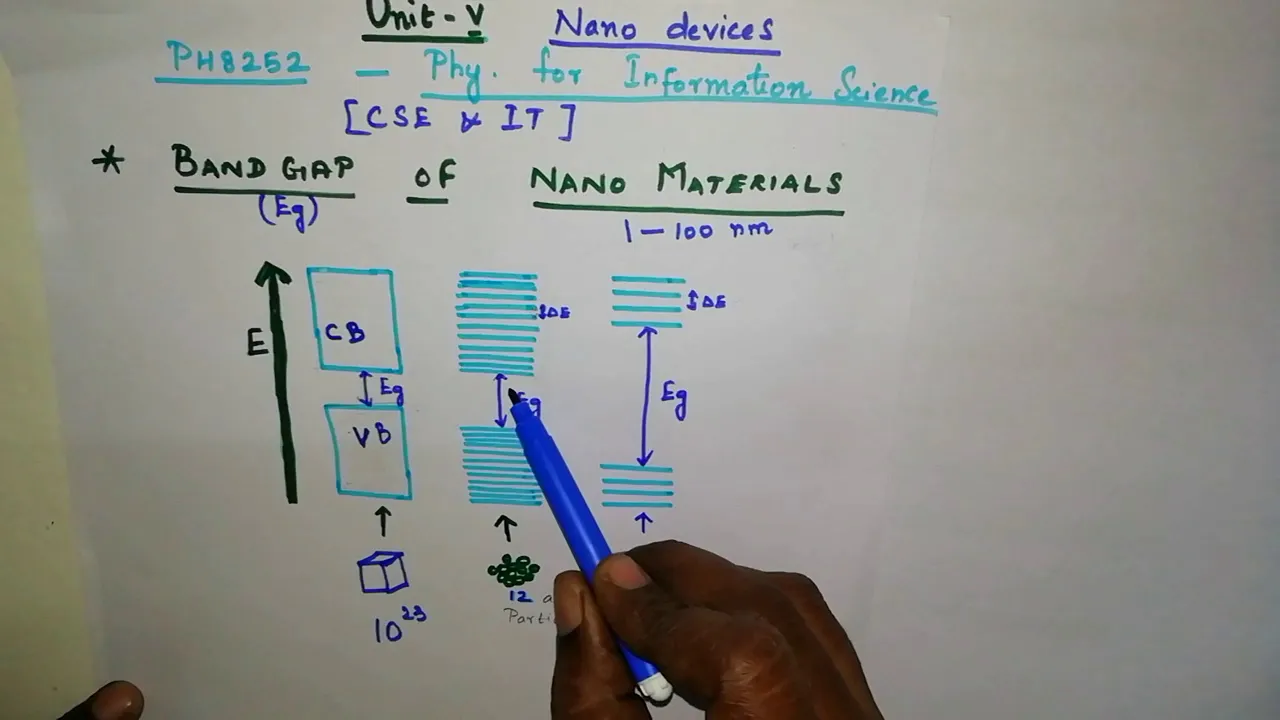
- Why this video is valuable: Directly relates size reduction to band gap widening. You will learn why blue-shifting occurs in nanomaterial absorption and emission spectra, which is crucial for tuning semiconductor quantum dots for light-emitting displays or solar cell designs.
- Knowledge Checkpoint:
- Explain why shrinking a semiconductor nanoparticle's physical size widens its effective band gap.
- Predict the optical shift (blue-shift vs. red-shift) in emission when quantum dots decrease in diameter.

- Why this video is valuable: An advanced, rigorous academic lecture that provides the complete electromagnetic background of surface plasmon resonance (SPR). It explains how incident light drives the collective oscillation of free conduction electrons in metallic nanoparticles.
- Knowledge Checkpoint:
- Define Localized Surface Plasmon Resonance (LSPR) in metal nanoparticles.
- Explain how size, shape, and surrounding dielectric medium control the plasmon resonance frequency of noble metal (Au, Ag) colloids.

- Why this video is valuable: This quick demonstration showcases the physical manifestation of LSPR, showing how and why nanoscale gold suspended in water appears brilliant ruby red rather than gold.
- Knowledge Checkpoint:
- Connect the visual color changes of colloidal gold directly to the selective absorption and scattering of light by surface plasmons.
Module 3: Synthesis Methods: Top-Down vs. Bottom-Up
To synthesize nanomaterials, chemists use two opposite paradigms. This module teaches you the physical, high-energy methods used in top-down pathways (such as ball milling, photolithography, and etching) and the chemical control required for bottom-up approaches (including sol-gel conversion, wet chemical reduction, and green plant-extract-mediated synthesis).
Recommended Videos

- Why this video is valuable: Provides a clear engineering overview contrasting physical size reduction (top-down) with atom-by-atom chemical assembly (bottom-up), framing the chemical advantages of each path.
- Knowledge Checkpoint:
- Contrast top-down fabrication with bottom-up self-assembly in terms of cost, scalability, and defect rates.
- Give classic examples of both pathways (e.g., lithography vs. chemical precipitation).
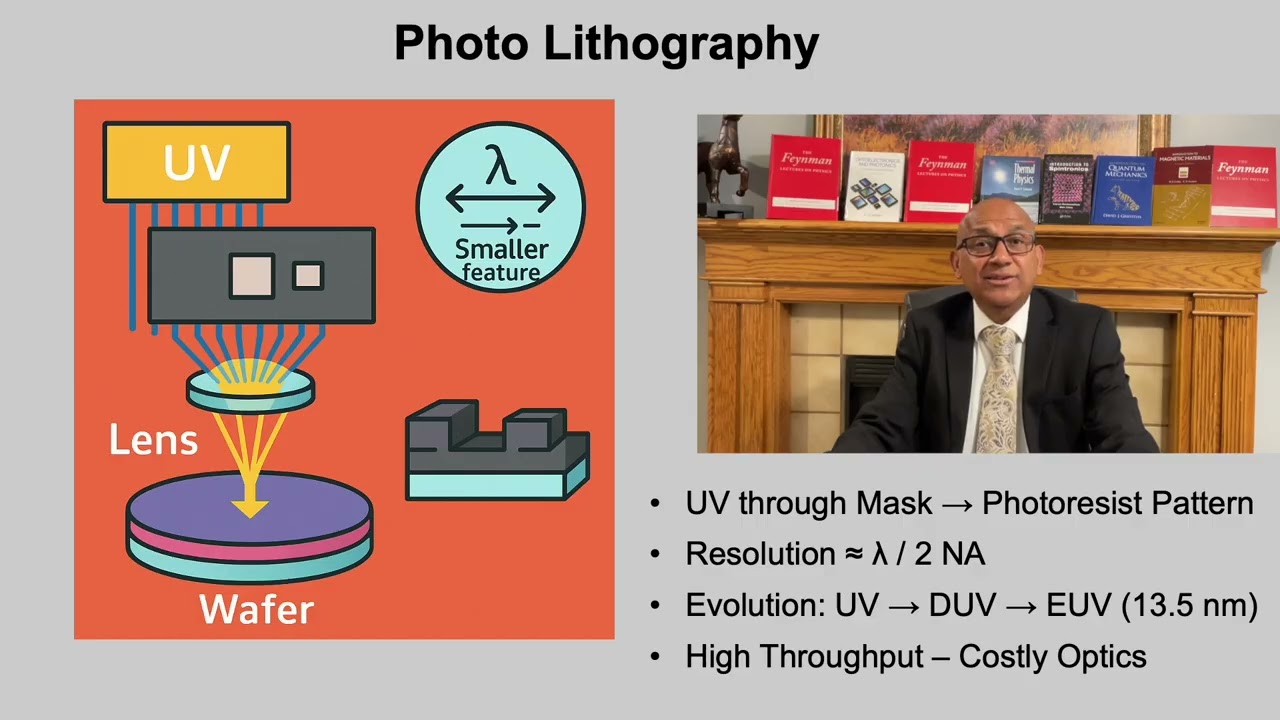
- Why this video is valuable: Corrects a key educational gap on physical top-down processes. Dr. Tiwari explains the mechanics of high-energy ball milling, micro-mechanical grinding, and the chemical etching steps used in photolithographic wafer processing.
- Knowledge Checkpoint:
- Explain how high-energy ball milling uses mechanical shear and collision forces to reduce grain size down to the nanoscale.
- Describe the photolithography process, identifying the roles of photoresist masks, UV illumination, and solvent etching.

- Why this video is valuable: An academic deep dive into wet chemical bottom-up synthesis. It explains the molecular transformations that occur when precursor monomers undergo hydrolysis and condensation to form a 3D network (gel) from a liquid suspension (sol).
- Knowledge Checkpoint:
- Map out the chemistry of sol-gel synthesis, identifying the hydrolysis and condensation reactions of metal alkoxide precursors.
- State how aging, drying, and calcination parameters dictate final oxide structure and porosity.

- Why this video is valuable: Focuses on wet chemical reduction of metal precursor salts to form colloidal metal nanoparticles. It highlights how reducing agents drive reaction kinetics and how capping agents prevent uncontrolled particle aggregation.
- Knowledge Checkpoint:
- Explain the roles of precursor metal salts, reducing agents (such as sodium borohydride), and capping/stabilizing molecules during wet synthesis.
- Outline how the balance between the nucleation rate and the crystal growth rate dictates the final nanoparticle size distribution.
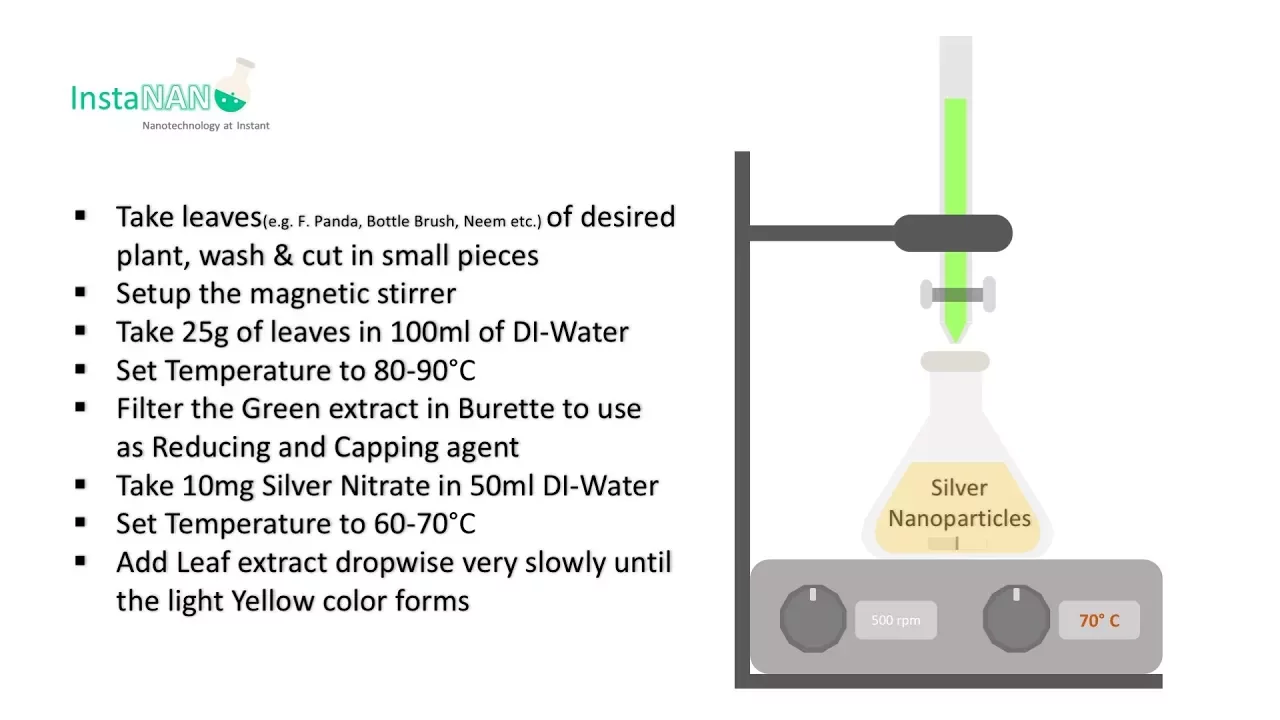
- Why this video is valuable: Showcases green biosynthesis, illustrating how organic molecules found in plant extracts serve as non-toxic, eco-friendly reducing and capping agents for silver nanoparticle synthesis.
- Knowledge Checkpoint:
- Identify which organic biomolecules in plant extracts (such as polyphenols or flavonoids) act as reducing agents.
- Explain why biological "green synthesis" is preferred over conventional wet chemical reduction for biomedical applications.
Module 4: Characterization Techniques for Nanoparticles
Because nanoparticles are too small for optical microscopes, researchers use specialized instruments to analyze them. This module covers electron microscopy (SEM, TEM) for visualizing morphology, X-ray diffraction (XRD) for checking crystalline phases and grain size, Dynamic Light Scattering (DLS) for measuring hydrodynamic diameter, and UV-Vis spectroscopy for optical profiling.
Recommended Videos

- Why this video is valuable: This animation clearly explains how electron microscopes overcome the optical diffraction limit of light. It details the mechanical and physical differences between Scanning Electron Microscopy (SEM) and Transmission Electron Microscopy (TEM).
- Knowledge Checkpoint:
- Explain why electron beams provide a sub-nanometer resolution that is impossible with visible light.
- Differentiate between SEM (surface topography, backscattered/secondary electrons) and TEM (transmitted electron absorption, inner structures).

- Why this video is valuable: Connects crystal lattice structures to analytical X-ray diffraction profiles. It explains how to determine structural parameters using Bragg's Law and calculate crystallite domain sizes.
- Knowledge Checkpoint:
- Write down Bragg's Law and explain how it relates X-ray wavelength, lattice spacing, and diffraction angle ().
- Explain how crystallite grain size causes peak broadening in XRD profiles and how to calculate this using the Scherrer equation.
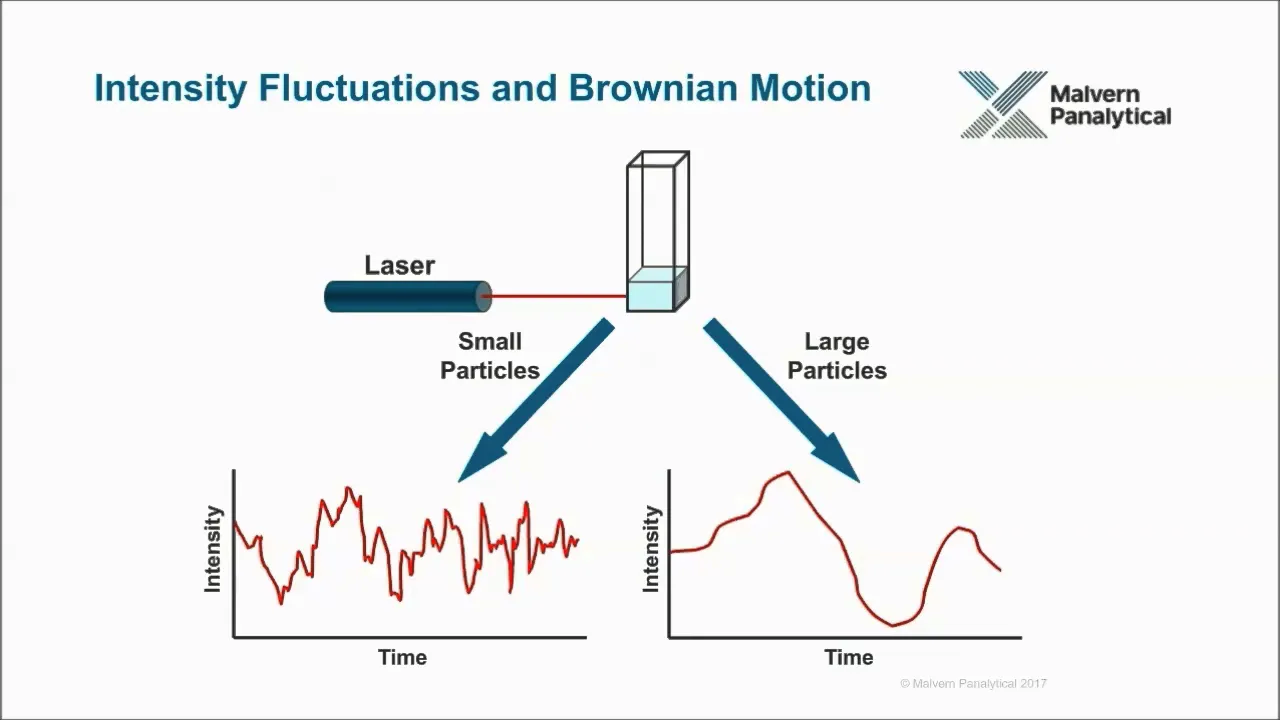
- Why this video is valuable: A thorough industry guide to Dynamic Light Scattering (DLS). It explains how measuring the Brownian motion of particles in suspension allows you to calculate their hydrodynamic size distribution.
- Knowledge Checkpoint:
- Describe how DLS translates scattered light intensity fluctuations into a particle diffusion coefficient.
- Explain the physical difference between a particle's core size (measured by TEM) and its hydrodynamic size (measured by DLS).
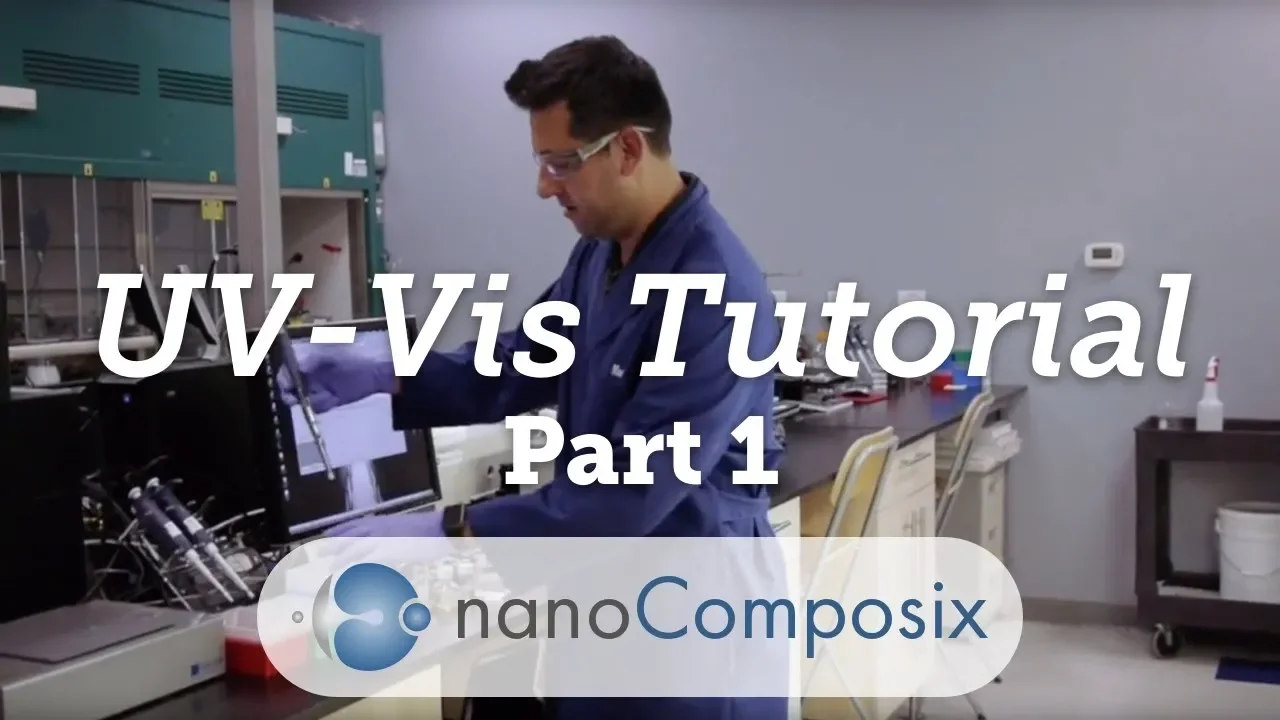
- Why this video is valuable: Demonstrates how UV-Vis spectroscopy can be used as a simple and fast screening tool. It shows how changes in absorption profiles reveal shifts in nanoparticle size, concentrations, and aggregation states.
- Knowledge Checkpoint:
- Explain how UV-Vis absorbance spectra reveal the aggregation state of a nanoparticle suspension.
- Describe why the absorption peak wavelength shifts when nanoparticles grow in size.
Module 5: Novel Carbon Nanomaterials & Real-World Applications
This module explores carbon allotropes, such as -hybridized graphene and carbon nanotubes (CNTs), and reviews real-world applications of nanotechnology. You will learn about gas-phase CVD synthesis, nanoparticle-based targeted drug delivery in medicine, and titanium dioxide () photocatalysis for environmental cleanups.
Recommended Videos

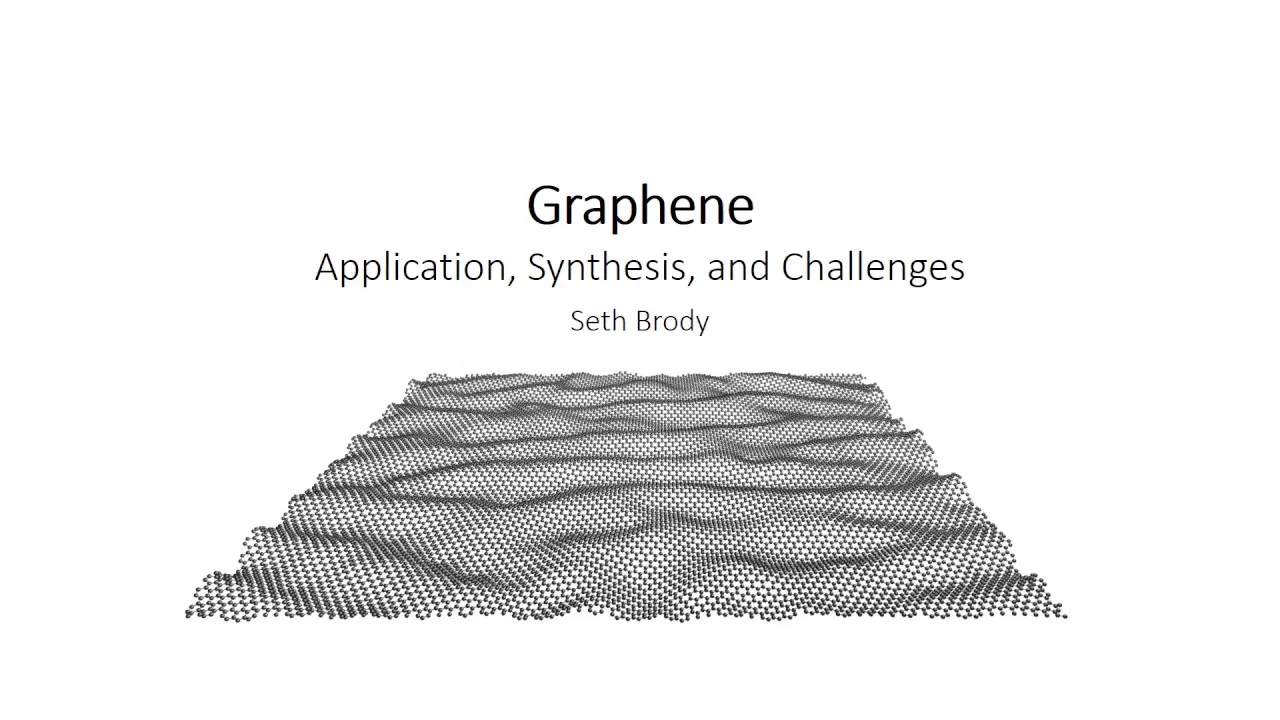
- Why this video is valuable: Addresses a key curriculum gap regarding carbon allotropes. It uses 3D models to show how single-sheet graphene is structurally isolated from graphite and details the rolled geometries of carbon nanotubes defined by their chiral indices .
- Knowledge Checkpoint:
- Describe the hybridized orbital structure of graphene.
- Differentiate between armchair, zigzag, and chiral carbon nanotubes based on their chiral vector coordinates .
- Why this video is valuable: Delves into the chemistry of Chemical Vapor Deposition (CVD). This is the primary industrial method for growing high-quality graphene sheets by cracking precursor gases over catalytic transition metal foils (like copper).
- Knowledge Checkpoint:
- Identify the chemical precursors, carrier gases, and temperature ranges typically used in graphene CVD growth.
- Explain the role of catalytic metal substrates (such as copper or nickel) in breaking down hydrocarbons and forming uniform carbon monolayers.

- Why this video is valuable: Visually demonstrates how engineered nanoparticles function as smart drug delivery systems, showing how protective shells and surface targeting ligands allow them to deliver therapeutics selectively to tumor cells.
- Knowledge Checkpoint:
- Explain the difference between passive targeting (via the Enhanced Permeability and Retention - EPR effect) and active targeting using surface ligands.
- Describe how surface coatings (such as PEGylation) prevent clearance by the immune system.

- Why this video is valuable: Details the chemistry of photocatalysis. This lecture compares crystalline phases (anatase vs. rutile) and explains how light absorption generates highly reactive electron-hole pairs to break down organic pollutants.
- Knowledge Checkpoint:
- Explain how light absorption generates electron-hole () pairs within a nanoparticle.
- Compare the photocatalytic activity and thermodynamic stability of the anatase and rutile phases of .
Course Map
This flowchart shows the recommended learning path and key module dependencies.
Key People Index
- Dr. Kalyanjyoti Deori (Module 1)
Context: An academic chemistry lecturer who provides clear mathematical frameworks for explaining how physical dimensions dictate surface atom coordinates and chemical thermodynamic properties. - Dr. T Dhananjay Rao (Module 3)
Context: A synthetic materials chemist who provides detailed practical parameters for the wet chemical synthesis of metal nanoparticles. - Mildred Dresselhaus (Module 5)
Context: Known as the "Queen of Carbon Science," she was a pioneer at MIT whose foundational work mapped the electronic structures of carbon nanotubes, graphene, and their Raman vibrational states. - Robert S. Langer (Module 5)
Context: A highly distinguished bioengineer at MIT who pioneered early and advanced nanoparticle-based drug delivery systems and controlled polymer release kinetics.
Final Self-Assessment
Test your understanding of the course material by completing this comprehensive self-assessment checklist:
- Can you calculate the change in total surface area when a 1 cm³ solid block of copper is divided into 5 nm particles?
- Do you understand why quantum dots of different sizes emit different colors under the same UV light source?
- Can you explain how the de Broglie wavelength of an electron relates to the physical dimensions required to observe quantum confinement?
- Are you able to describe the physical mechanism of Localized Surface Plasmon Resonance (LSPR) in gold and silver nanoparticles?
- Can you contrast photolithographic chip patterning (top-down) with wet-chemical sol-gel synthesis (bottom-up)?
- Do you understand the chemical reactions (hydrolysis and condensation) that turn a liquid sol into a solid gel?
- Can you explain why TEM can resolve smaller features than SEM, and list the sample preparation requirements for both techniques?
- Are you able to use Bragg's Law and the Scherrer equation to estimate crystallite size from peak broadening in an XRD pattern?
- Do you understand why the hydrodynamic diameter measured by DLS is typically larger than the physical core size measured by TEM?
- Can you identify how carbon nanotubes are rolled geometrically based on their chiral indices ?
- Do you know how catalytic transition metals (such as copper) grow single-layer graphene in a CVD furnace?
- Can you explain how nanoparticles absorb light to generate active radicals that break down organic pollutants?