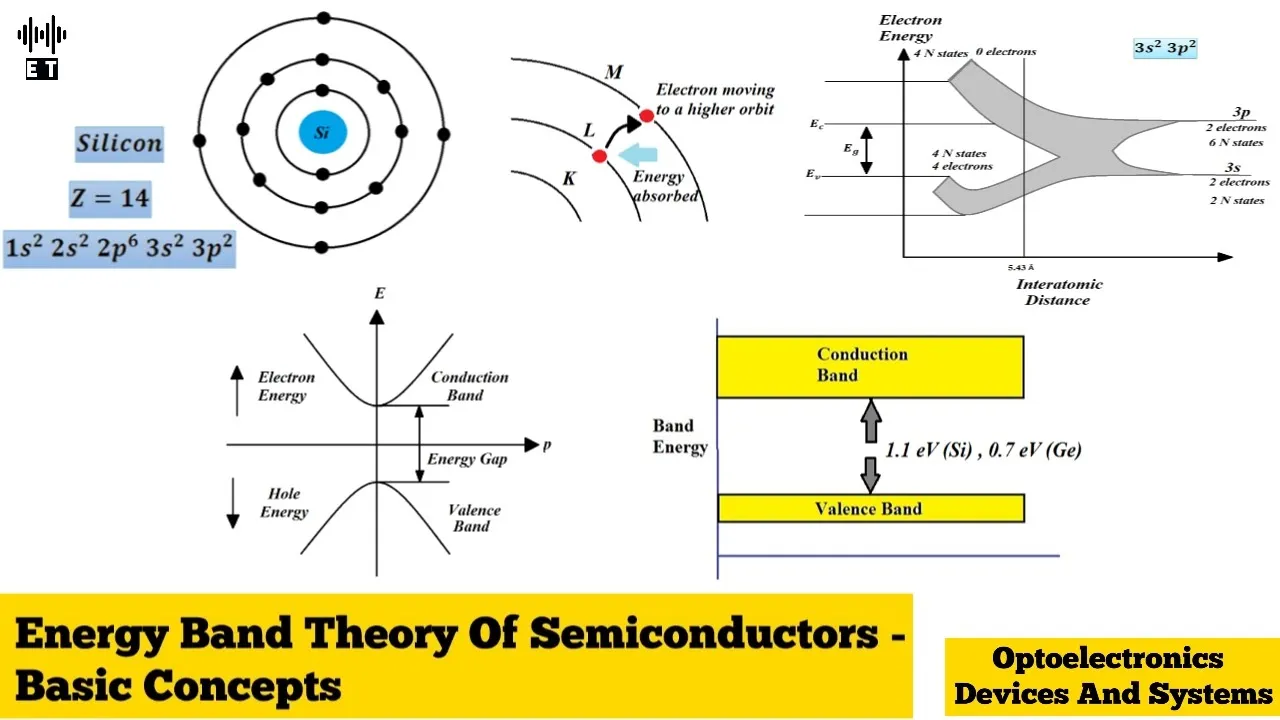















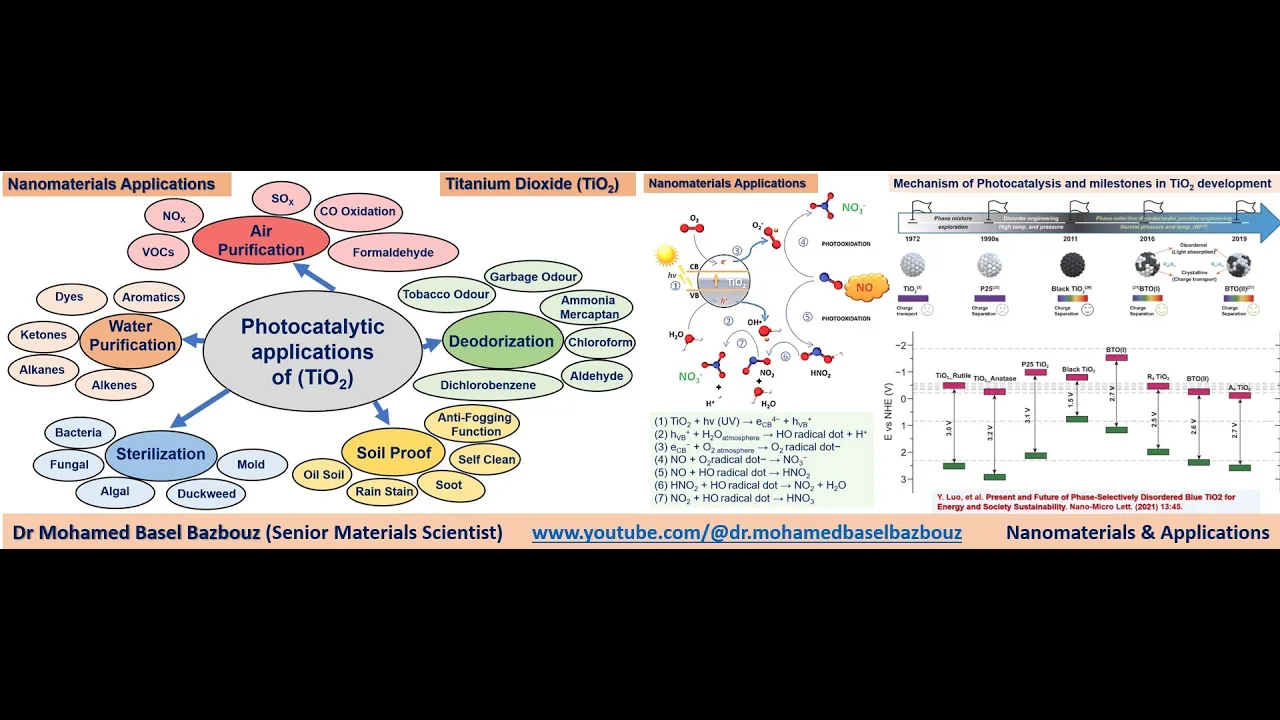







Titanium dioxide (TiO2) is an efficient photocatalyst but primarily responds to ultraviolet light due to its 3.2 eV band gap. To make TiO2 active under visible light, researchers employ several modification strategies: (1) Doping with non-metals, transition metals, or organic dyes to create intermediate energy levels within the band gap, (2) Loading with metal oxides that facilitate charge separation by acting as electron or hole traps, (3) Using core-shell nanoparticle structures where metal nanoparticles enhance light absorption through plasmon resonance and improve charge transfer efficiency, and (4) Utilizing metal oxides with variable oxidation states that introduce additional energy levels. These approaches collectively enable TiO2 to utilize the broader visible light spectrum, making photocatalytic applications more practical and economical by harnessing solar energy more effectively.
Photocatalysis: TiO2 Modification, Core-Shells, & Band Gaps
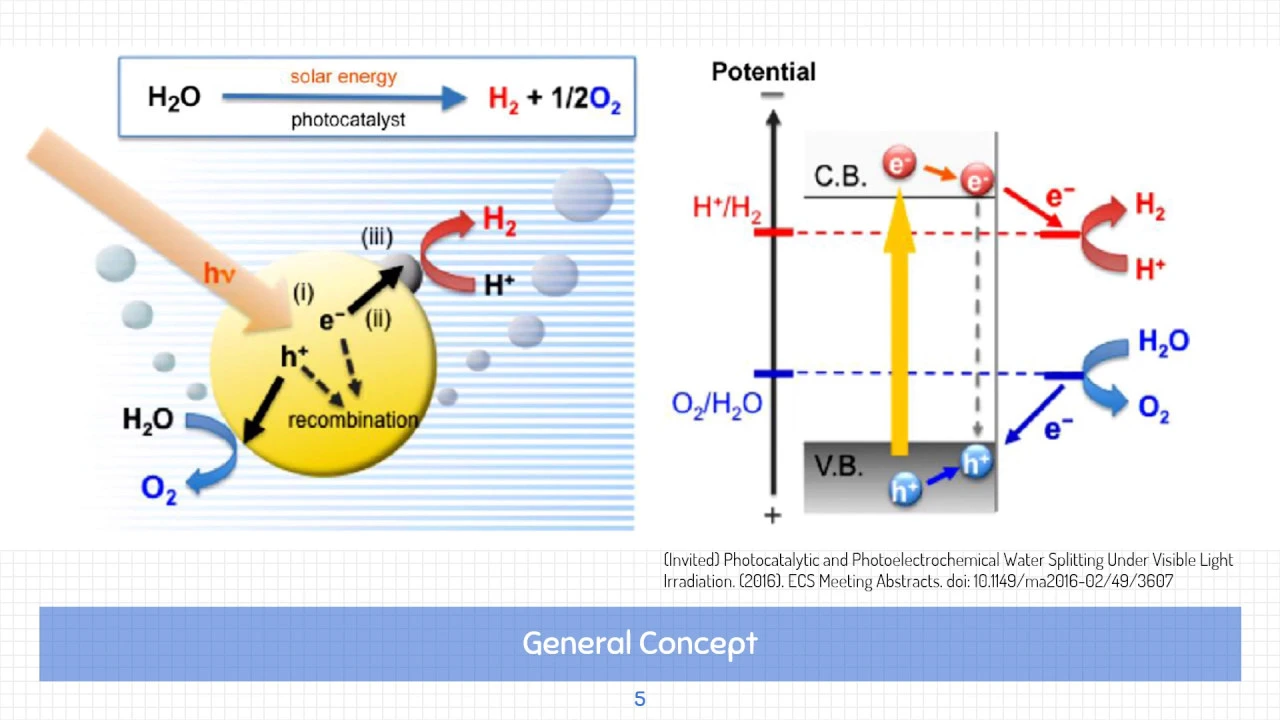
Added:[Music] Welcome to the course on nanoructured materials synthesis property. ities self assembly and applications. We are in the module four of this course and uh we are we are working on photocatalysis right now and we had two lectures on photocatalysis and today is the third lecture on photocatalysis and this is also the lecture three of module four. So in photocatalysis in the previous lectures we looked at the basic ideas of uh catalysis in the presence of light and how UV light and visible light uh catalyst uh catalyze reactions through the generation on of electrons and holes. And two important criteria are the electron and hole should be generated efficiently and the second thing is the electron and hole should be separated from each other so that they don't recombine and uh uh release of photon. So this recombination has to be prevented and this charge separation is an important part in the design of new materials which will allow for enhanced uh efficiency of the photoc catalyst.
Now uh the uh photoc catalysis as we see uh you can have high uh surface area small crystalline size uh the especially we are discussing for titanium dioxide and in this case the anotes form of titanium dioxide is very important. There are three forms of titanium dioxide. uh the uh rootile form is the high temperature form whereas uh the anotes form is the low temperature form and we require the anatas form for high photoc catalytic activity. So the anatas form is very important then ti2 photoc catalyst can be prepared with high crystallinity. It can be prepared with high porosity. So porous structures of titania can be prevented and the activation uh through a light source is possible uh in ti2.
Let us look at the conditions affecting the photoc catalytic activity of ti2.
Now uh ti2 is normally prepared through an aloxxide through solution methods. We start from a titanium aloxxide and typically we take titanium isopropoxide and when you hydrayze it with water you get this kind of hydrates at low temperature and then when you heat it further you calcine it you get the anatas form of ti2. If you heat it further that is you further calcine you get the routile form of ti2. Now if you look at the properties uh if you have at low temperature you normally have the amorphous form and at low temperatures you have low uh uh very low surface area.
Uh in this case you have a large when you have large crystallinity uh especially like in rootile. So if you have the surface area which is low uh and you may have very large uh surface area both are possible. The activity the activity goes down if the surface area goes down. So the activity will be large uh when the surface area is very high and the activity will become small when the surface area is small. In crystallinity if you have very high uh crystallinity then which you get at high temperatures uh and in the rootile form you will get this high crystallinity. In the arites form somewhere in the middle you have uh reasonable crystallinity and reasonable surface area whereas in the rootile form you have high crystallinity and small surface area and the difference between rootile and anace in their band gap anase has a band gap of 3.2 electron volts and rootile has a band gap of 3 electron volts. So uh if you decrease the surface area the number of active sides also decrease. So what you want is a very a balance between crystallinity and surface area and that you achieve in the middle because if you have very uh amorphous type of ti2 which you will get in the initial stages of the hydrate formation then you will your active sides uh will be low although you are having a high surface area because of poor crystallinity. So it is good to work in this region where you have the anatis form of ti2.
Now uh ti2 is a very efficient photoc catalyst but you need ultraviolet radiation UV light. Normally we would like to use visible light and uh to use the solar spectrum we would like to use the visible light. Uh and the material should be active under visible light.
visible light is in the lower energy uh region compared to UV light. So visible light active photoc catalyst is really needed for practical applications and will be economical if we have efficient uh visible light catalyst. So how do we modify the normal TiO2 which is a UV light photoc catalyst to make it into a visible light photoc catalyst and that can be done by doping TiO2 with different materials like non-metals transition metals or organic dyes all of them can modify the uh behavior of TiO2 with respect to the incoming radiation and all of them uh you have to choose appropriately the type of non-metal or transition metal or organic dye to control the band gap of TiO2 or effectively generate electron and whole pairs by using visible light instead of ultraviolet light. You can also increase the activity of the catalyst by loading a metal oxide and we will see examples of these. The metal oxide uh typically reduces the chance of recombination of the electrons and holes which are produced during the photoc catalytic reactions. So hence there are several ways by which people are trying to use uh dopens to modify the band gap or to effectively pre create electrons and holes in the using visible light because ti2 is available in large amounts in the uh earth and ti2 is environmental friendly. So it is a very challenging problem and important problem to convert TiO2 to a visible light photoc catalyst instead of a UV photoc catalyst.
Now how do you make uh titanium dioxide if you have to make it in the lab? Uh titanium dioxide is of course available in nature also. uh but you want to make titanium dioxide in the lab or in industry in bulk quantities. So how do you make titanium dioxide which is active and hence you want to make anotas form of titanium dioxide. So people have found several methods like the hydraysis of chlorides or sulfates of titanium salts and they have used the salt gel method uh which is a very popular method and we have discussed in our earlier lectures or they have used the hydrothermal method where you use uh teflon or steel containers to create a pressure in either either aquis medium or using a solvent and uh some pressure is created and reaction occurs under pressure at temperatures around 100 to 200 250° centigrade or maybe sometimes uh up to 300 350° centigrade. And there is another method which is the micro imulsion method where you use titanium salts and appropriate surfactants to make micro emulsions where you can make nano reactors using these microulsions which are present in solution depending on the type of surfactant and solvent. You can control the size of the nano reactors and then you can do reactions using the titanium salts and hydrayze them within the nano reactors to give you nanop particles of ti2 which are of the anotase form after certain calcination step. So people can have used all these methods to make titanium oxide nano powders in large amounts and in the anotase form.
Now uh this is another technique by which Diio2 can be synthesized. This is the metal organic chemical vapor deposition or MOCVD in general as it is told where you have your material which can be titanium isopropoxide as discussed earlier. So it's an aloxxide of titanium and that passes through a heater uh and there are several other heaters and temperature uh sensors uh in the furnace. So there is a furnace through which this uh titanium isopropoxide is passed in the presence of oxygen and argan and then at this temperature which you can control the titanium isopropoxide uh can be uh calcineed over a substrate and ti2 is generated on top of a substrate and if you want some metals to be doped metal oxides to be doped. Then you put this metal oxide or metal as a dopend here and the temperature should be sufficient to volatilize this dopend.
And then the dopen mixes with the incoming stream of the titanium isopropoxide and forms ti2 on this substrate along with the metal or metal oxide dopen. And uh this kind of system can generate large amount of very high quality uh films of ti2 on the surface of appropriately chosen substrates.
Substrates can vary from silicon to glass to quartz and a variety of substrates you can choose depending on what is your application of this photoc catalyst.
Now uh so how do we modify TiO2? Because we just discussed that we want to modify TiO2 which is a visible light uh UV light catalyst uh in general but we want to use visible light. So how do we modify this TiO2? By doping metals metal oxides and what happens when you dope metal and metal oxides to the band gap or to the valance band levels or to the conduction band levels. So this is a kind of a graphic to show you that when the photons fall on the uh photoc catalyst which has got some metal particles on top. So it's a metal doped ti2. So we have modified ti2 with a metal. The metal particles are here and this is uh the titanium dioxide particle. And when light falls on this particle ti2 then electrons and holes are generated. Now the electrons uh if they can migrate to the surface and meets the metal. The metal is a efficient conductor. So this will take away this electron quickly and so the electron this electron which is produced here is separated from the hole. And that is what is one of the important points how to separate electron and hole. And because of this metal dopend the electron has this tendency to go to the metal and the metal it is a good conductor and then it removes the electron. So the electron and hole are separated. So both the properties generation of electron and whole pair and transport of electron and hole away from each other such that they don't recombine both then can be met which makes then this material this metal doped ti2 will be good for uh photoc catalying. Now you can also dope a semiconductor. So cadmium sulfide is a semiconductor and this uh is your original TiO2 particle. So assume that you have cadmium sulfide particle uh doped doped in TiO2. Now TiO2 has a band gap of 3.2 electron volts and this is the valance band and this is the conduction band level of TiO2. Whereas cadmium sulfide has a smaller band gap of 2.5 electron volt.
So uh in it can take lower energy and create electron whole pair. So cadmium sulfide uh can be triggered to generate electrons and holes with lower energy of 2.5 electron volt. Whereas pi2 will require 3.2 electron volt. So lower energy if you give you can still generate electron and hole because of the presence of cadmium sulfide. then this electron can migrate to the uh conduction band of the ti2 and the hole uh this uh hole is generated in the cadmium sulfide. So when the light falls on cadmium sulfide the electron is goes to the conduction band and the electron is transferred to the ti2 and so the electron and hole are separated now on two different particles. The hole is retained on the cadmium sulfide and the electron goes to the uh ti2. Now this is so this was a metal doped ti2. This was semiconductor dope tiio2 and then you can have an organic dye doped ti2. So if a organic dye is doped uh in ti2 then what happens is this energy level of the energy gap of the organic dye to create an electron when light falls is suppose it's in the visible then this electron goes to the excited state of the die. The D is now in an excited state and then the electron from the conduction uh levels or the higher uh orbital is transferred to the conduction band of TiO2 and then uh you can have some acceptor molecules which will take over this electron. So the cond from the conduction band of ti2 the electron can be accepted by say an acceptor and that acceptor will get reduced. So a will get reduced to a minus because the electron will be transferred from the conduction band of ti2 to the acceptor. So uh three particular cases we looked at modification of TiO2, metal doped modification of TiO2, semiconductor doped modification of TiO2 and then organic Doped TiO2 which we call dieensitized solar cells is a very important area in which you are using a die to uh start this mechanism of electron being generated and then electron hole uh being uh separated. So if you look at the band diagrams uh you can create uh different types of levels. So suppose this is the original uh levels. This is the conduction band of TiO2 and this is the valance band of TiO2. And when you are doping transition metals, it is possible to have uh choose a transition metal such that you you now have levels which are lower than the conduction band of TiO2. So the electron will be here because it's lower in energy than this.
And you can have a hole in the uh lower energy level or you can have a non-metal doping TiO2. then you have a energy level which is higher than the valance band of TiO2. So this is the valance band of TiO2 and so it is higher than the valance band of TiO2 and the electron uh this energy may be close to the conduction band of TiO2. So either you can lower the conduction band or you can increase the energy of the uh valance band electron or hole balance band hole. So the hole will be here and the electron is here. So these these are two modifications to the uh bare ti which is shown here. So this is also possible and this is also possible. So this kind of changes in the band diagram by doping is called generally band gap engineering.
And uh you can also uh sensitize or the or increase the efficiency of titanium dioxide nanop particles by using metal particles through their plasmon resonance. Now we all know when you have metal nanop particles the conduction electrons of the metal nanop particles can have collective oscillations. Uh now these collective oscill oscillations of the conduction electrons uh can sensitize the TIO2 nanop particles and this has been observed uh for silver, gold, copper nanop particles where they exhibit plasmon resonance in the visible range.
So you shine light in the visible and the conduction electrons of the metal nano particles like silver or gold uh then uh get excited and you have these collective oscillations and then this excitation acts like an antenna. Uh the metal particle acts as an antenna. uh because this collective oscillation is generated by trapping the visible light energy or the solar energy and then it can enhance the uh catalysis of TiO2. Once the silver nanop particle which is doped on top of ti2 uh acting as an antenna catches the visible light radiation and then it can uh create electrons and holes in the ti2 to which it is connected. So this is uh what is shown here. So you have this metal particle and you have the uh ti2. So this is the conduction band of TiO2. This is a valance band of TiO2.
Now what can happen is uh the if you use UV light uh then you can excite this. So you can create electron here and hole here in the uh TiO2. And when you create electrons here then another property of the metal is that it can quickly take away the electron and then it can reduce any species. For example, oxide can oxygen gas can be reduced to uh this kind of super oxide ion. Now uh this reduction is possible because the electron generated in the conduction band of titania or ti2 is quickly transferred to the metal and the metal then uh the electron in the conduction band of the metal can get uh will ox will reduce this uh oxygen and the hole which is in the valance band can be used to oxidize some species. So this is another uh possibility where you are using UV light but the metal is enhancing the uh application of the electron and the hole that is the reducing and the oxidizing capabilities are enhanced uh by the presence of the metal. In the previous case, these surface plasmons are basically acting as an antenna to trap energy in the visible spectral range and uh then it helps in the uh sensitization of the titanium nanop particles. In this case, you are not using the visible light. You're using UV light. But you are efficiently removing the electron and hole because of the conduction properties of the metal. And the metal then can quickly reduce uh some uh molecule which may be uh oxygen and give you this super oxide ion.
Now you can have uh so here the metal nanop particles act as an electron sync as I mentioned earlier and it promotes interfacial charge transfer and basically it reduces the probability that the electron created in the conduction band of ti2 will interact with the hole on ti2 because the electron is being removed from there. So the metal is acting as a electron sync.
Now you can also have more complex nanoructures where you can have metal decorated on core shell nanop particles.
So core shell nanop particles we know that there is one particle uh and it is covered by something else. So the particle inside is the core and the material which is covered outside is the shell. So here you can have metals like silver, gold or alloys like silver, gold or copper, nickel or uh and you can make a large number of alloys of various sizes say between 5 to 150 nanometers.
Then you take this metal particle inside and on the outside this gray part you put your titanium oxide and there are methods by which you can make this shell out of pure titanium oxide. So the smaller particles the better you will have higher catalytic property the efficiency will be high. So if you have small particles of ti2 and you make a shell around the uh metal nanop particles then you will get a structure of this. So that will be core shell nanop particle. But in this case it is metal decorated core shell. That mean on top of the ti2 you again have either some metal or metal oxide. So either metal or metal oxide you can choose one of them and depending on that you will have now plasmon enhanced separation of electron whole pair. So this metal nanop particle will be activated uh by the light and you will have this plasmon surface plasmons because of the oscillations or the conduction electrons and that will couple to the ti2 and then you will get electron and holes and if you have a particle like a metal like platinum then the electron will quickly get separated. ated onto the platinum and then the hole will reside in the core and the electron will move to the surface. So you have effectively separated the hole and the electron.
If you use an oxide like ruinium oxide then it does not take up the electron like platinum does but it will remove the hole. So then the electron will remain in the uh core and the hole will go to the surface. So depending on whether you have put platinum or you have put ruthenium dioxide on the surface of the ti2 you can have the hole on the ti2 uh sur on the r2 surface. So hole will be removed from the metal or if you put metal particles like uh platinum on the surface of the ti2 then electrons can be removed more effectively and then the hole will remain inside the core of the core shell nanop particles. So this is a very efficient uh and interesting design of uh core shell metal oxide nanoructures where you have uh three uh materials designed. You have a inner core which is made of metal nanop particle like silver, gold, platinum or something and then you have uh a shell of titanium dioxide and on top of that you have some decoration of small particles of either metal and metal or metal oxide and these particles on the surface which decorate the surface of TiO2 act as a sink.
for either the electron or the hole. So as we discussed if it is platinum particles on the surface it will act as a sink for electrons and then the hole are inside the core and the electron is on the surface. So they are charge separated so the efficiency of the photoc catalysis is enhanced. The opposite is the hole goes to the surface and the electron stays in the core and that is possible if you use ruinium dioxide as particles decorating on the surface.
Now if you have metal particles covered with TiO2 uh covered with SiO2 or TiO2 then the visible light is not active because TiO2 will not uh activate uh the will not generate electron or holes because the band gap of TiO2 is 3.2 and two electron volts and the visible light is insufficient in energy to create electrons and holes. So this is not possible. However, if you shine UV light and you have uh the metal and you have TiO2, then you can have electrons and holes, but the metal core shortens the electron hole pairs. So you they recombine and hence you don't get charge separation easily and so this is not going to be a very efficient photoc catalyst. Although you will generate electron and hole but the lifetime of the electron and hole will be very small and they will quickly recombine. So this is also not a good situation. Now the third situation is that you have a metal particle inside then you put put a layer of something like silica this brown part and then on top of that you put titania and titania is a efficient UV photoc catalyst and this titania uh which creates the electron and holds the because of the silica coating the electron which goes towards the metal will not be uh recombining with the hole. So electron hole recombination will be prevented by the presence of an intermediate thin layer of silica. So this is another design of core shell structures where you have made titania to be active in the UV efficiently. Of course, still it is not active in the visible with this configuration, but it is active in the UV and the efficiency is high by putting a silica layer in between the metal core and the outside titania which will actually create electron hole pair when UV light shines on it. So these are three models. One model uh not effective in visible light.
Second model not effective in uh visible light and also not effective efficiently in UV light and this is a model which is not effective in visible light but very good catalyst in UV light.
Now if what is the role of the metal oxide? You can dope metals. We studied have different role and uh we looked at several cases of metal doping how it can remove the electron if it is outside and what it does if it is in the core. Now it look at metal oxide and choose a metal which can have variable oxidation states.
Now these can lot of all transition metal oxides show variable oxidation states. For example, iron shows oxidation states of 2 plus, 3+, sometime 4 plus and in extreme cases even 6 plus.
So you can have iron at with various oxidation states. Similarly you can also have cobalt with 2 plus 3+ or venadium 4 plus 5 plus etc. So if you choose a metal oxide which can show variable oxidation states uh and dope it with a titania uh ti2 then it can be a very good photoc catalyst in the visible ray.
So how does that happen?
You have again the uh large uh sphere showing you TiO2 particle and the band gap of TiO2. This is the conduction band and valance band. And now you have doped this titanium dioxide with metal oxide.
And the metal oxide that you have chosen is iron oxide. So iron oxide will have possibilities of being in iron 2+ 3+ 3+ 4+ and so if you have this kind of oxides on top of the surface so what can happen?
So if you have electron and hole generation uh even with less energy you can create uh these levels where electron in the conduction band can go to the iron uh 3+ and iron 3+ will get converted to iron 2+. So you start with uh Fe3 uh situation. So iron is 3+ but iron 3+ when it gains an electron becomes iron 2+ and if you have a electron which is coming uh you can do this reduction. Now if you have iron 3+ here so if you have a hole iron 3+ will get converted to iron 4 plus. So in the presence of electron iron 2 plus iron 3+ will get converted to iron 2+ in the presence of whole iron 3+ will convert to iron 4+.
So both are possible because of the variable oxidation state of uh iron and the dopent also creates addition levels.
So these levels are created additional levels. So although TiO2 has this band gap but the actual band gap will be due to the smaller uh the intermediate levels which are introduced by the metal oxide dopen and then this gap is lower in energy than this gap and if this falls in the visible light region then it will become a visible light photoc catalyst. So this kind of band gap engineering then creates the dopens create additional levels and lowers band gap from the ultraviolet to the visible region and hence this catalyst becomes active in the visible region. So here the important thing is you have chosen a metal oxide with variable oxidation states. Now the dopant also acts as electron hole trapping center because here you can see this acts as a electron trap because it is removing electrons from here and this way you can if you can choose some other material it can act as a whole trap. Right? So you can have dopens which not only lowers the band gap from UV to visible but they are also acting as electron whole trapping center. Finally they also can be used as carrier agents to facilitate migration of electrons and holes to the reaction sites. So wherever reaction is occurring because of the presence of these metal oxides on the surface they act as good carrier agents because they help in the migration of the photogenerated electron and holes. So, so two things are important as usual charge transfer events how the electron and hole are created and then migration of these charges to the surface both these effects enhance the efficiency of the photoc catalyst.
Now this is a case where uh it is photosensitization using u visible light. So how you are going to use visible light? Uh using a dye which is acts as a photosensitizer.
So in the previous case you brought down the band gap by adding metal oxide as dopens and then visible light became useful to make it act as a photoc catalyst. So TiO2 with the iron oxide dopen became a photoc catalyst in the UV. But here you are not using a metal oxide. You are using a dye which is organic compound. So you see this large molecule with the aromatic rings and some pendant uh substituents. You can see uh that this dye which is sulfuramine B. uh this particular dye can be used to sensitize ti2 because the energy levels of this sulfuramine die uh is uh in the region of the visible light. So using the energy levels of the dye of the sulfur rodamin B you can excite the sulfuramin B uh using visible light such that the electron goes to a excited state and this srb excited is the excited molecule and then the electron in this state can be transferred to the conduction band of ti2.
So the visible light is uh basically taken up by the dye the sulfurodamin B die here and electron gets excited and in the excited state the sulfurodamin B then transfers an electron to the conduction band uh with which it has an interface. So the d is doped onto the ti2. So this electron is transferred to the conduction band and then that electron can be further used for reduction. So it is then acting as a catalyst because it will do this reduction reaction and uh if some molecule is there which can pick up an electron then that will get reduced.
So what happens to this molecule? After it loses this electron, the sulfurodamin B excited molecule after it loses an electron it becomes a radical cation. So after removal of the electron with the electron goes to the titanium dioxide and then the sulfuramin B becomes a radical cation and then it reacts with oxygen further and then that uh forms another radical cation and which finally decomposes uh to form a smaller molecule. So this organic structure gets decomposed. So that is also a a a catalytic reaction.
That means you are trying to uh remove an organic dye. You have broken the organic dye by uh exciting uh the organic dye with visible light. And this photo degradation of the organic dye through a uh radical cation uh in the presence of oxygen can be seen. And the final degradation products of this chromopor chromophor is something which can uh give out light. So because it it it fluoreses sulfuramin B is uh has a property of fluoresing and so it is called a chromophore and is organic compound. So here we are more interested in seeing that how titania was photosensitized using visible light and the dye uh breaks down uh and gives rise to some products plus maybe some ions like sulfate iron, ammonium ion and gases like carbon dioxide and water vapor and this electron of titania is also used for reduction. So this is a case of how organic dyes uh having a particular uh difference in the energy levels in the ground state and excited state can be used in conjunction with ti2 to act as visible light photoc catalyst. So important thing very important thing is that this energy gap should be such that it can be this molecule can be excited with visible radiation and then only you can get this SRB star which means the excited sulfurodamin B is the ground state of sulfurodamin B is the excited state of sulfurodamin B and from the excited state electron transferred to conduction band of TiO2 and then it becomes radical cation and further under goes degradation in the presence of oxygen and this electron can be used for reduction of some other species. So this was another case. So we studied cases of metal doped titania, coarse shell titania uh decorated with metals. Then a coarse shell titania with an interfacial layer in between how it can become efficient UV photoc catalyst. Then we added metal oxides where the metal has variable oxidation states and how that can enable titania to be a visible light photoc catalyst and then this was a die sensitization. So the dye an organic dye is used which has particular energy levels which can accept visible light and hence it is a visible light photocatalysis that can be observed using uh the sulfurodamin B as an example and the electrons in TiO2 can further reduce other agents.
Now this another property the previous one we photosensitized using visible light. Now look let us look at another problem where we can do photoc catalysis uh using UV light and with the dye but this is another uh mechanism. So under UV light under UV light the energy will be absorbed now with TiO2 in the presence of visible light TiO2 cannot accept the radiation uh because of the lower energy but the sulfuramin B accepts the radiation. In this case, the UV region, the high higher energy light is being uh uh accepted by the TiO2 nanop particles because it matches the energy. So 3.2 electron volts is in the ultraviolet and so you will have electron generated in the conduction band and holes in the valance band. And so this electron can then reduce oxygen and this hole can then act on the die.
So here we are looking at addition of a hole on the die to create again a radical cation of sulfurodamine B. This again is simple from here what we studied in the previous slide that the radical cation then acts with oxygen to give you another radical cation and that breaks down to give you small molecules like diileamine NN diile acetamide etc and then in the presence of holes or hydroxile radicals it gets converted to this simple molecules or ions. So uh in the previous case the radical cation of sulfurodamin B uh is formed by the removal of electrons from the excited state of sulfuramin B and you get the radical cation. The same radical cation in this case you obtain not by removal of electrons but by addition of whole. And so two different processes, one acting in the presence of UV light and one acting in the presence of ultraviolet light in the presence of sulfuramine as a die or an organic reagent. uh how the same product of the dye occurs can be understood because in this although the mechanism is different in this case the sulfurodamin B uh degrades through the addition of a hole and uh in the previous case the sulfuramine degrades by removal of electron and then goes oxidation and then degradation. So two different things uh using similar materials TiO2 and sulfuramin B as the organic dye but the different mechanism of the degradation of the dye is due to the different energy that you are supplying.
In one case you are supplying uh visible light in the other case you're supplying ultraviolet light and hence the mechanism changes uh and the degradation uh happens due to uh electron in one case that loss of electrons in one case whereas in the other case it is uh addition of holes uh but both cases lead to the radical cation of sulfuramin B and then further reduction uh further uh degradation in the presence of oxygen.
Now let us look at few other case studies uh where we will see what is the role of network of corner shared octahedral units of metal cations. So we'll see when you use metal oxides other than TiO2 these are not TiO2 or these are other oxides why they are photoc catalyst in certain cases especially when you have corner shade octahedra it shows high photoc catalytic efficiency then what is the role of the dipole moment and distortion in symmetry how it affects the photoc catalytic properties then effect of the electronic band structure That's the overlap of the orbitals of the metal oxides. If there is good overlap, the bands will become broad and things will be different and so effect of overlapping of orbitals leading to changes in the electronic band structure. Then what happens when you have a mixed configuration of metal oxides? So we'll look at some of the case uh cases which have these different properties.
So in this particular case uh this is uh the basically you are looking at how the overlap of the metal particle uh metal and the oxygen uh their orbitals overlap and if it is good overlap or bad overlap what happens to the photoc catalytic properties. So these are not TiO2. Now we are discussing other oxides. Say this is a tantelum based oxide and it can be having a third element also. So there is some rarer tantlate or uh barerium dependent tantelum oxide etc. So this is rarer tantelate la tao4 in which case you have an orbital of tantelum 5d or band of tantelum 5d. All the orbitals of 5d uh overlap to form a band of tantelum 5d which looks like this and this is the energy scale and this is an oxide. So you will have oxygen levels and the oxygen levels are here much below the tantelum 5d levels which means this band has been formed from the 5d orbitals of tantelum and this band has been formed from the 2p orbitals of oxygen. Now when you have lanthnum also lanthonum appears to have very sharp band or narrow band. This is called a narrow band because the width of the band is very broad here in tantelum compared to that this is very narrow is almost like a discrete energy orbital. Okay. But now the energy of the lanthnum 4f orbital which is a very narrow band is lying somewhere in between within the energy levels possible for tantelum 5d band.
When such a thing happens that the orbital energies are similar then there is good overlap of bands. So there is excellent overlap of the lanthnum 4F and tantrum 5D bands and good overlap of these bands uh increases the activity of the catalyst and that is overlap of uh that is the case shown here where the highest activity is reported because it has excellent overlap of the lanthnum and tantelum orbitals and bands. Now here you see that this narrow band has shifted down. This is the case of serium and so uh it will have uh moderate uh efficiency. Whereas in this case where the precedomium uh compound the narrow band of corresponding to the precedomium 4f orbitals uh is uh much lower and has no overlap between the tantelum 5d orbitals which are contained in this band with the procedomium 4f orbitals. So there is hardly any overlap and if it there is no overlap then this acts as an electron trap. So once electron comes it stays here and so it can act as a electron trap especially in the 4F uh orbitals of precedomium since it is a narrow band.
The more wider the band there is more deoization. The more narrower the band then it is complete uh localization and very little uh electronic movement. So it acts like a electron trap. Uh so from the band structure these kind of diagrams are called band structure diagrams and give you a lot of idea about the possibility of the movement of electrons the conductivity of electrons uh through electrons and the band gaps and difference in uh what is what will be the optical band gap. uh all this you can understand by looking at the detailed band structure for these oxides. So one thing is clear that better the overlap of the orbitals higher is the activity and poorer is the overlap of orbitals or bands then the activity will be very low and the electron will be trapped and the electron will not be able to reduce anything because it is trapped there.
Now the also possible that uh you can have a high activity without even a co- catalyst. A co- catalyst sometimes is added which helps in reducing the band gap or helps in effective electron transfer or whole transfer. Now, zirconia has a band gap of five electron volts and it is a unique photoc catalyst that shows a very high activity and the reason of this is it has a high negative flat band potential. So if your uh flat band potential is very high then your uh it should be negative the high negative flatb potential will lead to very good photoc catalysis. So this is an example zirconia is an example of that. Another very important thing is corner sharing octahedral unit. So me many many structures are known where the metal oxygen bonds are within an octahedra and these octahedra are corner shared or edge shared or face shared. Now the most important and a large number of compounds are known where there are corner shared octahedral units of the metal cation. So if it is a tantlate you have ta6 octahedra. So no you have a nabium 06 octahedra and these niabium 06 octahedra or tantelum 06 octahedra are corner shared. Okay. Now if they are corner shared then it appears that the activity is very high because this corner shared octahedra as shown here will help in migration of electrons and holes and this will be this has been shown to be very good photoc catalyst for water splitting reaction and the reason is that tantelum oxide is a highly connected corner shared octrahedral units whereas the rarer The lanthnam also has an octahedra but it is not connected to the tantelum octahedra. In such cases the photoc catalysis is very high. There is another example where you have two types of octahedra tantelum oxide and another rare earth oxide. But when there are two types of octahedra and they get interconnected then the activity for the photoc catalysis decreases. So what it means is you need one this tantelum oxide or nabium oxide whichever is going to act as as the main site for photoc catalysis should have this corner connectivity of octahedra and it should not be interfered by some other octahedra say of a rare earth. So if it is unhindered then the activity is very high. If it is hindered by other octahedra then it becomes inactive. So this is very important. The role of corner shared octahedral units and the presence of uh linear chains of these octahedra is very important. If you have distortion in octahedra and if you have dipole moment then uh what is the effect on the water splitting or photoc catalysis activity.
Now the activity for D10 metal oxides is strongly dependent on the distortion on their structure and you can see that whenever you have a distortion uh then you will have uh local internal fields uh which will contribute to electron hole separation on photo excitation. Now if you have distorted gallium oxide like this which have a net dipole moment they were found to be photo catalytic activity. So dipole moment will be generated as a cause of distortion. So whenever you have a distortion you have high dipole moment.
This is zero dipole moment very low activity. This is high dipole moment and this is high activity. So distortion high dipole moment high and so it will lead to higher activity. So there is another case how you can increase the activity by better overlap of metal oxygen orbitals and you can increase the bandwidth by having good hybridization or overlap of metal oxygen orbitals and that will also give you uh increased mobility of the photogenerated electrons in the conduction band and lead to high photoc catalytic activity. So these are some of the examples of oxide photoc catast based on these zero metal ions.
So you can see titanium anotase and very good photoc catalyst you can see of lanthnum doped sodium tantilate where you have tao6 octahedra and these are linear and shows very high efficiency.
So with these examples I will come to the conclusion of this lecture today and then we will have our continuation of this lecture uh in our next uh class.
Thank you very much.
[Music] Heat. Heat.
[Music]
Up Next
Anodic Stripping Voltammetry: Cadmium & Lead Analysis Lab
@tamiclare1604
51.1K views•2016-01-21

Frances H. Arnold Nobel Lecture: Directed Evolution in Chemistry
@NobelPrize
109.5K views•2018-12-08
Understanding Fluorescence: Jablonski Diagrams, Lifetimes, and Quenching Effects
@iit
15.9K views•2019-05-13

Edible Water Bottles: A DIY Guide to Sodium Alginate Spherification
@ryan
10.5M views•2019-06-21
Related Study Plans & Knowledge Roadmaps
Structured learning paths in Chemistry