Nuclear Chemistry and Radiochemistry: Decay Dynamics, Radiopharmaceutical Synthesis, and Nuclear Fuel Cycle Chemistry
Learning Goal: Master the fundamental principles of nuclear structure, decay kinetics, and radiation interaction with matter. Apply this physical foundation to the highly specialized domains of synthetic organic radiochemistry (specifically the synthesis of radiopharmaceuticals like Fluorine-18 FDG), medical radionuclide generation, actinide coordination chemistry, and the solvent extraction mechanics of the nuclear fuel cycle (PUREX process).
- Prerequisites: General Chemistry, Introductory Organic Chemistry (specifically nucleophilic substitution mechanisms), and Single-Variable Calculus (differential equations).
- Estimated Study Time: 24 Hours
Module 1: Introduction to Nuclear Structure and Radioactivity
This module establishes the physical foundation of the atomic nucleus. You will study the balance between the strong nuclear force and electrostatic repulsion, map nuclear stability via the Neutron-to-Proton () ratio on the Band of Stability, and analyze the primary modes of radioactive decay (alpha, beta-minus, beta-plus/positron emission, gamma emission, and electron capture).
Recommended Videos
Why this video
This video provides a rapid conceptual overview of the fundamental differences between chemical reactions (which involve valence electrons) and nuclear reactions (which alter the composition of the nucleus). It introduces the concept of mass defect, nuclear binding energy, and the tremendous energy scales involved in nuclear transformations.
Knowledge Checkpoint
- Understand why nuclear chemistry focuses on changes to protons and neutrons rather than valence electron shells.
- Differentiate between chemical reaction energetics and nuclear binding energy.
- Explain how a mass defect arises when nucleons assemble into a nucleus.
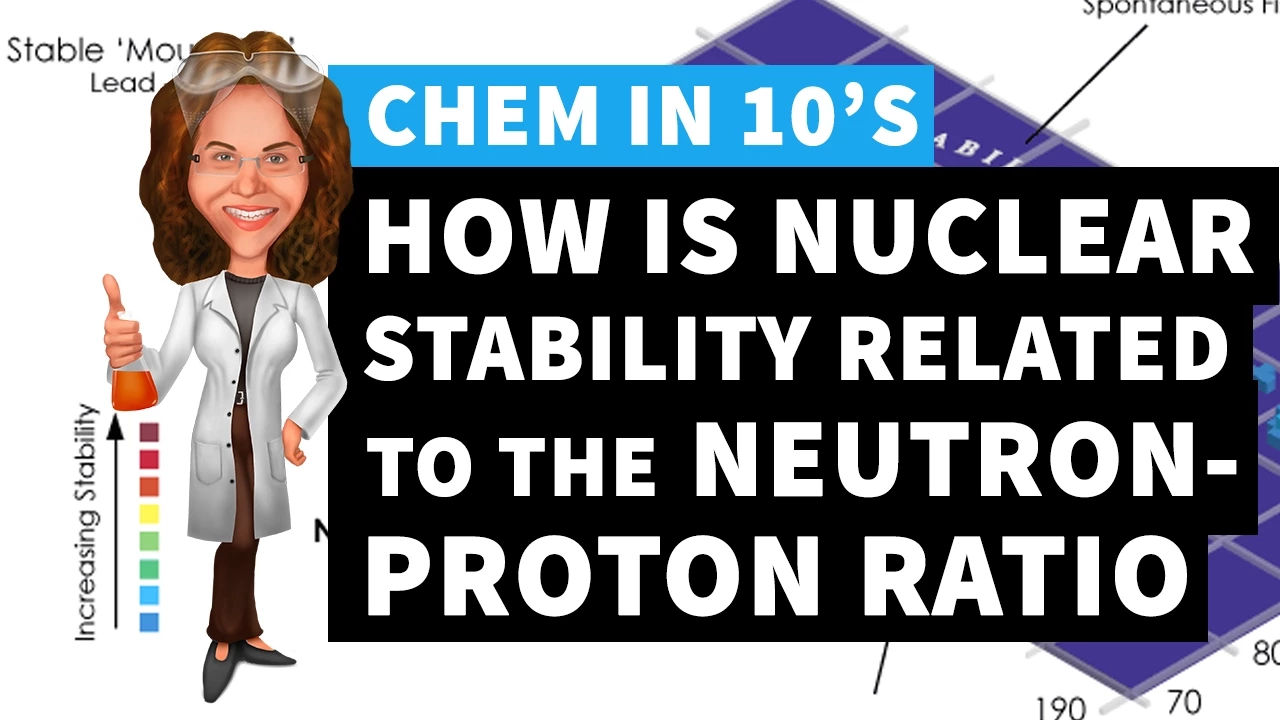
Why this video
This lecture provides an in-depth mathematical and conceptual examination of the Band of Stability. It explains how the ideal ratio of neutrons to protons shifts from for light nuclides () to approximately for heavier elements to counteract the electrostatic repulsion of protons, and maps specific decay pathways based on a nuclide's position relative to the band.
Knowledge Checkpoint
- Identify the stable ratios for light elements vs. heavy elements on the Band of Stability.
- Predict whether an unstable isotope will undergo beta-minus decay () or positron emission ()/electron capture based on its position relative to the Band of Stability.
- Define the upper limit of nuclear stability (lead-208, ) and explain why heavier elements must undergo alpha decay.
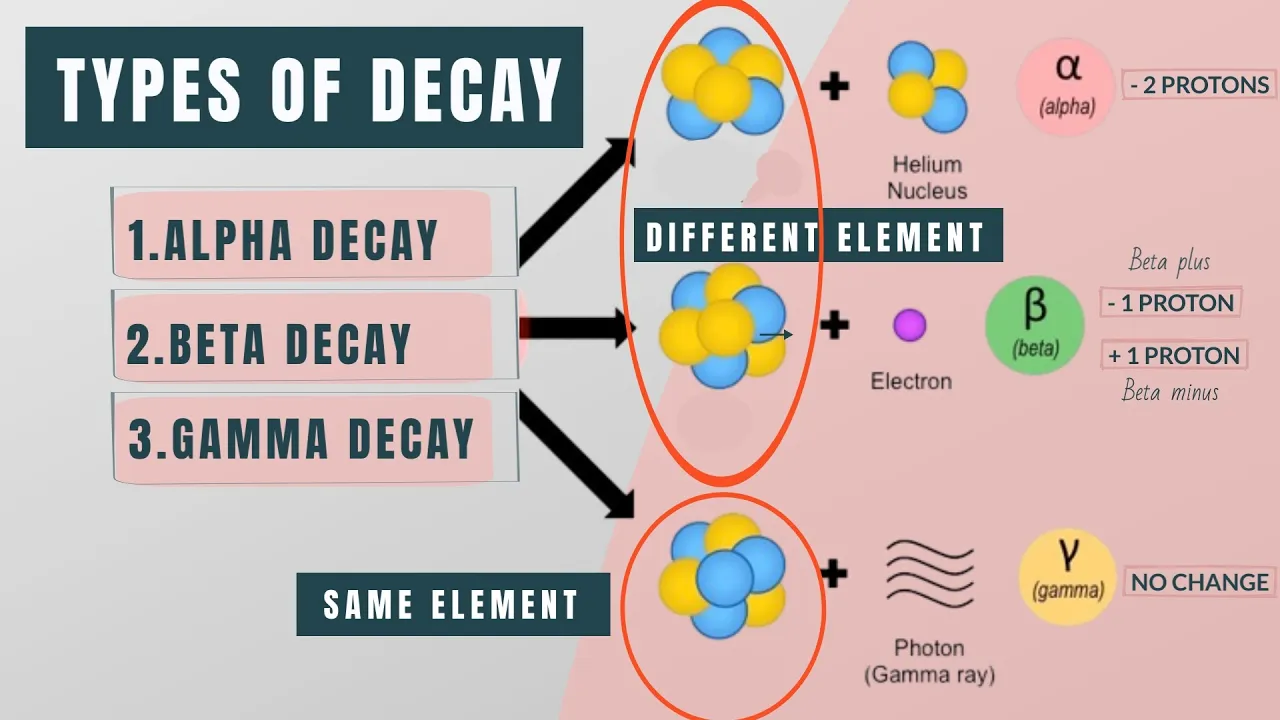
Why this video
This video uses detailed spatial animations to visualize the precise mechanics of alpha, beta, and gamma emissions. It details how the mass and atomic numbers balance on both sides of a nuclear equation, providing a clear visual representation of nuclear transmutations.
Knowledge Checkpoint
- Write balanced nuclear equations for alpha (), beta-minus (), and positron () emissions.
- Explain the role of the weak nuclear force in mediating beta decay (conversion of a neutron to a proton or vice versa).
- Describe the physical nature of gamma () radiation and its role in releasing excess nuclear energy from metastable states.
Module 2: Decay Dynamics and Kinetics
This module covers the mathematical modeling of radioactive decay. You will derive the first-order integrated rate law, define the relationships between decay constant (), activity (), and half-life (), solve complex decay kinetics problems, and distinguish between secular and transient radioactive equilibria.
Recommended Videos
Why this video
This video derives the first-order integrated rate law for nuclear decay () and the half-life equation (). It connects chemical kinetics with nuclear decay dynamics, providing a firm foundation for practical calculations.
Knowledge Checkpoint
- Derive the expression for the decay constant from a given half-life.
- Solve for the remaining quantity of a radioisotope over arbitrary time periods using the integrated rate law.
- Apply first-order kinetics to solve practical radioisotope dating problems.
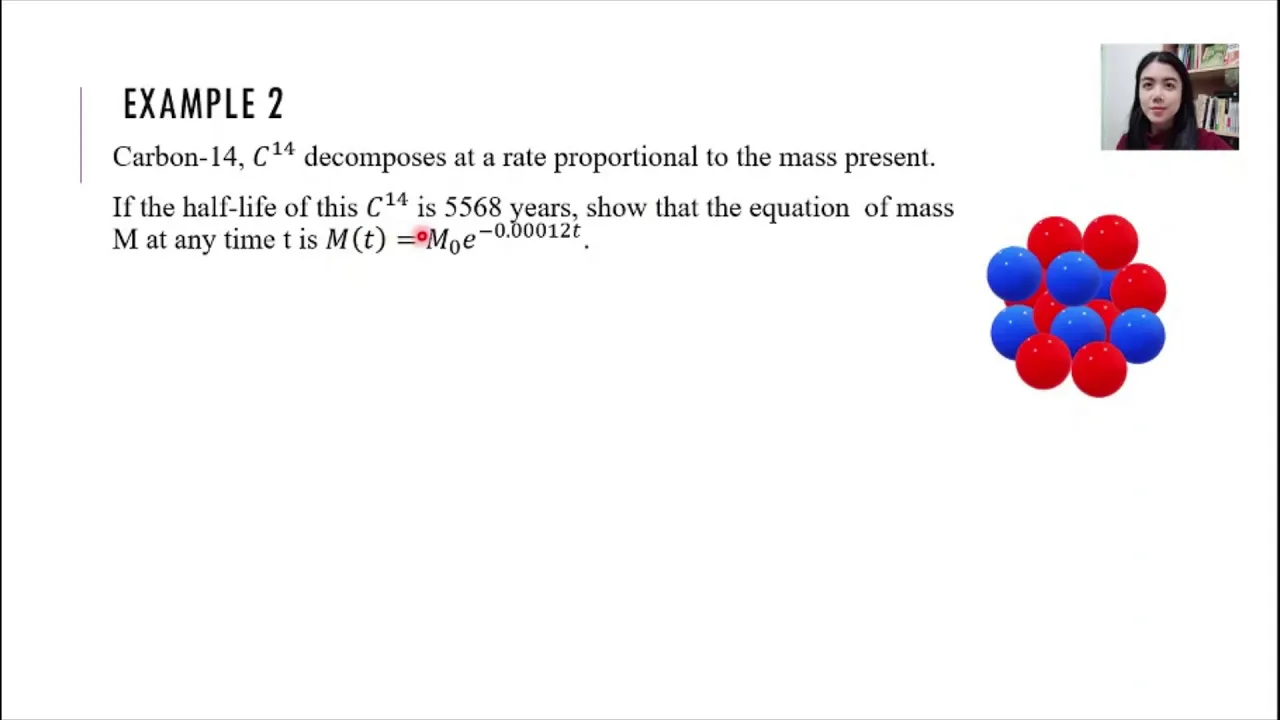
Why this video
This video provides a rigorous mathematical derivation of the decay law using separable first-order differential equations (). It guides the student through the integration steps and initial value boundary conditions, reinforcing the calculus behind nuclear activity calculations.
Knowledge Checkpoint
- Formulate and solve the differential equation representing radioactive decay.
- Apply initial boundary conditions () to solve for the integration constant.
- Convert mass values (mg) to nuclear active counts () using Avogadro's number for quantitative kinetics.

Why this video
This lecture explains the dynamics of parent-daughter decay chains. It defines the mathematical criteria for radioactive equilibrium, comparing secular equilibrium (where the parent half-life is infinitely longer than the daughter's) with transient equilibrium (where the parent's half-life is longer but comparable).
Knowledge Checkpoint
- State the mathematical condition for secular equilibrium () and transient equilibrium.
- Predict the ratio of daughter-to-parent activity over time given their respective decay constants.
- Identify which equilibrium regime governs the generator system.
Module 3: Radiation Interaction and Detection
This module bridges nuclear physics and radiation measurement. You will analyze how ionizing radiation interacts with physical and biological systems via processes like Compton scattering, photoelectric effect, and pair production. Additionally, you will examine the mechanical and material differences between gas-filled detectors (Geiger-Müller tubes in avalanche mode) and solid-state/crystal scintillation detectors coupled to photomultiplier tubes.
Recommended Videos
Why this video
This video presents a physical analysis of how different particles (, , ) lose energy as they travel through matter. It contrasts the high specific ionization and short range of heavy charged alpha particles with the highly penetrating, indirect ionization processes of gamma rays.
Knowledge Checkpoint
- Describe the primary physical mechanisms of energy loss for alpha particles vs. beta particles.
- Explain how Linear Energy Transfer (LET) relates to the biological damage potential of radiation.
- Identify the material requirements needed to shield against alpha, beta, and gamma radiation.
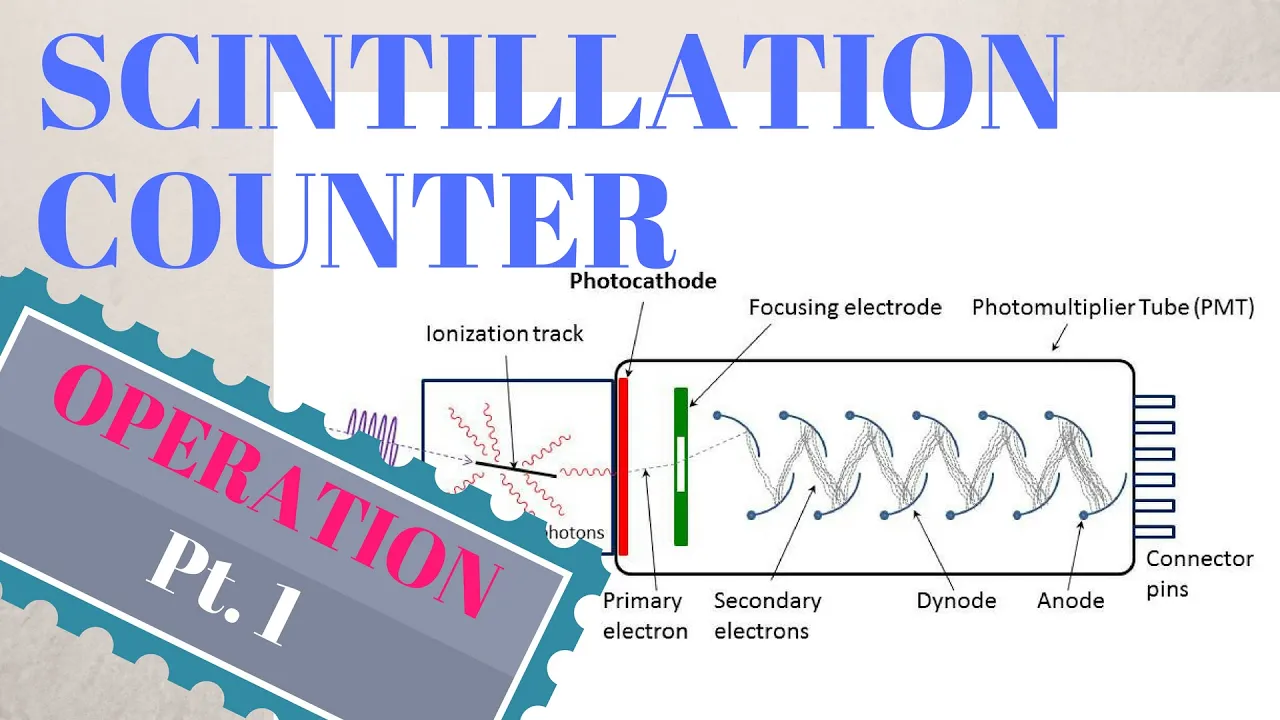
Why this video
This video addresses a critical gap highlighted in the review feedback: the physical principles of scintillation detectors. It explains how an inorganic thallium-doped sodium iodide [] crystal absorbs ionizing radiation to produce flash photons, which strike a photocathode to emit photoelectrons, subsequently multiplied down a high-voltage dynode chain in a Photomultiplier Tube (PMT).
Knowledge Checkpoint
- Explain the role of thallium doping in creating luminescent activator centers within crystal lattices.
- Diagram the step-by-step conversion of a gamma ray photon into a measurable electronic pulse within a PMT.
- Contrast scintillation detectors with gas-filled detectors in terms of detection efficiency and energy resolution.
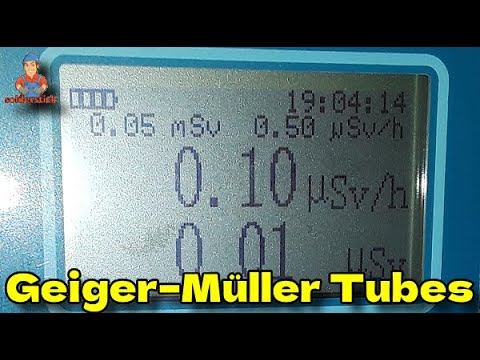
Why this video
This video breaks down the mechanical construction and electronics of the classic Geiger-Müller (GM) tube. It details the gas mixture (typically noble gases with a halogen quenching agent) and the electric field avalanche effect that allows a single ionizing event to produce a massive, easily measurable current pulse.
Knowledge Checkpoint
- Describe the Townsend avalanche mechanism that occurs when a high electric field is applied across a GM tube.
- Explain why a quenching gas (like bromine or chlorine) is added to a GM tube.
- Identify the physical limitations of gas-filled detectors, specifically focusing on "dead time."
Module 4: Radiopharmaceutical Synthesis and Nuclear Medicine
This module covers clinical radiochemistry. You will transition from nuclear reactor and cyclotron target physics to synthetic organic radiochemistry, focusing on the nucleophilic substitution mechanism () of Fluorine-18 Fluorodeoxyglucose () synthesis. You will also examine the coordination chemistry of medical generator systems, specifically the chromatographic elution of Technetium-99m.
Recommended Videos

Why this video
This video directly addresses a key feedback gap: the exact synthetic organic chemistry pathway of . It outlines the nucleophilic substitution () reaction of cyclotron-produced with a protected mannose triflate precursor. It details the use of aminopolyether cryptands (such as Kryptofix 222) to complex potassium ions, converting into a highly active naked nucleophile in anhydrous acetonitrile, followed by acid hydrolysis of the protective acetyl groups.
Step 1: Cryptand Activation K+ + 18F- + Kryptofix 222 ──► [K ⊂ 2.2.2]+ + "naked" 18F- (Highly Nucleophilic)
Step 2: SN2 Substitution [K ⊂ 2.2.2]+ 18F- + Mannose Triflate Precursor ──► 18F-Fluoro-acetylated-glucose + OTf- (Inversion of Config)
Step 3: Acid Hydrolysis 18F-Fluoro-acetylated-glucose + HCl / Heat ──► 18F-FDG (Deprotected active radiotracer)
Knowledge Checkpoint
- Explain why Fluorine-18 must be complexed with a phase-transfer catalyst/cryptand (like Kryptofix 222) for organic synthesis.
- Draw the step-by-step mechanism showing nucleophilic attack of on mannose triflate, noting stereochemical inversion.
- Explain the purpose of using acetyl protecting groups on the glucose precursor and how they are cleaved in the final step.

Why this video
This video provides a deep technical review of the wet generator system. It details the coordination chemistry occurring inside the acidic alumina () chromatography column, where the molybdate ion () binds tightly, while its decay product, pertechnetate (), has a lower affinity and is selectively eluted with physiological saline.
Knowledge Checkpoint
- Explain why the ion remains bound to the alumina column while the ion does not.
- Describe the chromatographic process of eluting a radioisotope generator.
- Identify the chemical species of Technetium obtained in the eluate and its oxidation state ().
Why this video
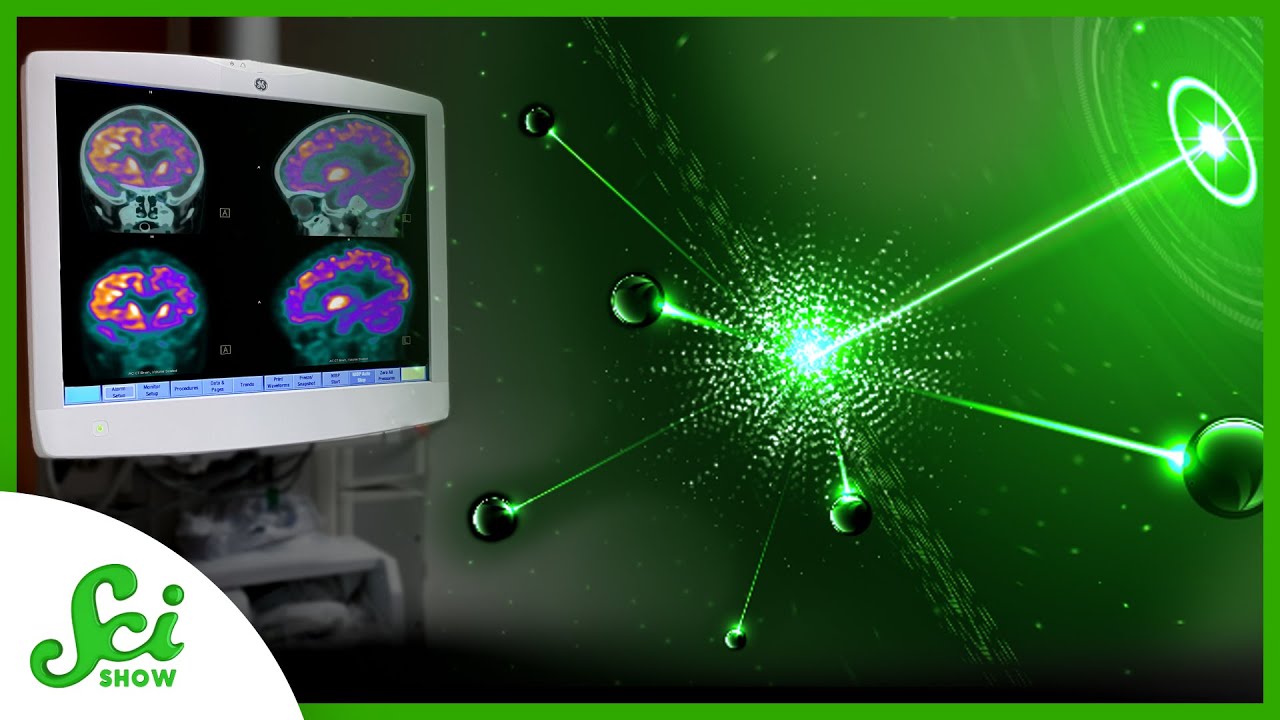
This video explains the operation of clinical medical cyclotrons. It details how negatively charged hydrogen ions () are accelerated through alternating electric fields, stripped of their electrons via a thin carbon foil to yield protons (), and directed to bombard oxygen-18 enriched water targets () to synthesize the Fluorine-18 isotope.
Knowledge Checkpoint
- Define the target reaction equation for the production of Fluorine-18 from Oxygen-18.
- Explain how a cyclotron accelerates particles and the function of the electron-stripping foil.
- Discuss why medical cyclotrons must be co-located with nuclear medicine centers based on radiochemical half-life.
Module 5: The Nuclear Fuel Cycle and Actinide Chemistry
This module covers industrial actinide coordination chemistry. You will analyze the molecular pathways of the nuclear fuel cycle, focusing on uranium extraction, enrichment, and reactor chemistry. You will study the coordination chemistry of orbitals in actinides and the molecular mechanism of the Plutonium-Uranium Reduction Extraction (PUREX) process, utilizing tri-n-butyl phosphate (TBP) solvent extraction.
Recommended Videos
Why this video
This lecture provides an in-depth chemical analysis of the PUREX process. It explains the solvent extraction equilibrium governed by the distribution coefficient (), focusing on how tri-n-butyl phosphate (TBP) in a kerosene diluent forms neutral coordination complexes with uranyl nitrate () and tetravalent plutonium nitrate () to selectively partition them from aqueous fission products.
\text{UO}_2^{2+}_{(\text{aq})} + 2\text{NO}_{3(\text{aq})}^- + 2\text{TBP}_{(\text{org})} \rightleftharpoons \text{UO}_2(\text{NO}_3)_2(\text{TBP})_{2(\text{org})}
Knowledge Checkpoint
- Write the chemical extraction equilibrium equation for Uranium using TBP.
- Explain the role of the distribution coefficient () in determining extraction efficiency.
- Describe how plutonium is chemically separated from uranium in the PUREX process by reducing to the non-extractable state.
Why this video
This video explains the fundamental coordination chemistry challenges of actinides. It contrasts the diffuse valence orbitals of actinides with the core-like orbitals of lanthanides, explaining why covalent bonding contributions are more prominent in actinide complexes. This distinction is critical for designing selective separation ligands.
Knowledge Checkpoint
- Explain how orbitals participate in covalent metal-ligand bonding compared to the highly shielded orbitals of lanthanides.
- Describe how the chemical similarity between trivalent actinides and lanthanides complicates radioactive waste partitioning.
- Outline how coordination chemistry is used to develop advanced extractants for nuclear waste management.
Why this video
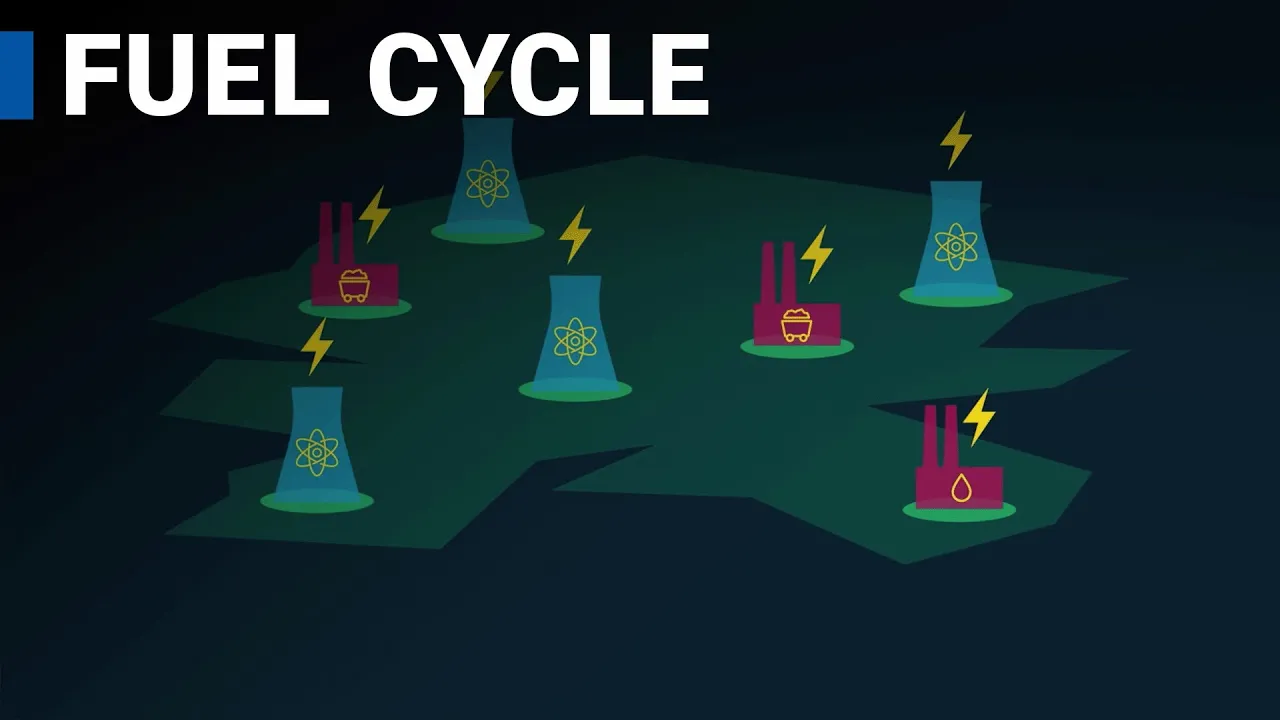
This animation provides an overview of the entire nuclear fuel cycle. It traces the journey of uranium from ore mining and milling to conversion into volatile Uranium Hexafluoride (), isotope enrichment of Uranium-235, fuel fabrication, power reactor generation, and ultimately waste storage or reprocessing.
Knowledge Checkpoint
- Diagram the sequence of chemical and physical transformations in the front-end of the nuclear fuel cycle.
- Explain why uranium is converted into gaseous for centrifugal isotope enrichment.
- Differentiate between open (once-through) and closed (reprocessing) nuclear fuel cycles.
Course Map
This flowchart maps the recommended learning sequence and module dependencies.
Key People Index
- Hans Geiger & Walter Müller: Invented and refined the gas-filled Geiger-Müller tube, establishing the foundation of gas ionization-based radiation detection.
- Robert Jubin: A leading chemical engineer in fuel reprocessing and solvent extraction; pioneer in developing modern nuclear waste management and the chemical engineering pathways of the PUREX process.
- Prof. Steve Liddle: A prominent synthetic inorganic chemist specialized in actinide chemistry; famous for his work on uranium-ligand multiple bonds and mapping the covalent properties of valence shell systems.
Final Self-Assessment
Test your understanding of the entire curriculum by verifying your ability to complete each of the following tasks:
- Predict the primary radioactive decay mode of any unstable nuclide based on its location relative to the Band of Stability.
- Derivate the integrated rate law for first-order nuclear decay from its differential starting equation and calculate sample activity ().
- Quantitatively differentiate secular equilibrium from transient equilibrium in radioisotope generator systems.
- Contrast the physical mechanics of gas-filled Geiger-Müller tubes with scintillation crystals coupled to Photomultiplier Tubes (PMTs).
- Write the step-by-step chemical reaction mechanism for the nucleophilic substitution () synthesis of using Kryptofix 222 and mannose triflate.
- Describe how a hospital cyclotron produces clinical-grade via proton bombardment of -enriched water.
- Write the complete chemical extraction equilibrium equation of uranyl nitrate with tri-n-butyl phosphate (TBP) during the organic phase transition of the PUREX process.
- Explain how the oxidation states of plutonium are manipulated () to separate it from uranium in solvent extraction phases.
- Discuss the physical role of actinide orbitals in coordination chemistry and explain how this distinguishes them from lanthanides.