The nuclear fuel cycle is an industrial process that converts uranium into electricity through several stages: mining uranium ore, milling it into yellow cake, converting it to uranium hexafluoride gas, enriching the uranium-235 concentration from 0.71% to 3-5%, fabricating fuel pellets into assemblies, using them in reactors for 3-5 years, then storing spent fuel underwater or dry, with options to reprocess it for additional energy or dispose of it deep underground in stable geological formations.
The Nuclear Fuel Cycle from Mining to Waste Disposal
Added:Deep Dive
Basic atomic structure and the concept of isotopes, specifically distinguishing between fissile Uranium-235 and fertile Uranium-238.

Thorium. Is it the future of clean energy?
236.7K
Uranium occurs naturally in two isotopes: uranium-235 with 143 neutrons and uranium-238 with 146 neutrons. Uranium-235 is fissile, meaning it can be hit by neutrons and split to release large amounts of energy. Uranium-238 is fertile, absorbing neutrons to transform into weapons-grade plutonium-239. Most nuclear reactors use enriched uranium-235 because natural uranium ore contains mostly the non-fissile 238 variety.
Click to watch →
Jak działa bomba atomowa? | Jądro ciemności, odc. 1
656K
Not all uranium isotopes are equally useful for nuclear reactions. Uranium-235 is fissile—it can sustain nuclear chain reactions when bombarded with neutrons of appropriate energy. Uranium-238 is fertile but not fissile; it cannot sustain chain reactions with thermal (low-energy) neutrons. Natural uranium contains only about 0.7% U-235, making it unsuitable for most nuclear applications without enrichment.
Click to watch →

Fisica Nucleare: la differenza tra Uranio 235 e Uranio 238 - Valerio Rossi Albertini
77.5K
Uranium-238 and Uranium-235 are isotopes of uranium that differ by three neutrons. U-238 is the original, more stable isotope that does not split when neutrons are removed. U-235 is created by removing three neutrons from U-238 (238 - 3 = 235). This isotope is unstable and can be split, releasing enormous energy.
Click to watch →

WHO Was The "Pioneer" On The Frost Moon!? Snezhnaya Looks INCREDIBLE! (Also Nuclear Engineering Yap)
4K
Uranium-235 (U-235) is the fissile isotope used in nuclear reactors and weapons because it readily decays and produces both energy and neutrons, sustaining a chain reaction. Uranium-238 (U-238) is the most common isotope of uranium and is classified as fertile rather than fissile. When U-238 absorbs a neutron, it becomes U-239, which undergoes beta decay to become neptunium-239, which then rapidly transforms into plutonium-239. The Hiroshima bomb used U-235, while the Nagasaki bomb used plutonium-239.
Click to watch →

Mengolah Biji Uranium.!! Pemurnian Bahan Nuklir..
39.7K
Uranium-238 is called 'fertile' because its nucleus is very difficult to split by neutrons during fission reactions, requiring high-energy neutrons to break the nucleus. In contrast, uranium-235 is called 'fissile' because its nucleus is very fragile and easily split by neutrons, making it ideal for nuclear reactions. This is why uranium-235 is primarily used in nuclear weapons and reactor fuel.
Click to watch →
Deep Dive
The fundamental physics of nuclear fission, including how neutron bombardment triggers a self-sustaining chain reaction.

Atomic Physics
384.4K
Each fission was found to be accompanied by the release of a few neutrons. One neutron had been used to provoke the fission, but the fission itself produces more than one neutron, and is itself capable of provoking more than one fission, and so on. There is thus the possibility of a self-sustaining chain reaction. The reaction can begin without any neutrons being supplied from outside since a few fissions are always taking place spontaneously, and these would supply the free neutrons. This discovery opened the possibility of both controlled nuclear reactions and atomic bombs.
Click to watch →

L9.7 Nuclear Physics: Fission
2K
Nuclear fission is the process by which very heavy nuclei split into daughter nuclei, releasing energy and additional neutrons. This can occur spontaneously in heavy nuclei like uranium-238 or be induced by neutron absorption. When a neutron is absorbed by uranium-235, it forms an excited compound nucleus (uranium-236) with ~6.5 MeV of energy, causing immediate fission. The resulting fragments carry ~180 MeV of kinetic energy and release 2.5 average prompt neutrons per event. A self-sustained chain reaction requires the neutron multiplication factor (k) to be ≥1; if k<1, the reaction dies out. This principle underlies all nuclear reactor operation and nuclear weapons design.
Click to watch →
Fission Chain Reaction, Physics Lecture | Sabaq.pk
7.9K
A fission chain reaction is a self-sustaining sequence where neutrons released from one fission event trigger additional fission reactions. When a neutron bombards uranium-235, it splits into barium-141 and krypton-92, releasing three neutrons and 200 MeV of energy. These three neutrons can then cause additional fission events, creating a chain effect. The energy released is proportional to the number of fission reactions, which grows exponentially as each reaction produces more neutrons. This fundamental principle explains how a single neutron can initiate a cascade of nuclear reactions.
Click to watch →

Why the Atomic Bomb Is So Powerful - Feynman Explains the Science
20.1K
Atoms are mostly empty space with mass concentrated in tiny nuclei held by the strong nuclear force. When a neutron strikes a uranium-235 nucleus, it becomes unstable and splits into two smaller nuclei, releasing energy and additional neutrons. Each fission event produces two or three new neutrons that can trigger further reactions, creating a chain reaction. For the reaction to grow, enough neutrons must remain inside the material—depending on mass, density, and shape. When conditions are just right, the reaction becomes self-sustaining (critical).
Click to watch →
Atom Bombaları Neden Bu Kadar GÜÇLÜ? - Feynman'ın Ürpertici Yanıtı | Richard Feynman
21.3K
Nuclear fission occurs when a neutron strikes a heavy nucleus like uranium-235, causing it to become unstable and split into two smaller nuclei. This process releases enormous energy and additional neutrons. The chain reaction mechanism creates exponential growth: one neutron causes one fission, releasing two or three new neutrons, each capable of causing additional fissions. For a chain reaction to become self-sustaining, the material must reach critical mass and density. If neutron production exceeds the critical threshold, the reaction accelerates uncontrollably, leading to a nuclear explosion.
Click to watch →
Deep Dive
An understanding of radioactivity, ionizing radiation, radioactive decay, and the concept of half-life.

3V H6.4 Werken met gammastraling
150
Radioactivity is the spontaneous emission of ionizing radiation from unstable atomic nuclei. Radioactive substances can be natural (found in food, building materials, air) or artificial (created in hospitals and nuclear power plants). During radioactive decay, unstable nuclei break apart and transform into different atoms, emitting radiation. The half-life is the time required for half of the radioactive atoms in a sample to decay. After one half-life, 50% remains; after two, 25%; after three, 12.5%. The activity of radiation decreases proportionally with the amount of radioactive material.
Click to watch →

The 4 Types of Radiation Emergencies & What You Should Do About Each
1.3K
Radioactivity originates from unstable isotopes—atoms with different neutron counts that undergo spontaneous decay. Half-life measures the time for half a sample to decay, ranging from seconds (lead-217) to billions of years (potassium-40). Ionizing radiation (alpha, beta, gamma) differs from non-ionizing radiation by its ability to knock electrons from atoms, potentially damaging DNA and causing cancer. Understanding these basic concepts reveals why different radioactive materials pose varying risks over different timescales.
Click to watch →

P4d Radioactivity and half life revision video
1K
Radioactivity is the process by which unstable atomic nuclei break down and emit ionizing radiation, which includes three types: alpha particles (helium nuclei with 2 protons and 2 neutrons, highly ionizing), beta particles (fast electrons with negative charge), and gamma rays (high-frequency electromagnetic waves, highly penetrating). Ionizing radiation ionizes atoms by removing electrons, creating charged ions. The activity of a radioactive substance is the number of decays per second, which decreases over time as nuclei decay. Half-life is the time taken for half of the radioactive nuclei in a sample to decay, during which the activity halves; for example, starting with 400 atoms, after one half-life 200 remain, after two half-lives 100 remain, and so on.
Click to watch →

ВСЕ типы 16 задания ЕГЭ физика: ядерная физика | Умскул
8.1K
This section introduces radioactivity and the concept of half-life. Radioactivity is the spontaneous ability of unstable atomic nuclei (typically heavy elements) to decay and emit radiation (alpha, beta, or gamma particles). This occurs because the nucleus is unstable and seeks a more stable configuration. Half-life (T) is the time required for half of the radioactive atoms in a sample to decay. After one half-life, 50% of atoms remain; after two half-lives, 25% remain; after three half-lives, 12.5% remain. This exponential decay pattern is characteristic of all radioactive materials.
Click to watch →

Radioactivity and Radiation: GCSE revision
38.2K
Radioactivity is the process by which unstable atomic nuclei decay to achieve greater stability, emitting radiation in the form of alpha particles (helium nuclei, positively charged, low penetration), beta particles (electrons, negatively charged, moderate penetration), or gamma rays (high-energy electromagnetic waves, no charge, high penetration); isotopes are variants of elements with the same number of protons but different neutrons, and while individual atom decay times are unpredictable, the half-life describes the statistical time for half of a radioactive sample to decay, with all three radiation types being ionizing radiation capable of damaging living cells by knocking electrons out of atoms.
Click to watch →
Deep Dive
The basic working principle of a nuclear power plant, specifically how thermal energy from fission is converted into electricity.

Nuclear Power Plants In India - For RRB NTPC, Group-D / SSC / Banking / UPSC and other Exams
485
A nuclear power plant is a thermal power station that uses nuclear fission as its heat source. The basic working principle involves: nuclear fission in the reactor generates heat, which converts water into high-pressure steam; this steam drives turbines connected to generators that produce electricity. Nuclear fission is the process where heavy atomic nuclei like uranium or thorium split into smaller nuclei, releasing enormous amounts of energy. This process is the fundamental principle behind nuclear power generation, where the splitting of atomic nuclei provides the heat needed to produce electricity.
Click to watch →

14 july/class 10th/Science-2/chapter 5
223
A nuclear power plant generates electricity through nuclear fission. The process involves: (1) Nuclear fuel (uranium-235 or plutonium) undergoes fission, releasing enormous thermal energy; (2) This thermal energy heats water to produce steam; (3) Steam drives turbines connected to generators; (4) Generators convert mechanical energy to electrical energy. The energy conversion chain is: Nuclear Energy → Thermal Energy → Kinetic Energy of Steam → Electrical Energy. The instructor explains that nuclear fission occurs when a neutron strikes a uranium-235 nucleus, causing it to split into lighter elements (barium and krypton) and release energy and additional neutrons.
Click to watch →
Nuclear Energy |Fission and Fusion Reaction | Olevel
117
Nuclear power plants generate electricity through a thermal conversion process: fission heat → steam generation → turbine rotation → electrical generation. The heat from controlled fission reactions transfers to a coolant (water, CO₂, or liquid metal), which then produces steam to drive turbines connected to generators.
Click to watch →

Class 10th Mid Term महायज्ञ | Science 2 Chapter 5 & 6 | Maharashtra Board | By Krushi Mam Pravin Sir
17.4K
Nuclear Power Plant working principle: (1) Nuclear fission (splitting of atoms) produces heat energy, (2) Heat converts water to steam, (3) Steam drives turbine, (4) Turbine drives generator, (5) Generator produces electrical energy. Nuclear fission involves Uranium-235 splitting into Barium and Krypton, releasing 3 neutrons and 200 MeV of energy in a chain reaction.
Click to watch →

Wie funktioniert ein Atomkraftwerk / Kernkraftwerk? - einfach und anschaulich erklärt
60.5K
The nuclear fission process releases significant thermal energy that heats the fuel rods and surrounding heavy water. This heated water transfers thermal energy to a secondary water circuit through heat exchangers, converting normal water into high-pressure steam. The steam then drives turbines connected to electrical generators, which convert mechanical rotational energy into electrical energy. This multi-stage energy conversion process transforms nuclear binding energy into usable electricity through thermal, mechanical, and electromagnetic transformations.
Click to watch →
Prerequisite Knowledge
- Concept 01Basic atomic structure and the concept of isotopes, specifically distinguishing between fissile Uranium-235 and fertile Uranium-238.
- Concept 02The fundamental physics of nuclear fission, including how neutron bombardment triggers a self-sustaining chain reaction.
- Concept 03An understanding of radioactivity, ionizing radiation, radioactive decay, and the concept of half-life.
- Concept 04The basic working principle of a nuclear power plant, specifically how thermal energy from fission is converted into electricity.
Subsequent Learning
- Step 01Nuclear fuel reprocessing technologies, such as the PUREX process, and the concept of a closed fuel cycle.
- Step 02The engineering, geology, and socio-political challenges of designing Deep Geological Repositories (DGRs) for high-level waste.
- Step 03Generation IV reactor designs and Breeder Reactors, which are designed to utilize spent fuel and depleted uranium as new fuel sources.
- Step 04The international regulatory frameworks, safeguards, and non-proliferation treaties governed by organizations like the International Atomic Energy Agency (IAEA).
Fuel Cycle
Spent Fuel
Fuel Cycle
0:00Playing Section
- 1
Covers uranium mining, milling, and conversion to gas.
- 2
Details enrichment process using centrifuges to boost U-235.
- 3
Explains fuel fabrication and electricity generation in reactors.
The 'Unclosed Loop' and Environmental Justice Critique
While the industrial concept of the nuclear fuel cycle depicts a highly managed, circular process, critics and environmental scientists argue this framing is misleading. In reality, the cycle remains 'open-ended' because the 'back-end'—permanent disposal of high-level radioactive waste—remains largely unresolved globally, with spent fuel accumulating in temporary storage for decades. Additionally, this critical perspective highlights the severe environmental justice impacts at the 'front-end' of the cycle, where uranium mining has disproportionately contaminated Indigenous lands and communities, such as the Navajo Nation. Critics argue that characterizing this process as a sustainable 'cycle' obscures the permanent ecological, financial, and social burdens passed on to future generations.
Deep Dive
Nuclear fuel reprocessing technologies, such as the PUREX process, and the concept of a closed fuel cycle.
Про Грязную Бомбу
21.5K
Nuclear fuel reprocessing involves extracting usable materials from spent fuel through chemical dissolution in aggressive acids like nitric acid. The process separates valuable elements including plutonium and transuranic elements, which can be reused as reactor fuel. This creates a closed fuel cycle that reduces dependence on fresh uranium mining. The technology addresses the fundamental problem of uranium scarcity, as natural uranium deposits are limited. Countries like Russia and France have developed this capability, though it requires extremely high technical standards and specialized facilities due to the extreme radioactivity involved.
Click to watch →
ПРОРЫВ - Замкнутый Ядерный Цикл. Брест ОД 300 - Сделано в России | Борис Марцинкевич
148K
A closed nuclear fuel cycle involves reprocessing spent nuclear fuel to recover usable fissile materials like plutonium and uranium, which are then recycled as fuel rather than disposed of as waste. This approach dramatically increases the energy yield from natural uranium resources—potentially multiplying usable fuel by a factor of 200 or more. The recovered materials can be fabricated into new fuel assemblies and returned to reactors, significantly extending fuel supplies and reducing long-term radioactive waste volumes.
Click to watch →
„Bez atomu za kilkanaście lat gasimy światło”. Gdzie i kiedy powstanie polska elektrownia jądrowa?
97.3K
Approximately 90% of spent nuclear fuel can be reprocessed into new nuclear fuel, creating a closed-loop fuel cycle. This technology is not experimental but has been implemented at scale, such as in France where spent fuel from multiple power plants is reprocessed. The reprocessing extracts usable fissile material from spent fuel, significantly reducing the volume and radioactivity of remaining waste. This closed-loop approach maximizes resource utilization and minimizes long-term waste challenges, representing an advanced stage of nuclear fuel cycle management.
Click to watch →

Горизонты атома. "Бесконечный ресурс. Вторая жизнь отработавшего ядерного топлива"
20.9K
Nuclear fuel reprocessing transforms spent nuclear fuel into reusable resources, addressing the fundamental challenge of nuclear waste management. Conventional nuclear reactors utilize only about 3% of their fuel, leaving 97% as spent material. Advanced reprocessing technologies, such as those developed at Russia's Gorno-Khimichesky Kombinat, enable the extraction of valuable isotopes like uranium and plutonium from spent fuel, allowing them to be recycled into new fuel for fast neutron reactors. This closed-loop approach, known as the balanced nuclear fuel cycle, not only maximizes resource utilization but also significantly reduces the volume and longevity of radioactive waste, potentially extending nuclear energy's viability for thousands of years while minimizing environmental impact.
Click to watch →
GREENPEACE Везёт ЯДЕРНЫЕ ОТХОДЫ в Россию? Что Франция Вывозит в Россию? Борис Марцинкевич
73.8K
This segment explains the nuclear fuel reprocessing process. The PUREX process uses tributyl phosphate dissolved in kerosene to chemically separate plutonium from uranium in dissolved nuclear fuel. This process achieves separation coefficients of up to 1000, allowing plutonium and uranium to be recovered separately. The video explains that France has two major reprocessing plants capable of processing 1000 tons of fuel annually, while Russia's RT-1 plant can process 400 tons. The segment explains that reprocessing allows recovery of approximately 1% of the original uranium-235, which can be reused as fuel. This process significantly reduces the volume of high-level waste requiring long-term storage.
Click to watch →
Deep Dive
The engineering, geology, and socio-political challenges of designing Deep Geological Repositories (DGRs) for high-level waste.

62nd Annual BGA Rankine Lecture
4.4K
High-level radioactive waste requires deep geological repositories at depths of 200-1000 meters with multibarrier systems. The first barrier is the canister containing nuclear waste, surrounded by compacted bentonite clay buffer (unsaturated state), with the host rock as the third barrier. Technical challenges include thermo-hydro-mechanical coupling in the buffer, water ingress from host rock hydrating bentonite causing swelling and sealing construction gaps, heat from canister causing phase changes and vapor flow, and double porosity structure in bentonite affecting resaturation behavior.
Click to watch →
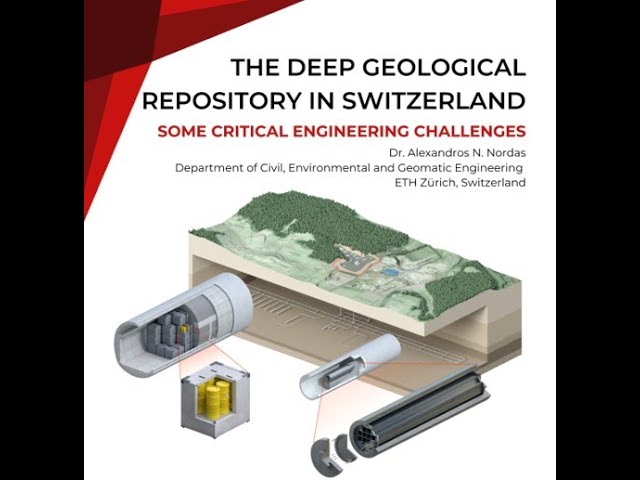
The Deep Geological Repository in Switzerland - Some Critical Engineering Challenges
254
Designing deep geological repositories for nuclear waste requires addressing complex geotechnical challenges, particularly in low-permeability clay formations like Opalinus clay in Switzerland. The key challenges include understanding the anisotropic mechanical behavior of clay (with different strength and stiffness depending on loading orientation relative to bedding planes), managing coupled hydro-mechanical processes during excavation that create negative pore pressures (suctions) leading to long-term ground deformation, and selecting appropriate tunnel support systems. For the Swiss repository, numerical simulations revealed that stiff segmental linings face unacceptable overstressing risks under squeezing conditions, while deformable linings that yield at controlled pressures (2 MPa) provide a feasible solution by accommodating ground deformation and eliminating overstressing concerns. The project demonstrates how advanced constitutive modeling, coupled with careful consideration of saturation uncertainties, enables safe design of underground structures intended to contain radioactive waste for hundreds of thousands of years.
Click to watch →
Designing the UK's long-term solution for nuclear waste | Positive Impact Podcast
394
Successful geological disposal depends on selecting suitable rock formations with specific characteristics: stability (limited faults and fractures, minimal seismic risk) and impermeability (reducing fluid and gas flow). Scientists analyze rock samples and imaging data to verify geological suitability. The multibarrier concept relies on natural geological barriers, passive-safe waste packages, and engineered seals working together over hundreds of thousands of years. High-level waste generates persistent heat requiring careful thermal management through appropriate spacing and understanding of rock thermal conductivity. Innovative concepts explore geothermal energy recovery from waste heat, potentially powering facility operations while reducing carbon footprint. These interconnected geological and engineering challenges demand sustained interdisciplinary research and careful site characterization.
Click to watch →
Soufiane Mekki | Der richtige Umgang mit Atommüll | Berlin Symposium
133
Deep geological repositories (DGRs), excavated 250-1000 meters underground with multiple engineered barrier systems, represent the international consensus for passively isolating high-level nuclear waste over thousands of years without human supervision. Near-surface repositories have safely managed 90% of radioactive waste volume for over 50 years, while DGRs are now licensed in Sweden, Finland, and France. Successful implementation requires holistic approaches combining technology, economics, stakeholder engagement, and long-term planning, as radioactive waste management spans generations and requires careful consideration of aging storage systems, extended storage periods, and societal acceptance.
Click to watch →
The challenges of UK radioactive waste disposal
293
Deep geological repositories for long-lived wastes require placement at depths of approximately 500 meters where groundwater has remained stable for millions of years. The design includes vaults for low-heat-generating waste packed closely together, and separate tunnels for heat-generating vitrified high-level waste and spent fuel spaced meters apart to prevent excessive temperature buildup that could compromise containment barriers. Despite occupying only 2% of total waste volume, heat-generating waste requires 98% of the repository footprint due to spacing requirements.
Click to watch →
Deep Dive
Generation IV reactor designs and Breeder Reactors, which are designed to utilize spent fuel and depleted uranium as new fuel sources.

Nuclear Power Update: The Right Climate Stuff (Bob Bauman)
3.1K
Gen 4 reactors use coolants other than water (sodium, molten salt, helium), fast breeder designs extending fuel cycles and minimizing waste, enhanced accident-tolerant fuels, and passively safe cores. They feature direct electric power conversion using Brayton cycles for quick load following to manage demand fluctuations and wind/solar intermittencies. The fast breeder design seeds fuel to create and consume its own plutonium, enabling 30+ years of operation before refueling. Waste is reduced by 80% and is recyclable. Multiple fuels including depleted uranium, plutonium, and thorium can be used.
Click to watch →
Gen-IV FBR designs
1.6K
The Generation Four Initiative identifies six promising reactor designs for future nuclear power: VHTR (thermal, 44-45% efficiency but poor breeding), SCWR (supercritical water, similar to thermal reactors), SFR (sodium-cooled fast breeder), LFR (lead-cooled fast breeder), GFR (gas-cooled fast breeder), and MSRs (molten salt). VHTR and SCWR face limitations in breeding capability and fuel utilization. MSRs remain immature with significant R&D needs. Only the three fast reactor types (SFR, LFR, GFR) offer viable paths forward for sustainable nuclear power with high fuel utilization and breeding capabilities.
Click to watch →
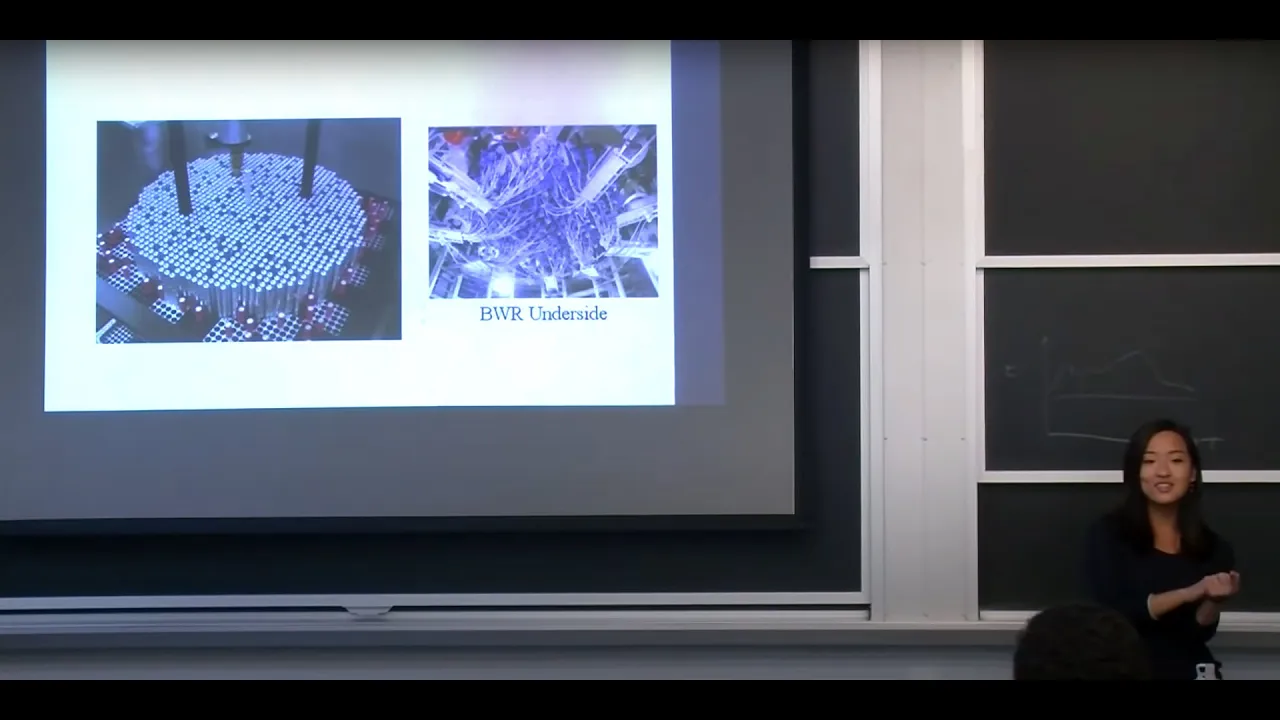
Nuclear Reactor Construction and Operation | MIT 22.01
1.2M
Heavy water reactors (like Canada's CANDU) use deuterium oxide (D₂O) instead of ordinary water, with a much lower neutron absorption cross-section (0.00052 barns vs. 0.332 barns for hydrogen), allowing use of lower-enriched uranium fuel. This reduces fuel costs but increases complexity, with heavy water costing approximately $1,000 per kilogram. Breeder reactors convert fertile materials (uranium-238 or thorium-232) into fissile materials through neutron absorption: uranium-238 absorbs a neutron to become uranium-239, which decays to plutonium-239; similarly, thorium-232 converts to uranium-233. By capturing escaping neutrons, breeder reactors create additional fuel rather than consuming it. Generation IV reactors represent advanced designs being developed to improve upon existing nuclear technology, including Gas-cooled Fast Reactors, Lead-cooled Fast Reactors, Molten Salt Reactors, Sodium-cooled Fast Reactors, Very High Temperature Gas Reactors, and Supercritical Water-cooled Reactors. These designs aim to achieve greater sustainability, improved safety, enhanced proliferation resistance, better economic viability, and more efficient resource utilization.
Click to watch →

Jancovici Cours 6-2 "e=mc², il suffisait d'y penser" Mines2008
7.2K
Generation IV reactors aim to address current technology limitations: improved fuel utilization, higher efficiency, reduced waste, enhanced safety, and reduced proliferation potential. Passive safety systems rely on natural physical processes (gravity, convection) to maintain safety without active intervention. Fast breeder reactors use fast neutrons to breed more fuel than consumed, converting uranium-238 into plutonium-239.
Click to watch →
Запуск нового реактора скоро произойдет в России. БРЕСТ ОД 300
1.2M
Breeder reactors are designed to produce more fuel than they consume by converting fertile isotopes into fissile isotopes. Traditional breeder reactors consume more energy than they produce, but Soviet and Russian nuclear engineers developed designs that can 'ignite' spent nuclear fuel, stopping the primary fuel (uranium-235) at a point where it can be reused in conventional reactors. Conventional reactors burn natural uranium, while fast neutron reactors burn a mixture of plutonium and uranium. The BREST reactor reprocesses spent fuel, cleans it, and transforms it back into highly enriched fuel, which is then repackaged and returned to conventional reactors or mixed with plutonium for fast neutron reactors. This approach dramatically extends uranium reserves and reduces waste.
Click to watch →
Deep Dive
The international regulatory frameworks, safeguards, and non-proliferation treaties governed by organizations like the International Atomic Energy Agency (IAEA).

"النفاق يملأ القاعة".. مندوب روسيا يحرج واشنطن في مجلس الأمن
358.9K
The strikes on Iranian nuclear facilities occurred in authorized areas under the Non-Proliferation Treaty framework and were subject to IAEA oversight. The speaker argued that attacking these facilities undermined the IAEA's authority and damaged the system of international cooperation. As a member state of the Non-Proliferation Treaty, Iran has the right to develop its nuclear program for peaceful purposes. Israel, which has not joined the Non-Proliferation Treaty, is not subject to IAEA safeguards, creating an unequal application of international nuclear non-proliferation norms. The speaker called for an immediate cessation of hostile actions and for all parties to exercise self-restraint and return to diplomacy.
Click to watch →

Daily Current Affairs- 4 March 2026 | The Hindu News Paper | Prelim Booster by Rajnikant Sir
11.1K
The International Atomic Energy Agency (IAEA), established in 1957 and headquartered in Vienna, Austria, serves as the world's central intergovernmental body for nuclear cooperation and peaceful applications. With 180 member states, the IAEA implements safeguards to verify that nuclear programs serve peaceful purposes only, preventing proliferation of nuclear weapons. The agency monitors nuclear facilities globally and implements Article III of the Non-Proliferation Treaty. India participates in IAEA activities while maintaining independent strategic nuclear programs, demonstrating how international frameworks can coexist with national security requirements.
Click to watch →

International Atomic Energy Agency - What is the mandate & role of nuclear watchdog IAEA? #UPSC #IAS
37.2K
The International Atomic Energy Agency (IAEA), established in 1957 as an autonomous UN organization, serves as the primary international body for nuclear governance, promoting peaceful nuclear energy use while preventing weapons proliferation. Reporting to both the General Assembly and Security Council, the IAEA conducts inspections and verification across nuclear facilities worldwide. The Non-Proliferation Treaty (NPT), signed by 191 countries, forms the cornerstone of this architecture, with four nations remaining outside: India, Pakistan, Israel, and South Sudan. North Korea joined in 1985 but withdrew in 2003 and conducted nuclear tests, revealing systemic vulnerabilities. The IAEA's fundamental limitation lies in its dependence on great power cooperation rather than independent enforcement authority, creating inherent tensions between verification needs and state sovereignty concerns that challenge the effectiveness of international nuclear governance frameworks.
Click to watch →
Attaque iranienne contre une base militaire américaine au Qatar|LCI
651K
The International Atomic Energy Agency (IAEA) is an international organization under the United Nations responsible for promoting safe, secure, and peaceful uses of nuclear energy. Countries that sign the Treaty on the Non-Proliferation of Nuclear Weapons (NPT) are subject to IAEA inspections and safeguards to verify compliance with their nuclear commitments. When countries violate these commitments, they may lose the legal protections afforded by the treaty and international agreements.
Click to watch →

Iran Israel US Conflict: IAEA NPT क्या ? Nuclear Project Plan l Khamenei l Rimjhim Ke 5 Points
107.1K
The International Atomic Energy Agency (IAEA), established in 1957, serves as the UN's nuclear watchdog to prevent nuclear proliferation by monitoring countries' nuclear facilities and ensuring they don't develop weapons. The Non-Proliferation Treaty (NPT), signed in 1968, is an international agreement where countries commit to not developing nuclear weapons in exchange for peaceful nuclear technology access and IAEA monitoring. Countries can enrich uranium up to 3.67% for peaceful purposes, but 90% enrichment is considered 'bomb grade' and enables nuclear weapons development. If a country withdraws from the NPT, it legally opens the path for nuclear weapons development, potentially triggering a regional arms race as other nations may follow suit.
Click to watch →
Fuel Cycle
Spent Fuel
Fuel Cycle
0:00- 1
Covers uranium mining, milling, and conversion to gas.
- 2
Details enrichment process using centrifuges to boost U-235.
- 3
Explains fuel fabrication and electricity generation in reactors.
The 'Unclosed Loop' and Environmental Justice Critique
While the industrial concept of the nuclear fuel cycle depicts a highly managed, circular process, critics and environmental scientists argue this framing is misleading. In reality, the cycle remains 'open-ended' because the 'back-end'—permanent disposal of high-level radioactive waste—remains largely unresolved globally, with spent fuel accumulating in temporary storage for decades. Additionally, this critical perspective highlights the severe environmental justice impacts at the 'front-end' of the cycle, where uranium mining has disproportionately contaminated Indigenous lands and communities, such as the Navajo Nation. Critics argue that characterizing this process as a sustainable 'cycle' obscures the permanent ecological, financial, and social burdens passed on to future generations.
Basic atomic structure and the concept of isotopes, specifically distinguishing between fissile Uranium-235 and fertile Uranium-238.
The fundamental physics of nuclear fission, including how neutron bombardment triggers a self-sustaining chain reaction.
An understanding of radioactivity, ionizing radiation, radioactive decay, and the concept of half-life.
The basic working principle of a nuclear power plant, specifically how thermal energy from fission is converted into electricity.
Nuclear fuel reprocessing technologies, such as the PUREX process, and the concept of a closed fuel cycle.
The engineering, geology, and socio-political challenges of designing Deep Geological Repositories (DGRs) for high-level waste.
Generation IV reactor designs and Breeder Reactors, which are designed to utilize spent fuel and depleted uranium as new fuel sources.
The international regulatory frameworks, safeguards, and non-proliferation treaties governed by organizations like the International Atomic Energy Agency (IAEA).
185.7K views1.7Klikes3:00@IAEAvideoOriginal Release: 2017-05-29
the nuclear fuel cycle is an industrial process to produce electricity from uranium in nuclear power reactors the cycle starts with the mining of uranium and ends with the disposal of spent Fuel and other radioactive waste as the first step of the nuclear fuel cycle uranium recovery focuses on mining natural uranium ore from the earth the minded uranium ore is crushed and chemically treated to separate the uranium which is called Milling this process leaves us with yellow cake the powder form of uranium oxide in general conversion is a process in which the uranium is converted to a form suitable for enrichment natural uranium only contains 0.71% of uranium 235 the isotope that maintains a nuclear reactor's chain reaction to increase the concentration of uranium 235 the yellow cake must be converted into uranium hexafluoride gas gas as most nuclear reactors require fuel with a uranium 235 concentration of 3 to 5% the proportion of the uranium 235 isotope must be increased this process is known as enrichment this is done by introducing the uf6 gas into fast spinning cylinders known as centrifuges where heavier Isotopes are pushed out to the cylinder walls enriched uf6 is converted to uranium dioxide powder and formed into small solid cylindri pellets these are packed in long metal tubes which are grouped in fuel assemblies controlled fishing or splitting of u235 atoms generates heat the heat produces steam at extremely high temperatures and pressure the steam then spins a turbine to generate electricity nuclear fuel is typically used in the reactor for 3 to 5 years after removal it is stored underwater which provides both with Cooling and radiation shielding later it can also be stored dry in shielded buildings or cks material in spent fuel can also be recycled to produce more energy some countries chemically reprocess spent fuel to separate the usable material from unusable waste for this plutonium and natural uranium are mixed to make a new type of fuel and can be reused in existing reactors or in fast Neutron reactors spent nuclear fuel or high level waste can be safely disposed of deep underground in stable rock formations waste is packed in long-lasting containers and buried deep in the geological formations chosen for their favorable stability and geochemistry the first such disposable facility is expected to be operational in the near future the iaea supports its member states in using nuclear technologies in a safe secure and sustainable [Music] manner
Up Next

9:31
Upgrading Stewart Platform Joints: Ball Joint vs Universal Design
@harrisonlow
10.5K views•2023-03-24

30:32
Ultrasonic Transducers: Resonant Frequency Measurement and Horn Design
@imajeenyus42
229.9K views•2017-02-22
54:16
Polymer Environmental Degradation: Mechanisms & Stabilization
@iit
1.8K views•2012-07-10
33:39
How a Student's Question Saved a NYC Skyscraper from Collapse
@veritasium
22.8M views•2025-04-26
Related Study Plans & Knowledge Roadmaps
Structured learning paths in Engineering
engineering
Building Acoustic Levitators: Physics & Arduino
01The Physics of Sound and Standing Waves
02Piezoelectric Transducers and H-Bridge Drivers
03Arduino Programming: Generating 40 kHz Signals
+ 2 more learning modules
14h5 modules
Explore Roadmap
engineering
Building Peltier Cloud Chambers: Particle Tracks
01Cosmic Rays & Cloud Chamber Physics
02Thermoelectric Cooling (TEC) Fundamentals
03Custom Liquid-Cooling Loop Design
+ 2 more learning modules
18h5 modules
Explore Roadmap
engineering
Yagi-Uda Antennas: Modeling, Build & VNA Test
01Introduction to RF and Antenna Fundamentals
02Yagi-Uda Antenna Design Principles
03Antenna Modeling and Simulation in 4NEC2
+ 2 more learning modules
18h5 modules
Explore Roadmap
engineering
ECG Monitor Design: Op-Amps, Filters & Noise
01Electronics & Breadboard Basics
02Op-Amps and Instrumentation Amplifiers
03Bioelectricity and ECG Fundamentals
+ 2 more learning modules
18h5 modules
Explore Roadmap