Structural Dynamics: DIY TMDs & Shake Tables
Learning Goal: Design, construct, and analyze a multi-story scale building model equipped with an adjustable tuned mass damper, measuring its structural displacement and resonance mitigation on a DIY motorized shake table using accelerometer data.
Prerequisites
- Basic Electronics & Coding: Familiarity with Arduino IDE, standard microcontrollers (e.g., Arduino Uno/Nano), and basic electronic components (MOSFETs, potentiometers, breadboards).
- Python Programming: Basic understanding of Python scripting, libraries (NumPy, Matplotlib), and reading data from serial ports.
- Basic Mathematics: High school physics (force, mass, spring constants) and introductory calculus (simple harmonic motion concepts).
Estimated Study Time: 35 Hours
Module 1: Foundations of Structural Dynamics & Resonance
In this module, you will explore the fundamental physical forces governing structural behavior during seismic events. You will learn how structures store and dissipate energy, why tall and short buildings react differently to varying ground motions, and how passive structural control devices—specifically Tuned Mass Dampers (TMDs)—are utilized in world-famous skyscrapers to prevent catastrophic failures.
Recommended Videos

Why this video
This video is a visual explanation of how a building's height dictates its natural frequency. Using the "BOSS model" (flexible rod-and-mass structures of varying heights), it demonstrates how ground motions of different periods isolate and excite specific heights of buildings, showing that matching frequencies cause massive resonant deflections while unmatched frequencies result in almost no movement.
Knowledge Checkpoint
- Define "natural frequency" and explain why tall structures have lower natural frequencies (longer periods) than short structures.
- Explain the term "resonance" as it relates to earthquake ground motion and building height.
- Identify which type of building (tall or short) is most vulnerable to rapid, high-frequency ground oscillations.

Why this video
This classic engineering case study centers on the Citicorp Center's structural crisis. It illustrates how the addition of a 400-ton concrete Tuned Mass Damper was critical to reducing structural sway from quartering wind loads, highlighting the real-world stakes of dynamic load analysis.
Knowledge Checkpoint
- State how a TMD behaves relative to a building's motion during dynamic excitation (wind or seismic).
- Describe the structural vulnerability of the Citicorp Center under diagonal (quartering) winds.
- Explain how a damper's movement dissipates kinetic energy from the primary structure.
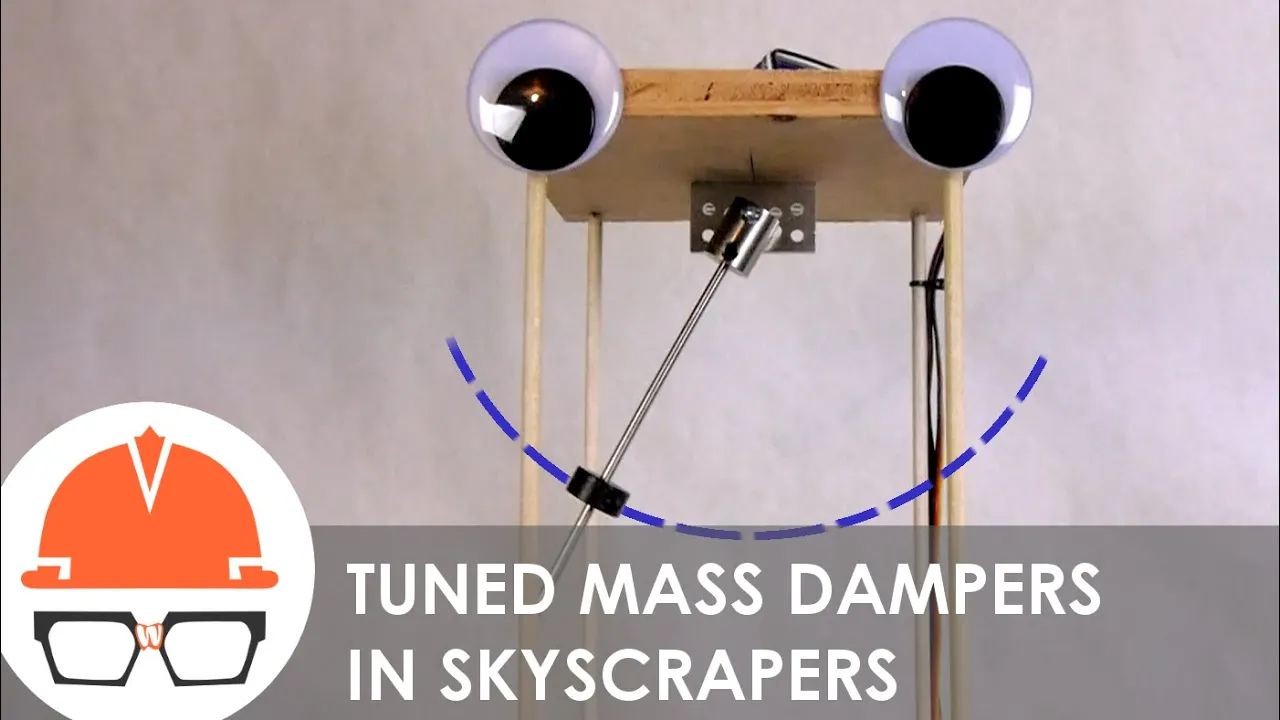
Why this video
This short, highly focused demonstration uses clear physics models to show how a small secondary mass absorbs and cancels the kinetic energy of a larger primary structure. It provides a visual baseline of how a spring-mass damper systems counteracts steady state forces.
Knowledge Checkpoint
- Define the primary components of a passive tuned mass damper (mass, stiffness/spring, and damping mechanism).
- Explain how transferring energy from a primary structure to a secondary mass stabilizes the main structure.
Module 2: Designing and Building a Motorized Shake Table
To run dynamic experiments on scale buildings, you need a controllable ground excitation source. In this module, you will design and construct a variable-speed motorized shake table. You will use a Scotch yoke or eccentric mechanism to translate rotational motor power into precise linear sliding motion and implement an electronic speed controller using a potentiometer and a microcontroller-switched MOSFET to simulate varying earthquake frequencies.
[Potentiometer] ---> [Arduino Analog Pin] ---> [PWM Signal] ---> [MOSFET Transistor] ---> [DC Motor] ---> [Scotch Yoke] ---> [Sliding Table Base]
Recommended Videos

Why this video
This 3D animation details the conversion of rotational movement into pure sinusoidal linear translation. This precise motion profile is essential for executing controlled frequency sweeps on your structural models.
Knowledge Checkpoint
- Identify the four primary mechanical components of a Scotch yoke mechanism.
- Explain why the Scotch yoke mechanism generates a pure sinusoidal displacement wave compared to a typical long-rod crank linkage.
- Describe how to adjust the stroke (amplitude of translation) of a Scotch yoke shake table.

Why this video
This video details the integration of low-cost electronics with mechanical drive assemblies. It shows how analog potentiometers interface with a microcontroller to deliver smooth, responsive, real-time speed adjustments.
Knowledge Checkpoint
- Explain how an analog potentiometer maps physical rotation to a digital value inside a microcontroller.
- Discuss why micro-stepping or smooth PWM signals are required to prevent structural test noise.

Why this video
This official Arduino guide demonstrates how to safely isolate microcontrollers from high-current DC motors using an N-channel MOSFET as an electronic switch. Understanding this circuit prevents back-EMF damage and provides linear speed control through Pulse Width Modulation (PWM).
Knowledge Checkpoint
- Explain why a microcontroller cannot drive a high-power shake table DC motor directly from its digital output pins.
- Describe the role of a MOSFET (Gate, Drain, Source) in switching external, higher-voltage power supplies.
- State why a flyback (freewheeling) diode must be placed across the motor terminals in inductive load circuits.
Module 3: Constructing the Scale Building & Tuned Mass Damper
In this module, you will move from concept to physical fabrication. You will construct a physical multi-story scale "shear frame" model and design an adjustable Tuned Mass Damper (TMD). Because pre-fabricated kits are rare, you must engineer these components yourself to exhibit predictable structural resonance behaviors during testing.
Structural Design Specifications
The Shear Frame Model
To mimic real-world multi-degree-of-freedom (MDOF) dynamic behavior, your scale building should follow a shear frame configuration. Use the following parameters to ensure predictable physics:
  [Floor 3 Platter] (Rigid Plywood / Acrylic)
       |        |
[Columns] (Flexible spring-steel bands or plastic rulers)
       |        |
  [Floor 2 Platter] (Rigid Plywood / Acrylic)
       |        |
[Columns] (Flexible spring-steel bands or plastic rulers)
       |        |
  [Floor 1 Platter] (Rigid Plywood / Acrylic)
       |        |
[Columns] (Flexible spring-steel bands or plastic rulers)
       |        |
================================= (Shake Table Top Plate)
- Columns (Stiffness, ): Construct columns using flexible, thin spring-steel bands, metal strapping, or plastic rulers. These columns must flex easily along the shake table’s axis of motion but resist twisting. Keep column geometry uniform across all levels.
- Floor Platters (Mass, ): Build floor platters from rigid materials like thick plywood, medium-density fiberboard (MDF), or acrylic sheets. The plates must be rigid enough to prevent local bending, concentrating the building's mass at discrete levels.
- Joint Connections: Fasten columns securely to the floor platters using bolts or brackets. The joints must remain rigid (90 degrees) to simulate a classic shear-frame model where lateral displacement dominates.
The Adjustable Tuned Mass Damper (TMD)
To effectively mitigate your building's primary natural frequency, construct a customizable damper assembly that installs on the top floor:
- Tunable Cantilever/Spring: Use a threaded metal rod or a flexible steel ruler extending horizontally from the top floor plate.
- Variable Mass Carriage: Thread heavy hex nuts, lead fishing weights, or steel washers onto the rod. By sliding the mass along the length of the rod, you can adjust the effective pendulum/cantilever length (), varying the damper's natural frequency ().
- Damping Element: Introduce a tiny paddle submerged in high-viscosity oil or a light mechanical friction slider to act as a dashpot, converting kinetic energy into heat.
Recommended Videos

Why this video
This lecture defines the mathematics of a Multi-Degree-of-Freedom (MDOF) shear-frame building. It explains the core mechanical assumptions—rigid floors, weightless flexible columns, and perpendicular lateral displacement—necessary for designing a physical structural testing model.
Knowledge Checkpoint
- Explain why a shear frame model assumes columns are weightless and girders (floors) are completely rigid.
- Define what a "mode shape" is and how many mode shapes a three-story scale building will exhibit.
- Calculate how adding mass to a specific floor impacts the natural frequency of that mode.

Why this video
This short, intuitive video showcases a simple DIY tuned mass damper built from consumer items. It provides a blueprint for fabricating scale-model dampers using basic mechanical parts like springs and hanging weights.
Knowledge Checkpoint
- Describe how to physically suspend a secondary mass so that it vibrates freely inside or atop a structure.
- Explain why the secondary mass must have a tuning mechanism to match the building's sway rate.
Module 4: Telemetry: Accelerometers and Data Acquisition
To measure structural responses, you must install electronic sensors. This module covers wiring an inertial measurement unit (IMU) like the MPU-6050 to an Arduino, calibrating the sensor to remove gravitational bias, writing code to read acceleration registers, and piping that telemetry in real-time into a Python plotting environment.
+------------------+ I2C Bus +-------------+ USB Serial +--------------+ | MPU-6050 IMU | ---------------------> | Arduino Uno | -------------------------> | Python Host | | (SDA, SCL, VCC) | SDA to A4 / SCL to A5 | (ATMega328p)| 9600 / 115200 Baud Rate | (Matplotlib) | +------------------+ +-------------+ +--------------+
Recommended Videos
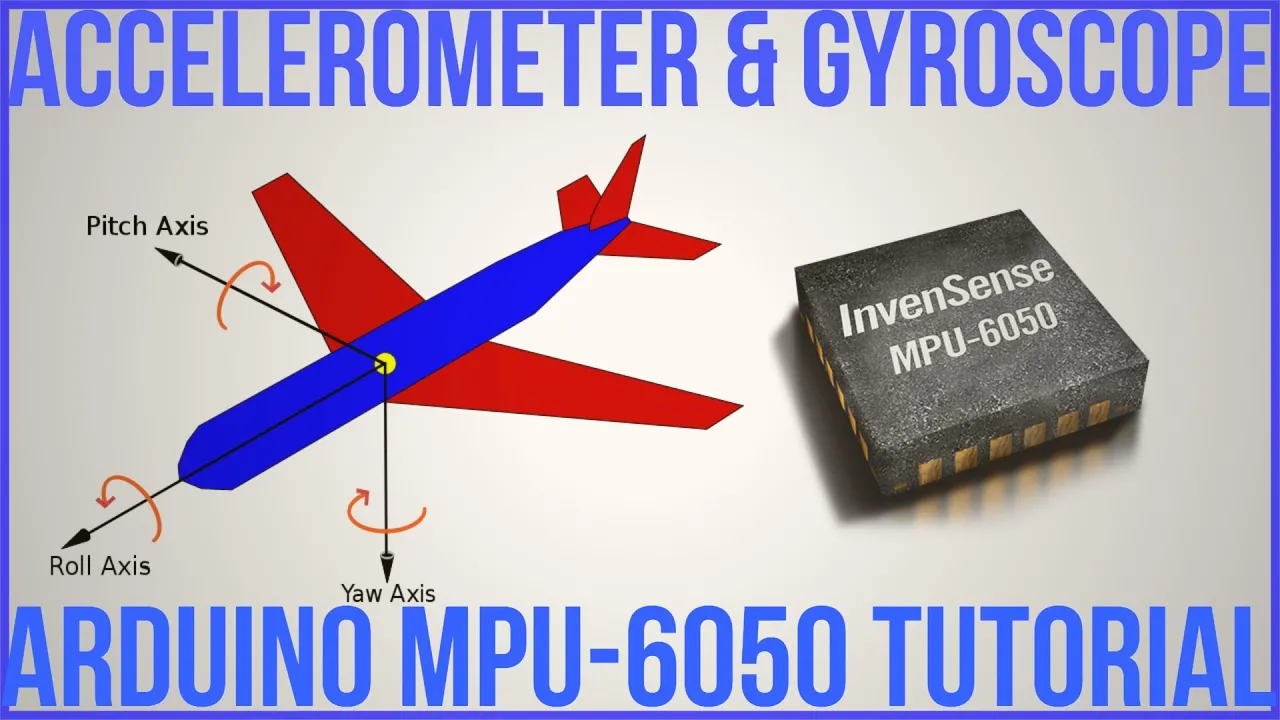
Why this video
This in-depth tutorial provides complete instructions for wiring, coding, and configuring the MPU-6050 sensor via the I2C protocol. It covers how to read raw accelerometer registers and convert those values into usable physical units (such as -forces or ).
Knowledge Checkpoint
- Wire the MPU-6050 to your Arduino Uno (identify the correct pins for VCC, GND, SDA, and SCL).
- Write a sketch utilizing the
<Wire.h>library to poll raw acceleration data from the X-axis register. - Explain how configuring the accelerometer's sensitivity scale (, , , ) impacts resolution and maximum measurable force.
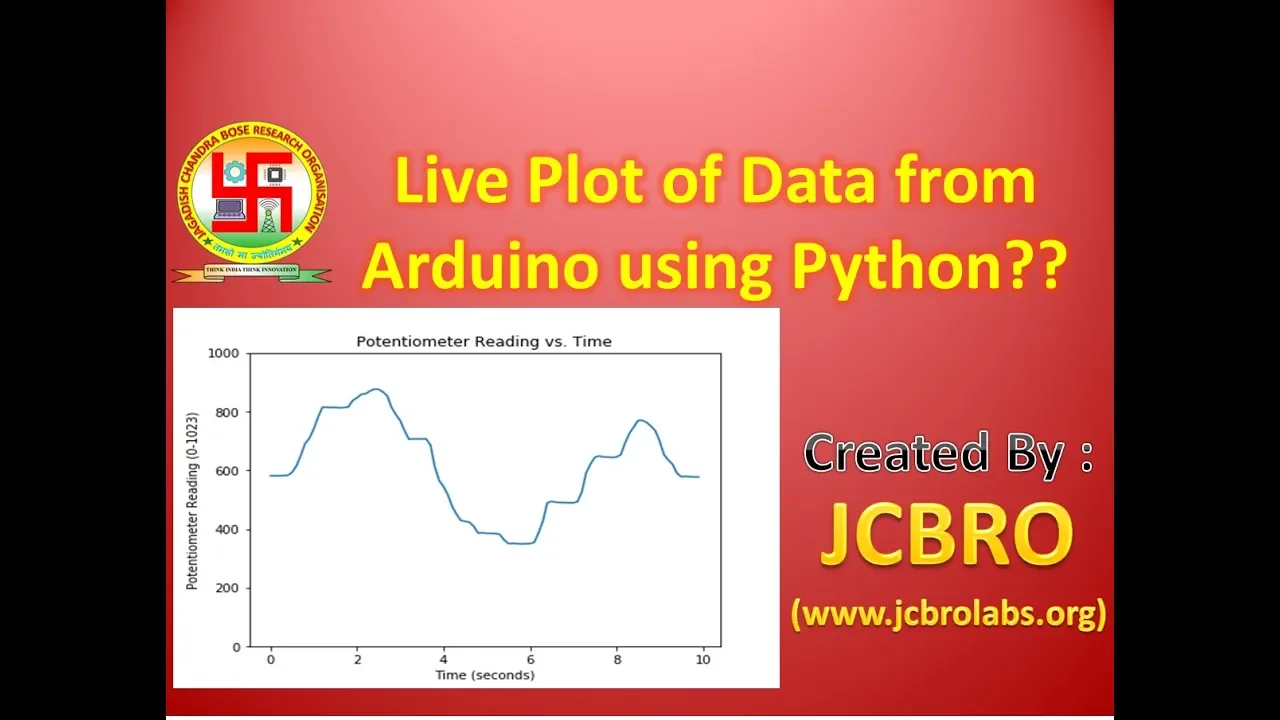
Why this video
This video explains how to establish serial communication between an Arduino and a Python script, using Matplotlib's plotting interface to draw incoming live data.
Knowledge Checkpoint
- Construct a Python script using
pyserialto open a connection and read incoming serial strings from your Arduino. - Format the Arduino's output (
Serial.print) so that multiple axes can be parsed correctly by Python. - Create a real-time updating plot of the accelerometer data stream on your computer.

Why this video
This video guides you through building a structured Python interface to manage incoming data streams without causing buffer overflows or interface lag. It implements non-blocking execution using root.after() to ensure reliable telemetry capture during high-speed shaker sweeps.
Knowledge Checkpoint
- Explain how a blocking read loop in Python can cause GUI lockups or frame rate drops.
- Describe the purpose of buffered data arrays when plotting high-frequency telemetry.
Module 5: Resonance Mitigation Testing and Analysis
Now, you will run full dynamic tests. You will mount the MPU-6050 accelerometer to the top floor of your building, mount the building to your motorized shake table, and run a frequency sweep to isolate resonance. You will analyze your data in Python using Fast Fourier Transforms (FFT) and calculate damping ratios using the Logarithmic Decrement method.
   UN-DAMPED RESONANCE                 DAMPED RESONANCE (TMD ACTIVE)

      /\        /\                       /\
     /  \      /  \                     /  \
/\ / \ / \ /\ / ________ / \ / \ / \ / \ / ____ / / / \ / /
Frequency Sweep Input Frequency Sweep Input
Analytical Guide
1. Performing the Frequency Sweep (Sine Sweep)
- Secure the un-damped model to the shake table.
- Initialize your Python data acquisition script to record acceleration at 100 Hz.
- Turn on the table motor at its lowest speed setting (e.g., 1 Hz).
- Gradually increase the motor's speed (using the potentiometer) by 0.5 Hz increments every 10 seconds.
- Record the top-floor acceleration amplitude.
- The frequency that causes the highest acceleration amplitude is your building’s first-mode natural frequency ().
2. Damping Ratio Calculation () via Logarithmic Decrement
To measure your structure’s natural damping ratio before and after tuning the TMD:
- Displace the top floor of the structure laterally and release it, letting it vibrate freely to rest.
- Export the resulting free-vibration decay curve.
- Identify two peak amplitudes separated by cycles ( and ).
Once the logarithmic decrement () is calculated, find the damping ratio ():
3. Tuning the TMD
Tune your cantilever/pendulum TMD to the isolated natural frequency ():
Adjust the length of your cantilever rod or modify its tip mass until its natural sway rate matches your structural sweep's peak frequency. Re-run your tests to measure and compare the reduction in structural displacement.
Recommended Videos

Why this video
This video explains the mathematics of the logarithmic decrement method. It provides the core formulas required to calculate your scale building's damping ratio () from raw free-vibration data.
Knowledge Checkpoint
- Extract consecutive peak amplitudes (, ) from a recorded free-decay acceleration curve.
- Calculate the logarithmic decrement () and solve for the damping ratio ().
- Explain why a higher damping ratio leads to quicker decay in building sway after an excitation event.

Why this video
This video walks through writing Python code to compute Fast Fourier Transforms (FFT) using NumPy. You will use these steps to convert your accelerometer's time-domain data into a frequency-domain spectrum to identify your building's resonant frequencies.
Knowledge Checkpoint
- Explain the difference between time-domain telemetry and frequency-domain telemetry.
- Write a Python script utilizing
numpy.fft.fftto process raw building acceleration datasets. - Identify peak frequencies on an FFT magnitude plot to locate your model's natural frequencies.

Why this video
This physical experiment demonstrates mounting an accelerometer directly to a solid panel to map vibration responses across a frequency sweep, showing how to practically capture dynamic data from a physical surface.
Knowledge Checkpoint
- Securely mount an accelerometer sensor to a physical structure to prevent slipping during high-amplitude shakes.
- Explain why physical sensor coupling is critical for recording accurate, noise-free telemetry.
Course Map
Key People Index
- William LeMessurier (1923–2007): A legendary structural engineer known for designing the Citicorp Center in New York. His transparency and quick action during the 1978 engineering crisis saved the building from wind-induced failure, standardizing the use of Tuned Mass Dampers in modern high-rises.
- Diane Hartley: An engineering student whose undergraduate thesis in 1978 questioned the Citicorp Center's stability under quartering wind loads, prompting LeMessurier to recalculate his designs and retroactively weld the building's joints.
Final Self-Assessment
Complete this checklist to verify you have met all the objectives of the curriculum:
- Explain how structural natural frequency varies as a function of height, mass, and column stiffness.
- Assemble a functional motorized shake table utilizing a Scotch yoke or eccentric linkage driven by a DC motor.
- Build a speed control circuit using a microcontroller, potentiometer, and N-channel MOSFET to adjust the shake table's frequency.
- Fabricate a multi-story scale building model designed to undergo lateral shear deformation without twisting.
- Build an adjustable Tuned Mass Damper (TMD) capable of matching your building's primary resonant frequency.
- Program a microcontroller to poll and transmit real-time X-axis acceleration data from an MPU-6050 sensor via an I2C bus.
- Write a Python script to parse incoming serial data and generate live plots of structural displacement.
- Execute a controlled frequency sweep (sine sweep) on the shake table to isolate your model's primary natural frequency.
- Write and run a Python script to compute and plot the Fast Fourier Transform (FFT) of your building's vibration data.
- Calculate the structural damping ratio () of your building before and after tuning your TMD using the Logarithmic Decrement method.
- Demonstrate a measurable reduction in peak resonant acceleration (mitigation efficiency) with your tuned mass damper active.