Buildings resonate at different frequencies based on their height—shorter buildings oscillate rapidly while taller buildings move slowly—and when earthquake ground motion matches a building's resonant frequency, its oscillation amplitude increases dramatically, causing the most damage; this explains why some buildings collapse while others remain standing during the same earthquake.
Earthquake Resonance: Building Seismic Response Model (Resonance 3)
Added:Deep Dive
Fundamental principles of wave mechanics, including frequency, amplitude, and period.

WAVES (I) : LESSON 3
8.9K
Waves possess three fundamental measurable properties: amplitude, frequency, and period. Amplitude represents the maximum displacement from equilibrium, indicating wave height and energy. Frequency measures oscillations per second (in hertz), while period measures time per oscillation. These properties are interconnected - waves with the same frequency share the same period, and frequency is inversely proportional to period (f = 1/T). Understanding these relationships forms the foundation for analyzing all wave phenomena.
Click to watch →

فيزياء تانية ثانوى|| ج10 || ملخص قوانين الفصل الأول ( الموجات )
92.4K
This comprehensive section covers the core principles of wave mechanics. The period equals total time divided by number of oscillations, while frequency equals oscillations per unit time—they are reciprocals. Wave speed equals wavelength multiplied by frequency (v = λf). The complete oscillation period equals four times the quarter-period, and the distance traveled in one full oscillation equals four times the amplitude. At maximum displacement, kinetic energy is zero and potential energy is maximum; at equilibrium, kinetic energy is maximum and potential energy is minimum. These principles form the foundation for understanding wave behavior and energy transformations in oscillatory systems.
Click to watch →
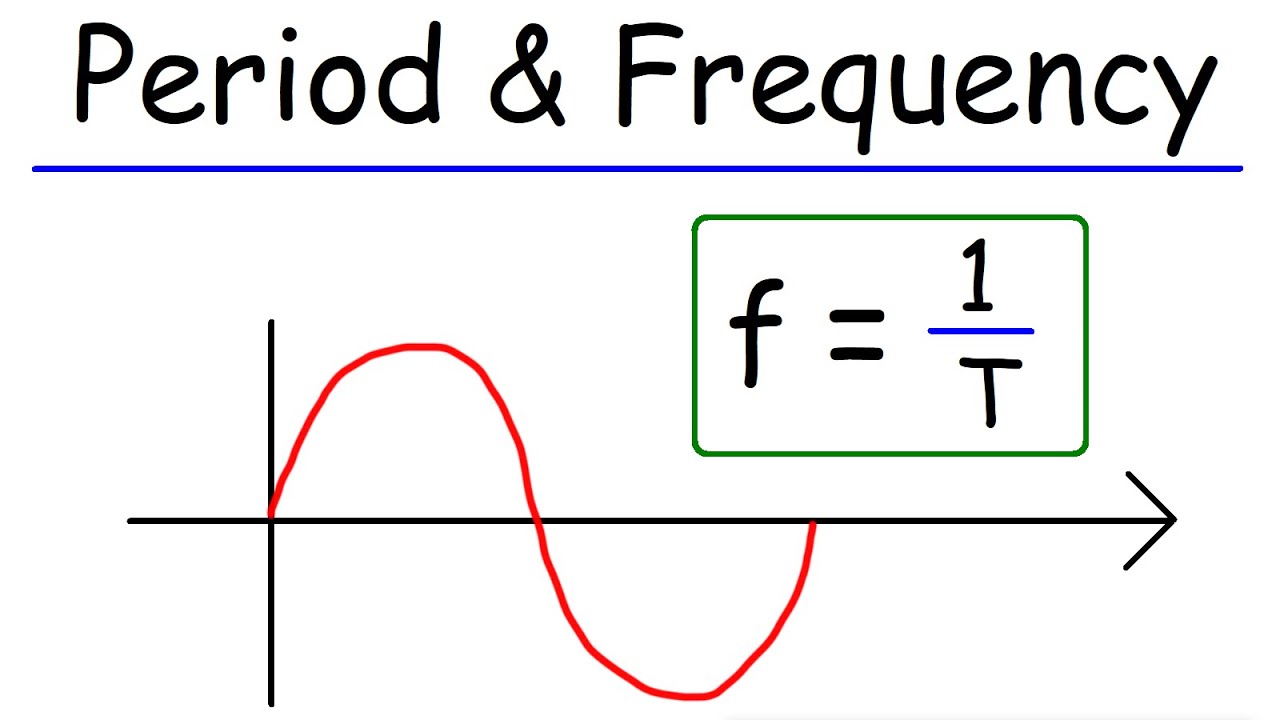
Period, Frequency, Amplitude, & Wavelength - Waves
389.2K
Waves have four fundamental properties: (1) Period (T) is the time to complete one cycle, measured in seconds; (2) Wavelength (λ) is the distance between cycles, measured in meters; (3) Amplitude is half the distance between peak and trough, representing maximum displacement; (4) Frequency (f) is the inverse of period (f = 1/T), measured in hertz (cycles per second). The wave speed equation v = λ × f connects these properties. Amplitude can be calculated from max and min values using (max - min)/2.
Click to watch →

PHY 1001 CH16 1
194
This video introduces fundamental wave mechanics concepts including period (T, time for one cycle measured in seconds), frequency (f, number of cycles per second measured in hertz), wavelength (λ, distance between wave peaks measured in meters), and wave velocity (vw = f × λ). It explains that frequency and period are reciprocals (f = 1/T) and demonstrates these principles through spring-mass systems and pendulums, showing how amplitude affects wave intensity while frequency determines vibration speed.
Click to watch →

ELEMENTOS DE UMA ONDA | ONDULATÓRIA
585
This lesson covers the essential elements of wave mechanics: (1) Wave structure - crest (highest point), trough (lowest point), amplitude (distance from equilibrium to crest/trough), and wavelength (distance between consecutive corresponding points), (2) Time-based properties - period (time for one complete oscillation) and frequency (oscillations per second, measured in Hz), (3) Key relationships - frequency equals one divided by period (f = 1/T), and (4) Wave velocity equations - v = λ/T and v = λf, where velocity equals wavelength divided by period or wavelength times frequency. These fundamental concepts form the basis for understanding all wave phenomena.
Click to watch →
Deep Dive
The concept of natural frequency and simple harmonic motion in physical structures.

Vibration Sec 1. - ENG. Kareem Enan
122
This section covers natural frequency and simple harmonic motion. Simple harmonic motion is the fundamental vibration form where restoring force is proportional to displacement. Natural frequency (ω_n = √(k/m)) determines oscillation rate and is a fundamental system property. All vibration systems can be analyzed in terms of their natural frequencies. This concept is essential for understanding resonance and system response to dynamic loads.
Click to watch →

Clase 16 - Introducción Dinámica de Estructuras
1.2K
The natural frequency ωn = √(k/m) is a fundamental property of the structure, depending only on its mass and stiffness. This property determines how the structure will vibrate when disturbed. Every structure has a natural frequency at which it tends to vibrate when displaced from equilibrium. This property is independent of amplitude or initial conditions. The period Tn = 2π/ωn is the time for one complete cycle.
Click to watch →

Lecture#11 Subsystem Lecture for CubeSat: Structure System (KiboCUBE)
2.5K
Natural frequency is one of the most important concepts for evaluating spacecraft structures. For a simple vibration system consisting of mass m connected to a spring with spring constant k, the natural frequency is the square root of k/m. The equation of motion is mx'' + kx = Fe. Assuming harmonic force and response, substituting into the equation yields the compliance frequency response function (FRF), which shows displacement over applied force. When excitation frequency equals the natural frequency, the denominator becomes zero, causing the magnitude to become very large—this phenomenon is called resonance. In vibration testing, frequency is expressed in Hertz (cycles per second) rather than radians per second for easier interpretation.
Click to watch →

Séance 1 VOM
12.1K
The natural frequency of a simple harmonic oscillator is ω₀ = √(k/m), where k is the spring constant and m is the mass. This frequency depends only on the system's physical properties and is independent of the amplitude of oscillation. The natural frequency is also called the pulsation or angular frequency. It is related to the ordinary frequency f by ω₀ = 2πf, and to the period T by ω₀ = 2π/T.
Click to watch →

Simple Harmonic Motion Natural Frequency
256
Natural frequency is the tendency of an object to vibrate or oscillate at a specific frequency, which is determined by physical properties such as length (for pendulums) or mass (for mass-spring systems), as demonstrated by Galileo's observation that a pendulum's frequency increases as its length decreases.
Click to watch →
Deep Dive
Basic understanding of seismic waves (such as P-waves and S-waves) and how they propagate through the Earth.

Complete Geography for UPSC Prelims | Topic 4/50 Part B | UPSC CSE 2026 #upsccse #upscpreparation
284
P-waves propagate through the Earth by causing particles to vibrate parallel to the direction of wave travel, creating alternating areas of compression and rarefaction. P-waves can travel through solid, liquid, and gaseous materials, making them the fastest earthquake waves. S-waves propagate by causing particles to vibrate perpendicular to the direction of wave travel, creating shearing motion. S-waves can only travel through solid materials and cannot pass through liquids, which is why they are blocked by the Earth's liquid outer core.
Click to watch →

Seismic Waves - P Wave, S Wave and Surface Wave | Geography
5.8K
Seismic waves are vibrations generated when rocks rupture suddenly at an earthquake focus, propagating through Earth's interior and surface; P-waves (primary/compressional waves) move particles back-and-forth in the same direction as wave propagation and travel fastest through all materials including solids, liquids, and gases, while S-waves (secondary/shear waves) move particles perpendicular to wave direction and can only travel through solids, and surface waves form when body waves interact with Earth's surface, causing the most destructive ground motion by moving the ground both horizontally and vertically.
Click to watch →

Seismic Slinky: Modeling P and S Waves in Earth Science
258.7K
Earthquakes generate two primary types of seismic waves with distinct characteristics. P-waves (Primary waves) are the fastest seismic waves and can travel through both solids and liquids. They transmit energy through compression and expansion, causing particles to move in the same direction as the wave. S-waves (Secondary waves) move in a side-to-side motion perpendicular to their direction of travel and are slower than P-waves. Critically, S-waves cannot travel through liquids—they are restricted to solid materials. These fundamental differences in propagation mechanisms and material requirements make P-waves and S-waves essential for understanding earthquake detection and Earth's internal structure.
Click to watch →

EarthScope Southwest Geology and Geophysics Workshop
244
Seismic waves are energy waves released by earthquakes that travel through Earth's interior in two main types: P-waves (compressional waves) travel by compressing and expanding material in the direction of wave propagation, while S-waves (shear waves) move perpendicular to the direction of travel, causing side-to-side motion; these waves travel through solid parts of Earth where molecules are close together and don't move relative to each other, but cannot travel through liquid parts.
Click to watch →

Solid Earth Geophysics (Class 1) 2021 08 03 at 21 36 GMT 7
8.9K
Seismic waves are elastic waves that propagate through Earth's interior. P-waves (Primary or compressional waves) have particle motion in the same direction as wave propagation, travel very fast, and can propagate through both solid and liquid materials. S-waves (Secondary or shear waves) have particle motion perpendicular to wave propagation, travel slower than P-waves, and can only propagate through solid materials. The behavior of these waves as they encounter different materials provides crucial information about Earth's internal structure.
Click to watch →
Deep Dive
The physics of resonance, specifically how periodic driving forces can amplify oscillations.
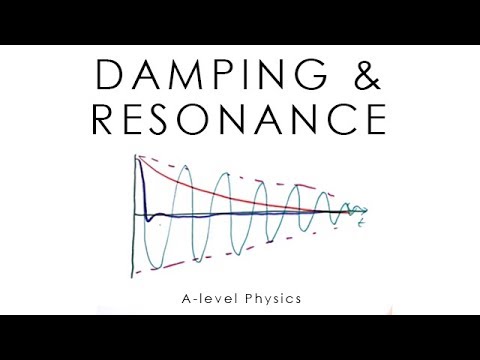
Damping & Resonance - A-level Physics
371.9K
A driving force is a force that acts in the same direction as velocity, increasing the amplitude of oscillation. When the driving force frequency matches the natural/resonant frequency (the frequency at which an object oscillates without external forces), resonance occurs and amplitude increases dramatically. The driving force must be 90° out of phase with the restoring force to effectively increase amplitude. The Millennium Bridge incident demonstrates this: slight initial movement caused pedestrians to adjust their stance, providing additional driving forces that amplified oscillations until significant shaking occurred.
Click to watch →

Simple Harmonic Motion Concepts [Periodic Motion]
1.6K
Driven oscillations occur when a periodic driving force is applied to a damped system to maintain oscillations. When driven at or near the natural frequency, the system exhibits resonance - a dramatically increased amplitude response. This occurs because the driving force adds energy most effectively when synchronized with the system's natural oscillations. The Tacoma Narrows Bridge collapse (1940) was caused by wind driving the bridge at its resonance frequency, causing catastrophic oscillations.
Click to watch →

Resonance | AP Physics | Khan Academy
168
Driven oscillations occur when an external periodic force continuously adds energy to counteract damping. When the driving frequency matches the natural frequency, resonance occurs, causing dramatically increased amplitude. When frequencies don't match, the force sometimes opposes motion, reducing amplitude. This principle explains why matching driving frequency to natural frequency is the most effective way to transfer energy to an oscillator.
Click to watch →

Lecture - Driven Oscillations and Resonance (Part 1/4)
306
When the driving force is periodic, it takes the form F_d(t) = F₀cos(ω_d t), where F₀ is the amplitude and ω_d is the driving frequency. This periodic jostling can cause the system to exhibit resonance when the driving frequency matches the natural frequency of the oscillator. Resonance is an incredibly important phenomenon with applications in many fields, including structural engineering (buildings must avoid resonant frequencies), microwave technology, and medical imaging like MRI.
Click to watch →

The Entire History Of Trigonometry Explained Slowly (For Sleep)
1K
When an oscillating system is driven at its natural frequency, resonance occurs and amplitude grows dramatically. This is how you pump a swing - pushing at the right moment increases height. Resonance is useful (musical amplification) and dangerous (Tacoma Narrows Bridge collapse).
Click to watch →
Prerequisite Knowledge
- Concept 01Fundamental principles of wave mechanics, including frequency, amplitude, and period.
- Concept 02The concept of natural frequency and simple harmonic motion in physical structures.
- Concept 03Basic understanding of seismic waves (such as P-waves and S-waves) and how they propagate through the Earth.
- Concept 04The physics of resonance, specifically how periodic driving forces can amplify oscillations.
Subsequent Learning
- Step 01Advanced seismic mitigation strategies in structural engineering, such as base isolation and tuned mass dampers.
- Step 02The study of soil-structure interaction (SSI) and how local geological conditions alter building resonance.
- Step 03Dynamic structural analysis of multi-degree-of-freedom (MDOF) systems under seismic loading.
- Step 04Real-world application of seismic building codes and performance-based design principles.
Nonlinear Structural Response and Dynamic Frequency Shifting
While physical models elegantly demonstrate linear elastic resonance, real-world structural engineering must account for nonlinear behavior during major earthquakes. Simple resonance models assume buildings behave elastically, maintaining a constant natural frequency. However, under severe seismic loading, actual buildings undergo yielding, cracking, and plastic deformation. This damage fundamentally alters the structure's stiffness, causing its natural frequency to shift dynamically during the shaking. Consequently, perfect resonance is rarely sustained because the building 'detunes' itself as it sustains damage. Modern seismic design therefore relies on nonlinear time-history analysis, ductility, and energy dissipation (damping) rather than just avoiding static resonant frequencies.
Deep Dive
Advanced seismic mitigation strategies in structural engineering, such as base isolation and tuned mass dampers.

L3 Seismic Loads2
353
Reduced beam sections are purposefully weakened areas that stretch under seismic motion, functioning like electrical fuses that fail first to protect more valuable structural elements. After earthquakes, these beams can be easily replaced. This detailing is used only in high seismic activity areas. Tuned mass dampers are masses hung from structures that counteract seismic motion when tuned to the building's frequency. The mass's inertia resists movement, and when properly tuned, it reduces both building sway and forces in supporting elements. These strategies allow engineers to control where and how seismic energy is dissipated, protecting the overall structural integrity.
Click to watch →

W12M03 Base Isolation
42K
Base isolation is a seismic protection technique that places flexible rubber bearings between a building and its foundation to filter out harmful ground motion frequencies, thereby reducing structural damage during earthquakes; this method is most effective for short-period buildings (typically 5-10 storeys) as taller structures experience bending behavior that can cause shear keys to overturn and exceed the tension capacity of the isolation bearings.
Click to watch →

¿Cómo se vive un Terremoto en un Rascacielos? 😱
3K
Tuned mass dampers are large masses (up to 600 tons) placed at the top of buildings to counteract seismic forces. These devices function as pendulums that respond to building movement with a slight delay, absorbing and dissipating seismic energy. Base isolation systems use specialized bearings placed between the building foundation and the ground, allowing the building to decouple from ground motion during earthquakes. These technologies are particularly effective for existing buildings that need seismic retrofitting and represent the most advanced approaches to seismic protection.
Click to watch →

ЭТИ ТЕХНОЛОГИИ спасут от ЗЕМЛЕТРЯСЕНИЯ - 7 САМЫХ СЕЙСМОУСТОЙЧИВЫХ зданий в мире. ИЗБЕЖАТЬ КАТАСТРОФУ
130.3K
This section presents a comprehensive overview of engineering solutions for earthquake-resistant construction. It covers seismic dampers capable of withstanding hundreds of tons of load, allowing buildings to shift as units while absorbing energy. Tuned mass dampers, weighing 300 tons each, are installed on building roofs to counteract seismic forces. The video examines testing methodologies including crash tests on specialized stands and rooftop testing facilities. It explores how tuned mass dampers can retrofit existing high-rise buildings. The section culminates in case studies of the world's most seismically resilient structures: Burj Al Arab in Dubai using 200 pile columns supporting 500,000 tons each, U.S. Bank Tower in Los Angeles engineered for magnitude 8.3 earthquakes, Taipei 101 containing the world's largest tuned mass damper, Istanbul Airport using 300 seismic base isolators, and the Transamerica Pyramid in San Francisco which survived the 1989 magnitude 6.9 earthquake with only 30 centimeters of sway.
Click to watch →

Китай наизнанку: трущобы, небоскребы, самый быстрый лифт в мире, мусульманский город | Шанхай, Синин
243.3K
Supertall buildings experience significant wind-induced sway that can cause occupant discomfort and structural stress. Engineers counteract this by installing tuned mass dampers—large counterweights that oscillate in opposition to building movement. The Shanghai Tower contains a massive 1,000-ton pendulum-like device that absorbs and dissipates energy from wind forces, stabilizing the structure and preventing dangerous oscillations. These advanced damping systems represent critical engineering innovations enabling the construction of extremely tall buildings in seismically active and windy regions.
Click to watch →
Deep Dive
The study of soil-structure interaction (SSI) and how local geological conditions alter building resonance.

EXPERTO GEÓLOGO: IGNORARON INFORME TÉCNICO SOBRE LA GUAIRA
2.8K
Seismic damage depends critically on the relationship between soil conditions and building design. Resonance occurs when building natural periods match ground vibration periods—in Caraballeda, 1.2-second soil periods matched 12-13 floor buildings, causing amplified forces. Seismic spectral amplification means local soil conditions can increase damage beyond earthquake magnitude expectations. Soil classification based on shear wave velocity (Type D at 235 m/s, Type E lower) determines amplification potential. Proper design requires shear walls over columns, robust foundations, and materials that resist lateral forces. Older buildings (30-40 years) often performed better than newer ones (20-25 years) because they were built with different construction practices.
Click to watch →

Recitales que mueven edificios- Ing. Raùl Bertero
395
When vibrations reach building foundations, amplification occurs if building natural frequency matches incoming wave frequency. Soil transmitting 0.1g at 2 Hz to a building with 2 Hz natural frequency produces 2.5g at the roof (25x amplification). Buildings filter out multiple soil frequencies, responding only at their natural frequency. Field measurements confirmed theoretical predictions: soil accelerations near River Plate reached 0.06g (below perception), but buildings 500-3000m away showed amplified rooftop accelerations up to 2% of g when in resonance. This demonstrates how soil-structure interaction creates localized vibration problems.
Click to watch →

DEPREM - KAYSERİ'DE DEPREM - TÜRKİYE'DE DEPREM - PERSPEKTİF |KAYSERİ GÜN TV - Murat Ziya ÖZTÜRK
199
During earthquakes, buildings experience resonance when their natural vibration period matches seismic wave periods, amplifying damage. In the 1717 earthquake, small buildings on soft soil suffered severe damage due to resonance. Modern high-rise buildings on rocky foundations have shorter natural periods, reducing resonance risk. Building height must match local soil conditions: soft alluvial soils require shorter buildings, while rocky foundations allow higher structures. Modern engineering can modify building periods to avoid resonance, but this increases costs.
Click to watch →

🚨COLOMBIA, VENEZUELA Y REP. DOM. ⚠️EN LA PLACA DEL CARIBE ¿QUÉ SIGNIFICA ESO?
31.8K
Building vulnerability during earthquakes depends critically on soil type. Buildings on soft soils (Types D and E with shear wave velocities of 200-240 m/s) experience amplified seismic waves and longer vibration periods (1.4-1.8 seconds). Buildings on hard rock experience minimal amplification. Soil resonance occurs when the natural vibration period of soil matches a building's structural period, causing structural failure. A 15-story building has a theoretical vibration period of 1.5 seconds, while 12-story buildings have periods around 1.2 seconds. Repeated earthquake events reveal consistent building vulnerability patterns: weak column-beam connections, hollow brick walls that explode, and weak first-floor conditions (soft story effect).
Click to watch →

Introduction to soil-structure interaction, Prof. Dr. Ioannis Anastasopoulos
1.4K
The 1985 Mexico City earthquake (Michoacán fault, ~350 km away) caused differential damage due to varying soil conditions. Foothill zone experienced minimal damage (0.03g), while downtown with soft clay suffered devastation (up to 0.7g). Site amplification occurs through soil resonance: Tsoil ≈ 4H/vs, yielding ~3 seconds for H=60m, vs=80 m/s. Amplification factors reached ~12x. The double resonance effect explains damage: soil amplification created dominant period ~2 seconds, while SSI increased building periods from 0.96s to ~1.8s (1.85× increase), bringing buildings into resonance with amplified soil motion. Combined with cracking effects, this caused tremendous damage to 10-12 story buildings. This demonstrates that SSI can be detrimental under specific soil-motion conditions, contrary to typical beneficial effects. The lesson: SSI is not universally beneficial—it depends on site-specific conditions, soil profiles, and expected seismic motions.
Click to watch →
Deep Dive
Dynamic structural analysis of multi-degree-of-freedom (MDOF) systems under seismic loading.

Seismic analysis of MDOF systems - 01
170
This video tutorial explains the principles of seismic analysis for multi-degree-of-freedom (MDOF) structural systems, demonstrating how to formulate governing equations using matrix methods to analyze building vibrations and displacements under dynamic loads.
Click to watch →

17.03.26 МС 5 Розрахунок на динамічні впливи
100
Dynamic loads vary with time and cause significant inertia forces. The equation of motion is M*u'' + C*u' + K*u = Q, solved via modal decomposition (linear only) or direct integration. Seismic analysis adds ground motion γm*S(t) with zero external loads. Modal decomposition expands solutions in eigenforms determined by iterative methods, with accuracy inversely proportional to the square of the highest frequency. Building codes require 90% modal mass contribution. Mass condensation eliminates negligible forms. Damping uses Rayleigh linear combination of mass and stiffness coefficients. Difference schemes yield unconditionally stable implicit schemes with second-order accuracy. The Newmark scheme from 1959 differs but can be algebraically transformed to equivalent forms. Physically nonlinear beam elements for bending based on elastoplasticity theory enable dynamic analysis beyond elastic range. Floor accelerograms and response spectra are used for seismic analysis of installed equipment. Soil-structure models use half-space foundations with non-reflecting boundary elements. LIRA 10 includes soil finite elements with models of Coulomb-Mohr, Drucker, Prager, and Bodin. Nonlinear static pushover analysis assesses structural behavior beyond elastic range under monotonic loading with horizontal seismic forces. Progressive collapse resistance addresses sudden failure of load-bearing elements, associated with the 1968 Ronan Point building collapse, using quasi-static analysis with dynamic coefficient of 2.
Click to watch →

Sesión 12: Sistemas De Varios Grados de Liberad | Ingeniería Sísmica | Teoría.
965
Multi-degree-of-freedom (MDOF) systems can be analyzed by representing them as n single-degree-of-freedom (SDOF) systems through coordinate rotation, where the displacement vector equals the rotation matrix multiplied by the modal coordinates (u = θ × Q). The equation of motion for MDOF systems is M × ü + C × u̇ + K × u = 0, where M, C, and K are the mass, damping, and stiffness matrices respectively. For free vibration analysis, the natural frequencies are found by solving det(K - ω²M) = 0, yielding n frequencies for an n-degree-of-freedom system, with corresponding mode shapes obtained from (K - ω²M)φ = 0.
Click to watch →

Dinámica Estructural. Sistema de Varios Grados de Libertad
1.4K
This section introduces the fundamental concepts of multi-degree-of-freedom structural analysis. Key topics include: (1) Degrees of freedom - 2 DOF for 2D planar structures (horizontal displacement and rotation), 3 DOF for 3D structures (two horizontal displacements and vertical displacement); (2) The three most damaging structural movements: vertical movement, horizontal movement, and torsional movement; (3) Mathematical modeling where each mass has corresponding stiffness contributions from columns; (4) The dynamic equation involving mass, damping, and stiffness elements; (5) Seismic force transformation from ground to structure using mathematical methods; (6) The distinction between rigid floor systems (where all columns deform equally) and flexible floor systems (where different parts deform differently).
Click to watch →

Aplicaciones con Matlab/Simulink- Dinámica Estructural e Ingeniería de Control Estructural
501
This tutorial demonstrates how to model and simulate multi-degree-of-freedom structural systems (such as 10-story and 3-story building frames) using state space formulation in Matlab/Simulink, where the system dynamics are represented through matrices of mass, damping, and stiffness, enabling analysis of displacements, velocities, and accelerations under seismic loading conditions.
Click to watch →
Deep Dive
Real-world application of seismic building codes and performance-based design principles.

Diseño de Edificios altos por Desempeño
13.4K
Performance-based design represents a fundamental shift from regulatory-based approaches. While regulations provide calibrated rules from committees, they don't capture actual structural behavior. Analysis of earthquake damage reveals universal principles: 91% of collapsed structures used previous codes that didn't account for modern seismic considerations. Soft-story collapse occurs when first-floor rigidity differs significantly from upper floors. Seismic design involves numerous uncertainties including earthquake magnitude, distance from fault, duration, and frequency characteristics. Concrete structures crack significantly under seismic loading, with only 10-30% of the gross section remaining effective. Non-linear analysis capabilities have improved exponentially, making complex modeling practical. Performance-based design establishes specific objectives for building behavior under different earthquake intensities. In California, all buildings from 1 to 200 levels must be designed using performance-based methods. In Mexico City's new post-2017 earthquake regulation, buildings over 80 meters in height in transition zones or lake zones must use performance-based design.
Click to watch →

Retos y oportunidades en el futuro de la Ingeniería Sísmica
512
Seismic actions have been included in design codes since the last century, evolving through distinct phases: 1990s gravity loads only, 1970s uniform seismic coefficient, 1940s-1970s dynamic characteristics and elastic analysis, 1970s ductility and force-based design with reduction factors, 1990s displacement demands and ATC-40 nonlinear static analysis, 2000s performance-based design with FEMA P58 and Vision 2000, 2010s seismic resilience and incremental dynamic analysis. Performance-based design establishes relationships between performance levels and earthquake intensities, enabling systematic evaluation of design decisions against multiple performance criteria rather than relying on simplified force-based approaches.
Click to watch →

History of Performance-based Seismic Design - Performance Based Design of Tall Buildings (1 of 10)
26.3K
Performance-based seismic design enables buildings to reliably achieve desired performance measured by life safety, occupancy preservation, and repair cost minimization. Originating from SIOC's Vision 2000 committee in 1996 following the Northridge earthquake, this approach was funded by California OES and FEMA to reduce post-earthquake repair costs. The methodology requires decision-makers (developers, lenders, insurers) to define performance objectives before engineers develop compliant designs. Between 1971-1994, California experienced frequent earthquakes (magnitude 6+ every 18 months), prompting building owners to ask engineers about performance. Early solutions included upgrading buildings to 75% of code strength for life safety and applying essential facility criteria (importance factor of 1.5) for immediate occupancy, establishing practical foundations for standardized performance-based methodologies.
Click to watch →

Performance-Based Seismic Design of Structures - Prof. Yogendra Singh
5.4K
Conventional earthquake design using response reduction factors creates false impressions of safety since structures are designed for only ~20% of actual elastic forces. Response reduction factors are empirically based on past earthquake experience, limiting applicability to regular symmetric buildings. Current codes cannot guarantee structural survival under maximum considered earthquakes. Performance-based design emerged to address these limitations by quantifying performance objectives, enabling design of irregular buildings, code-exceeding structures, and critical facilities requiring operational post-earthquake functionality.
Click to watch →

Performance-Based Seismic Design
15.8K
Performance-based seismic design enables more efficient tall building designs by allowing engineers to optimize core wall configurations and utilize innovative coupling beam technologies, such as fiber-reinforced concrete beams, which can reduce material usage and costs while improving seismic energy dissipation through ductility; this approach addresses limitations of prescriptive codes by enabling tailored solutions for complex urban high-rise buildings with asymmetric core geometries and varying seismic demands.
Click to watch →
Nonlinear Structural Response and Dynamic Frequency Shifting
While physical models elegantly demonstrate linear elastic resonance, real-world structural engineering must account for nonlinear behavior during major earthquakes. Simple resonance models assume buildings behave elastically, maintaining a constant natural frequency. However, under severe seismic loading, actual buildings undergo yielding, cracking, and plastic deformation. This damage fundamentally alters the structure's stiffness, causing its natural frequency to shift dynamically during the shaking. Consequently, perfect resonance is rarely sustained because the building 'detunes' itself as it sustains damage. Modern seismic design therefore relies on nonlinear time-history analysis, ductility, and energy dissipation (damping) rather than just avoiding static resonant frequencies.
Fundamental principles of wave mechanics, including frequency, amplitude, and period.
The concept of natural frequency and simple harmonic motion in physical structures.
Basic understanding of seismic waves (such as P-waves and S-waves) and how they propagate through the Earth.
The physics of resonance, specifically how periodic driving forces can amplify oscillations.
Advanced seismic mitigation strategies in structural engineering, such as base isolation and tuned mass dampers.
The study of soil-structure interaction (SSI) and how local geological conditions alter building resonance.
Dynamic structural analysis of multi-degree-of-freedom (MDOF) systems under seismic loading.
Real-world application of seismic building codes and performance-based design principles.
17.5K views96likes2:39@IRISEarthquakeScienceOriginal Release: 2009-11-09
of the different building models this is my favorite this model uses a uh block of wood in this case they've got wheels out to make it easy to move back and forth to simulate earthquake vibrations and these are doll sticks of different lengths with blocks of wood on top so we've got tall building representation down to short building and I I like if there's a group of people a group of kids ask them which building do you think would move around the most in an earthquake which will move the most in an earthquake and very often they will pick the tall building because this obviously is is it's moving around seems a lot even by itself right now but so then I generate the earthquake by vibrating the ground oh my goodness the tall the short building has moved the most okay well now you know what the answer is you get one more guess so now a lot of people change the guess and say well maybe the short one will move the most so I make another earthquake say well here's another earthquake oh lo and behold it's the tall one now that's vibrating the most so at this point I think it's good to have a question an issue for kids to to think about for a second okay now what's going on there must be some trick to this what is he doing differently between the short building moving the most and the tall building moving the most and so then I explained that well it actually has to do with the resonant frequency of each of these buildings which is quite different the resident frequency is the frequency that building wants to move back and forth if you just give it a bump and you can see the Shar building moves back and forth very quickly when you just pull it and let it go P building moves very slowly and these move with intermediate frequencies so if the ground motion is the same as the resonant period resonant frequency of one of these buildings the amplitude of the building motion will build larger and larger so if I move the ground very rapidly back and forth I'm giving a resonant resonant frequency near this one you can see the amplitude there gets very large and if I go very slowly tolerability moves most and you can also go in intermediate frequencies for this one or for the blue one
Up Next

83:57
Natural Frequencies & Mode Shapes of an MDOF Frame System
@dr.mohamednoureldin5718
13.6K views•2020-11-25

30:21
Damped Free Vibration of Structures: Viscous Damping Theory
@IITKanpurNPTEL
23.4K views•2019-08-26
41:27
Seismic Acquisition: Land & Marine Methods Explained
@IRISEarthquakeScience
33.9K views•2017-08-22

33:39
How a Student's Question Saved a NYC Skyscraper from Collapse
@veritasium
22.8M views•2025-04-26
Related Study Plans & Knowledge Roadmaps
Structured learning paths in Engineering
engineering
Structural Dynamics (DIY TMDs & Shake Tables)
01Foundations of Structural Dynamics & Resonance
02Designing and Building a Motorized Shake Table
03Constructing the Scale Building & Tuned Mass Damper
+ 2 more learning modules
35h5 modules
Explore Roadmap
engineering
Building Acoustic Levitators: Physics & Arduino
01The Physics of Sound and Standing Waves
02Piezoelectric Transducers and H-Bridge Drivers
03Arduino Programming: Generating 40 kHz Signals
+ 2 more learning modules
14h5 modules
Explore Roadmap
engineering
Building Peltier Cloud Chambers: Particle Tracks
01Cosmic Rays & Cloud Chamber Physics
02Thermoelectric Cooling (TEC) Fundamentals
03Custom Liquid-Cooling Loop Design
+ 2 more learning modules
18h5 modules
Explore Roadmap
engineering
Yagi-Uda Antennas: Modeling, Build & VNA Test
01Introduction to RF and Antenna Fundamentals
02Yagi-Uda Antenna Design Principles
03Antenna Modeling and Simulation in 4NEC2
+ 2 more learning modules
18h5 modules
Explore Roadmap