













![ESERCITAZIONE AL CALCOLATORE 06: [A cura dell'Ing. Eugeniu Grabovic]. Tricept Parallel Robot](https://i.ytimg.com/vi_webp/Re9y6yLIROM/maxresdefault.webp)












This video demonstrates how upgrading from complex universal joints to a simplified magnetic ball joint design can significantly improve Stewart platform performance by reducing part count by 3x (from 19.5 to 6.5 parts per leg), enabling easier assembly and disassembly, providing smoother motion, and maintaining three degrees of freedom while addressing the limitations of previous designs including limited range of motion, structural weakness, and tedious assembly processes.
Upgrading Stewart Platform Joints: Ball Joint vs Universal Design
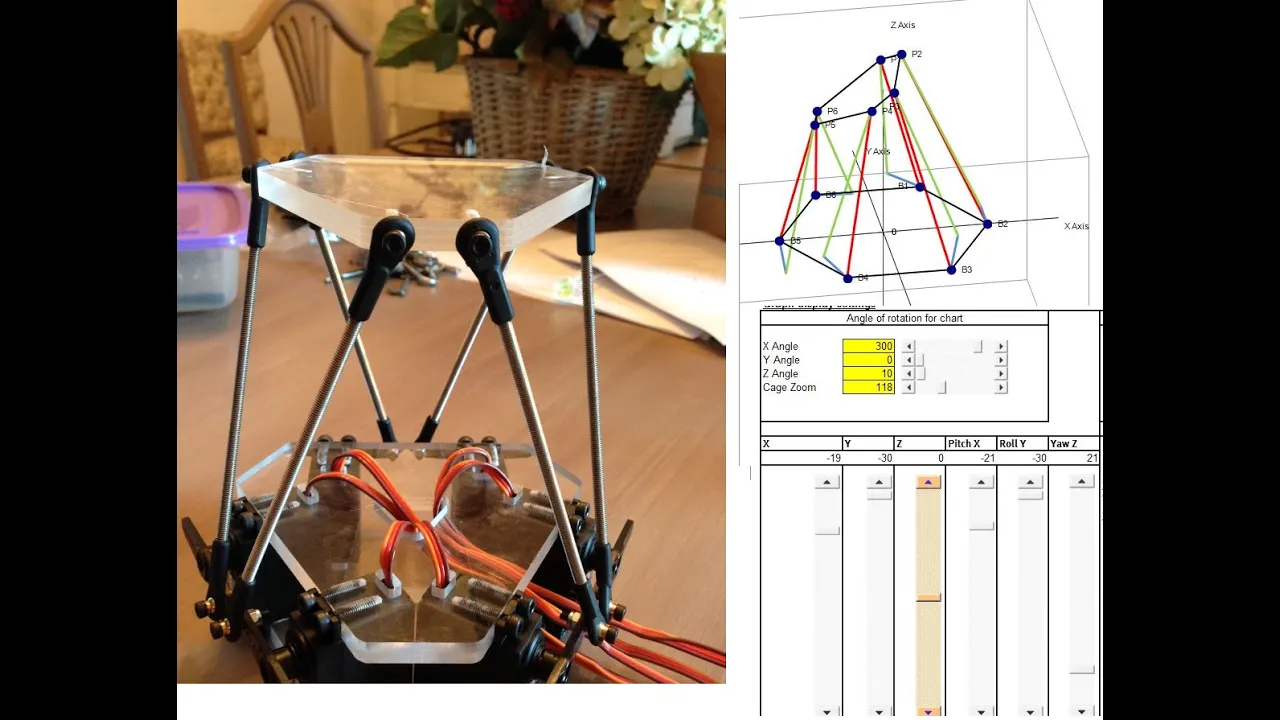
Added:Basic anatomy and working principles of a Stewart Platform (parallel manipulator) and its six degrees of freedom (DoF).
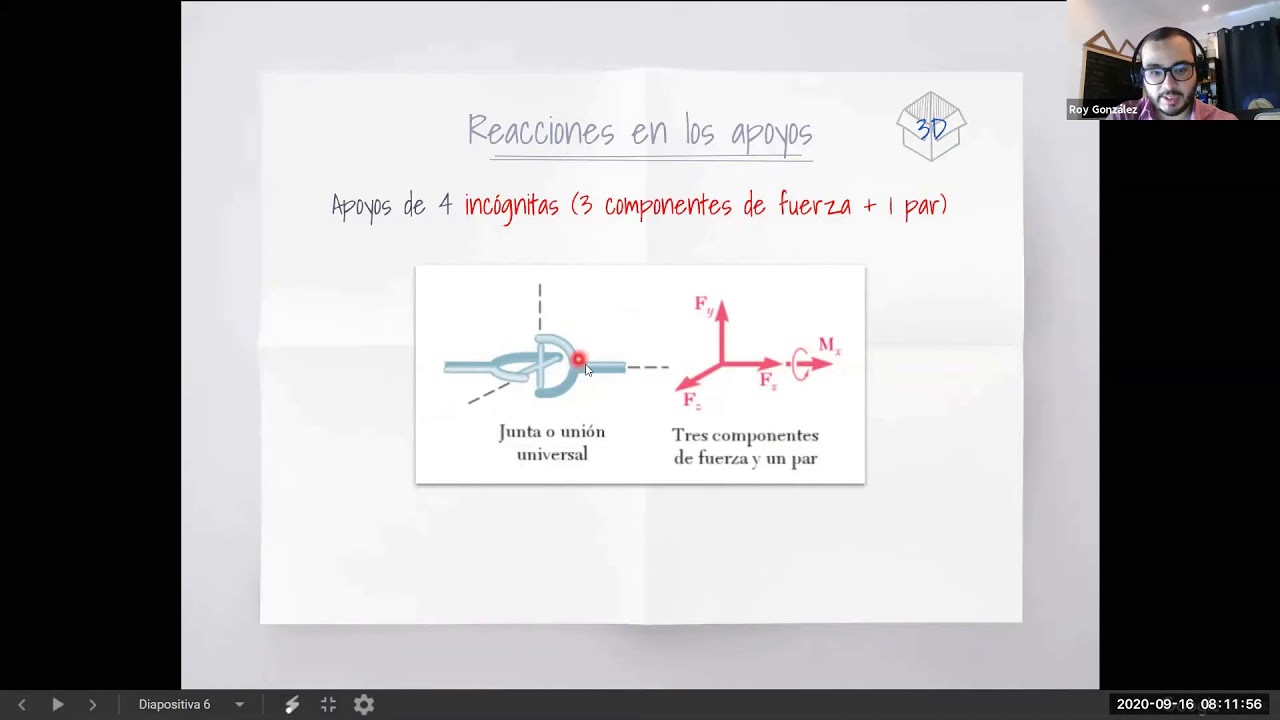
The mechanical differences between a universal joint (U-joint) and a spherical/ball joint, including their constraint profiles.
Fundamental concepts of magnetic force, coupling, and holding power in mechanical engineering design.
The impact of backlash, friction, and physical joint limits on the precision and range of motion of robotic linkages.
Mathematical formulation of inverse kinematics updates required when altering joint centers and offsets in parallel robots.
Dynamic simulation and payload analysis to determine the breakaway force thresholds of magnetic joints under high acceleration.
Designing closed-loop control algorithms to exploit the smooth, low-friction motion of upgraded parallel linkages.
Exploring advanced applications of modular magnetic joints in precision fields such as micro-positioning, haptic devices, and optical alignment.
10.5K views374likes9:31Original Release: 2023-03-24
hey everyone welcome back to another video on the development of juggabot I'm very excited about this video because it shows a pretty important upgrade that I'm making from the old design to the current design specifically we're going to be going over the joints that attach the legs to the platform I think to understand why these joints are the way they are right now it's worth going back to revisit the old designs that I had to see why they didn't work the very first design that I had for this component consisted of some ball joints that I just bought online and these joints were decent they're very cheap they're very easy to use but they have a very limited range of motion they can only move like I think it's like 50 degrees or something before they hit their end in any direction and that's pretty annoying that's very very limiting because of this limited range of motion I had to be really careful with where I was positioning them and if I made any changes to the rest of the platform I would have to go back and change the angle where these cup Parts attached onto this printed part and I forgot to do that a couple times and I meant I just had to keep reprinting parts and it was really annoying so the limited range of motion really killed these for me and they made them not really an option moving on from that the next design that I had was these universal joints that I designed and I think they look pretty cool but they have some pretty big problems as well the main one is that this part here is very small and is not super strong after it's printed and one of these actually broke in my testing of juggabot and I don't want to have to keep reprinting everything to make it all work another big problem was that it's not really that modular like if I'm putting the platform part onto the rest of the legs it's really tedious to have to screw up all of these bolts and do them one at a time it's very slow and kind of hard to hold everything at the same time because there's six things that all kind of want to go in different directions and it's annoying to have to hold them all this design definitely was better than the original one because it has a huge range of motion like these joints can go in any direction that I want them to but their limited strength is a bit of a weakness and the fact that they're not very modular it was pretty annoying and I would prefer to move out of that if I can so the early designs one of them didn't have enough range of motion one of them kept breaking and they're both pretty annoying to separate from the rest of the design and the second design had way too many parts before jumping into my new design it's worth going over what the design requirements of this part are so that we can see what it actually needs to do the first one is that it has to be able to support three degrees of freedom now this might sound a bit cryptic but all that it means is that the platform up here needs to be able to move relative to the leg in three ways and these three ways are the three rotations so if I can drag this around if it plays nice it needs to be able to rotate that way and that way this is a little bit messy but hopefully you get the idea and that way if it card rotate in all of these ways then the mechanism will get jammed up in some positions and something will break so it needs to be able to rotate in all directions the second design requirement is that it needs to have a really wide range of motion I want juggawatt to be able to move as far as it possibly can and to do that the joints themselves need to be able to move as far as possible the third design requirement is that they must be easy to disassemble and by this I mean easy to remove from the platform I would like to be able to separate the platform from jugglebot very very easily and to make any changes that I need to make without having to screw and unscrew everything that was really frustrating with the old design finally this joint needs to have a solid and strong connection that is very smooth if the joint is gritty at all then it will impede the motion of juggabot and it will make it harder to control where it's going so I need this joint to be really really smooth so as juggabot moves around the joints just slide nicely and allow that motion to happen it would also be quite nice if this component had as few parts as possible because more parts is more effort and effort is bad so that brings us to my new design which looks like this and you can see already that this is far far simpler than the previous design so here all we've got is a we've got a bolt that comes through the printed part that's held on with a nut that bolt screws into a metal ball with some thread and then that ball is attached with a magnet to the leg so this can just stick and unstick and if you see here it's very easy to separate it and attach it this joint moves super smoothly there's really not much stopping it from sliding around and it's ticks all the boxes super wide range of motion this can go really far in all directions it's great to give this design an objective comparison with the old design we can do a part count comparison and we can see the old universal joints have 19 and a half parts per leg including all the bolts and the bearings and everything which means that in total between the six legs there are 117 Parts which is nuts compared to the new one where there's only six and a half parts per leg meaning that there's in total only 39 Parts between all six legs so this means we have a 3X reduction in the number of parts that that are needed for this component which is fantastic in my mind I'm very very happy with that so this is all well and good but does it actually meet all the design requirements the first is that it needs to support three degrees of freedom and we can see pretty easily just by holding it moving it around it can twist so that's one you can move this way and it can move the other way all three it's a ball inside done the second is that it needs to have a wide range of motion as we've already seen it has an extremely wide range of motion third it needs to be easy to disassemble and it's a magnet it's about as easy as it gets and the fourth is that it needs to have a solid and smooth connection as for the solidity of this connection it's definitely not as solid as the previous design was because I was all like hardware parts that were bonded to each other and so this one can be removed but it's fairly strong and I think it will be strong enough I am not a steward platform expert but I'm pretty confident that all of the forces that are going inside the legs are purely in the direction of the leg so there should be very little force acting to separate this magnet from the leg so I think that 450 grams ish of force should be more than enough as for the smoothness this joint is fairly smooth as it is but just in case it isn't smooth enough and it does cause some like friction problems I've bought some PTFE sheet that I might be able to like stick between the ball and the printed part to maybe like smoothen it up a bit and I'm thinking also I could add some fabric that I could Lube up and that will smooth things out a bit but as it is I'm I'm pretty surprised with how easily the steel ball slides on the printed part it's it's really quite good so for now I definitely consider this to have a solid and smooth connection and as we just saw this design absolutely meets the would be nice requirement of having fewer Parts with a 3X reduction of the old design so I'm pretty happy with that ticks all the boxes I don't have too many concerns with the design but one of them is that the magnet on the ball might not be strong enough if that is the case and I do find that the platform separates from the legs when it shouldn't then I can always either get a stronger Magnet or just decrease the distance between the magnet and the ball so I move myself over here you can see there's a bit of a gap here between the magnet and the ball and there is a bit of space there for me to reduce that down if I have the magnet just on the ball by itself it's very very strong and works really well the reason why I don't have just the magnet attached to the ball straight up and why I have this printed cup part is so that the magnet doesn't slide along the ball up and down making it less precise as to where it's actually positioned and the second concern is that it might not slide easily enough but I think it's pretty fine to be honest and even if it's not I've got some ideas with the fabric and the PTFE sheet to alleviate that and there you have it the new design is so much better than the previous ones it's fewer Parts it's easier to make it's better in pretty much every way and I'm really Keen to put this into the actual jugglebot I'm still waiting on some carbon fiber tubes to actually be able to make this design and in the meantime I'm going to be making a couple more videos on the specifics of how this design has improved on the previous one you can see pretty easily that there are some big changes between this and this it's definitely a big step as always I hope you found that interesting and if you have any thoughts or comments about any of this then please let me know down below and until the next one have a good one
Up Next

85:20
Raspberry Pi Pico RP2040 Embedded Programming: C/C++ Framework Guide
@UtahCppProgrammers
6.5K views•2022-02-10

30:32
Ultrasonic Transducers: Resonant Frequency Measurement and Horn Design
@imajeenyus42
229.9K views•2017-02-22

54:16
Polymer Environmental Degradation: Mechanisms & Stabilization
@iit
1.8K views•2012-07-10

33:39
How a Student's Question Saved a NYC Skyscraper from Collapse
@veritasium
22.8M views•2025-04-26
Related Study Plans & Knowledge Roadmaps
Structured learning paths in Engineering
engineering
Building Acoustic Levitators: Physics & Arduino
01The Physics of Sound and Standing Waves
02Piezoelectric Transducers and H-Bridge Drivers
03Arduino Programming: Generating 40 kHz Signals
+ 2 more learning modules
14h5 modules
Explore Roadmap
engineering
Building Peltier Cloud Chambers: Particle Tracks
01Cosmic Rays & Cloud Chamber Physics
02Thermoelectric Cooling (TEC) Fundamentals
03Custom Liquid-Cooling Loop Design
+ 2 more learning modules
18h5 modules
Explore Roadmap
engineering
Yagi-Uda Antennas: Modeling, Build & VNA Test
01Introduction to RF and Antenna Fundamentals
02Yagi-Uda Antenna Design Principles
03Antenna Modeling and Simulation in 4NEC2
+ 2 more learning modules
18h5 modules
Explore Roadmap
engineering
ECG Monitor Design: Op-Amps, Filters & Noise
01Electronics & Breadboard Basics
02Op-Amps and Instrumentation Amplifiers
03Bioelectricity and ECG Fundamentals
+ 2 more learning modules
18h5 modules
Explore Roadmap