































Nuclear stability is determined by an isotope's neutron-to-proton ratio and its position on the band of stability; isotopes with atomic numbers less than 20 are most stable at a 1:1 ratio, while those between 20-83 are stable at approximately 1.5:1, and isotopes falling off the band will undergo radioactive decay—beta decay for those with excess neutrons (left side) and positron emission for those with insufficient neutrons (right side)—with additional stability provided by magic numbers of protons and neutrons.
Nuclear Stability: Neutron-to-Proton Ratio and the Band of Stability
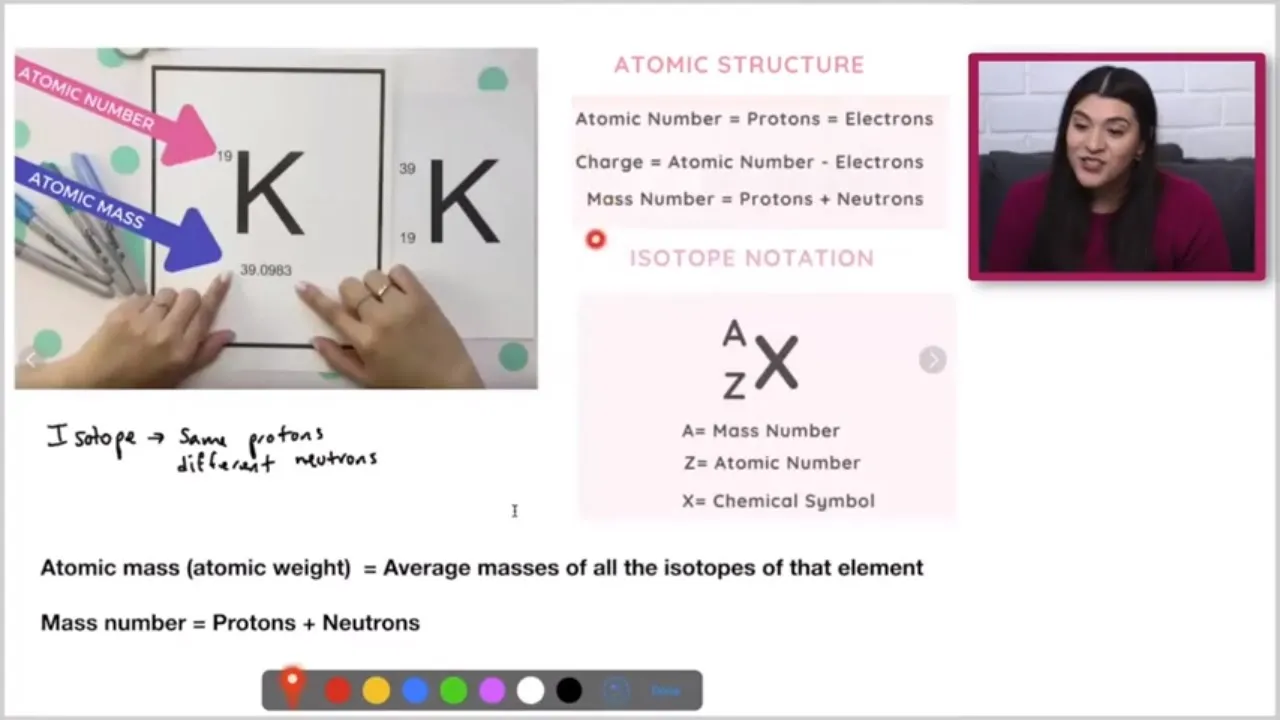
Added:Basic atomic structure, including the definitions of protons, neutrons, isotopes, atomic number (Z), and mass number (A).
The concept of fundamental physical forces, specifically the electrostatic repulsion between protons and the attractive strong nuclear force.
An introductory understanding of radioactivity and what defines an unstable atomic nucleus.
The definition of nuclear binding energy and the concept of mass defect.
An in-depth analysis of specific decay pathways (alpha decay, beta decay, positron emission, electron capture) and how each shifts a nucleus toward the band of stability.
The Nuclear Shell Model, exploring the quantum mechanical explanations behind the existence of 'magic numbers' of nucleons.
Mathematical modeling of radioactive decay kinetics, including half-life, decay constants, and carbon-14 dating calculations.
The mechanics of nuclear fission and fusion, examining how heavy and light elements shift toward the peak of nuclear binding energy (around iron-56).
Practical applications of nuclear chemistry in medicine (such as PET scans and radiopharmaceuticals) and energy production.
33.2K views290likes10:48Original Release: 2015-07-17
In this lesson, we will learn how nuclear stability is related to the band of stability and the neutron to proton ratio.
85% of all nuclei are unstable.
Stability depends on the neutron to proton ratio, the band of stability, and on magic numbers.
Let's begin by talking about the neutron to proton ratio. Nuclei with atomic numbers less than 20 are most stable when the neutron to proton ratio is 1: one. Nuclei with atomic numbers between 20 and 83 are most stable when the neutron to proton ratio is approximately 1.5.
You can see this on the band of stability. The band of stability plots the number of neutrons on the y-axis versus the number of protons on the x-axis. The yaxis over the x-axis gives you the neutron to proton ratio. Shown here at a 45° angle is a diagonal line representing a neutron to proton ratio of 1:1.
On the colored blue and orange band, the black center represents the most stable neutron to proton ratio.
As you can see, for nuclei with fewer than 20 protons, the black center of that color band is approximately at the black printed line of a 1:1 ratio. At atomic numbers greater than 20, the most stable neutron to proton ratio is slightly larger than 1:1.
Let's look at a sample problem.
Determine the neutron to proton ratio of carbon 12, carbon 13, and carbon 14 and identify the most stable isotope.
To determine the neutron to proton ratio of these three isotopes, we first need to figure out how many protons and neutrons each contains.
The mass number of carbon 12 is 12 and its atomic number is 12. This means it has six protons and six neutrons because the number of neutrons is determined by subtracting the atomic number from the mass number. The neutron to proton ratio is equal to the number of neutrons divided by the number of protons which in this case is 6 / 6 which is 1 1.
The mass number of carbon 13 is 13 and it atomic number is still six. That means carbon 13 has six protons and 13 - 6 neutrons or seven neutrons in a neutron to proton ratio of 7 to 6.
Carbon 14 has a mass number of 14 and atomic number 6. That means it has six protons. 14 - 6 or 8 neutrons and a neutron to proton ratio of 8 to 6 which reduces to 4.
Therefore, the most stable of these three isotopes is carbon 12 since for nuclei with atomic numbers less than 20, the most stable neutron to proton ratio is 1: one.
The band of stability can also help us determine which type of radioactive decay an unstable isotope will undergo.
If the neutron to proton ratio lands in the yellow area, it means that the isotope is too heavy. An isotope that is too heavy will release alpha particles to reduce its size.
Isotopes that land in the turquoise area have a larger neutron to proton ratio than is considered stable. These isotopes need to get rid of some of those neutrons in order to have a stable neutron to proton ratio. They do this through beta decay in which, as you may recall, a neutron turns into a proton and an electron, thereby decreasing the number of neutrons and increasing the number of protons. By lowering the number of neutrons in the numerator of the neutron to proton ratio and raising the number of protons in the denominator of the neutron to proton ratio, it lowers the neutron to proton ratio. If an isotope falls on the orange line which is below the black line of stable nuclei, it clearly has too few neutrons to be stable. In order to increase the neutron to proton ratio, a proton becomes a neutron. It does this through posetron emission in which a proton becomes a neutron and a posetron which is a positive version of a beta particle.
In summary, this is how to determine the most probable type of decay a radioactive isotope will undergo.
If the nucleus contains more than 83 protons, it is simply too heavy to be held together by the strong nuclear force and will most likely undergo alpha decay because emitting heavy alpha particles is the quickest way to reduce mass.
If the neutron to proton ratio falls to the left of the band of stability, meaning it contains too many neutrons or too few protons, the nucleus will most likely undergo beta decay. Because in beta decay, a neutron is turned into a proton, thereby decreasing the number of neutrons while increasing the number of protons. If the nucleus falls to the right of the band of stability, meaning it contains either too few neutrons or too many protons, it will most likely undergo posetron emission, in which case a proton is turned into a neutron, thereby increasing the number of neutrons and decreasing the number of protons.
There is also something called magic numbers.
Experimental evidence has shown that the number of nucleons, a nucleon, can either be a proton or a neutron, helps to determine whether a nucleus will be stable. When considering magic numbers, the greatest influence on stability is having a positive number of both protons and neutrons. In fact, most nuclei containing both a positive number of protons and a positive number of neutrons are stable.
In addition to having a positive number of protons and a positive number of neutrons, there are certain magic numbers that are especially stable.
These numbers are for protons 2 8 20 28 40 50 and 82. And for neutrons 2 8 20 40 50 82 and 126. This means that if the nucleus has one of these magic numbers of protons and or one of these magic numbers of neutrons, it will be especially stable. These magic numbers are assumed to correspond to filled nuclear shells. These magic numbers are similar to but not necessarily the same as the number of electrons in filled electron shells that give noble gases special stability.
One piece of evidence to support this nuclear shell model and the existence of magic numbers is that many radioisotopes decay by alpha radiation. An alpha particle contains a magic number two for both protons and neutrons which gives it special stability.
In this example, we have the alpha decay of pelonium 212. Notice how when ponium 212 under goes alpha decay, it becomes lead 208. Lead 208 contains a magic number of protons, 82, and a magic number of neutrons. The number of neutrons can be determined by subtracting the atomic number from the mass number. 208 - 82 is equal to 126 neutrons, which is a magic number.
Therefore, we would expect lead 208 to be stable and to not undergo radioactive decay.
To predict whether an isotope will be stable, follow these steps. First, determine if the number of protons and number of neutrons is an even number.
Next, determine if the number of protons and/or the number of neutrons is equal to a magic number. Third, calculate the neutron to proton ratio. Check that neutron to proton ratio on the band of stability. If the neutron to proton ratio is on the band of stability, it is a stable isotope. If it's off the band of stability, you can then predict what type of decay it's most likely to undergo.
Is calcium 40 stable? First, we determine if the number of protons and the number of neutrons is even, which they are.
Second, we determine if there is a magic number of protons and neutrons. Calcium 40 has 20 protons, which is a magic number for protons, and 20 neutrons, which is a magic number for neutrons. So already we can see that this is a stable isotope. Let's continue. Anyway, step three is to calculate the neutron to proton ratio. We do that by dividing the number of neutrons by the number of protons and we get a neutron to proton ratio of 1:1.
Finally, we take that 1:1 ratio and compare it to the band of stability. And we see that an isotope with 20 protons and 20 neutrons is indeed stable.
Another sample problem. Is manganese 54 stable?
We first check to see if the number of protons and number of neutrons are even.
Manganese has 25 protons and 29 neutrons. So, no, it does not have an even number of either protons or neutrons.
Further, neither of these odd numbers is a magic number for either protons or neutrons.
Finally, we calculate the neutron to proton ratio. The neutron to proton ratio is 29 to 25 which is about 1.16 to1.
We compare that ratio to what we find on the band of stability.
Looking on the band of stability, it seems as if the ratio of 29 neutrons to 25 protons is indeed stable.
Sample problem. Write the equation for the probable mode of decay of aluminum 28.
To determine the probable mode of decay, we need to figure out where aluminum 28 falls on the band of stability. To do that, we need to determine the neutron to proton ratio.
Aluminum 28 has 13 protons and 28 - 13 or 15 neutrons. Therefore, it has a neutron to proton ratio of 15 to 13, which is equal to 1.15 to1.
It's hard to tell from this graph, but it seems as if this neutron to proton ratio falls in the blue section of our band of stability. This means it has more neutrons than is stable. So, in order to reduce the number of neutrons, aluminum 28 will most likely undergo beta decay, turning a neutron into a proton and a beta particle.
Finally, since we predict that aluminum 28 underos beta decay, we write the equation for the beta decay of aluminum 28.
In beta decay, aluminum 28 gives off a beta particle.
Knowing that the sum of the mass numbers on the right hand side must equal the mass number on the reactant side and that the sum of the atomic numbers on the right hand side must equal the atomic number on the left hand side. We know that the atomic number of our decay product is 14 and its mass number is 28.
From the periodic table, we can identify this decay product as silicon 28.
Up Next
14:10
Alpha, Beta & Gamma Decay Explained | Nuclear Equations
@Chemin10
203.7K views•2015-07-14

12:53
21cm Hyperfine Transition in Neutral Hydrogen: Radio Astronomy Basics
@AaronRobertParsons
12.4K views•2011-10-13

32:32
NMR Spin Physics I: Zeeman Effect, Resonance Condition & Larmor Frequency
@nptel-indianinstituteofsci8064
2.3K views•2024-01-17

27:14
Entropy and the Second Law of Thermodynamics Explained
@veritasium
27.5M views•2023-07-01
Related Study Plans & Knowledge Roadmaps
Structured learning paths in Physics
physics
Nuclear Physics (Decay, Fission & Reactors)
01Atomic Structure and the Binding Force
02Radioactive Decay and Half-Life
03Nuclear Fission Mechanics and Chain Reactions
+ 2 more learning modules
12h5 modules
Explore Roadmap
physics
Soft Matter (Polymers, Colloids & Rheology)
01Foundations of Soft Matter & Thermal Forces
02Polymer Physics and Macromolecules
03Colloids, Surfactants, and Self-Assembly
+ 2 more learning modules
38h5 modules
Explore Roadmap
physics
Analytical Mechanics: Lagrangian & Hamiltonian
01Mathematical Foundations: Calculus of Variations
02From Newtonian Mechanics to Constraint Dynamics
03The Principle of Least Action & Lagrangian Mechanics
+ 3 more learning modules
28h6 modules
Explore Roadmap
physics
General Relativity (Spacetime & Cosmology)
01Foundations of Relativity: Special Relativity
02The Geometry of Spacetime: Equivalence Principle & Curvature
03Einstein's Field Equations: The Mathematics of Gravity
+ 2 more learning modules
55h5 modules
Explore Roadmap