







![05 - تفاعل محلول ملحي مع معدن [ شرح الدرس كاملا ✨️]](https://i.ytimg.com/vi/obd7bkNojGo/hqdefault.jpg)


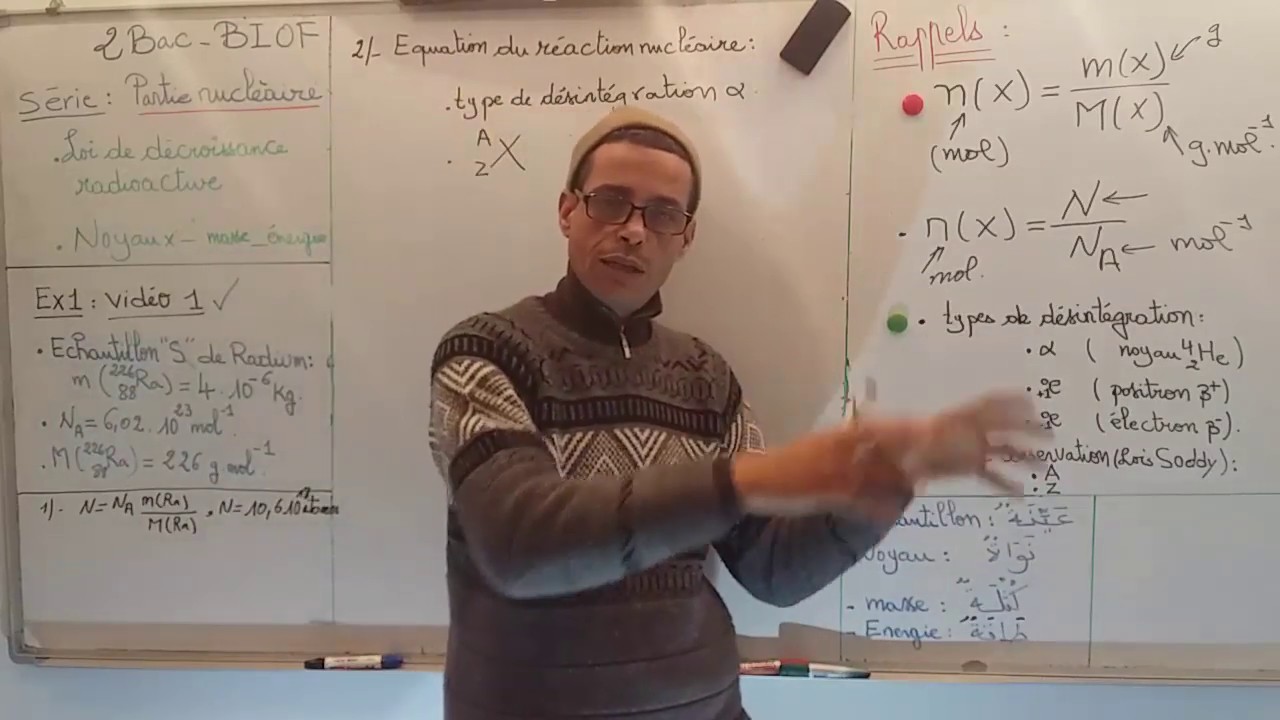








Radioactive decay involves unstable nuclei emitting particles or energy to become more stable; alpha decay emits helium nuclei (2 protons, 2 neutrons) reducing mass by 4 and atomic number by 2, beta decay converts neutrons to protons emitting electrons which increases atomic number by 1 while mass stays constant, and gamma decay releases high-energy electromagnetic radiation without changing the nucleus or causing transmutation.
Alpha, Beta & Gamma Decay Explained | Nuclear Equations
Added:Basic atomic structure, including the properties and locations of protons, neutrons, and electrons within an atom.
Understanding chemical elements, atomic numbers (Z), and mass numbers (A).
The concept of isotopes, which are atoms of the same element with different numbers of neutrons.
The fundamental principle of conservation of mass and charge, which is essential for balancing equations.
The concept of radioactive half-life and performing exponential decay calculations.
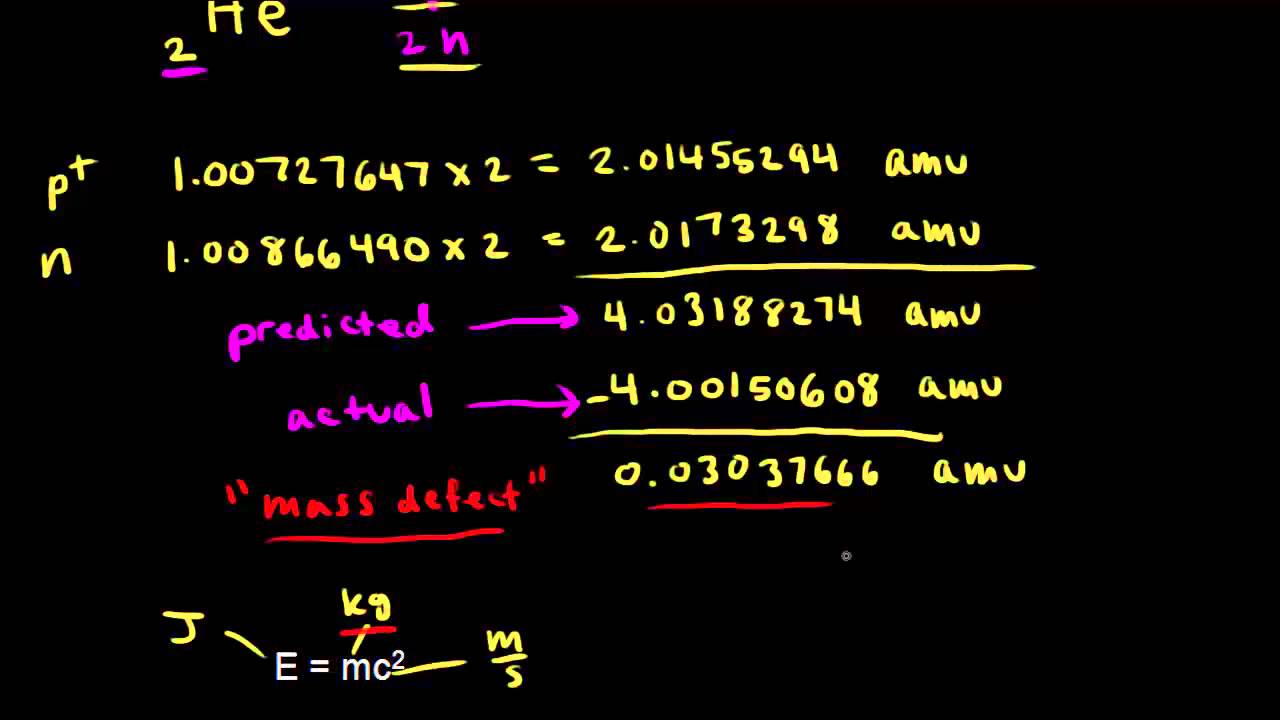
Nuclear binding energy, mass defect, and Einstein's mass-energy equivalence equation (E=mc²).
The differences between radioactive decay, nuclear fission, and nuclear fusion.
Real-world applications of nuclear chemistry, such as radiocarbon dating, nuclear medicine (radiotherapy), and nuclear power generation.
203.7K views1.6Klikes14:10Original Release: 2015-07-14
In this video we are going to learn about Alpha, Beta and Gamma decay.
We will learn what Alpha and Beta particles are, and how to write out alpha and beta nuclear equations.
Recall that elements with atomic numbers greater than 83 are unstable and therefore undergo radioactive decay to become more stable.
In addition, smaller elements may also be unstable because of their neutron to proton ratio.
These elements may also undergo radioactive decay to become more stable.
For the purposes of today's lesson, we will consider radioactive decay by emission of either an alpha particle, a beta particle or a gamma ray.
Alpha decay involves the emission of an alpha particle from the nucleus of an atom.
An alpha particle contains two protons and two neutrons, so it has an atomic number of two and a mass number four.
An alpha particle is identical to a helium nucleus, because a helium nucleus also contains two protons and two neutrons, so we often write an alpha particle using the nuclide symbol for helium.
Recall that the upper left-hand corner tells us the mass number, and the lower left-hand corner tells us the atomic number, which is also equal to the number protons.
And we obtain the number of neutrons by subtracting the atomic number two from the mass number four, and we get two neutrons.
Here is the general nuclear equation for alpha decay.
The nuclide X emits an alpha particle, becoming a new nuclide Y. X represents an unstable atom, which becomes a more stable atom by emitting an alpha particle.
Notice that the mass number of the new nuclide Y is four less than the mass number of the original nuclide X.
This is because an alpha particle with a mass number of 4 was given off.
Notice also that the atomic number of the new nuclide Y is 2 less than the atomic number of X.
This is because two protons were given off as an alpha particle.
This will be easier to visualize using an example.
The nuclide radium-226 undergoes alpha decay by emitting an alpha particle.
Determine the nuclide symbol of the new atom.
When radium gives off an alpha particle, the new atom has a mass number four less than that of radium, so the new mass number would be 222.
Also, the new atom will have an atomic number two less than the atomic number of radium, so its atomic number will be 86.
Notice how the mass numbers added up together on the product side equal the mass number on the reactant side.
222+4 = 226.
The same is true with the atomic numbers.
When we add 86 and two we get 88 on the reactant side.
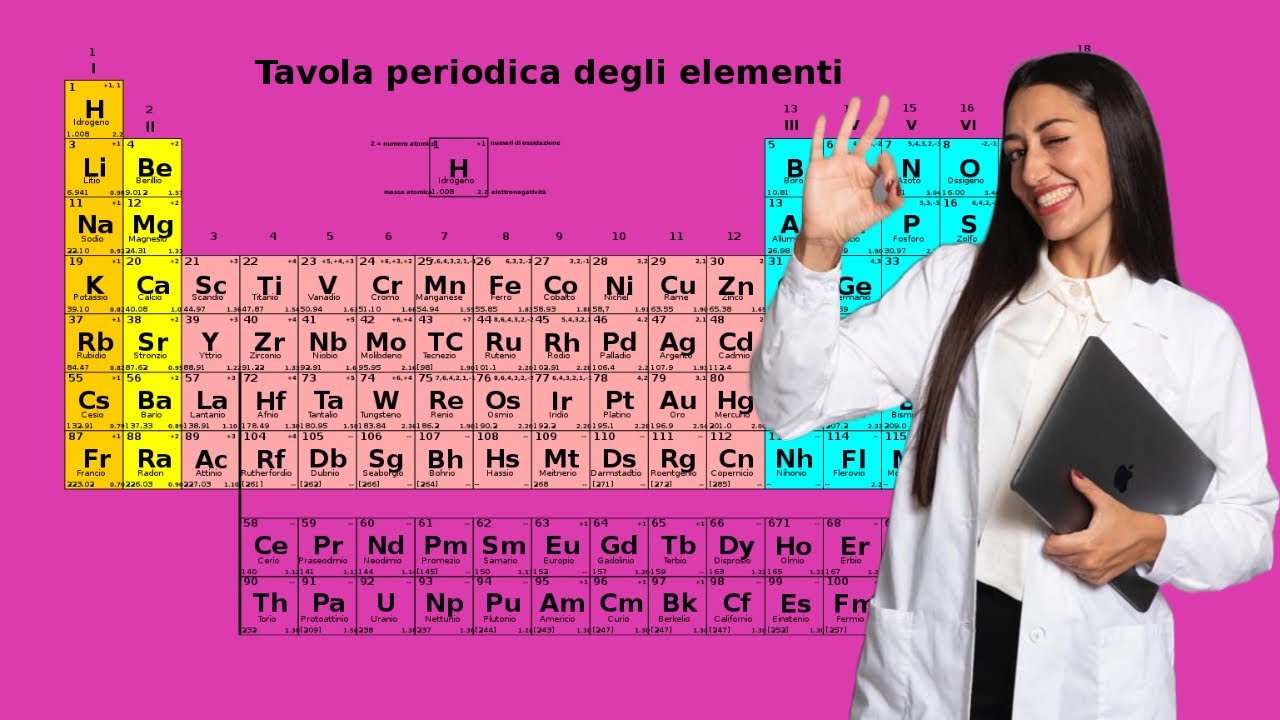
To identify our newly formed nuclide, we go the periodic table and find out which element has an atomic number of 86.
That element is radon, Rn.
Therefore, our newly formed nuclide is radon 222.
Transmutation is the act of changing an atom into another type of atom.
The alpha decay of radium into radon is an example of transmutation.
Radium has changed into another type of atom, radon.
Now that we formed radon-222 from the alpha decay of radium-226, what does radon-222 decay into?
Again, we know that the sum of the mass numbers on the product side must equal the mass numbers on the reactant side.
So we know that four plus our unknown mass number is equal to 222.
Therefore we know that our unknown mass number is 218.
Similarly, the atomic numbers on the right-hand side must equal the atomic number on the left-hand side.
The atomic number of our unknown plus the atomic number of helium, two, must equal 86.
Therefore we know that the atomic number of our unknown element is 84.
To determine the identity of our unknown element, we look to the periodic table.
Our unknown element is polonium-218.
Polonium-218 also undergoes alpha decay, giving off an alpha particle in order to form a more stable nucleus.
We can determine the mass number of our new nuclide, because we know that the sum of the mass numbers on the product side must equal the mass numbers on the reactant side.
Four plus the mass number of our unknown nuclide must equal 218.
Therefore, the mass number of our unknown nuclide is 214.
In addition, the sum of the atomic numbers on the right-hand side must equal the atomic number on the left-hand side.
The atomic number of our unknown nuclide plus the atomic number of our alpha particle, two, must equal 84.
Therefore, the atomic number of our unknown nuclide is 82.
Looking to the periodic table, we identify our unknown nuclide as lead-214.
Let's look at the alpha decay of uranium-234.
We know that the mass number of our unknown nuclide must be 230, because 230+4 is equal to the mass number of uranium 234.
And, we know that the atomic number of our unknown nuclide is 90, because 90+2 is equal to 92.
Looking at the periodic table, we see that are unknown nuclide is thorium-230.
Thorium-230 also undergoes alpha decay.
The mass number of the nuclide it forms is 226, and its atomic number is 88, whose identity is radium.
Beta decay is the emission of a beta particle from the nucleus of an atom undergoing radioactive decay.
A beta particle is a fast-moving electron emitted from the nucleus of an atom.
Normally, electrons do not exist inside the nucleus of an atom, but outside.
This is not the case with a beta particle.
A beta particle type of electron is formed when a neutron turns into a proton and an electron.
As a result of this, the nucleus has one fewer neutron and one extra proton.
Therefore, the atomic number Z increases by one but the mass number A stays the same.
Let's consider the beta decay of polonium-218.
We write a beta particle using either the Greek letter beta, or e for electron.
You'll see it written both ways.
Notice how we write a beta particle with the mass number of zero and atomic number of -1.
This is because, when a beta particle is emitted, the mass number does not change, but the atomic number increases by one when a neutron becomes a proton.
Remember that the sum of the mass numbers on the right-hand side must equal the mass number on the left-hand side, and the sum of the atomic numbers on the right-hand side is equal to the atomic number on the left-hand side.
Since the mass number doesn't change in beta decay, the mass number of our new nuclide is still 218.
Since its atomic number increases by one, the atomic number of our new nuclide is 85.
Notice how the mass numbers on the right-hand side, when added together, 218+0, equal the mass number of polonium, 218.
And the atomic numbers on the right-hand side, when added together, 85+ -1 equal the atomic number of polonium, 84.
The identity of our new nuclide is astatine-218.
As with alpha decay, the emission of a beta particle results in the transmutation of the atom, which means that the atom changes into another type of atom.
The beta decay of thorium-234.
We know in beta decay that the mass number stays the same, so the mass number of our new nuclide is still 234.
And that the atomic number increases by one so that the atomic number of our new nuclide is 91.
Notice that 91+ -1, the atomic numbers on the right-hand side of the equation, are equal to the atomic number of thorium on the left-hand side, 90.
Our new nuclide is palladium-234.
Let's look at a sample problem.
What isotope decays into lead-210 when it undergoes beta decay?
This problem tells us that lead-210 is the product of this decay.
We can solve this by adding numbers.
We know that the sum of the mass numbers on the right-hand side must equal the mass number on the left-hand side, so that the mass number of our unknown isotope is 210.
We also know that the sum of the atomic numbers on the right-hand side must equal the atomic number the left-hand side.
So 82+ a negative 1 is equal to 81.
Our unknown isotope is thallium.
The beta decay of bismuth-210 results in an isotope with mass number 210, and atomic number 84.
The identity of this isotope with atomic number 84 is polonium.
Finally let's consider gamma decay.
Unlike alpha and beta decay, gamma decay is the emission of energy, not a particle.
Gamma decay is the emission of a Gamma Ray, which is high-frequency electromagnetic radiation.
You can see on this chart of the electromagnetic spectrum, that gamma rays are higher energy than x-rays which are higher energy than ultraviolet light which is higher energy than visible light, the visible spectrum.
A Gamma Ray is not a particle like an alpha or beta particle.
Therefore, the resulting nucleus is not changed physically when it undergoes gamma radiation.
Rather, it releases excess energy in the form of gamma rays.
Gamma ray photons have energies of approximately 1×10 to the -12 joules.
Since the nucleus does not change physically, a nuclide undergoing gamma decay does not undergo transmutation.
Therefore, we do not need to learn how to write gamma decay nuclear equations.
Sample problem.
Write a nuclear equation for the beta decay of xenon-152.
We know that, in beta decay, a beta particle is emitted from the nucleus.
We write that beta particle as having a mass number of zero, and an atomic number of -1.
Solving for our unknown is as easy as making sure the numbers on the left-hand side and right-hand side of the nuclear equation are equal to each other.
Therefore the atomic number of our unknown nuclide is 55, because 55+ -1 is equal to 54.
And the mass number of our nuclide is 152 because 152+0 is equal to 152.
Looking on the PeriodicTable we would find out that are unknown nuclide is cesium.
New sample problem.
Write a nuclear equation for the alpha decay of xenon-152.
In this problem we are starting off with the same isotope xenon-152, but now it's undergoing alpha decay.
When xenon undergoes alpha decay, it emits an alpha particle which has a mass number of four and an atomic number of two.
The atomic number of our new nuclide is 52, because 52+2 is equal to 54, and it has a mass number of 148, because 148+4 is equal to 152.
Our new nuclide is tellurium.
There other types of nuclear decay which you are usually not responsible for knowing in a high school chemistry class.
One such type of decay is electron capture, in which a proton captures an electron and becomes a neutron.
This is the opposite of beta decay.
Here, nickel captures an electron, turning a proton into a neutron, so that its atomic number decreases by one, while its mass number stays the same.
Another type of decay is positron emission, in which the nucleus releases a positron, an anti-electron, which has the mass of the electron but a positive charge.
We write a positron just as we write an electron, but instead of writing its atomic number as -1, the atomic number of a positron is positive one.
In positron emission, the atomic number decreases by one, while the mass number stays the same.
Let's summarize what we've learned.
In alpha decay, the nucleus emits an alpha particle, which consists of two protons and two neutrons.
The resulting nucleus has 2 fewer protons and 2 fewer neutrons, so its atomic number decreases by 2, and its mass number decreases by 4.
In alpha decay, the nucleus undergoes transmutation.
In beta decay, the nucleus converts a neutron into a proton and a beta particle, which is an electron.
The resulting nucleus has 1 more proton and 1 fewer neutron, so its atomic number increases by 1, while its mass number stays the same.
As with alpha decay, beta decay results in a transmutation.
In gamma decay, energy is given off in the form of electromagnetic radiation, without a change to the nucleus.
In gamma decay, the nucleus does NOT undergo transmutation.
Up Next
4:25
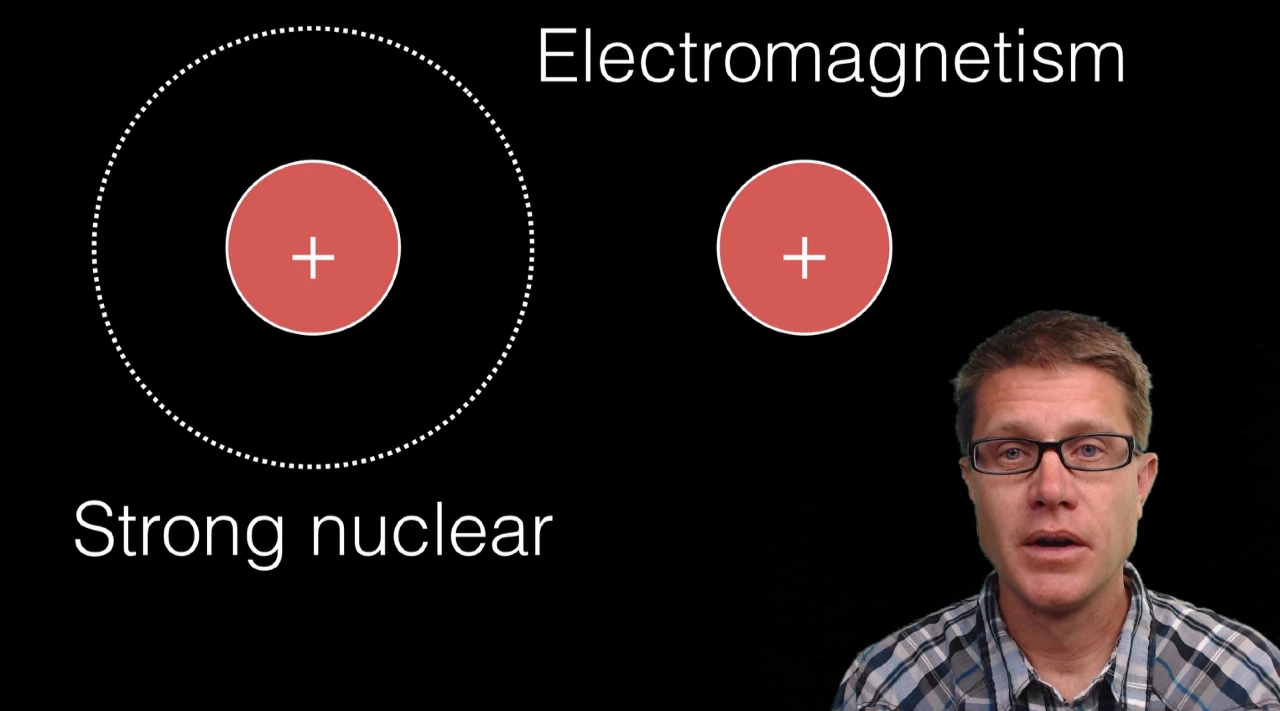
Strong Nuclear Force Explained: Holding the Nucleus Together
@Bozemanscience1
213.2K views•2014-10-07

12:53
21cm Hyperfine Transition in Neutral Hydrogen: Radio Astronomy Basics
@AaronRobertParsons
12.4K views•2011-10-13
10:48
Nuclear Stability: Neutron-to-Proton Ratio and the Band of Stability
@Chemin10
33.2K views•2015-07-17

27:14
Entropy and the Second Law of Thermodynamics Explained
@veritasium
27.5M views•2023-07-01
Related Study Plans & Knowledge Roadmaps
Structured learning paths in Physics
physics
Nuclear Physics (Decay, Fission & Reactors)
01Atomic Structure and the Binding Force
02Radioactive Decay and Half-Life
03Nuclear Fission Mechanics and Chain Reactions
+ 2 more learning modules
12h5 modules
Explore Roadmap
physics
Soft Matter (Polymers, Colloids & Rheology)
01Foundations of Soft Matter & Thermal Forces
02Polymer Physics and Macromolecules
03Colloids, Surfactants, and Self-Assembly
+ 2 more learning modules
38h5 modules
Explore Roadmap
physics
Analytical Mechanics: Lagrangian & Hamiltonian
01Mathematical Foundations: Calculus of Variations
02From Newtonian Mechanics to Constraint Dynamics
03The Principle of Least Action & Lagrangian Mechanics
+ 3 more learning modules
28h6 modules
Explore Roadmap
physics
General Relativity (Spacetime & Cosmology)
01Foundations of Relativity: Special Relativity
02The Geometry of Spacetime: Equivalence Principle & Curvature
03Einstein's Field Equations: The Mathematics of Gravity
+ 2 more learning modules
55h5 modules
Explore Roadmap