



![[Vật Lý 12] Phóng xạ - Full bài tập Sách mới | Kết Nối Tri Thức & Chân Trời Sáng Tạo](https://i.ytimg.com/vi/pqbPSODYLtc/maxresdefault.jpg)


![Exponential decay [IB Physics SL/HL]](https://i.ytimg.com/vi_webp/ekOFoWWCXto/maxresdefault.webp)











![[Vật Lý 12 - 2K8 XPS Lớp 12] Định Luật Phóng Xạ (HAY NHẤT) | Thầy VNA](https://i.ytimg.com/vi/tuRZ9vG23t8/maxresdefault.jpg)


Radioactive equilibrium occurs when the rate of decomposition of each element in a decay series becomes equal, meaning the number of atoms of each element remains constant over time; this condition manifests in two forms: secular equilibrium, where the parent nucleus has a half-life much longer than the daughter (such as uranium-238 with 4.5 billion year half-life decaying to thorium-234 with 24-day half-life), and transient equilibrium, where parent and daughter half-lives are comparable (like thorium-234 with 24-day half-life decaying to protactinium-234 with 1.18-minute half-life); in both cases, the number of atoms of each element is inversely proportional to its disintegration constant and directly proportional to its half-life.
Radioactive Equilibrium: Secular vs Transient Equilibrium
Added:Fundamental understanding of radioactive decay laws, including the exponential decay equation and the decay constant (lambda).
The concept of half-life and how it dictates the rate of decay for a given radionuclide.
The relationship between a parent nuclide and its subsequent daughter nuclides in a decay chain.
The definition of nuclear activity (A = lambda * N) and how the number of radioactive atoms relates to decay rate.
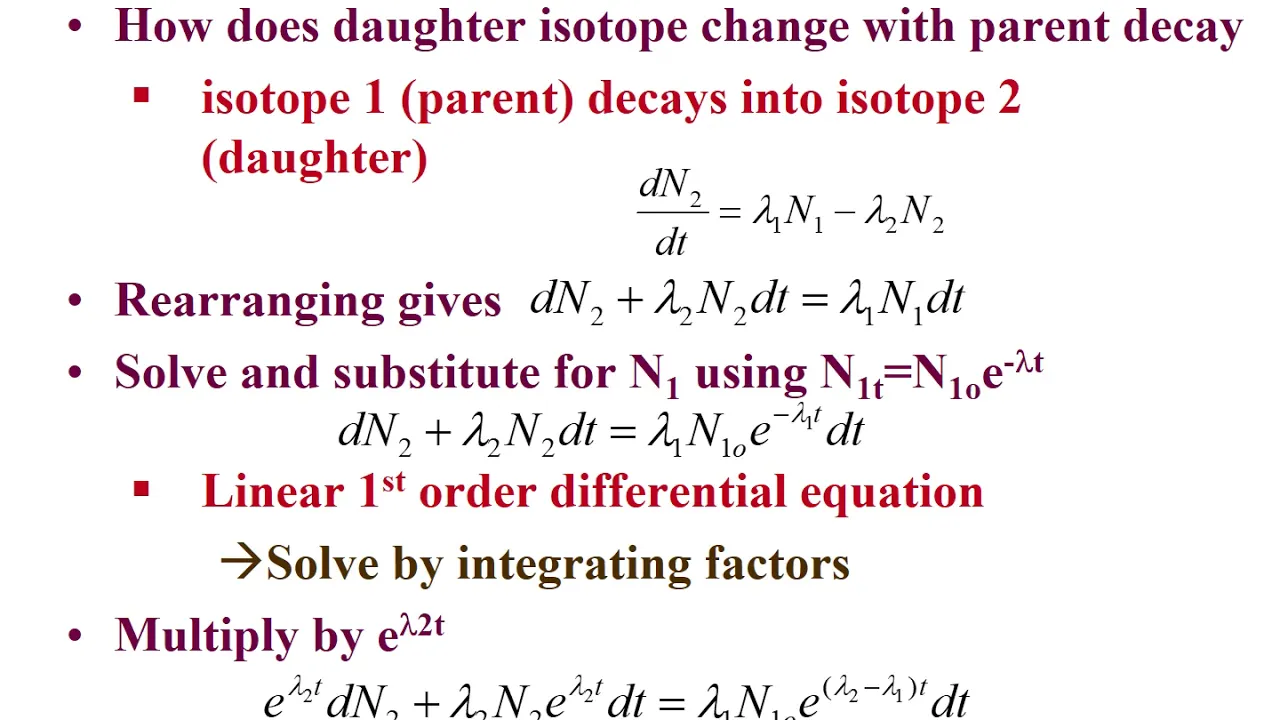
Mathematical modeling of multi-generation decay chains using the Bateman equations.
Analysis of 'no-equilibrium' scenarios where the parent nuclide has a shorter half-life than the daughter nuclide.
Practical applications in nuclear medicine, such as the operation of Molybdenum-99/Technetium-99m generator systems via transient equilibrium.
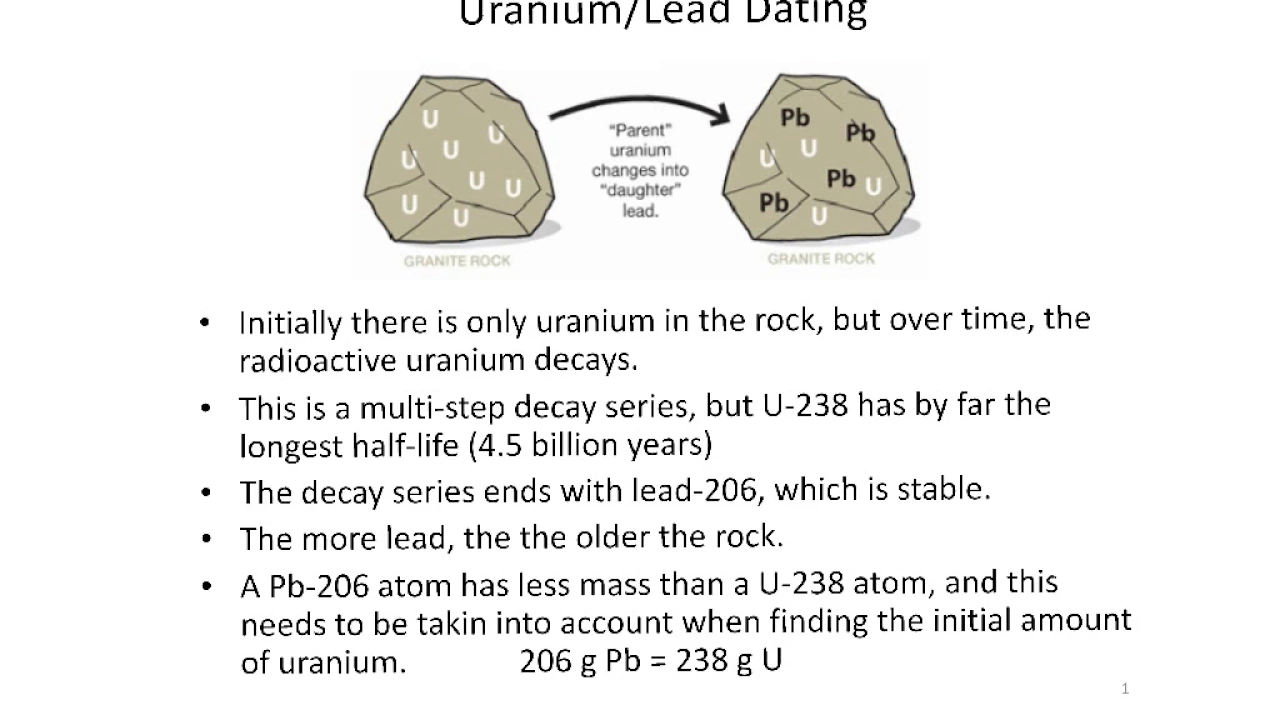
Use of secular equilibrium principles in geological dating and determining the age of the Earth (e.g., Uranium-Lead dating systems).
46.5K views539likes5:26Original Release: 2017-03-21
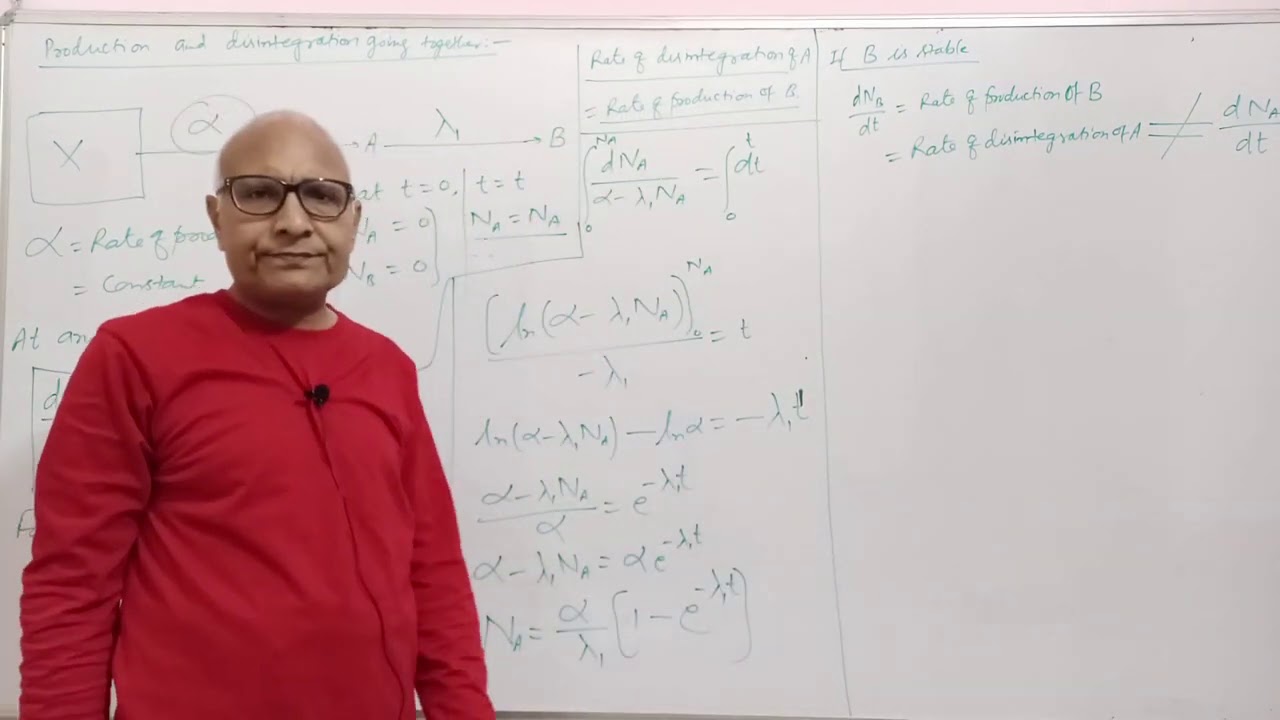
Hello friends today we will study about the radioactive equilibrium what is equilibrium let me consider this disintegration Series in this series a compound radioactive element a is decaying to B and this is decaying to C and this C is decaying to D and so on so after it some time we get a condition that the rate of decomposing of each element becomes equal it means that the number of atoms of each element becomes constant suppose After Time T the number of atoms of a becomes na a the number of atoms of B becomes NB the number of atoms of C becomes NC and the number of atoms of D becomes n d so the rate of Disappearing of each element becomes equal this condition is known as equilibrium condition so the rate of all disappearing will be equal so minus DNA upon DT will be equal to minus DNB upon DT this will be equal to minus DN C upon DT and this will be equal to minus DND D upon DT here a negative sign is imposed because the concentration of each element is decreasing but the rate of Disappearing of each element depends upon the number number of atoms of this present at that time so minus DNA upon DT will be equal to Lambda a n where Lambda is the disintegration constant for the radioactive element a and na is the number of atoms of the a we can also put K instead of Lambda here the minus dnv upon DT will be equal to Lambda V upon NB Lambda B into NB minus DNC upon DT will be equal to Lambda C into n B and minus d n d upon DT will be equal to Lambda c n c so from these equation we can write that Lambda A N A is equal to Lambda b n b is equal to Lambda C and C and is equal to Lambda D and D so the number of atoms na a upon NB will be equal to Lambda B upon Lambda a from this equation we can see that the number of atoms of a or any radioactive El is inversely proportional to its disintegration constant but we also know that disintegration constant is inversely proportional to its half life so the number of atoms of each element will be directly proportional to its half life so greater the half life greater will be the number of atoms of that element the radioactive equilibrium is of two types first is secular equilibrium in this type of equilibrium the half life of parent nucle is many much times greater than that of the daughter it may be by a factor of 10 to the power 4 or more than it for example we can see this disintegration Series this is a uranium disintegration Series in this uranium is converting to thorium and thorium is converting to some other substance in this case uranium is parent at parent atom and its half life is 4.5 into 10 to the power 9 years and thorium is the daughter nucle and its half life is 24.1 days so there is difference much more than we can think so this is a type of secular equilibrium for secular equilibrium the number of atoms of B is given by n b is equal to Lambda a upon Lambda b n0 e to the power minus Lambda a t next equilibrium is transient equilibrium in this type of equilibrium the half life of parent and daughter nucleid differs by very small factor for example we can see the thorium disintegration Series in this series thorium is the the parent atom and padium is the daughter nuclei the the rate for the the half life for the thorium is 24.1 days while that for padium is 1.18 minutes so this is in days this is a minute this is not a much difference so this is called a transient equilibrium the number of atoms here is given by NV is equal to Lambda a upon Lambda a minus Lambda b n0 e to the power minus Lambda a t so this is all about the radioactive equilibrium cirular and transient equilibrium in next video we will concern more things thank you for watching the video
Up Next

10:43
How a Geiger Counter Works: Physics of Radiation Detection
@learnelectronics
2K views•2023-09-19

12:53
21cm Hyperfine Transition in Neutral Hydrogen: Radio Astronomy Basics
@AaronRobertParsons
12.4K views•2011-10-13

32:32
NMR Spin Physics I: Zeeman Effect, Resonance Condition & Larmor Frequency
@nptel-indianinstituteofsci8064
2.3K views•2024-01-17

27:14
Entropy and the Second Law of Thermodynamics Explained
@veritasium
27.5M views•2023-07-01
Related Study Plans & Knowledge Roadmaps
Structured learning paths in Physics
physics
Nuclear Physics (Decay, Fission & Reactors)
01Atomic Structure and the Binding Force
02Radioactive Decay and Half-Life
03Nuclear Fission Mechanics and Chain Reactions
+ 2 more learning modules
12h5 modules
Explore Roadmap
physics
Soft Matter (Polymers, Colloids & Rheology)
01Foundations of Soft Matter & Thermal Forces
02Polymer Physics and Macromolecules
03Colloids, Surfactants, and Self-Assembly
+ 2 more learning modules
38h5 modules
Explore Roadmap
physics
Analytical Mechanics: Lagrangian & Hamiltonian
01Mathematical Foundations: Calculus of Variations
02From Newtonian Mechanics to Constraint Dynamics
03The Principle of Least Action & Lagrangian Mechanics
+ 3 more learning modules
28h6 modules
Explore Roadmap
physics
General Relativity (Spacetime & Cosmology)
01Foundations of Relativity: Special Relativity
02The Geometry of Spacetime: Equivalence Principle & Curvature
03Einstein's Field Equations: The Mathematics of Gravity
+ 2 more learning modules
55h5 modules
Explore Roadmap