Polymer Chemistry: Synthesis & Properties
Learning Goal: Master the foundational concepts of polymer chemistry, ranging from the fundamental classification of macromolecules and monomers to the step-by-step synthetic mechanisms (addition, condensation, ionic). Gain practical competency in interpreting macromolecular characterization data (such as molecular weight averages, polydispersity, GPC, and FTIR) and evaluating how molecular structure dictates thermal and mechanical properties (Tg, Tm, and stress-strain relationships) for advanced structural and sustainable materials.
- Prerequisites: High School Chemistry, basic understanding of Organic Chemistry functional groups.
- Estimated Total Study Time: 12 Hours
Module 1: Introduction to Macromolecules & Monomers
This module establishes the conceptual foundation of polymer science. You will learn the difference between single-unit monomers and high-molecular-weight macromolecules, explore the classification of polymers (natural vs. synthetic, structural geometry, homopolymers vs. copolymers), and trace the historical evolution of the field from accidental industrial discoveries to Hermann Staudinger's breakthrough macromolecular hypothesis.
Recommended Videos

- Why this video: This video acts as a highly accessible gateway. It uses simple animations and clear organic structures to break down the "building block" analogy, explaining how repeating monomers undergo polymerization to yield enormous macromolecules. It is the perfect conceptual starting point.
- Knowledge Checkpoint:
- Understand the root Greek terms poly and meros and define a repeating unit.
- Differentiate between a single monomer unit and the final polymer chain.
- Identify key structural changes that occur when monomer units link together via chemical bonds.

- Why this video: This rigorous university-level lecture provides deep technical taxonomy. It covers the categorization of polymers into homopolymers and copolymers, linear vs. branched vs. cross-linked structural geometries, and provides a formal chemical engineering perspective on material classification.
- Knowledge Checkpoint:
- Explain the structural difference between a homopolymer and a copolymer (random, alternating, block, graft).
- Describe how linear, branched, and cross-linked molecular architectures influence overall physical space and density.
- Define high molecular mass limits (typically to units) that characterize true polymeric materials.

- Why this video: This lecture segment provides essential historical context, telling the story of Eduard Simon's accidental 1839 synthesis of polystyrene and detailing the pivotal contributions of Hermann Staudinger. This historical perspective explains why early chemists struggled to accept the existence of giant macromolecules.
- Knowledge Checkpoint:
- Explain why early 19th-century chemists believed polymers were merely aggregate colloidal clusters rather than single covalent molecules.
- State the significance of Hermann Staudinger’s 1922 paper and how it changed the scientific consensus.
- Identify the historical milestone of the first commercial synthetic polymer (Bakelite, 1907).
Module 2: Polymerization Synthesis Mechanisms
This module addresses the chemical reaction pathways used to construct polymers. You will contrast the step-growth (condensation) and chain-growth (addition) polymerization mechanisms. Additionally, you will master the kinetics of free radical polymerization (initiation, propagation, and termination) and examine ionic polymerization pathways (both anionic and cationic).
Recommended Videos

- Why this video: Professor Darren Lipomi explains the fundamental step-by-step kinetic differences between step-growth and chain-growth. He clarifies how any two reactive end groups in a reaction mixture can react with each other in step-growth, leading to a slow, progressive increase in molecular weight across the entire system.
- Knowledge Checkpoint:
- Explain why monomer concentration drops rapidly at the very start of step-growth polymerization while average molecular weight increases slowly.
- Write the basic premise of the Carothers Equation linking fractional conversion () to the average degree of polymerization ().
- Contrast step-growth reaction progression with chain-growth, where high-molecular-weight chains form almost instantaneously.
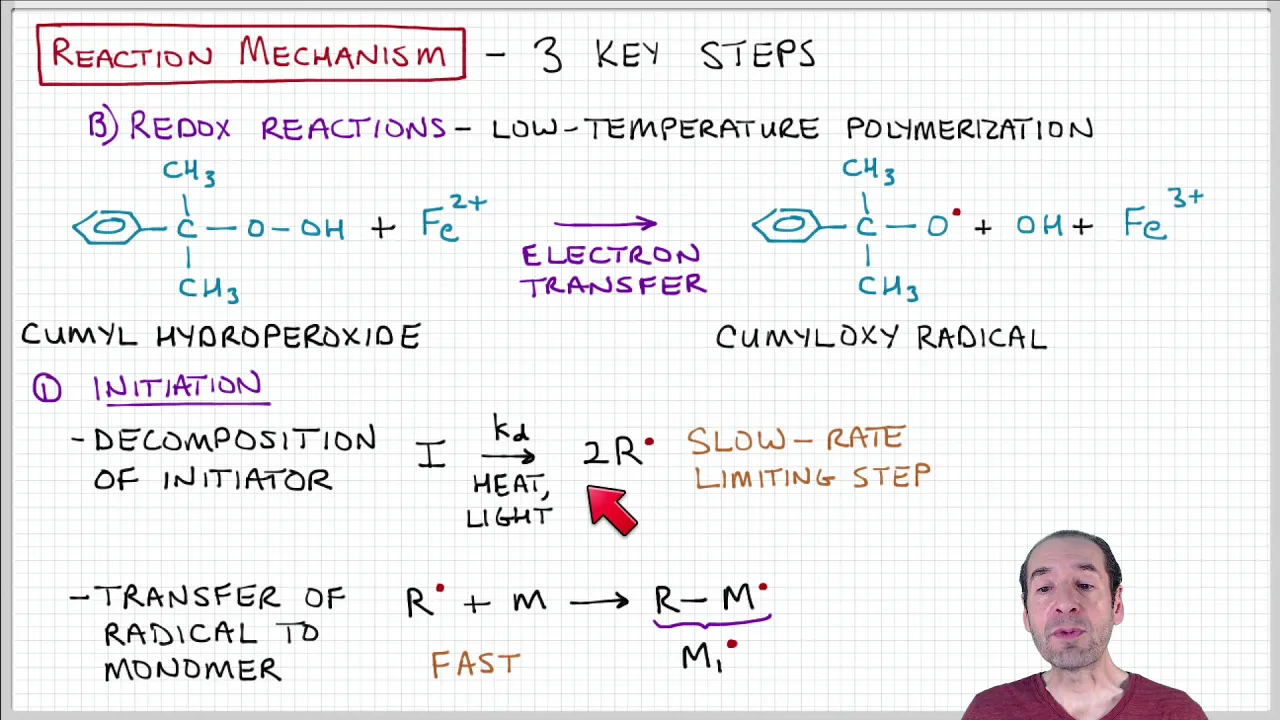
- Why this video: This video focuses on free radical chain-growth polymerization. It visually breaks down the three essential mechanistic stages—initiation (homolytic cleavage of organic peroxides like benzoyl peroxide), propagation (radical addition to alkene monomers), and termination (combination or disproportionation).
- Knowledge Checkpoint:
- Draw the homolytic cleavage of a common initiator (such as benzoyl peroxide) to yield active primary radicals.
- Write out the chemical equation showing radical attack on an asymmetric alkene monomer (like vinyl chloride or styrene), showing regioselectivity.
- Differentiate between the two termination pathways: coupling/combination (which doubles molecular weight) and disproportionation (which yields one saturated and one unsaturated polymer end).
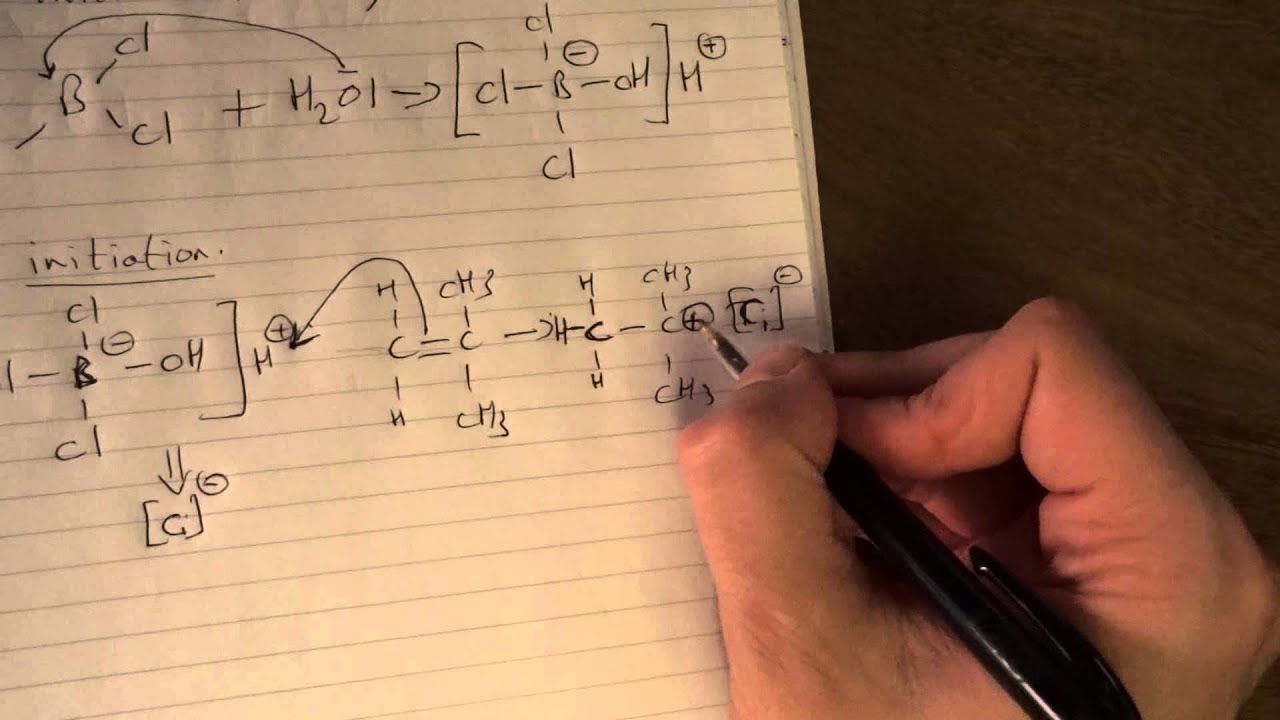
- Why this video: This tutorial covers ionic polymerization by exploring cationic pathways. It details how Lewis acids (such as or ) act as co-initiators with a proton source to generate carbocation active centers, specifying which monomer substituents stabilize this intermediate.
- Knowledge Checkpoint:
- Identify which monomer classes undergo cationic polymerization (monomers with electron-donating substituents like alkyl, alkoxy, or vinyl groups).
- Describe the initiation step involving a Lewis acid co-initiator complex generating a carbocation.
- Explain the common chain-transfer and termination routes in cationic systems, highlighting why they require low temperatures to prevent premature termination.

- Why this video: This video covers anionic chain-growth, demonstrating how strong nucleophiles (such as organolithium compounds like n-butyllithium) initiate anionic centers. It addresses the concept of "living polymers," where the absence of inherent termination steps allows for precise macromolecular design.
- Knowledge Checkpoint:
- Identify monomer structures suitable for anionic polymerization (monomers with electron-withdrawing groups like cyano, nitro, or ester groups).
- Explain why anionic systems are highly sensitive to protic impurities (like water or alcohols) which act as immediate terminating agents.
- Define the term "living polymerization" and explain how block copolymers are synthesized by sequentially adding different monomers to a living anionic system.
Module 3: Polymer Characterization Techniques
Note: While the original feedback flagged characterization as a critical video gap, our revised pool contains excellent resources. We address these gaps using highly focused lectures.
In this module, you will learn how chemists characterize synthetic polymers. Unlike small organic molecules, polymers possess a statistical distribution of chain lengths. You will master the concepts of Number Average Molecular Weight (), Weight Average Molecular Weight (), and the Polydispersity Index (PDI). You will also learn the analytical mechanics of Gel Permeation Chromatography (GPC/SEC) and functional group identification via Fourier Transform Infrared (FTIR) spectroscopy.
Recommended Videos

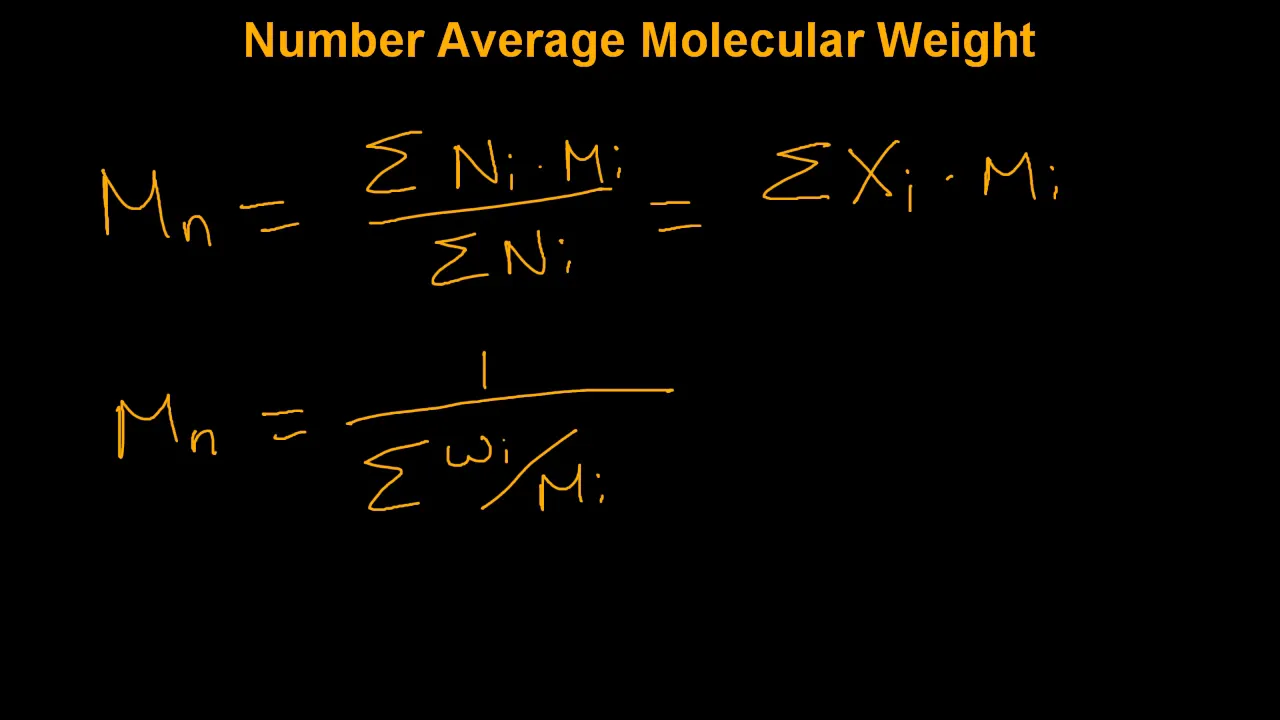
- Why this video: This crash course provides the exact mathematical formulas for the different molecular weight averages. It walks through how , , viscosity-average molecular weight (), and z-average molecular weight () are mathematically defined, calculated, and compared.
- Knowledge Checkpoint:
- Write out the mathematical summation formulas for:
- Define the Polydispersity Index (PDI) as and explain what a PDI value of indicates versus values greater than .
- Explain why is always mathematically greater than or equal to for a polydisperse sample.
- Why this video: This video focuses on , demonstrating how colligative property measurements (such as osmotic pressure, freezing point depression, and boiling point elevation) are physically used to calculate the absolute number of polymer chains present in a known mass sample.
- Knowledge Checkpoint:
- Explain why colligative properties depend strictly on the number of particles in solution, making them ideal for determining .
- Solve a basic calculation of given the number of chains () in each molecular weight fraction ().
- Describe the physical significance of (e.g., its correlation with polymer transition temperatures and flow behavior).

- Why this video: This comprehensive webinar explains the analytical principles of Gel Permeation Chromatography (GPC), also called Size Exclusion Chromatography (SEC). It clearly explains that the separation is driven by the hydrodynamic size (or volume) of the polymer chains in solution, rather than their chemical affinity or absolute mass.
- Knowledge Checkpoint:
- Describe the internal structure of GPC column packing (porous gel beads) and explain why large polymer chains elute first while small chains elute last.
- Draw a representative GPC chromatogram showing concentration vs. retention volume (or time) and identify where and fall relative to the peak.
- Explain the role of mobile phase solvent choice (e.g., THF or DMF) and calibration standards in GPC analysis.

- Why this video: This video shows how FTIR spectroscopy is used to analyze polymer molecular structures. It explains how exposing samples to infrared light causes specific functional groups to absorb characteristic frequencies, creating a unique spectroscopic fingerprint.
- Knowledge Checkpoint:
- Define the units of the horizontal axis in an FTIR spectrum (wavenumber, measured in ) and the vertical axis (Transmittance or Absorbance).
- Identify key infrared absorption regions for common polymer functional groups (e.g., stretch, carbonyl stretch, hydroxyl stretch).
- Explain how FTIR can verify that an addition polymerization reaction went to completion (e.g., monitoring the disappearance of the monomer's vinyl stretch around ).
Module 4: Thermal and Mechanical Properties
In this module, you will explore how a polymer's molecular architecture and chemical composition dictate its macro-scale physical behavior. You will study the differences between amorphous and semi-crystalline polymers, define the critical transition temperatures ( and ), analyze polymer stress-strain behavior during mechanical deformation, and learn how Differential Scanning Calorimetry (DSC) is used to track these transitions.
Recommended Videos

- Why this video: This concise comparison distinguishes between (glass transition temperature) and (melting temperature). It explains that is a second-order thermodynamic transition representing the onset of cooperative chain mobility in amorphous regions, whereas is a first-order phase change representing the transition of crystalline domains from solid to liquid.
- Knowledge Checkpoint:
- Describe the physical state of a polymer below its (hard, glass-like, brittle) versus its state above but below (rubbery, ductile, flexible).
- Explain why purely amorphous polymers exhibit only a , while semi-crystalline polymers exhibit both a and a .
- Explain how chemical structural factors (such as chain stiffness, bulky side groups, and intermolecular forces) affect the value of .

- Why this video: This practical guide explains the operation of Differential Scanning Calorimetry (DSC). It demonstrates how a polymer sample and an inert reference pan are heated at a constant rate, tracking heat capacity changes and heat flow to identify thermal transitions.
- Knowledge Checkpoint:
- Identify a transition on a DSC thermogram (visible as a step-change in the baseline heat capacity).
- Identify crystallization peaks (exothermic peak) and melting peaks (endothermic peak) on a DSC curve, and explain the direction of heat flow for each.
- Calculate the percent crystallinity of a semi-crystalline polymer by comparing its experimental enthalpy of melting () to the theoretical enthalpy of a crystalline reference sample ().
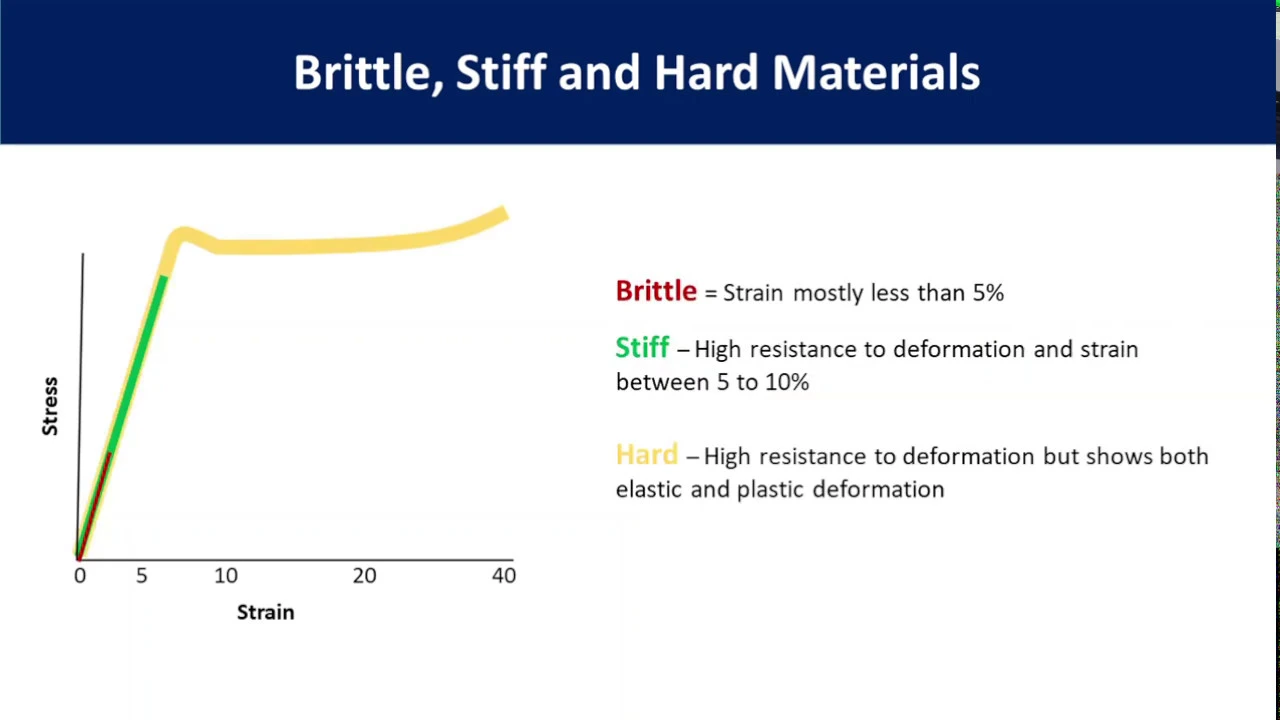
- Why this video: This video explains how to measure and interpret the mechanical behavior of polymers using tensile testing. It walks through the step-by-step changes a polymer specimen undergoes when subjected to tension, connecting the molecular rearrangement of chains to regions of the stress-strain curve.
- Knowledge Checkpoint:
- Identify the following points on a polymer stress-strain curve: Elastic Region, Yield Point, Necking/Plastic Deformation Region, and Ultimate Tensile Strength.
- Contrast the stress-strain curves of: (a) a glassy, brittle polymer, (b) a ductile thermoplastic, and (c) an elastomer (rubber).
- Define Young's Modulus (Elastic Modulus) as the slope of the initial linear elastic region and explain its physical meaning on the molecular level.
Module 5: Advanced Polymers & Sustainability
This module explores cutting-edge applications and environmental solutions in modern polymer science. You will study how conjugation and doping turn insulating plastics into conductive polymers, examine the 3D network structure and water absorption capacity of smart hydrogels, and analyze the chemical synthesis and degradation pathways of biodegradable plastics.
Recommended Videos

- Why this video: This video provides an animation explaining how certain polymers conduct electricity. It details how hybridized carbon backbones generate a continuous system of overlapping, unhybridized -orbitals, creating a delocalized -bond system that allows electron movement when doped.
- Knowledge Checkpoint:
- Identify the structural requirement for polymer conductivity (alternating single and double carbon-carbon bonds, or a conjugated backbone).
- Explain the difference between p-doping (oxidation/removing electrons) and n-doping (reduction/adding electrons) in conductive polymers like polyacetylene or polyaniline.
- Explain how polaron and bipolaron charge carriers form and migrate along the conjugated polymer backbone.

- Why this video: This video introduces hydrogels, describing them as soft, flexible materials composed of highly hydrophilic polymer networks. It explains how chemical or physical cross-links prevent these structures from dissolving, allowing them to absorb and retain enormous volumes of water.
- Knowledge Checkpoint:
- Define physical cross-linking (hydrogen bonding, ionic interactions) vs. chemical cross-linking (covalent bonds) within hydrogel networks.
- Explain why hydrogels are highly hydrophilic and describe the thermodynamic balance between the osmotic swelling force and the elastic retractive force of the network.
- List two biomedical applications of hydrogels, explaining how their soft, water-rich structure mimics natural extracellular matrices.
- Why this video: This educational video covers the chemistry of bioplastics and biodegradable polymers. It contrasts oil-based, non-degradable polymers with plant-derived, biodegradable alternatives like polylactic acid (PLA), detailing how ester linkages in PLA are broken down through hydrolytic and enzymatic cleavage.
- Knowledge Checkpoint:
- Differentiate between bio-sourced (made from renewable resources) and biodegradable (capable of decomposing under environmental conditions) polymers.
- Describe the chemical synthesis of PLA (ring-opening polymerization of lactide).
- Explain the chemical mechanism of PLA degradation (ester hydrolysis, breaking the polymer chain down into lactic acid monomers).
Course Map
Key People Index
- Hermann Staudinger (1881–1965)
- Context: Mentioned in Module 1 (MIT Lecture). Staudinger is considered the father of macromolecular chemistry. He proposed that polymers are giant molecules held together by standard covalent bonds, a concept for which he received the 1953 Nobel Prize in Chemistry.
- Leo Baekeland (1863–1944)
- Context: Highlighted in Module 1 as the commercializer of Bakelite (1907), the world’s first fully synthetic plastic, which catalyzed the growth of the modern plastics industry.
- Eduard Simon (1789–1856)
- Context: Mentioned in Module 1 (MIT Lecture). An apothecary who accidentally synthesized polystyrene in 1839 by distilling storax resin, though he did not understand the macromolecular nature of the product.
- Wallace Carothers (1896–1937)
- Context: Highlighted in Module 2 (UCSD NANO 134 Darren Lipomi). Carothers developed the kinetic equations governing step-growth polymerization and led the DuPont team that invented Nylon-6,6 and Neoprene.
Final Self-Assessment
Complete this comprehensive self-assessment to verify your mastery of the curriculum:
- Monomer vs. Polymer: Can you define a repeating unit and write out the structural formula of a polymer chain given its monomer structure?
- Step-Growth vs. Chain-Growth: Can you list three key differences in polymerization kinetics, monomer consumption, and average molecular weight development between these two mechanisms?
- Free Radical Polymerization: Can you draw the complete curved-arrow mechanism for the initiation, propagation, and termination of polystyrene from styrene monomers and a peroxide initiator?
- Ionic Polymerization: Can you explain why cationic polymerization requires electron-donating substituents, while anionic polymerization requires electron-withdrawing substituents?
- Molecular Weight Calculations: Can you write the formulas for and and calculate the Polydispersity Index (PDI) of a polymer sample given its molecular weight distribution?
- GPC Separation Mechanism: Can you explain why larger polymer chains elute faster than smaller chains in a Gel Permeation Chromatography column?
- FTIR Spectroscopy: Can you identify the wavenumber region for a carbonyl group stretch () and explain how FTIR is used to monitor polymerization progress?
- vs. : Can you explain the structural and mechanical changes that occur when an amorphous polymer is heated through its glass transition temperature?
- DSC Interpretation: Can you look at a DSC thermogram and identify the step-change (), the exothermic crystallization peak (), and the endothermic melting peak ()?
- Stress-Strain Behavior: Can you sketch and label the stress-strain curves for a brittle polymer, a ductile plastic, and an elastomer, and explain how chain orientation relates to yield behavior?
- Conductive Polymers: Can you describe how conjugation along a carbon backbone, combined with doping, allows polymers to conduct electricity?
- Biodegradable Chemistry: Can you explain the chemical mechanism of polylactic acid (PLA) degradation and how its ester bonds make it susceptible to hydrolysis?