


















Polymers are large macromolecules composed of many repeating structural units, derived from Greek words 'poly' (many) and 'mers' (parts). They are classified into homopolymers (made from a single monomer type) and copolymers (made from two or more different monomers). Key polymer terminology includes monomers (building blocks with at least two functional groups), repeating units (the structural segment that repeats), and oligomers (shorter chain precursors). The degree of polymerization refers to the number of structural units in a polymer molecule. Polymers exhibit superior properties like high tensile strength, impact resistance, and toughness due to chain entanglement, which distinguishes them from small molecules. Polymers are primarily synthesized from petroleum-derived monomers through polymerization processes and are processed into final products through compounding and molding operations. Current research focuses on developing bio-based polymers, improving waste management, and creating environmentally friendly polymer processes.
Introduction to Polymers: Polymer Chemistry Lecture 1
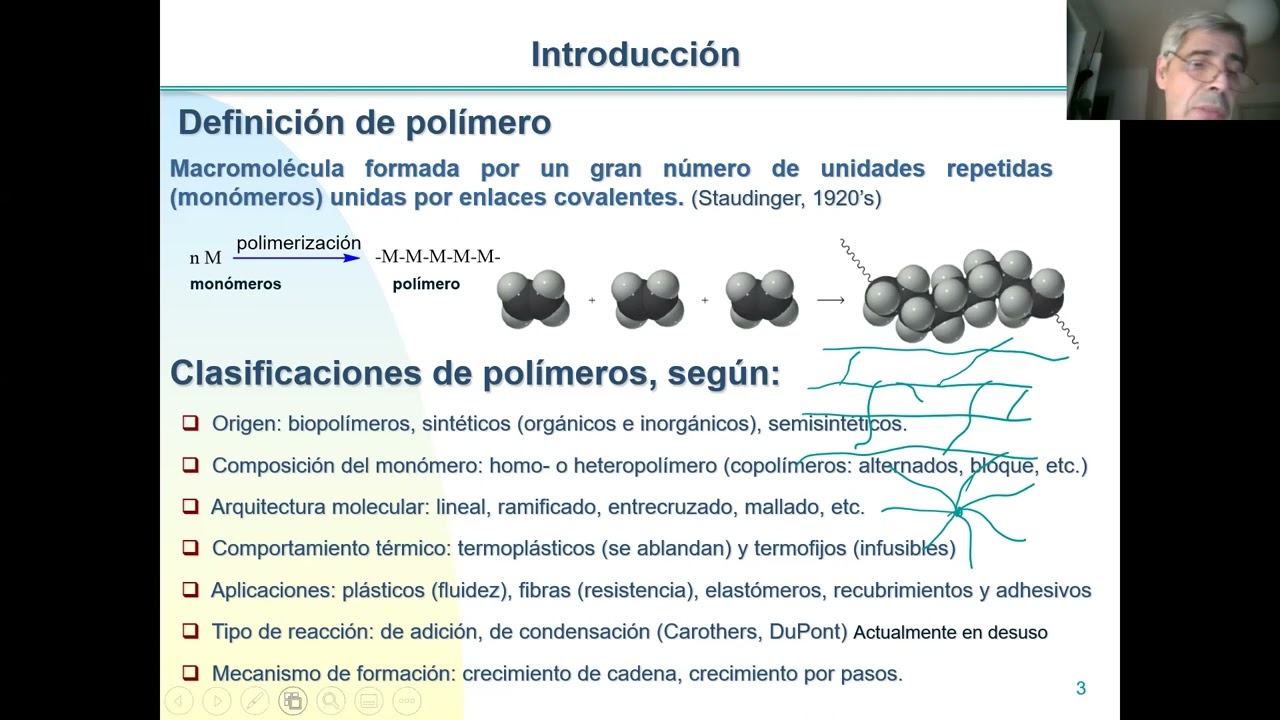
Added:[Music] welcome to this course on polymer chemistry I am dibakar dhara I belong to the Department of Chemistry of I Kapur in this course I plan to cover the following topics at the start I'll be giving a thorough introduction about the polymers which includes the classification nomenclature and a perspective of molecular of polymer molecules then I plan to cover in details various polymerization processes I talk about I'll talk about the kinetics and the mechanism of different polymer processes which incl includes step growth and chain growth polymerization I also will cover co- polymerization especially the kinetics of f radical copolymerization and then I'll also cover other important polymerization techniques such as ring opening polymerization and coordination polymers in the characterization I will talk in detail about the the thermodynamics of polymer Solutions and then polymer chain dimensions and I also will cover in detail about various methods for measuring molecular weight of polymer polymers and then I'll will cover polymer important polymer properties and how the structure of polymer molecules correlates to these properties I'll also cover both the chemical structure as well as physical structure of the polymers and how it relates to the polymer properties I'll cover in brief uh the reaction of polymers which include polymer dation stabilization and also polymer modifications and at the end I plan to brief you about few new topics and special topics and new developments in polymer chemistry and at the end I will complete with a summary of this course now after learning what are the topics we plan to cover in this course let's introduce polymer to you what are polymers we we listen everywhere about the polymers but what are polymers in a very simple term in a single sentence polymers can be defined that they are large molecules that's why sometimes they call macro molecules synonymously they consist of many repeating structural units the term polymers derived from Greek words poly and mirrors poly means many and mirrors means part if I want to just show you pally or schematically this is uh the representation of polymers you have this structural units monomers and on polymerization it gives you a linkage between the polymers making a large molecules so you get a polymer for example you have ethylene here and in this side after polymerization you have polyethyl in this case all the mon poers are same so we name these polymers we turn these polymers as homopolymers polymers can be made from more than one monomers as well different monomers just so in victorial in two colors and in that case you get a polymers consist of two different structural units you and we call them as co- polymers to just give you example of of Co polymers uh I have a say I have a molecule like styen and I also have a molecule like methy meate now these two can be polymerized to give you a poly styen Co MMA this is a copolymer of poyin and meth methy meate now this St copolymers are used generally when you have a polymers which are synthesized from two different monomers where the monomers can be po merized independently which means in this case styrene as well as the can be polymerized to individually can into poyin and polymethyl meates there is other type of polymers which are also synthesized from two different monomers for example if I take example of tryc acid and ethylene glycol I have n molecules of this n molecules of this which on polymerization gives you a polymers which is known as polyethylen talet we get this pet bottles they are this they are made of this polyline talet so in this case this polymer pit is also made from two different monomers talic acid and ethine glycol and we make a polymer but generally generally we do not call this polymer as a co-polymer whenever because as I said earlier this monomer pyic acid or this ethine glycol cannot be polymerized independently by or individually this STC acid cannot be made polymers by itself or a e glycol cannot be made polymer by this process if if we have say more than one diol in this case ethine glycol and say buttin glycol that case we will have a mixture of two structural unit where you have teric acid and ethylen glycol and also teric acid and buttin glycol in this that case we call this or we name this polymers as a co-polymers so just repeat about this co-polymer generally we use the term co-polymers where the polymer is synthesized from to different monomers where the monomers are or can be uh M with homopolymer individually there is another case where polymer is made from two different monomers but in this case we do not call this as a co- polymer because the constituents monomer usually cannot be homopolymerized independently by the same process and when you make polymerization polymers we invariably land up in a distribution of molecular weight while a polymer is a high molecular weight but it also gives you a distribution of molecu that means it has several length the polymer mixture is consisted of different molecular weight chains and this is this High molecular of polymer which gives you or which enables a polymer to have this useful properties where you know for which the polymer is known for for example it gives you high tensile strength impact resistance toughness M viscosity and and so on now you might ask me why you know what is the reason this High molecular help in giving the a polymer uh this Superior properties compared to the small molecules let's look at this cartoon if you compare as collection of small molecules of shortt molecules like sugar and and the long molecules which is a polymer sample this each individual colors individual chains represent a individual molecules in this case as well now this is case where the individual molecules are small in size they are not entangled with each other so given a Stace from outside they can be separated easily in other words this small molecules behave independently if I just give you a example of uh real life say I have taken a bowl of rice and you want to take out uh rice with a spoon you can easily take out because each individual rice units behave independently so you can easily take out uh rice from a bowl by a spoon whereas in case of polymers because of the large size and its flexibility they are present in a mixture in entangled W that means the polymer chains are entangled to each other and as they entangled they cannot be moved independently with each other for example real life example if I have a bowl of noodles and I ask you to take a spoon one spoon of noodles you cannot independently take out as a noodles with a spoon because they entangled so chains comes together so once you take out the noodles you get a chunk of polymer or pieces of noodles which you take out so in this case where it was very easy to deform or a a set of small mixture of small molecules in this case because of the large molecules it is difficult to deform a polymer molecules which gives you high viscosity which gives you the high strength of the polymer molecules high impact resistant how toughness and all other good properties of Mo polymer samples and that's why polymers is so popular now this okay coming to the more definitions relevant to uh our course of polymer chemistry as such monomers we talked about several times monomers monomers are molecules from which polymers are made they must have at least functionality of two that means they can be you know reacted at least from two sides for example we talked about sty molecules or ethline molecules which means they can be extended from two sides if you have a molecules which have only one functionality for example instead of ethylin glycol you have a phenol molecules then once this W of phenol is reacted you the chain doesn't go you you cannot make a polymers so for making a polymers you require monomers which have at least two functionality in them repeating units it's is a structure a polymer is formed from repeating units which means that when you write a polymer structures the repeating unit is the unit which gets repeated for examples I talked about the ethylene molecule in or see a simple example of say poyin molecule this is styen and when it polymerized it gives you polyan in this case this is the unit which is repeated which means and this is called this is the repeat unit for uh Po in case now if I go back to the example I gave in the uh few minutes back in this case for example for polyanin talet this is the unit which is represented in the bracket with skes of n this is the units which gets repeated so if I want to write a structure of P then I can take these units and put one after one to build the polymer units or the polymer molecules so just to clarify one more time in case of styen we have the styen unit as as a repeat unit and in case of PT you have this unit have a with a repeating unit we talk about olers olers are you know during the process of polymer synthesis you get the small chain units which are consist of two monomers three monomers four monomers and so on d t and tetar and these are called or termed as oligomers now you can ask me till when till what time we call a molecule as a polymer or a homer whether it's after 10 11 12 20 50 100 you know after how many repeat units you call a polymer as a polymer and before that you called as a oliger now it depends it depends upon different polymers the easiest way to think a molecule a long molecule as a polymer not a Al if you add another unit repeating unit or you take out another unit and by doing this addition of one unit or taking out of a unit is the property of the polymer of the molecule the doesn't change you call as a polymer but if change significantly then you still call this as a aler and that will depend on the chemical structure of the polymer so some cases if you increase from a repeat unit number from 20 to 21 or decrease from 20 to 19 you might see there's change in the property you cannot call that chain as a polymer you have to call that as a oligomer whereas in some cases some poly some cases you do not see any changes say after 202 to make 20 21 and 20 to9 then you call that as a polymer Define degree of polymers it's it is the number of structural units present in a PO molecule what is structural units let's talk about the example I just showed you before in the case of poyin this is repeating unit and this is also a structural unit because structural units is the unit which is derived from a monomer so in this case this unit is coming from a single monomer of Stylin which where double bond is replaced by a single molecules so in this case number of repeating units Ru repeating units is same as number of structural units Su structural units whereas in this case case of polythylene toalet individual monomers which are coming here and making the polymer they are called structural units so in this case if n is number of repeat units then it each rep un consist of two structure units because in this repeat units is derived from two monomers one EC acid unit one ethylin glycol units so is earlier case the number of repea units were same as number of structural units in this case number of repeat units is actually half of the number of structural units so when you define degree of polymerization it is the number of structural units not the number of repeat units present in a polymer so in this case if the molecular of of each styrene molecular siren is M and you have a polymer with n number of repeat units same as structural units then molecular weight of this polymer would be M * n now what happened in this case in the case of PT for example if I take the molecular of this as M1 and this as M2 then how do you get the polymer molecular weight how do you define how do they Define the degree of polymerization is the number of structure unit so in this case the polymer molecular will be degree of polymerization multiplied by the average of these two monomers minus the water molecules which have been eliminated I'll show you example real example and coming pages so that it will get uh clear little bit more if it is not clear already so let's see whether it get clarified to you in this cartoon and know in this case of stying you have poly Stylin in this case so structural units is same as repeat units and in this case whether you have a example of polyic acid pyate P to it's the PO is derived from two different units then the repeat units is this whereas this consist of true structural units so if I take this this part then it this consist of four structural units but only two repeat units and as I said degree of polymer is number of structural units and the molecular of polymer molecules is degree of polymerization that means number of structural units multiplied by the average structural unit okay now before going forward uh let's uh clarify one thing you know more often or not you know in commonly polymers are referred as Plastics people ask for Banning Plastics uh plastic bag plastic shoes Plastics bottle everything you know most of the applications of polymers are referred to as the application of plastics now there is a subtle difference between uh the term Plastics and polymer polymers are the molecules which we synthesize from the monomer they are individual molecules or mixture of molecules but we don't use when you synthesize the polymer from in the lab or in a plant we don't use know seldom use as the polymers as synthesized in most cases what happened we add some additives like pigment stabilizers and then process that polymer mixture you know polymer with the mixture to turn this polymer into a practical product so if I talk about pet bottle when you synthesize pet in the lab and that's not a plastic material but when you take a pit molecule poly molecule in the plant and then mix it the stabilizer other things and form that bottle that is called plastic Plastics has also more have more scientific definitions which we uh come later but at at this point you must remember that Plastics are made of polymers but not all polymers are Plastics like there are several other applications where plast polymers are not used as plastic okay so when you talk about you know but in commonly in common man whatever they see is applications of polymers they see uh in daily life is a plastic and applications are visible as a plastic applications so that's this uh common term that's why this common term is appearing okay just one more time Plastics are polymers but not all polymers are Plastics now just knowing uh what are polymers what are Plastics and what brings the good properties in polymers now why why you are you will ask me why you are why you need to study poly why you should be interested in studying polymer or polymer chemistry now if you think yourself or if you read magazines and talk to the older people then you'll find that in last century whatever new material development has happened polymers will rank as one of the top so in last century polymer is one of the biggest success in terms of new material development and as a results more and more applications are existing or coming up where the polymers are replacing the conventional materials like Metals glass wood and so on for example I'm wearing a spec now earlier a few years back or a decade back or so this spake was used to be made from class but now you will hardly find any SP is made off of glass they are all made off of either polycarbonates or the cheaper ones are from acrylics there are hundreds of such example I can give uh maybe I'll give in a later classes but uh I hope you are convinced that uh polymers is finding applications in several PL places and nowadays when we talk about you know we a scientist or the uh developer you know application specialist we think for a new material application uh first thing comes in mind is a polymer and more often not a polymer becomes uh very often the material of choice for new application so I hope you are convinced that uh polymers are you know a useful material and replacing the conventional materials if you're still not convinced if you think what you do once you wake up from bed you take a brass which is made up of plastic material you use the toothpaste which contain polymer molecules you take food foods are also having natural polymers the container sometimes we use disposable Plastics we wear shirts clothes which are made of polyesters Cottons these are all examples of polymers then you come to office buy a car or a bus or a cycle there are hundreds of polymer goes in in those applications you name you know where shoes everything now you can argue me that these are very common common materials and uh there are uh no need for namely development work for this so you do not need to study uh polymer because the knowledge or technical knowledge for this common applications are well established but if you think think about examples of polymer like a artificial Val which is made of vol FL talk about an oxygenator which is used during a heart open heart surgery or talk about applications in car headlamp aircraft windows and and several high-end applications like very high capacity DVDs now these are also application of polymers which it doesn't come to your mind immediately but like this there are hundreds of very high-end applications of polymers for examples polymers are used in medicine as a dark delivery vehicle as a conjugation with darks molecules and so many so in this case you require uh a definitive knowledge about polymers which will enable you to uh develop or uh innovate new polymer molecules or new polymer applications now why are why people use polymer compared to this conventional materials or traditional materials there are definitive there are some definitive advantages for example I just give you example of this p now when you use a plastic material like polycarbonate compared to a glass this becomes much lighter it gives you a lot of comfort than the glass now because of the lighter weights polymer used heavily in transportations like car automotive and trains and all these things because the light you travel that will consume less fuel this is one of the most important advantages of using polymers it gives you excellent strain to width ratio it gives you design flexibility you know there are and also very you know the option of giving you modern styling You by a cheap processing you can make take the polymers which is comes in after uh from the lab or in a plant and you can do the polymer processing proc uh do a process and make or give that polymer very nice shapes of your choice and give good style which is not possible with the traditional materials like glass and metals poers are most cases thermal insulator which uh makes it polymers to use in electronics Industry and unlike the conventional materials like wood metal they are optically clear which uh enables application of polymers in media and optical devices and one more important that there are so many polymers available in Market that you can choose a definite polymer for your particular applications so that you have you don't have to limit it with number of polymers available there are so many polymers available now in market so it gives you the option of choosing a definite polymer or particular polymers for your choice of applications and of course you know not more often than not it comes with a lower cost some volum are of course very costly because that gives you very good performance but more often not uh the polymers gives you comes with a lower cost now before I come to the introduction of uh polymers or polymer chemistry I just want to give you a big picture A View on the top a bar side view from how you look at polymers you know different stages life stages of polymers and how it get transformed where Where is the indu or polymers so you have a polymer molecule which you synthesized in the lab now when you synthesized you get it in solution or in a bulk so you have a polymer which is prepared in the plant which is coming either in solution or in a bulk sometimes it come other form as well like in emulsions so if it is solution you have to take out the polymers from the solution in a powder form and if it's in the bulk or in a melt form you can use as such and if it's in Emulsion cases like some cases it's in Emulsion so you can use the Emulsion as such now where how do you get these polymers there are some polymers or few polymers which comes from natural sources like polysaccharide cellulose now more often not these natural polymers the poers which comes from natural source are very useful so in most cases to find a polymer these polymers are synthesized in a plant from raw materials which are monomers by the process which are termed as polymerization so you have polymers which you can get from natural source but in majority of CES a polymer is synthesized from raw materials monomer by a process called polymerization how where from do you get this monomers or the raw material most cases you get from petroleum resources ultimately from a crude oil uh or and some cases you also get am monomers from renewable resources or bi resources as I said most cases synthetic poers are prepared or synthesized from monomers which are derived from petroleum resources so now we have know where from the polymer is made now you have to take the polymers towards application side there are minority of polymers are taken to the applications where polymers are used along with the other ingredients like in detergents in a deterent formulation you have surfactant polymers and other ingredients if you talking about ey drop you have polymer in aqua Solutions with salt and other ingredients so in this case these are the applications which are which are or where the minor it's a minor fraction of polymers go in where polymers are used in a mixture in a solution or some other form where the polymers is either a know active ingredient or it just act as a support Ro Ro like enhancing the viscosity or wind cury enhancer and so on but in majority you know the major volume of polymer comes out in from the manufacturing plants goes in the application where polymer is the major part is application of polymers it's major you can have other ingredients along with the polymer like the stabilizer fillers or pigments but it is the polymers which is the major ingredient and the other additives acts as a support which either enable the polymer to have you know better uh performance on so in that case what is done the polymers as uh comes out from plan is taken to a step taken through a step a polymer processing steps which are commonly called compound where the polymer either in a m form or in a powder form is mixed with the required additives or property enhance enhancing fillers or sometimes with other polymers as well to make polymer blinds and you get a intermediate product is like pellets we call this as resins you might have seen this granules or pellets yourself in sometimes in the market and if the final applications is doesn't require very complicated geometry then in this process itself you can make the final product for example like sheets flame where in this processing step itself the polymers are taken and the additives or fillers are added and it is given a shape of the final products like sheets and fleam Etc but this is not the major application this is the minor applications in most cases the Bon manufacturer makes this as a intermediate products and they sell is to its customer who makes the final product and Once the polymer and these pelletes are supplied to the equipment manufacturer they do a processing steps to give you to give the final shape design fabrication step or in finishing shape and you get the final products which gives you the which goes into the final application I'll give you uh examples which will clarify these points more in once the final application is done the the life cycle of the polymer doesn't end once application of over polymer become a West now it's very important is as important as the earlier steps that we have a very good waste management system by which we can either reuse or recycle the polymers and if you cannot recycle or reuse the polymers then this waste of the polymer the polymer waste has to be handled very carefully so that it does not pollute the environment so if I repeat this life stages and various uh transformation step you have a monomer which most often we get from petroleum products and from monomers by doing a step called polymerization we get the polymers in the plant or in l either in solution or in bulk or in some cases in imulsion form if it is solution you have to take out the polymers as a powder form so you have now the polymers in a minority of application these polymers are taken and added to other ingredients like the examples I G detergents but in major cases the polymer is mixed with the other ingredients like additives pigments stabilizers and it is by a process called polymer processing or compounding and it is transformed with granules or Flex or pellets to form intermediate product these intermediate products are taken by the equipment manufacturer and by doing another processing step for example injection molding they give the proper shape of the final applications where this polymer goes in how this how the polymer industry works now if we talk about the big polymer manufacturer like dupon do chemical sabic buyer they are manufacturer poers they get the monomers from other source or they might make themselves as well and they after making the polymers in the plant they also do these steps themselves from this intermediate product and then sell it to some original equipment manufacturer which do this processing step molding step to make the final product which goes into the final applications now let's come to a specific example for example if I take a card headlamp cover the cover of the car head lamp is now it is mid form polycarbonate material polycarbonate is synthesized from two monomers B phenol a and false gen to give you polycarbonate now how do you get how this uh this is produced this BPA molecule this is produced from phenol and acetone and this is produced from Coke getting oxidized to carbon monoxide which one react with chlorine gives you phen where from this phenol comes from it comes from cumin plus aceton but from this cumin comes from this comes from petroleum products which is eventually comes from prod you take this polycarbonate as synthesized in a plant or in a lab add this additives pigments Etc and do a compounding strips and you get PC pellets you sell this PC plates to a equipment manufacturer which will make say injection molding and make the head lamp cover at OEM which will be sold to the car manufacturer that's a let go back to earlier page and repeat this now a company which makes polycarbonate which sells polycarbonate like a buyer or sabic they make this process definitely they make they synthesize the polymer in the the polycarbonate in the plant themsel they can Source the mon at any stage they can buy BPA and fos genin they can buy phenol and make BPA thems or they can buy a cumine and they make and they can make uh phenol from which they can make BPA and and then PC they also do this step this step compounding step thems now after making this pellet they sell it to original equipment manufacturer this original equipment manufacturer buy these pellets polycarbonate pellets from any of these big companies and they mold it to the mold it to give you form of a headlamp cover which they then Supply and sell it to a car manufacturer who assembl this headlamp along with other things and have this product in the market so this gives you idea about a difference stage of polymers and how the industry works there are some smaller Industries which make custom Polymer Products these are the examples of big polymer industry where the PO the companies make the polymers in very large quantity but for the applications where polymers find uh you know minor like the example examples I said where polymer synthesiz and added as a active or secondary ingredient in other formulations those polymers are typically made by the smaller companies and they are taken they are synthesized by the small companies now what is the present focus of uh know polymer research if I go back to the earlier slide as I said that most of the current synthetic polymers are made up from monomers which are ultimately Source from petroleum products as there is a increasing interested interest to make polymer from the monomers which are not sourced from petroleum products because on using the polymers or making polymers from petroleum there's a fear of you know depletion of petroleum resources so current focus in polymer research is to make monomer and subsequent polymers from a natural sources which could be a bio Source or a source which can be renewed the force bio renewable resources there is a focus also make this polymer process green or environmental friendly where you avoid use of these toxic chemicals and gases like solvents and other things there's also emphasis of making new Polymers of comp compated structures which will find applications in newer especially in medicines and also this this is a continued uh research interest where you take existing polymers and at additives fers new additiv fers or different processing uh step no improved processing inut polymer processing step where you you make this uh know different improved application of or newer applications of the existing polymers and of course there is a very highly important you know more important is given especially from the government side about the waste management of polymers especially recycling of polymers and find the ways where you can read use the polymers and of course the uh there's a need for research how to properly manage the polymer waste okay with this uh I will stop this class in the coming class I'll start with uh classifications of polymer just to repeat what uh what I covered in this class we talked about the definition of water polymers polymers are large molecules which is made from repetition of structural units we also learned why we should study polymers polymers as you by now convinced that find applications in conventional applications as well as very newer applications very high-end applications and you also learned why nowadays polymer is used more and more applications what are the good properties of polymers and why polymers are different you know why polymers are get what what are the structural features of polymer gives you this uh improved properties and then we also learned the big picture know what are the different stages of polymers and then how the polymers are transform from one stage to another and ultimately where how the polymer industry works and then uh we talked about finally about what are the uh important research areas in currently uh researcher focusing in polymer chemistry okay we'll start in the next class uh continue the introduction and we start from the classification of poers [Music]
Up Next

Polymers Explained: Radical, Cationic & Anionic Polymerization
@TheOrganicChemistryTutor
258.5K views•2022-08-07
Biocatalysis and Catalysis in Islatravir Synthesis | Merck Webinar
@SCIwheresciencemeetsbusiness
675 views•2020-10-08
Understanding Fluorescence: Jablonski Diagrams, Lifetimes, and Quenching Effects
@iit
15.9K views•2019-05-13

Edible Water Bottles: A DIY Guide to Sodium Alginate Spherification
@ryan
10.5M views•2019-06-21
Related Study Plans & Knowledge Roadmaps
Structured learning paths in Chemistry