Mastering Coordination Chemistry: Bonding Theories, Spectroscopic Properties, and Magnetic Behavior of Transition Metal Complexes
Learning Goal: Master the foundational and advanced concepts of coordination chemistry. Upon completing this curriculum, you will understand d-block transition metal properties, coordinate covalent bonding, crystal field splitting across multiple geometries, magnetic and spectroscopic behavior, Jahn-Teller distortions, molecular-orbital-based Ligand Field Theory, metal-carbonyl backbonding, and the 18-electron stability rule.
Prerequisites
- General Chemistry (atomic structure, electron configurations, Lewis structures, and molecular geometry/VSEPR).
- Basic Physics (electrostatic interactions and electromagnetic radiation).
Estimated Total Study Time
- 14 Hours (including video lectures, notes, practice calculations, and self-assessments).
Course Map
Module 1: Introduction, Nomenclature, and Isomerism in Coordination Compounds
This module establishes the foundational chemistry of d-block transition elements. You will study why transition metals behave as Lewis acids to accommodate dative bonds, how to classify ligands by their denticity (monodentate, bidentate, polydentate/chelating), how to name complex ions systematically using IUPAC rules, and how to identify different structural and stereoisomers (geometric and optical) in coordination spheres.
Recommended Videos
Video 1: Introduction to Transition Metals & Coordination Complexes

- Why this video: This rigorous MIT lecture explains the atomic-level electronic structure of transition metals, d-orbital configurations, and how coordination complexes coordinate ligands via dative covalent bonds.
- Knowledge Checkpoint:
- Write down the ground-state electron configuration of any first-row transition metal atom and its corresponding or ions (e.g., vs. ).
- Describe the primary difference between a normal covalent bond and a coordinate covalent (dative) bond.
- Identify the coordination number and oxidation state of a central metal in a simple complex.
Video 2: Ligands, Denticity & Chelating Agents | Coordination Compounds
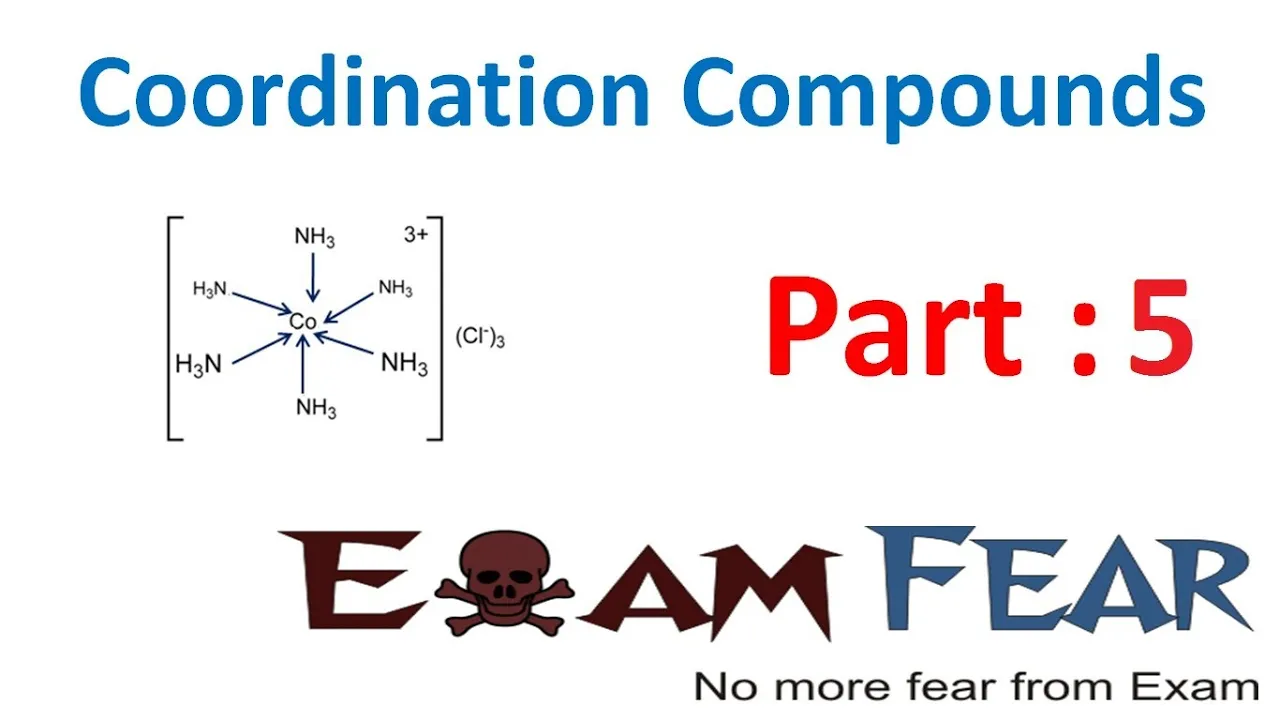
- Why this video: Understanding the behavior of coordination complexes depends heavily on the type of ligand coordinated to the metal. This video provides a clear taxonomy of ligands based on their denticity and highlights the thermodynamic "chelate effect."
- Knowledge Checkpoint:
- Distinguish between monodentate, bidentate, and polydentate ligands with clear structural examples (e.g., ethylenediamine vs. EDTA).
- Explain why chelating ligands form significantly more stable complexes than their monodentate counterparts.
- Identify ambidentate ligands and describe how they bind to a metal ion.
Video 3: 21.2 Naming Complex Ions and Coordination Compounds | General Chemistry
- Why this video: This step-by-step tutorial demystifies IUPAC nomenclature rules for coordination compounds, highlighting prefixes, ligand naming conventions, and when to use modified metal suffixes (e.g., ferrate, cuprate).
- Knowledge Checkpoint:
- Name coordination compounds systematically when given a chemical formula, ensuring the cation is named before the anion.
- Correctly translate a complex IUPAC name back into its accurate molecular formula.
- Apply specific naming rules for anionic ligands (ending in -o) and neutral ligands (using specific terms like aqua, ammine, and carbonyl).
Video 4: Isomerism in Coordination Compounds
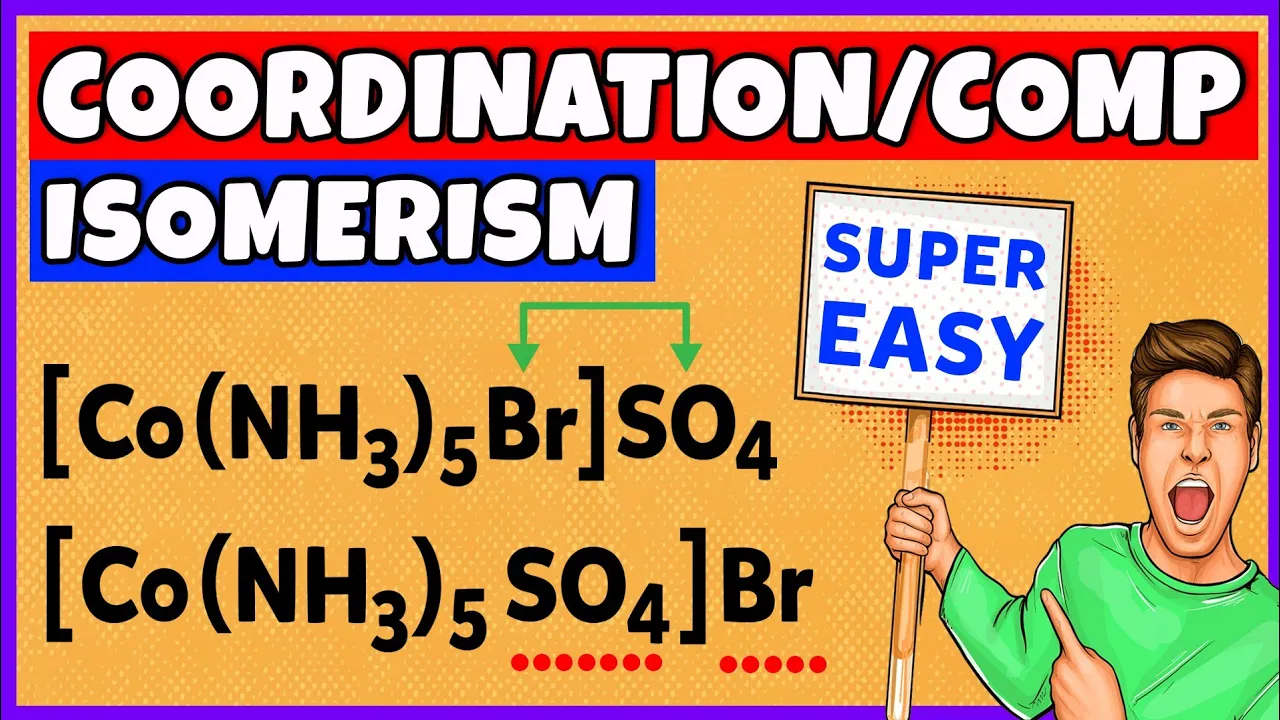
- Why this video: Isomerism determines the physical and biochemical properties of complexes. This tutorial covers structural isomers (ionization, solvate, linkage, and coordination isomerism) alongside stereoisomers (geometric cis/trans and optical isomers).
- Knowledge Checkpoint:
- Identify and differentiate linkage, ionization, and hydrate isomers.
- Draw cis and trans geometric isomers for square planar and octahedral complexes.
- Explain why tetrahedral complexes do not exhibit geometric (cis/trans) isomerism.
- Sketch non-superimposable mirror images (enantiomers) for chiral octahedral complexes such as .
Module 2: Crystal Field Theory (CFT), Geometry, and Jahn-Teller Distortion
This module covers Crystal Field Theory (CFT). By treating ligands as negative point charges, CFT explains how electrostatic repulsions lift the degeneracy of d-orbitals. You will learn about splitting patterns in octahedral, tetrahedral, and square planar fields, calculate Crystal Field Stabilization Energy (CFSE), and explore the Jahn-Teller effect, which causes structural distortions in certain degenerate electronic configurations.
Recommended Videos
Video 1: Crystal Field Theory: Octahedral, Tetrahedral, & Square Planar Complexes
- Why this video: This video provides a comprehensive visual guide to d-orbital splitting patterns across the three main coordination geometries (octahedral, tetrahedral, and square planar), showing how orbital orientation relative to incoming ligands dictates energy levels.
- Knowledge Checkpoint:
- Sketch the d-orbital splitting diagram for an octahedral field, labeling the lower-energy set () and the higher-energy set ().
- Explain why tetrahedral splitting () is inverted relative to octahedral splitting () and why its magnitude is significantly smaller ().
- Draw the splitting pattern of a square planar complex and explain why the orbital lies at the highest energy level.
Video 2: Calculation of CFSE in Octahedral complexes
- Why this video: This is a clear, math-focused walkthrough of how to calculate Crystal Field Stabilization Energy (CFSE). It demonstrates how to determine whether an electron configuration yields a net stabilization.
- Knowledge Checkpoint:
- State the stabilization energy value for an electron in a orbital () and the destabilization energy value for an electron in an orbital ().
- Calculate the total CFSE (including pairing energy, , if applicable) for both high-spin and low-spin and octahedral configurations.
- Define the conditions under which a complex is stabilized by crystal field effects.
Video 3: Jahn-Teller Effect
- Why this video: This advanced lecture explains why certain non-linear complexes undergo spontaneous geometric distortion to lift electronic degeneracy. It focuses on the Jahn-Teller effect in octahedral complexes, which leads to axial elongation or compression.
- Knowledge Checkpoint:
- State the Jahn-Teller theorem and explain how structural distortion reduces a molecule's overall ground-state energy.
- Identify which d-electron configurations in octahedral complexes show strong ( degenerate, e.g., high-spin , low-spin , ) vs. weak ( degenerate, e.g., ) Jahn-Teller distortions.
- Describe the structural changes in an octahedron during z-out axial elongation and how this alters the energy levels of versus .
Module 3: Magnetic Behavior and Spin States
In this module, you will learn how the magnitude of crystal field splitting () relative to electron pairing energy () determines spin states. You will study the spectrochemical series, calculate spin-only magnetic moments, and examine orbital contributions and spin-orbital coupling in complexes.
Recommended Videos
Video 1: Magnetic Properties of Transition Metal Complexes | OpenStax Chemistry 2e 19.3

- Why this video: This video introduces the physical basis of magnetochemistry in coordination complexes. It explains how high-spin and low-spin states arise and why tetrahedral complexes are almost exclusively high-spin.
- Knowledge Checkpoint:
- Explain how a weak-field ligand (low ) leads to a high-spin complex, whereas a strong-field ligand (high ) leads to a low-spin complex.
- Contrast paramagnetic and diamagnetic electronic states based on orbital occupancy.
- Explain why tetrahedral complexes are generally high-spin even when coordinated to strong-field ligands.
Video 2: How To Calculate Magnetic Moment | Spin only Magnetic Moment

- Why this video: This tutorial demonstrates how to determine the spin-only magnetic moment () of a transition metal complex using the number of unpaired d-electrons.
- Knowledge Checkpoint:
- State and apply the spin-only magnetic moment formula: , where is the number of unpaired electrons.
- Calculate the expected magnetic moment in Bohr Magnetons (B.M.) for transition metal ions with 1, 2, 3, 4, or 5 unpaired electrons.
- Relate the experimentally measured magnetic moment of a complex back to its coordination geometry and spin state.
Video 3: Magnetic Properties of transition elements (spin & orbital contribution)
- Why this video: This video explores exceptions to the spin-only formula. It explains when and how orbital angular momentum contributes to the overall magnetic moment, as well as the role of spin-orbital coupling.
- Knowledge Checkpoint:
- Identify the conditions under which the orbital contribution to the magnetic moment is quenched (i.e., when no degenerate orbitals can be interconverted via rotation).
- Differentiate between the spin-only magnetic moment and the effective magnetic moment () that includes orbital contributions.
- Explain why configurations like or may exhibit an orbital magnetic contribution, whereas configurations like do not.
Module 4: Color, Spectroscopy, and Selection Rules
This module explores the origin of color in transition metal complexes. You will study how electronic transitions between split d-orbitals absorb specific wavelengths of light, and how these transitions are governed by quantum mechanical selection rules. You will also learn to read basic electronic spectra using Orgel diagrams.
Recommended Videos
Video 1: WHY TRANSITION METAL COMPLEXES ARE COLOURED?

- Why this video: This video explains how coordination complexes absorb visible light. It details how incoming photons trigger d-d transitions and how the complementary color of the absorbed wavelength is reflected or transmitted.
- Knowledge Checkpoint:
- Explain the relationship between the absorbed wavelength () and the energy gap () using the Planck-Einstein relation: .
- Use a color wheel to predict the color of a complex given its absorption maximum, or vice versa.
- Explain why complexes with filled or empty configurations (e.g., , ) are typically colorless.
Video 2: d-d Transitions in Coordination Chemistry | CFT & Selection Rules
- Why this video: This detailed academic lecture explains the quantum mechanical selection rules that govern the probability—and therefore the intensity—of electronic transitions.
- Knowledge Checkpoint:
- State and apply the Laporte selection rule (explaining why transitions between orbitals of the same parity, such as d-to-d transitions, are formally forbidden in centrosymmetric environments).
- Explain how vibronic coupling (the mixing of vibrational and electronic states) and the lack of a center of inversion (as in tetrahedral complexes) relax the Laporte rule.
- State and apply the Spin selection rule (explaining why transitions involving a change in the number of unpaired electrons are spin-forbidden).
Video 3: Orgel Diagram - How to use them [Easiest Explanation]
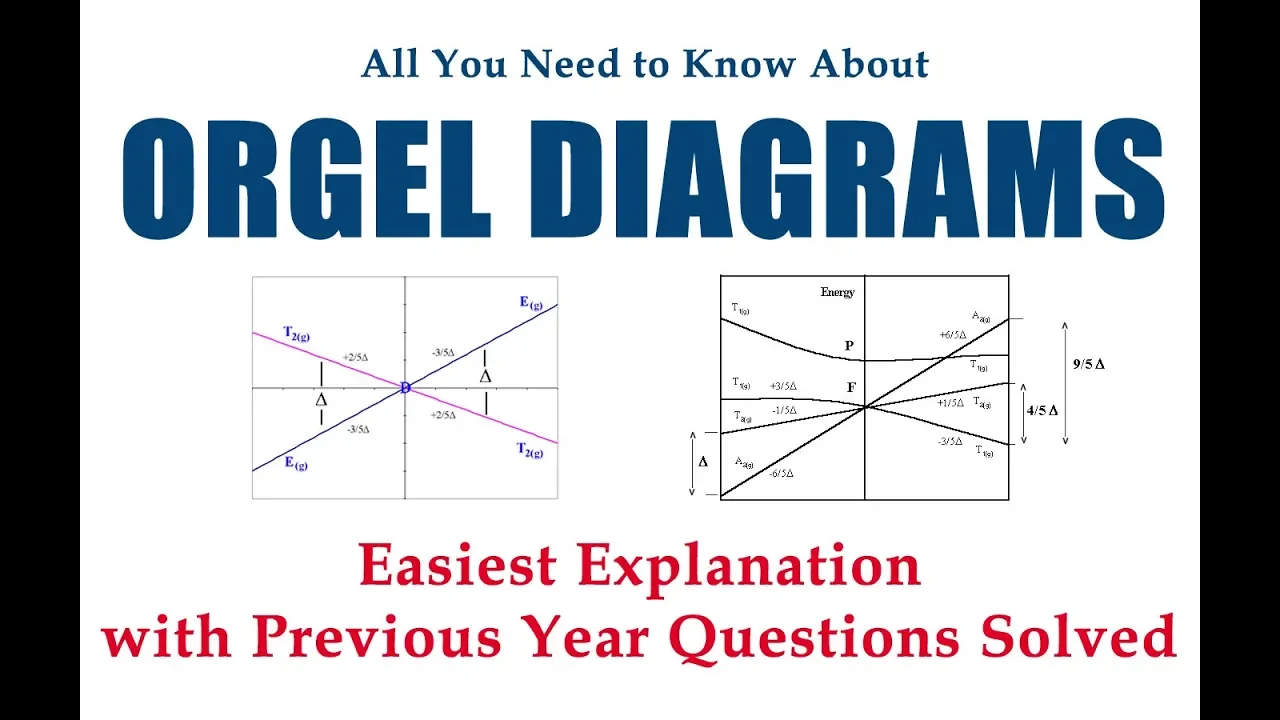
- Why this video: Electronic spectra of d-complexes involve multiple microstates and terms. This video explains how to read and use Orgel diagrams to predict and interpret electronic absorption transitions for high-spin octahedral and tetrahedral complexes.
- Knowledge Checkpoint:
- Differentiate between a free-ion term symbol (e.g., ) and its split states in a crystal field (e.g., ).
- Use an Orgel diagram to identify the spin-allowed d-d transitions for and high-spin complexes.
- Explain why Orgel diagrams are only used for high-spin complexes and how they differ from Tanabe-Sugano diagrams.
Module 5: Ligand Field Theory, Metal-Ligand Backbonding, and the 18-Electron Rule
This module transitions from electrostatic models to molecular orbital theory through Ligand Field Theory (LFT). You will learn how metal d-orbitals mix with ligand - and -orbitals, investigate synergic backbonding in metal carbonyl complexes, and master the 18-electron rule to predict the stability of organometallic and coordination complexes.
Recommended Videos
Video 1: Ligand Field Theory
- Why this video: This advanced lecture introduces Ligand Field Theory, which blends Crystal Field Theory with Molecular Orbital (MO) theory to describe bonding in transition metal complexes.
- Knowledge Checkpoint:
- Explain why CFT's electrostatic point-charge assumption is insufficient, and how LFT addresses its limitations.
- Construct a basic MO diagram for an octahedral complex showing -bonding interactions.
- Explain how ligand -donation decreases (acting as weak-field ligands), while ligand -acceptor behavior increases (acting as strong-field ligands).
Video 2: Back bonding in transition metal complexes
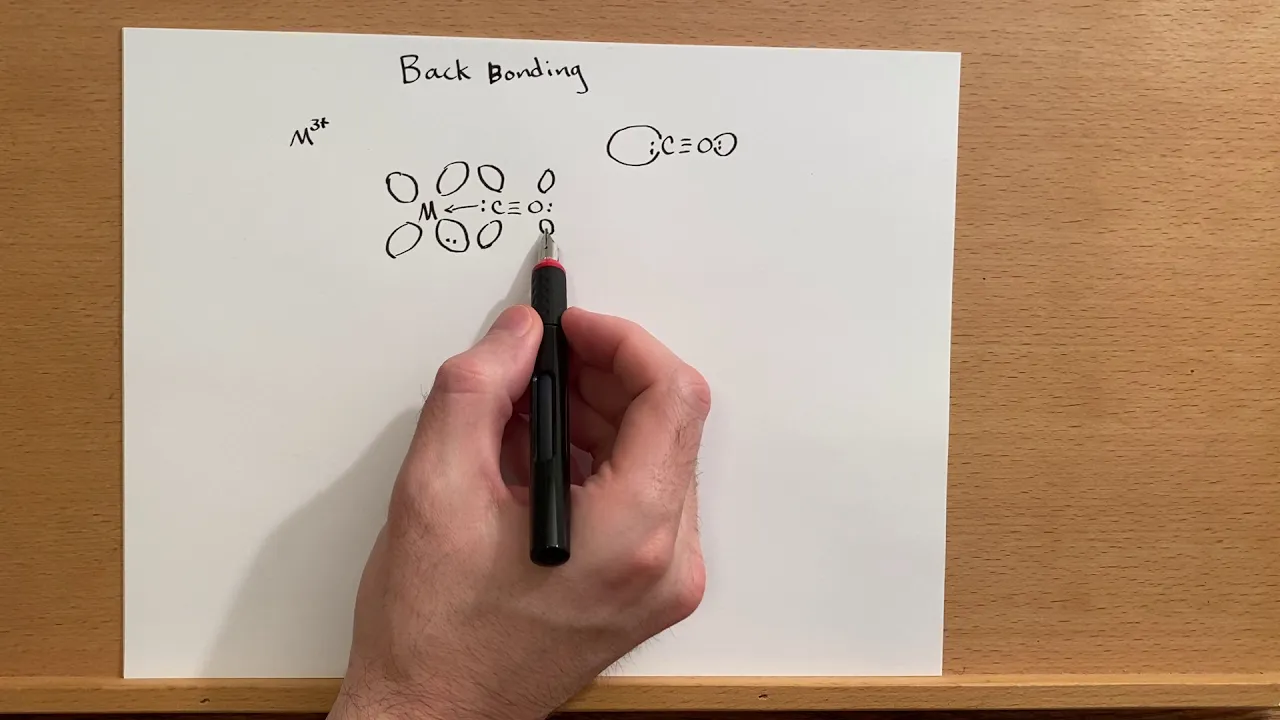
- Why this video: This video focuses on metal-carbonyl complexes and explains synergic bonding. It details how simultaneous -donation and -backdonation strengthen the metal-ligand bond while weakening the ligand's internal bond.
- Knowledge Checkpoint:
- Draw a diagram showing synergic bonding, illustrating -donation from the carbonyl carbon's lone pair into a vacant metal orbital, and -backdonation from a filled metal d-orbital into the vacant antibonding orbital of .
- Explain how backbonding affects the bond length and its vibrational stretching frequency () in infrared (IR) spectroscopy.
- Predict which complex will have a lower frequency based on the metal center's oxidation state and electron density (e.g., vs. ).
Video 3: The 18 Electron Rule for Transition Metal Complexes
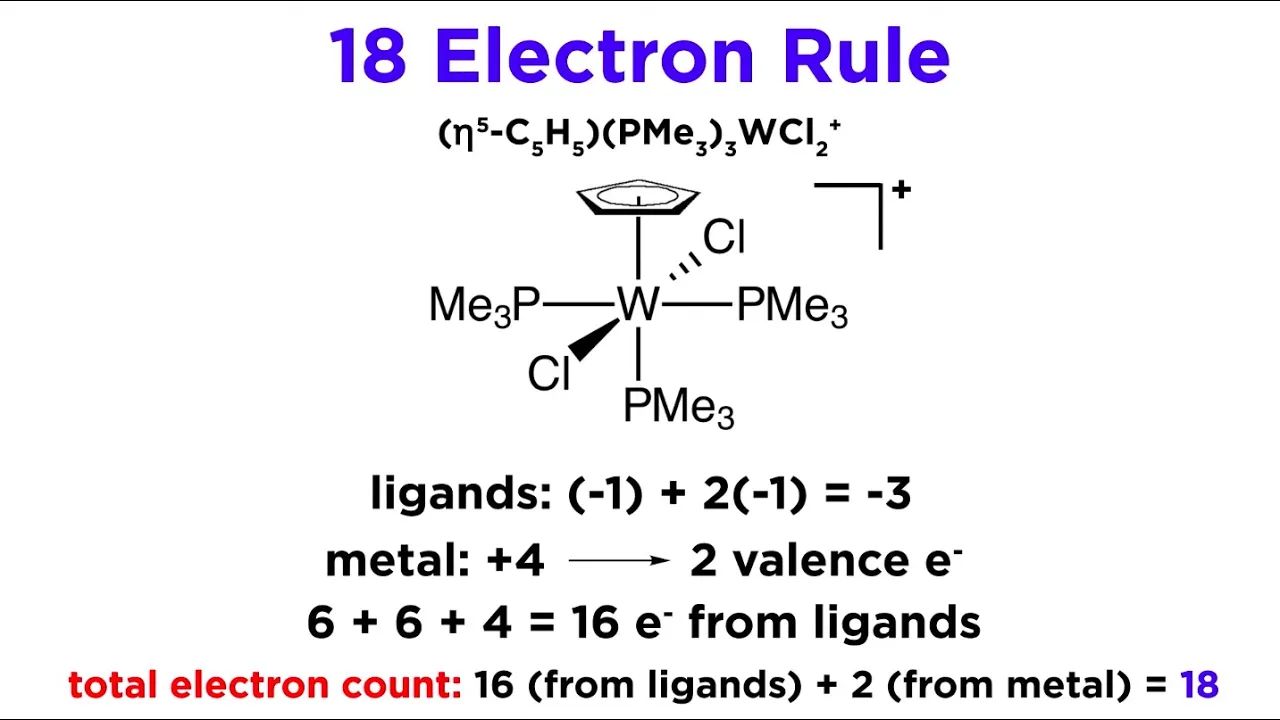
- Why this video: This video explains how to apply the 18-electron rule, which is the transition-metal equivalent of the main-group octet rule. It is a key tool for predicting the stability of organometallic complexes.
- Knowledge Checkpoint:
- Differentiate between the Neutral Atom method (covalent method) and the Ionic method for counting valence electrons in coordination complexes.
- Count total valence electrons for complexes like , , and ferrocene.
- Use the 18-electron rule to predict whether a organometallic complex is likely to be stable, or if it will undergo reaction to gain or lose ligands.
Key People Index
- Alfred Werner (1866–1919): Swiss chemist who proposed the octahedral structure of transition metal complexes. He won the Nobel Prize in Chemistry in 1913 for establishing the concepts of primary (oxidation state) and secondary (coordination number) valencies.
- Hans Bethe (1906–2005) & John Hasbrouck Van Vleck (1899–1980): Developed Crystal Field Theory (Bethe, 1929) and later modified it into Ligand Field Theory (Van Vleck, 1930s), integrating quantum mechanical models of electrostatic repulsion and covalent orbital mixing.
- Hermann Arthur Jahn (1907–1979) & Edward Teller (1908–2003): Formulated the Jahn-Teller Theorem in 1937. This theorem mathematically proves that non-linear degenerate systems must distort structurally to lift their degeneracy and minimize ground-state energy.
- Leslie Orgel (1927–2007): British chemist who introduced Orgel diagrams, which simplified the application of ligand field theory to the electronic spectra of transition metal complexes.
Final Self-Assessment
To verify your mastery of coordination chemistry, ensure you can confidently complete each of the following tasks:
- Write the electronic configurations for any first-row transition metal atom and its common oxidation states, correctly removing s-electrons before d-electrons.
- Name coordination compounds according to IUPAC rules, and draw chemical structures from IUPAC names.
- Draw all possible structural and stereoisomers (geometric and optical) for a given coordination formula.
- Sketch the d-orbital splitting diagrams for octahedral, tetrahedral, and square planar geometries, labeling energy levels and orbital designations.
- Calculate the Crystal Field Stabilization Energy (CFSE) for any to complex in both octahedral and tetrahedral geometries.
- Predict whether a coordination complex is high-spin or low-spin based on its position in the spectrochemical series and its pairing energy.
- Calculate the spin-only magnetic moment () of any complex using its unpaired d-electron count, and explain any deviations due to orbital contributions.
- Determine whether an octahedral complex will undergo Jahn-Teller distortion based on its electronic configuration, and sketch the resulting split d-orbital diagram.
- Apply the Laporte and spin selection rules to predict whether an electronic transition is allowed or forbidden, and explain how these rules impact color intensity.
- Sketch a qualitative molecular orbital diagram for an octahedral complex with -donor and -acceptor ligands to illustrate Ligand Field Theory.
- Draw the synergic bonding mechanism of a metal-carbonyl complex and predict how changes in metal electron density shift the carbonyl infrared (IR) stretching frequency.
- Apply the 18-electron rule using both the neutral atom and ionic counting methods to evaluate the stability of any given organometallic complex.