






![Configuración electrónica 🧪 Química [CICLO FREE]](https://i.ytimg.com/vi/YokhyAS0B94/maxresdefault.jpg)















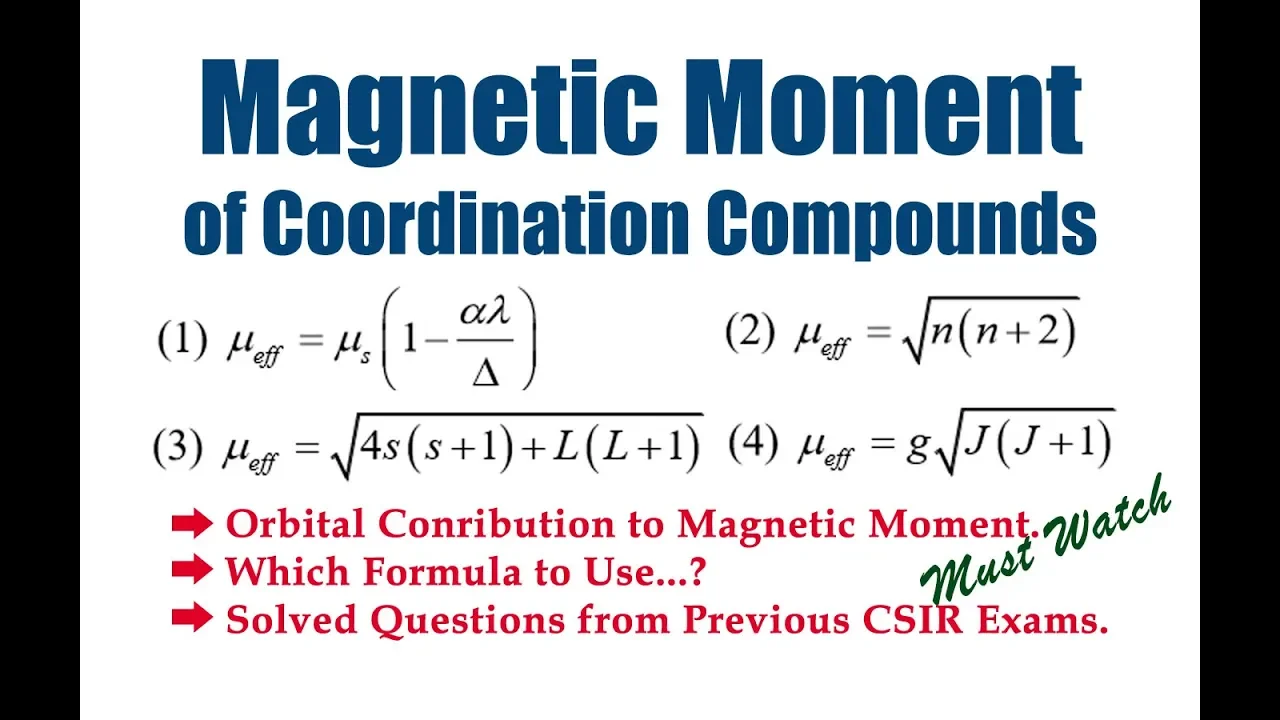








The spin only magnetic moment (μ) of a compound or ion is calculated using the formula μ = √[n(n+2)] Bohr magnetons, where n represents the number of unpaired electrons. To calculate: (1) determine the electronic configuration of the ion, (2) count the unpaired electrons (n), and (3) substitute into the formula. For example, Mn²⁺ (3d⁵) has n=5, giving μ = √35 ≈ 5.92 BM, while Fe²⁺ (3d⁶) has n=4, giving μ = √24 ≈ 4.92 BM. Common values to remember: n=1 gives 1.73 BM, n=2 gives 2.83 BM, n=3 gives 3.87 BM, n=4 gives 4.90 BM, and n=5 gives 5.92 BM.
How to Calculate Spin-Only Magnetic Moment | Chemistry
Added:Understanding the electronic configuration of transition metal elements (d-block) and how they form cations by losing outer-shell electrons first.
Familiarity with Hund's Rule of Maximum Multiplicity and the Aufbau Principle to correctly populate d-orbitals with electrons.
The ability to identify and count 'unpaired electrons' in a given orbital diagram.
Basic knowledge of magnetism, specifically the qualitative difference between paramagnetic (attracted to magnetic fields) and diamagnetic (repelled) substances.
Introduction to Crystal Field Theory (CFT) and how ligand field strength (spectrochemical series) influences high-spin versus low-spin electronic configurations.
Understanding deviations from the spin-only formula due to orbital angular momentum contribution (spin-orbit coupling).
Using experimental magnetic susceptibility measurements to deduce the coordination geometry (e.g., tetrahedral vs. square planar) of coordination compounds.
Exploring cooperative magnetic phenomena in solid-state chemistry, such as ferromagnetism, antiferromagnetism, and ferrimagnetism.
3.6K views70likes7:26Original Release: 2020-10-02
Hello everyone welcome to easy chemistry by provin. So today we are going to discuss about the topic is called as a spin only magnetic moment. How to calculate the magnetic moment. So here one formula is there. It help us to calculate the magnetic moment of any compound or element. So ions. So here formula is equal mu is equal<unk> of n n + 2 both magnet. So here mu is nothing but the magnetic moment. So n is equal number of unpaired electrons.
unpaired electron number of unpaired electron. First we have to calculate the n value. we can calculate then you can keep your n value in this formula you will get the bore magnet so here you can see mn + 2 so magnus atomic number is 25 so what is the magnetic moment so here electronic configuration if you see argon 3d5 forest but what they asking mn plus2 they are asking That means remove these two electron. So a r argon 3d five will be there. So how many unpair of electrons will be there? 1 2 3 4 5 and period of electrons will be there. So n value is equal 5. So just substitute the n value. mu is equal roo<unk> of 5. 5 + 2 bore magneton. So is equal roo<unk> of 35 will give the value of 5.9 b magneton will give the value. So now you can see f + 2 bore magneton of f +2 whose atomic number is iron atomic number is 26.
After first we have to write the electronic configuration. Whatever the ion is there plus two is there remove the two electron. Plus one is there remove one electron. Plus three is there remove the three electron. So electronic configuration are gone 3d6 4s.
So here f plus2 they are asking. So remove the two electrons the last. So how many electron will left? 3d is six.
So 1 2 3 4 5 6 1 2 3 4 four unpaired of electrons is there. So that means n value is equal four. So mu is equal roo<unk> of n + 2 magneton n value is how much? 4 4 + 2 is equal 24.
So is equal 4.92 bore magneton we will get.
So without using that formula also we can calculate the bore magnet many cases but we have to know the how many unpaired of electrons is present then only it is very easy. So for example if you see n is equal 1 number of unpaired of electron one number of unpaired electron 2 number of unpaired electron 3 number of unpaired electron four number of unpaired electron five. So what will be the magnetic moment value? So whatever the unpaired of electrons is there first write the values 1 2 3 4 5 just to keep the point first write 1.73 1.73 this means number of unpaired of electrons one whose magnetic moment both magnetic how much 1.73 magnetic moment so we know magnetic moment so 283 387 7 4.9 5.92 magnetic moment you will get by using this formula you can easily calculate easily get the magnetic moment of it is very easy first write the unpair of electron how many so same first keep the point just remember this one 173 just next 73 next value is 83 so 83 87 4.9 5.9 92 easily you can remember. So see the one questions among the following which ion has a magnetic momentum similarly magnetic momentum value is equal 2.83.
So now what we have to do is first of all find out the how many unpaired of electrons is present in the given ion.
If the given ion containing the two unpaired of electron automatically it is having the mag only board magnetic moment is equal 2.83. So first write the electronic configuration they have given the atomic numbers also they have given.
So first titanium. So titanium electronic configurations first we have to write the electronic configuration then only it's very easy. So ara.
So 3d2 4 s2 3d8 4 s2 3d 7 4 s2 3d 5 4 s this is electronic configuration original electronic configuration what they're asking CR +2 CR +2 that means removing of two electrons so automatically electronic configuration will be become 3d 4. So CO + 2. So electronic configuration will become 3d7. Na + 2 3d8 ten + 3. So 3d1 3d1 in the sense here it is having one unpaired of electrons. 3d4 in the sense it is having the four unpaired of electron. These two answers are not correct. Only 3d8 or 3d7. Now we have cover the unpaired of electron. So 3D 8.
So 1 2 3 4 5 6 7 8. It is having the two one pair of electrons. Na + 2. Let us check here also.
So 1 2 3 4 5 6 7 3 unpair of electron.
It is having the three unperiod of electrons. So it is having the two unpair of electrons. So both magnetic moment is equal 2.83.
So answer is the N9 + 2.
Up Next
21:06
Magnetic Properties of Transition Metals: Spin & Orbital Contribution
@PriyankaJainchemistry
119K views•2017-10-14

83:56
Biocatalysis and Catalysis in Islatravir Synthesis | Merck Webinar
@SCIwheresciencemeetsbusiness
675 views•2020-10-08
10:06
1H NMR: Determining Number of Peaks from Structure
@MSJChem
59.2K views•2017-04-06

17:31
Edible Water Bottles: A DIY Guide to Sodium Alginate Spherification
@ryan
10.5M views•2019-06-21
Related Study Plans & Knowledge Roadmaps
Structured learning paths in Chemistry
chemistry
Nuclear Chemistry: Decay, Meds & Fuel Cycle
01Introduction to Nuclear Structure and Radioactivity
02Decay Dynamics and Kinetics
03Radiation Interaction and Detection
+ 2 more learning modules
24h5 modules
Explore Roadmap
chemistry
Supramolecular Chemistry: Forces & Machines
01Foundations of Chemical Bonding and Intermolecular Forces
02Introduction to Host-Guest Chemistry
03Thermodynamics and Dynamics of Self-Assembly
+ 2 more learning modules
16h5 modules
Explore Roadmap
chemistry
Photochemistry: Excited States & Reactions
01Foundations of Light-Matter Interactions
02Molecular Orbitals and Electronic States
03Photophysical Processes and Jablonski Diagrams
+ 2 more learning modules
18h5 modules
Explore Roadmap
chemistry
Coordination Chemistry: Bonding & Properties
01Introduction to Transition Metals and Ligands
02Crystal Field Theory (CFT) and Geometry
03Magnetic Behavior and Spin States
+ 2 more learning modules
14h5 modules
Explore Roadmap