












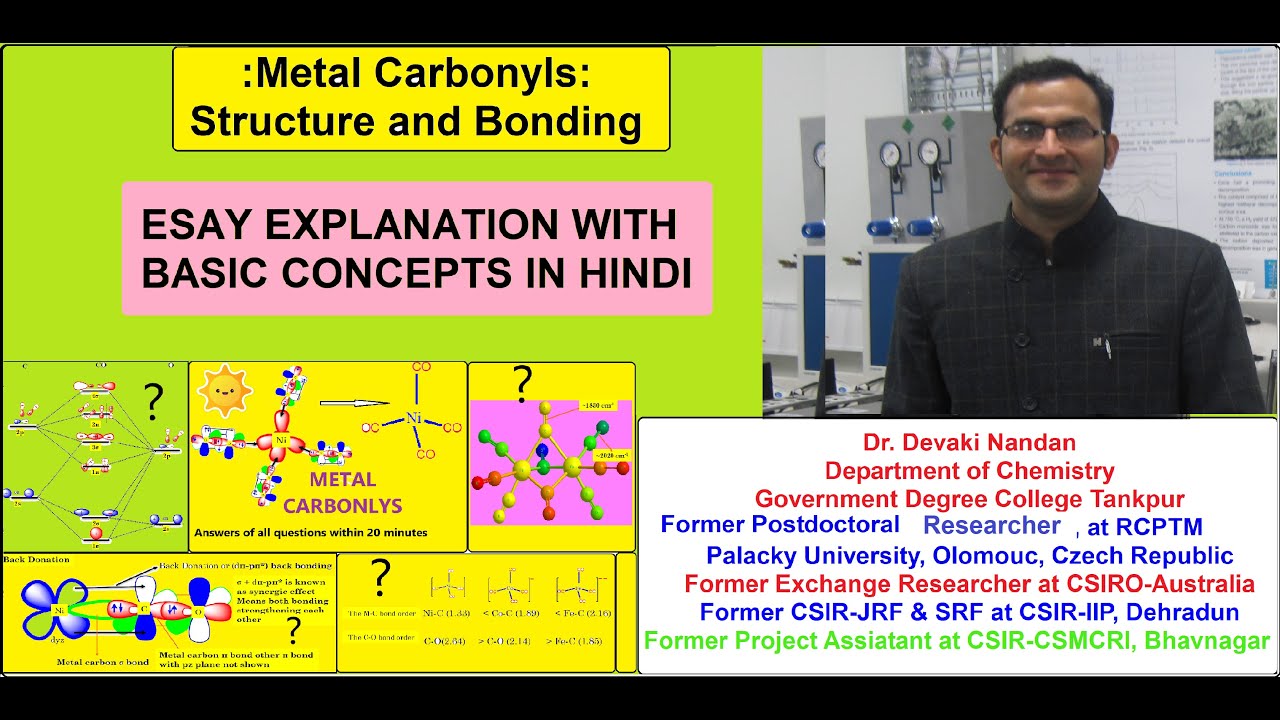









Back bonding in transition metal complexes occurs when a ligand like carbon monoxide donates electrons to the metal through sigma donation and simultaneously accepts electrons from the metal's d-orbitals into its pi anti-bonding orbital, which stabilizes the metal's t2g orbitals while destabilizing the eg orbitals, thereby increasing the crystal field splitting energy (Δ_octahedral) and affecting the complex's electronic properties, spin state, and reactivity.
Back Bonding in Transition Metal Complexes Explained
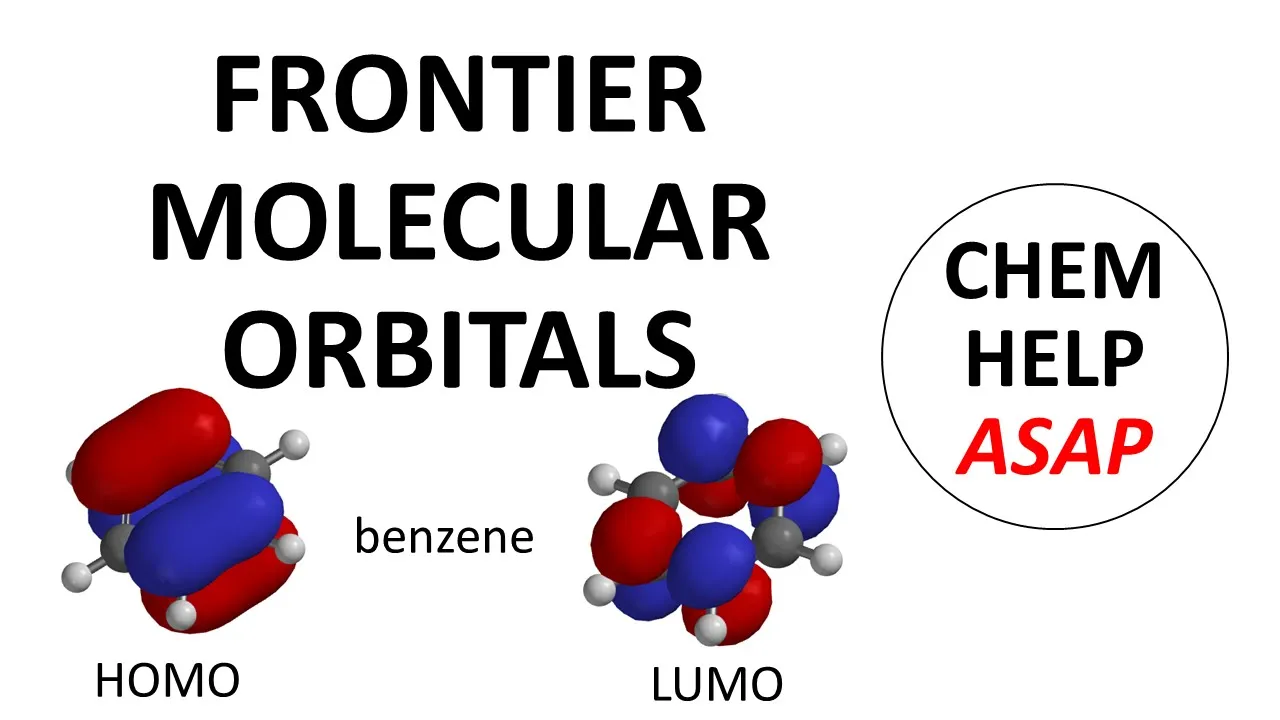
Added:Basic Molecular Orbital (MO) Theory, specifically the frontier orbitals (HOMO and LUMO) of diatomic molecules like carbon monoxide.
Crystal Field Theory (CFT) and Ligand Field Theory (LFT), including d-orbital splitting in coordination complexes.
The concept of coordinate covalent bonding, particularly sigma-donation from a ligand's lone pair to a metal d-orbital.
Transition metal electron configurations and the determination of metal oxidation states and d-electron counts.
Infrared (IR) Spectroscopy of metal carbonyls to analyze how back-bonding affects C-O bond strength and stretching frequencies.
The Dewar-Chatt-Duncanson model, which extends the concept of pi back-bonding to alkene and alkyne complexes.
The 18-Electron Rule and its use in predicting the stability and reactivity of organometallic compounds.
Homogeneous industrial catalysis (e.g., the Monsanto process or hydroformylation) where pi-acceptor ligands play a critical role.
25K views502likes10:29Original Release: 2020-06-09
you know in a previous video I mentioned how carbon monoxide is one of those very high field ligands it likes to really donate electrons back to the metal and it has the capability of accepting electrons into its PI anti-bonding orbital and so I've drawn up the lewis structure for carbon monoxide and you'll notice here that carbon actually has a formal charge of minus 1 an oxygen has a formal charge of plus 1 well does that actually happen or should we have a better drawing using molecular orbital theory well maybe let's not go in that deep to this but let's recognize that the oxygen is going to be holding the electrons that it has a much tighter than the carbon will and so this Sigma orbital right here this orbital will be much larger this lone pair not gonna be held as tightly so this is gonna be a much larger orbital than on the oxygen side oxygen is electronegative it's going to be holding its electrons a lot tighter well what does that have to do with bonding to metals well metal orbitals are kind of large they're a bigger shell and so in order to match up the size well it's going to bond to the carbon and this was initially surprising to people because we have a positively charged object right here sometimes even three plus and you would look at this molecule you say well the oxygen is the negative side of this molecule that one's electronegative this side is negative this thing is positive we would expect that the oxygen would bond to the middle well it just so happens that Carbon over here has kind of it has an octet right but it has a little bit more electrons around it than it might like and so it's just a little easier for this to give away electrons and again the size of the orbital matches up a little bit better with the metal so in the first case this Sigma orbital right here is going to give its electrons to the metal and I'll draw that right here and I'm going to use an arrow to indicate that both electrons are being donated to the metal you know this is a very strong donation and it's going to push up the EG orbital to a higher energy level and that will cause a higher field or eventually lead to lower spin because the orbitals are further apart and then there's less chance of the electrons being paired or unpaired now that's not all of the story and that's not at all explaining the title of this video back bonding well the metal has orbitals of its own like this here's one of the D orbitals and that will have electron density in it there's some electrons in here well maybe they're not both in the same word only some might be up there too in any case remember there's metal orbitals and they do look like this now one thing that we didn't focus as much on when we drew Lewis structures and drew the PI orbitals might be the shape of the ant type Dean orbital on the carbon monoxide so I'm gonna draw that for you I'm trying to draw the oxygen orbitals a little smaller than the carbon ones simply because that's the truth the oxygen holds its electrons a little tighter now normally this orbital is empty but when we have the metal bonding with carbon monoxide electrons like to spread out as much as they can and these electrons here notice that there's a empty orbital the PI anti-bonding orbital now these are anti-bonding because this is a different phase so if you recall we would shade in some orbital here and we'd shade in that orbital there well these are also phased and we could have kind of like that kind of picture well you can notice that the phase of these two orbitals matches up and the phase of those match up so they can interact with each other and this is why it's anti-bonding over here because the phase does not match in between these two in the bonding orbital these do match in phase and so there is an interaction between these two but in the antibody these are opposite phases of each other and they combine in a destructive manner well what happens here is these electrons can donate back into this anti-bonding orbital because we have some Sigma donation coming in we have some PI back bonding here so Sigma is direct overlap and PI bounding is a side to side interaction in two locations right now what this does is it lowers the energy of these orbitals on the metal well these orbitals are the T 2g orbitals so what that does is instead of the eg being like this and the T 2g being like this if we have very strong Sigma donation that will push up the T 2g orbital and if we have pi back bonding that will stabilize the the T 2g orbital so pushes up the EG stabilizes the T 2g and the net effect of that is these have an increase in energy difference between them and since we're in an octahedral environment we call that the Delta octahedral energy right there and that's how back bonding works now you might say hmm that's interesting but since this is going into the anti-bonding orbital of the carbon monoxide won't that weaken the bond and that's true it will weaken the bond of the carbon monoxide and that's one of the things that we can measure you can use the infrared stretching frequency of the carbon oxygen bond to determine what the electronic character is on the metal so if the metal is say oxidized then it will have less electrons on it and less donation back to this orbital and so then this bond will be stronger and the frequency will be higher because stronger Springs vibrate quicker now conversely if instead of this metal being a three plus charge it would say a two plus charge that means there's more electrons on the metal and it has another electron in one of these D orbitals and again since these are the T 2g orbitals that are going to interact with the PI system here there will be electrons in there so we'll have more electrons being donated back to the carbon monoxide that will weaken this bond more and the stretching frequency will slow down because this is not a strong of a bond and you can have a wide variability in between there but this is one of the ways to probe how much electron density is on the metal and that can have far-reaching implications on how the metal will react because electrons are everything about chemistry chemistry is actually about the electrons and where they are so this is a convenient way of measuring them and this also helps us explain the wide variety of colors and the difference between these orbitals and the energy that we see and how many unpaired electrons all comes into play here and PI back bonding has a role again the Sigma donation here is pushing up the EG orbital
Up Next
10:45
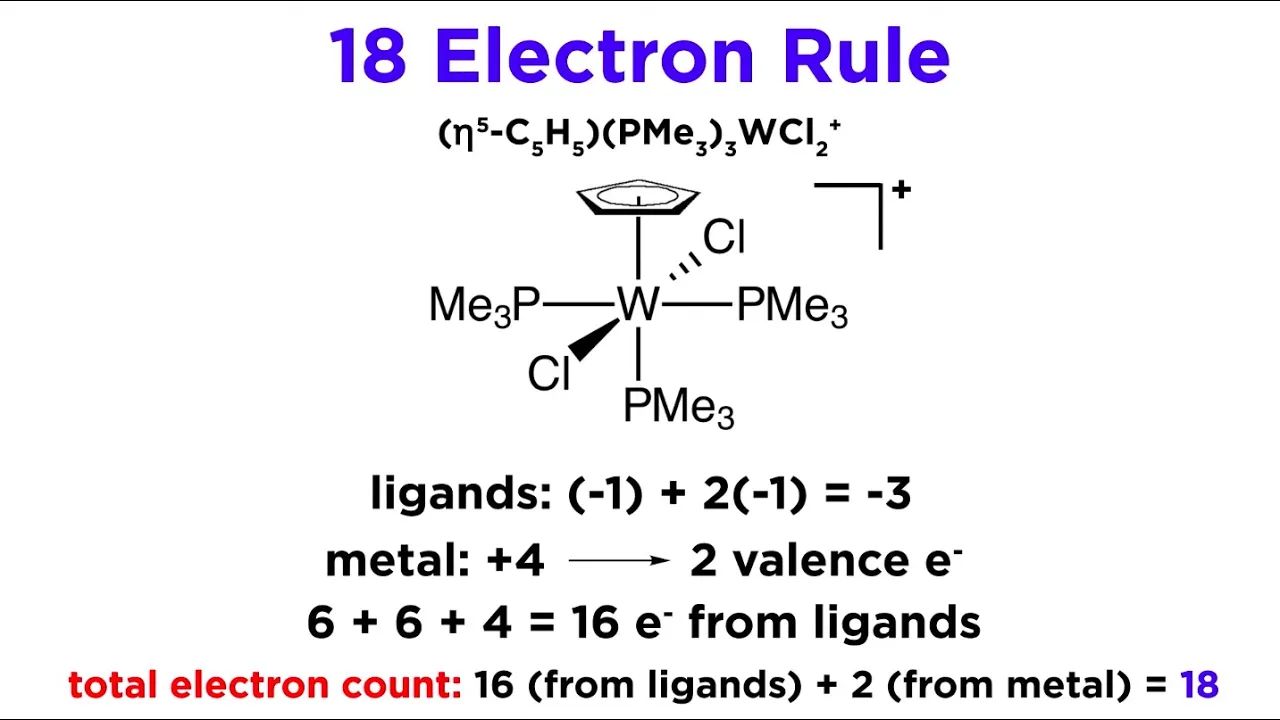
18 Electron Rule in Transition Metal Complexes | Stability & Electron Counting
@ProfessorDaveExplains
176.2K views•2022-09-28
83:56
Biocatalysis and Catalysis in Islatravir Synthesis | Merck Webinar
@SCIwheresciencemeetsbusiness
675 views•2020-10-08
10:06
1H NMR: Determining Number of Peaks from Structure
@MSJChem
59.2K views•2017-04-06

17:31
Edible Water Bottles: A DIY Guide to Sodium Alginate Spherification
@ryan
10.5M views•2019-06-21
Related Study Plans & Knowledge Roadmaps
Structured learning paths in Chemistry
chemistry
Nuclear Chemistry: Decay, Meds & Fuel Cycle
01Introduction to Nuclear Structure and Radioactivity
02Decay Dynamics and Kinetics
03Radiation Interaction and Detection
+ 2 more learning modules
24h5 modules
Explore Roadmap
chemistry
Supramolecular Chemistry: Forces & Machines
01Foundations of Chemical Bonding and Intermolecular Forces
02Introduction to Host-Guest Chemistry
03Thermodynamics and Dynamics of Self-Assembly
+ 2 more learning modules
16h5 modules
Explore Roadmap
chemistry
Photochemistry: Excited States & Reactions
01Foundations of Light-Matter Interactions
02Molecular Orbitals and Electronic States
03Photophysical Processes and Jablonski Diagrams
+ 2 more learning modules
18h5 modules
Explore Roadmap
chemistry
Coordination Chemistry: Bonding & Properties
01Introduction to Transition Metals and Ligands
02Crystal Field Theory (CFT) and Geometry
03Magnetic Behavior and Spin States
+ 2 more learning modules
14h5 modules
Explore Roadmap