



















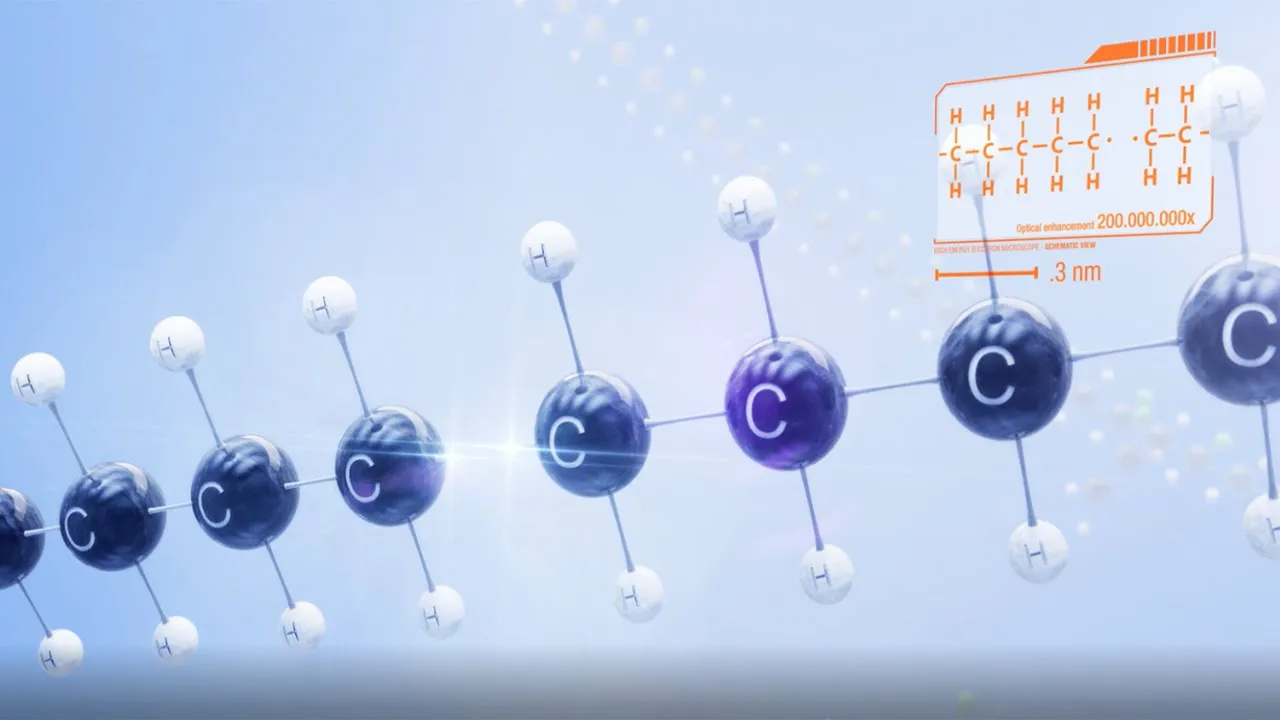


Free radical polymerization is a chain-growth polymerization process consisting of three key steps: initiation (creation of free radical active sites through homolytic cleavage of initiators like benzoyl peroxide or AIBN, or via redox reactions), propagation (sequential addition of monomers to growing chains with the same rate constant k_p), and termination (formation of inactive/dead polymers through either disproportionation termination or combination termination). The decomposition of the initiator is typically the rate-limiting step, while propagation is fast, and the relative influence of termination mechanisms depends on reaction conditions and can be controlled to tailor polymer properties.
Free Radical Polymerization: Initiation, Propagation, Termination
Added:Understanding of basic organic chemistry reaction mechanisms, particularly homolytic bond cleavage and the formation of reactive intermediates.
The definition and chemical behavior of free radicals, including factors that influence radical stability (e.g., resonance and hyperconjugation).
Fundamentals of macromolecular structure, including the distinction between monomers and polymers, and the nature of unsaturated carbon-carbon double bonds (alkenes).
Basic chemical kinetics, specifically how reaction rates, collision theory, and activation energy govern multi-step reaction pathways.
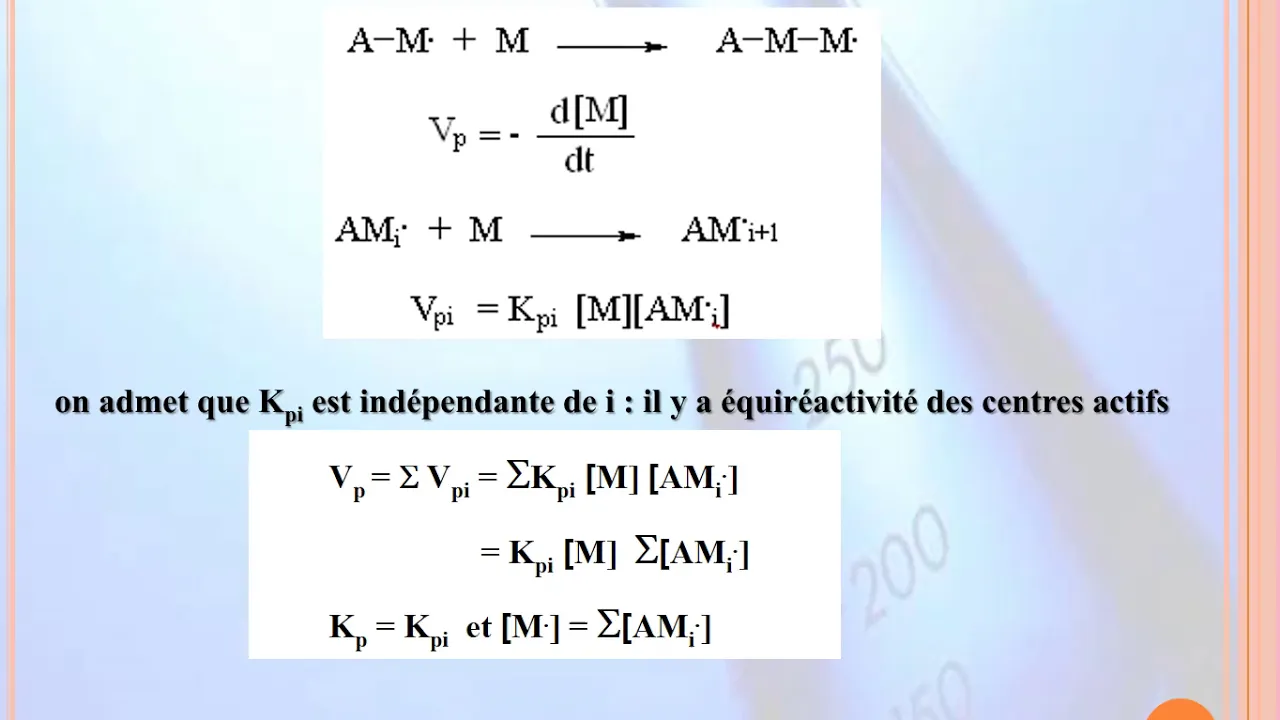
Kinetics of free radical polymerization, including the derivation of rate equations and applying the steady-state approximation to determine polymerization rates.
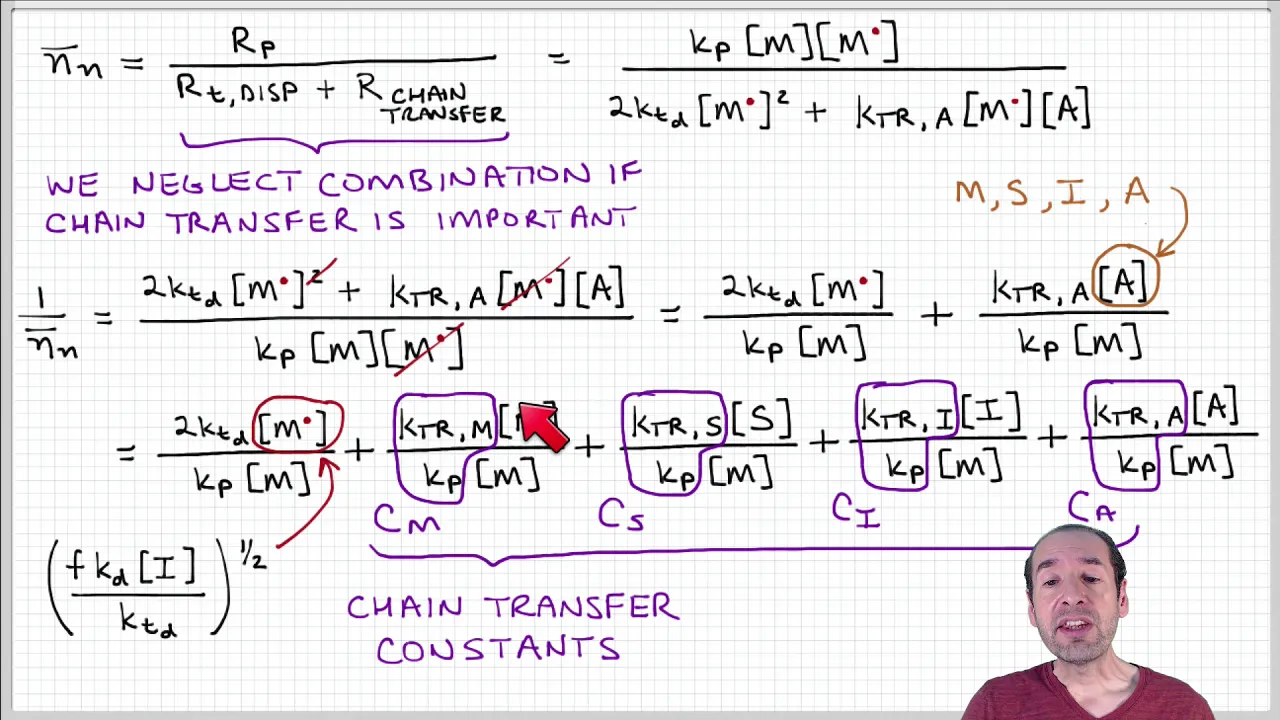
The phenomenon of chain transfer reactions and how chain transfer agents are used to control the molecular weight and branching of the resulting polymer.
Controlled/Living Radical Polymerization (CRP) techniques, such as ATRP, RAFT, and NMP, which allow for precise control over polymer architecture and molecular weight distribution.
A comparative study of alternative chain-growth mechanisms, specifically cationic and anionic polymerization.
Industrial scale synthesis and real-world applications of major commercial polymers produced via free radical pathways, such as low-density polyethylene (LDPE), polystyrene, and PVC.
28.9K views360likes6:36Original Release: 2020-02-19
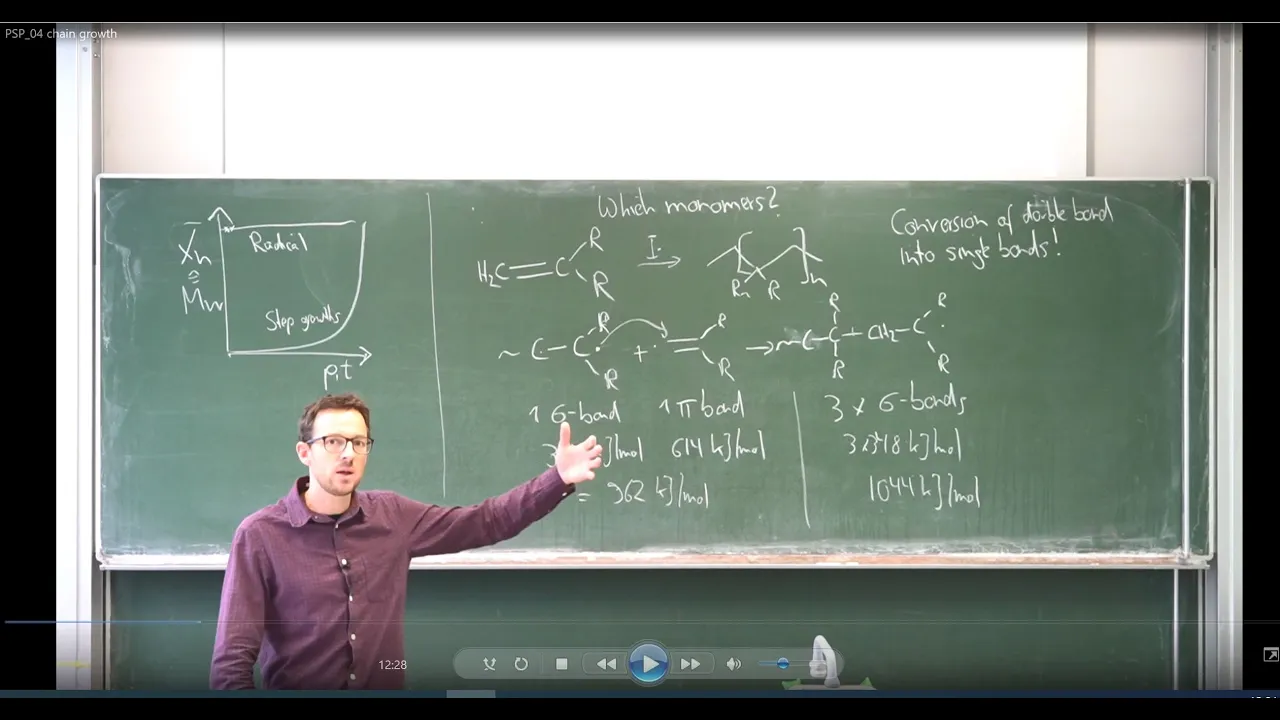
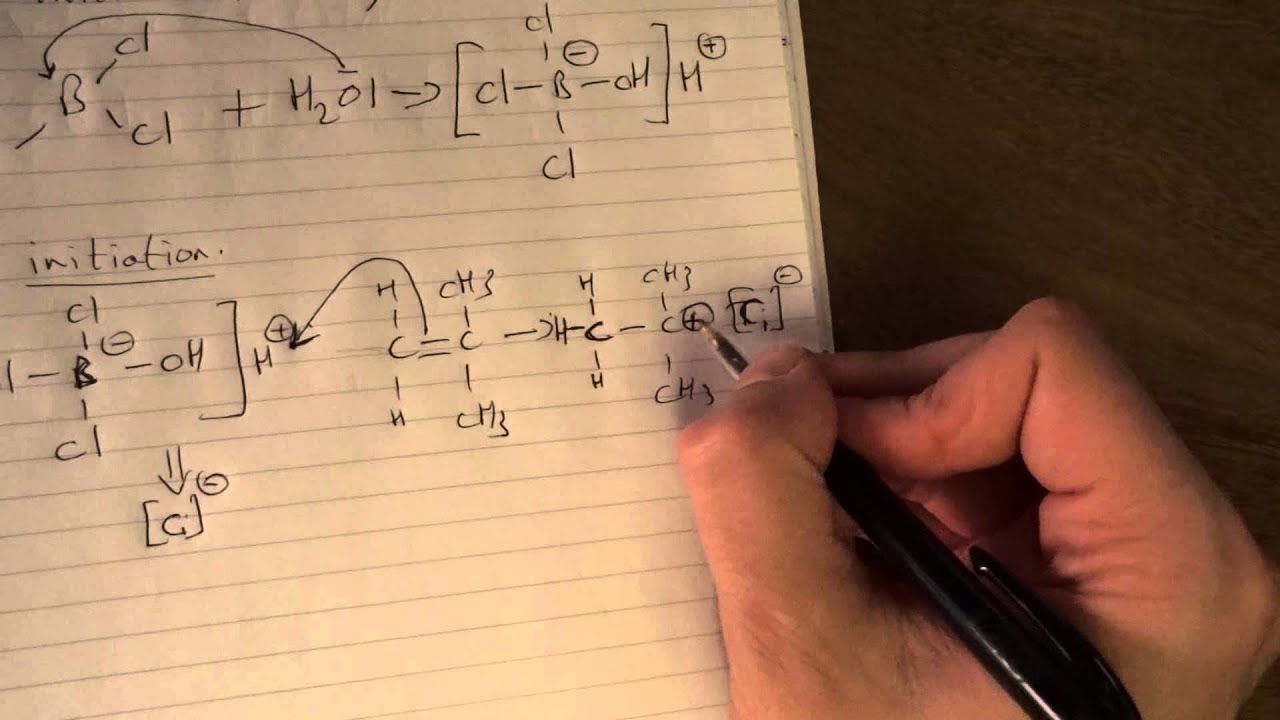
chain growth polymerization and a particular free radical polymerization which is the variation that we're focusing on here involves three key steps and those are initiation propagation and termination so I'm going to walk you through each of those three steps here in general and then we'll do a more detailed analysis a little bit later when we develop our kinetic model the first step is initiation and this deals with creation of this free radical active site which remember is the key to enabling addition of monomers sequentially at the end of the growing polymer chain and this occurs by cleavage of the chemical group in some kind of additive some kind of initiator additive to form a species that has a free radical active site so one example is a peroxide linkage in benzoyl peroxide for example this could be cleaved by heat by heating it up we're by exposing it to UV light to create this radical active site so remember a free radical it describes a site where there is an unpaired electron but unlike an ionic group it's not the molecule doesn't have a net charge because the total number of protons and electrons are equal but this is still a reactive site and it's the key to this polymerization process so here benzoyl peroxide this linkage is cleaved to form two benzyl oxy radicals another example of a chemical group cleavage process that can be used to form a rack free radical site is an azo linkage there's a double bond between two nitrogen atoms so for example azo bizz isobutyl nitrile or AIBN is a typical initiator another example of a typical initiator that forms again a chemical group that has this radical active site so these processes where a bond is broken to create this active site are called home Eliza's processes there's another class of processes that can be used to form these free radical active sites and these involve redox reactions now these aren't as common they're often used in situations where it's desirable to have the process take place at a lower temperature so for example this huemul hydro peroxide could experience an electron transfer reaction to produce a radical group and additional charge transferred to this iron atom which would generate this free radical active site okay so in terms of the kinetics associated with this process we can think about two steps decomposition of the initiator where we go from the initiator molecule to our radical species and then there's some rate constant associated with that and that occurs again typically as we're talking about homo lysis with the addition of heat or light to break those chemical bonds and then once this radical is formed then it's transferred to a monomer unit so generally this second step this transfer step is a fast or consider to be a fast process and so that leaves the decomposition of the initiator as the slow or rate limiting step in the reaction so generally when we're considering the kinetics we just consider the kinetics associated with the decomposition step as represented representing the initiation process because that's the rate limiting a part of the process the next step in rear addict apalla murres ation is propagation so this involves addition of monomers to growing chains once the radical group has been transferred to them so for example you could have a monomer that contains a single monomer that contains this radical active site that reacts with a second monomer to form a polymer that has two monomer units that's what I'm showing here similarly a polymer that's two monomer units with the active site then could add a monomer and form an active chain that has three monomer units you could imagine that this could happen for polymer chain of length I arbitrary length that's active adds another monomer unit and forms an active chain with length I plus one so all these processes are assumed to take place with the same rate constant which I'm denoting case of P for propagation notice that when this radical site is transferred to the end of the active chain this chain is still able to continue to react and add subsequent monitor so monomer so these are called active chains or growing chains or living chains I'm going to call them active chains termination is the third step in the process so this deals with transfer of the radical away from the growing or active chain to form inactive polymers or what we call dead polymer and this can happen in two different ways so one way is that each active chain experiences a transfer of the radical away so that it becomes inactive or dead so for example you have two chains that are growing their radicals are transferred away so now you have two dead chains this is called disproportionation termination so you have each growing chain then forms a dead polymer chain another way that this radical group can be transferred away is by combination of two growing chains together this is called combination termination so here a chain of length I that's active and an active chain of length J join together or combine and lose their radical group to form a chain a dead chain of length I plus J both of these mechanisms can take place but the relative influence of each of these processes depends on the you know conditions the stoichiometry the chemistry and as you might imagine that's an important thing that one would want to control if one wants to tailor the properties of the polymer that's being produced
Up Next

26:18
Polymers Explained: Radical, Cationic & Anionic Polymerization
@TheOrganicChemistryTutor
258.5K views•2022-08-07
83:56
Biocatalysis and Catalysis in Islatravir Synthesis | Merck Webinar
@SCIwheresciencemeetsbusiness
675 views•2020-10-08
10:06
1H NMR: Determining Number of Peaks from Structure
@MSJChem
59.2K views•2017-04-06

17:31
Edible Water Bottles: A DIY Guide to Sodium Alginate Spherification
@ryan
10.5M views•2019-06-21
Related Study Plans & Knowledge Roadmaps
Structured learning paths in Chemistry
chemistry
Nuclear Chemistry: Decay, Meds & Fuel Cycle
01Introduction to Nuclear Structure and Radioactivity
02Decay Dynamics and Kinetics
03Radiation Interaction and Detection
+ 2 more learning modules
24h5 modules
Explore Roadmap
chemistry
Supramolecular Chemistry: Forces & Machines
01Foundations of Chemical Bonding and Intermolecular Forces
02Introduction to Host-Guest Chemistry
03Thermodynamics and Dynamics of Self-Assembly
+ 2 more learning modules
16h5 modules
Explore Roadmap
chemistry
Photochemistry: Excited States & Reactions
01Foundations of Light-Matter Interactions
02Molecular Orbitals and Electronic States
03Photophysical Processes and Jablonski Diagrams
+ 2 more learning modules
18h5 modules
Explore Roadmap
chemistry
Coordination Chemistry: Bonding & Properties
01Introduction to Transition Metals and Ligands
02Crystal Field Theory (CFT) and Geometry
03Magnetic Behavior and Spin States
+ 2 more learning modules
14h5 modules
Explore Roadmap