





![Trening przed maturą podstawową z matematyki [ARKUSZ DO POBRANIA W OPISIE]](https://i.ytimg.com/vi/vEfnXYBs3dE/maxresdefault.jpg)



















![Euler's Method [IB Math AI HL]](https://i.ytimg.com/vi/jDZKlcGlFqQ/maxresdefault.jpg)


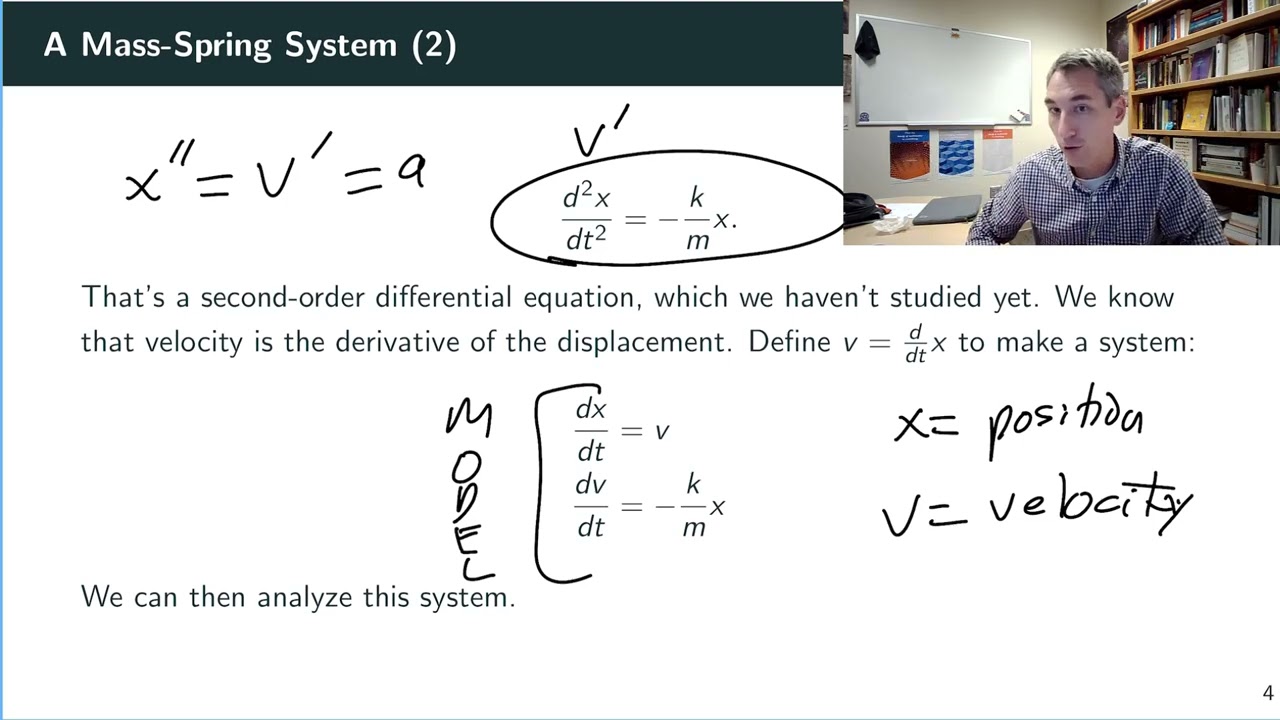
Radioactive decay follows the separable differential equation dM/dt = -kM, where M is the mass of the substance at time t and k is the decay constant; solving this equation yields M(t) = M₀e^(-kt), and the half-life T₁/₂ can be calculated using T₁/₂ = ln(2)/k, allowing prediction of remaining substance quantity at any time given initial conditions and decay parameters.
Radioactive Decay Model: Solving Differential Equations
Added:Basic integration and differentiation techniques, particularly involving exponential and natural logarithmic functions.
The conceptual definition of a derivative as representing a rate of change with respect to time.
Algebraic rules of exponents and logarithms, which are crucial for manipulating and solving equations.
A foundational understanding of nuclear decay concepts, such as what an isotope and a half-life are.
Real-world applications of exponential decay, such as carbon-14 dating in archaeology and managing radioactive tracer dosages in nuclear medicine.
Radioactive decay chains, which involve solving systems of coupled differential equations when a substance decays into another unstable isotope.
Other first-order differential equation models, such as Newton's Law of Cooling or logistic population growth.
Numerical approximation methods, like Euler's method, used when differential equations cannot be solved analytically.
483 views8likes22:50Original Release: 2020-05-17
it's four by three point two radio a 50k appreciations of separable tuitions so let's just look at the model for radioactive decay this problem behaved Alberta to of operation grow and consider a sample of matches that contains the Mays empty eternity it has seen decay into another isotope with popper sherry constant so then the different share equations repeat then this problem is DM DT equal to minus K M so decay here is refer to the UK in constant the M here is the maze of the material at panty and the T here is refer to the tab let's just look at a half-life so the half-life of a radioactive substance is the time required for one half of the atoms in an initial amount and not to dictate the means that your MT is equals one half of the end the longer the half-life of a substan the more stable it is let's look at the example one a radioactive substances integrates at a rate proportional to the amount present per milligram of this material reduced to 14 the gram in three weeks hi and expressions of the mouth present at any time T what is its half-life okay so first of all let's gather the information from the example 1 so what we have here is we have 100 milligram the one Horomia is the initial mates so means that you have the M the M 0 that is equal to 1 milligram and it's reduced to 4 the milligram in 3 weeks so means that your time it's actually tree so this is referred to your M tree okay the entry is actually 40 milligram now let's also get the questions so the questions are testify the expressions of the amount present at any time it's basically asked us to find the mathematic equations for this amount of radioactive substance at any time T and for a question B it asks us to the bigger the half line is actually asked us to figure out the time right the time is actually a question mark so when will be the Mase become half okay so the may set the time T will be half of T will be half of T initial so your initial is actually 100 gram so just our substitute here so you have 1 over to multiply we have a gram so this century give you 15 milligram once we have gather the informations for the example one master speaking it's a sample one by using differential equations okay so we're going to begin spy on using the planning of stuff preparations you could separate it if we have the black key and chickaletta with it and so you have to bring it to the left-hand side so you bring to the left-hand side we have 1 over m together with the p.m. okay and you have to bring the et to the right hand side just that is together with the k okay but then you have the right answer you will have minus minus K the okay so now okay this will the left-hand side and this about the right hand side okay now let us integrate both sided assistant degree beside it so the integral is 1 and integrate this one okay so if we integrate the left hand side so you have move on M so the right hand side if you integrate you have minus K T plus C now I'm going to exponent both side it ok if you exponent the left hand side okay so you have the Emily if you exponent the right-hand side minus exponent to the power K minus KT Bessie so weary e to the power KT person you can stick into two you can have e to the power negative KT multiply e to the power c and e to the power C of G is a constant so you can change it into any constant let say a Sonia a multiply e to the power negative K the let us name it as the equation number one so means that you have two parameters that you have to pick their outlets apart the a and the part of the K how could a figure out the parameter a and K so they it's true the information so that's sort of the first information that we have here so you have M 0 equal to 100 so with a substitute your M 0 equal to 100 milligram into your equation number 1 this mean what this means that you're very and in Section 108 already substitute into here okay going to heal so means that your M is 100 okay and it's equal to you're a you're a okay exponent okay - Kay the time here is actually little place at hand here is it easy so using the cabbage hey I'll simplify it if you simplify this one so you manage to get your is actually 100 okay now once you know so video base so we're going to subject you your value of a that is 100 into your equation number 1 so if you substitute into the equation number 1 so it means that you will have M equals to 100 multiply we e to the power K so that's the thing is equation number 2 so since we have knowns the parameter a that we no longer need equation number 1 okay so we just start focus on the equation number 2 so the next task is you have to pick up the parameter value K okay so you have to pick up ready of the parameter K so how to pick up certain a use of second information so that it's substitute your m3 equal to 40 into your equation so unless this substitute into equation 2 2 means that your M here is 40 so we have 42 equals to 100 the e to the power of negative K weight of T here your time here is it to be tree okay so are really high like it okay we have the M a is 43 substitute here okay and a helper and it's actually three we will substitute here okay then if you fight again so we have to bring the 100 to the left-hand side so we have 40 divided by 100 so that is will give you 2 over 5 okay 40 divided by 100 you will give you 205 and then when the right hand side if you simplify you have my exponent to the power negative three K so now we'll get along both sided so let's long it okay so we have one two over five and for the right hand side you have minus 3k on okay so bring the minus K minus 3k to the left hand side you'll be coming right so you have a lot to all five divided by negative three so we get your video case or your where okay is section zero point three zero five four now substitute you're ready okay that is zero point zero point three zero five four they into your equation number two okay so into the equation number two so and your M is equal to 100 e could be negative zero point three zero five four okay do not forget to write the negative okay is because be radioactive decay so you must have the negative that he mathematicians okay so once we obtain this on so say this is the equation of a tree so this is actually the answer for the question a okay the question a okay so we are managed to answer the question a this is the metamer equations for this amount of ratio its offense at any time T now we're going to look for the answer for the equation P so they're interested to know what it what is the half-life okay so how to find out the half-life so what you have to do is I have to subject you okay you have a substitute the MT equal to 50 a gram okay I have to substitute your M be equal to 50 they into your equation tree so if you substitute into the equation tree so your M here is actually 15 the equals to the 150 power multiplied with the e to the power negative 3/5 zero point three zero five four e okay and then you bring the one Herot to the left hand side you will have one over two and they have exponent okay and long both sided okay Senor on the left-hand side and on the right hand side is what you get and bring this one to the left hand side we have 102 divided by negative zero point three zero five four and then we have your video team so your EOP is two point two nine six three that is some [Music] two pi two six nine six three great so this answer body question be let's just look at the example to to combine 14 or C 14 decomposes at the rate proportional to the maze prints and so if the powerful I love this people thing is five thousand five hundred sixty eight years should stare the equations of mains at any time is this one so and hence find the presentation lanes of the c14 after 10,000 years okay first of all let's just extract the information from this example - okay and the first thing that you have to do is you have to identify the initial base and virtually we cannot find any informations we get solution Thanks okay so means that you have to let the M 0 okay M 0 equal to angle okay so the animal is some constant and because we do not have the information to get the initial base so we that include a constant let say m 1 okay and then let's also get here so you have the half-life of this 314 is 5,000 568 its means that actually your T is actually 5,000 568 okay so that is your mace at the time of five five six eight is equal to the half half of the Alicia mace your initiatives and one so then we have the next line now let us look at the question so again the question asked is to shows the you have to show this equations and then you have to figure out the percentage of the base of the pan pounds and years since your tea if you cure equal to 10,000 okay and the maze what is the maze at the time equal to ten thousand so that is in terms of percentage so that is what we should figure out later now once they have gather the informations from the example number two nurses begin to solve this example ok so I'll begin by this differential equations if you bring this M to the left hand side so you have 1 over m 1 over m together with a DM okay and bring the DT to the right hand side so you have negative pay with the BT okay and I integrate folks I did so in degree outside it so if you integrate the left hand side this is actually if you leave on M so when the right hand side you're integrating give you a negative K B plus C okay and then exponent both sided so if exponent that's how you give you Emily and if you exponent the right hand side is is what you get you only have e to the 1/2 negative k k plus C okay so now the exponent there okay we have to speak into two exponent so you have exponent to the power negative K ki multiplied with the exponent involve c and e to the power C is actually a constant so you can place it by saying with a constant a so now we have reference equations okay so the next house is you have to pick out what is the parameter money for a and what's parameter for K so in order to find the value of parameter a in K so you need to use the information that we have here so that's a speaking to use the information that we have here so we need to do the substitutions so let's do the substitutions and substitute your M 0 because 2 m know it into your equation number 1 so it means that now your M is M 1 so what happens are you have M mode ok equals to a there e to the power of negative okay okay okay multiply with the time okay the time here is actually zero so you multiply without zero okay so we simplify this one so we have that your eye is actually M okay the sub stick tips your a equals to M naught into your equation number one reversal fit into number one so we have M equals to M one again substitute here is the I am NOT the equals equal to M naught e to the power of negative hey the renamed es number two so now we use the second information that we have here so I order to find e the value of K so you could substitute your M 5560 8 equals to 1 over 2 m naught into your number 2 okay so you will have that the left-hand side is actually one or two Emma equals two M naught e to the power of negative K multiplied with the time the Tonia is pi five six eight okay so basically I can simplify this okay because the left hand side right hand side will come down now having DM look so you can cancel the animal here so um that's a simplify it so you have the next time and we have one over two and by the right hand side you have e to the power of negative 5 5 6 8 K and love both sided again if you have gone both sided so this is where we have okay for the right hand side if your garlic belong with exponent you will have negative five five six okay okay no okay oh you have to bring the negative five five six six the left-hand side we have 1 1 / 2 divided by negative 5 5 6 8 so this is me give you the very okay so you're ready okay is actually equal to zero point zero zero zero one two okay now substitute this value into the equations for the substitute okay go to 0.0001 to into your equation number two okay so then we have M equals to M not e to the power negative Hey so you okay here is 0.0001 - ok together with the time here you is you may sit okay the time here okay positions that you do not forget to write a negative okay um we are talking about the model of the radio 50k so this is a mathematical equations for these questions okay so you must have the negativeness talking about RIT of 50k okay so now okay so we have senthil with the first part with the first father is they asked us to show step two shows that your M okay at any time the rates at any time is actually equal to this one so you are managed to show that but this is shown okay so that's okay the second part the second part is asked us to figure out the percentage of the lace percentage - up to 10,000 years okay so the weight of something thank you ratio so you have to do the substitutions again to have a sensitive and 1,000 into [Music] okay let's say into your equations didn't say corrosion on the tree isn't number three oh let me put a question mark here then you have a question mark here okay into your number tree okay so let's substitute together we have M okay that is equals 2l e- 0.0001 - okay multiplied with the talent the time here is actually and thousand okay let's simplify it you have many people 1.2 okay and then we have this is actually equal to 0.301 one 9m okay use your concrete er to get the answer for the e to the power negative one point to this what you have okay so okay didn't internal decimal okay all the one does in terms of percentage okay so you have to multiply on that one create a decimal with a percentage okay so you have to multiply we have represent market when we have a person this is basically give you thirty point one one nine percent Hey so Minister again is instead okay um the percentage maze of carbon 14 of the 10,000 business actually thirty point one one nine percent a percent fish nice of c14 [Music] of the 1,000 years is thirty point one one nine percent okay so this is answer footing at bumper number two
Up Next

45:05
Probability Fundamentals for Machine Learning | Math4ML Guide
@WeightsBiases
36.1K views•2021-01-14

4:43
Elliptic Curve Cryptography Explained: ECC, ECDSA, ECDH
@PracticalNetworking
28.5K views•2024-10-21
10:44
Fourier Series Introduction: The Big Idea Explained
@DrTrefor
387K views•2021-05-03

6:00
The Mathematical Impossibility of Accurate World Maps
@Vox
23.3M views•2016-12-02
Related Study Plans & Knowledge Roadmaps
Structured learning paths in Mathematics
mathematics
Tensor Calculus: Vectors to Riemann Curvature
01Mathematical Foundations: Linear Algebra & Calculus
02Covectors, Dual Spaces, and Tensor Basics
03The Metric Tensor and Index Gymnastics
+ 2 more learning modules
40h5 modules
Explore Roadmap
mathematics
Gödel's Incompleteness: Logic, Proofs & Limits
01Introduction to Formal Systems & Hilbert's Dream
02Set Theory, Cardinality, and Cantor's Diagonal Argument
03Arithmetization and Gödel Numbering
+ 2 more learning modules
14h5 modules
Explore Roadmap
mathematics
Galois Theory: Fields, Groups & Solvability
01Foundations of Abstract Algebra: Groups & Fields
02Polynomials & Field Extensions
03Splitting Fields & Symmetries
+ 2 more learning modules
24h5 modules
Explore Roadmap
mathematics
Non-Euclidean Geometry: Models & Geodesics
01Euclid's Fifth Postulate and the Birth of New Geometries
02Hyperbolic Space and the Poincaré Disk Model
03Geodesics: Defining Straight Lines in Curved Spaces
+ 2 more learning modules
15h5 modules
Explore Roadmap